

The DOI matches its Crossref record; 45 of the 45 references it cites were found in a registry or an index.
CSF biomarkers of Alzheimer's disease concord with amyloid‐β PET and predict clinical progression: A study of fully automated immunoassays in BioFINDER and ADNI cohorts
Open accessAbstract
Introduction: We studied whether fully automated Elecsys cerebrospinal fluid (CSF) immunoassay results were concordant with positron emission tomography (PET) and predicted clinical progression, even with cutoffs established in an independent cohort. Methods: Cutoffs for Elecsys amyloid‐β 1–42 (Aβ), total tau/Aβ(1–42), and phosphorylated tau/Aβ(1–42) were defined against [18 F]flutemetamol PET in Swedish BioFINDER (n = 277) and validated against [18 F]florbetapir PET in Alzheimer's Disease Neuroimaging Initiative (n = 646). Clinical progression in patients with mild cognitive impairment (n = 619) was studied. Results: CSF total tau/Aβ(1–42) and phosphorylated tau/Aβ(1–42) ratios were highly concordant with PET classification in BioFINDER (overall percent agreement: 90%; area under the curve: 94%). The CSF biomarker statuses established by predefined cutoffs were highly concordant with PET classification in Alzheimer's Disease Neuroimaging Initiative (overall percent agreement: 89%–90%; area under the curves: 96%) and predicted greater 2‐year clinical decline in patients with mild cognitive impairment. Strikingly, tau/Aβ ratios were as accurate as semiquantitative PET image assessment in predicting visual read–based outcomes. Discussion: Elecsys CSF biomarker assays may provide reliable alternatives to PET in Alzheimer's disease diagnosis.
Overview
The claims and statistics of this paper haven’t been checked yet.
Run the check — free, no account needed. It reads the open-access text and checks the sources it cites.
Integrity signals
Registry
Cites
Statistics
Figures

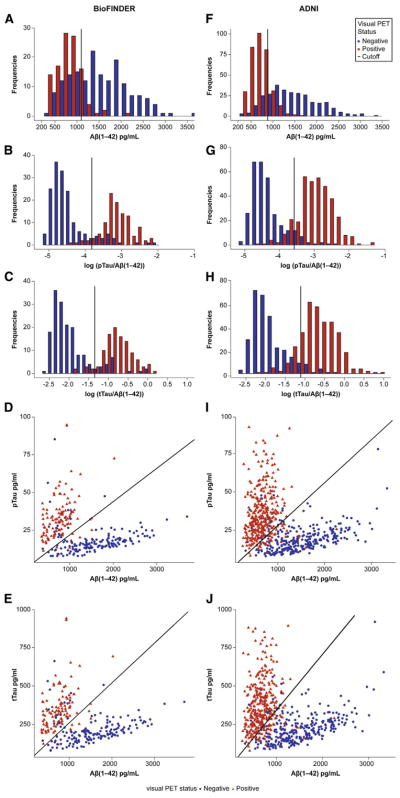
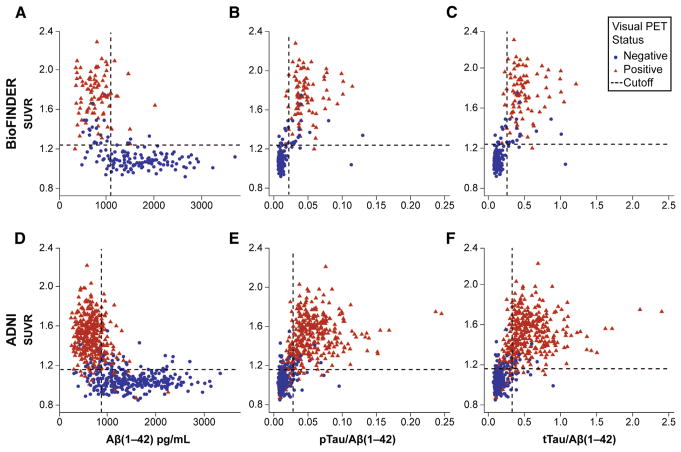
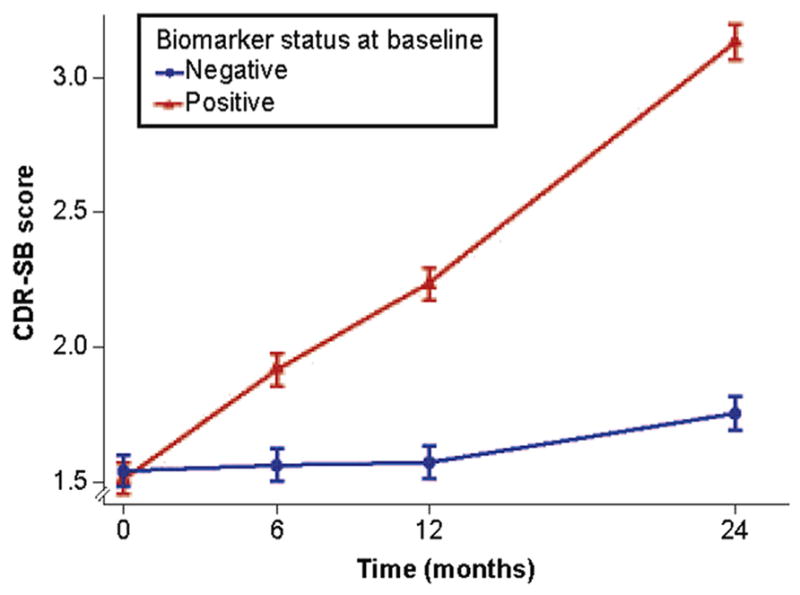
Verification
Claims the paper makes
The claims and statistics of this paper haven’t been checked yet.
Run the check — free, no account needed. It reads the open-access text and checks the sources it cites.
Claims other papers make about this one
Each is checked against this paper’s own text: does it say what the citing paper says it does?
The source backs part of the claim, not all of it — or backs it for a different population, condition or comparison.
In the citing paper
“For instance, the FDA-approved Elecsys CSF p-tau181/Aβ42 test has, in previous studies, classified Aβ PET status with overall accuracies of 89–90% (refs. 39–41), which was replicated in the present study.”
From Highly accurate blood test for Alzheimer's disease is similar or superior to clinical cerebrospinal fluid tests (2024) · cites this paper as [39]
Experimental — accuracy not yet measuredIn the citing paper
“An extracellular deposition of amyloid-β (Aβ) protein and aggregated form of hyper phosphorylated tau protein in the brain are two main pathological characteristics of AD [41].”
From Recent Advancements in Pathogenesis, Diagnostics and Treatment of Alzheimer’s Disease (2020) · cites this paper as [41]
In the citing paper
“For example, for the Elecsys immunoassays (Roche Diagnostics), it has been shown that CSF cutoffs established in one European cohort could be applied to another independent cohort in the United States to determine amyloid PET status with high accuracy.24”
From Performance of Fully Automated Plasma Assays as Screening Tests for Alzheimer Disease–Related β-Amyloid Status (2019) · cites this paper as [24]
In the citing paper
“Recently, fully automated immunoassays have been developed by several different vendors with improved reliability and precision for CSF Aβ and tau species.23,24,25”
From Performance of Fully Automated Plasma Assays as Screening Tests for Alzheimer Disease–Related β-Amyloid Status (2019) · cites this paper as [24]
In the citing paper
“This robust result is similar to what has been shown when using the Elecsys assays for CSF to establish a cutoff in one cohort and replicating it in a second cohort.24”
From Performance of Fully Automated Plasma Assays as Screening Tests for Alzheimer Disease–Related β-Amyloid Status (2019) · cites this paper as [24]
In the citing paper
“Plasma tau increased the AUC slightly, and provided a better model fit (ΔAIC –27), but clinically this is not comparable with the contribution CSF tau has combined with CSF Aβ42,24 and improved plasma tau assays are probably needed in the future, such as measurement of specifically phosphorylated tau,46 to increase the added value of plasma tau to plasma Aβ42 and Aβ40.”
From Performance of Fully Automated Plasma Assays as Screening Tests for Alzheimer Disease–Related β-Amyloid Status (2019) · cites this paper as [24]
Self-check
Percentages, sums and reported differences re-computed from the paper’s own numbers.
The self-check needs the paper’s full text.
Citations
Cites
McKhann, G. M., Knopman, D. S., Chertkow, H., Hyman, B. T., Jack, C. R., Kawas, C. H., Klunk, W. E., Koroshetz, W. J., Manly, J. J., Mayeux, R., et al. (2011) · Alzheimer's & Dementia · doi:10.1016/j.jalz.2011.03.005 · Cited by 18,657
Albert, M. S., DeKosky, S. T., Dickson, D., Dubois, B., Feldman, H. H., Fox, N. C., Gamst, A., Holtzman, D. M., Jagust, W. J., Petersen, R. C., et al. (2011) · Alzheimer's & Dementia · doi:10.1016/j.jalz.2011.03.008 · Cited by 10,152
Sperling, R. A., Aisen, P. S., Beckett, L. A., Bennett, D. A., Craft, S., Fagan, A. M., Iwatsubo, T., Jack, C. R., Kaye, J., Montine, T. J., et al. (2011) · Alzheimer's & Dementia · doi:10.1016/j.jalz.2011.03.003 · Cited by 7,155
Hypothetical model of dynamic biomarkers of the Alzheimer's pathological cascade
Jack, C. R., Knopman, D. S., Jagust, W. J., Shaw, L. M., Aisen, P. S., Weiner, M. W., Petersen, R. C., & Trojanowski, J. Q. (2010) · The Lancet Neurology · doi:10.1016/s1474-4422(09)70299-6 · Cited by 4,806
Self-citationAdvancing research diagnostic criteria for Alzheimer's disease: the IWG-2 criteria
Dubois, B., Feldman, H. H., Jacova, C., Hampel, H., Molinuevo, J. L., Blennow, K., DeKosky, S. T., Gauthier, S., Selkoe, D., Bateman, R., et al. (2014) · The Lancet Neurology · doi:10.1016/s1474-4422(14)70090-0 · Cited by 3,321
Self-citationScheltens, P., Blennow, K., Breteler, M. M. B., de Strooper, B., Frisoni, G. B., Salloway, S., & Van der Flier, W. M. (2016) · The Lancet · doi:10.1016/s0140-6736(15)01124-1 · Cited by 3,125
Self-citationAlbert, M., DeKosky, S. T., Dickson, D. W., Dubois, B., Feldman, H., Fox, N. C., Gamst, A. C., Holtzman, D. M., Jagust, W. J., Petersen, R. C., et al. (2013) · FOCUS The Journal of Lifelong Learning in Psychiatry · doi:10.1176/appi.focus.11.1.96 · Cited by 2,643
Cerebrospinal fluid biomarker signature in Alzheimer's disease neuroimaging initiative subjects
Shaw, L. M., Vanderstichele, H., Knapik‐Czajka, M., Clark, C. M., Aisen, P. S., Petersen, R. C., Blennow, K., Soares, H., Simon, A., Lewczuk, P., et al. (2009) · Annals of Neurology · doi:10.1002/ana.21610 · Cited by 2,065
Self-citationOlsson, B., Lautner, R., Andreasson, U., Öhrfelt, A., Portelius, E., Bjerke, M., Hölttä, M., Rosén, C., Olsson, C., Strobel, G., et al. (2016) · The Lancet Neurology · doi:10.1016/s1474-4422(16)00070-3 · Cited by 2,049
Self-citationTwo Phase 3 Trials of Bapineuzumab in Mild-to-Moderate Alzheimer's Disease
Salloway, S., Sperling, R., Fox, N. C., Blennow, K., Klunk, W., Raskind, M., Sabbagh, M., Honig, L. S., Porsteinsson, A. P., Ferris, S., et al. (2014) · New England Journal of Medicine · doi:10.1056/nejmoa1304839 · Cited by 1,960
Self-citation
Cited by
Sorted by citations
Items 801–809 of 809
The value of timely treatment with anti‐amyloid therapy for Alzheimer's disease
Chapel, J. M., Tysinger, B., Pourmand, H., Goldman, D. P., Aisen, P., & Initiative, A. D. N. (2026) · Alzheimer s & Dementia · doi:10.1002/alz.71819
Self-citationDing, L., Zheng, M., Wang, S., Liu, W., Liang, Y., Xie, S., Yang, T., Sheng, D., Wang, S., Sheng, J., et al. (2026) · Alzheimer s & Dementia · doi:10.1002/alz.71915
Benussi, A., Agosta, F., Agnello, L., Alfano, A. R., Altini, M., Antico, A., Basilico, S., Bellelli, G., Bonanni, L., Bottini, G., et al. (2026) · The Journal of Prevention of Alzheimer s Disease · doi:10.1016/j.tjpad.2026.100685
Associations of Serum Lipids With Clinical–Amyloid Groups, CSF Aβ42, and SHBG in ADNI-1
Zhang, L., Zhang, X., Zhang, Q., Chang, X., & Yang, L. (2026) · American Journal of Alzheimer s Disease & Other Dementias® · doi:10.1177/15333175261498635
Rodríguez‐Baz, Í., Ferrer, R., Falip, M. S., Vera-Campuzano, E., Sala, I., Maure‐Blesa, L., Selma‐González, J., García-Castro, J., Gala, I. I., Bueno, A., et al. (2026) · Research Square · doi:10.21203/rs.3.rs-11271891/v1
Jianjing, Z., Wang, X., Yang, L., Lv, Z., Jia, S., & Ye, T. (2026) · Frontiers in Aging Neuroscience · doi:10.3389/fnagi.2026.1826215
Botelho, C. V., Carneiro, A. A. M., Regadas, C. M., Cavalcante, C., Ribeiro, I., Rabelo, S., Araujo, V., Ferreira, G., Iepsen, B. D., & Frota, N. A. F. (2026) · Journal of Alzheimer s Disease · doi:10.1177/13872877261494512
Martinez-Lage, P., Solje, E., Martins, J. G., Guess, M., & Sarkar, S. (2026) · Neurology and Therapy · doi:10.1007/s40120-026-01056-1
Nakashima, S., Sato, K., Niimi, Y., Satake, W., Iwatsubo, T., & Initiative, F. T. A. D. N. (2026) · Alzheimer s & Dementia Behavior & Socioeconomics of Aging · doi:10.1002/bsa3.70121
Metadata
- Authors
- Hansson, O., Seibyl, J., Stomrud, E., Zetterberg, H., Trojanowski, J. Q., Bittner, T., Lifke, V., Corradini, V., Eichenlaub, U., Batrla, R., Buck, K., Zink, K., Rabe, C., Blennow, K., Shaw, L. M., for the Swedish BioFINDER study group, & Initiative, A. D. N.
- Affiliations
- Lund University (SE)
- Institute for Neurodegenerative Disorders (US)
- Sahlgrenska University Hospital (SE)
- University of Pennsylvania (US)
- Former Employee of Roche Diagnostics GmbH Penzberg Germany
- Roche Diagnostics GmbH Penzberg Germany
- F. Hoffmann-La Roche AG (CH)
- Alzheimer’s Disease Neuroimaging Initiative (US)
- Corresponding author
- Hansson, Oskar
- Blennow, Kaj
- Shaw, Leslie M.
- ORCID
- Venue
- Alzheimer's & Dementia
- Publisher
- Wiley
- Published
- 2018-02-27
- Volume
- 14
- Issue
- 11
- Pages
- 1470-1481
- ISSN
- 1552-5260 (ISSN-L)
- 1552-5279
- PMC
- PMC6119541
- OpenAlex
- W2789976306
- Cited by
- 808
- References
- 45
- Citations by year
- 2026: 84 · 2025: 117 · 2024: 146 · 2023: 96 · 2022: 98 · 2021: 95 · 2020: 97 · 2019: 56 · 2018: 15
- FWCI
- 51.74
- Type
- journal article
- Language
- en
- Open access
- hybrid
- doi.org
- Licence
- Locations
- Alzheimer s & Dementia (publishedVersion, cc-by-nc-nd)
- PubMed (publishedVersion)
- Europe PMC (PubMed Central) (acceptedVersion, cc-by-nc-nd)
- PubMed Central (acceptedVersion, cc-by-nc-nd)
- UCL Discovery (University College London) (submittedVersion)
- Lund University Publications (Lund University) (submittedVersion)
- Funders
- Michael J. Fox Foundation for Parkinson's Research
- Eli Lilly and Company
- Göteborgs Universitet
- National Institutes of Health
- National Institute on Aging (P30AG010124)
- Topics
- Health Sciences › Medicine › Psychiatry and Mental health › Dementia and Cognitive Impairment Research
- Life Sciences › Neuroscience › Cellular and Molecular Neuroscience › Alzheimer's disease research and treatments
- Health Sciences › Medicine › Clinical Neurology › Cerebrospinal fluid and hydrocephalus
- Keywords
- Alzheimer's disease, cerebrospinal fluid biomarkers
- MeSH terms
- Aged, Alzheimer Disease, Aniline Compounds, Ethylene Glycols, Female, Humans, Immunoassay, Male, Cohort Studies, Biomarkers, Amyloid beta-Peptides, tau Proteins, Disease Progression, Radiopharmaceuticals, Positron-Emission Tomography, Automation, Laboratory, Cognitive Dysfunction
About these checks
Registry, retraction, Cites and statistics results are computed, not judged, with one exception: a printed reference that no index lists is read once by a model before it counts as a citation error. Claims are extracted by a model and kept only when their quote appears verbatim in the text; each cited source is then checked, with a model’s help, for whether it says what the claim relies on. Those verdicts can be wrong — read the claim’s quote and the cited source before relying on one.
Statistics and arithmetic are recomputed, not judged.
Confidence bands are shown only for fields calibrated on our annotated test set. None is calibrated yet, so no band is shown.
What counts as a claim ›How we measure confidence ›How we check this ›
Are you an author, or do you see a problem with this page? Request a review
