

The DOI matches its Crossref record; 112 of the 116 references it cites were found in a registry or an index.
Nanostructures: Current uses and future applications in food science
Open accessAbstract
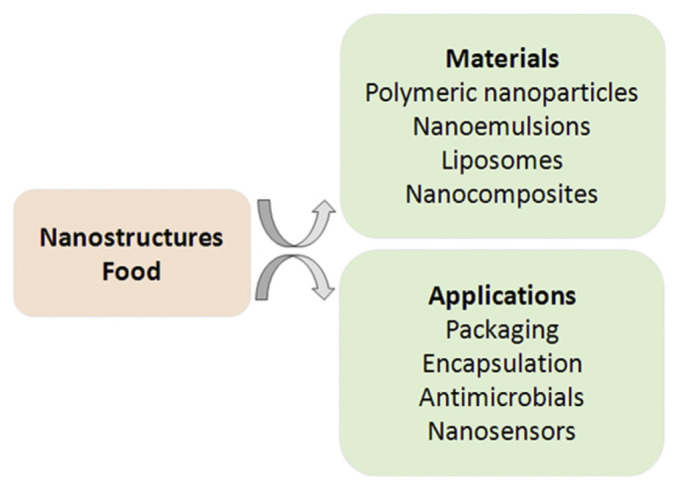
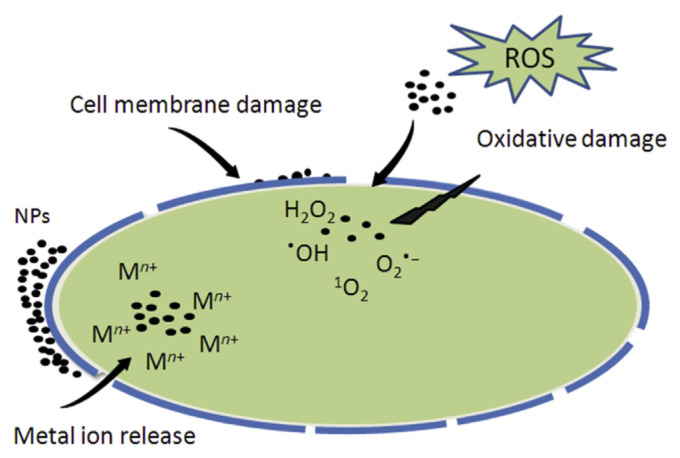
Recent developments in nanoscience and nanotechnology intend novel and innovative applications in the food sector, which is rather recent compared with their use in biomedical and pharmaceutical applications. Nanostructured materials are having applications in various sectors of the food science comprising nanosensors, new packaging materials, and encapsulated food components. Nanostructured systems in food include polymeric nanoparticles, liposomes, nanoemulsions, and microemulsions. These materials enhance solubility, improve bioavailability, facilitate controlled release, and protect bioactive components during manufacture and storage. This review highlights the applications of nanostructured materials for their antimicrobial activity and possible mechanism of action against bacteria, including reactive oxygen species, membrane damage, and release of metal ions. In addition, an overview of nanostructured materials, and their current applications and future perspectives in food science are also presented.
Overview
The claims and statistics of this paper haven’t been checked yet.
Run the check — free, no account needed. It reads the open-access text and checks the sources it cites.
Integrity signals
Registry
Cites
Statistics
Figures
Verification
Claims the paper makes
The claims and statistics of this paper haven’t been checked yet.
Run the check — free, no account needed. It reads the open-access text and checks the sources it cites.
Claims other papers make about this one
Each is checked against this paper’s own text: does it say what the citing paper says it does?
In the citing paper
“A number of engineered nanoparticles have been already developed for a variety of applications in the food sector”
From Emerging trends in European food, diets and food industry (2018) · cites this paper as Pathakoti et al., 2017
In the citing paper
“they are expected to provide a range of important benefits including sensory improvements, increased absorption of nutrients, stabilization of bioactive compounds, extended product shelf-life, quality and safety monitoring”
From Emerging trends in European food, diets and food industry (2018) · cites this paper as Pathakoti et al., 2017
Self-check
Percentages, sums and reported differences re-computed from the paper’s own numbers.
The self-check needs the paper’s full text.
Citations
Cites
1 retracted
(2015) · Critical Reviews in Food Science and Nutrition · doi:10.1080/10408398.2013.802662 · Cited by 17
RetractedSynthesis and surface engineering of iron oxide nanoparticles for biomedical applications
Gupta, A. K., & Gupta, M. S. (2004) · Biomaterials · doi:10.1016/j.biomaterials.2004.10.012 · Cited by 6,906
The bactericidal effect of silver nanoparticles
Morones‐Ramírez, J. R., Elechiguerra, J. L., Camacho, A., Holt, K. B., Kouri, J. B., Tapia-Ramı́rez, J., & Yacamán, M. J. (2005) · Nanotechnology · doi:10.1088/0957-4484/16/10/059 · Cited by 6,690
A review of chitin and chitosan applications
Ravi Kumar, M. N. V. (2000) · Reactive and Functional Polymers · doi:10.1016/s1381-5148(00)00038-9 · Cited by 6,009
Antimicrobial effects of silver nanoparticles
Kim, J. S., Kuk, E., Yu, K. N., Kim, J., Park, S. J., Lee, H.-J., Ys, K., Park, Y. K., Park, Y. H., Hwang, C., et al. (2007) · Nanomedicine Nanotechnology Biology and Medicine · doi:10.1016/j.nano.2006.12.001 · Cited by 4,934
Functionalized graphene sheets for polymer nanocomposites
Ramanathan, T., Abdala, A. A., Stankovich, S., Dikin, D. A., Herrera‐Alonso, M., Piner, R. D., Adamson, D. H., Schniepp, H. C., Chen, X., Ruoff, R. S., et al. (2008) · Nature Nanotechnology · doi:10.1038/nnano.2008.96 · Cited by 3,494
Duncan, T. V. (2011) · Journal of Colloid and Interface Science · doi:10.1016/j.jcis.2011.07.017 · Cited by 2,042
Proteomic Analysis of the Mode of Antibacterial Action of Silver Nanoparticles
Lok, C., Ho, C., Chen, R., He, Q., Yu, W., Sun, H., Tam, P. K. H., Chiu, J., & Che, C. (2006) · Journal of Proteome Research · doi:10.1021/pr0504079 · Cited by 1,577
Maness, P., Smolinski, S. L., Blake, D. M., Huang, Z. Q., Wolfrum, E. J., & Jacoby, W. A. (1999) · Applied and Environmental Microbiology · doi:10.1128/aem.65.9.4094-4098.1999 · Cited by 1,411
Mechanisms of nanotoxicity: Generation of reactive oxygen species
Fu, P. P., Xia, Q., Hwang, H., Ray, P. C., & Yu, H. (2014) · Journal of Food and Drug Analysis · doi:10.1016/j.jfda.2014.01.005 · Cited by 1,403
Self-citation
Research works printed but not linked: 2
- Swientek, 1990, Microfluidizing technology enhances emulsion stability, Food Process, 152
- Cubadda, 2013, Nanomaterials in the food sector: new approaches for safety assessment, Rapporti ISTISAN, 13, 48
Cited by
Sorted by citations
Nanotechnologies in Food Science: Applications, Recent Trends, and Future Perspectives
Nile, S. H., Venkidasamy, B., Selvaraj, D., Nile, A. S., Xiao, J., & Kai, G. (2020) · Nano-Micro Letters · doi:10.1007/s40820-020-0383-9 · Cited by 669
Prospects of using nanotechnology for food preservation, safety, and security
Bajpai, V. K., Kamle, M., Shukla, S., Mahato, D. K., Chandra, P., Hwang, S. K., Kumar, P., Huh, Y. S., & Han, Y. (2018) · Journal of Food and Drug Analysis · doi:10.1016/j.jfda.2018.06.011 · Cited by 464
Neme, K., Nafady, A., Uddin, S., & Tola, Y. B. (2021) · Heliyon · doi:10.1016/j.heliyon.2021.e08539 · Cited by 364
The safety of nanomaterials in food production and packaging
Onyeaka, H. N., Passaretti, P., Miri, T., & Al-Sharify, Z. T. (2022) · Current Research in Food Science · doi:10.1016/j.crfs.2022.04.005 · Cited by 354
Nanosystems in Edible Coatings: A Novel Strategy for Food Preservation
Zambrano‐Zaragoza, M. L., González-Reza, R. M., Mendoza‐Muñoz, N., Miranda-Linares, V., Bernal-Couoh, T. F., Mendoza-Elvira, S. E., & Quintanar‐Guerrero, D. (2018) · International Journal of Molecular Sciences · doi:10.3390/ijms19030705 · Cited by 315
Metadata
- Authors
- Pathakoti, K., Manubolu, M., & Hwang, H.-M.
- Affiliations
- Jackson State University (US)
- The Ohio State University (US)
- Corresponding author
- Hwang, Huey-Min
- Venue
- Journal of Food and Drug Analysis
- Published
- 2017-04
- Volume
- 25
- Issue
- 2
- Pages
- 245-253
- ISSN
- 1021-9498 (ISSN-L)
- PMC
- PMC9332533
- OpenAlex
- W2596330344
- Cited by
- 339
- References
- 116
- Citations by year
- 2026: 14 · 2025: 31 · 2024: 45 · 2023: 37 · 2022: 52 · 2021: 39 · 2020: 45 · 2019: 46 · 2018: 26 · 2017: 4
- FWCI
- 3.59
- Type
- journal article
- Language
- en
- Open access
- hybrid
- doi.org
- Licence
- Locations
- Journal of Food and Drug Analysis (publishedVersion, cc-by-nc-nd)
- PubMed Central (publishedVersion, cc-by-nc-nd)
- PubMed (publishedVersion)
- Funders
- Jackson State University (#HRD-157754)
- Topics
- Life Sciences › Agricultural and Biological Sciences › Food Science › Proteins in Food Systems
- Physical Sciences › Materials Science › Biomaterials › Nanocomposite Films for Food Packaging
- Life Sciences › Agricultural and Biological Sciences › Food Science › Microencapsulation and Drying Processes
- Keywords
- nanostructured materials, food nanotechnology, polymeric nanoparticles, liposomes, nanoemulsions, microemulsions, food encapsulation, food packaging, nanosensors, bioactive compounds, antimicrobial activity, reactive oxygen species, membrane damage, metal ion release, controlled release, bioavailability
- MeSH terms
- Food Technology, Polymers, Nanostructures, Nanoparticles
About these checks
Registry, retraction, Cites and statistics results are computed, not judged, with one exception: a printed reference that no index lists is read once by a model before it counts as a citation error. Claims are extracted by a model and kept only when their quote appears verbatim in the text; each cited source is then checked, with a model’s help, for whether it says what the claim relies on. Those verdicts can be wrong — read the claim’s quote and the cited source before relying on one.
Statistics and arithmetic are recomputed, not judged.
Confidence bands are shown only for fields calibrated on our annotated test set. None is calibrated yet, so no band is shown.
What counts as a claim ›How we measure confidence ›How we check this ›
Are you an author, or do you see a problem with this page? Request a review
