

The DOI matches its Crossref record; 86 of the 91 references it cites were found in a registry or an index, and 1 are not checked yet; none of the 118 sources its claims cite is checked for support yet.
Redefining boundaries in innovation and knowledge domains: Investigating the impact of generative artificial intelligence on copyright and intellectual property rights
Open accessAbstract
The rapid integration of generative AI (GenAI) into industries and society has prompted a re-evaluation of copyright and intellectual property rights (IPR) frameworks. GenAI's ability to produce original content using data from human-created sources raises critical ethical and legal concerns. Current copyright and IPR frameworks, designed around human authorship, are insufficient to address these challenges. This study, using a multi-perspective approach, explores GenAI's disruptive potential in replicating or transforming copyrighted materials, challenging established IPR norms. Findings highlight gaps in legislation and the opacity of GenAI platforms. To address these issues, this study presents a Dynamic Ethical Framework linked to a future global fair use policy, aiming to guide responsible GenAI development and use. By incorporating insights from domain experts, this study contextualizes emerging challenges and potential solutions within broader societal and technological trends. That said, this study calls for international collaboration and further research to reform IPR related laws and frameworks, ensuring they remain relevant and equitable in a GenAI-driven era.
Checked 2026-11-12 · 1 reference not checked yet
Overview
CoChat Summary
Written by AI from the paper’s full text.
TL;DR
This multi-expert paper argues that current copyright and intellectual property rights frameworks, built around human authorship, are insufficient for generative AI, and it proposes a Dynamic Ethical Framework linked to a future global fair use policy. It synthesizes legal, policy, and practice perspectives to call for international collaboration and further research on GenAI-related copyright reform.
Key findings
- The paper finds gaps in legislation and opacity in GenAI platforms, with current copyright/IPR frameworks unable to address GenAI’s use of human-created data and its generation of content that challenges authorship, ownership, and fair use.
- It reports that GenAI’s economic impact is estimated at US$2.6–$4.4 trillion in annual value added, increasing AI’s total economic impact by 40%; ChatGPT reached 100 million users in two months; and recorded music alone is a global annual market worth $26bn.
- Legal disputes illustrate the uncertainty: Getty Images accused Stability AI of using more than 12 million copyrighted images, and cases such as New York Times v. OpenAI test fair use, transformation, and market impact.
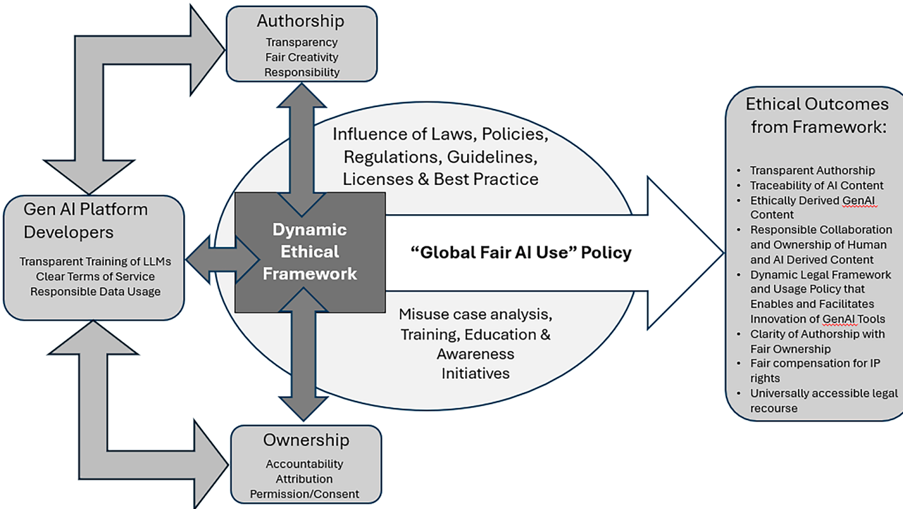
- The authors propose a Dynamic Ethical Framework and “Global Fair AI Use” policy covering GenAI platform developers, authorship, and ownership, and call for international collaboration to reform IPR laws.
Methods
- Design: a multiperspective expert-based approach, following prior work by von Foerster and Dwivedi et al., inviting specialists from academia and practice to contribute perspectives on GenAI, copyright, and IPR.
- Data/sample: eleven invited expert contributions, plus legal cases, policy documents, and literature; no primary empirical dataset is collected.
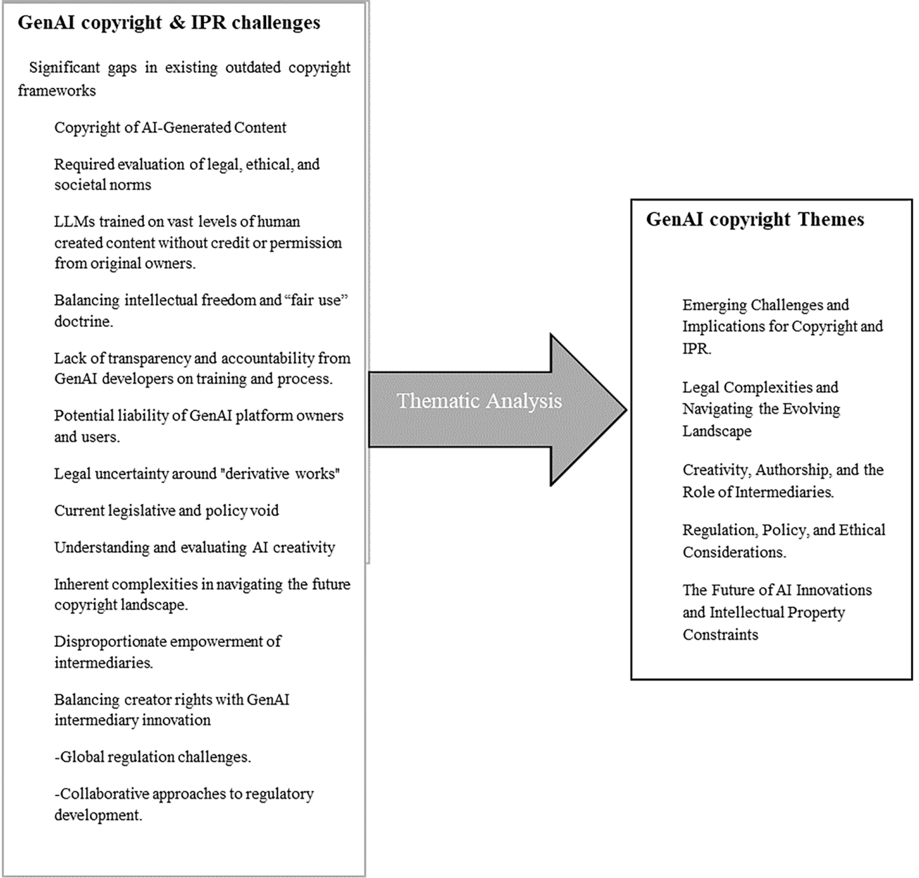
- Analysis: thematic analysis of the contributions, organized around emerging challenges, legal complexities, creativity/authorship/ownership, regulation and policy, and future adaptation; the discussion develops the Dynamic Ethical Framework and a proposed “Global Fair AI Use” policy.
Limitations
- Stated in the paper: the multi-expert format may produce overlapping narratives across perspectives; the paper’s length is a limitation; contributions were limited to eleven due to the specialised nature of the topic.
- Evident from the text: the study is conceptual/editorial rather than empirical, and the proposed Dynamic Ethical Framework is not tested or validated; legal coverage is jurisdiction-specific and not a systematic global legal review.
Model-written summary. Check it against the paper before relying on it.
Integrity signals
Registry
Cites
Statistics
Figures

Verification
Claims the paper makes
125 Own interpretation · 60 Sources not found · 26 No basis given · 17 Check pending · 12 Not checked yet · 7 No full text of the sources · 5 Own result
In the paper
“The absence of a traditional mechanism of authorship in AI-generated content creation, could potentially shift the economic benefits away from human creators towards those who own or operate the AI technologies and platforms (Israhadi, 2023).”
§ Redefining boundaries in innovation and knowledge domains: Investigating the impact of generative artificial intelligence on copyright and intellectual property rights > Introduction
What the sources say
- Check pendingcites Israhadi, 2023 source
hedgedstates a possible cause- Asserted: passes — The authors put it forward as true.
- Checkable: passes — It can be checked against evidence.
- Load-bearing: passes — The paper’s conclusions depend on it.
- Based: passes — The paper gives a reason why it holds.
In the paper
“GenAI's ability to produce original content using data from human-created sources raises critical ethical and legal concerns.”
- Also stated in: § Introduction · plain
“This has profound legal and ethical consequences related to the protection of human creativity, authorship, and content ownership (Frosio, 2024).”
§ Redefining boundaries in innovation and knowledge domains: Investigating the impact of generative artificial intelligence on copyright and intellectual property rights > Abstract
What the sources say
- Check pendingcites Frosio, 2024 source
plainstates a cause- Asserted: passes — The authors put it forward as true.
- Checkable: unclear — It is unclear whether it could be checked against evidence.
- Load-bearing: passes — The paper’s conclusions depend on it.
- Based: passes — The paper gives a reason why it holds.
- Also stated in: § Introduction · plain
A conclusion the paper draws from its own results — it cites no other source for it, so there is none to check. The quote shows it is in the paper.
In the paper
“Current copyright and IPR frameworks, designed around human authorship, are insufficient to address these challenges.”
§ Redefining boundaries in innovation and knowledge domains: Investigating the impact of generative artificial intelligence on copyright and intellectual property rights > Abstract
plain- Asserted: passes — The authors put it forward as true.
- Checkable: passes — It can be checked against evidence.
- Load-bearing: passes — The paper’s conclusions depend on it.
- Based: passes — The paper gives a reason why it holds.
- Rests on an assumption not shown here.
In the paper
“The emergence of AI as a non-human creator, directly challenges the existing legal infrastructure built around the human creator (Frosio, 2024;Liu et al., 2023).”
§ Redefining boundaries in innovation and knowledge domains: Investigating the impact of generative artificial intelligence on copyright and intellectual property rights > Introduction
What the sources say
- Check pendingcites Frosio, 2024 source
- Not matchedcites Liu et al., 2023
Couldn’t be matched to a paper in Crossref, so it can’t be checked.
plainstates a cause- Asserted: passes — The authors put it forward as true.
- Checkable: passes — It can be checked against evidence.
- Load-bearing: passes — The paper’s conclusions depend on it.
- Based: passes — The paper gives a reason why it holds.
In the paper
“Within the current legal frameworks, GenAI applications may be liable for copyright infringement if they both had access to the original works and GenAI generated output is substantially similar to the original works (Zirpoli, 2023).”
§ Redefining boundaries in innovation and knowledge domains: Investigating the impact of generative artificial intelligence on copyright and intellectual property rights > Legal Complexities
What the sources say
- Not matchedcites Zirpoli, 2023
Couldn’t be matched to a paper in Crossref, so it can’t be checked.
hedgedstates a possible cause- Asserted: passes — The authors put it forward as true.
- Checkable: passes — It can be checked against evidence.
- Load-bearing: passes — The paper’s conclusions depend on it.
- Based: passes — The paper gives a reason why it holds.
- Not matched
- It may state two separate claims as one. 98
- Probably not a substantial claim. 175
- The quote only partly states this claim. 1
Create a free account to see these claims.
Create a free account to see these assumptions.
43 more claims
Create a free account to see all 252 claims and to verify the 24 references still open.
Citations
Cites
Proceedings of the 24th international conference on Machine learning
(2007) · doi:10.1145/1273496 · Cited by 11,870
Dwivedi, Y. K., Hughes, L., Ismagilova, E., Aarts, G., Coombs, C., Crick, T., Duan, Y., Dwivedi, R., Edwards, J., Eirug, A., et al. (2021) · International Journal of Information Management · doi:10.1016/j.ijinfomgt.2019.08.002 · Cited by 4,611
Self-citationDwivedi, Y. K., Kshetri, N., Hughes, L., Slade, E. L., Jeyaraj, A., Kar, A. K., Baabdullah, A. M., Koohang, A., Raghavan, V., Ahuja, M., et al. (2023) · International Journal of Information Management · doi:10.1016/j.ijinfomgt.2023.102642 · Cited by 4,584
Self-citationChatGPT: five priorities for research
van Dis, E. A. M., Bollen, J., Zuidema, W., van Rooij, R., & Bockting, C. L. (2023) · Nature · doi:10.1038/d41586-023-00288-7 · Cited by 1,842
Generative AI and ChatGPT: applications, challenges, and AI-human collaboration
Fui-Hoon Nah, F., Zheng, R., Cai, J., Siau, K., & Chen, L. (2023) · Journal of Information Technology Case and Application Research · doi:10.1080/15228053.2023.2233814 · Cited by 1,363
Organizations: A Dialectical View
Benson, J. (1977) · Administrative Science Quarterly · doi:10.2307/2391741 · Cited by 942
ChatGPT listed as author on research papers: many scientists disapprove
Stokel-Walker, C. (2023) · Nature · doi:10.1038/d41586-023-00107-z · Cited by 868
Neural Network Methods for Natural Language Processing
Goldberg, Y. (2017) · Synthesis Lectures on Human Language Technologies · doi:10.1007/978-3-031-02165-7 · Cited by 821
Art and the science of generative AI
Epstein, Z., Hertzmann, A., the Investigators of Human Creativity, Akten, M., Farid, H., Fjeld, J., Frank, M. R., Groh, M., Herman, L., Leach, N., et al. (2023) · Science · doi:10.1126/science.adh4451 · Cited by 788
Ooi, K.-B., Tan, G. W.-H., Al-Emran, M., Al-Sharafi, M. A., Capatina, A., Chakraborty, A., Dwivedi, Y. K., Huang, T.-L., Kar, A. K., Lee, V.-H., et al. (2025) · Journal of Computer Information Systems · doi:10.1080/08874417.2023.2261010 · Cited by 746
Self-citation
Research works printed but not linked: 14
- Baker, 2023, Intellectual Property and Generative AI, Deloitte AI Institute. Retrieved from
- De Mantaras, 2002, AI and music: From composition to expressive performance, AI magazine, 23
- Dornis, 2020, Artificial creativity: Emergent works and the void in current copyright doctrine, Yale Journal of Law & Technology, 22, 1
- Gans, 2024, Copyright policy options for generative artificial intelligence (No. w32106), National Bureau of Economic Research
- Jo, 2023, The promise and peril of generative AI, Nature, 614, 214
- Jodha, 2023, Copyright issues in the era of Ai-A critical analysis, Res Militaris, 13, 1737
- Metrics, PlumX. (2024). Policy Citations. Accessed on 17th November 2024. https://plu.mx/plum/a/policy_citation?doi=10.1016/j.ijinfomgt.2023.102642&theme=plum-sciencedirect-theme&hideUsage=true. · DOI · Paper page
- Metz, 2024, How tech giants cut corners to harvest data for AI, The New York Times
- MIT Technology Review (2023). The great acceleration: CIO perspectives on generative AI. Retrieved from https://www.databricks.com/sites/default/files/2023-07/ebook_mit-cio-generative-ai-report.pdf.
- Roberts, 2023, 39, 79
- Sanders, 2020, The Secret to AI is People, Harvard Business Review
- Senftleben, 2020, Robot creativity: An incentive-based neighbouring rights approach, European Intellectual Property Review, 42, 797
- Sindre, 2001, Capturing security requirements through misuse cases. NIK 2001, Norsk Informatikkonferanse, 74
- Yu, 2003, The copyright divide, Cardozo Law Review, 25, 331
Cited by
Generative AI for decision-making: A multidisciplinary perspective
Albashrawi, M. A. (2025) · Journal of Innovation & Knowledge · doi:10.1016/j.jik.2025.100751 · Cited by 82
Self-citationDwivedi, Y. K. (2025) · International Entrepreneurship and Management Journal · doi:10.1007/s11365-025-01089-2 · Cited by 79
Self-citationScholarly Discourse on GenAI’s Impact on Academic Publishing
Dwivedi, Y. K., Malik, T., Hughes, L., & Albashrawi, M. A. (2024) · Journal of Computer Information Systems · doi:10.1080/08874417.2024.2435386 · Cited by 38
Self-citationCerchione, R., Liccardo, G., & Passaro, R. (2025) · Journal of Innovation & Knowledge · doi:10.1016/j.jik.2025.100866 · Cited by 37
Zaidan, E., Truby, J., Ibrahim, I. A., & Hoppe, T. (2025) · Technology in Society · doi:10.1016/j.techsoc.2025.103159 · Cited by 19
Abbas, F., Chesterman, S. A., & Taeihagh, A. (2025) · AI & Society · doi:10.1007/s00146-025-02698-9 · Cited by 17
Lahuerta, L. A., Ramajo, M. R. L., & Gandía, A. (2026) · Management Decision · doi:10.1108/md-05-2025-1462 · Cited by 15
Mangubat, J. C., Mangubat, M. R., Uy, T. B. L., Acut, D. P., & Garcia, M. B. (2025) · Advances in computational intelligence and robotics book series · doi:10.4018/979-8-3373-0122-8.ch013 · Cited by 15
GenAI’s Impact on Global IT Management: A Multi-Expert Perspective and Research Agenda
Dwivedi, Y. K., Hughes, L., Al-Ahmadi, S., Dutot, V., Ahmed, S., Akter, S., Dé, R., Li, K., Singh, N., & Walton, P. (2025) · Journal of Global Information Technology Management · doi:10.1080/1097198x.2025.2454192 · Cited by 12
Self-citationRokhshad, R., Tichý, A., Ducret, M., Chaurasia, A., Uribe, S. E., Gambelin, O., & Schwendicke, F. (2025) · Journal of Dentistry · doi:10.1016/j.jdent.2025.106187 · Cited by 12
Exploring value creation of generative artificial intelligence in organizations: A systematic review
Sánchez, M. A. (2025) · Strategic Business Research · doi:10.1016/j.sbr.2025.100015 · Cited by 12
Machine Thinking and Human Imagination: New Horizons for Creativity in the Digital Age
Skoryk, A., Антіпіна, І., Гаврош, О. І., Shunevych, Y., & Shvets, V. (2025) · International Journal on Culture History and Religion · doi:10.63931/ijchr.v7isi1.156 · Cited by 11
Alhur, M., Omar, F., Alqirem, R. M., & Yousuf, A. A. N. (2025) · Human Behavior and Emerging Technologies · doi:10.1155/hbe2/9751686 · Cited by 11
Hodzic, S., Stević, A., & Matthes, J. (2026) · Technology in Society · doi:10.1016/j.techsoc.2026.103331 · Cited by 10
Bag, S., Routray, S., Saikouk, T., & Roubaud, D. (2025) · Information Systems Frontiers · doi:10.1007/s10796-025-10662-7 · Cited by 9
Mahala, A., & Chauhan, B. (2025) · International Cybersecurity Law Review · doi:10.1365/s43439-025-00144-6 · Cited by 7
Ali, S. I., & Shaban, M. (2025) · International Nursing Review · doi:10.1111/inr.70100 · Cited by 6
Tan, X. J., Cheor, W. L., Cheng, E. M., Lim, C. C., & Rahman, K. S. A. (2025) · Computers, materials & continua/Computers, materials & continua (Print) · doi:10.32604/cmc.2025.063407 · Cited by 5
Regulatory framework for the use of artificial intelligence in european higher education
Tabacu, A. E. (2025) · Jurídicas CUC · doi:10.17981/juridcuc.21.1.2025.07 · Cited by 5
Digital Boundaries and Consent in the Metaverse: A Comparative Review of Privacy Risks
Sakka, S., Liagkou, V., Ferreira, A., & Stylios, C. D. (2026) · Journal of Cybersecurity and Privacy · doi:10.3390/jcp6010024 · Cited by 5
Benelli, F. (2026) · Journal of Open Innovation Technology Market and Complexity · doi:10.1016/j.joitmc.2026.100804 · Cited by 5
Purposeful AI integration in education: Aligning policy, literacy, and practice
Hefnawi, A. (2025) · Management in Education · doi:10.1177/08920206251394517 · Cited by 4
ORIGINALITY, AUTHORSHIP, AND GENERATIVE AI: RETHINKING INDONESIAN COPYRIGHT LAW
Zakiyah, N., Hardyanthi, T., Hidayati, N. K., & Utomo, Y. A. T. (2025) · Jurnal Hukum Progresif · doi:10.14710/jhp.13.2.385-416 · Cited by 4
PENYALAHGUNAAN TEKNOLOGI AI DALAM PENIRUAN GAYA SENI STUDIO GHIBLI PERSPEKTIF HAK CIPTA DI INDONESIA
Lofi, R. M. (2026) · JIPRO Journal of Intellectual Property · doi:10.20885/jipro.vol9.iss1.art1 · Cited by 4
Osobase, K. O., Akadiri, O. O., Dirisu, C. D., Asolo, E., Adewara, D. E., & Ekechi, C. C. (2025) · Asian Journal of Basic Science & Research · doi:10.38177/ajbsr.2025.7312 · Cited by 4
The hybrid IT sourcing model: Will it work for media enterprises?
Reji, S. K. (2025) · Journal of Information Technology Teaching Cases · doi:10.1177/20438869251376668 · Cited by 3
Schwandt, S., Viehhauser, G., Andrews, T. L., & Wallnig, T. (2026) · Open Repository and Bibliography (University of Luxembourg) · doi:10.5281/zenodo.18591947 · Cited by 3
Regulating the unseen hand: AI, authorship, and trust in medical science
Gautam, N. (2025) · Annals of Medicine & Surgery · doi:10.1097/ms9.0000000000003498 · Cited by 2
Between pixels and principles: the responsible use of AI-generated images in physiology education
Carpes, F. P., Umpierre, D., Cadore, E. L., Diefenthaeler, F., Pinheiro, E. D. S., & Laitano, O. (2025) · AJP Advances in Physiology Education · doi:10.1152/advan.00095.2025 · Cited by 2
Demirok, K., Eren, F., Akkaya, Y. S., & Çayirli, D. (2025) · Bilgi ve İletişim Teknolojileri Dergisi · doi:10.53694/bited.1710862 · Cited by 2
Ethics, generative AI and science communication
Feldman, H. R., Medvecky, F., & Riedlinger, M. E. (2025) · Public Understanding of Science · doi:10.1177/09636625251393621 · Cited by 2
Jubaidi, D., & Khoirunnisa, K. (2025) · Journal of Judicial Review · doi:10.37253/jjr.v27i2.11069 · Cited by 2
Afuwape, K. (2025) · Journal of Digital Technologies and Law · doi:10.21202/jdtl.2025.27 · Cited by 2
An ISM framework for construct analysis using AI technologies for architecture design
Mangubat, M. R. (2026) · Journal of Asian Architecture and Building Engineering · doi:10.1080/13467581.2026.2621535 · Cited by 2
Artificial intelligence literacy in design intelligence: A review
Tee Hui, T. E. O., & Chew, D. X. H. (2026) · Design+ · doi:10.36922/dp025520053 · Cited by 2
Editorial: special issue on digital economy in the global south
Khanra, S., & Shirish, A. (2025) · DECISION · doi:10.1007/s40622-025-00427-1 · Cited by 2
Self-citationArthur, A. W., Moore, A., Carmona-Rosado, L., Kassam, P., Logel, M., Nieves, C. I., Tope, P., Litaker, D. G., & Borrell, L. N. (2025) · Preventive Medicine Reports · doi:10.1016/j.pmedr.2025.103334 · Cited by 2
LLM Harms: A Taxonomy and DiscussionPreprint
Chen, K., Afroogh, S., Murali, A., Atkinson, D., Dhurandhar, A., & Jiao, J. (2025) · arXiv (Cornell University) · doi:10.48550/arxiv.2512.05929 · Cited by 2
Mardonov, A. (2025) · Uzbek journal of law and digital policy. · doi:10.59022/ujldp.317 · Cited by 1
The Future of Graphic Design in the Age of Generative AI: Its Impact on Creativity and Industry
Alotaibi, N. (2025) · مجلة كلية التربية بتفهنا الأشراف · doi:10.21608/jfst.2025.431299 · Cited by 1
ChatGPT in Education: A Critical Overview of Breakthroughs and Challenges
Troussas, C., Krouska, A., Phivos Mylonas, B., & Sgouropoulou, C. (2026) · Lecture notes in networks and systems · doi:10.1007/978-3-032-10824-1_12 · Cited by 1
Data Privacy and Security in AI-Driven Education Systems
Alhazmi, A. K. (2026) · Advances in computational intelligence and robotics book series · doi:10.4018/979-8-3373-0756-5.ch010 · Cited by 1
AI-designed drugs: clinical development and future directions
Ahmed, R., Akhtar, S., Das, A., Begum, K., Sarma, A., Chakraborty, A., Neog, T., & Banu, S. (2026) · Elsevier eBooks · doi:10.1016/b978-0-443-34059-8.00010-5 · Cited by 1
Ramadhan, R. F., Ahmad, S., Alanazi, N. M., & Cengiz, K. (2026) · Blockchain Artificial Intelligence and Future Research · doi:10.70211/bafr.v2i1.410 · Cited by 1
Overcoming GenAI adoption barriers in construction cost management: evidence from Nigeria
Oyenubi, A., & Oyeyipo, O. O. (2026) · Construction Innovation · doi:10.1108/ci-02-2026-0050 · Cited by 1
Abubakar, N., Shehu, H., Akinyemi, M. M., Abdulazeez, H. A., Ariyo, A. A., & Godswill, J. M. (2026) · Journal of arts, humanities and social science. · doi:10.69739/jahss.v3i2.2039 · Cited by 1
GenAI as Fictional Author: Statutory Attribution of Copyright in AIGC
Lan, Z. (2026) · International Journal of Digital Law and Governance · doi:10.1515/ijdlg-2026-0008 · Cited by 1
Ranaware, V., & Karale, S. (2026) · International Journal of Systems Assurance Engineering and Management · doi:10.1007/s13198-026-03378-7 · Cited by 1
Criminal Liability for Data Leaks Caused by Artificial Intelligence in Providing Legal Consultation
Salsabila, D. S. (2024) · International Journal of Law Dynamics Review · doi:10.62039/ijldr.v2i2.49
Pastor, F. Z., Loayza-Apaza, Y. T., Velarde-Tejada, M. J., Barrientos-Alfaro, A. R., Romero-Carazas, R., & Bernedo-Moreira, D. H. (2024) · Metaverse Basic and Applied Research · doi:10.56294/mr2024122
Buriro, S. (2025) · UCP Journal of Law & Legal Education · doi:10.24312/ucp-jlle.03.01.311
MACHINE LOGIC, LEGAL CONSCIENCE: THE DILEMMA OF POSITIVISM IN THE AGE OF ARTIFICIAL INTELLIGENCE
Wibawa, K. C. S., Natalis, A., & Sipayung, Y. R. (2025) · Veredas do Direito Direito Ambiental e Desenvolvimento Sustentável · doi:10.18623/rvd.v22.n2.3104
Chugh, R., Tuladhar, R., Thampapillai, S., & Shariatian, M. (2025) · University development and administration · doi:10.1007/978-981-96-0473-9_15-1
Arthur, A. W., Moore, A., Carmona-Rosado, L., Kassam, P., Logel, M., Nieves, C. I., Tope, P., Litaker, D. G., & Borrell, L. N. (2025) · Preventive Medicine · doi:10.1016/j.ypmed.2025.108436
Kazimi, J. (2025) · Trends in Intellectual Property Research · doi:10.69971/tipr.3.1.2025.84
GENERATIVE ARTIFICIAL INTELLIGENCE: LEGAL CHALLENGES REGARDING COPYRIGHT IN THE USE OF CHATBOTS
Machado, J. D. S., Holanda, F. S. R., Neto, V. R. P., & Menezes, A. C. (2025) · Revista Foco · doi:10.54751/revistafoco.v18n11-292
May AI be sustainable? An outlook on sustainability and technology
Kondratenko, A., Kondratenko, A. A., & Kamberov, K. H. (2025) · AI & Society · doi:10.1007/s00146-025-02804-x
Darma, I. M. W., Kurniawan, I. G. A., Mahadnyani, T. M. A., & Thapa, N. Y. (2025) · ADLIYA Jurnal Hukum dan Kemanusiaan · doi:10.15575/adliya.v19i2.40020
Srinivas, M. K., & AKSHAY, M. S. (2026) · Indian Journal of Legal Review · doi:10.65393/naub3491
Grammar in the AI Era: How Technology is Shaping Linguistic Accuracy and Fluency
Kartikey, Krishna, G., Sood, R., Koli, S., Kaur, H., Chaudhary, R., & Jain, A. (2025) · Global AI Summit - International Conference on Artificial Intelligence and Emerging Technology (AI Summit) · doi:10.1109/aisummit66170.2025.11411043
Livro de Atas do XVIII Encontro de CTDI (Ciências e Tecnologias da Documentação e Informação)
(2025) · Directory of Open access Books (OAPEN Foundation)
Global Collaborative Approaches to Scale Circular Nanotechnology Innovations
Jindal, S., Jain, H., Dhupper, R., & Zameer, Q. A. (2026) · Waste as a resource · doi:10.1007/978-3-032-12685-6_16
Shaping the Sound of Tomorrow With the Algorithmic Composer
Baeti, A. W., Sekti, B. A., & Pamungkas, V. A. (2026) · Advances in computational intelligence and robotics book series · doi:10.4018/407617
Understanding AI: A Deep Dive into Its Forms, Functions, and Ethical Frontiers
Moloi, T. (2026) · Springer eBooks · doi:10.1007/978-981-95-8212-9_3
ARTIFICIAL INTELLIGENCE, ART, AND AUTHORSHIP: EDUCATION IN THE AGE OF ALGORITHMS
Lytvynska, S., Zhadko, V., Priadka, D., Zhadko, D., & Bozhkov, A. (2026) · ShodhKosh Journal of Visual and Performing Arts · doi:10.29121/shodhkosh.v7.i6s.2026.7547
A systematic exploration of GenAI-driven security mechanisms for IoT in edge computing environments
Tripathi, A., & Samriya, J. K. (2026) · International Journal of Systems Assurance Engineering and Management · doi:10.1007/s13198-026-03314-9
Hai, D. B. T. (2026) · Access to Justice in Eastern Europe · doi:10.33327/ajee-18-9.2-a0001970
The state of AI and intellectual property – a thematic scientometric assessment
Lendvai, G. F., Mezei, P., & Pogácsás, A. (2026) · SN Social Sciences · doi:10.1007/s43545-026-01479-5
Dağ, G. N., & Horasan, F. (2026) · Expert Systems with Applications · doi:10.1016/j.eswa.2026.133214
Thomas, G., Alley, S., Browne, M., Baumann, H., Duncan, M. J., Vandelanotte, C., & Gilson, N. D. (2026) · Digital Health · doi:10.1177/20552076261455158
Boulitama, O., Ouatiq, A., Rahli, D., & Karim, S. (2026) · Advances in computational intelligence and robotics book series · doi:10.4018/979-8-2600-0050-2.ch003
Enhancing mental health and cognitive research with generative artificial intelligence
Joshi, G., Ghai, B., Goutam, N., & Joshi, N. (2026) · Elsevier eBooks · doi:10.1016/b978-0-443-44344-2.00008-x
Mahmud, K., Kumar, M., Singh, D., & Saini, R. (2026) · Elsevier eBooks · doi:10.1016/b978-0-443-44344-2.00022-4
Ramos, F. (2026) · Revista Iberoamericana de la Propiedad Intelectual · doi:10.26422/ripi.2026.espia.zag
The State of AI and Intellectual Property – A Thematic Scientometric AssessmentPreprint
Lendvai, G. F., Mezei, P., & Pogácsás, A. (2026) · SSRN Electronic Journal · doi:10.2139/ssrn.6911222
LEGAL PROTECTION OF AI-ASSISTED SCIENTIFIC WORK ORIGINALITY IN THE DIGITAL SOCIETY
Fachri, M., Fuady, F. A., Marlin, & Syahird, A. (2026) · Journal of International Islamic Law, Human Right and Public Policy · doi:10.5281/zenodo.21731426
Willetts, M., & Atkins, A. S. (2026) · International Journal of Research and Innovation in Social Science · doi:10.47772/ijriss.2026.100700603
Ayinde, L. A., Katta, K., & Adebayo, J. O. (2026) · Journal of Science and Technology Policy Management · doi:10.1108/jstpm-01-2025-0010
Minbaleev, A., Svirin, Y., Solovkin, S. V., & Taran, K. K. (2025) · Revista do Curso de Direito do UNIFOR · doi:10.24862/rcdu.v16i3.2424
Tenecela-Calderon, M. E. (2025) · Sapiens Global · doi:10.64747/x410dg25
Aton, M. G., Gabawa, L. G., Jr., Wannakaew, T., & Santos, R. A. G. (2026) · Proceeding of International Conference Technology, Economics, and Social Science
Kenneth, & Syamil, A. (2026) · International Conference on ICT for Smart Society (ICISS) · doi:10.1109/iciss71466.2026.11715446
Mayayise, T. O. (2026) · Journal of African Business · doi:10.1080/15228916.2026.2740302
Derecho y metaverso frente a los desafíos de los mundos virtuales
Cedeño, A. M. C., Herrera, D. I. B., Nájera, S. O. V., Trujillo, K. D. A., & Angulo, R. M. M. (2026) · doi:10.70577/v62jrk27
Kant, R., & Pal, R. (2026) · Asian Journal of Law and Society · doi:10.1017/als.2026.10076
Generative Artificial Intelligence: Development, Applications and Security
Oliynychuk, O., & Paluszak, J. (2026) · Emerald Group Publishing Limited eBooks · doi:10.1108/978-1-83662-878-120261002
Philosophical Perspectives on Intellectual Property Law
Baldini, A. (2026) · Philosophy Compass · doi:10.1111/phc3.70142
Yerram, S. (2026) · American Journal of Society and Law · doi:10.54536/ajsl.v5i2.8527
Sagala, E., Mohamed, S. B., & Sriono, S. (2026) · Greenation International Journal of Law and Social Sciences · doi:10.38035/gijlss.v4i4.894
Artificial Intelligence and Intellectual Property After the European AI Act
Altaba, M. S. (2026) · Balkans Journal of Emerging Trends in Social Sciences · doi:10.31410/balkans.jetss.2026.9.1.62-76
Bamir, M., Okhovati, M., Talbian, A., Haghdoost, A. A., & Poursheikhali, A. (2026) · International Journal of Preventive Medicine · doi:10.4103/ijpvm.ijpvm_50_25
Application of Artificial Intelligence in Digital Marketing Communication and its Development Trends
Šalkovska, J., Batraga, A., & Kaibe, L. (2026) · Lecture notes in networks and systems · doi:10.1007/978-3-032-36005-2_9
Dabas, D., Singh, S., & Aggarwal, N. D. (2026) · Vikalpa The Journal for Decision Makers · doi:10.1177/02560909261495855
Aketema, J. (2026) · Journal of Science Innovation and Creativity · doi:10.58721/zrgehq45
Metadata
- Authors
- Al-Busaidi, A. S., Raman, R., Hughes, L., Albashrawi, M. A., Malik, T., Dwivedi, Y. K., Al- Alawi, T., AlRizeiqi, M., Davies, G., Fenwick, M., Gupta, P., Gurpur, S., Hooda, A., Jurcys, P., Lim, D., Lucchi, N., Misra, T., Raman, R., Shirish, A., & Walton, P.
- Affiliations
- Sultan Qaboos University (OM)
- Edith Cowan University (AU)
- Swansea University (GB)
- King Fahd University of Petroleum and Minerals (SA)
- University of Wales Trinity Saint David (GB)
- Kyushu University (JP)
- Management Development Institute (IN)
- Symbiosis International University (IN)
- O. P. Jindal Global University (IN)
- Pennsylvania State University (US)
- Universitat Pompeu Fabra (ES)
- Université Paris-Saclay (FR)
- Capgemini (United Kingdom) (GB)
- ORCID
- Venue
- Journal of Innovation & Knowledge
- Publisher
- Elsevier BV
- Published
- 2024-10
- Volume
- 9
- Issue
- 4
- Pages
- 100630
- ISSN
- 2444-569X (ISSN-L)
- OpenAlex
- W4404867434
- Cited by
- 95
- References
- 91
- Citations by year
- 2026: 48 · 2025: 43 · 2024: 4
- FWCI
- 9.92
- Type
- journal article
- Language
- en
- Open access
- gold
- doi.org
- Licence
- Locations
- Journal of Innovation & Knowledge (publishedVersion, cc-by-nc-nd)
- SSRN Electronic Journal (submittedVersion)
- Econstor (Econstor) (submittedVersion, cc-by-nc-nd)
- Australasian Journal of Paramedicine (submittedVersion, cc-by-nc-nd)
- HAL (submittedVersion)
- Cronfa (Swansea University) (submittedVersion, cc-by-nc-nd)
- DOAJ (DOAJ: Directory of Open Access Journals) (submittedVersion)
- Institutional Research Information System University of Ferrara (University of Ferrara) (submittedVersion, cc-by-nc-nd)
- Topics
- Physical Sciences › Computer Science › Artificial Intelligence › Law, AI, and Intellectual Property
- Social Sciences › Law › Intellectual Property Law
- Social Sciences › Law › Intellectual Property Rights and Media
- Keywords
- generative AI, copyright, intellectual property, AI-generated content, authorship, fair use, AI ethics, AI regulation, international intellectual property law
About these checks
Registry, retraction, Cites and statistics results are computed, not judged, with one exception: a printed reference that no index lists is read once by a model before it counts as a citation error. Claims are extracted by a model and kept only when their quote appears verbatim in the text; each cited source is then checked, with a model’s help, for whether it says what the claim relies on. Those verdicts can be wrong — read the claim’s quote and the cited source before relying on one.
A language model drew the claims from the paper on 2026-11-12, under version 3 of the claim definition (model deepseek-v4.1-flash, prompt extract-v3).
A second model labelled each claim on 2026-11-12 (model jev-1.13-20260917, definition revision gold-guideline-v0.2).
Statistics and arithmetic are recomputed, not judged.
Confidence bands are shown only for fields calibrated on our annotated test set. None is calibrated yet, so no band is shown.
What counts as a claim ›How we measure confidence ›How we check this ›
Are you an author, or do you see a problem with this page? Request a review
