

The DOI matches its Crossref record; 86 of the 91 references it cites were found in a registry or an index, and 1 are not checked yet; none of the 118 sources its claims cite is checked for support yet.
Redefining boundaries in innovation and knowledge domains: Investigating the impact of generative artificial intelligence on copyright and intellectual property rights
Open accessAbstract
The rapid integration of generative AI (GenAI) into industries and society has prompted a re-evaluation of copyright and intellectual property rights (IPR) frameworks. GenAI's ability to produce original content using data from human-created sources raises critical ethical and legal concerns. Current copyright and IPR frameworks, designed around human authorship, are insufficient to address these challenges. This study, using a multi-perspective approach, explores GenAI's disruptive potential in replicating or transforming copyrighted materials, challenging established IPR norms. Findings highlight gaps in legislation and the opacity of GenAI platforms. To address these issues, this study presents a Dynamic Ethical Framework linked to a future global fair use policy, aiming to guide responsible GenAI development and use. By incorporating insights from domain experts, this study contextualizes emerging challenges and potential solutions within broader societal and technological trends. That said, this study calls for international collaboration and further research to reform IPR related laws and frameworks, ensuring they remain relevant and equitable in a GenAI-driven era.
Checked 2026-11-12 · 1 reference not checked yet
Overview
CoChat Summary
Written by AI from the paper’s full text.
TL;DR
This multi-expert paper argues that current copyright and intellectual property rights frameworks, built around human authorship, are insufficient for generative AI, and it proposes a Dynamic Ethical Framework linked to a future global fair use policy. It synthesizes legal, policy, and practice perspectives to call for international collaboration and further research on GenAI-related copyright reform.
Key findings
- The paper finds gaps in legislation and opacity in GenAI platforms, with current copyright/IPR frameworks unable to address GenAI’s use of human-created data and its generation of content that challenges authorship, ownership, and fair use.
- It reports that GenAI’s economic impact is estimated at US$2.6–$4.4 trillion in annual value added, increasing AI’s total economic impact by 40%; ChatGPT reached 100 million users in two months; and recorded music alone is a global annual market worth $26bn.
- Legal disputes illustrate the uncertainty: Getty Images accused Stability AI of using more than 12 million copyrighted images, and cases such as New York Times v. OpenAI test fair use, transformation, and market impact.
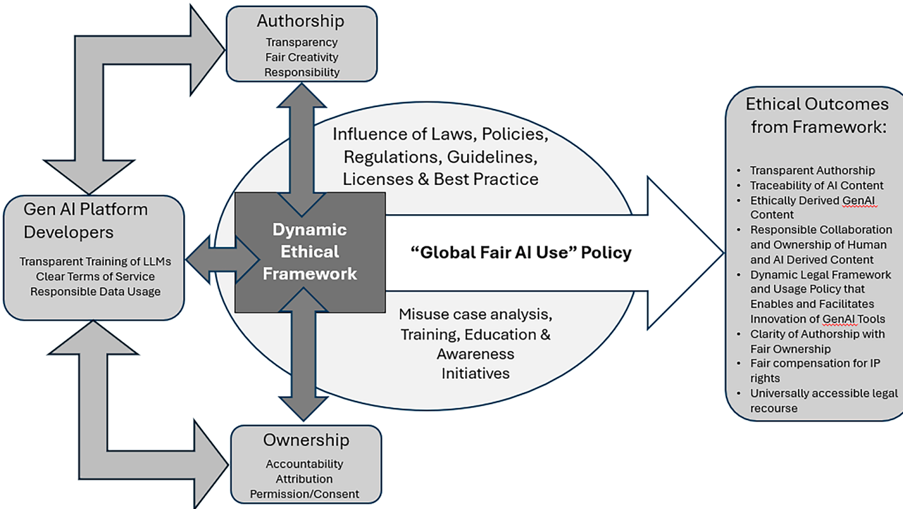
- The authors propose a Dynamic Ethical Framework and “Global Fair AI Use” policy covering GenAI platform developers, authorship, and ownership, and call for international collaboration to reform IPR laws.
Methods
- Design: a multiperspective expert-based approach, following prior work by von Foerster and Dwivedi et al., inviting specialists from academia and practice to contribute perspectives on GenAI, copyright, and IPR.
- Data/sample: eleven invited expert contributions, plus legal cases, policy documents, and literature; no primary empirical dataset is collected.
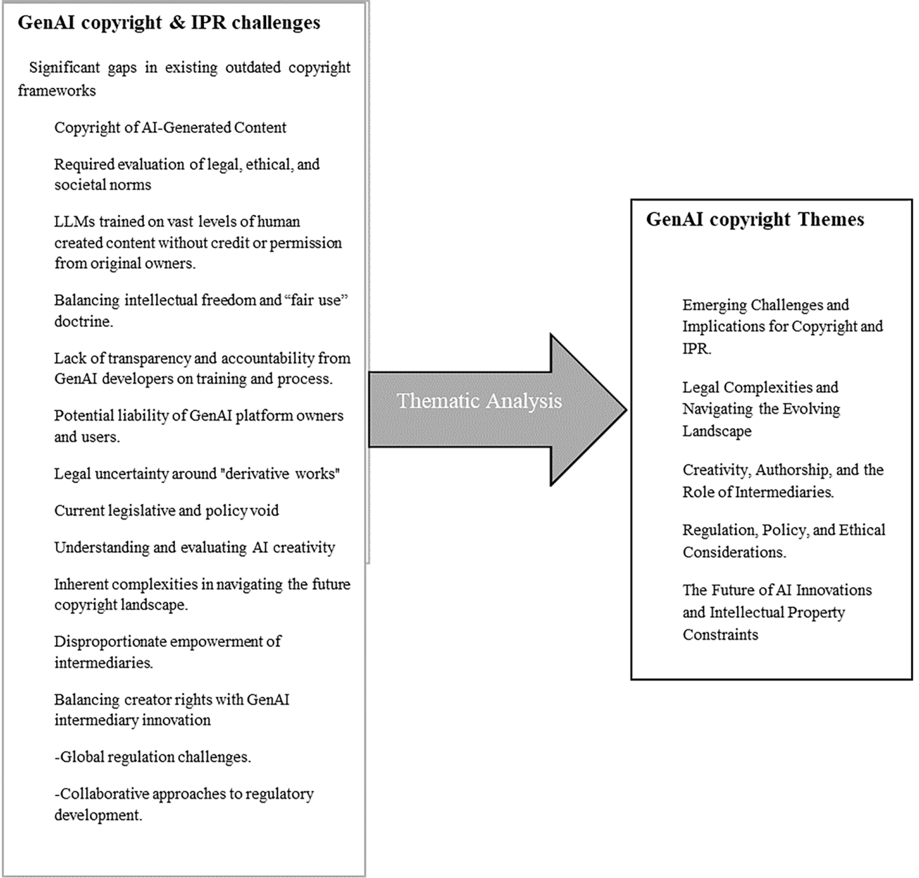
- Analysis: thematic analysis of the contributions, organized around emerging challenges, legal complexities, creativity/authorship/ownership, regulation and policy, and future adaptation; the discussion develops the Dynamic Ethical Framework and a proposed “Global Fair AI Use” policy.
Limitations
- Stated in the paper: the multi-expert format may produce overlapping narratives across perspectives; the paper’s length is a limitation; contributions were limited to eleven due to the specialised nature of the topic.
- Evident from the text: the study is conceptual/editorial rather than empirical, and the proposed Dynamic Ethical Framework is not tested or validated; legal coverage is jurisdiction-specific and not a systematic global legal review.
Model-written summary. Check it against the paper before relying on it.
Integrity signals
Registry
Cites
Statistics
Figures

Verification
Claims the paper makes
125 Own interpretation · 60 Sources not found · 26 No basis given · 17 Check pending · 12 Not checked yet · 7 No full text of the sources · 5 Own result
In the paper
“The absence of a traditional mechanism of authorship in AI-generated content creation, could potentially shift the economic benefits away from human creators towards those who own or operate the AI technologies and platforms (Israhadi, 2023).”
§ Redefining boundaries in innovation and knowledge domains: Investigating the impact of generative artificial intelligence on copyright and intellectual property rights > Introduction
What the sources say
- Check pendingcites Israhadi, 2023 source
hedgedstates a possible cause- Asserted: passes — The authors put it forward as true.
- Checkable: passes — It can be checked against evidence.
- Load-bearing: passes — The paper’s conclusions depend on it.
- Based: passes — The paper gives a reason why it holds.
In the paper
“GenAI's ability to produce original content using data from human-created sources raises critical ethical and legal concerns.”
- Also stated in: § Introduction · plain
“This has profound legal and ethical consequences related to the protection of human creativity, authorship, and content ownership (Frosio, 2024).”
§ Redefining boundaries in innovation and knowledge domains: Investigating the impact of generative artificial intelligence on copyright and intellectual property rights > Abstract
What the sources say
- Check pendingcites Frosio, 2024 source
plainstates a cause- Asserted: passes — The authors put it forward as true.
- Checkable: unclear — It is unclear whether it could be checked against evidence.
- Load-bearing: passes — The paper’s conclusions depend on it.
- Based: passes — The paper gives a reason why it holds.
- Also stated in: § Introduction · plain
A conclusion the paper draws from its own results — it cites no other source for it, so there is none to check. The quote shows it is in the paper.
In the paper
“Current copyright and IPR frameworks, designed around human authorship, are insufficient to address these challenges.”
§ Redefining boundaries in innovation and knowledge domains: Investigating the impact of generative artificial intelligence on copyright and intellectual property rights > Abstract
plain- Asserted: passes — The authors put it forward as true.
- Checkable: passes — It can be checked against evidence.
- Load-bearing: passes — The paper’s conclusions depend on it.
- Based: passes — The paper gives a reason why it holds.
- Rests on an assumption not shown here.
In the paper
“The emergence of AI as a non-human creator, directly challenges the existing legal infrastructure built around the human creator (Frosio, 2024;Liu et al., 2023).”
§ Redefining boundaries in innovation and knowledge domains: Investigating the impact of generative artificial intelligence on copyright and intellectual property rights > Introduction
What the sources say
- Check pendingcites Frosio, 2024 source
- Not matchedcites Liu et al., 2023
Couldn’t be matched to a paper in Crossref, so it can’t be checked.
plainstates a cause- Asserted: passes — The authors put it forward as true.
- Checkable: passes — It can be checked against evidence.
- Load-bearing: passes — The paper’s conclusions depend on it.
- Based: passes — The paper gives a reason why it holds.
In the paper
“Within the current legal frameworks, GenAI applications may be liable for copyright infringement if they both had access to the original works and GenAI generated output is substantially similar to the original works (Zirpoli, 2023).”
§ Redefining boundaries in innovation and knowledge domains: Investigating the impact of generative artificial intelligence on copyright and intellectual property rights > Legal Complexities
What the sources say
- Not matchedcites Zirpoli, 2023
Couldn’t be matched to a paper in Crossref, so it can’t be checked.
hedgedstates a possible cause- Asserted: passes — The authors put it forward as true.
- Checkable: passes — It can be checked against evidence.
- Load-bearing: passes — The paper’s conclusions depend on it.
- Based: passes — The paper gives a reason why it holds.
- Not matched
- It may state two separate claims as one. 98
- Probably not a substantial claim. 175
- The quote only partly states this claim. 1
Create a free account to see these claims.
Create a free account to see these assumptions.
43 more claims
Create a free account to see all 252 claims and to verify the 24 references still open.
Citations
Cites
Proceedings of the 24th international conference on Machine learning
(2007) · doi:10.1145/1273496 · Cited by 11,870
Dwivedi, Y. K., Hughes, L., Ismagilova, E., Aarts, G., Coombs, C., Crick, T., Duan, Y., Dwivedi, R., Edwards, J., Eirug, A., et al. (2021) · International Journal of Information Management · doi:10.1016/j.ijinfomgt.2019.08.002 · Cited by 4,611
Self-citationDwivedi, Y. K., Kshetri, N., Hughes, L., Slade, E. L., Jeyaraj, A., Kar, A. K., Baabdullah, A. M., Koohang, A., Raghavan, V., Ahuja, M., et al. (2023) · International Journal of Information Management · doi:10.1016/j.ijinfomgt.2023.102642 · Cited by 4,584
Self-citationChatGPT: five priorities for research
van Dis, E. A. M., Bollen, J., Zuidema, W., van Rooij, R., & Bockting, C. L. (2023) · Nature · doi:10.1038/d41586-023-00288-7 · Cited by 1,842
Generative AI and ChatGPT: applications, challenges, and AI-human collaboration
Fui-Hoon Nah, F., Zheng, R., Cai, J., Siau, K., & Chen, L. (2023) · Journal of Information Technology Case and Application Research · doi:10.1080/15228053.2023.2233814 · Cited by 1,363
Organizations: A Dialectical View
Benson, J. (1977) · Administrative Science Quarterly · doi:10.2307/2391741 · Cited by 942
ChatGPT listed as author on research papers: many scientists disapprove
Stokel-Walker, C. (2023) · Nature · doi:10.1038/d41586-023-00107-z · Cited by 868
Neural Network Methods for Natural Language Processing
Goldberg, Y. (2017) · Synthesis Lectures on Human Language Technologies · doi:10.1007/978-3-031-02165-7 · Cited by 821
Art and the science of generative AI
Epstein, Z., Hertzmann, A., the Investigators of Human Creativity, Akten, M., Farid, H., Fjeld, J., Frank, M. R., Groh, M., Herman, L., Leach, N., et al. (2023) · Science · doi:10.1126/science.adh4451 · Cited by 788
Ooi, K.-B., Tan, G. W.-H., Al-Emran, M., Al-Sharafi, M. A., Capatina, A., Chakraborty, A., Dwivedi, Y. K., Huang, T.-L., Kar, A. K., Lee, V.-H., et al. (2025) · Journal of Computer Information Systems · doi:10.1080/08874417.2023.2261010 · Cited by 746
Self-citationKanbach, D. K., Heiduk, L., Blueher, G., Schreiter, M., & Lahmann, A. D. F. (2023) · Review of Managerial Science · doi:10.1007/s11846-023-00696-z · Cited by 634
Peres, R., Schreier, M., Schweidel, D., & Sorescu, A. (2023) · International Journal of Research in Marketing · doi:10.1016/j.ijresmar.2023.03.001 · Cited by 535
On Self-Organizing Systems and Their Environments
von Foerster, H. (2003) · Springer eBooks · doi:10.1007/0-387-21722-3_1 · Cited by 457
Welcome to the Era of ChatGPT et al.: The Prospects of Large Language Models
Teubner, T., Flath, C. M., Weinhardt, C., van der Aalst, W., & Hinz, O. (2023) · Business & Information Systems Engineering · doi:10.1007/s12599-023-00795-x · Cited by 384
From a ‘race to AI’ to a ‘race to AI regulation’: regulatory competition for artificial intelligence
Smuha, N. A. (2021) · Law, Innovation and Technology · doi:10.1080/17579961.2021.1898300 · Cited by 380
ChatGPT: Evolution or revolution?
Gordijn, B., & Have, H. T. (2023) · Medicine, Health Care and Philosophy · doi:10.1007/s11019-023-10136-0 · Cited by 317
Chandra, S., Shirish, A., & Srivastava, S. C. (2022) · Journal of Management Information Systems · doi:10.1080/07421222.2022.2127441 · Cited by 315
Self-citationAmankwah-Amoah, J., Abdalla, S., Mogaji, E., Elbanna, A., & Dwivedi, Y. K. (2024) · International Journal of Information Management · doi:10.1016/j.ijinfomgt.2024.102759 · Cited by 305
Self-citationKurki, V. (2019) · doi:10.1093/oso/9780198844037.001.0001 · Cited by 246
Samuelson, P. (2023) · Science · doi:10.1126/science.adi0656 · Cited by 240
Lundvall, B.-Å., & Rikap, C. (2022) · Research Policy · doi:10.1016/j.respol.2021.104395 · Cited by 222
The rise of digital constitutionalism in the European Union
Gregorio, G. D. (2021) · International Journal of Constitutional Law · doi:10.1093/icon/moab001 · Cited by 194
ChatGPT: A Case Study on Copyright Challenges for Generative Artificial Intelligence Systems
Lucchi, N. (2024) · European Journal of Risk Regulation · doi:10.1017/err.2023.59 · Cited by 173
Self-citationThe Chinese Approach to Artificial Intelligence: An Analysis of Policy, Ethics, and Regulation
Roberts, H., Cowls, J., Morley, J., Taddeo, M., Wang, V., & Floridi, L. (2021) · Philosophical Studies Series · doi:10.1007/978-3-030-81907-1_5 · Cited by 170
Imagining Desirable Futures: A call for prospective theorizing with speculative rigour
Gümüşay, A. A., & Reinecke, J. (2024) · Organization Theory · doi:10.1177/26317877241235939 · Cited by 140
Margoni, T., & Kretschmer, M. (2021) · GRUR International · doi:10.1093/grurint/ikac054 · Cited by 133
Dwivedi, Y. K., Jeyaraj, A., Hughes, L., Davies, G. H., Ahuja, M. K., Albashrawi, M. A., Al-Busaidi, A. S., Al-Sharhan, S., Al‐Sulaiti, K. I., Altinay, L., et al. (2024) · International Journal of Information Management · doi:10.1016/j.ijinfomgt.2023.102750 · Cited by 133
Self-citationOchmann, J., Michels, L., Tiefenbeck, V., Maier, C., & Laumer, S. (2024) · Information Systems Journal · doi:10.1111/isj.12482 · Cited by 132
Copyright and Artificial Creation: Does EU Copyright Law Protect AI-Assisted Output?
Hugenholtz, P. B., & Quintais, J. P. (2021) · IIC - International Review of Intellectual Property and Competition Law · doi:10.1007/s40319-021-01115-0 · Cited by 103
Authors and MachinesPreprint
Ginsburg, J. C., & Budiardjo, L. A. (2018) · SSRN Electronic Journal · doi:10.15779/z38sf2mc24 · Cited by 98
Khan, J. I., Khan, J., Ali, F., Ullah, F., Bacha, J., & Lee, S. (2022) · IEEE Access · doi:10.1109/access.2022.3181605 · Cited by 96
The Legal Personhood of Artificial Intelligences
Kurki, V. (2019) · doi:10.1093/oso/9780198844037.003.0007 · Cited by 94
Generative AI and Author Remuneration
Senftleben, M. (2023) · GRURRR. Gewerblicher Rechtsschutz und Urheberrecht, Rechtsprechungs-Report/GRUR-DVD/GRUR-CD/IIC/Gewerblicher Rechtsschutz und Urheberrecht/Gewerblicher Rechtsschutz und Urheberrecht. Internationaler Teil · doi:10.1007/s40319-023-01399-4 · Cited by 91
Originality and the future of copyright in an age of generative AI
Fenwick, M., & Jurčys, P. (2023) · Computer law & security review · doi:10.1016/j.clsr.2023.105892 · Cited by 88
Self-citationKhalil, U., Mueen-Uddin, Malik, O. A., & Hussain, S. (2022) · IEEE Access · doi:10.1109/access.2022.3189998 · Cited by 82
How Generative AI Turns Copyright Law Upside Down
Lemley, M. A. (2024) · Science and Technology Law Review · doi:10.52214/stlr.v25i2.12761 · Cited by 82
The New Legal Landscape for Text Mining and Machine LearningPreprint
Sag, M. (2019) · SSRN Electronic Journal · doi:10.2139/ssrn.3331606 · Cited by 70
Companion Proceedings of the ACM Web Conference 2023
(2023) · doi:10.1145/3543873 · Cited by 70
New Food Product Development: From Concept to Marketplace
Kuesten, C. L. (2006) · Journal of Product Innovation Management · doi:10.1111/j.1540-5885.2006.00192_4.x · Cited by 69
Copyright, compensation, and commons in the music AI industry
Drott, E. (2021) · Creative Industries Journal · doi:10.1080/17510694.2020.1839702 · Cited by 66
The forgotten creator: Towards a statutory remuneration right for machine learning of generative AI
Geiger, C., & Iaia, V. (2023) · Computer law & security review · doi:10.1016/j.clsr.2023.105925 · Cited by 59
Foundation Models and Fair Use
Henderson, P., Li, X., Jurafsky, D., Hashimoto, T., Lemley, M. A., & Liang, P. (2023) · doi:10.2139/ssrn.4404340 · Cited by 57
Hu, K., Weng, C., Shen, C., Wang, T., Weng, L., & Xia, M. (2023) · Engineering Applications of Artificial Intelligence · doi:10.1016/j.engappai.2023.106196 · Cited by 47
Generative mechanisms of AI implementation: A critical realist perspective on predictive maintenance
Stohr, A., Ollig, P., Keller, R., & Rieger, A. (2024) · Information and Organization · doi:10.1016/j.infoandorg.2024.100503 · Cited by 45
Artificial Intelligence’s Fair Use Crisis
Sobel, B. L. W. (2017) · Columbia University · doi:10.7916/d8ww90t7 · Cited by 44
Research Handbook on Intellectual Property and Artificial Intelligence
(2022) · Edward Elgar Publishing eBooks · doi:10.4337/9781800881907 · Cited by 39
ChatGPT and Generative AI Tools: Theft of Intellectual Labor?
Strowel, A. M. (2023) · GRURRR. Gewerblicher Rechtsschutz und Urheberrecht, Rechtsprechungs-Report/GRUR-DVD/GRUR-CD/IIC/Gewerblicher Rechtsschutz und Urheberrecht/Gewerblicher Rechtsschutz und Urheberrecht. Internationaler Teil · doi:10.1007/s40319-023-01321-y · Cited by 38
Connecting the Path Between Open Innovation and Industry 4.0: A Review of the Literature
Strazzullo, S., Cricelli, L., Grimaldi, M., & Ferruzzi, G. (2022) · IEEE Transactions on Engineering Management · doi:10.1109/tem.2021.3139457 · Cited by 37
Developing New Food Products for a Changing Marketplace
(2007) · CRC Press eBooks · doi:10.1201/9781420004328 · Cited by 36
New Food Product Development: From Concept to Marketplace, Third Edition
Fuller, G. W. (2011) · CRC Press eBooks · doi:10.1201/b10521 · Cited by 36
A Theory of Copyright Authorship
Buccafusco, C. J. (2016) · eYLS (Yale Law School) · doi:10.5281/zenodo.23418807 · Cited by 35
What if Artificial Intelligence Wrote This? Artificial Intelligence and Copyright Law
Palace, V. M. (2019) · UF Law Scholarship Repository (University of Florida) · Cited by 33
Bonadio, E., & McDonagh, L. (2020) · London School of Economics and Political Science Research Online (London School of Economics and Political Science) · Cited by 32
Growth of Listeria monocytogenes in Thawed Frozen Foods
Kataoka, A., Wang, H., Elliott, P. H., Whiting, R. C., & Hayman, M. M. (2017) · Journal of Food Protection · doi:10.4315/0362-028x.jfp-16-397r · Cited by 31
Rosati, E. (2019) · Asia Pacific Law Review · doi:10.1080/10192557.2019.1705525 · Cited by 31
Mason, R. (2003) · State University of New York Press eBooks · doi:10.1353/book4730 · Cited by 30
People Not Machines: Authorship and What It Means in the Berne Convention
Ginsburg, J. C. (2018) · IIC - International Review of Intellectual Property and Competition Law · doi:10.1007/s40319-018-0670-x · Cited by 29
Guadamuz, A. (2021) · Artificial Intelligence and Intellectual Property · doi:10.1093/oso/9780198870944.003.0008 · Cited by 27
Proceedings of the 2003 International Conference on Electronic Business
Ang, J. (2003) · University of Groningen research database (University of Groningen / Centre for Information Technology) · Cited by 26
Generative AI and copyright: principles, priorities and practicalities
Lim, D. (2023) · Journal of Intellectual Property Law & Practice · doi:10.1093/jiplp/jpad081 · Cited by 25
Self-citationCopyright protection for AI-generated outputs: The experience from China
Wan, Y., & Lu, H. (2021) · Computer Law & Security Review · doi:10.1016/j.clsr.2021.105581 · Cited by 24
Bonadio, E., Lucchi, N., & Mazziotti, G. (2022) · GRURRR. Gewerblicher Rechtsschutz und Urheberrecht, Rechtsprechungs-Report/GRUR-DVD/GRUR-CD/IIC/Gewerblicher Rechtsschutz und Urheberrecht/Gewerblicher Rechtsschutz und Urheberrecht. Internationaler Teil · doi:10.1007/s40319-022-01213-7 · Cited by 24
Self-citationSheeran succeeds in ‘Shape of You’ music copyright infringement claim
Bosher, H. (2022) · Journal of Intellectual Property Law & Practice · doi:10.1093/jiplp/jpac055 · Cited by 23
To Steal a Book is an Elegant Offense: Intellectual Property Law in Chinese Civilization.
Knight, B., & Alford, W. P. (1996) · The American Historical Review · doi:10.2307/2170293 · Cited by 21
Attribution problem of generative AI: a view from US copyright law
Kahveci, Z. Ü. (2023) · Journal of Intellectual Property Law and Practice · doi:10.1093/jiplp/jpad076 · Cited by 20
How Generative AI Turns Copyright Upside Down
Lemley, M. A. (2023) · doi:10.2139/ssrn.4517702 · Cited by 17
To Launch or Not to Launch: An Empirical Estimate of New Food Product Success Rate
Salnikova, E., Baglione, S. L., & Stanton, J. L. (2019) · Journal of Food Products Marketing · doi:10.1080/10454446.2019.1661930 · Cited by 15
AI-generated works and copyright law: Towards a union of strange bedfellows
Salami, E. (2021) · Journal of Intellectual Property Law & Practice · doi:10.1093/jiplp/jpaa189 · Cited by 15
What Does it Mean to Consider AI a Person?
Graves, M. (2023) · Theology and Science · doi:10.1080/14746700.2023.2230424 · Cited by 14
Frosio, G. (2024) · Recreating Creativity, Reinventing Inventiveness · doi:10.4324/9781003260127-2 · Cited by 14
Trade Secrets: Law and Practice
Quinto, D. W., & Singer, S. H. (2009) · Cited by 13
Dornis, T. W. (2021) · SSRN Electronic Journal · doi:10.2139/ssrn.3776236 · Cited by 12
Mezei, P. (2021) · SSRN Electronic Journal · doi:10.2139/ssrn.3890051 · Cited by 11
Copyright Law in the European Union, the United States and China
Hutukka, P. (2023) · GRURRR. Gewerblicher Rechtsschutz und Urheberrecht, Rechtsprechungs-Report/GRUR-DVD/GRUR-CD/IIC/Gewerblicher Rechtsschutz und Urheberrecht/Gewerblicher Rechtsschutz und Urheberrecht. Internationaler Teil · doi:10.1007/s40319-023-01357-0 · Cited by 11
Can artificial intelligence infringe copyright? Some reflections
Bonadio, E., Dinev, P., & McDonagh, L. (2022) · Edward Elgar Publishing eBooks · doi:10.4337/9781800881907.00019 · Cited by 10
Radauer, A., Searle, N., & Bader, M. A. (2023) · World Patent Information · doi:10.1016/j.wpi.2023.102183 · Cited by 8
Israhadi, E. I. (2023) · Journal of Law and Sustainable Development · doi:10.55908/sdgs.v11i11.1965 · Cited by 8
Proceedings of the Symposium on Computer Science and Law
(2024) · doi:10.1145/3614407 · Cited by 6
Artificial Intelligence and Copyright:
de Champris, B. (2024) · Journal of AI Law and Regulation · doi:10.21552/aire/2024/1/14 · Cited by 6
Transformational Leadership and Innovation for Competitive Advantage in Large Firms and SMEs
Ashoor, W. A. (2021) · International Journal of R&D Innovation Strategy · doi:10.4018/ijrdis.20210101.oa2 · Cited by 5
The Work of Copyright Law in the Age of Generative AI
Crawford, K., & Schultz, J. (2024) · Grey Room · doi:10.1162/grey_a_00389 · Cited by 4
Komlos, E. (2021) · Open Scholarship Institutional Repository (Washington University in St. Louis) · Cited by 1
Creative AI: The Complex Relationship between Human Inventiveness and Intellectual Property
Laukyte, M., & Lucchi, N. (2022) · BioLaw Journal - Rivista di BioDiritto · doi:10.15168/2284-4503-2381 · Cited by 1
Self-citationBusiness (mis)Use Cases of Generative AI
Houde, S., Liao, V., Martino, J., Muller, M., Piorkowski, D., Richards, J., Weisz, J., & Zhang, Y. (2020) · arXiv · doi:10.48550/arxiv.2003.07679
On Provable Copyright Protection for Generative Models
Vyas, N., Kakade, S., & Barak, B. (2023) · arXiv · doi:10.48550/arxiv.2302.10870
(2024) · HAL
Self-citation
Research works printed but not linked: 14
- Baker, 2023, Intellectual Property and Generative AI, Deloitte AI Institute. Retrieved from
- De Mantaras, 2002, AI and music: From composition to expressive performance, AI magazine, 23
- Dornis, 2020, Artificial creativity: Emergent works and the void in current copyright doctrine, Yale Journal of Law & Technology, 22, 1
- Gans, 2024, Copyright policy options for generative artificial intelligence (No. w32106), National Bureau of Economic Research
- Jo, 2023, The promise and peril of generative AI, Nature, 614, 214
- Jodha, 2023, Copyright issues in the era of Ai-A critical analysis, Res Militaris, 13, 1737
- Metrics, PlumX. (2024). Policy Citations. Accessed on 17th November 2024. https://plu.mx/plum/a/policy_citation?doi=10.1016/j.ijinfomgt.2023.102642&theme=plum-sciencedirect-theme&hideUsage=true. · DOI · Paper page
- Metz, 2024, How tech giants cut corners to harvest data for AI, The New York Times
- MIT Technology Review (2023). The great acceleration: CIO perspectives on generative AI. Retrieved from https://www.databricks.com/sites/default/files/2023-07/ebook_mit-cio-generative-ai-report.pdf.
- Roberts, 2023, 39, 79
- Sanders, 2020, The Secret to AI is People, Harvard Business Review
- Senftleben, 2020, Robot creativity: An incentive-based neighbouring rights approach, European Intellectual Property Review, 42, 797
- Sindre, 2001, Capturing security requirements through misuse cases. NIK 2001, Norsk Informatikkonferanse, 74
- Yu, 2003, The copyright divide, Cardozo Law Review, 25, 331
Cited by
Generative AI for decision-making: A multidisciplinary perspective
Albashrawi, M. A. (2025) · Journal of Innovation & Knowledge · doi:10.1016/j.jik.2025.100751 · Cited by 82
Self-citationDwivedi, Y. K. (2025) · International Entrepreneurship and Management Journal · doi:10.1007/s11365-025-01089-2 · Cited by 79
Self-citationScholarly Discourse on GenAI’s Impact on Academic Publishing
Dwivedi, Y. K., Malik, T., Hughes, L., & Albashrawi, M. A. (2024) · Journal of Computer Information Systems · doi:10.1080/08874417.2024.2435386 · Cited by 38
Self-citationCerchione, R., Liccardo, G., & Passaro, R. (2025) · Journal of Innovation & Knowledge · doi:10.1016/j.jik.2025.100866 · Cited by 37
Zaidan, E., Truby, J., Ibrahim, I. A., & Hoppe, T. (2025) · Technology in Society · doi:10.1016/j.techsoc.2025.103159 · Cited by 19
Metadata
- Authors
- Al-Busaidi, A. S., Raman, R., Hughes, L., Albashrawi, M. A., Malik, T., Dwivedi, Y. K., Al- Alawi, T., AlRizeiqi, M., Davies, G., Fenwick, M., Gupta, P., Gurpur, S., Hooda, A., Jurcys, P., Lim, D., Lucchi, N., Misra, T., Raman, R., Shirish, A., & Walton, P.
- Affiliations
- Sultan Qaboos University (OM)
- Edith Cowan University (AU)
- Swansea University (GB)
- King Fahd University of Petroleum and Minerals (SA)
- University of Wales Trinity Saint David (GB)
- Kyushu University (JP)
- Management Development Institute (IN)
- Symbiosis International University (IN)
- O. P. Jindal Global University (IN)
- Pennsylvania State University (US)
- Universitat Pompeu Fabra (ES)
- Université Paris-Saclay (FR)
- Capgemini (United Kingdom) (GB)
- ORCID
- Venue
- Journal of Innovation & Knowledge
- Publisher
- Elsevier BV
- Published
- 2024-10
- Volume
- 9
- Issue
- 4
- Pages
- 100630
- ISSN
- 2444-569X (ISSN-L)
- OpenAlex
- W4404867434
- Cited by
- 95
- References
- 91
- Citations by year
- 2026: 48 · 2025: 43 · 2024: 4
- FWCI
- 9.92
- Type
- journal article
- Language
- en
- Open access
- gold
- doi.org
- Licence
- Locations
- Journal of Innovation & Knowledge (publishedVersion, cc-by-nc-nd)
- SSRN Electronic Journal (submittedVersion)
- Econstor (Econstor) (submittedVersion, cc-by-nc-nd)
- Australasian Journal of Paramedicine (submittedVersion, cc-by-nc-nd)
- HAL (submittedVersion)
- Cronfa (Swansea University) (submittedVersion, cc-by-nc-nd)
- DOAJ (DOAJ: Directory of Open Access Journals) (submittedVersion)
- Institutional Research Information System University of Ferrara (University of Ferrara) (submittedVersion, cc-by-nc-nd)
- Topics
- Physical Sciences › Computer Science › Artificial Intelligence › Law, AI, and Intellectual Property
- Social Sciences › Law › Intellectual Property Law
- Social Sciences › Law › Intellectual Property Rights and Media
- Keywords
- generative AI, copyright, intellectual property, AI-generated content, authorship, fair use, AI ethics, AI regulation, international intellectual property law
About these checks
Registry, retraction, Cites and statistics results are computed, not judged, with one exception: a printed reference that no index lists is read once by a model before it counts as a citation error. Claims are extracted by a model and kept only when their quote appears verbatim in the text; each cited source is then checked, with a model’s help, for whether it says what the claim relies on. Those verdicts can be wrong — read the claim’s quote and the cited source before relying on one.
A language model drew the claims from the paper on 2026-11-12, under version 3 of the claim definition (model deepseek-v4.1-flash, prompt extract-v3).
A second model labelled each claim on 2026-11-12 (model jev-1.13-20260917, definition revision gold-guideline-v0.2).
Statistics and arithmetic are recomputed, not judged.
Confidence bands are shown only for fields calibrated on our annotated test set. None is calibrated yet, so no band is shown.
What counts as a claim ›How we measure confidence ›How we check this ›
Are you an author, or do you see a problem with this page? Request a review
