

The DOI matches its Crossref record; 39 of the 39 references it cites were found in a registry or an index; 2 of the 30 sources its claims cite were checked for support.
The use of chitosan-coated flexible liposomes as a remarkable carrier to enhance the antitumor efficacy of 5-fluorouracil against colorectal cancer
Open accessAbstract
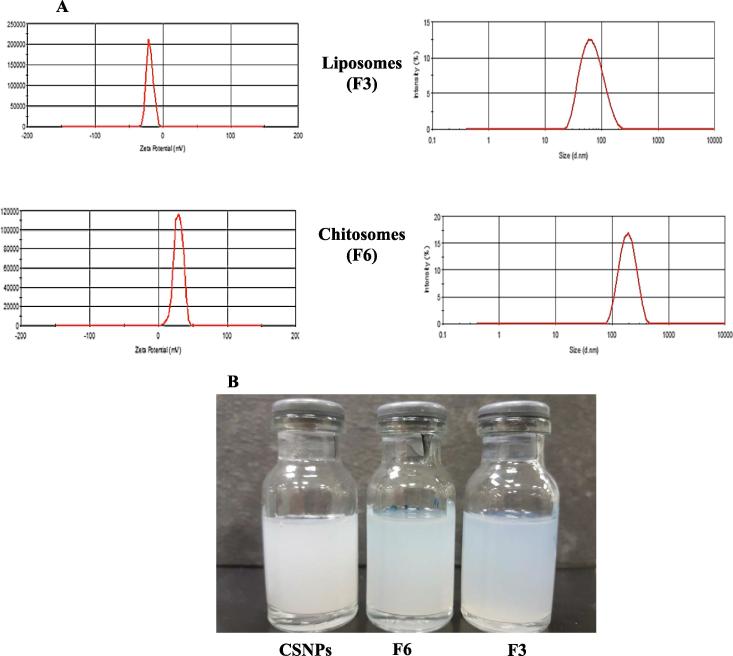
Surface-coated nanocarriers have been extensively used to enhance the delivery of anticancer drugs and improve their therapeutic index. In this study, chitosan (CS)-coated flexible liposomes (chitosomes) containing 5-fluorouracil (5-FU) were designed and characterized for use as a novel approach to target colon cancer cells. 5-FU-loaded flexible liposomes (F1, F2, and F3) and 5-FU-loaded chitosomes (F4, F5, and F6) were prepared using film hydration and electrostatic deposition techniques, respectively. The particle size, polydispersity index (PDI), zeta potential, entrapment efficiency (EE%), morphology, and in vitro drug release ability, and cytotoxicity of the formulations were determined. The results revealed that the size of chitosomes ranged from 212 to 271 nm with a positive surface charge of 6.1 to 14.7 mV, whereas the particle size of liposomes ranged from 108 to 234 nm with negative surface charges of −2.3 to −16.3. F3 and F6 had a spherical shape with a rough surface structure. The in vitro drug release study revealed that chitosomes retard 5-FU release as opposed to the 5-FU solution and liposomes. The cytotoxicity study using a colon cancer cell line (HT-29) showed that 5-FU-loaded chitosomes were more effective in killing cancer cells in a sustained manner than liposomes and the 5-FU solution. Chitosomes were therefore successfully developed as nanocarriers of 5-FU, with potential cytotoxicity for colorectal cancer cells.
Overview
AI snapshot
Written from the paper’s full text.
TL;DR
5-FU-loaded chitosan-coated flexible liposomes (chitosomes) were prepared and characterized, showing positive surface charge, improved entrapment, sustained release, and sustained cytotoxicity against HT-29 colon cancer cells. The authors conclude chitosomes are promising nanocarriers for 5-FU in colorectal cancer therapy.
Key findings
- Chitosomes F4–F6 had particle sizes of 212, 236, and 271 nm and positive zeta potentials of 6.1, 8.3, and 14.7 mV; uncoated liposomes F1–F3 were 234, 146, and 108 nm with negative zeta potentials of −2.3, −7.5, and −16.3 mV. CSNPs were 194 nm with +28.8 mV.
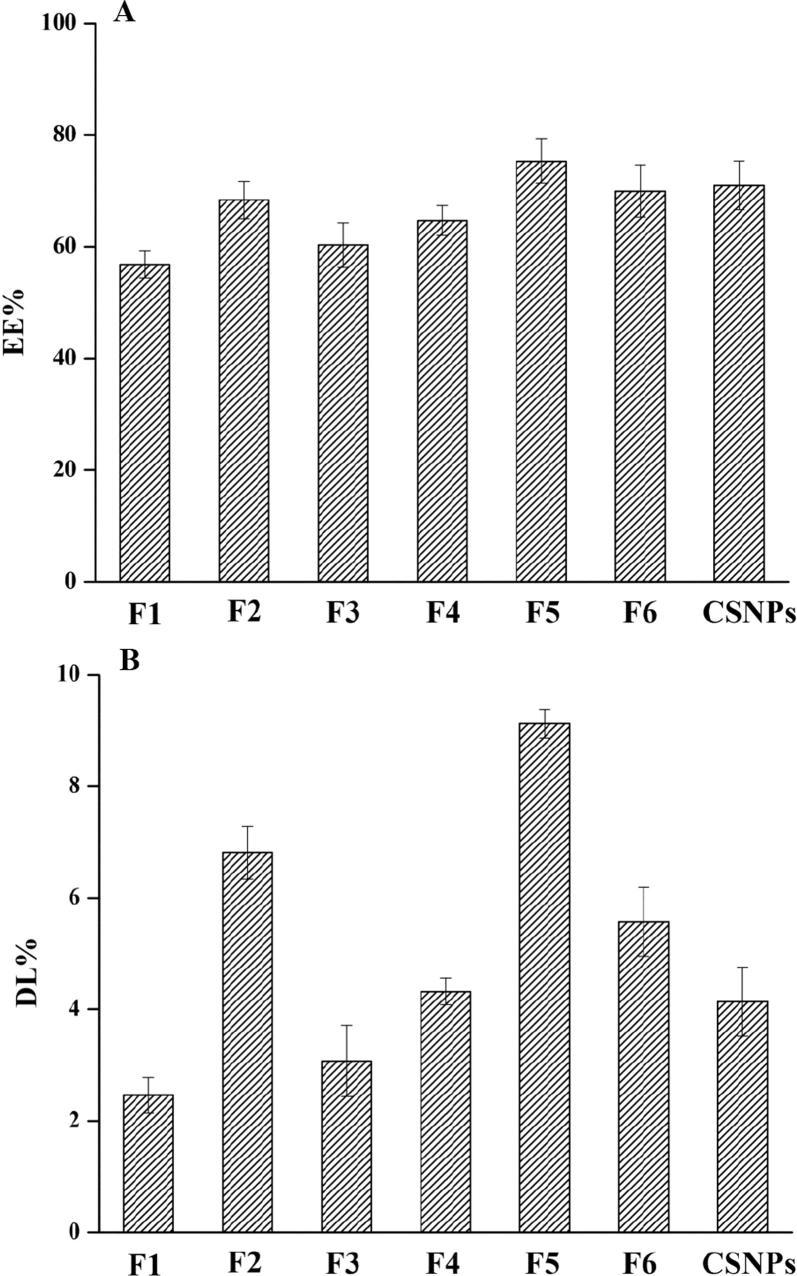
- EE% and DL% were 37%, 46%, and 42% and 2.5%, 4.8%, and 3.1% for F1–F3; 45%, 55%, and 51% and 4.2%, 6.1%, and 5.6% for F4–F6; and 61% and 7.3% for CSNPs.
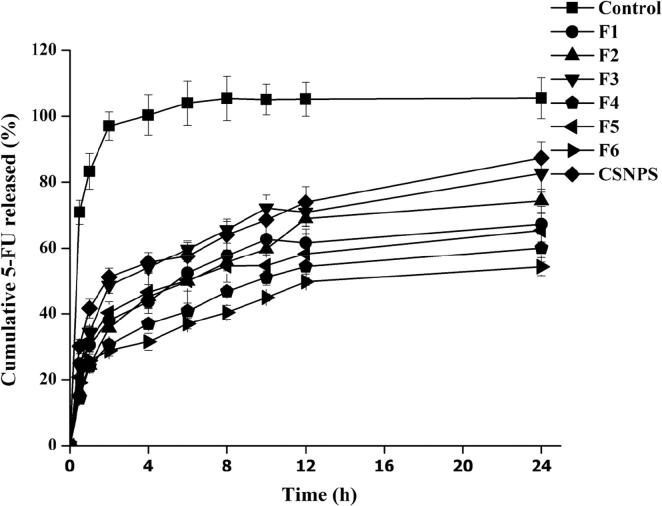
- 5-FU solution released ~70% within 1 h and almost 100% within 2 h. Liposomes F1–F3 released 43.6%, 49.8%, and 54.1% at 2 h and 61.6%, 68.7%, and 70.9% at 12 h; chitosomes F4–F6 released 40.7%, 46.5%, and 31.4% at 4 h and 53.4%, 50.1%, and 44.6% at 12 h; CSNPs released 57.5% at 4 h, 73.9% at 12 h, and 87.4% at 24 h.
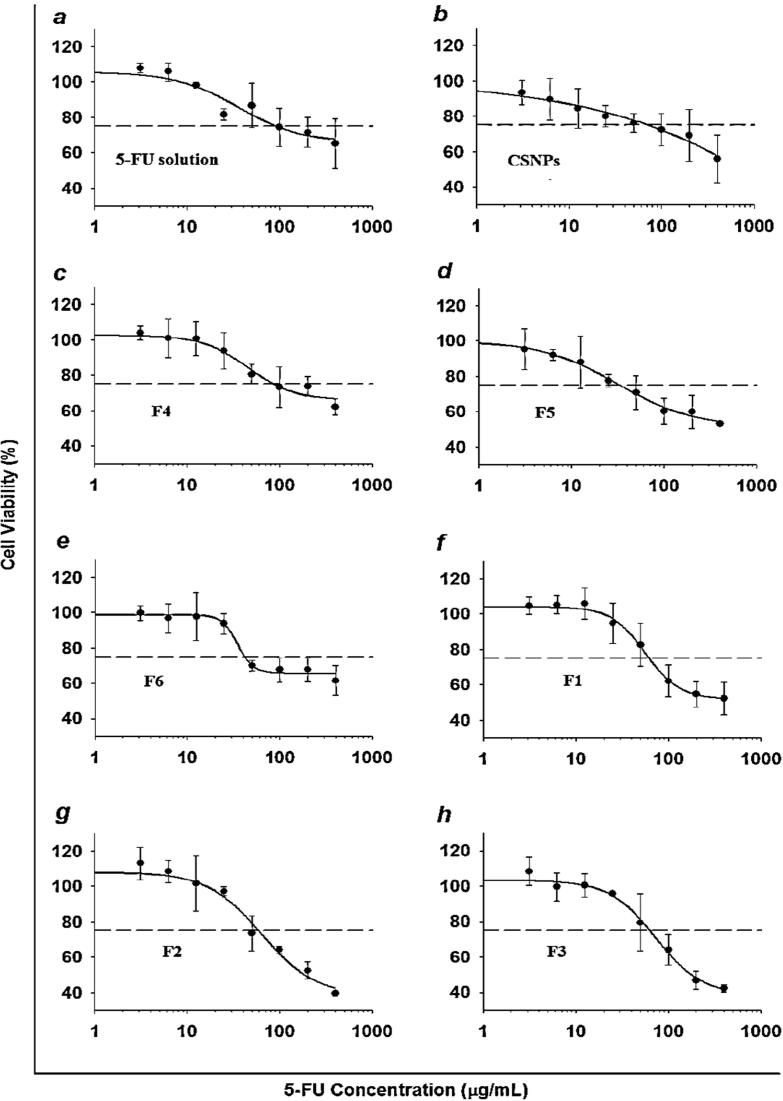
- In HT-29 cells, unloaded formulations and PBS showed >90% survival. Free 5-FU was more effective at low concentrations (3.1–25 μg/mL), while liposomes reduced cell growth more rapidly at high concentrations (50–400 μg/mL); chitosomes reduced viability in a sustained manner.
Methods
- 5-FU-loaded liposomes were prepared by thin-film hydration, chitosomes by electrostatic deposition of chitosan onto liposomes, and CSNPs by TPP crosslinking.
- Formulations were characterized for particle size, PDI, zeta potential, EE%, DL%, TEM morphology, and physical stability at 4 °C for 1 month.
- In vitro 5-FU release used dialysis in PBS pH 7.4 at 37 ± 0.5 °C; hemocompatibility used erythrocyte hemolysis; cytotoxicity used MTT in HT-29 cells at 3.1–400 μg/mL for 24 h.
Limitations
- The paper does not state limitations explicitly; the conclusion notes that future studies will aim to improve the anticancer effectiveness of 5-FU.
- Evident from the text: efficacy is limited to in vitro HT-29 cytotoxicity and release studies, with no in vivo tumor model, pharmacokinetics, or biodistribution data.
- Evident from the text: chitosomes showed minor to moderate hemolysis and CSNPs showed significant hemolysis, which may limit systemic use; physical stability was assessed only for 1 month at 4 °C.
Model-written summary. Check it against the paper before relying on it.
Integrity signals
Registry
Cites
Statistics
Figures
Verification
Claims the paper makes
24 Own result · 16 No full text of the sources · 9 Own interpretation · 7 Not checked yet · 4 No basis given · 2 Partly supported · 1 Check pending · 1 Own method · accuracy not yet measured
A result the paper reports from its own data — it cites no other source for it, so there is none to check. The quote shows it is in the paper.
In the paper
“the release rate of 5-FU from the prepared systems exhibited a biphasic mode: an initial fast rate of drug release followed by a slow rate of drug release.”
§ The use of chitosan-coated flexible liposomes as a remarkable carrier to enhance the antitumor efficacy of 5-fluorouracil against colorectal cancer > Results and discussion > In vitro 5-FU release studies
plainn = 3- Asserted: passes — The authors put it forward as true.
- Checkable: passes — It can be checked against evidence.
- Load-bearing: unclear — It is unclear whether the paper’s conclusions depend on it.
- Based: passes — The paper gives a reason why it holds.
A result the paper reports from its own data — it cites no other source for it, so there is none to check. The quote shows it is in the paper.
In the paper
“Moreover, cumulative release of 5-FU from F4, F5 and F6 was 53.4%, 50.1% and 44.6%, respectively, after 12 h (Fig. 5).”
§ The use of chitosan-coated flexible liposomes as a remarkable carrier to enhance the antitumor efficacy of 5-fluorouracil against colorectal cancer > Results and discussion > In vitro 5-FU release studies
plain- Asserted: passes — The authors put it forward as true.
- Checkable: passes — It can be checked against evidence.
- Load-bearing: passes — The paper’s conclusions depend on it.
- Based: passes — The paper gives a reason why it holds.
A result the paper reports from its own data — it cites no other source for it, so there is none to check. The quote shows it is in the paper.
In the paper
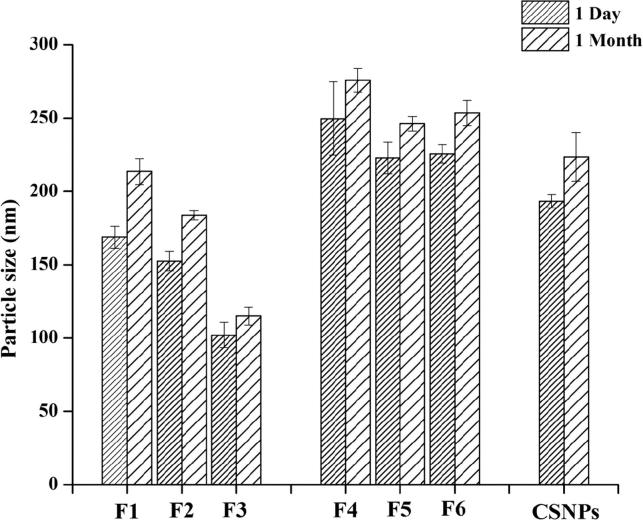
“These liposomes displayed a slight change in particle size after one month of storage (Fig. 4)”
§ The use of chitosan-coated flexible liposomes as a remarkable carrier to enhance the antitumor efficacy of 5-fluorouracil against colorectal cancer > Results and discussion > Physical stability studies
plainn = 3- Asserted: passes — The authors put it forward as true.
- Checkable: passes — It can be checked against evidence.
- Load-bearing: unclear — It is unclear whether the paper’s conclusions depend on it.
- Based: passes — The paper gives a reason why it holds.
A result the paper reports from its own data — it cites no other source for it, so there is none to check. The quote shows it is in the paper.
In the paper
“The liposomes containing CS relatively improved EE% and DL% of 5-FU as F4, F5, and F6 had EE% of 45, 55, and 51%, and DL% values of 4.2, 6.1, and 5.6, respectively.”
§ The use of chitosan-coated flexible liposomes as a remarkable carrier to enhance the antitumor efficacy of 5-fluorouracil against colorectal cancer > Results and discussion > Encapsulation efficiency (EE%) and drug loading (DL%)
plaindirectn = 3- Asserted: passes — The authors put it forward as true.
- Checkable: passes — It can be checked against evidence.
- Load-bearing: passes — The paper’s conclusions depend on it.
- Based: passes — The paper gives a reason why it holds.
A result the paper reports from its own data — it cites no other source for it, so there is none to check. The quote shows it is in the paper.
In the paper
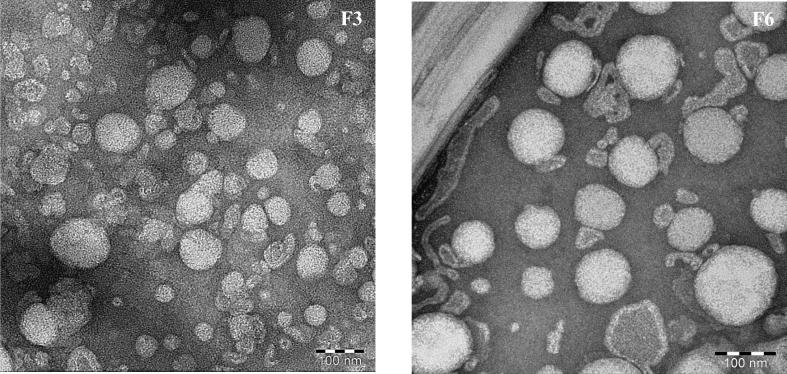
“F3 and F6 had a spherical shape with a rough surface structure.”
- Also stated in: § Morphological characterization · plain
“a spherical shape with rough surface structure is revealed for these formulations.”
§ The use of chitosan-coated flexible liposomes as a remarkable carrier to enhance the antitumor efficacy of 5-fluorouracil against colorectal cancer > Abstract
plain- Asserted: passes — The authors put it forward as true.
- Checkable: passes — It can be checked against evidence.
- Load-bearing: unclear — It is unclear whether the paper’s conclusions depend on it.
- Based: passes — The paper gives a reason why it holds.
- Also stated in: § Morphological characterization · plain
A result the paper reports from its own data — it cites no other source for it, so there is none to check. The quote shows it is in the paper.
In the paper
“which revealed that 54–63% of 5-FU in F1, F2, and F3 was present on the exterior of the liposomal particles.”
§ The use of chitosan-coated flexible liposomes as a remarkable carrier to enhance the antitumor efficacy of 5-fluorouracil against colorectal cancer > Results and discussion > In vitro 5-FU release studies
plain- Asserted: passes — The authors put it forward as true.
- Checkable: passes — It can be checked against evidence.
- Load-bearing: unclear — It is unclear whether the paper’s conclusions depend on it.
- Based: passes — The paper gives a reason why it holds.
A result the paper reports from its own data — it cites no other source for it, so there is none to check. The quote shows it is in the paper.
In the paper
“The cytotoxicity study using a colon cancer cell line (HT-29) showed that 5-FU-loaded chitosomes were more effective in killing cancer cells in a sustained manner than liposomes and the 5-FU solution.”
- Also stated in: § Conclusion · plain
“The in vitro cytotoxicity studies showed that chitosomes improved the cytotoxicity of 5-FU with a sustained effect unlike liposomes and the 5-FU solution.”
§ The use of chitosan-coated flexible liposomes as a remarkable carrier to enhance the antitumor efficacy of 5-fluorouracil against colorectal cancer > Abstract
plaindirect- Asserted: passes — The authors put it forward as true.
- Checkable: passes — It can be checked against evidence.
- Load-bearing: passes — The paper’s conclusions depend on it.
- Based: passes — The paper gives a reason why it holds.
- Also stated in: § Conclusion · plain
A result the paper reports from its own data — it cites no other source for it, so there is none to check. The quote shows it is in the paper.
In the paper
“It is clear that the presence of an edge activator (tween 80) in F2 and F3 resulted in a smaller liposomal size than conventional liposomes (F1).”
§ The use of chitosan-coated flexible liposomes as a remarkable carrier to enhance the antitumor efficacy of 5-fluorouracil against colorectal cancer > Results and discussion > Particle size distribution and zeta potential measurements
boosteddirect- Asserted: passes — The authors put it forward as true.
- Checkable: passes — It can be checked against evidence.
- Load-bearing: unclear — It is unclear whether the paper’s conclusions depend on it.
- Based: passes — The paper gives a reason why it holds.
The paper states this without a source or data behind it here, so there is nothing to check it against. The quote shows it is in the paper.
In the paper
“At low concentrations (3.1, 6.2, 12.5 and 25 μg/mL), free 5-FU was more efficient in preventing cell growth than liposomes, chitosomes, and CSNPs”
§ The use of chitosan-coated flexible liposomes as a remarkable carrier to enhance the antitumor efficacy of 5-fluorouracil against colorectal cancer > Results and discussion > In vitro cytotoxicity studies
plaindirectn = 6- Asserted: passes — The authors put it forward as true.
- Checkable: passes — It can be checked against evidence.
- Load-bearing: unclear — It is unclear whether the paper’s conclusions depend on it.
- Based: passes — The paper gives a reason why it holds.
A result the paper reports from its own data — it cites no other source for it, so there is none to check. The quote shows it is in the paper.
In the paper
“Over a 4 h period, the values of 5-FU release from chitosomes were 40.7%, 46.5% and 31.4% from F4, F5 and F6, respectively.”
§ The use of chitosan-coated flexible liposomes as a remarkable carrier to enhance the antitumor efficacy of 5-fluorouracil against colorectal cancer > Results and discussion > In vitro 5-FU release studies
plain- Asserted: passes — The authors put it forward as true.
- Checkable: passes — It can be checked against evidence.
- Load-bearing: passes — The paper’s conclusions depend on it.
- Based: passes — The paper gives a reason why it holds.
- Probably not a substantial claim. 10
- It may state two separate claims as one. 24
The cited sources support only part of this claim — read each source’s verdict below.
In the paper
“5-fluorouracil (5-FU) is commonly used alone or in combination with other chemotherapeutic drugs to treat CRC (Wen et al., 2016).”
§ The use of chitosan-coated flexible liposomes as a remarkable carrier to enhance the antitumor efficacy of 5-fluorouracil against colorectal cancer > Introduction
What the sources say
- Partly supportedcites Wen et al., 2016 sourceExperimental — accuracy not yet measured
The Introduction states that 5-FU-based chemotherapy is the main chemotherapeutic approach for CRC patients, supporting its common use. Neither the Introduction nor the Discussion specifies that 5-FU is used both alone and with other chemotherapeutic drugs. (LLM, conf=0.84)
plain- Asserted: passes — The authors put it forward as true.
- Checkable: passes — It can be checked against evidence.
- Load-bearing: fails — The paper’s conclusions may not depend on it.
- Based: passes — The paper gives a reason why it holds.
Probably not a substantial claim. The paper’s conclusions may not depend on it.
- Partly supported
The cited sources support only part of this claim — read each source’s verdict below.
In the paper
“Colorectal cancer (CRC) is considered one of the most commonly detected cancers that causes mortality (Siegel et al., 2017).”
§ The use of chitosan-coated flexible liposomes as a remarkable carrier to enhance the antitumor efficacy of 5-fluorouracil against colorectal cancer > Introduction
What the sources say
- Partly supportedcites Siegel et al., 2017 sourceExperimental — accuracy not yet measured
The Results report 490,305 colorectal cancer diagnoses in the studied SEER registries, and the Discussion refers to premature mortality from the disease. Neither passage establishes the claim that CRC is one of the most commonly detected cancers relative to other cancers. (LLM, conf=0.84)
plain- Asserted: passes — The authors put it forward as true.
- Checkable: passes — It can be checked against evidence.
- Load-bearing: fails — The paper’s conclusions may not depend on it.
- Based: passes — The paper gives a reason why it holds.
Probably not a substantial claim. The paper’s conclusions may not depend on it.
- Partly supported
A result the paper reports from its own data — it cites no other source for it, so there is none to check. The quote shows it is in the paper.
In the paper
“The results revealed that the size of chitosomes ranged from 212 to 271 nm with a positive surface charge of 6.1 to 14.7 mV”
§ The use of chitosan-coated flexible liposomes as a remarkable carrier to enhance the antitumor efficacy of 5-fluorouracil against colorectal cancer > Abstract
plain- Asserted: passes — The authors put it forward as true.
- Checkable: passes — It can be checked against evidence.
- Load-bearing: unclear — It is unclear whether the paper’s conclusions depend on it.
- Based: passes — The paper gives a reason why it holds.
It may state two separate claims as one.
A result the paper reports from its own data — it cites no other source for it, so there is none to check. The quote shows it is in the paper.
In the paper
“The results reveal that the unloaded formulations and PBS did not display significant cytotoxicity, and >90% of HT-29 cells survived when the same concentration range was used as the 5-FU formulations (Fig. 7).”
§ The use of chitosan-coated flexible liposomes as a remarkable carrier to enhance the antitumor efficacy of 5-fluorouracil against colorectal cancer > Results and discussion > In vitro cytotoxicity studies
plainn = 6- Asserted: passes — The authors put it forward as true.
- Checkable: passes — It can be checked against evidence.
- Load-bearing: passes — The paper’s conclusions depend on it.
- Based: passes — The paper gives a reason why it holds.
It may state two separate claims as one.
A result the paper reports from its own data — it cites no other source for it, so there is none to check. The quote shows it is in the paper.
In the paper
“whereas the particle size of liposomes ranged from 108 to 234 nm with negative surface charges of −2.3 to −16.3.”
§ The use of chitosan-coated flexible liposomes as a remarkable carrier to enhance the antitumor efficacy of 5-fluorouracil against colorectal cancer > Abstract
plain- Asserted: passes — The authors put it forward as true.
- Checkable: passes — It can be checked against evidence.
- Load-bearing: unclear — It is unclear whether the paper’s conclusions depend on it.
- Based: passes — The paper gives a reason why it holds.
It may state two separate claims as one.
A result the paper reports from its own data — it cites no other source for it, so there is none to check. The quote shows it is in the paper.
In the paper
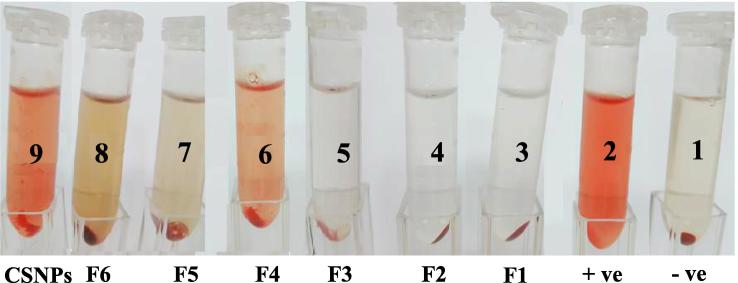
“For the liposomal formulations F1, F2, and F3, no hemolysis was observed, indicating good hemocompatabilty.”
- Also stated in: § Conclusion · plain
“the negatively charged liposomes did not produce any hemolysis and were safe toward erythrocytes.”
§ The use of chitosan-coated flexible liposomes as a remarkable carrier to enhance the antitumor efficacy of 5-fluorouracil against colorectal cancer > Results and discussion > Hemocompatability
plain- Asserted: passes — The authors put it forward as true.
- Checkable: passes — It can be checked against evidence.
- Load-bearing: passes — The paper’s conclusions depend on it.
- Based: passes — The paper gives a reason why it holds.
It may state two separate claims as one.
- Also stated in: § Conclusion · plain
None of the sources cited for this claim have been checked yet.
In the paper
“Over 4 h, drug release from CSNPs was 57.5%, and cumulative release reached 73.9% and 87.4% after 12 and 24 h, respectively.”
§ The use of chitosan-coated flexible liposomes as a remarkable carrier to enhance the antitumor efficacy of 5-fluorouracil against colorectal cancer > Results and discussion > In vitro 5-FU release studies
plain- Asserted: passes — The authors put it forward as true.
- Checkable: passes — It can be checked against evidence.
- Load-bearing: passes — The paper’s conclusions depend on it.
- Based: passes — The paper gives a reason why it holds.
It may state two separate claims as one.
A result the paper reports from its own data — it cites no other source for it, so there is none to check. The quote shows it is in the paper.
In the paper
“The liposome formulations F1, F2, and F3 had EE% of 37, 46, and 42% and DL% of 2.5, 4.8 and 3.1%, respectively.”
§ The use of chitosan-coated flexible liposomes as a remarkable carrier to enhance the antitumor efficacy of 5-fluorouracil against colorectal cancer > Results and discussion > Encapsulation efficiency (EE%) and drug loading (DL%)
plainn = 3- Asserted: passes — The authors put it forward as true.
- Checkable: passes — It can be checked against evidence.
- Load-bearing: passes — The paper’s conclusions depend on it.
- Based: passes — The paper gives a reason why it holds.
It may state two separate claims as one.
A result the paper reports from its own data — it cites no other source for it, so there is none to check. The quote shows it is in the paper.
In the paper
“F4, F5, and F6 had EE% of 45, 55, and 51%, and DL% values of 4.2, 6.1, and 5.6, respectively.”
§ The use of chitosan-coated flexible liposomes as a remarkable carrier to enhance the antitumor efficacy of 5-fluorouracil against colorectal cancer > Results and discussion > Encapsulation efficiency (EE%) and drug loading (DL%)
plainn = 3- Asserted: passes — The authors put it forward as true.
- Checkable: passes — It can be checked against evidence.
- Load-bearing: passes — The paper’s conclusions depend on it.
- Based: passes — The paper gives a reason why it holds.
It may state two separate claims as one.
A result the paper reports from its own data — it cites no other source for it, so there is none to check. The quote shows it is in the paper.
In the paper
“The 5-FU-loaded liposome formulations F1, F2, and F3 respectively released 43.6%, 49.8%, and 54.1% of the loaded 5-FU within the first 2 h.”
§ The use of chitosan-coated flexible liposomes as a remarkable carrier to enhance the antitumor efficacy of 5-fluorouracil against colorectal cancer > Results and discussion > In vitro 5-FU release studies
plain- Asserted: passes — The authors put it forward as true.
- Checkable: passes — It can be checked against evidence.
- Load-bearing: unclear — It is unclear whether the paper’s conclusions depend on it.
- Based: passes — The paper gives a reason why it holds.
It may state two separate claims as one.
A result the paper reports from its own data — it cites no other source for it, so there is none to check. The quote shows it is in the paper.
In the paper
“the aqueous solution of 5-FU showed fast release as approximately 70% of 5-FU was released within the first hour and almost 100% was released in the 2 h (Fig. 5).”
§ The use of chitosan-coated flexible liposomes as a remarkable carrier to enhance the antitumor efficacy of 5-fluorouracil against colorectal cancer > Results and discussion > In vitro 5-FU release studies
plainn = 3- Asserted: passes — The authors put it forward as true.
- Checkable: passes — It can be checked against evidence.
- Load-bearing: passes — The paper’s conclusions depend on it.
- Based: passes — The paper gives a reason why it holds.
It may state two separate claims as one.
A result the paper reports from its own data — it cites no other source for it, so there is none to check. The quote shows it is in the paper.
In the paper
“EE% and DL of CSNPs were 61% and 7.3, respectively.”
§ The use of chitosan-coated flexible liposomes as a remarkable carrier to enhance the antitumor efficacy of 5-fluorouracil against colorectal cancer > Results and discussion > Encapsulation efficiency (EE%) and drug loading (DL%)
plainn = 3- Asserted: passes — The authors put it forward as true.
- Checkable: passes — It can be checked against evidence.
- Load-bearing: passes — The paper’s conclusions depend on it.
- Based: passes — The paper gives a reason why it holds.
It may state two separate claims as one.
In the paper
“The amount of 5-FU in the investigated samples was quantified using an HPLC method (Alanazi et al., 2009)”
§ The use of chitosan-coated flexible liposomes as a remarkable carrier to enhance the antitumor efficacy of 5-fluorouracil against colorectal cancer > Materials and methods > HPLC analysis
What the sources say
- Not checked — no full text of the sourcecites Alanazi et al., 2009 source
plain- Asserted: passes — The authors put it forward as true.
- Checkable: passes — It can be checked against evidence.
- Load-bearing: fails — The paper’s conclusions may not depend on it.
- Based: passes — The paper gives a reason why it holds.
Probably not a substantial claim. The paper’s conclusions may not depend on it.
A conclusion the paper draws from its own results — it cites no other source for it, so there is none to check. The quote shows it is in the paper.
In the paper
“Chitosomes were therefore successfully developed as nanocarriers of 5-FU, with potential cytotoxicity for colorectal cancer cells.”
- Also stated in: § Conclusion · plain
“Novel chitosomes containing 5-FU have been successfully molded as nano-cargoes for use in the treatment of colon cancer.”
§ The use of chitosan-coated flexible liposomes as a remarkable carrier to enhance the antitumor efficacy of 5-fluorouracil against colorectal cancer > Abstract
plaindirect- Asserted: passes — The authors put it forward as true.
- Checkable: passes — It can be checked against evidence.
- Load-bearing: passes — The paper’s conclusions depend on it.
- Based: passes — The paper gives a reason why it holds.
It may state two separate claims as one.
- Also stated in: § Conclusion · plain
What the paper did — it cites no source for this, so there is none to check. The quote shows it is in the paper.
In the paper
“All samples were run in triplicate.”
- Also stated in: § Physicochemical characterization of FU-loaded liposomes and chitosomes · plain
“All experiments were performed in triplicate.”
§ The use of chitosan-coated flexible liposomes as a remarkable carrier to enhance the antitumor efficacy of 5-fluorouracil against colorectal cancer > Materials and methods > Physicochemical characterization of FU-loaded liposomes and chitosomes
plain- Asserted: passes — The authors put it forward as true.
- Checkable: passes — It can be checked against evidence.
- Load-bearing: fails — The paper’s conclusions may not depend on it.
- Based: passes — The paper gives a reason why it holds.
Probably not a substantial claim. The paper’s conclusions may not depend on it.
- Also stated in: § Physicochemical characterization of FU-loaded liposomes and chitosomes · plain
In the paper
“As it is associated with a short half-life in the body (<30 min), high dose 5-FU over a long period is recommended to achieve the desired effect (Karmi et al., 2011).”
§ The use of chitosan-coated flexible liposomes as a remarkable carrier to enhance the antitumor efficacy of 5-fluorouracil against colorectal cancer > Introduction
What the sources say
- Not checked — no full text of the sourcecites Karmi et al., 2011 source
plaincorrelational- Asserted: passes — The authors put it forward as true.
- Checkable: passes — It can be checked against evidence.
- Load-bearing: passes — The paper’s conclusions depend on it.
- Based: passes — The paper gives a reason why it holds.
It may state two separate claims as one.
In the paper
“Chitosan (CS) is a common polymer that possesses cationic, bioadhesive, biocompatible, biodegradable, and absorption-enhancing properties (Cho et al., 2016).”
§ The use of chitosan-coated flexible liposomes as a remarkable carrier to enhance the antitumor efficacy of 5-fluorouracil against colorectal cancer > Introduction
What the sources say
- Not checked — no full text of the sourcecites Cho et al., 2016 source
plain- Asserted: passes — The authors put it forward as true.
- Checkable: passes — It can be checked against evidence.
- Load-bearing: passes — The paper’s conclusions depend on it.
- Based: passes — The paper gives a reason why it holds.
It may state two separate claims as one.
A claim is checked only against the cited paper’s full text, never its abstract, and none is available for its sources.
In the paper
“CS-coated liposomes have therefore gained mucoadhesive characteristics, which facilitate drug absorption with prolonged residence time (Chen et al., 2016, Zhou et al., 2018).”
§ The use of chitosan-coated flexible liposomes as a remarkable carrier to enhance the antitumor efficacy of 5-fluorouracil against colorectal cancer > Introduction
What the sources say
plaindirect- Asserted: passes — The authors put it forward as true.
- Checkable: passes — It can be checked against evidence.
- Load-bearing: passes — The paper’s conclusions depend on it.
- Based: passes — The paper gives a reason why it holds.
It may state two separate claims as one.
In the paper
“Nano-size carriers that target cancer tissues could passively or actively increase selectivity and reduce the side effects of anticancer agents (Kim et al., 2018).”
§ The use of chitosan-coated flexible liposomes as a remarkable carrier to enhance the antitumor efficacy of 5-fluorouracil against colorectal cancer > Introduction
What the sources say
- Not checked — no full text of the sourcecites Kim et al., 2018 source
hedgedconditional- Asserted: passes — The authors put it forward as true.
- Checkable: passes — It can be checked against evidence.
- Load-bearing: passes — The paper’s conclusions depend on it.
- Based: passes — The paper gives a reason why it holds.
Probably not a substantial claim.
A conclusion the paper draws from its own results — it cites no other source for it, so there is none to check. The quote shows it is in the paper.
In the paper
“By using chitosomes, cell viability was reduced in a sustained manner due to the CS layer, which enhanced the cytotoxic effect of 5-FU against HT-29.”
§ The use of chitosan-coated flexible liposomes as a remarkable carrier to enhance the antitumor efficacy of 5-fluorouracil against colorectal cancer > Results and discussion > In vitro cytotoxicity studies
plaindirectn = 6- Asserted: passes — The authors put it forward as true.
- Checkable: passes — It can be checked against evidence.
- Load-bearing: passes — The paper’s conclusions depend on it.
- Based: passes — The paper gives a reason why it holds.
It may state two separate claims as one.
In the paper
“determined by the indirect method (Badran et al., 2016).”
§ The use of chitosan-coated flexible liposomes as a remarkable carrier to enhance the antitumor efficacy of 5-fluorouracil against colorectal cancer > Materials and methods > Physicochemical characterization of FU-loaded liposomes and chitosomes
What the sources say
- Not checked — no full text of the sourcecites Badran et al., 2016 source
plain- Asserted: passes — The authors put it forward as true.
- Checkable: passes — It can be checked against evidence.
- Load-bearing: fails — The paper’s conclusions may not depend on it.
- Based: passes — The paper gives a reason why it holds.
Probably not a substantial claim. The paper’s conclusions may not depend on it.
None of the sources cited for this claim have been checked yet.
In the paper
“the protocol by Huang et al. (2016) was adopted with minor modifications.”
§ The use of chitosan-coated flexible liposomes as a remarkable carrier to enhance the antitumor efficacy of 5-fluorouracil against colorectal cancer > Materials and methods > Hemocompatability studies
What the sources say
- Not checked yetcites Huang et al., 2016 source
Checked before — its earlier verdict is held back until a new check runs.
plain- Asserted: passes — The authors put it forward as true.
- Checkable: passes — It can be checked against evidence.
- Load-bearing: fails — The paper’s conclusions may not depend on it.
- Based: passes — The paper gives a reason why it holds.
Probably not a substantial claim. The paper’s conclusions may not depend on it.
- Not checked yet
A conclusion the paper draws from its own results — it cites no other source for it, so there is none to check. The quote shows it is in the paper.
In the paper
“Both 5-FU loaded liposomes and chitosomes showed desirable physicochemical properties.”
§ The use of chitosan-coated flexible liposomes as a remarkable carrier to enhance the antitumor efficacy of 5-fluorouracil against colorectal cancer > Conclusion
plain- Asserted: passes — The authors put it forward as true.
- Checkable: passes — It can be checked against evidence.
- Load-bearing: passes — The paper’s conclusions depend on it.
- Based: passes — The paper gives a reason why it holds.
It may state two separate claims as one.
In the paper
“Coating liposomal surface with polymers is an approach used to stabilize liposomes in normal body milieus, retard drug release, and deliver the loaded drug to the intended target site (Mady et al., 2009).”
§ The use of chitosan-coated flexible liposomes as a remarkable carrier to enhance the antitumor efficacy of 5-fluorouracil against colorectal cancer > Introduction
What the sources say
- Not checked — no full text of the sourcecites Mady et al., 2009 source
plaindirect- Asserted: passes — The authors put it forward as true.
- Checkable: passes — It can be checked against evidence.
- Load-bearing: passes — The paper’s conclusions depend on it.
- Based: passes — The paper gives a reason why it holds.
It may state two separate claims as one.
A claim is checked only against the cited paper’s full text, never its abstract, and none is available for its sources.
In the paper
“Living cells usually carry a negative charge; therefore, nano-particles with positively charged surfaces are expected to interact with these cells by electrostatic interaction, facilitating the cellular uptake of the drug (Sunderland et al., 2006, Laye et al., 2008).”
§ The use of chitosan-coated flexible liposomes as a remarkable carrier to enhance the antitumor efficacy of 5-fluorouracil against colorectal cancer > Introduction
What the sources say
plainconditional- Asserted: passes — The authors put it forward as true.
- Checkable: passes — It can be checked against evidence.
- Load-bearing: passes — The paper’s conclusions depend on it.
- Based: passes — The paper gives a reason why it holds.
It may state two separate claims as one.
A conclusion the paper draws from its own results — it cites no other source for it, so there is none to check. The quote shows it is in the paper.
In the paper
“The image of F6 depicts the presence of hollow particles, proving that CS generated a film layer around liposomal particles.”
§ The use of chitosan-coated flexible liposomes as a remarkable carrier to enhance the antitumor efficacy of 5-fluorouracil against colorectal cancer > Results and discussion > Morphological characterization
boosteddirect- Asserted: passes — The authors put it forward as true.
- Checkable: passes — It can be checked against evidence.
- Load-bearing: passes — The paper’s conclusions depend on it.
- Based: passes — The paper gives a reason why it holds.
It may state two separate claims as one.
None of the sources cited for this claim have been checked yet.
In the paper
“evaluated using the dialysis method (Song et al., 2015).”
§ The use of chitosan-coated flexible liposomes as a remarkable carrier to enhance the antitumor efficacy of 5-fluorouracil against colorectal cancer > Materials and methods > In vitro 5-FU release studies
What the sources say
- Not checked yetcites Song et al., 2015 source
Checked before — its earlier verdict is held back until a new check runs.
plain- Asserted: passes — The authors put it forward as true.
- Checkable: passes — It can be checked against evidence.
- Load-bearing: fails — The paper’s conclusions may not depend on it.
- Based: passes — The paper gives a reason why it holds.
Probably not a substantial claim. The paper’s conclusions may not depend on it.
- Not checked yet
None of the sources cited for this claim have been checked yet.
In the paper
“Liposomes are considered one of the most promising carriers for anticancer drugs (Han et al., 2016), and their vesicular structure allows them to accommodate both hydrophilic and lipophilic drugs.”
§ The use of chitosan-coated flexible liposomes as a remarkable carrier to enhance the antitumor efficacy of 5-fluorouracil against colorectal cancer > Introduction
What the sources say
- Not checked yetcites Han et al., 2016 source
Checked before — its earlier verdict is held back until a new check runs.
plaindirect- Asserted: passes — The authors put it forward as true.
- Checkable: passes — It can be checked against evidence.
- Load-bearing: passes — The paper’s conclusions depend on it.
- Based: passes — The paper gives a reason why it holds.
Probably not a substantial claim. It may state two separate claims as one.
- Not checked yet
In the paper
“Coated liposomes possess high cell affinity, which increases the cellular uptake of the drug due to the positive surface charge (CS), leading to enhanced absorption on the negatively charged cell membrane in cells (Yang et al., 2015).”
§ The use of chitosan-coated flexible liposomes as a remarkable carrier to enhance the antitumor efficacy of 5-fluorouracil against colorectal cancer > Results and discussion > In vitro cytotoxicity studies
What the sources say
- Not checked — no full text of the sourcecites Yang et al., 2015 source
plaindirect- Asserted: passes — The authors put it forward as true.
- Checkable: passes — It can be checked against evidence.
- Load-bearing: passes — The paper’s conclusions depend on it.
- Based: passes — The paper gives a reason why it holds.
It may state two separate claims as one.
A conclusion the paper draws from its own results — it cites no other source for it, so there is none to check. The quote shows it is in the paper.
In the paper
“the results of the hemocompatability test revealed that erythrocyte hemolysis was influenced by the surface charge of the formulations. Neutral and negatively charged particles caused no effect and were safe toward erythrocytes, while positively charged particles induced hemolysis.”
§ The use of chitosan-coated flexible liposomes as a remarkable carrier to enhance the antitumor efficacy of 5-fluorouracil against colorectal cancer > Results and discussion > Hemocompatability
plaindirect- Asserted: passes — The authors put it forward as true.
- Checkable: passes — It can be checked against evidence.
- Load-bearing: passes — The paper’s conclusions depend on it.
- Based: passes — The paper gives a reason why it holds.
It may state two separate claims as one.
A conclusion the paper draws from its own results — it cites no other source for it, so there is none to check. The quote shows it is in the paper.
In the paper
“The chitosomes exhibited valuable EE% and DL% with good physical stability, and sustained 5-FU release.”
§ The use of chitosan-coated flexible liposomes as a remarkable carrier to enhance the antitumor efficacy of 5-fluorouracil against colorectal cancer > Conclusion
plain- Asserted: passes — The authors put it forward as true.
- Checkable: passes — It can be checked against evidence.
- Load-bearing: passes — The paper’s conclusions depend on it.
- Based: passes — The paper gives a reason why it holds.
It may state two separate claims as one.
In the paper
“Therefore, high dose chemotherapy is necessary to overcome such limitations, which usually increases the risk of adverse effects (Nie et al., 2007).”
§ The use of chitosan-coated flexible liposomes as a remarkable carrier to enhance the antitumor efficacy of 5-fluorouracil against colorectal cancer > Introduction
What the sources say
- Not checked — no full text of the sourcecites Nie et al., 2007 source
plaindirect- Asserted: passes — The authors put it forward as true.
- Checkable: passes — It can be checked against evidence.
- Load-bearing: passes — The paper’s conclusions depend on it.
- Based: passes — The paper gives a reason why it holds.
It may state two separate claims as one.
In the paper
“5-FU is effective against numerous tumors, including colorectal, breast, liver and pancreatic cancer (Tseng et al., 2015).”
§ The use of chitosan-coated flexible liposomes as a remarkable carrier to enhance the antitumor efficacy of 5-fluorouracil against colorectal cancer > Introduction
What the sources say
- Not checked — no full text of the sourcecites Tseng et al., 2015 source
plaindirect- Asserted: passes — The authors put it forward as true.
- Checkable: passes — It can be checked against evidence.
- Load-bearing: fails — The paper’s conclusions may not depend on it.
- Based: passes — The paper gives a reason why it holds.
Probably not a substantial claim. The paper’s conclusions may not depend on it.
The paper relies on this without support.
Adequate data regarding CS-coated liposomes as a delivery system for 5-FU have not yet been presented in the literature.
“However, adequate data regarding CS-coated liposomes as a delivery system for 5-FU have not yet been presented in the literature.”
The authors state this as an assumption.
The amount of drug detected in the donor compartment during the first 2 h was mainly due to un-entrapped drug.
“The amount of drug detected in the donor compartment during the first 2 h was mainly due to un-entrapped drug. This assumption correlates with the EE% data”
The paper relies on this without support.
5-FU is a hydrophilic molecule and is expected to accumulate in the hydrophilic core of liposomes.
“As 5-FU is a hydrophilic molecule, it is expected to accumulate in the hydrophilic core of liposomes.”
The paper relies on this without support.
5-FU is a small and hydrophilic molecule; therefore, it can easily leach from the lipid membrane.
“5-FU is a small and hydrophilic molecule; therefore, it can easily leach from the lipid membrane.”
Self-check
Percentages, sums and reported differences re-computed from the paper’s own numbers.
Each contradiction between two passages listed here was confirmed by an independent check.
Rated minor: it would not touch a result — a value no result rests on, a p-value that stays on the same side of the significance level, or a conflict that is clerical, resolved elsewhere in the paper, or outside its own findings.
In the paper
§ The use of chitosan-coated flexible liposomes as a remarkable carrier to enhance the antitumor efficacy of 5-fluorouracil against colorectal cancer > Results and discussion > Particle size distribution and zeta potential measurements
“a large particle size of the CS-coated liposomes was found when compared to that of the corresponding uncoated liposomes (Table 2).”
§ The use of chitosan-coated flexible liposomes as a remarkable carrier to enhance the antitumor efficacy of 5-fluorouracil against colorectal cancer > Results and discussion > Particle size distribution and zeta potential measurements
“| F1 | 234 ± 9 | 0.26 ± 0.03 | −2.3 ± 0.6 | | F2 | 146 ± 19 | 0.23 ± 0.06 | −7.5 ± 1.4 | | F3 | 108 ± 11 | 0.31 ± 0.05 | −16.3 ± 1.5 | | F4 | 212 ± 21 | 0.42 ± 0.06 | 6.1 ± 0.5 |”
Rated minor: it would not touch a result — a value no result rests on, a p-value that stays on the same side of the significance level, or a conflict that is clerical, resolved elsewhere in the paper, or outside its own findings.
In the paper
§ The use of chitosan-coated flexible liposomes as a remarkable carrier to enhance the antitumor efficacy of 5-fluorouracil against colorectal cancer > Results and discussion > Particle size distribution and zeta potential measurements
“Particle size of the CS-coated liposomes F4, F5, and F6 were 212, 226 and 271 nm”
§ The use of chitosan-coated flexible liposomes as a remarkable carrier to enhance the antitumor efficacy of 5-fluorouracil against colorectal cancer > Results and discussion > Particle size distribution and zeta potential measurements
“| F5 | 236 ± 16 | 0.33 ± 0.019 | 8.3 ± 1.1 |”
Rated minor: it would not touch a result — a value no result rests on, a p-value that stays on the same side of the significance level, or a conflict that is clerical, resolved elsewhere in the paper, or outside its own findings.
In the paper
§ The use of chitosan-coated flexible liposomes as a remarkable carrier to enhance the antitumor efficacy of 5-fluorouracil against colorectal cancer > Materials and methods > Hemocompatability studies
“Phosphate buffered saline solution was used as the negative control (0% hemolysis of erythrocytes) and 10% Triton-X-100 used as the positive control (100% hemolysis of erythrocytes).”
§ The use of chitosan-coated flexible liposomes as a remarkable carrier to enhance the antitumor efficacy of 5-fluorouracil against colorectal cancer > Results and discussion > Hemocompatability
“with isotonic solution and deionized water serving as the negative and positive controls, respectively.”
Rated minor: it would not touch a result — a value no result rests on, a p-value that stays on the same side of the significance level, or a conflict that is clerical, resolved elsewhere in the paper, or outside its own findings.
In the paper
§ The use of chitosan-coated flexible liposomes as a remarkable carrier to enhance the antitumor efficacy of 5-fluorouracil against colorectal cancer > Materials and methods > In vitro cytotoxicity studies
“Cell viability%=(Untreated cells - Treated cell)/(Untreated cells)×100”
§ The use of chitosan-coated flexible liposomes as a remarkable carrier to enhance the antitumor efficacy of 5-fluorouracil against colorectal cancer > Materials and methods > In vitro cytotoxicity studies
“The viability of untreated controls was normalized to 100%.”
Rated minor: it would not touch a result — a value no result rests on, a p-value that stays on the same side of the significance level, or a conflict that is clerical, resolved elsewhere in the paper, or outside its own findings.
In the paper
§ The use of chitosan-coated flexible liposomes as a remarkable carrier to enhance the antitumor efficacy of 5-fluorouracil against colorectal cancer > Results and discussion > Hemocompatability
“Figure: Fig. 6 Hemolysis test results obtained using the naked eye (6, negative control; 2, positive control; 3–9, test samples).”
§ The use of chitosan-coated flexible liposomes as a remarkable carrier to enhance the antitumor efficacy of 5-fluorouracil against colorectal cancer > Results and discussion > In vitro 5-FU release studies
“| 1 | PBS | 200 | 1500 | 15 | | 2 | Triton | 200 | 1500 | 15 | | 3 | F1 | 200 | 1500 | 15 | | 4 | F2 | 200 | 1500 | 15 | | 5 | F3 | 200 | 1500 | 15 | | 6 | F4 | 200 | 1500 | 15 |”
Citations
Cites
Colorectal Cancer Incidence Patterns in the United States, 1974–2013
Siegel, R. L., Fedewa, S. A., Anderson, W. F., Miller, K. D., Ma, J., Rosenberg, P. S., & Jemal, A. (2017) · JNCI: Journal of the National Cancer Institute · doi:10.1093/jnci/djw322 · Cited by 1,002
Nanotechnology applications in cancer
Nie, S., Xing, Y., Kim, G. J., & Simons, J. W. (2007) · Annual Review of Biomedical Engineering · doi:10.1146/annurev.bioeng.9.060906.152025 · Cited by 952
El Zaafarany, G. M., Awad, G. A. S., Holayel, S. M., & Mortada, N. D. (2010) · International Journal of Pharmaceutics · doi:10.1016/j.ijpharm.2010.06.034 · Cited by 485
Song, C. K., Balakrishnan, P., Shim, C., Chung, S.-J., Chong, S., & Kim, D. (2011) · Colloids and Surfaces B Biointerfaces · doi:10.1016/j.colsurfb.2011.12.004 · Cited by 384
Song, J., Yang, X., Jacobson, O., Lin, L., Huang, P., Niu, G., Ma, Q., & Chen, X. (2015) · ACS Nano · doi:10.1021/acsnano.5b03804 · Cited by 319
Chitosan-Modified PLGA Nanoparticles with Versatile Surface for Improved Drug Delivery
Wang, Y., Li, P., & Kong, L. (2013) · AAPS PharmSciTech · doi:10.1208/s12249-013-9943-3 · Cited by 305
Singh (2010) · International Journal of Nanomedicine · doi:10.2147/ijn.s8030 · Cited by 262
Targeted nanoparticles for detecting and treating cancer
Sunderland, C. J., Steiert, M., Talmadge, J. E., Derfus, A. M., & Barry, S. E. (2006) · Drug Development Research · doi:10.1002/ddr.20069 · Cited by 200
An evaluation of blood compatibility of silver nanoparticles
Huang, H., Lai, W., Cui, M., Liang, L., Lin, Y., Fang, Q., Liu, Y., & Xie, L. (2016) · Scientific Reports · doi:10.1038/srep25518 · Cited by 186
Zhou, F., Xu, T., Zhao, Y., Song, H., Zhang, L., Wu, X., & Lu, B. (2018) · Food Hydrocolloids · doi:10.1016/j.foodhyd.2018.04.040 · Cited by 173
Research works printed but not linked: 1
- Paolino, D., Fresta, M., Sinha, P., Ferrari, M. 2006. In: Webester, J.G. (Ed.). Encyclopedia of Medical Devices and Instrumentation, second ed., vol. 437. John Wiley and Sons, New York.
Cited by
Sorted by citations
Items 101–143 of 143
Eleraky, N. E., Hassan, A. S., Soliman, G. M., Al-Gayyar, M. M. H., & Safwat, M. A. (2024) · AAPS PharmSciTech · doi:10.1208/s12249-024-02957-w · Cited by 4
Mehrabi-Khozani, Z., Jafari, S. M., Sarabandi, K., Rezaei, A., & Maghsoudlou, Y. (2024) · Carbohydrate Polymer Technologies and Applications · doi:10.1016/j.carpta.2024.100617 · Cited by 4
Zhang, X., Sathiyaseelan, A., Jin, T., & Wang, M. (2025) · Colloids and Surfaces B Biointerfaces · doi:10.1016/j.colsurfb.2025.114737 · Cited by 4
Zhao, N., Chen, H., Cai, S., Li, Q., Wang, J., Wang, W., & Lv, C. (2025) · Industrial Crops and Products · doi:10.1016/j.indcrop.2025.121608 · Cited by 4
Rangsimawong, W., Duangjit, S., Samseethong, T., Tansathien, K., Ngawhirunpat, T., & Opanasopit, P. (2023) · Journal of Drug Delivery Science and Technology · doi:10.1016/j.jddst.2023.105194 · Cited by 4
Khalil, L. M., El-Refaie, W. M., Elnaggar, Y. S. R., Allam, M., & Abdallah, O. Y. (2025) · International Journal of Pharmaceutics · doi:10.1016/j.ijpharm.2025.126020 · Cited by 3
Zagana, P., & Paxinou, A. (2026) · Future Pharmacology · doi:10.3390/futurepharmacol6010006 · Cited by 3
Alomrani, A. H., Badran, M. M., Duhaim, T. B., Alobid, S. E., & Qamar, W. (2026) · ACS Omega · doi:10.1021/acsomega.5c10664 · Cited by 3
Self-citationMohamadzadeh, F., Pourmadadi, M., & Shabestari, S. M. (2026) · Journal of Polymers and the Environment · doi:10.1007/s10924-026-03825-3 · Cited by 3
Harisa, G. I., Alanazi, S. A., Badran, M. M., Sherif, A. Y., Alqahtani, S., & Alanazi, F. K. (2023) · European Journal of Lipid Science and Technology · doi:10.1002/ejlt.202300039 · Cited by 3
Self-citationİPEKÇİ, E., Çağlar, E. Ş., Kaynak, M. S., Gündoğdu, E., & Okur, N. Ü. (2025) · Current Pharmaceutical Design · doi:10.2174/0113816128401910250706133608 · Cited by 3
Liew, K. B., Yahya, F. S., Azli, N. D. W., Segaran, A. S., Wong, Y. Y., & Kee, P. E. (2024) · Drug Delivery Letters · doi:10.2174/0122103031328871241023075235 · Cited by 2
Mostafa, H. G., Sheta, N. M., Farag, M. M., El-Dahmy, R. M., & Abdel-Halim, S. A. (2026) · Pharmaceutical Development and Technology · doi:10.1080/10837450.2026.2693861 · Cited by 2
Teng, H., Yan, M., Chen, C., Ai, C., Huo, H., & Chen, L. (2026) · Food Chemistry X · doi:10.1016/j.fochx.2026.104259 · Cited by 2
Suhaib Ahmed, S. Y. E. D., Murthannagari, V. R., Venkatachalam, S., Rajendra, P. K. M., Janani, S. K., & Natarajan, J. (2023) · Journal of Research in Pharmacy · doi:10.29228/jrp.402 · Cited by 2
Mobarak, S. A., Al‐Madi, E. M., Almohaimede, A. A., Badran, M. M., & Lambarte, R. N. A. (2025) · International Journal of Molecular Sciences · doi:10.3390/ijms26041412 · Cited by 2
Self-citationRangsimawong, W., Duangjit, S., Charoenputtakun, P., Tansathien, K., Ngawhirunpat, T., & Opanasopit, P. (2025) · Pharmacia · doi:10.3897/pharmacia.72.e165253 · Cited by 1
Nanoscale drug delivery systems for gastrointestinal therapeutics
Mohapatra, D., Shreya, S., Senapati, P. C., Biswal, S., Naik, G. G., Kathait, P., Malang, S. D., Patel, P. K., ., S., Ankur, A., et al. (2025) · Elsevier eBooks · doi:10.1016/b978-0-443-34039-0.00005-6 · Cited by 1
Baher, N. K., Heikal, L., El-Salamouni, N. S., Gaafar, P. M. E., Bakr, B. A., Badae, N. M., & ElGamal, S. S. (2025) · Journal of Drug Delivery Science and Technology · doi:10.1016/j.jddst.2025.107925 · Cited by 1
Importance of Nanocarriers in Colon Cancer
Srivastava, N., Mishra, Y., & Mishra, V. K. (2023) · BENTHAM SCIENCE PUBLISHERS eBooks · doi:10.2174/9789815080506123010011 · Cited by 1
An outlook into liposomal drug delivery of chemotherapeutic agents to combat colorectal cancer
Paul, D., Satheeshkumar, N., Prajapati, B. G., & Kunnambath, K. (2024) · Elsevier eBooks · doi:10.1016/b978-0-443-13870-6.00002-7 · Cited by 1
Polysaccharide-Based Nano-delivery Systems for the Treatment of Colorectal Cancer
Corrie, L., Gulati, M., Kapoor, B., Adams, J., Dua, K., Singh, S. K., & Dureja, H. (2024) · Springer eBooks · doi:10.1007/978-981-99-6263-1_73 · Cited by 1
GEETHA, V. S., & Velraj, M. (2021) · International Journal of Applied Pharmaceutics · doi:10.22159/ijap.2021v13i1.39932 · Cited by 1
Solid tumor: Addressing the problems associated
Jain, S., Raza, K., Agrawal, A. K., & Vaidya, A. (2020) · Elsevier eBooks · doi:10.1016/b978-0-12-817846-1.00020-5
Encapsulation for general cancer treatment
Zolali, E., Rashedi, S., Abdolahinia, E. D., Rashedi, N., Allahyari, S., & Hashemzadeh, N. (2023) · Elsevier eBooks · doi:10.1016/b978-0-12-824345-9.00019-2
Polysaccharide-Based Nano-Delivery Systems for the Treatment of Colorectal Cancer
Corrie, L., Gulati, M., Kapoor, B., Adams, J., Dua, K., Singh, S. K., & Dureja, H. (2023) · Springer eBooks · doi:10.1007/978-981-99-2196-6_73-1
Nanomedicines in the Treatment of Gastrointestinal Disorders
Ayaz, M., Usman, A., Khalil, A. T., Sadiq, A., Ullah, F., Mosa, O. F., & Khan, M. A. (2023) · Learning materials in biosciences · doi:10.1007/978-981-99-7626-3_10
Influence of Formulation Composition on Characteristic Properties of 5-Fluorouracil-Loaded Liposomes
Yalcın, T. E., & Yetgin, C. (2024) · Turkish Journal of Pharmaceutical Sciences · doi:10.4274/tjps.galenos.2024.18124
Imam, S. S., Alshammari, S. O., Alshehri, S., Mahdi, W. A., & Al-Agamy, M. H. (2024) · Saudi Pharmaceutical Journal · doi:10.1016/j.jsps.2024.102072
comprehensive overview of drug delivery systems for tumor treatment
Alhabib, N. A., Alehaidib, S. M., Almansour, M. A., Aldosary, M. S., Almegbel, M. T., & Alzahrani, A. M. (2021) · International Journal of Health Sciences · doi:10.53730/ijhs.v5ns1.15039
Tagoe, B., Muolokwu, C. E., Quainoo, L., & Amponsah, S. K. (2025) · Elsevier eBooks · doi:10.1016/b978-0-443-24806-1.00010-8
Singh, S., Mehendiratta, H., Sharma, N., & Kishore, L. (2025) · Current Pharmaceutical Design · doi:10.2174/0113816128362419250523061958
Metwaly, A. M., Abd-El-Azim, H., Zewail, M., Alsfouk, A. A., Elkaeed, E. B., Elkady, H., & Eissa, I. H. (2025) · Natural Product Communications · doi:10.1177/1934578x251384515
Avanços recentes das abordagens nanotecnológicas para diagnóstico e tratamento do cancro colorretal
Serrano, D. A. C. (2021) · Lusophone University Repository
Chitosan-Based Liposomes in Cancer Therapy
Sabarees, G., Vishvaja, S., Priyadharshini, D., Alagarsamy, V., & Solomon, V. R. (2025) · AAPS introductions in the pharmaceutical sciences · doi:10.1007/978-3-032-08347-0_13
Lipid nanocarrier-based drug delivery for the treatment of colon cancer
Chauhan, S. B. (2026) · Elsevier eBooks · doi:10.1016/b978-0-443-40443-6.00015-5
Elimam, H., El‐Say, K. M., Abostate, H. M., Ashraf, M., El‐Sawy, H. S., & Elshal, M. (2026) · BioNanoScience · doi:10.1007/s12668-026-02797-x
Yasmin, A., Casula, L., Pittiu, A., Massoni, C., Lai, F., Carpi, A., Monte, R. D., Barbolini, G., Brun, P., Schlich, M., et al. (2026) · Frontiers in Bioengineering and Biotechnology · doi:10.3389/fbioe.2026.1903742
Lipid-based systems for colorectal cancer: advances in early diagnosis and therapeutic efficacy
Coelho, M., Soares, P. I. P., Borges, J. P., Rodrigues, C. M. P., & Gaspar, M. M. (2026) · International Journal of Pharmaceutics · doi:10.1016/j.ijpharm.2026.127391
Rangsimawong, W., Sritananuwat, P., Duangjit, S., Chankana, N., & Opanasopit, P. (2026) · Pharmaceutics · doi:10.3390/pharmaceutics18101246
Supachettapun, C., Jayeoye, T. J., Wongsam, P., Okajima, M. K., Kaneko, T., Khanchaitit, P., Sansanaphongpricha, K., Matsumura, K., & Muangsin, N. (2026) · Journal of Materials Chemistry B · doi:10.1039/d6tb00970k
Albash, R., Al-Sawahli, M. M., Fares, A. R., Elshafeey, A., Agiba, A. M., & El-Dahmy, R. M. (2026) · RSC Pharmaceutics · doi:10.1039/d6pm00281a
Metadata
- Authors
- Alomrani, A., Badran, M., Harisa, G. I., ALshehry, M., Alhariri, M., Alshamsan, A., & Alkholief, M.
- Affiliations
- King Saud University (SA)
- Al-Azhar University (EG)
- King Saud bin Abdulaziz University for Health Sciences (SA)
- Corresponding author
- Alshamsan, Aws
- Venue
- Saudi Pharmaceutical Journal
- Published
- 2019-07
- Volume
- 27
- Issue
- 5
- Pages
- 603-611
- ISSN
- 1319-0164 (ISSN-L)
- PMC
- PMC6598218
- OpenAlex
- W2919083801
- Semantic Scholar
- 4f002be79bd496a826c4c8694a507173c84aef68
- Cited by
- 143
- References
- 39
- Citations by year
- 2026: 14 · 2025: 24 · 2024: 30 · 2023: 28 · 2022: 13 · 2021: 16 · 2020: 14 · 2019: 4
- FWCI
- 3.08
- Type
- journal article
- Language
- en
- Open access
- hybrid
- doi.org
- Licence
- Locations
- Saudi Pharmaceutical Journal (publishedVersion, cc-by-nc-nd)
- PubMed (publishedVersion)
- PubMed Central (publishedVersion, cc-by-nc-nd)
- DOAJ (DOAJ: Directory of Open Access Journals) (submittedVersion, cc-by-sa)
- Funders
- King Saud University
- Topics
- Physical Sciences › Materials Science › Biomaterials › Nanoparticle-Based Drug Delivery
- Life Sciences › Pharmacology, Toxicology and Pharmaceutics › Pharmaceutical Science › Advanced Drug Delivery Systems
- Life Sciences › Pharmacology, Toxicology and Pharmaceutics › Pharmaceutical Science › Drug Solubulity and Delivery Systems
- Keywords
- chitosan-coated liposomes, chitosomes, 5-fluorouracil, colorectal cancer, drug delivery nanocarriers, electrostatic deposition, film hydration, sustained drug release, HT-29 cells, cytotoxicity, anticancer drug delivery
About these checks
Registry, retraction, Cites and statistics results are computed, not judged, with one exception: a printed reference that no index lists is read once by a model before it counts as a citation error. Claims are extracted by a model and kept only when their quote appears verbatim in the text; each cited source is then checked, with a model’s help, for whether it says what the claim relies on. Those verdicts can be wrong — read the claim’s quote and the cited source before relying on one.
A language model drew the claims from the paper on 2026-11-10, under version 3 of the claim definition (model deepseek-v4.1-flash, prompt extract-v3).
A second model labelled each claim on 2026-11-10 (model jev-1.13-20260917, definition revision gold-guideline-v0.2).
Cited sources are checked with a language model’s help (gpt-6-sol).
Statistics and arithmetic are recomputed, not judged.
Confidence bands are shown only for fields calibrated on our annotated test set. None is calibrated yet, so no band is shown.
What counts as a claim ›How we measure confidence ›How we check this ›
Are you an author, or do you see a problem with this page? Request a review
