

The DOI matches its Crossref record.
Anticancer effects of clinically acceptable colchicine concentrations on human gastric cancer cell lines
Abstract
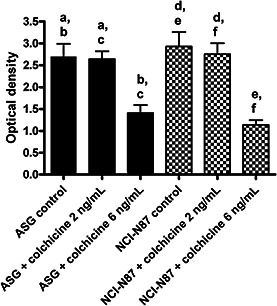
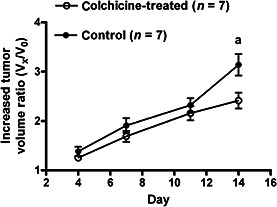
Colchicine is a very cheap microtubule destabilizer. Because microtubules are an ideal target for anticancer drugs, the purpose of this study was to investigate whether clinically acceptable colchicine concentrations have anticancer effects on gastric cancer cells, and its possible anticancer mechanisms. Two human gastric cancer cell lines (i.e., AGS and NCI‐N87) were investigated by proliferative assay, microarray, quantitative reverse transcriptase‐polymerase chain reaction, and a nude mice study using clinically acceptable colchicine concentrations (2 ng/mL and 6 ng/mL for in vitro tests and 0.07 mg colchicine/kg/d for in vivo tests). Our results showed that colchicine had the same inhibitory effects on the proliferation of both cell lines. The antiproliferative effects of colchicine on both cell lines were achieved only at the concentration of 6 ng/mL (p < 0.0001). In both cell lines, 18 genes were consistently upregulated and 10 genes were consistently downregulated by 6 ng/mL colchicine, compared with 2 ng/mL colchicine. Among these genes, only the upregulated DUSP1 gene may contribute to the antiproliferative effects of colchicine on gastric cancer cells. The nude mice (BALB/c‐nu) experiment showed that colchicine‐treated mice after 14 days of treatment had lower increased tumor volume ratios (p = 0.0199) and tumor growth rates (p = 0.024) than the control mice. In conclusion, colchicine has potential for the palliative treatment of gastric cancer. However, the anticancer effects are achieved only at high clinically acceptable colchicine concentrations. Monitoring the colchicine plasma concentration is mandatory if this drug is applied for the palliative treatment of gastric cancer.
Overview
The claims and statistics of this paper haven’t been checked yet.
Run the check — free, no account needed. It reads the open-access text and checks the sources it cites.
Integrity signals
Registry
Cites
Statistics
Figures
Verification
Claims the paper makes
The claims and statistics of this paper haven’t been checked yet.
Run the check — free, no account needed. It reads the open-access text and checks the sources it cites.
Claims other papers make about this one
Each is checked against this paper’s own text: does it say what the citing paper says it does?
In the citing paper
“Despite COL not yet being used clinically for cancer therapy because of its toxicity to normal cells, it is used as a lead compound in generating potent anticancer agents [5,6,7,8,9].”
From Targeted Nano-Drug Delivery of Colchicine against Colon Cancer Cells by Means of Mesoporous Silica Nanoparticles (2020) · cites this paper as [9]
Self-check
Percentages, sums and reported differences re-computed from the paper’s own numbers.
The self-check needs the paper’s full text.
Citations
Cites
No references could be resolved yet.
Research works printed but not linked: 40
- 10.1016/S1470-2045(13)70102-5 · DOI
- 10.1371/journal.pone.0060320 · DOI
- 10.5009/gnl.2013.7.4.385 · DOI
- 10.1542/peds.2006-1434 · DOI
- 10.1093/eurheartj/ehn608 · DOI
- 10.1016/j.ejim.2010.09.010 · DOI
- 10.3109/15563650.2010.495348 · DOI
- 10.1002/med.20097 · DOI · Paper page
- 10.1002/med.20242 · DOI
- 10.1007/s11095-012-0828-z · DOI · Paper page
- Sivakumar G., 2013, Colchicine semisynthetics: chemotherapeutics for cancer?, Curr Med Chem, 20, 892
- 10.1158/0008-5472.CAN-10-2429 · DOI
- 10.1007/BF00194404 · DOI
- 10.1002/j.1552-4604.1996.tb04753.x · DOI
- 10.1002/art.27327 · DOI
- 10.1016/j.lfs.2013.07.002 · DOI
- 10.1016/j.kjms.2015.01.008 · DOI
- 10.1093/annonc/mdg350 · DOI
- 10.1016/j.biopha.2012.02.001 · DOI
- 10.1016/j.biopha.2012.04.001 · DOI
- 10.1186/1471-2407-12-192 · DOI
- 10.1148/radiol.2472070363 · DOI
- 10.1158/0008-5472.CAN-06-3822 · DOI
- 10.1124/pr.107.00106 · DOI
- 10.1158/0008-5472.CAN-07-6157 · DOI
- Cheng P., 2015, Production of DUSP1 protein using the baculovirus insect cell expression system and its in vitro effects on cancer cells, Int J Mol Med, 35, 1715, 10.3892/ijmm.2015.2179 · DOI
- 10.1016/S0002-9440(10)62254-7 · DOI
- 10.1038/onc.2013.566 · DOI
- 10.1186/1476-4598-10-122 · DOI
- 10.1016/j.cyto.2012.09.013 · DOI
- 10.1002/bjs.5536 · DOI
- 10.1371/journal.pone.0085318 · DOI
- 10.1091/mbc.E10-08-0703 · DOI
- 10.1245/s10434-012-2437-9 · DOI
- 10.4161/cc.22853 · DOI
- Muller P.A., 2013, NCF2/p67phox: A novel player in the anti‐apoptotic functions of p53, Cell Cycle, 12, 14, 10.4161/cc.23173 · DOI
- 10.3892/or.2015.3998 · DOI
- 10.1186/1471-2407-11-413 · DOI
- 10.1002/jcb.23214 · DOI
- 10.1038/onc.2012.305 · DOI
Cited by
Sorted by citations
Dhyani, P., Quispe, C., Sharma, E., Bahukhandi, A., Sati, P., Attri, D. C., Szopa, A., Sharifi-Rad, J., Docea, A. O., Mardare, I., et al. (2022) · Cancer Cell International · doi:10.1186/s12935-022-02624-9 · Cited by 483
AbouAitah, K., Hassan, H. A., Swiderska-Sroda, A., Gohar, L., Shaker, O. G., Wojnarowicz, J., Opalinska, A., Smalc-Koziorowska, J., Gierlotka, S., & Lojkowski, W. (2020) · Cancers · doi:10.3390/cancers12010144 · Cited by 105
Metadata
- Authors
- Lin, Z., Kuo, C., Wu, D., & Chuang, W.
- Venue
- The Kaohsiung Journal of Medical Sciences
- Publisher
- Wiley
- Published
- 2016-02
- Volume
- 32
- Issue
- 2
- Pages
- 68-73
- ISSN
- 1607-551X
- 2410-8650
- PMC
- PMC11916832
- Cited by
- 68
- References
- 0
- Language
- en
About these checks
Registry, retraction, Cites and statistics results are computed, not judged, with one exception: a printed reference that no index lists is read once by a model before it counts as a citation error. Claims are extracted by a model and kept only when their quote appears verbatim in the text; each cited source is then checked, with a model’s help, for whether it says what the claim relies on. Those verdicts can be wrong — read the claim’s quote and the cited source before relying on one.
Statistics and arithmetic are recomputed, not judged.
Confidence bands are shown only for fields calibrated on our annotated test set. None is calibrated yet, so no band is shown.
What counts as a claim ›How we measure confidence ›How we check this ›
Are you an author, or do you see a problem with this page? Request a review
How to cite
Cite CoChat for the checks on this page, and the paper for its own findings.
- This page
- CoChat. (2026). Citation check: Anticancer effects of clinically acceptable colchicine concentrations on human gastric cancer cell lines. https://app.cochat.ai/papers/10.1016/j.kjms.2015.12.006
- The paper
- Lin, Z., Kuo, C., Wu, D., & Chuang, W. (2016). Anticancer effects of clinically acceptable colchicine concentrations on human gastric cancer cell lines. The Kaohsiung Journal of Medical Sciences. https://doi.org/10.1016/j.kjms.2015.12.006
