

The DOI matches its Crossref record; 2 of the 2 references it cites were found in a registry or an index.
Perceptions of Barriers and Facilitators to Becoming a Medical Professional Among Underrepresented Undergraduate and Postbaccalaureate Learners
Open accessAbstract
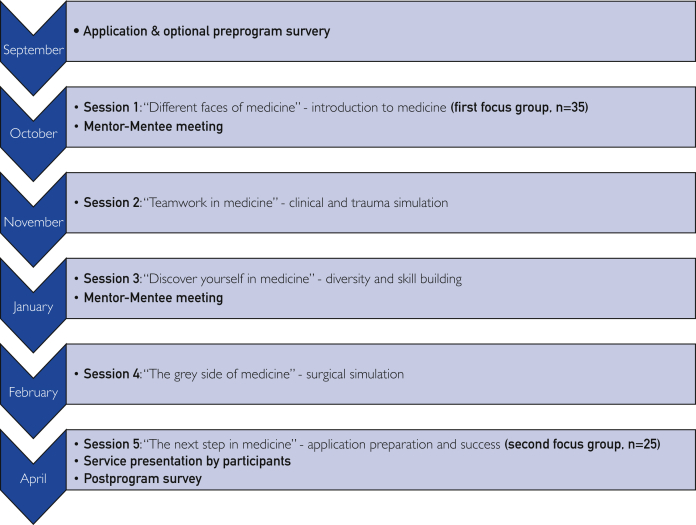
OBJECTIVE: To assess underrepresented undergraduate and postbaccalaureate learners' perceptions of (1) the medical field, (2) barriers that might prevent individuals from pursuing professional medical careers, and (3) resources that assist in overcoming these barriers. PARTICIPANTS AND METHODS: A qualitative study with focus groups was designed to achieve the objective. Participants were recruited from a community initiative to provide early exploration of the medical field to disadvantaged and minority individuals. Thirty-five individuals voluntarily participated in semistructured interviews. Audio from the interviews was analyzed using a qualitative descriptive approach and thematic analysis. This study was conducted from October 20, 2018, to April 6, 2019. RESULTS: Participants identified multiple characteristics related to the health care work environment and desirable attributes of health care personnel. The following barriers were identified: financial burden, lacking knowledge of the path to becoming a medical professional, inadequate social support, and lacking the metrics of a competitive candidate. Resources identified by participants to overcome barriers included professional networks and programmatic considerations. CONCLUSION: The study participants discussed negative and positive aspects of the health care environment, such as implicit and explicit biases and attributes that promote or sustain success. Participants expounded on financial, academic, social, and personal factors as barriers to success. In regard to resources that were believed to be helpful to mitigate barriers and promote success, participants commented on activities that simulate a professional medical environment, include networking with medical personnel, support well-being, and provide exposure to structured information on the process of obtaining professional medical training.
Overview
The claims and statistics of this paper haven’t been checked yet.
Run the check — free, no account needed. It reads the open-access text and checks the sources it cites.
Integrity signals
Registry
Cites
Statistics
Figures
Verification
Claims the paper makes
The claims and statistics of this paper haven’t been checked yet.
Run the check — free, no account needed. It reads the open-access text and checks the sources it cites.
Claims other papers make about this one
Each is checked against this paper’s own text: does it say what the citing paper says it does?
The source backs part of the claim, not all of it — or backs it for a different population, condition or comparison.
In the citing paper
“However, underrepresented students face unique challenges when pursuing health professional careers, leading to lower achievements and opportunities.”
From Perceived Success After Participation in the Summer Health Professions Education Program (2024) · cites this paper as [11]
Experimental — accuracy not yet measured
Self-check
Percentages, sums and reported differences re-computed from the paper’s own numbers.
The self-check needs the paper’s full text.
Citations
Cites
Theme development in qualitative content analysis and thematic analysis
Vaismoradi, M., Jones, J., Turunen, H., & Snelgrove, S. (2016) · Journal of Nursing Education and Practice · doi:10.5430/jnep.v6n5p100 · Cited by 1,994
The Health Equity Scholars Program: Innovation in the Leaky Pipeline
Upshur, C. C., Wrighting, D. M., Bacigalupe, G., Becker, J., Hayman, L., Lewis, B., Mignon, S., Rokop, M. E., Sweet, E., Torres, M. I., et al. (2018) · Journal of Racial and Ethnic Health Disparities · doi:10.1007/s40615-017-0376-7 · Cited by 40
Research works printed but not linked: 19
- Deville, 2015, Diversity in graduate medical education in the United States by race, ethnicity, and sex, 2012 [published correction appears in JAMA Intern Med. 2015;175(10):1729], JAMA Intern Med, 175, 1706, 10.1001/jamainternmed.2015.4324 · DOI · Paper page
- Robinson, 2007, An examination of community members’, researchers’ and health professionals’ perceptions of barriers to minority participation in medical research: an application of concept mapping, Ethn Health, 12, 521, 10.1080/13557850701616987 · DOI
- Garces, 2015, Racial diversity in the medical profession: the impact of affirmative action bans on underrepresented student of color matriculation in medical schools, J Higher Educ, 86, 264, 10.1080/00221546.2015.11777364 · DOI
- Umbach, 2006, The contribution of faculty of color to undergraduate education, Res Higher Educ, 47, 317, 10.1007/s11162-005-9391-3 · DOI
- Frierson, 1987, Black medical students' perceptions of the academic environment and of faculty and peer interactions, J Natl Med Assoc, 79, 737
- Sánchez, 2013, Racial and ethnic minority medical students' perceptions of and interest in careers in academic medicine, Acad Med, 88, 1299, 10.1097/ACM.0b013e31829f87a7 · DOI
- Girotti, 1999, The Urban Health Program to encourage minority enrollment at the University of Illinois at Chicago College of Medicine, Acad Med, 74, 370, 10.1097/00001888-199904000-00027 · DOI
- Agrawal, 2005, Progress and pitfalls in underrepresented minority recruitment: perspectives from the medical schools, J Natl Med Assoc, 97, 1226
- Sandelowski, 2000, Whatever happened to qualitative description?, Res Nurs Health, 23, 334, 10.1002/1098-240X(200008)23:4<334::AID-NUR9>3.0.CO;2-G · DOI
- Vaismoradi, 2013, Content analysis and thematic analysis: implications for conducting a qualitative descriptive study, Nurs Health Sci, 15, 398, 10.1111/nhs.12048 · DOI · Paper page
- Rao, 2007, Why aren't there more African-American physicians? a qualitative study and exploratory inquiry of African-American students' perspectives on careers in medicine, J Natl Med Assoc, 99, 986
- Odom, 2007, Exploring obstacles to and opportunities for professional success among ethnic minority medical students, Acad Med, 82, 146, 10.1097/ACM.0b013e31802d8f2c · DOI · Paper page
- Kennedy, 2007, African Americans and their distrust of the health care system: healthcare for diverse populations, J Cult Divers, 14, 56
- Cohen, 2002, The case for diversity in the health care workforce, Health Aff (Millwood), 21, 90, 10.1377/hlthaff.21.5.90 · DOI · Paper page
- Young, 2016, Cultural diversity training: the necessity of cultural competence for health care providers and in nursing practice, Health Care Manag (Frederick), 35, 94, 10.1097/HCM.0000000000000100 · DOI
- Bright, 1998, Perceived barriers and biases in the medical education experience by gender and race, J Natl Med Assoc, 90, 681
- Freeman, 2016, Understanding the leaky pipeline: perceived barriers to pursuing a career in medicine or dentistry among underrepresented-in-medicine undergraduate students, Acad Med, 91, 987, 10.1097/ACM.0000000000001020 · DOI · Paper page
- Hadinger, 2017, Underrepresented minorities in medical school admissions: a qualitative study, Teach Learn Med, 29, 31, 10.1080/10401334.2016.1220861 · DOI
- Woodward, 1996, Time spent on professional activities and unwaged domestic work: is it different for male and female primary care physicians who have children at home?, Can Fam Physician, 42, 1928
Cited by
Perceived Success After Participation in the Summer Health Professions Education Program
Xirau-Probert, P., Lai, T., Black, E., Fanfan, D., Blue, A., Rush, C. C., Powers, R., & Stacciarini, J.-M. R. (2024) · JAMA Network Open · doi:10.1001/jamanetworkopen.2023.52440 · Cited by 8
Metadata
- Authors
- Joseph, J., Dao, D., Hwang, S. M., Dotzler, S. M., Chesak, S. S., Weiskittel, T. M., Lang, M. E., Melo, V. D., Anderson, J. B., Vega, B., Englund, M., Boruch, P. M., & Bhagra, A.
- Affiliations
- Mayo Clinic (US)
- Johns Hopkins University (US)
- University of Minnesota Rochester (US)
- Corresponding author
- Bhagra, Anjali
- ORCID
- Venue
- Mayo Clinic Proceedings: Innovations, Quality & Outcomes
- Publisher
- Elsevier BV
- Published
- 2021-04
- Volume
- 5
- Issue
- 2
- Pages
- 347-358
- ISSN
- 2542-4548 (ISSN-L)
- PMC
- PMC8105502
- OpenAlex
- W3159453320
- Cited by
- 36
- References
- 2
- Citations by year
- 2026: 2 · 2025: 9 · 2024: 11 · 2023: 9 · 2022: 5
- FWCI
- 7.20
- Type
- journal article
- Language
- en
- Open access
- gold
- doi.org
- Licence
- Locations
- Mayo Clinic Proceedings Innovations Quality & Outcomes (publishedVersion, cc-by-nc-nd)
- PubMed Central (publishedVersion, cc-by-nc-nd)
- PubMed (publishedVersion)
- DOAJ (DOAJ: Directory of Open Access Journals) (submittedVersion, cc-by-sa)
- Funders
- National Institutes of Health (T32GM065841)
- Topics
- Social Sciences › Gender Studies › Diversity and Career in Medicine
- Social Sciences › Education › Medical Education and Admissions
- Social Sciences › Psychology › Applied Psychology › Career Development and Diversity
- Keywords
- underrepresented minority students, barriers to medical education, financial burden, social support, professional networks, health workforce diversity, implicit bias, student perceptions
About these checks
Registry, retraction, Cites and statistics results are computed, not judged, with one exception: a printed reference that no index lists is read once by a model before it counts as a citation error. Claims are extracted by a model and kept only when their quote appears verbatim in the text; each cited source is then checked, with a model’s help, for whether it says what the claim relies on. Those verdicts can be wrong — read the claim’s quote and the cited source before relying on one.
Statistics and arithmetic are recomputed, not judged.
Confidence bands are shown only for fields calibrated on our annotated test set. None is calibrated yet, so no band is shown.
What counts as a claim ›How we measure confidence ›How we check this ›
Are you an author, or do you see a problem with this page? Request a review
