

The DOI matches its Crossref record; 10 of the 10 references it cites were found in a registry or an index.
K-Alpha Calculator—Krippendorff’s Alpha Calculator: A user-friendly tool for computing Krippendorff’s Alpha inter-rater reliability coefficient
Open accessAbstract
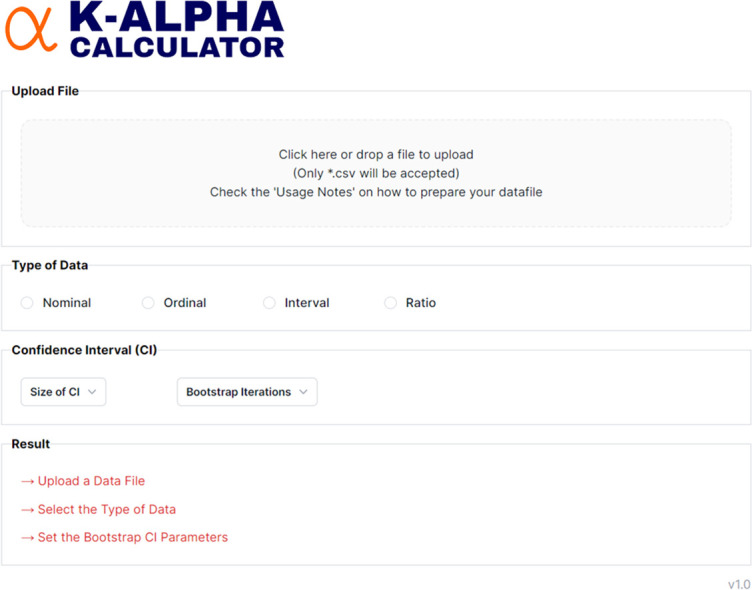
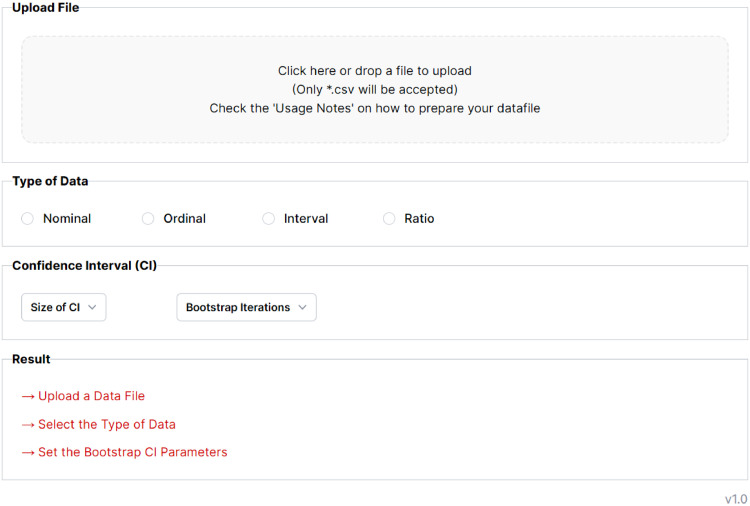
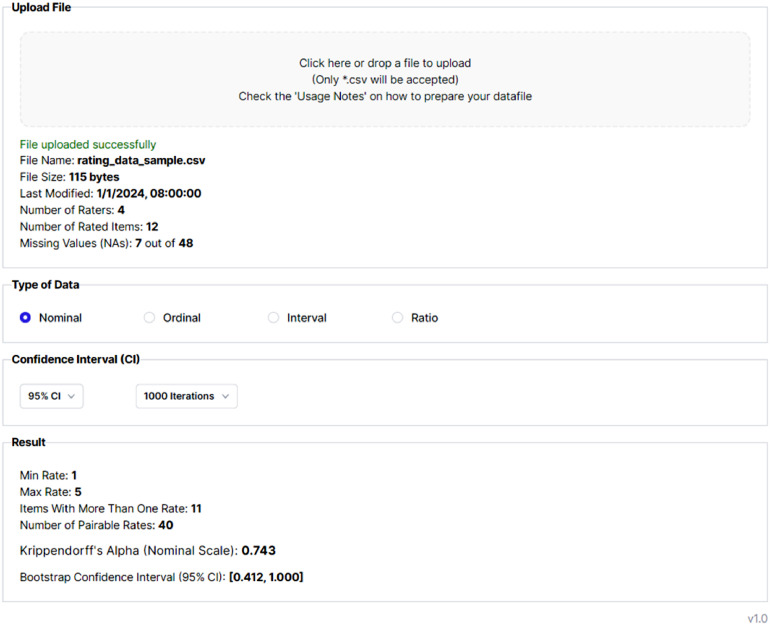
Krippendorff's Alpha is a measure for assessing inter-rater reliability, facilitating triangulated evaluations among multiple raters. Indeed, Krippendorff's Alpha is key in validating the dependability of human assessments, thereby reinforcing the robustness of human-based choices in contexts where interpretive variability could otherwise undermine the research outcomes. Despite its versatility across various data types, the procedure for computing this coefficient might limit its applicability for researchers unfamiliar with specialised statistical software. Addressing this issue, this paper introduces the "K-Alpha Calculator"-Krippendorff's Alpha Calculator-a freely accessible, user-friendly, web application available at https://www.k-alpha.org designed for easy computation of Krippendorff's Alpha. By offering a web interface without any software dependency, the K-Alpha Calculator seeks to promote the broader integration of such a reliability metric in research processes. We envisage that the tool's contribution could support researchers in enhancing methodological rigour, fostering conclusions are rooted in triangulated interpretations and assessments. The K-Alpha Calculator is both a computational tool and an educational resource, encouraging more researchers to include reliability measures in their studies.•Development of the K-Alpha Calculator.The study centres on the introduction of a web-based application: the K-Alpha Calculator. The tool is developed to simplify the calculation of Krippendorff's Alpha without any required software dependency.•User-friendly interface for diverse data types.The K-Alpha Calculator is characterised by its accessibility and user-friendliness, designed to simplify the procedures for computing the Krippendorff's Alpha. Its utility extends to various data types, which aligns with the intrinsic versatility of this coefficient.
Overview
The claims and statistics of this paper haven’t been checked yet.
Run the check — free, no account needed. It reads the open-access text and checks the sources it cites.
Integrity signals
Registry
Cites
Statistics
Figures
Verification
Claims the paper makes
The claims and statistics of this paper haven’t been checked yet.
Run the check — free, no account needed. It reads the open-access text and checks the sources it cites.
Claims other papers make about this one
Each is checked against this paper’s own text: does it say what the citing paper says it does?
In the citing paper
“Inter-coder reliability was 0.81 based on Krippendorff’s Alpha [45,46], indicating a good level of agreement among coders.”
From Help-Seeking Situations Related to Visual Interactions on Mobile Platforms and Recommended Designs for Blind and Visually Impaired Users (2024) · cites this paper as [46]
Self-check
Percentages, sums and reported differences re-computed from the paper’s own numbers.
The self-check needs the paper’s full text.
Citations
Cites
A Coefficient of Agreement for Nominal Scales
Cohen, J. (1960) · Educational and Psychological Measurement · doi:10.1177/001316446002000104 · Cited by 42,398
Content Analysis: An Introduction to Its Methodology
Krippendorff, K. (2019) · doi:10.4135/9781071878781 · Cited by 15,448
Measuring nominal scale agreement among many raters.
Fleiss, J. L. (1971) · Psychological Bulletin · doi:10.1037/h0031619 · Cited by 8,733
Answering the Call for a Standard Reliability Measure for Coding Data
Hayes, A. F., & Krippendorff, K. (2007) · Communication Methods and Measures · doi:10.1080/19312450709336664 · Cited by 4,225
Intercoder Reliability in Qualitative Research: Debates and Practical Guidelines
O’Connor, C., & Joffe, H. (2020) · International Journal of Qualitative Methods · doi:10.1177/1609406919899220 · Cited by 3,871
Answers to 20 questions about interrater reliability and interrater agreement
LeBreton, J. M., & Senter, J. L. (2008) · Organizational Research Methods · doi:10.1177/1094428106296642 · Cited by 3,608
Zapf, A., Castell, S., Morawietz, L., & Karch, A. (2016) · BMC Medical Research Methodology · doi:10.1186/s12874-016-0200-9 · Cited by 377
Zhang, Y. E., Liu, G., Zhang, L., Xu, S., & Cheung, M. W. ‐. (2020) · Journal of Management · doi:10.1177/0149206320917195 · Cited by 212
Multiple‐Principal Demands and CEO Compliance in Emerging Market State‐Owned Enterprises
Apriliyanti, I. D., Dieleman, M. H., & Randøy, T. (2023) · Journal of Management Studies · doi:10.1111/joms.12977 · Cited by 36
KANOM: Stata module to estimate Krippendorff's alpha for nominal variables
Mitnik, P. A. (2016) · RePEc: Research Papers in Economics · Cited by 1
Research works printed but not linked: 2
- Freelon, 2010, ReCal: intercoder reliability calculation as a web service, Int. J. Internet Sci., 5, 20
- Freelon, 2013, ReCal OIR: ordinal, interval, and ratio intercoder reliability as a web service, Int. J. Internet Sci., 8, 10
Cited by
Sorted by citations
Marzi, G., Balzano, M., Caputo, A., & Pellegrini, M. M. (2024) · International Journal of Management Reviews · doi:10.1111/ijmr.12381 · Cited by 831
“Convergence assessments can be performed recurring to the computation of Krippendorff’s Alpha coefficient (Krippendorff, 2019), for example, using the K-Alpha Calculator (Marzi et al., 2024) available at https://www.k-alpha.org/.”
Self-citationInter-Coder Agreement in Qualitative Coding: Considerations for its Use
Halpin, S. N. (2024) · American Journal of Qualitative Research · doi:10.29333/ajqr/14887 · Cited by 149
SMEs and institutional theory: major inroads and opportunities ahead
Balzano, M., Marzi, G., & Turzo, T. (2024) · Management Decision · doi:10.1108/md-05-2023-0734 · Cited by 153
Self-citationAnalysis of LLMs for educational question classification and generation
Faraby, S. A., Romadhony, A., & Adiwijaya, A. (2024) · Computers and Education Artificial Intelligence · doi:10.1016/j.caeai.2024.100298 · Cited by 79
Cafforio, F., Franco, S., & Giannoccaro, I. (2025) · Business Strategy and the Environment · doi:10.1002/bse.4338 · Cited by 20
Metadata
- Authors
- Marzi, G., Balzano, M., & Marchiori, D.
- Affiliations
- IMT School for Advanced Studies Lucca (IT)
- Ca' Foscari University of Venice (IT)
- Corresponding author
- Marzi, Giacomo
- Venue
- MethodsX
- Publisher
- Elsevier BV
- Published
- 2024-06
- Volume
- 12
- Pages
- 102545
- ISSN
- 2215-0161 (ISSN-L)
- PMC
- PMC11636850
- OpenAlex
- W4390636334
- Cited by
- 292
- References
- 10
- Citations by year
- 2026: 143 · 2025: 113 · 2024: 36
- FWCI
- 80.91
- Type
- journal article
- Language
- en
- Open access
- gold
- doi.org
- Licence
- Locations
- MethodsX (publishedVersion, cc-by)
- PubMed Central (publishedVersion, cc-by)
- PubMed (publishedVersion)
- ArTS Archivio della ricerca di Trieste (University of Trieste https://www.units.it/) (submittedVersion, cc-by)
- ARCA (Università Ca' Foscari Venezia) (submittedVersion, other-oa)
- DOAJ (DOAJ: Directory of Open Access Journals) (submittedVersion)
- Topics
- Social Sciences › Decision Sciences › Statistics, Probability and Uncertainty › Reliability and Agreement in Measurement
- Social Sciences › Decision Sciences › Management Science and Operations Research › Psychometric Methodologies and Testing
- Social Sciences › Decision Sciences › Statistics, Probability and Uncertainty › Multidisciplinary Science and Engineering Research
- Keywords
- Krippendorff's alpha, inter-rater reliability, web-based calculator, reliability analysis software
About these checks
Registry, retraction, Cites and statistics results are computed, not judged, with one exception: a printed reference that no index lists is read once by a model before it counts as a citation error. Claims are extracted by a model and kept only when their quote appears verbatim in the text; each cited source is then checked, with a model’s help, for whether it says what the claim relies on. Those verdicts can be wrong — read the claim’s quote and the cited source before relying on one.
Statistics and arithmetic are recomputed, not judged.
Confidence bands are shown only for fields calibrated on our annotated test set. None is calibrated yet, so no band is shown.
What counts as a claim ›How we measure confidence ›How we check this ›
Are you an author, or do you see a problem with this page? Request a review
