

The DOI matches its Crossref record; 45 of the 47 references it cites were found in a registry or an index.
Fructose ingestion acutely stimulates circulating FGF21 levels in humans
Open accessAbstract
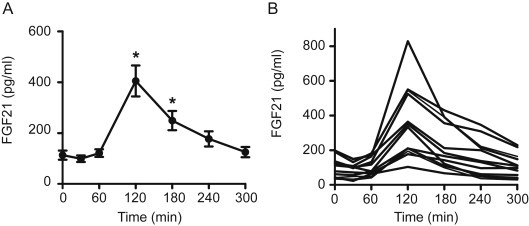
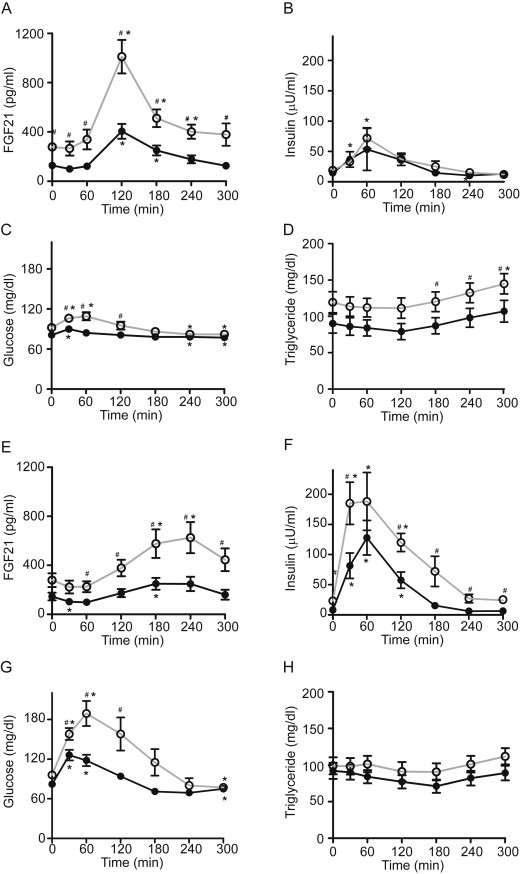
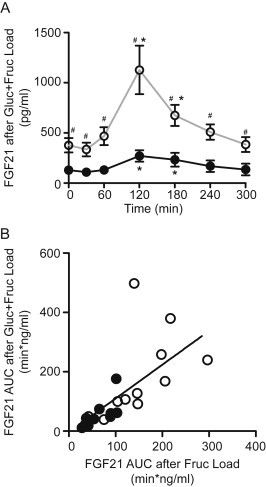
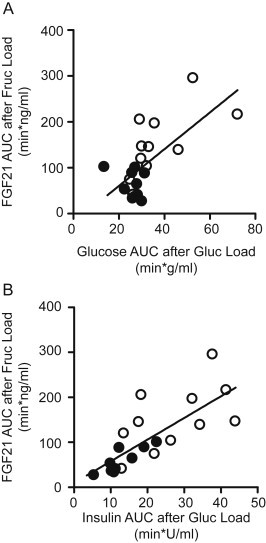
OBJECTIVE: Fibroblast growth factor 21 (FGF21) is a hormone with pleiotropic metabolic activities which, in rodents, is robustly regulated by fasting and ketogenic diets. In contrast, similar dietary interventions have either no or minimal effects on circulating FGF21 in humans. Moreover, no intervention or dietary challenge has been shown to acutely stimulate circulating FGF21 in either humans or animals. Recent animal data suggest that the transcription factor Carbohydrate Responsive-Element Binding Protein (ChREBP) stimulates hepatic FGF21 expression and that fructose may activate hepatic ChREBP more robustly than glucose. Here, we examined whether fructose ingestion can acutely stimulate FGF21 in humans. METHODS: We measured serum FGF21, glucose, insulin, and triglyceride levels in ten lean, healthy adults and eleven adults with the metabolic syndrome following oral ingestion of 75 g of glucose, fructose, or a combination of the two sugars. RESULTS: FGF21 levels rose rapidly following fructose ingestion, achieved a mean 3.4-fold increase at two hours (P < 0.01), and returned to baseline levels within five hours. In contrast, FGF21 did not increase in the first two hours following ingestion of a glucose load, although more modest increases were observed after three to four hours. Both baseline and fructose-stimulated FGF21 levels were 2-3 fold elevated in subjects with metabolic syndrome. CONCLUSIONS: Fructose ingestion acutely and robustly increases serum FGF21 levels in humans in a pattern consistent with a hormonal response. While FGF21 appears to be critical for the adaptive response to fasting or starvation in rodents, these findings suggest that in humans, FGF21 may play an important role in fructose metabolism.
Overview
The claims and statistics of this paper haven’t been checked yet.
Run the check — free, no account needed. It reads the open-access text and checks the sources it cites.
Integrity signals
Registry
Cites
Statistics
Figures
Verification
Claims the paper makes
The claims and statistics of this paper haven’t been checked yet.
Run the check — free, no account needed. It reads the open-access text and checks the sources it cites.
Claims other papers make about this one
Each is checked against this paper’s own text: does it say what the citing paper says it does?
In the citing paper
“Starvation30,31, high sugar intake32,33 and dietary protein restriction26 all induce circulating FGF21 levels in humans.”
From Metabolic messengers: FGF21 (2021) · cites this paper as [32]
In the citing paper
“FGF21 is induced by simple-sugar intake in both mice and humans22,32,33, and that sugar-induced production of FGF21 from the liver occurs in a ChREBP-dependent manner22,121.”
From Metabolic messengers: FGF21 (2021) · cites this paper as [32]
In the citing paper
“In addition, in humans, plasma FGF21 levels have been shown to be induced by increases in both glucose and insulin levels (31, 84, 110, 133), supporting a role during refeeding.”
From Fibroblast Growth Factor 21: A Versatile Regulator of Metabolic Homeostasis (2018) · cites this paper as [31]
In the citing paper
“The ingestion of a single bolus of fructose or glucose induces plasma FGF21 levels in both lean healthy participants and patients with metabolic syndrome.”
From Fibroblast Growth Factor 21: A Versatile Regulator of Metabolic Homeostasis (2018) · cites this paper as [31]
In the citing paper
“While fructose markedly and acutely increased plasma FGF21 levels in humans, glucose caused a delayed and gradual increase in plasma FGF21 levels (31).”
From Fibroblast Growth Factor 21: A Versatile Regulator of Metabolic Homeostasis (2018) · cites this paper as [31]
In the citing paper
“Circulating FGF21 levels are robustly increased by diets that are high in carbohydrate but low in protein”
From FGF21 and the physiological regulation of macronutrient preference (2020) · cites this paper as [138]
In the citing paper
“Both acute carbohydrate ingestion and long-term exposure to high-carbohydrate diets significantly increase liver FGF21 mRNA expression and circulating FGF21 levels”
From FGF21 and the physiological regulation of macronutrient preference (2020) · cites this paper as [138]
In the citing paper
“liver FGF21 production seems to be robustly stimulated by an imbalance in macronutrients, particularly settings of high-carbohydrate but low-protein intake”
From FGF21 and the physiological regulation of macronutrient preference (2020) · cites this paper as [138]
Self-check
Percentages, sums and reported differences re-computed from the paper’s own numbers.
The self-check needs the paper’s full text.
Citations
Cites
Toprak, Ö., Kurt, H., Sarı, Y., Şarkış, C., Us, H., & Kırık, A. (2017) · Kidney & Blood Pressure Research · doi:10.1159/000468530 · Cited by 29,772
Grundy, S. M., Bilheimer, D. W., Chait, A., Clark, L. T., Denke, M. A., Havel, R. J., Hazzard, W. R., Hulley, S. B., Hunninghake, D. B., Kreisberg, R. A., et al. (1993) · JAMA · doi:10.1001/jama.269.23.3015 · Cited by 27,944
Expert Panel on Detection, E. (2001) · JAMA: The Journal of the American Medical Association · doi:10.1001/jama.285.19.2486 · Cited by 26,011
FGF-21 as a novel metabolic regulator
Kharitonenkov, A., Shiyanova, T. L., Koester, A., Ford, A. M., Micanovic, R., Galbreath, E. J., Sandusky, G. E., Hammond, L. J., Moyers, J. S., Owens, R. A., et al. (2005) · Journal of Clinical Investigation · doi:10.1172/jci23606 · Cited by 2,125
Stanhope, K. L., Schwarz, J. M., Keim, N. L., Griffen, S. C., Bremer, A. A., Graham, J. L., Hatcher, B., Cox, C. L., Dyachenko, A., Zhang, W., et al. (2009) · Journal of Clinical Investigation · doi:10.1172/jci37385 · Cited by 1,765
Inagaki, T., Dutchak, P., Zhao, G., Ding, X., Gautron, L., Parameswara, V., Li, Y., Goetz, R., Mohammadi, M., Esser, V., et al. (2007) · Cell Metabolism · doi:10.1016/j.cmet.2007.05.003 · Cited by 1,504
Badman, M. K., Pissios, P., Kennedy, A. R., Koukos, G., Flier, J. S., & Maratos-Flier, E. (2007) · Cell Metabolism · doi:10.1016/j.cmet.2007.05.002 · Cited by 1,495
Self-citationZhang, X., Yeung, D. C. Y., Karpisek, M., Stejskal, D., Zhou, Z.-G., Liu, F., Wong, R. L. C., Chow, W.-S., Tso, A. W. K., Lam, K. S. L., et al. (2008) · Diabetes · doi:10.2337/db07-1476 · Cited by 908
Obesity Is a Fibroblast Growth Factor 21 (FGF21)-Resistant State
Fisher, F. M., Chui, P. C., Antonellis, P. J., Bina, H. A., Kharitonenkov, A., Flier, J. S., & Maratos-Flier, E. (2010) · Diabetes · doi:10.2337/db10-0193 · Cited by 830
Self-citationPotthoff, M. J., Inagaki, T., Satapati, S., Ding, X., He, T., Goetz, R., Mohammadi, M., Finck, B. N., Mangelsdorf, D. J., Kliewer, S. A., et al. (2009) · Proceedings of the National Academy of Sciences · doi:10.1073/pnas.0904187106 · Cited by 704
Cited by
Sorted by citations
Fructose and sugar: A major mediator of non-alcoholic fatty liver disease
Jensen, T., Abdelmalek, M. F., Sullivan, S. A., Nadeau, K. J., Cree‐Green, M., Roncal, C., Nakagawa, T., Kuwabara, M., Sato, Y., Kang, D., et al. (2018) · Journal of Hepatology · doi:10.1016/j.jhep.2018.01.019 · Cited by 993
Understanding the Physiology of FGF21
Fisher, F. M., & Maratos-Flier, E. (2016) · Annual Review of Physiology · doi:10.1146/annurev-physiol-021115-105339 · Cited by 912
Self-citationNonalcoholic fatty liver disease as a nexus of metabolic and hepatic diseases
Samuel, V. T., & Shulman, G. I. (2018) · Cell Metabolism · doi:10.1016/j.cmet.2017.08.002 · Cited by 745
Fructose metabolism and metabolic disease
Hannou, S. A., Haslam, D. E., McKeown, N. M., & Herman, M. A. (2018) · Journal of Clinical Investigation · doi:10.1172/jci96702 · Cited by 561
Self-citationFructose Consumption, Lipogenesis, and Non-Alcoholic Fatty Liver Disease
ter Horst, K. W., & Serlie, M. J. M. (2017) · Nutrients · doi:10.3390/nu9090981 · Cited by 379
Metadata
- Authors
- Dushay, J. R., Toschi, E., Mitten, E. K., Fisher, F. M., Herman, M. A., & Maratos-Flier, E.
- Affiliations
- Beth Israel Deaconess Medical Center (US)
- Broad Institute (US)
- Corresponding author
- Herman, Mark A.
- Venue
- Molecular Metabolism
- Publisher
- Elsevier BV
- Published
- 2015-01
- Volume
- 4
- Issue
- 1
- Pages
- 51-57
- ISSN
- 2212-8778 (ISSN-L)
- PMC
- PMC4314524
- OpenAlex
- W2048578282
- Cited by
- 233
- References
- 47
- Citations by year
- 2026: 12 · 2025: 17 · 2024: 19 · 2023: 16 · 2022: 22 · 2021: 22 · 2020: 14 · 2019: 28 · 2018: 20 · 2017: 29 · 2016: 22 · 2015: 11
- FWCI
- 8.60
- Type
- journal article
- Language
- en
- Open access
- gold
- doi.org
- Licence
- Locations
- Molecular Metabolism (publishedVersion, cc-by-nc-nd)
- Europe PMC (PubMed Central) (publishedVersion, cc-by-nc-nd)
- PubMed Central (publishedVersion, cc-by-nc-nd)
- PubMed (publishedVersion)
- DukeSpace (Duke University) (submittedVersion, cc-by-nc-nd)
- Funders
- JPB Foundation (8UL1TR000170-05)
- Harvard Catalyst/Harvard Clinical and Translational Science Center (1UL1 TR001102-01)
- EMF (R01DK028082)
- MAH (P30DK057521, R01DK100425)
- Topics
- Life Sciences › Biochemistry, Genetics and Molecular Biology › Molecular Biology › Fibroblast Growth Factor Research
- Health Sciences › Medicine › Endocrinology, Diabetes and Metabolism › Diet, Metabolism, and Disease
- Health Sciences › Medicine › Physiology (medical) › Dietary Effects on Health
- Keywords
- fructose, FGF21, glucose, carbohydrate-responsive element-binding protein, ChREBP, metabolic syndrome, fructose metabolism, insulin, triglycerides, fasting response
About these checks
Registry, retraction, Cites and statistics results are computed, not judged, with one exception: a printed reference that no index lists is read once by a model before it counts as a citation error. Claims are extracted by a model and kept only when their quote appears verbatim in the text; each cited source is then checked, with a model’s help, for whether it says what the claim relies on. Those verdicts can be wrong — read the claim’s quote and the cited source before relying on one.
Statistics and arithmetic are recomputed, not judged.
Confidence bands are shown only for fields calibrated on our annotated test set. None is calibrated yet, so no band is shown.
What counts as a claim ›How we measure confidence ›How we check this ›
Are you an author, or do you see a problem with this page? Request a review
