

A systematic and meta-analytic review of the impact of sleep restriction on memory formation.
Open accessThe DOI matches its Crossref record; 251 of the 253 references it cites were found in a registry or an index; none of the 131 sources its claims cite is checked for support yet.
Abstract
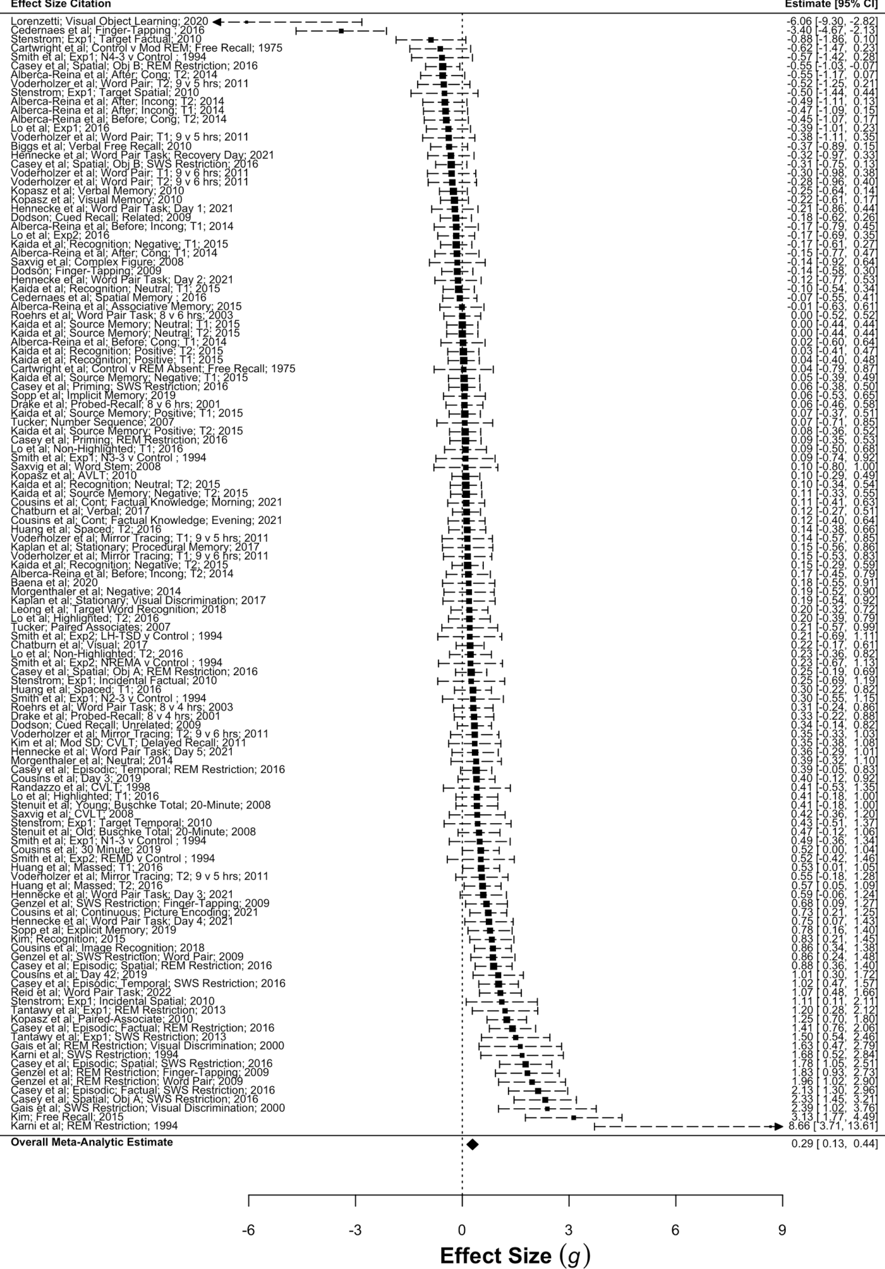
Modern life causes a quarter of adults and half of teenagers to sleep for less than is recommended (Kocevska et al., 2021). Given well-documented benefits of sleep on memory, we must understand the cognitive costs of short sleep. We analysed 125 sleep restriction effect sizes from 39 reports involving 1234 participants. Restricting sleep (3-6.5 hours) compared to normal sleep (7-11 hours) negatively affects memory formation with a small effect size (Hedges' g = 0.29, 95 % CI = [0.13, 0.44]). We detected no evidence for publication bias. When sleep restriction effect sizes were compared with 185 sleep deprivation effect sizes (Newbury et al., 2021) no statistically significant difference was found, suggesting that missing some sleep has similar consequences for memory as not sleeping at all. When the analysis was restricted to post-encoding, rather than pre-encoding, sleep loss, sleep deprivation was associated with larger memory impairment than restriction. Our findings are best accounted for by the sequential hypothesis which emphasises complementary roles of slow-wave sleep and REM sleep for memory.
Overview
CoChat Summary
TL;DR
This systematic meta-analysis of 125 effect sizes from 39 reports (1234 participants) found that sleep restriction (3–6.5 h vs 7–11 h) impairs long-term memory formation with a small effect (Hedges’ g = 0.29). Combined with total sleep deprivation data, the overall memory cost was not significantly different from not sleeping at all, and the pattern was best accounted for by sequential sleep theories emphasizing complementary SWS and REM roles.
Key findings
- Sleep restriction (3–6.5 h vs 7–11 h) impaired long-term memory formation with a small effect: Hedges’ g = 0.29, 95% CI [0.13, 0.44], p < .001; after removing 9 outliers/influential cases, g = 0.23, 95% CI [0.12, 0.35], p < .001.
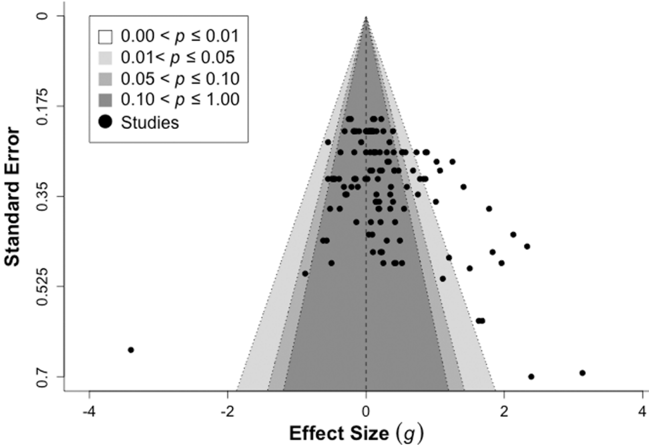
- No conclusive evidence of publication bias was detected: the three-parameter selection model showed no significant improvement when modelling publication bias (χ²(1) = 1.46, p = .228), although Egger’s test indicated funnel-plot asymmetry (z = 3.90, p < .001).
- Combining the 125 sleep-restriction effect sizes with 185 total sleep deprivation effect sizes from Newbury et al. (2021), type of sleep loss did not significantly moderate the overall effect (Q(1, 308) = 2.63, p = .105; after outlier removal Q(1, 288) = 2.16, p = .141), suggesting short sleep may have broadly similar memory consequences as no sleep.
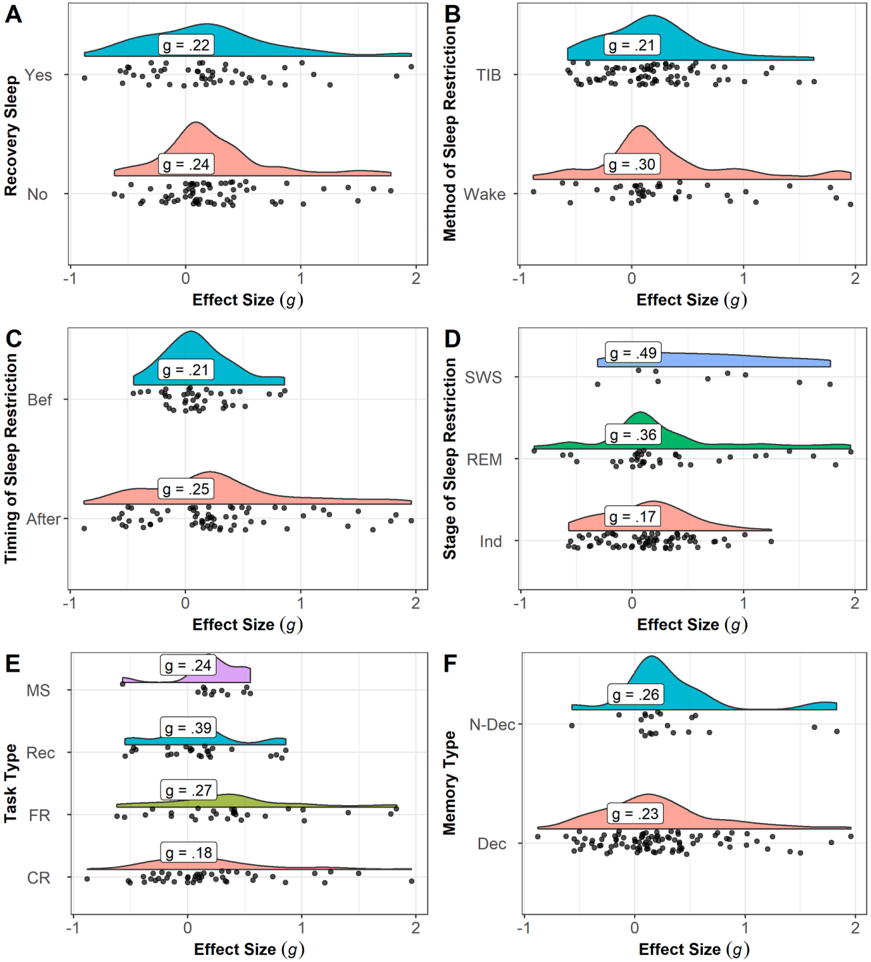
- Sleep stage moderated the effect only with outliers retained: SWS-targeted restriction g = 0.85, REM-targeted g = 0.40, indiscriminate g = 0.17 (Q(2, 122) = 11.72, p = .003); this did not survive outlier removal (p = .135). In timing analyses, sleep deprivation before encoding impaired memory more than sleep restriction before encoding (g = 0.63 vs 0.20 with outliers; g = 0.48 vs 0.20 without), whereas after encoding they were similar.
Methods
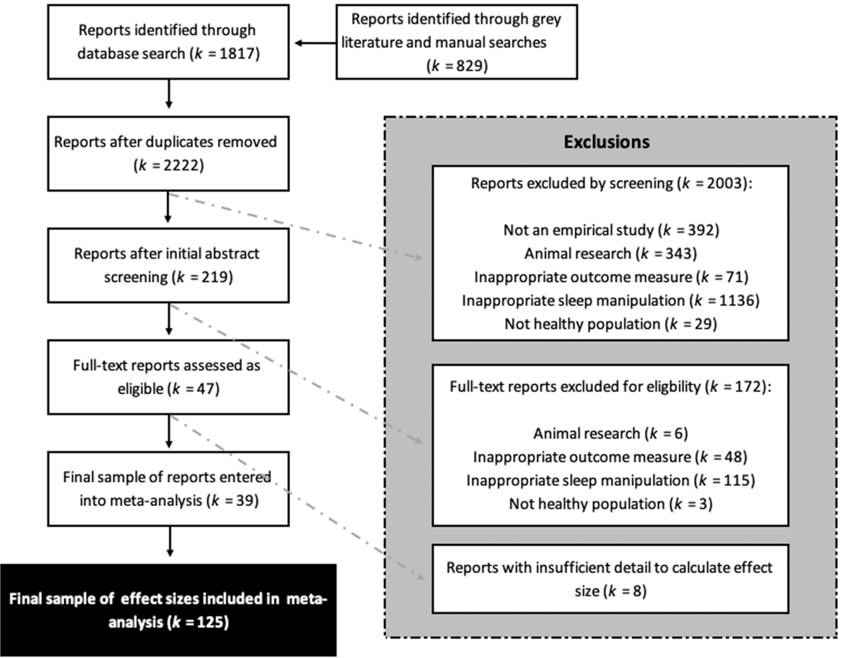
- Systematic search of EBSCOhost, PubMed, grey literature, preprints, reference lists, and author contact yielded 39 reports, 125 effect sizes, and 1234 participants; sleep restriction was 3–6.5 h over 1–14 nights versus control sleep of 7–11 h.
- Three-level random-effects meta-analysis with robust variance estimation was used to calculate Hedges’ g, with moderator analyses for sleep stage, timing, memory/task type, recovery sleep, age, methodological quality, and statistical power.
- Publication bias was assessed via contour-enhanced funnel plot, Egger’s regression, trim-and-fill, and the three-parameter selection model; sleep-restriction data were also combined with 185 total sleep deprivation effect sizes from Newbury et al. (2021).
Limitations
- The paper states that only seven grey-literature reports were identified, inclusion was English-only (51% of located effect sizes from Europe; 72% from western cultures), and only healthy typical populations were included, excluding sleep and psychiatric disorders.
- The paper states that only one effect size had a mean age above 30 years, so findings cannot be generalised to older adults; moderator analyses were underpowered and imbalanced (e.g., 13 SWS-targeted effect sizes, 12 motor-skill effect sizes, 25 non-declarative memory effect sizes), and the meta-analysis was not preregistered.
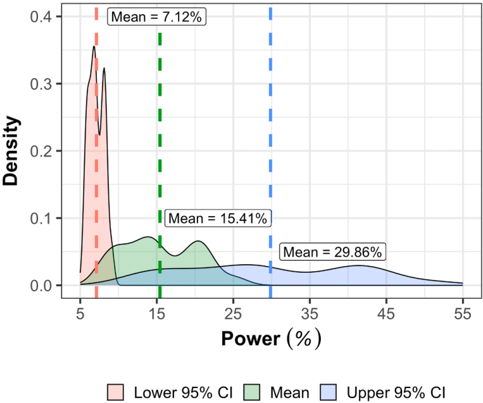
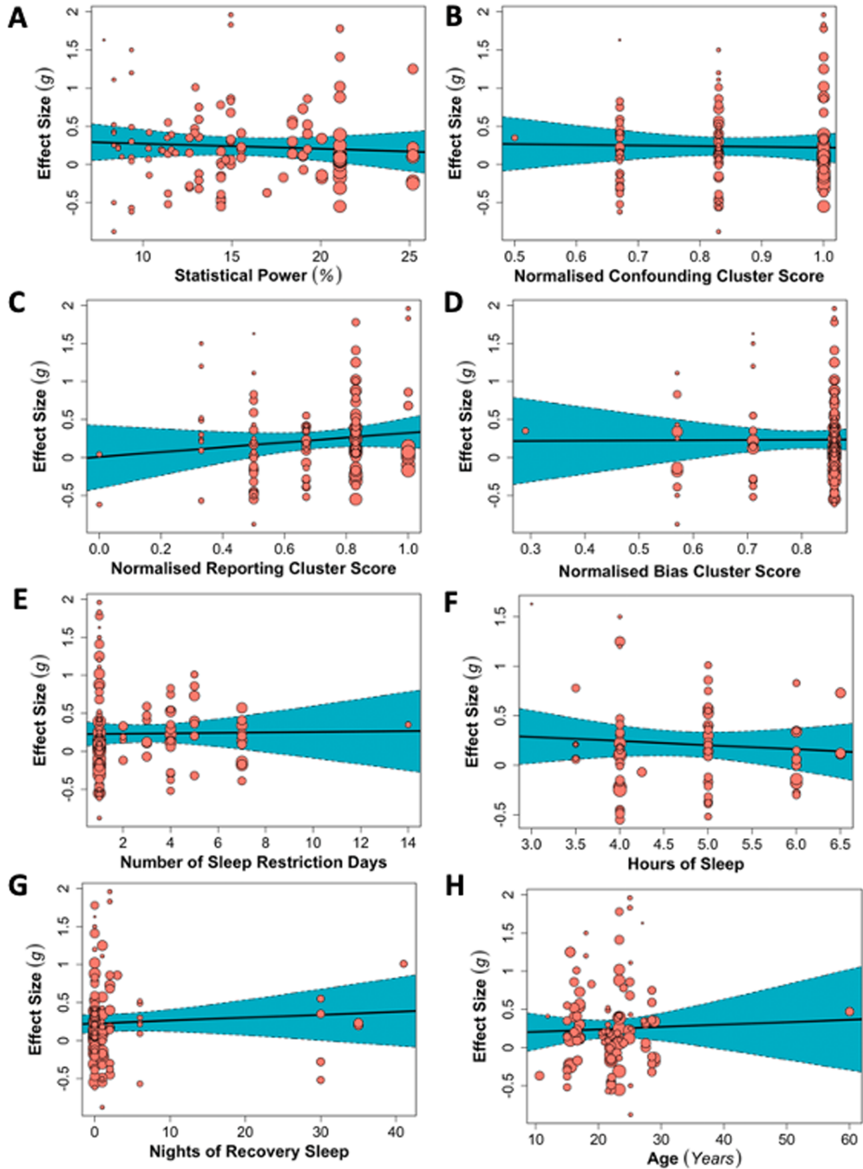
- The paper states that the meta-analysis is based on behavioural data only and that protocol differences between sleep restriction and total sleep deprivation may limit direct comparison; the text also makes evident that average statistical power to detect the meta-analytic estimate was very low (mean = 15.41%, range = 7.61%–25.19%).
Model-written summary. Check it against the paper before relying on it.
Integrity signals
Registry
Cites
Statistics
Figures

Verification
Claims the paper makes
0 Valid · 0 Not valid · 79 Not checked · 166 Own results and interpretations
A result the paper reports from its own data — it cites no other source for it, so there is none to check. The quote shows it is in the paper.
In the paper
“When the analysis was restricted to post-encoding, rather than pre-encoding, sleep loss, sleep deprivation was associated with larger memory impairment than restriction.”
§ A systematic and meta-analytic review of the impact of sleep restriction on memory formation > Abstract
plainstates an association- Asserted: passes — The authors put it forward as true.
- Checkable: passes — It can be checked against evidence.
- Load-bearing: passes — The paper’s conclusions depend on it.
- Based: passes — The paper gives a reason why it holds.
A result the paper reports from its own data — it cites no other source for it, so there is none to check. The quote shows it is in the paper.
In the paper
“We detected no evidence for publication bias.”
§ A systematic and meta-analytic review of the impact of sleep restriction on memory formation > Abstract
plain- Asserted: passes — The authors put it forward as true.
- Checkable: passes — It can be checked against evidence.
- Load-bearing: unclear — It is unclear whether the paper’s conclusions depend on it.
- Based: passes — The paper gives a reason why it holds.
In the paper
“When sleep restriction effect sizes were compared with 185 sleep deprivation effect sizes (Newbury et al., 2021) no statistically significant difference was found, suggesting that missing some sleep has similar consequences for memory as not sleeping at all.”
§ A systematic and meta-analytic review of the impact of sleep restriction on memory formation > Abstract
What the sources say
- Not checked yetcites Newbury et al., 2021 matched to “Sleep deprivation and memory: meta-analytic reviews of studies on sleep deprivation before and after learning” (2021) source
plain- Asserted: passes — The authors put it forward as true.
- Checkable: passes — It can be checked against evidence.
- Load-bearing: passes — The paper’s conclusions depend on it.
- Based: passes — The paper gives a reason why it holds.
A result the paper reports from its own data — it cites no other source for it, so there is none to check. The quote shows it is in the paper.
In the paper
“Restricting sleep (3-6.5 hours) compared to normal sleep (7-11 hours) negatively affects memory formation with a small effect size (Hedges' g = 0.29, 95 % CI = [0.13,0.44]).”
§ A systematic and meta-analytic review of the impact of sleep restriction on memory formation > Abstract
plainstates a causen = 1,234- Asserted: passes — The authors put it forward as true.
- Checkable: passes — It can be checked against evidence.
- Load-bearing: passes — The paper’s conclusions depend on it.
- Based: passes — The paper gives a reason why it holds.
In the paper
“Crucially, this combined sleep loss moderator analysis revealed that the type of sleep loss did not significantly moderate the magnitude of the detriment to memory”
§ A systematic and meta-analytic review of the impact of sleep restriction on memory formation > 4.1. Investigating predictions made by the sleep theories
What the sources say
- Not checked yetcites Newbury et al. (2021) matched to “Sleep deprivation and memory: meta-analytic reviews of studies on sleep deprivation before and after learning” (2021) source
plain- Asserted: passes — The authors put it forward as true.
- Checkable: passes — It can be checked against evidence.
- Load-bearing: passes — The paper’s conclusions depend on it.
- Based: passes — The paper gives a reason why it holds.
91 more claims
Create a free account to see all 245 claims and to verify the 125 references still open.
- Probably not a substantial claim. 66
- It may state two separate claims as one. 103
Statistics recomputed
Every reported test result, recomputed from its test statistic and degrees of freedom. A result shows as not adding up only once an independent check has confirmed it.
- Consistentt(33.93) = 3.64reported p < .001 · recomputed p < .001
“t(33.93)= 3.64, p < .001”
- Consistentz = 3.9reported p < .001 · recomputed p < .001
“(z = 3.90, p < .001”
- Consistentz = 4.92reported p < .001 · recomputed p < .001
“Z = 4.92, p < .001”
Self-check
Percentages, sums and reported differences re-computed from the paper’s own numbers.
Each contradiction between two passages listed here was confirmed by an independent check.
Rated major: it would touch a result — a value a result rests on, reported and recomputed p-values on opposite sides of the significance level, two passages that conflict with no sign which is right, or a cited work retracted before this paper was published.
In the paper
§ A systematic and meta-analytic review of the impact of sleep restriction on memory formation > Abstract
“When the analysis was restricted to post-encoding, rather than pre-encoding, sleep loss, sleep deprivation was associated with larger memory impairment than restriction.”
§ A systematic and meta-analytic review of the impact of sleep restriction on memory formation > 3.5. Moderator analyses with combined sleep loss data
“Sleep loss type (restriction vs. deprivation) was a significant moderator only when sleep loss occurred before encoding”
Rated minor: it would not touch a result — a value no result rests on, a p-value that stays on the same side of the significance level, or a conflict that is clerical, resolved elsewhere in the paper, or outside its own findings.
In the paper
§ A systematic and meta-analytic review of the impact of sleep restriction on memory formation > 4.8. Conclusion
“0.24 | [-0.03, 0.45]”
§ A systematic and meta-analytic review of the impact of sleep restriction on memory formation > 4.8. Conclusion
“[-0.03, 0.45] | .029*”
Rated minor: it would not touch a result — a value no result rests on, a p-value that stays on the same side of the significance level, or a conflict that is clerical, resolved elsewhere in the paper, or outside its own findings.
In the paper
§ A systematic and meta-analytic review of the impact of sleep restriction on memory formation > 4.8. Conclusion
“0.17 | [-0.02, 0.33]”
§ A systematic and meta-analytic review of the impact of sleep restriction on memory formation > 4.8. Conclusion
“[-0.02, 0.33] | .030*”
Citations
Cites
Items 201–251 of 251
Role of sleep for encoding of emotional memory
Kaida, K., Niki, K., & Born, J. (2015) · Neurobiology of Learning and Memory · doi:10.1016/j.nlm.2015.04.002 · Cited by 54
Denis, D., Sanders, K. E. G., Kensinger, E. A., & Payne, J. D. (2022) · Proceedings of the National Academy of Sciences · doi:10.1073/pnas.2202657119 · Cited by 54
Morgenthaler, J., Wiesner, C. D., Hinze, K., Abels, L. C., Prehn-Kristensen, A., & Göder, R. (2014) · PLoS ONE · doi:10.1371/journal.pone.0089849 · Cited by 53
Accelerated long-term forgetting in aging and intra-sleep awakenings
Mary, A., Schreiner, S., & Peigneux, P. (2013) · Frontiers in Psychology · doi:10.3389/fpsyg.2013.00750 · Cited by 53
Acute Sleep Restriction Has Differential Effects on Components of Attention
Cunningham, J. E. A., Jones, S. A. H., Eskes, G. A., & Rusak, B. (2018) · Frontiers in Psychiatry · doi:10.3389/fpsyt.2018.00499 · Cited by 53
The role of memory consolidation in generalisation of new linguistic information
Tamminen, J., Davis, M. H., Merkx, M., & Rastle, K. (2012) · Cognition · doi:10.1016/j.cognition.2012.06.014 · Cited by 52
Self-citationHennecke, E., Lange, D., Steenbergen, F., Fronczek, J., Elmenhorst, D., Bauer, A., Aeschbach, D., & Elmenhorst, E. (2020) · Journal of Sleep Research · doi:10.1111/jsr.13225 · Cited by 51
Age Modulates the Effects of Sleep Restriction in Women
Stenuit, P., & Kerkhofs, M. (2005) · Sleep · doi:10.1093/sleep/28.10.1283 · Cited by 51
van Schalkwijk, F. J., Sauter, C., Hoedlmoser, K., Heib, D. P. J., Klösch, G., Moser, D., Gruber, G., Anderer, P., Zeitlhofer, J., & Schabus, M. (2019) · Journal of Sleep Research · doi:10.1111/jsr.12649 · Cited by 50
An update on recent advances in targeted memory reactivation during sleep
Carbone, J., & Diekelmann, S. (2024) · npj Science of Learning · doi:10.1038/s41539-024-00244-8 · Cited by 50
Sleep loss, executive function, and decision-making
Satterfield, B. C., & Killgore, W. D. S. (2019) · Elsevier eBooks · doi:10.1016/b978-0-12-815373-4.00026-5 · Cited by 49
The long-term memory benefits of a daytime nap compared with cramming
Cousins, J. N., Wong, K. F., Raghunath, B. L., Look, C., & Chee, M. W. L. (2018) · SLEEP · doi:10.1093/sleep/zsy207 · Cited by 47
Stojanoski, B. B., Benoit, A., van den Berg, N., Ray, L. B., Owen, A. M., Zandi, A. S., Quddus, A., Comeau, F. J. E., & Fogel, S. M. (2018) · SLEEP · doi:10.1093/sleep/zsy200 · Cited by 47
Effects of REM Time on What Is Recalled
Cartwright, R. D., Lloyd, S., Butters, E., Weiner, L., Mccarthy, L., & Hancock, J. (1975) · Psychophysiology · doi:10.1111/j.1469-8986.1975.tb00047.x · Cited by 43 · cited 1×
“…6 items of the reporting cluster by ensuring that participants had no neurological, psychiatric or sleep disorders, had not recently taken medication known to affect sleep or travelled across time zones, and were matched according to chronotype, whereas Cartwright et al. (1975) did not satisfy any.”
BackgroundSmithies, T. D., Toth, A. J., Dunican, I. C., Caldwell, J. A., Kowal, M., & Campbell, M. J. (2021) · SLEEP · doi:10.1093/sleep/zsab008 · Cited by 43
Effects of sleep restriction on cognition in women
Stenuit, P., & Kerkhofs, M. (2008) · Biological Psychology · doi:10.1016/j.biopsycho.2007.09.011 · Cited by 42
Wang, G., Ren, F., Liu, Z., Xu, G., Jiang, F., Skora, E., & Lewin, D. S. (2016) · Journal of School Health · doi:10.1111/josh.12379 · Cited by 41
Adolescents’ sleep in low-stress and high-stress (exam) times: A prospective quasi-experiment
Dewald, J. F., Meijer, A. M., Oort, F. J., Kerkhof, G. A., & Bögels, S. M. (2014) · Behavioral Sleep Medicine · doi:10.1080/15402002.2012.670675 · Cited by 38
KOPASZ, M., LOESSL, B., VALERIUS, G., KOENIG, E., MATTHAEAS, N., HORNYAK, M., KLOEPFER, C., NISSEN, C., RIEMANN, D., & VODERHOLZER, U. (2010) · Journal of Sleep Research · doi:10.1111/j.1365-2869.2009.00742.x · Cited by 37
Cousins, J. N., Leong, R. L. F., Jamaluddin, S. A., Ng, A., Ong, J. L., & Chee, M. W. L. (2021) · Scientific Reports · doi:10.1038/s41598-021-84625-8 · Cited by 34
Observing changes in human functioning during induced sleep deficiency and recovery periods
Ochab, J. K., Szwed, J., Oleś, K., Bereś, A., Chialvo, D. R., Domagalik, A., Fąfrowicz, M., Ogińska, H., Gudowska-Nowak, E., Marek, T., et al. (2021) · PLOS ONE · doi:10.1371/journal.pone.0255771 · Cited by 33
Spitschan, M., Schmidt, M. H., & Blume, C. (2020) · Wellcome Open Research · doi:10.12688/wellcomeopenres.16111.1 · Cited by 33
Spindle-dependent memory consolidation in healthy adults: a meta-analysis
Kumral, D., Matzerath, A., Leonhart, R., & Schönauer, M. (2023) · Neuropsychologia · doi:10.1016/j.neuropsychologia.2023.108661 · Cited by 32
Crowley, R., Bendor, D., & Javadi, A.-H. (2019) · Progress in Neurobiology · doi:10.1016/j.pneurobio.2019.04.004 · Cited by 31
Self-citationBaena, D., Cantero, J. L., Fuentemilla, L., & Atienza, M. (2020) · Scientific Reports · doi:10.1038/s41598-020-58496-4 · Cited by 30
Sleep restriction can attenuate prioritization benefits on declarative memory consolidation
Lo, J. C., Bennion, K. A., & Chee, M. W. L. (2016) · Journal of Sleep Research · doi:10.1111/jsr.12424 · Cited by 29
Huang, S., Deshpande, A., Yeo, S.-C., Lo, J. C., Chee, M. W. L., & Gooley, J. J. (2016) · Sleep · doi:10.5665/sleep.6092 · Cited by 28 · cited 2×
“This suggestion that sleep should not be sacrificed for cramming is supported by evidence showing that recall is impaired following sleep restriction even in the presence of cramming (Huang et al., 2016) and that sleep is more beneficial for long-term retention than cramming (Cousins et al., 2019).”
BackgroundInfluentialSopp, M. R., Brueckner, A. H., Schäfer, S. K., Lass‐Hennemann, J., & Michael, T. (2019) · European Journal of Psychotraumatology · doi:10.1080/20008198.2019.1644128 · Cited by 28
The effect of a REM sleep deprivation procedure on different aspects of memory function in humans
Saxvig, I. W., Lundervold, A. J., Grønli, J., Ursin, R., Bjorvatn, B., & Portas, C. M. (2008) · Psychophysiology · doi:10.1111/j.1469-8986.2007.00623.x · Cited by 27
Back to baseline: sleep recalibrates synapses
Niethard, N., & Born, J. (2019) · Nature Neuroscience · doi:10.1038/s41593-018-0327-6 · Cited by 26
Optimizing the methodology of human sleep and memory research
Németh, D., Gerbier, É., Born, J., Rickard, T. C., Diekelmann, S., Fogel, S. M., Genzel, L., Prehn‐Kristensen, A., Payne, J. D., Dresler, M., et al. (2023) · Nature Reviews Psychology · doi:10.1038/s44159-023-00262-0 · Cited by 26
Mak, M. H., O’Hagan, A., Horner, A. J., & Gaskell, M. G. (2023) · Royal Society Open Science · doi:10.1098/rsos.220595 · Cited by 26
Why We Sleep: The new science of sleep and dreams
Armstrong, R. (2019) · Clinical Psychology Forum · doi:10.53841/bpscpf.2019.1.318.55 · Cited by 26
Reid, M. J., Omlin, X., Espie, C. A., Sharman, R. L., Tamm, S., & Kyle, S. D. (2022) · Journal of Sleep Research · doi:10.1111/jsr.13634 · Cited by 25
Multi-night sleep restriction impairs long-term retention of factual knowledge in adolescents
Cousins, J. N., Wong, K. F., & Chee, M. W. L. (2019) · Journal of Adolescent Health · doi:10.1016/j.jadohealth.2019.04.030 · Cited by 25
Semantic congruence reverses effects of sleep restriction on associative encoding
Alberca-Reina, E., Cantero, J. L., & Atienza, M. (2014) · Neurobiology of Learning and Memory · doi:10.1016/j.nlm.2014.01.012 · Cited by 24
The effects of sleep restriction and sleep deprivation in producing false memories
Chatburn, A., Kohler, M. J., Payne, J. D., & Drummond, S. P. A. (2017) · Neurobiology of Learning and Memory · doi:10.1016/j.nlm.2016.11.017 · Cited by 22
Tellawy, H. E., Tantawy, A. O. S., Farghaly, H. S., Farghaly, W. M. A., & Hussein, A. S. R. (2013) · Neuropsychiatric Disease and Treatment · doi:10.2147/ndt.s38905 · Cited by 21
Cedernaes, J., Sand, F., Liethof, L., Lampola, L., Hassanzadeh, S., Axelsson, E. K., Yeganeh, A., Ros, O., Broman, J., Schiöth, H. B., et al. (2016) · Neurobiology of Learning and Memory · doi:10.1016/j.nlm.2016.03.012 · Cited by 18
Acute sleep restriction does not affect declarative memory in 10-year-old girls
Biggs, S. N., BAUER, K. M. M., PETERS, J., Dorrian, J., Kennedy, J. D., Martin, A., & Lushington, K. (2010) · Sleep and Biological Rhythms · doi:10.1111/j.1479-8425.2010.00443.x · Cited by 18
Sánchez-Mora, J., & Tamayo, R. M. (2021) · Acta Psychologica · doi:10.1016/j.actpsy.2021.103325 · Cited by 16
Multiple nights of partial sleep deprivation do not affect prospective remembering at long delays
Leong, R. L. F., Koh, S. Y. J., Tandi, J., Chee, M. W. L., & Lo, J. C.-Y. (2017) · Sleep Medicine · doi:10.1016/j.sleep.2017.09.037 · Cited by 16
The impact of sleep on eyewitness identifications
Morgan, D. P., Tamminen, J., Seale-Carlisle, T. M., & Mickes, L. (2019) · Royal Society Open Science · doi:10.1098/rsos.170501 · Cited by 14
Self-citationThe coupling of short sleep duration and high sleep need predicts riskier decision making
Lau, E. Y. Y., Wong, M. L., Rusak, B., Lam, Y. C., Wing, Y. K., Tseng, C., & Lee, T. M. C. (2019) · Psychology and Health · doi:10.1080/08870446.2019.1594807 · Cited by 14
Impact of sleep loss before learning on cortical dynamics during memory retrieval
Alberca-Reina, E., Cantero, J. L., & Atienza, M. (2015) · NeuroImage · doi:10.1016/j.neuroimage.2015.08.033 · Cited by 13
Is word learning capacity restored after a daytime nap?
March, J. A., Ricketts, J., & Tamminen, J. (2022) · Cortex · doi:10.1016/j.cortex.2022.10.013 · Cited by 5
Self-citationThe role of sleep and dreaming in the processing of episodic memory
Stenstrom, P. (2010) · doi:10.71781/18000 · Cited by 4
Crowley, R., Javadi, A., & Tamminen, J. (2023) · Chronobiology International · doi:10.1080/07420528.2023.2258954 · Cited by 4
Self-citationThe Effects of Sleep Restriction on Biological, Psychological, and Neurocognitive Measures of Health
Lorenzetti, M. S. (2020) · NSUWorks (Nova Southeastern University) · Cited by 2
Kim, S. H. (2015) · Cited by 1
Cited by
Haddaouy, A. E., Blaak, H., Elkhalladi, J., Essaidi, M., Iziki, H., Es-Sabir, F., & Omari, F. E. (2025) · BMC Nursing · doi:10.1186/s12912-025-03949-2 · Cited by 12
Meneo, D., Baldi, E., Benz, F., & Fabris, M. A. (2025) · Cogent Mental Health · doi:10.1080/28324765.2025.2541697 · Cited by 10
Dzierzewski, J. M., Hirshkowitz, M., Dautovich, N. D., Nielson, S. A., Miller, A. N., Erickson, A. J., & Vitiello, M. V. (2026) · Sleep Health · doi:10.1016/j.sleh.2026.05.011 · Cited by 9
Memory consolidation during sleep: a facilitator of new learning?
Guttesen, A. Á. V., Harrington, M. O., Fleming, M. K., Gaskell, M. G., & Cairney, S. A. (2025) · Neuropsychologia · doi:10.1016/j.neuropsychologia.2025.109320 · Cited by 8
Frías, C., Almería, M., Castejón, J., Artero, C., Caruana, G., Elias-Mas, A., Uscamaita, K. E., Hawkins, V. E., Ray, N. J., Buongiorno, M., et al. (2025) · Neurology International · doi:10.3390/neurolint17090147 · Cited by 8
Metadata
- Authors
- Crowley, R., Alderman, E., Javadi, A.-H., & Tamminen, J.
- Affiliations
- Royal Holloway University of London (GB)
- University of Kent (GB)
- Corresponding author
- Crowley, Rebecca
- Venue
- Neuroscience & Biobehavioral Reviews
- Publisher
- Elsevier BV
- Published
- 2024-12
- Volume
- 167
- Pages
- 105929
- ISSN
- 0149-7634 (ISSN-L)
- OpenAlex
- W4403566188
- Semantic Scholar
- fefdc4213c67606850ac27602819dcd8a523e052
- Cited by
- 61
- References
- 253
- Citations by year
- 2026: 44 · 2025: 16
- FWCI
- 2.42
- Type
- journal article
- Language
- en
- Open access
- hybrid
- doi.org
- Licence
- cc-by
- www.elsevier.com/tdm/userlicense/1.0/ (tdm)
- www.elsevier.com/legal/tdmrep-license (tdm)
- creativecommons.org/licenses/by/4.0/ (vor)
- Locations
- Neuroscience & Biobehavioral Reviews (publishedVersion, cc-by)
- PubMed (publishedVersion)
- Kent Academic Repository (University of Kent) (submittedVersion, cc-by)
- Funders
- Royal Holloway University of London
- Topics
- Life Sciences › Neuroscience › Cognitive Neuroscience › Sleep and Wakefulness Research
- Social Sciences › Psychology › Experimental and Cognitive Psychology › Sleep and Work-Related Fatigue
- Social Sciences › Psychology › Experimental and Cognitive Psychology › Sleep and related disorders
- Keywords
- sleep restriction, sleep deprivation, memory formation, short sleep duration, slow-wave sleep, REM sleep, cognitive impairment
- MeSH terms
- Humans, Memory, Memory Disorders, Sleep Deprivation
About these checks
Registry, retraction, Cites and statistics results are computed, not judged, with one exception: a printed reference that no index lists is read once by a model before it counts as a citation error. Claims are extracted by a model and kept only when their quote appears verbatim in the text; each cited source is then checked, with a model’s help, for whether it says what the claim relies on. Those verdicts can be wrong — read the claim’s quote and the cited source before relying on one.
A language model drew the claims from the paper on 2026-11-24, under version 3 of the claim definition (model deepseek-v4.1-flash, prompt extract-v3).
A second model labelled each claim on 2026-11-24 (model jev-1.13-20260917, definition revision gold-guideline-v0.2).
Statistics and arithmetic are recomputed, not judged.
Confidence bands are shown only for fields calibrated on our annotated test set. None is calibrated yet, so no band is shown.
What counts as a claim ›How we measure confidence ›How we check this ›
Are you an author, or do you see a problem with this page? Request a review
Data sources
Bibliographic data: Semantic Scholar, OpenAlex, Crossref.
Contains information from the Semantic Scholar Academic Graph Datasets, made available under the ODC Attribution License (ODC-BY 1.0).
Semantic Scholar’s data is described in: Kinney, R., et al. (2023). The Semantic Scholar Open Data Platform. arXiv:2301.10140.
