

The DOI matches its Crossref record; 107 of the 107 references it cites were found in a registry or an index.
Optimal trajectories of brain state transitions
Open accessAbstract
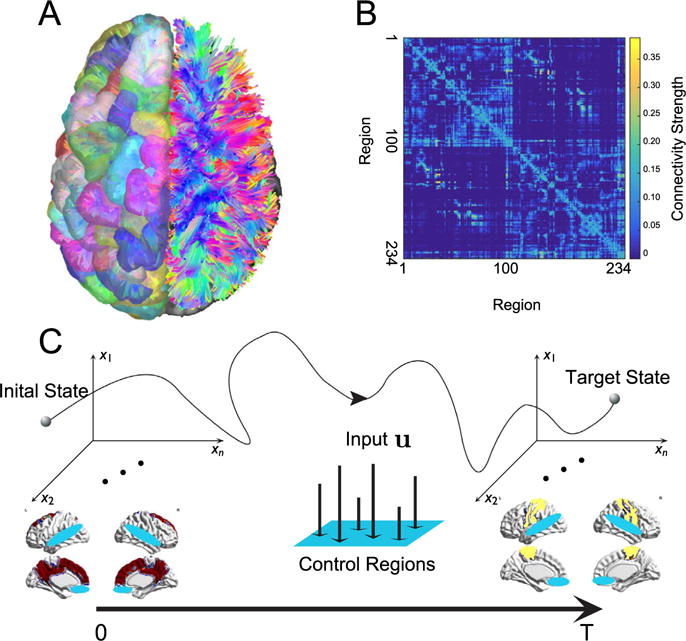
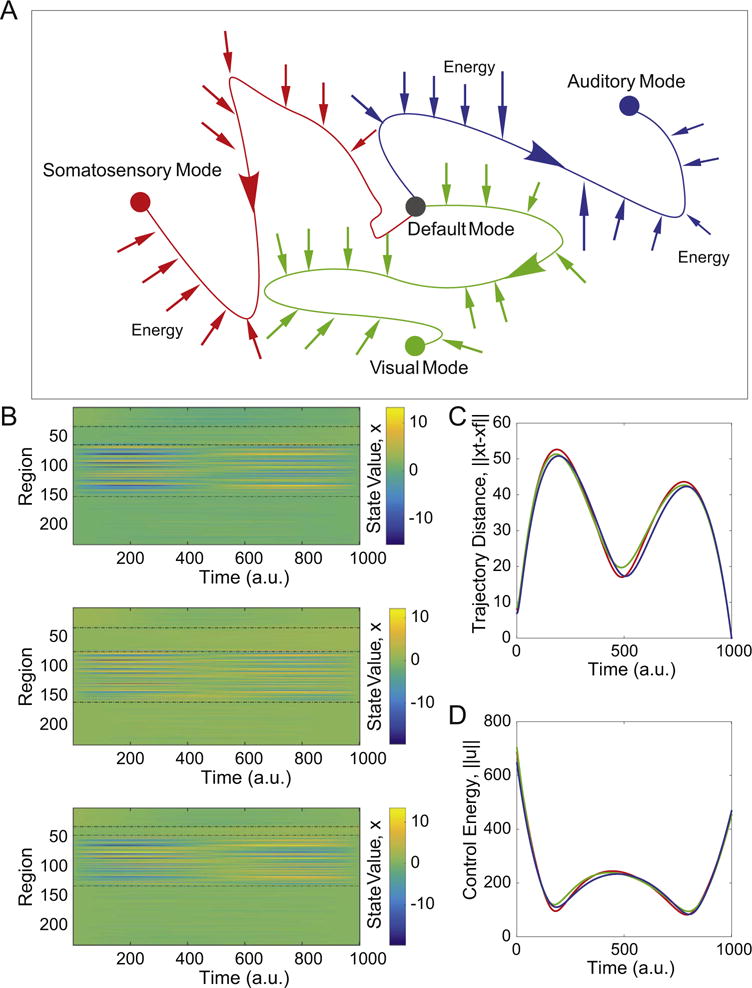
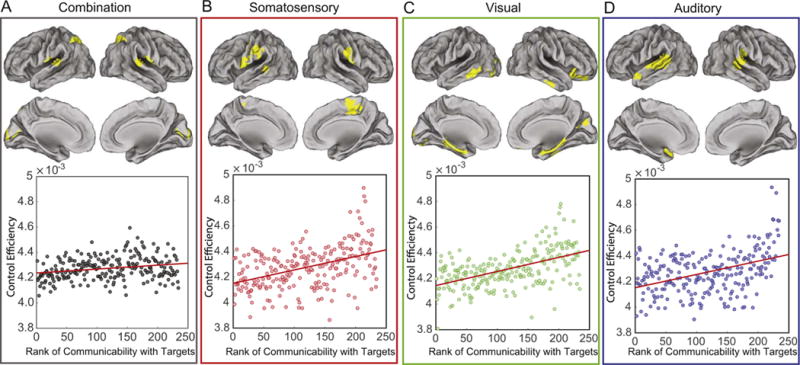
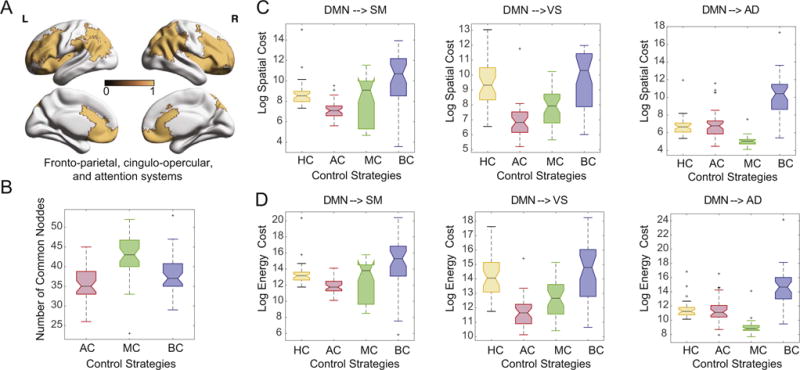
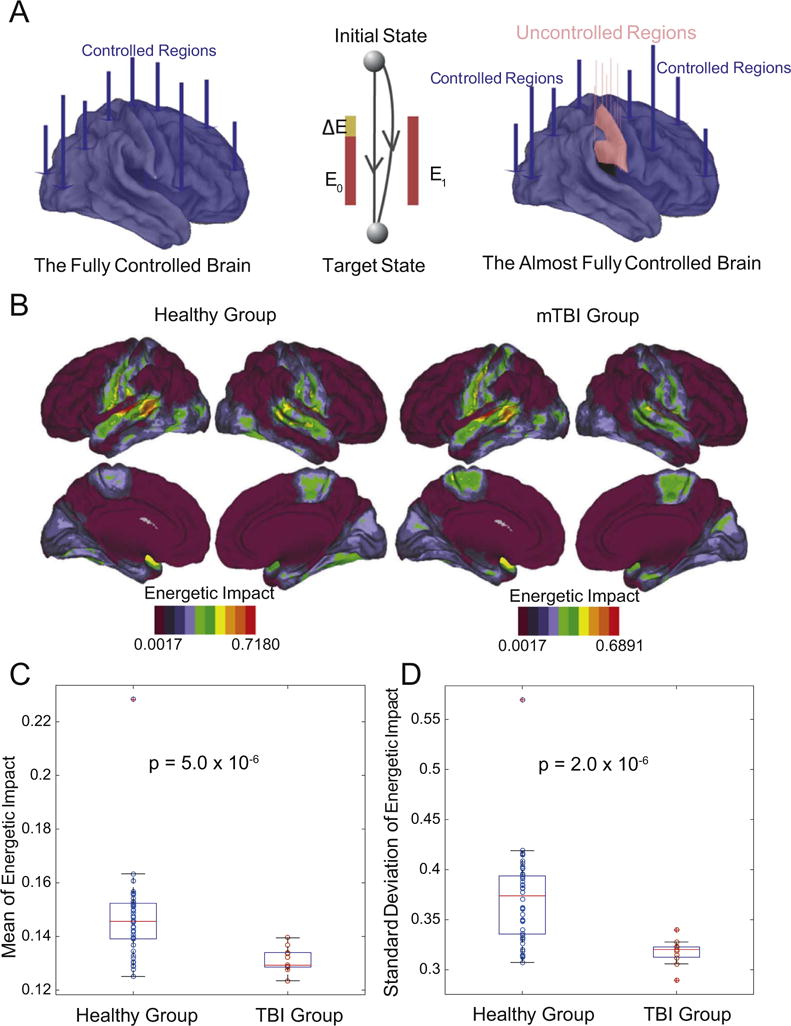
The complexity of neural dynamics stems in part from the complexity of the underlying anatomy. Yet how white matter structure constrains how the brain transitions from one cognitive state to another remains unknown. Here we address this question by drawing on recent advances in network control theory to model the underlying mechanisms of brain state transitions as elicited by the collective control of region sets. We find that previously identified attention and executive control systems are poised to affect a broad array of state transitions that cannot easily be classified by traditional engineering-based notions of control. This theoretical versatility comes with a vulnerability to injury. In patients with mild traumatic brain injury, we observe a loss of specificity in putative control processes, suggesting greater susceptibility to neurophysiological noise. These results offer fundamental insights into the mechanisms driving brain state transitions in healthy cognition and their alteration following injury.
Overview
The claims and statistics of this paper haven’t been checked yet.
Run the check — free, no account needed. It reads the open-access text and checks the sources it cites.
Integrity signals
Registry
Cites
Statistics
Figures
Verification
Claims the paper makes
The claims and statistics of this paper haven’t been checked yet.
Run the check — free, no account needed. It reads the open-access text and checks the sources it cites.
Claims other papers make about this one
Each is checked against this paper’s own text: does it say what the citing paper says it does?
In the citing paper
“(in line with the overarching finding that regions with a large number of long distance connections tend to be optimal controllers79.”
From Paying attention to attention in depression (2019) · cites this paper as [79]
Self-check
Percentages, sums and reported differences re-computed from the paper’s own numbers.
The self-check needs the paper’s full text.
Citations
Cites
Control of goal-directed and stimulus-driven attention in the brain
Corbetta, M., & Shulman, G. L. (2002) · Nature Reviews Neuroscience · doi:10.1038/nrn755 · Cited by 12,881
A default mode of brain function
Raichle, M. E., MacLeod, A. M., Snyder, A. Z., Powers, W. J., Gusnard, D. A., & Shulman, G. L. (2001) · Proceedings of the National Academy of Sciences · doi:10.1073/pnas.98.2.676 · Cited by 12,190
Complex brain networks: graph theoretical analysis of structural and functional systems
Bullmore, E., & Sporns, O. (2009) · Nature Reviews Neuroscience · doi:10.1038/nrn2575 · Cited by 11,820
The organization of the human cerebral cortex estimated by intrinsic functional connectivity
Thomas Yeo, B. T., Krienen, F. M., Sepulcre, J., Sabuncu, M. R., Lashkari, D., Hollinshead, M., Roffman, J. L., Smoller, J. W., Zöllei, L., Polimeni, J. R., et al. (2011) · Journal of Neurophysiology · doi:10.1152/jn.00338.2011 · Cited by 9,182
The attention system of the human brain
Posner, M. I., & Petersen, S. E. (1990) · Annual Review of Neuroscience · doi:10.1146/annurev.ne.13.030190.000325 · Cited by 8,070 · cited 2×
“We take a hypothesis-driven approach and define the “control set” to be composed of dorsal and ventral attention (Posner and Petersen, 1989), fronto-parietal, and cingulo-opercular cognitive control regions (Gu et al., 2015).”
The organization of the human cerebellum estimated by intrinsic functional connectivity
Buckner, R. L., Krienen, F. M., Castellanos, A., Diaz, J. C., & Yeo, B. T. T. (2011) · Journal of Neurophysiology · doi:10.1152/jn.00339.2011 · Cited by 7,304
(2005) · Choice Reviews Online · doi:10.5860/choice.43-0626 · Cited by 4,726
Mapping the structural core of human cerebral cortex
Hagmann, P., Cammoun, L., Gigandet, X., Meuli, R., Honey, C. J., Wedeen, V. J., & Sporns, O. (2008) · PLoS Biology · doi:10.1371/journal.pbio.0060159 · Cited by 4,173
Functional Network Organization of the Human Brain
Power, J. D., Cohen, A. L., Nelson, S. M., Wig, G. S., Barnes, K. A., Church, J. A., Vogel, A. C., Laumann, T. O., Miezin, F. M., Schlaggar, B. L., et al. (2011) · Neuron · doi:10.1016/j.neuron.2011.09.006 · Cited by 4,124
The brain's default mode network
Raichle, M. E. (2015) · Annual Review of Neuroscience · doi:10.1146/annurev-neuro-071013-014030 · Cited by 3,904
Research works printed but not linked: 1
- Kandel, E.R., Schwartz, J.H., Jessell, T.M. et al., 2000. Principles of Neural Science, vol. 4. McGraw-Hill, New York.
Cited by
Sorted by citations
The physics of brain network structure, function and control
Lynn, C. W., & Bassett, D. S. (2019) · Nature Reviews Physics · doi:10.1038/s42254-019-0040-8 · Cited by 452
Self-citationPaying attention to attention in depression
Keller, A. S., Leikauf, J. E., Holt-Gosselin, B., Staveland, B. R., & Williams, L. M. (2019) · Translational Psychiatry · doi:10.1038/s41398-019-0616-1 · Cited by 329
Awakening: Predicting external stimulation to force transitions between different brain states
Deco, G., Cruzat, J., Cabral, J., Tagliazucchi, E., Laufs, H., Logothetis, N. K., & Kringelbach, M. L. (2019) · Proceedings of the National Academy of Sciences · doi:10.1073/pnas.1905534116 · Cited by 261
Brain States and Transitions: Insights from Computational Neuroscience
Kringelbach, M. L., & Deco, G. (2020) · Cell Reports · doi:10.1016/j.celrep.2020.108128 · Cited by 249
From maps to multi-dimensional network mechanisms of mental disorders
Braun, U., Schaefer, A., Betzel, R. F., Tost, H., Meyer-Lindenberg, A., & Bassett, D. S. (2018) · Neuron · doi:10.1016/j.neuron.2017.11.007 · Cited by 177
Self-citation
Metadata
- Authors
- Gu, S., Betzel, R. F., Mattar, M. G., Cieslak, M., Delio, P. R., Grafton, S. T., Pasqualetti, F., & Bassett, D. S.
- Affiliations
- University of Pennsylvania (US)
- Princeton University (US)
- University of California, Santa Barbara (US)
- University of California, Riverside (US)
- Corresponding author
- Bassett, Danielle S.
- ORCID
- Venue
- NeuroImage
- Publisher
- Elsevier BV
- Published
- 2017-03
- Volume
- 148
- Pages
- 305-317
- ISSN
- 1053-8119 (ISSN-L)
- PMC
- PMC5489344
- OpenAlex
- W2963186114
- Cited by
- 183
- References
- 105
- Citations by year
- 2026: 9 · 2025: 19 · 2024: 20 · 2023: 19 · 2022: 22 · 2021: 19 · 2020: 23 · 2019: 16 · 2018: 21 · 2017: 13
- FWCI
- 11.46
- Type
- journal article
- Language
- en
- Open access
- hybrid
- doi.org
- Licence
- Locations
- NeuroImage (publishedVersion, cc-by-nc-nd)
- PubMed (publishedVersion)
- Europe PMC (PubMed Central) (acceptedVersion, other-oa)
- PubMed Central (acceptedVersion, cc-by-nc-nd)
- arXiv (Cornell University) (submittedVersion)
- arXiv (Cornell University)
- Funders
- National Science Foundation (W911NF-10-2-0022, 1430280, 1R01HD086888-01, 1554488, 1430087, CAREER, 2-R01-DC-009209-11, 1441502, W911NF-14-1-0679)
- John D. and Catherine T. MacArthur Foundation (W911NF-10-2-0022, W911NF-14-1-0679, 2-R01-DC-009209-11, 1R01HD086888-01, BCS-1441502, PHY-1554488)
- Alfred P. Sloan Foundation (W911NF-10-2-0022, W911NF-14-1-0679, 2-R01-DC-009209-11, BCS-1441502, PHY-1554488, 1R01HD086888-01)
- National Institutes of Health (5r01ns099348-04, 2r01dc009209-11, 1r01hd086888-01)
- Office of Naval Research (BCS-1441502, PHY-1554488, W911NF-10-2-0022, W911NF-14-1-0679, CAREER PHY-1554488, 1R01HD086888-01, BCS-1430087, 2-R01-DC-009209-11)
- National Institute of Mental Health (2R01‐DC‐009209‐11, R01-DC-009209-11, R21MH106799)
- National Institute on Deafness and Other Communication Disorders (R01-DC009209)
- National Institute of Neurological Disorders and Stroke ((R01 NS099348)
- National Institute of Child Health and Human Development (1R01HD086888-01)
- Eunice Kennedy Shriver National Institute of Child Health and Human Development (R01 HD086888)
- Army Research Office (1R01HD086888-01, PHY-1554488, W911NF-14–1-0679, BCS-1441502, W911NF-14-1, R01-DC-009209-11, W911NF-10-2-0022, W911NF, 2-R01-DC-009209-11)
- Army Research Laboratory (W911-NF-10-2-0022, W911NF-14-1-0679, 1R01HD086888-01, PHY-1554488, W911NF, 2-R01-DC-009209-11, BCS-1441502, W911NF-10)
- Topics
- Life Sciences › Neuroscience › Cognitive Neuroscience › Functional Brain Connectivity Studies
- Life Sciences › Neuroscience › Cognitive Neuroscience › Neural dynamics and brain function
- Health Sciences › Medicine › Radiology, Nuclear Medicine and Imaging › Advanced Neuroimaging Techniques and Applications
- Keywords
- brain state transitions, network control theory, white matter structure, attention, executive function, mild traumatic brain injury, cognitive states, neural dynamics
- MeSH terms
- Brain Injuries, Traumatic, Adult, Algorithms, Attention, Brain, Cerebral Cortex, Cognition, Cognition Disorders, Energy Metabolism, Female, Humans, Male, Psychomotor Performance, Diffusion Magnetic Resonance Imaging, Young Adult, Executive Function, Healthy Volunteers, White Matter
About these checks
Registry, retraction, Cites and statistics results are computed, not judged, with one exception: a printed reference that no index lists is read once by a model before it counts as a citation error. Claims are extracted by a model and kept only when their quote appears verbatim in the text; each cited source is then checked, with a model’s help, for whether it says what the claim relies on. Those verdicts can be wrong — read the claim’s quote and the cited source before relying on one.
Statistics and arithmetic are recomputed, not judged.
Confidence bands are shown only for fields calibrated on our annotated test set. None is calibrated yet, so no band is shown.
What counts as a claim ›How we measure confidence ›How we check this ›
Are you an author, or do you see a problem with this page? Request a review
