

The DOI matches its Crossref record; 107 of the 107 references it cites were found in a registry or an index.
Optimal trajectories of brain state transitions
Open accessAbstract
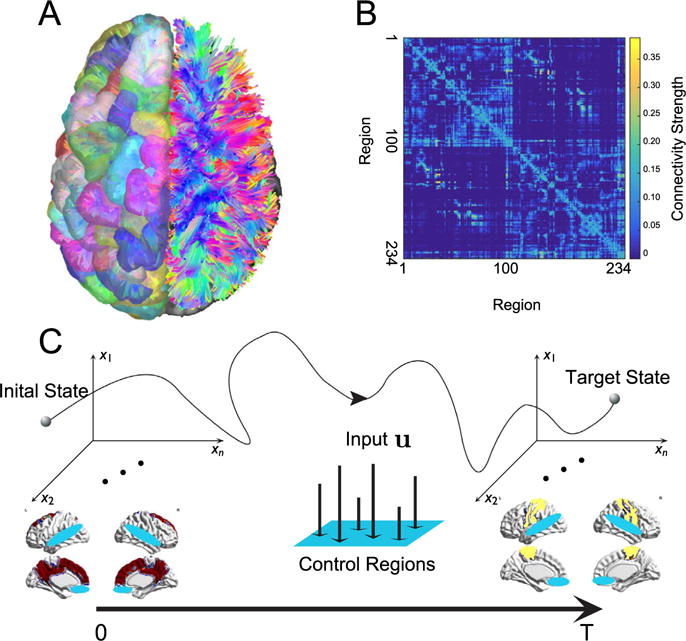
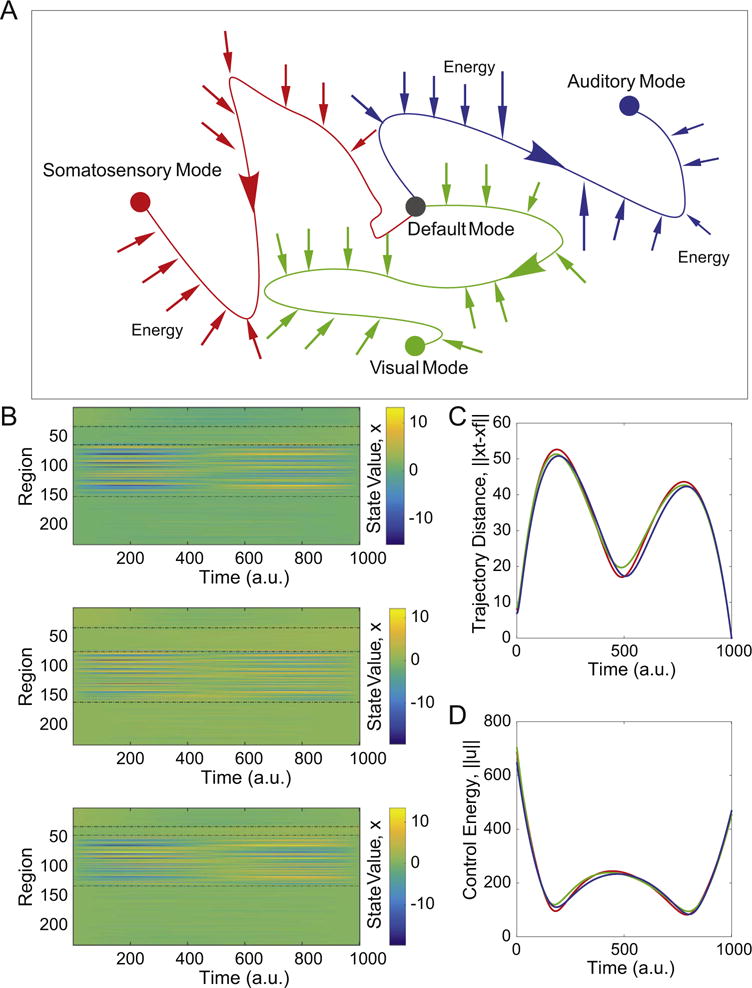
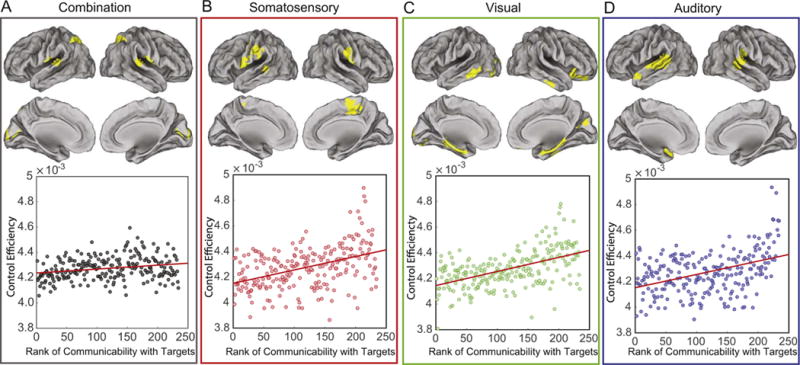
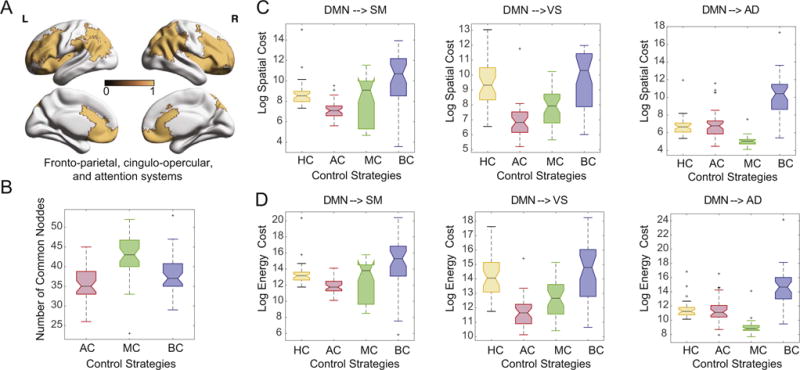
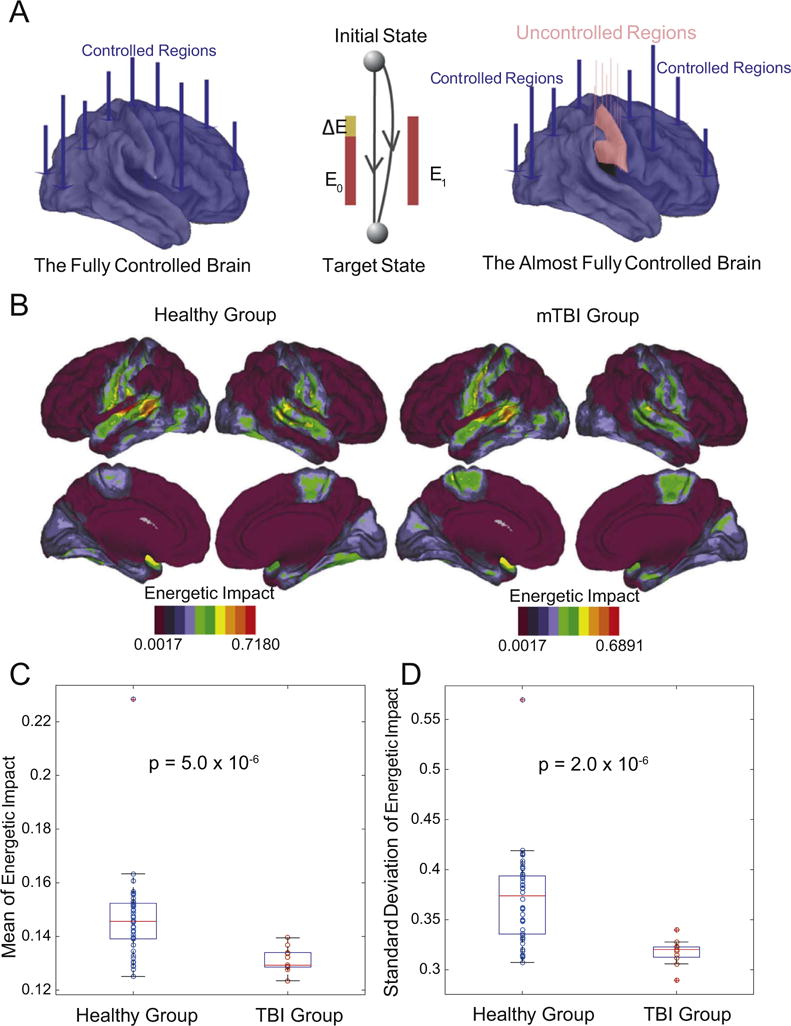
The complexity of neural dynamics stems in part from the complexity of the underlying anatomy. Yet how white matter structure constrains how the brain transitions from one cognitive state to another remains unknown. Here we address this question by drawing on recent advances in network control theory to model the underlying mechanisms of brain state transitions as elicited by the collective control of region sets. We find that previously identified attention and executive control systems are poised to affect a broad array of state transitions that cannot easily be classified by traditional engineering-based notions of control. This theoretical versatility comes with a vulnerability to injury. In patients with mild traumatic brain injury, we observe a loss of specificity in putative control processes, suggesting greater susceptibility to neurophysiological noise. These results offer fundamental insights into the mechanisms driving brain state transitions in healthy cognition and their alteration following injury.
Overview
The claims and statistics of this paper haven’t been checked yet.
Run the check — free, no account needed. It reads the open-access text and checks the sources it cites.
Integrity signals
Registry
Cites
Statistics
Figures
Verification
Claims the paper makes
The claims and statistics of this paper haven’t been checked yet.
Run the check — free, no account needed. It reads the open-access text and checks the sources it cites.
Claims other papers make about this one
Each is checked against this paper’s own text: does it say what the citing paper says it does?
In the citing paper
“(in line with the overarching finding that regions with a large number of long distance connections tend to be optimal controllers79.”
From Paying attention to attention in depression (2019) · cites this paper as [79]
Self-check
Percentages, sums and reported differences re-computed from the paper’s own numbers.
The self-check needs the paper’s full text.
Citations
Cites
Control of goal-directed and stimulus-driven attention in the brain
Corbetta, M., & Shulman, G. L. (2002) · Nature Reviews Neuroscience · doi:10.1038/nrn755 · Cited by 12,881
A default mode of brain function
Raichle, M. E., MacLeod, A. M., Snyder, A. Z., Powers, W. J., Gusnard, D. A., & Shulman, G. L. (2001) · Proceedings of the National Academy of Sciences · doi:10.1073/pnas.98.2.676 · Cited by 12,190
Complex brain networks: graph theoretical analysis of structural and functional systems
Bullmore, E., & Sporns, O. (2009) · Nature Reviews Neuroscience · doi:10.1038/nrn2575 · Cited by 11,820
The organization of the human cerebral cortex estimated by intrinsic functional connectivity
Thomas Yeo, B. T., Krienen, F. M., Sepulcre, J., Sabuncu, M. R., Lashkari, D., Hollinshead, M., Roffman, J. L., Smoller, J. W., Zöllei, L., Polimeni, J. R., et al. (2011) · Journal of Neurophysiology · doi:10.1152/jn.00338.2011 · Cited by 9,182
The attention system of the human brain
Posner, M. I., & Petersen, S. E. (1990) · Annual Review of Neuroscience · doi:10.1146/annurev.ne.13.030190.000325 · Cited by 8,070 · cited 2×
“We take a hypothesis-driven approach and define the “control set” to be composed of dorsal and ventral attention (Posner and Petersen, 1989), fronto-parietal, and cingulo-opercular cognitive control regions (Gu et al., 2015).”
The organization of the human cerebellum estimated by intrinsic functional connectivity
Buckner, R. L., Krienen, F. M., Castellanos, A., Diaz, J. C., & Yeo, B. T. T. (2011) · Journal of Neurophysiology · doi:10.1152/jn.00339.2011 · Cited by 7,304
(2005) · Choice Reviews Online · doi:10.5860/choice.43-0626 · Cited by 4,726
Mapping the structural core of human cerebral cortex
Hagmann, P., Cammoun, L., Gigandet, X., Meuli, R., Honey, C. J., Wedeen, V. J., & Sporns, O. (2008) · PLoS Biology · doi:10.1371/journal.pbio.0060159 · Cited by 4,173
Functional Network Organization of the Human Brain
Power, J. D., Cohen, A. L., Nelson, S. M., Wig, G. S., Barnes, K. A., Church, J. A., Vogel, A. C., Laumann, T. O., Miezin, F. M., Schlaggar, B. L., et al. (2011) · Neuron · doi:10.1016/j.neuron.2011.09.006 · Cited by 4,124
The brain's default mode network
Raichle, M. E. (2015) · Annual Review of Neuroscience · doi:10.1146/annurev-neuro-071013-014030 · Cited by 3,904
Interplay between Cortical Spreading Depolarization and Seizures
Kramer, D. R., Fujii, T., Ohiorhenuan, I. E., & Liu, C. Y. (2017) · Stereotactic and Functional Neurosurgery · doi:10.1159/000452841 · Cited by 3,721
An Energy Budget for Signaling in the Grey Matter of the Brain
Attwell, D., & Laughlin, S. B. (2001) · Journal of Cerebral Blood Flow & Metabolism · doi:10.1097/00004647-200110000-00001 · Cited by 3,543
Predicting human resting-state functional connectivity from structural connectivity
Honey, C. J., Sporns, O., Cammoun, L., Gigandet, X., Thiran, J. P., Meuli, R., & Hagmann, P. (2009) · Proceedings of the National Academy of Sciences · doi:10.1073/pnas.0811168106 · Cited by 3,307
Controllability of complex networks
Liu, Y., Slotine, J.-J. E., & Barabási, A.-Ĺ. (2011) · Nature · doi:10.1038/nature10011 · Cited by 3,238
Sridharan, D., Levitin, D. J., & Menon, V. (2008) · Proceedings of the National Academy of Sciences · doi:10.1073/pnas.0800005105 · Cited by 2,892
A default mode of brain function: a brief history of an evolving idea
Raichle, M. E., & Snyder, A. Z. (2007) · NeuroImage · doi:10.1016/j.neuroimage.2007.02.041 · Cited by 2,173
Emerging concepts for the dynamical organization of resting-state activity in the brain
Deco, G., Jirsa, V. K., & McIntosh, A. R. (2011) · Nature reviews. Neuroscience · doi:10.1038/nrn2961 · Cited by 1,798
Network structure of cerebral cortex shapes functional connectivity on multiple time scales
Honey, C. J., Kötter, R., Breakspear, M. J., & Sporns, O. (2007) · Proceedings of the National Academy of Sciences · doi:10.1073/pnas.0701519104 · Cited by 1,727
Dynamic reconfiguration of human brain networks during learning
Bassett, D. S., Wymbs, N. F., Porter, M. A., Mucha, P. J., Carlson, J. M., & Grafton, S. T. (2011) · Proceedings of the National Academy of Sciences · doi:10.1073/pnas.1018985108 · Cited by 1,705
Self-citationInverted-U–Shaped Dopamine Actions on Human Working Memory and Cognitive Control
Cools, R., & D'Esposito, M. (2011) · Biological Psychiatry · doi:10.1016/j.biopsych.2011.03.028 · Cited by 1,673
Modern network science of neurological disorders
Stam, C. J. (2014) · Nature reviews. Neuroscience · doi:10.1038/nrn3801 · Cited by 1,327
Axonal pathology in traumatic brain injury
Johnson, V. E., Stewart, W., & Smith, D. H. (2013) · Experimental Neurology · doi:10.1016/j.expneurol.2012.01.013 · Cited by 1,273
The metabolic cost of neural information
Laughlin, S. B., van Steveninck, R. R. D. R., & Anderson, J. C. (1998) · Nature Neuroscience · doi:10.1038/236 · Cited by 1,175
Introduction to dynamic systems: theory, models and applications
(1981) · Mathematics and Computers in Simulation · doi:10.1016/0378-4754(81)90069-0 · Cited by 1,136
Dysconnection in schizophrenia: from abnormal synaptic plasticity to failures of self-monitoring
Stephan, K. E., Friston, K. J., & Frith, C. D. (2009) · Schizophrenia Bulletin · doi:10.1093/schbul/sbn176 · Cited by 1,134
Energy limitation as a selective pressure on the evolution of sensory systems
Niven, J. E., & Laughlin, S. B. (2008) · Journal of Experimental Biology · doi:10.1242/jeb.017574 · Cited by 1,056
Controllability of structural brain networks
Gu, S., Pasqualetti, F., Cieslak, M., Telesford, Q. K., Yu, A. B., Kahn, A. E., Medaglia, J. D., Vettel, J. M., Miller, M. B., Grafton, S. T., et al. (2015) · Nature Communications · doi:10.1038/ncomms9414 · Cited by 912
Self-citationAge-related changes in modular organization of human brain functional networks
Meunier, D., Achard, S., Morcom, A., & Bullmore, E. (2009) · NeuroImage · doi:10.1016/j.neuroimage.2008.09.062 · Cited by 756
Thomas, C., Ye, F. Q., Irfanoglu, M. O., Modi, P., Saleem, K. S., Leopold, D. A., & Pierpaoli, C. (2014) · Proceedings of the National Academy of Sciences · doi:10.1073/pnas.1405672111 · Cited by 725
White matter damage and cognitive impairment after traumatic brain injury
Kinnunen, K. M., Greenwood, R., Powell, J. H., Leech, R., Hawkins, P. C. T., Bonnelle, V., Patel, M. C., Counsell, S. J., & Sharp, D. J. (2010) · Brain · doi:10.1093/brain/awq347 · Cited by 685
Network dysfunction after traumatic brain injury
Sharp, D. J., Scott, G., & Leech, R. (2014) · Nature Reviews Neurology · doi:10.1038/nrneurol.2014.15 · Cited by 657
Moment-to-moment brain signal variability: A next frontier in human brain mapping?
Garrett, D. D., Samanez-Larkin, G. R., MacDonald, S. W. S., Lindenberger, U., McIntosh, A. R., & Grady, C. L. (2013) · Neuroscience & Biobehavioral Reviews · doi:10.1016/j.neubiorev.2013.02.015 · Cited by 624
Controllability Metrics, Limitations and Algorithms for Complex Networks
Pasqualetti, F., Zampieri, S., & Bullo, F. (2014) · IEEE Transactions on Control of Network Systems · doi:10.1109/tcns.2014.2310254 · Cited by 608
Self-citationLearning-induced autonomy of sensorimotor systems
Bassett, D. S., Yang, M., Wymbs, N. F., & Grafton, S. T. (2015) · Nature Neuroscience · doi:10.1038/nn.3993 · Cited by 603
Self-citationStructural foundations of resting-state and task-based functional connectivity in the human brain
Hermundstad, A. M., Bassett, D. S., Brown, K., Aminoff, E., Clewett, D., Freeman, S., Frithsen, A., Johnson, A., Tipper, C. M., Miller, M. B., et al. (2013) · Proceedings of the National Academy of Sciences · doi:10.1073/pnas.1219562110 · Cited by 580
Self-citationResting-brain functional connectivity predicted by analytic measures of network communication
Goñi, J., van den Heuvel, M. P., Avena‐Koenigsberger, A., de Mendizábal, N. V., Betzel, R. F., Griffa, A., Hagmann, P., Corominas‐Murtra, B., Thiran, J., & Sporns, O. (2013) · Proceedings of the National Academy of Sciences · doi:10.1073/pnas.1315529111 · Cited by 570
Self-citationFunctional connectivity dynamics: modeling the switching behavior of the resting state
Hansen, E. C. A., Battaglia, D., Spiegler, A., Deco, G., & Jirsa, V. K. (2015) · NeuroImage · doi:10.1016/j.neuroimage.2014.11.001 · Cited by 528
Sidaros, A., Engberg, A. W., Sidaros, K., Liptrot, M. G., Herning, M., Petersen, P., Paulson, O. B., Jernigan, T. L., & Rostrup, E. (2007) · Brain · doi:10.1093/brain/awm294 · Cited by 526
Mapping the human connectome at multiple scales with diffusion spectrum MRI
Cammoun, L., Gigandet, X., Meskaldji, D. E., Thiran, J., Sporns, O., Kim, Q., Maeder, P. P., Meuli, R. A., & Hagmann, P. (2011) · Journal of Neuroscience Methods · doi:10.1016/j.jneumeth.2011.09.031 · Cited by 451
Undirected graphs of frequency-dependent functional connectivity in whole brain networks
Salvador, R., Suckling, J., Schwarzbauer, C., & Bullmore, E. (2005) · Philosophical Transactions of the Royal Society B: Biological Sciences · doi:10.1098/rstb.2005.1645 · Cited by 437
(2014) · The MIT Press eBooks · doi:10.7551/mitpress/9504.001.0001 · Cited by 436
Dynamic cooperation and competition between brain systems during cognitive control
Cocchi, L., Zalesky, A., Fornito, A., & Mattingley, J. B. (2013) · Trends in Cognitive Sciences · doi:10.1016/j.tics.2013.08.006 · Cited by 429
Cognitive Network Neuroscience
Medaglia, J. D., Lynall, M.-E., & Bassett, D. S. (2015) · Journal of Cognitive Neuroscience · doi:10.1162/jocn_a_00810 · Cited by 419
Self-citationReveley, C., Seth, A. K., Pierpaoli, C., Silva, A. C., Yu, D., Saunders, R. C., Leopold, D. A., & Ye, F. Q. (2015) · Proceedings of the National Academy of Sciences · doi:10.1073/pnas.1418198112 · Cited by 417
Controlling Complex Networks: How Much Energy Is Needed?
Yan, G. F., Ren, J., Lai, Y., Lai, C.-H., & Li, B. (2012) · Physical Review Letters · doi:10.1103/physrevlett.108.218703 · Cited by 411
Bassett, D. S., Greenfield, D. L., Meyer‐Lindenberg, A., Weinberger, D. R., Moore, S. W., & Bullmore, E. T. (2010) · PLoS Computational Biology · doi:10.1371/journal.pcbi.1000748 · Cited by 401
Self-citationConnection Patterns Distinguish 3 Regions of Human Parietal Cortex
Rushworth, M. F. S., Behrens, T. E. J., & Johansen‐Berg, H. (2005) · Cerebral Cortex · doi:10.1093/cercor/bhj079 · Cited by 390
Conserved and variable architecture of human white matter connectivity
Bassett, D., Brown, J. A., Deshpande, V., Carlson, J., & Grafton, S. T. (2011) · NeuroImage · doi:10.1016/j.neuroimage.2010.09.006 · Cited by 380
Self-citationUnraveling the Miswired Connectome: A Developmental Perspective
Martino, A. D., Fair, D. A., Kelly, C. A. M., Satterthwaite, T. D., Castellanos, F. X., Thomason, M. E., Craddock, R. C., Luna, B., LEVENTHAL, B. L., Zuo, X., et al. (2014) · Neuron · doi:10.1016/j.neuron.2014.08.050 · Cited by 357
Task-Based Core-Periphery Organization of Human Brain Dynamics
Bassett, D. S., Wymbs, N. F., Rombach, M. P., Porter, M. A., Mucha, P. J., & Grafton, S. T. (2013) · PLoS Computational Biology · doi:10.1371/journal.pcbi.1003171 · Cited by 356
Self-citationRecurrent network models of sequence generation and memory
Rajan, K., Harvey, C. D., & Tank, D. W. (2016) · Neuron · doi:10.1016/j.neuron.2016.02.009 · Cited by 351
Cooperative and competitive spreading dynamics on the human connectome
Mišić, B., Betzel, R. F., Nematzadeh, A., Goñi, J., Griffa, A., Hagmann, P., Flammini, A., Ahn, Y.-Y., & Sporns, O. (2015) · Neuron · doi:10.1016/j.neuron.2015.05.035 · Cited by 342
Self-citationMechanisms for recovery of motor function following cortical damage
Nudo, R. J. (2006) · Current Opinion in Neurobiology · doi:10.1016/j.conb.2006.10.004 · Cited by 332
Small-World Propensity and Weighted Brain Networks
Muldoon, S. F., Bridgeford, E., & Bassett, D. S. (2016) · Scientific Reports · doi:10.1038/srep22057 · Cited by 316
Self-citationStimulation-Based Control of Dynamic Brain Networks
Muldoon, S. F., Pasqualetti, F., Gu, S., Cieslak, M., Grafton, S. T., Vettel, J. M., & Bassett, D. S. (2016) · PLoS Computational Biology · doi:10.1371/journal.pcbi.1005076 · Cited by 298
Self-citationJohnston, J. M., Vaishnavi, S. N., Smyth, M. D., Zhang, D., He, B. J., Zempel, J. M., Shimony, J. S., Snyder, A. Z., & Raichle, M. E. (2008) · Journal of Neuroscience · doi:10.1523/jneurosci.0573-08.2008 · Cited by 296
The Connectome Mapper: An Open-Source Processing Pipeline to Map Connectomes with MRI
Daducci, A., Gerhard, S., Griffa, A., Lemkaddem, A., Cammoun, L., Gigandet, X., Meuli, R. A., Hagmann, P., & Thiran, J. (2012) · PLoS ONE · doi:10.1371/journal.pone.0048121 · Cited by 275
Fiete, I., Senn, W., Wang, C. Z.-H., & Hahnloser, R. H. R. (2010) · Neuron · doi:10.1016/j.neuron.2010.02.003 · Cited by 269
Bzdok, D., Langner, R., Schilbach, L., Jakobs, O., Roski, C., Caspers, S., Laird, A. R., Fox, P. T., Zilles, K., & Eickhoff, S. B. (2013) · NeuroImage · doi:10.1016/j.neuroimage.2013.05.046 · Cited by 262
Abdelnour, F., Voss, H. U., & Raj, A. (2014) · NeuroImage · doi:10.1016/j.neuroimage.2013.12.039 · Cited by 260
Evaluation and statistical inference for human connectomes
Pestilli, F., Yeatman, J. D., Rokem, A., Kay, K. N., & Wandell, B. A. (2014) · Nature Methods · doi:10.1038/nmeth.3098 · Cited by 259
Treating Working Memory Deficits in Schizophrenia: A Review of the Neurobiology
Lett, T. A., Voineskos, A. N., Kennedy, J. L., Levine, B., & Daskalakis, Z. J. (2014) · Biological Psychiatry · doi:10.1016/j.biopsych.2013.07.026 · Cited by 257
Optimally controlling the human connectome: the role of network topology
Betzel, R. F., Gu, S., Medaglia, J. D., Pasqualetti, F., & Bassett, D. S. (2016) · Scientific Reports · doi:10.1038/srep30770 · Cited by 247
Self-citationCausal effect of disconnection lesions on interhemispheric functional connectivity in rhesus monkeys
O’Reilly, J. X., Croxson, P. L., Jbabdi, S., Sallet, J., Noonan, M. P., Mars, R. B., Browning, P. G. F., Wilson, C. R. E., Mitchell, A. S., Miller, K. L., et al. (2013) · Proceedings of the National Academy of Sciences · doi:10.1073/pnas.1305062110 · Cited by 225
Upstream Dysfunction of Somatomotor Functional Connectivity After Corticospinal Damage in Stroke
Carter, A. R., Patel, K. R., Astafiev, S. V., Snyder, A. Z., Rengachary, J., Strube, M., Pope, A., Shimony, J. S., Lang, C. E., Shulman, G. L., et al. (2011) · Neurorehabilitation and neural repair · doi:10.1177/1545968311411054 · Cited by 216
Virtual Cortical Resection Reveals Push-Pull Network Control Preceding Seizure Evolution
Khambhati, A. N., Davis, K. A., Lucas, T. H., Litt, B., & Bassett, D. S. (2016) · Neuron · doi:10.1016/j.neuron.2016.07.039 · Cited by 212
Self-citationAdachi, Y., Osada, T., Sporns, O., Watanabe, T., Matsui, T., Miyamoto, K., & Miyashita, Y. (2012) · Cerebral Cortex · doi:10.1093/cercor/bhr234 · Cited by 211
The Treatment of Hallucinations in Schizophrenia Spectrum Disorders
Sommer, I. E., Slotema, C. W., Daskalakis, Z. J., Derks, E. M., Blom, J. D., & van der Gaag, M. (2012) · Schizophrenia Bulletin · doi:10.1093/schbul/sbs034 · Cited by 199
Collin, G., & van den Heuvel, M. P. (2013) · The Neuroscientist · doi:10.1177/1073858413503712 · Cited by 198
Disconnection of network hubs and cognitive impairment after traumatic brain injury
Fagerholm, E. D., Hellyer, P. J., Scott, G., Leech, R., & Sharp, D. J. (2015) · Brain · doi:10.1093/brain/awv075 · Cited by 193
On How Network Architecture Determines the Dominant Patterns of Spontaneous Neural Activity
Galán, R. F. (2008) · PLoS ONE · doi:10.1371/journal.pone.0002148 · Cited by 185
A weighted communicability measure applied to complex brain networks
Crofts, J. J., & Higham, D. J. (2009) · Journal of The Royal Society Interface · doi:10.1098/rsif.2008.0484 · Cited by 176
Cognitive-behavioral treatments for tinnitus: a review of the literature
Cima, R. F. F., Andersson, G., Schmidt, C. J., & Henry, J. A. (2014) · Journal of the American Academy of Audiology · doi:10.3766/jaaa.25.1.4 · Cited by 155 · cited 1×
“A prime empirical example of multi-point control is cognitive behavioral therapy, which offers a spatio-temporal pattern of activations that enhances cognitive function and decreases psychiatric symptoms across diagnostic categories (Lett et al., 2014; Radhu et al., 2012; Cima et al., 2014).”
The Energy Landscape of Neurophysiological Activity Implicit in Brain Network Structure
Gu, S., Cieslak, M., Baird, B., Muldoon, S. F., Grafton, S. T., Pasqualetti, F., & Bassett, D. S. (2018) · Scientific Reports · doi:10.1038/s41598-018-20123-8 · Cited by 118
Self-citationFew inputs can reprogram biological networks
Müller, F.-J., & Schuppert, A. (2011) · Nature · doi:10.1038/nature10543 · Cited by 109
Jbabdi, S., Sotiropoulos, S. N., & Behrens, T. E. (2013) · Current Opinion in Neurobiology · doi:10.1016/j.conb.2012.12.004 · Cited by 107
Distributed synchrony in a cell assembly of spiking neurons
Levy, N., Horn, D., Meilijson, I., & Ruppin, E. (2001) · Neural Networks · doi:10.1016/s0893-6080(01)00044-2 · Cited by 106
Individual prediction of white matter injury following traumatic brain injury
Hellyer, P. J., Leech, R., Ham, T. E., Bonnelle, V., & Sharp, D. J. (2012) · Annals of Neurology · doi:10.1002/ana.23824 · Cited by 95
Computational significance of transient dynamics in cortical networks
Durstewitz, D., & Deco, G. (2007) · European Journal of Neuroscience · doi:10.1111/j.1460-9568.2007.05976.x · Cited by 95
A disconnection account of Gerstmann syndrome: Functional neuroanatomy evidence
Rusconi, E., Pinel, P., Eger, E., Bihan, D. L., Thirion, B., Dehaene, S., & Kleinschmidt, A. K. (2009) · Annals of Neurology · doi:10.1002/ana.21776 · Cited by 92
Luenberger, D. G. (1979) · doi:10.21236/ada080206 · Cited by 92
Structurally-Constrained Relationships between Cognitive States in the Human Brain
Hermundstad, A. M., Brown, K., Bassett, D. S., Aminoff, E., Frithsen, A., Johnson, A., Tipper, C. M., Miller, M. B., Grafton, S. T., & Carlson, J. M. (2014) · PLoS Computational Biology · doi:10.1371/journal.pcbi.1003591 · Cited by 91
Self-citationResolving Structural Variability in Network Models and the Brain
Klimm, F., Bassett, D. S., Carlson, J. M., & Mucha, P. J. (2014) · PLoS Computational Biology · doi:10.1371/journal.pcbi.1003491 · Cited by 89
Self-citationA dynamical systems view of motor preparation
Shenoy, K. V., Kaufman, M. T., Sahani, M., & Churchland, M. M. (2011) · Progress in brain research · doi:10.1016/b978-0-444-53355-5.00003-8 · Cited by 81
Task-Based Core-Periphery Organisation of Human Brain DynamicsPreprint
Bassett, D. S., Wymbs, N. F., Rombach, M. P., Porter, M. A., Mucha, P. J., & Grafton, S. T. (2012) · arXiv (Cornell University) · doi:10.48550/arxiv.1210.3555 · Cited by 81
Self-citationControl without Controllers: Toward a Distributed Neuroscience of Executive Control
Eisenreich, B. R., Akaishi, R., & Hayden, B. Y. (2017) · Journal of Cognitive Neuroscience · doi:10.1162/jocn_a_01139 · Cited by 79
Brain signal variability relates to stability of behavior after recovery from diffuse brain injury
Beharelle, A. R., Kovačević, N., McIntosh, A. R., & Levine, B. (2012) · NeuroImage · doi:10.1016/j.neuroimage.2012.01.037 · Cited by 78
Classification of weighted networks through mesoscale homological features
Sizemore, A. E., Giusti, C., & Bassett, D. S. (2016) · Journal of Complex Networks · doi:10.1093/comnet/cnw013 · Cited by 74
Self-citationThe theory of optimal processes. I. The maximum principle
Boltyanskii, V. G., Gamkrelidze, R. V., & Pontryagin, L. S. (1961) · Translations - American Mathematical Society/Translations · doi:10.1090/trans2/018/20 · Cited by 73
On Human Brain Networks in Health and Disease
Braun, U., Muldoon, S. F., & Bassett, D. S. (2015) · Wiley eBooks · doi:10.1002/9780470015902.a0025783 · Cited by 62
Self-citationFreeman, W. (1994) · Integrative Psychological and Behavioral Science · doi:10.1007/bf02691333 · Cited by 58
Learning, Memory, and the Role of Neural Network Architecture
Hermundstad, A. M., Brown, K., Bassett, D. S., & Carlson, J. M. (2011) · PLoS Computational Biology · doi:10.1371/journal.pcbi.1002063 · Cited by 52
Self-citationDistributed control in a mean-field cortical network model: Implications for seizure suppression
Ching, S., Brown, E. N., & Kramer, M. A. M. (2012) · Physical Review E · doi:10.1103/physreve.86.021920 · Cited by 48
Szameitat, A. J., Schubert, T., & Müller, H. J. (2010) · NeuroImage · doi:10.1016/j.neuroimage.2010.07.069 · Cited by 48
Tortella, G., Selingardi, P. M. L., Moreno, M., Veronezi, B. P., & Brunoni, A. R. (2015) · CNS & Neurological Disorders - Drug Targets · doi:10.2174/1871527313666141130224431 · Cited by 47
Collin, G., de Nijs, J., Pol, H. E. H., Cahn, W., & van den Heuvel, M. P. (2015) · Schizophrenia Research · doi:10.1016/j.schres.2015.03.012 · Cited by 42
Fluctuations in Cortical Synchronization in Pediatric Traumatic Brain Injury
Nenadovic, V., Hutchison, J. S., Dominguez, L. G., Otsubo, H., Gray, M., Sharma, R. K., Belkas, J. S., & Velázquez, J. L. P. (2008) · Journal of Neurotrauma · doi:10.1089/neu.2007.0474 · Cited by 41
Persistency and flexibility of complex brain networks underlie dual‐task interference
Alavash, M., Hilgetag, C. C., Thiel, C. M., & Gießing, C. (2015) · Human Brain Mapping · doi:10.1002/hbm.22861 · Cited by 37
Lee, S., Ueno, M., & Yamashita, T. (2011) · Cell Death and Disease · doi:10.1038/cddis.2011.16 · Cited by 35
Efficiency and Complexity in Neural Coding
Laughlin, S. B. (2001) · Novartis Foundation symposium · doi:10.1002/0470846674.ch14 · Cited by 32
Cognitive behavioral therapy-related increases in cortical inhibition in problematic perfectionists
Radhu, N., Daskalakis, Z. J., Guglietti, C. L., Farzan, F., Barr, M. S., Arpin-Cribbie, C. A., Fitzgerald, P. B., & Ritvo, P. (2012) · Brain Stimulation · doi:10.1016/j.brs.2011.01.006 · Cited by 30
Local termination pattern analysis: a tool for comparing white matter morphology
Cieslak, M., & Grafton, S. T. (2013) · Brain Imaging and Behavior · doi:10.1007/s11682-013-9254-z · Cited by 27
Self-citationWeiss, S. A., Bassett, D. S., Rubinstein, D., Holroyd, T., Apud, J. A., Dickinson, D., & Coppola, R. (2011) · Frontiers in Human Neuroscience · doi:10.3389/fnhum.2011.00081 · Cited by 26
Self-citationKalpinski, R. J., Williamson, M. L. C., Elliott, T. R., Berry, J. W., Underhill, A. T., & Fine, P. R. (2013) · BioMed Research International · doi:10.1155/2013/102570 · Cited by 23
The Energy Landscape of Neurophysiological Activity Implicit in Brain Network StructurePreprint
Gu, S., Cieslak, M., Baird, B., et al. (2016) · arXiv (Cornell University) · doi:10.48550/arxiv.1607.01959 · Cited by 17
Self-citationVirtual cortical resection reveals push-pull network control preceding seizure evolutionPreprint
Khambhati, A. N., Davis, K. A., Lucas, T. H., Litt, B., & Bassett, D. S. (2016) · bioRxiv (Cold Spring Harbor Laboratory) · doi:10.1101/055566 · Cited by 7
Self-citation
Research works printed but not linked: 1
- Kandel, E.R., Schwartz, J.H., Jessell, T.M. et al., 2000. Principles of Neural Science, vol. 4. McGraw-Hill, New York.
Cited by
Sorted by citations
The physics of brain network structure, function and control
Lynn, C. W., & Bassett, D. S. (2019) · Nature Reviews Physics · doi:10.1038/s42254-019-0040-8 · Cited by 452
Self-citationPaying attention to attention in depression
Keller, A. S., Leikauf, J. E., Holt-Gosselin, B., Staveland, B. R., & Williams, L. M. (2019) · Translational Psychiatry · doi:10.1038/s41398-019-0616-1 · Cited by 329
Awakening: Predicting external stimulation to force transitions between different brain states
Deco, G., Cruzat, J., Cabral, J., Tagliazucchi, E., Laufs, H., Logothetis, N. K., & Kringelbach, M. L. (2019) · Proceedings of the National Academy of Sciences · doi:10.1073/pnas.1905534116 · Cited by 261
Brain States and Transitions: Insights from Computational Neuroscience
Kringelbach, M. L., & Deco, G. (2020) · Cell Reports · doi:10.1016/j.celrep.2020.108128 · Cited by 249
From maps to multi-dimensional network mechanisms of mental disorders
Braun, U., Schaefer, A., Betzel, R. F., Tost, H., Meyer-Lindenberg, A., & Bassett, D. S. (2018) · Neuron · doi:10.1016/j.neuron.2017.11.007 · Cited by 177
Self-citation
Metadata
- Authors
- Gu, S., Betzel, R. F., Mattar, M. G., Cieslak, M., Delio, P. R., Grafton, S. T., Pasqualetti, F., & Bassett, D. S.
- Affiliations
- University of Pennsylvania (US)
- Princeton University (US)
- University of California, Santa Barbara (US)
- University of California, Riverside (US)
- Corresponding author
- Bassett, Danielle S.
- ORCID
- Venue
- NeuroImage
- Publisher
- Elsevier BV
- Published
- 2017-03
- Volume
- 148
- Pages
- 305-317
- ISSN
- 1053-8119 (ISSN-L)
- PMC
- PMC5489344
- OpenAlex
- W2963186114
- Cited by
- 183
- References
- 105
- Citations by year
- 2026: 9 · 2025: 19 · 2024: 20 · 2023: 19 · 2022: 22 · 2021: 19 · 2020: 23 · 2019: 16 · 2018: 21 · 2017: 13
- FWCI
- 11.46
- Type
- journal article
- Language
- en
- Open access
- hybrid
- doi.org
- Licence
- Locations
- NeuroImage (publishedVersion, cc-by-nc-nd)
- PubMed (publishedVersion)
- Europe PMC (PubMed Central) (acceptedVersion, other-oa)
- PubMed Central (acceptedVersion, cc-by-nc-nd)
- arXiv (Cornell University) (submittedVersion)
- arXiv (Cornell University)
- Funders
- National Science Foundation (W911NF-10-2-0022, 1430280, 1R01HD086888-01, 1554488, 1430087, CAREER, 2-R01-DC-009209-11, 1441502, W911NF-14-1-0679)
- John D. and Catherine T. MacArthur Foundation (W911NF-10-2-0022, W911NF-14-1-0679, 2-R01-DC-009209-11, 1R01HD086888-01, BCS-1441502, PHY-1554488)
- Alfred P. Sloan Foundation (W911NF-10-2-0022, W911NF-14-1-0679, 2-R01-DC-009209-11, BCS-1441502, PHY-1554488, 1R01HD086888-01)
- National Institutes of Health (5r01ns099348-04, 2r01dc009209-11, 1r01hd086888-01)
- Office of Naval Research (BCS-1441502, PHY-1554488, W911NF-10-2-0022, W911NF-14-1-0679, CAREER PHY-1554488, 1R01HD086888-01, BCS-1430087, 2-R01-DC-009209-11)
- National Institute of Mental Health (2R01‐DC‐009209‐11, R01-DC-009209-11, R21MH106799)
- National Institute on Deafness and Other Communication Disorders (R01-DC009209)
- National Institute of Neurological Disorders and Stroke ((R01 NS099348)
- National Institute of Child Health and Human Development (1R01HD086888-01)
- Eunice Kennedy Shriver National Institute of Child Health and Human Development (R01 HD086888)
- Army Research Office (1R01HD086888-01, PHY-1554488, W911NF-14–1-0679, BCS-1441502, W911NF-14-1, R01-DC-009209-11, W911NF-10-2-0022, W911NF, 2-R01-DC-009209-11)
- Army Research Laboratory (W911-NF-10-2-0022, W911NF-14-1-0679, 1R01HD086888-01, PHY-1554488, W911NF, 2-R01-DC-009209-11, BCS-1441502, W911NF-10)
- Topics
- Life Sciences › Neuroscience › Cognitive Neuroscience › Functional Brain Connectivity Studies
- Life Sciences › Neuroscience › Cognitive Neuroscience › Neural dynamics and brain function
- Health Sciences › Medicine › Radiology, Nuclear Medicine and Imaging › Advanced Neuroimaging Techniques and Applications
- Keywords
- brain state transitions, network control theory, white matter structure, attention, executive function, mild traumatic brain injury, cognitive states, neural dynamics
- MeSH terms
- Brain Injuries, Traumatic, Adult, Algorithms, Attention, Brain, Cerebral Cortex, Cognition, Cognition Disorders, Energy Metabolism, Female, Humans, Male, Psychomotor Performance, Diffusion Magnetic Resonance Imaging, Young Adult, Executive Function, Healthy Volunteers, White Matter
About these checks
Registry, retraction, Cites and statistics results are computed, not judged, with one exception: a printed reference that no index lists is read once by a model before it counts as a citation error. Claims are extracted by a model and kept only when their quote appears verbatim in the text; each cited source is then checked, with a model’s help, for whether it says what the claim relies on. Those verdicts can be wrong — read the claim’s quote and the cited source before relying on one.
Statistics and arithmetic are recomputed, not judged.
Confidence bands are shown only for fields calibrated on our annotated test set. None is calibrated yet, so no band is shown.
What counts as a claim ›How we measure confidence ›How we check this ›
Are you an author, or do you see a problem with this page? Request a review
