

The DOI matches its Crossref record; 83 of the 86 references it cites were found in a registry or an index.
Atypical recruitment of medial prefrontal cortex in autism spectrum disorders: An fMRI study of two executive function tasks
Open accessAbstract
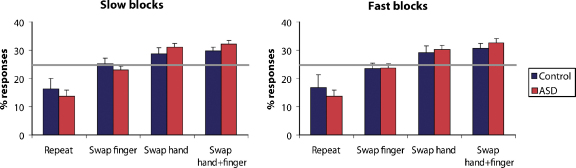
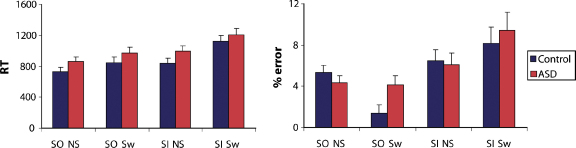
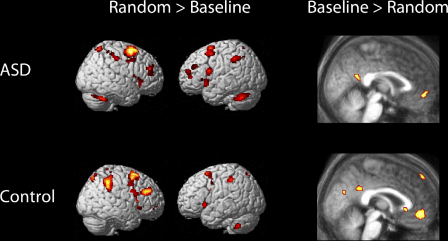
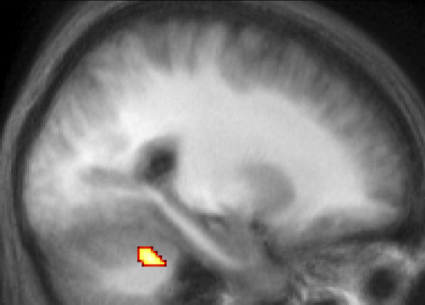
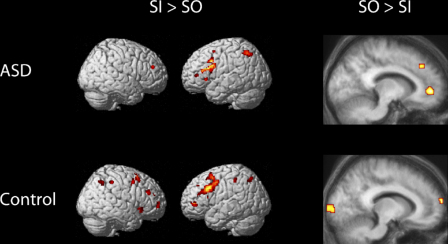
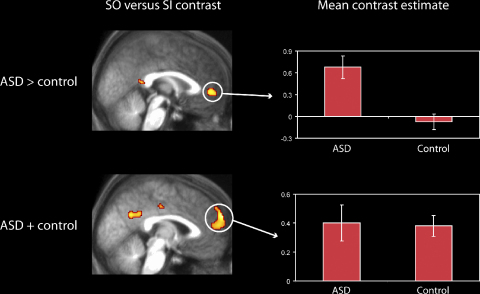
Recent studies have suggested an uneven profile of executive dysfunction in autism spectrum disorders (ASD). For example, some authors have reported deficits on newly developed tests of executive function sensitive to rostral prefrontal function, despite spared, or even superior, performance on other tests. We investigated the performance of a group of high-functioning participants with ASD (N=15) and an age- and IQ-matched control group (N=18) on two executive function tests, whilst undergoing functional magnetic resonance imaging (fMRI). Behaviourally, there were no significant differences between the two groups. In a classical test of executive function (random response generation), BOLD signal differed between the groups in the cerebellum but not in the frontal lobes. However, on a new test of executive function (selection between stimulus-oriented and stimulus-independent thought), the ASD group exhibited significantly greater signal-change in medial rostral prefrontal cortex (especially Brodmann Area 10) in the comparison of stimulus-oriented versus stimulus-independent attention. In addition, the new test (but not the classical test) provided evidence for abnormal functional organisation of medial prefrontal cortex in ASD. These results underline the heterogeneity of different tests of executive function, and suggest that executive functioning in ASD is associated with task-specific functional change.
Overview
The claims and statistics of this paper haven’t been checked yet.
Run the check — free, no account needed. It reads the open-access text and checks the sources it cites.
Integrity signals
Registry
Cites
Statistics
Figures
Verification
Claims the paper makes
The claims and statistics of this paper haven’t been checked yet.
Run the check — free, no account needed. It reads the open-access text and checks the sources it cites.
Claims other papers make about this one
Each is checked against this paper’s own text: does it say what the citing paper says it does?
The source backs part of the claim, not all of it — or backs it for a different population, condition or comparison.
In the citing paper
“disruptions in cerebellar–mPFC connectivity have been demonstrated in ASD20.”
From Regulation of autism-relevant behaviors by cerebellar-prefrontal cortical circuits (2020) · cites this paper as [20]
Experimental — accuracy not yet measured
Self-check
Percentages, sums and reported differences re-computed from the paper’s own numbers.
The self-check needs the paper’s full text.
Citations
Cites
Studies of interference in serial verbal reactions
Stroop, J. R. (1935) · Journal of Experimental Psychology · doi:10.1037/h0054651 · Cited by 18,622
Miyake, A., Friedman, N. P., Emerson, M. J., Witzki, A. H., Howerter, A., & Wager, T. D. (2000) · Cognitive Psychology · doi:10.1006/cogp.1999.0734 · Cited by 15,798
Statistical parametric maps in functional imaging: A general linear approach
Friston, K. J., Holmes, A. P., Worsley, K. J., Poline, J. ‐., Frith, C. D., & Frackowiak, R. S. J. (1994) · Human Brain Mapping · doi:10.1002/hbm.460020402 · Cited by 9,688
Self-citationLord, C., Rutter, M., & Le Couteur, A. (1994) · Journal of Autism and Developmental Disorders · doi:10.1007/bf02172145 · Cited by 9,065
Does the autistic child have a “theory of mind” ?
Baron-Cohen, S., Leslie, A. M., & Frith, U. (1985) · Cognition · doi:10.1016/0010-0277(85)90022-8 · Cited by 8,599
Lord, C., Risi, S., Lambrecht, L., Cook, E. H., Leventhal, B. L., DiLavore, P. C., Pickles, A., & Rutter, M. (2000) · Journal of Autism and Developmental Disorders · doi:10.1023/a:1005592401947 · Cited by 7,520
From Neuropsychology to Mental Structure
Shallice, T. (1988) · doi:10.1017/cbo9780511526817 · Cited by 4,072
Specific impairments of planning
Shallice, T. (1982) · Philosophical Transactions of the Royal Society of London. B, Biological Sciences · doi:10.1098/rstb.1982.0082 · Cited by 3,741
Wechsler Adult Intelligence Scale-III
Ryan, J. J., & Lopez, S. J. (2001) · Springer eBooks · doi:10.1007/978-1-4615-1185-4_2 · Cited by 3,680
Frith, C., & Frith, U. (2005) · Current Biology · doi:10.1016/j.cub.2005.08.041 · Cited by 3,561
Self-citation
Cited by
Sorted by citations
An aberrant precision account of autism
Lawson, R. P., Rees, G., & Friston, K. J. (2014) · Frontiers in Human Neuroscience · doi:10.3389/fnhum.2014.00302 · Cited by 641
A genome-wide linkage and association scan reveals novel loci for autism
The Gene Discovery Project of Johns Hopkins & the Autism Consortium, Weiss, L. A., & Arking, D. E. (2009) · Nature · doi:10.1038/nature08490 · Cited by 619
A meta-analysis of cerebellar contributions to higher cognition from PET and fMRI studies
E, K., Chen, S. A., Ho, M. R., & Desmond, J. E. (2014) · Human Brain Mapping · doi:10.1002/hbm.22194 · Cited by 516
Understanding Executive Control in Autism Spectrum Disorders in the Lab and in the Real World
Kenworthy, L., Yerys, B. E., Anthony, L. G., & Wallace, G. L. (2008) · Neuropsychology Review · doi:10.1007/s11065-008-9077-7 · Cited by 504
Minds made for sharing: initiating joint attention recruits reward-related neurocircuitry
Schilbach, L., Wilms, M., Eickhoff, S. B., Romanzetti, S., Tepest, R., Bente, G., Shah, N. J., Fink, G. R., & Vogeley, K. (2010) · Journal of Cognitive Neuroscience · doi:10.1162/jocn.2009.21401 · Cited by 415
Metadata
- Authors
- Gilbert, S. J., Bird, G., Brindley, R., Frith, C. D., & Burgess, P. W.
- Affiliations
- University College London (GB)
- Corresponding author
- Gilbert, Sam J.
- Venue
- Neuropsychologia
- Publisher
- Elsevier BV
- Published
- 2008-07
- Volume
- 46
- Issue
- 9
- Pages
- 2281-2291
- ISSN
- 0028-3932 (ISSN-L)
- PMC
- PMC2648877
- OpenAlex
- W2101777433
- Cited by
- 158
- References
- 86
- Citations by year
- 2026: 3 · 2025: 7 · 2024: 5 · 2023: 10 · 2022: 10 · 2021: 6 · 2020: 12 · 2019: 6 · 2018: 6 · 2017: 7 · 2016: 8 · 2015: 5 · 2014: 11 · 2013: 17 · 2012: 8
- FWCI
- 6.03
- Type
- journal article
- Language
- en
- Open access
- hybrid
- doi.org
- Licence
- Locations
- Neuropsychologia (publishedVersion, cc-by)
- Europe PMC (PubMed Central) (publishedVersion, cc-by)
- PubMed Central (publishedVersion, cc-by)
- PubMed (publishedVersion)
- UCL Discovery (University College London) (submittedVersion)
- Research Portal (King's College London) (submittedVersion)
- Funders
- Wellcome Trust (061171)
- Topics
- Life Sciences › Neuroscience › Cognitive Neuroscience › Autism Spectrum Disorder Research
- Life Sciences › Neuroscience › Cognitive Neuroscience › Neural and Behavioral Psychology Studies
- Life Sciences › Biochemistry, Genetics and Molecular Biology › Genetics › Genetics and Neurodevelopmental Disorders
- Keywords
- autism spectrum disorder, executive function, medial prefrontal cortex, Brodmann area 10, cerebellum, high-functioning autism
- MeSH terms
- Adult, Autistic Disorder, Brain, Cognition, Female, Humans, Image Processing, Computer-Assisted, Magnetic Resonance Imaging, Male, Mental Processes, Middle Aged, Neuropsychological Tests, Parietal Lobe, Psychomotor Performance, Reaction Time, Recruitment, Neurophysiological, Task Performance and Analysis, Prefrontal Cortex
About these checks
Registry, retraction, Cites and statistics results are computed, not judged, with one exception: a printed reference that no index lists is read once by a model before it counts as a citation error. Claims are extracted by a model and kept only when their quote appears verbatim in the text; each cited source is then checked, with a model’s help, for whether it says what the claim relies on. Those verdicts can be wrong — read the claim’s quote and the cited source before relying on one.
Statistics and arithmetic are recomputed, not judged.
Confidence bands are shown only for fields calibrated on our annotated test set. None is calibrated yet, so no band is shown.
What counts as a claim ›How we measure confidence ›How we check this ›
Are you an author, or do you see a problem with this page? Request a review
