

Lipid nanoparticle mRNA delivery preserves CAR T cell cytotoxicity and limits exhaustion compared to electroporation
Open accessThe DOI matches its Crossref record; 78 of the 78 references it cites were found in a registry or an index; 2 of the 101 sources its claims cite were checked for support.
Abstract
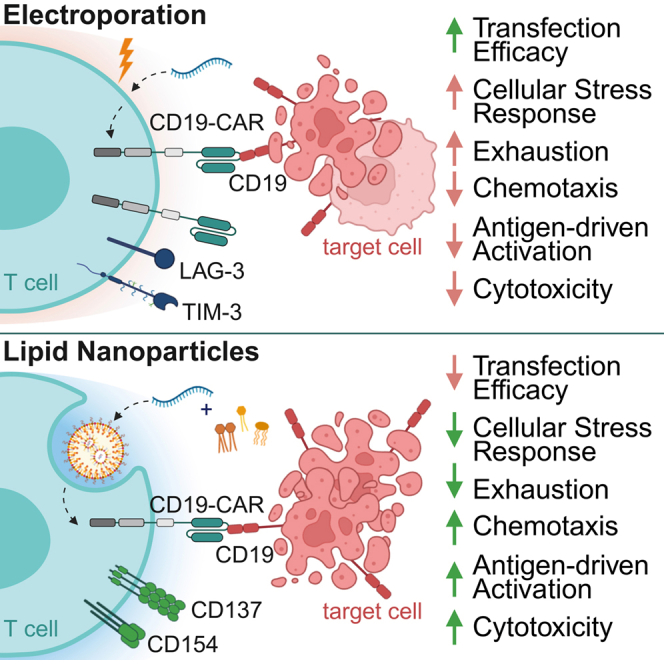
Chimeric antigen receptor (CAR) T cells offer a promising strategy for the treatment of autoimmune diseases. However, clinical translation is limited by the high cost, complexity, and poor scalability of current manufacturing, restricting broad patient access and persisting safety concerns including insertional mutagenesis risk from integrating vectors and uncontrolled long-term CAR T cell persistence. In-vitro -transcribed (IVT) mRNA enables transient, non-integrating CAR expression with improved safety and scalability, making it particularly suited for non-malignant indications where prolonged persistence may not be required. Here, we systematically compare two IVT mRNA delivery platforms, electroporation and lipid nanoparticles (LNPs), for transient CAR T cell engineering in primary human T cells using single-cell transcriptomics and functional cell assays. We show that electroporation yields higher transfection efficiency and more sustained CAR surface expression, whereas LNP delivery reduces stress- and senescence-related transcriptional signatures as well as exhaustion marker expression, while enhancing antigen-driven activation, chemotactic responses, and cytotoxic function. Our comparative analysis highlights that the mode of mRNA delivery is associated with distinct transcriptional signatures and functional properties of CAR T cells, providing a framework to guide future development of mRNA-based approaches. These insights support LNP-mediated delivery as a functionally favorable strategy for transient CAR T cell engineering in autoimmune disease and beyond.
Overview
CoChat Summary
TL;DR
In primary human T cells, LNP-mediated IVT mRNA delivery produced lower CAR expression than electroporation but preserved cytotoxicity, improved migration, and reduced exhaustion/stress signatures. Electroporation achieved higher transfection and CAR density but induced stress, DNA damage, senescence, and exhaustion-associated programs.
Key findings
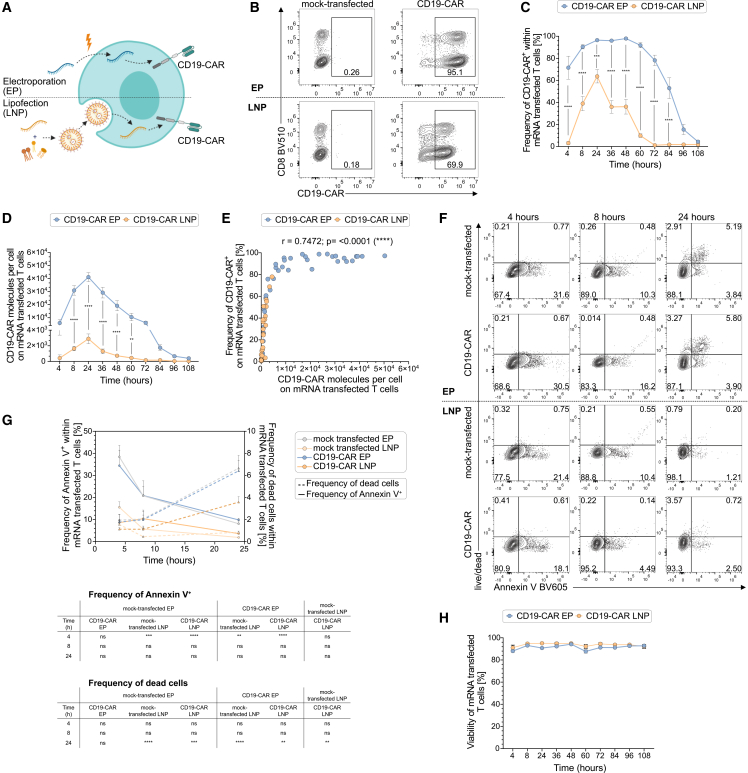
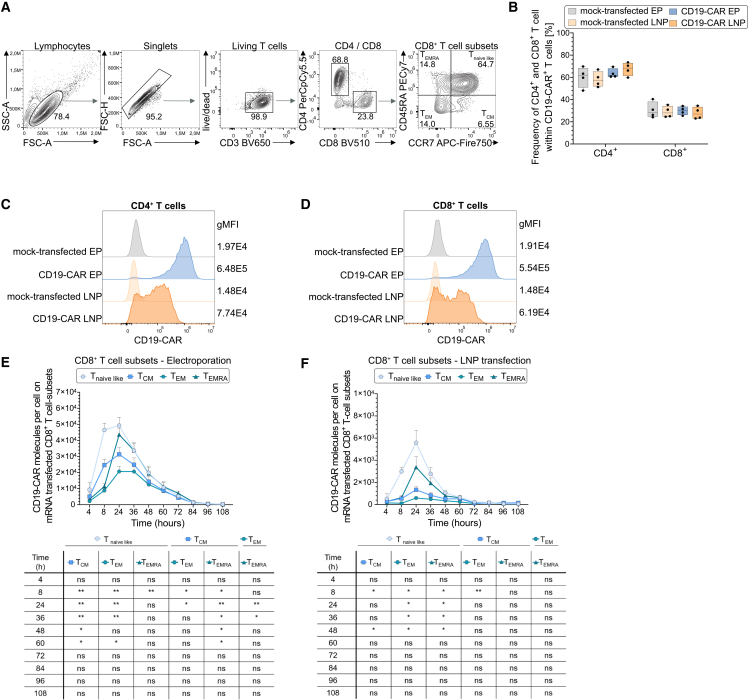
- Electroporation achieved >95% CD19-CAR+ T cells at 24 h and ∼4 × 10⁴ CD19-CAR molecules per cell, whereas LNP delivery reached ∼65% and ∼3 × 10³ molecules per cell; both peaked at 24 h, with detectable CAR for 4 days (electroporation) versus 3 days (LNP).
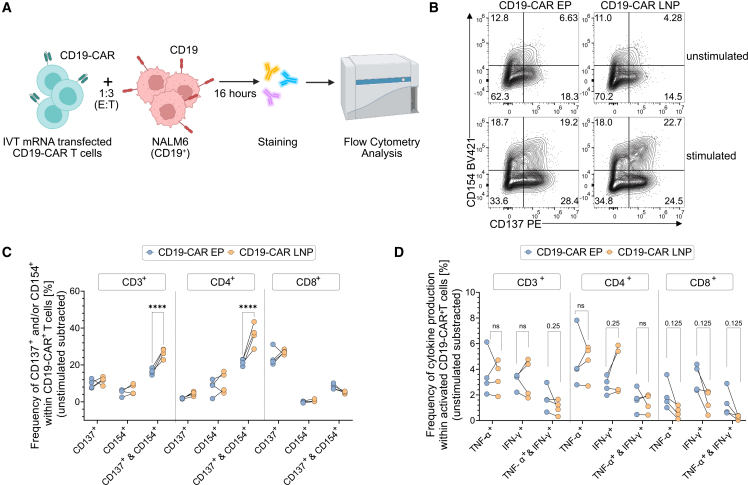
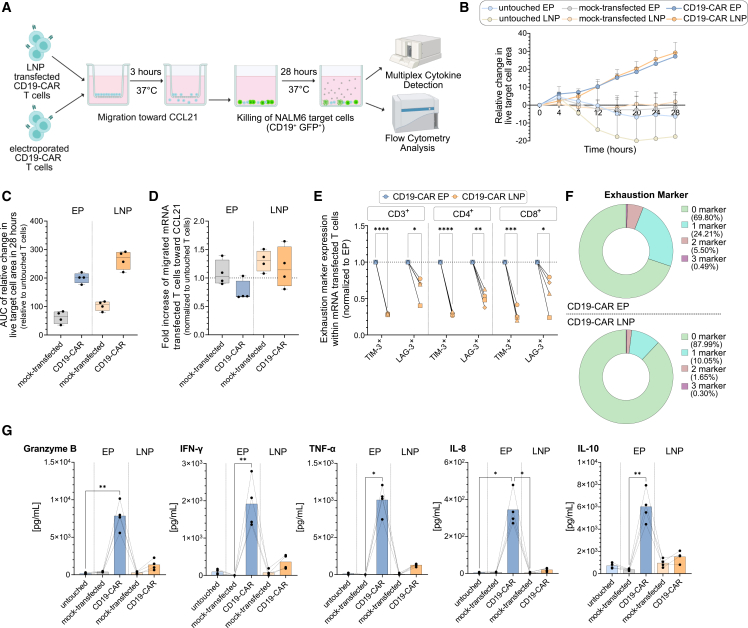
- Despite lower CAR expression, LNP-transfected CAR T cells achieved comparable target-cell killing and trended toward enhanced per-cell cytotoxicity; they also showed lower TIM-3 and LAG-3 across CD3+, CD4+, and CD8+ subsets, while PD-1 was unaffected, and trended toward improved CCL21 migration.
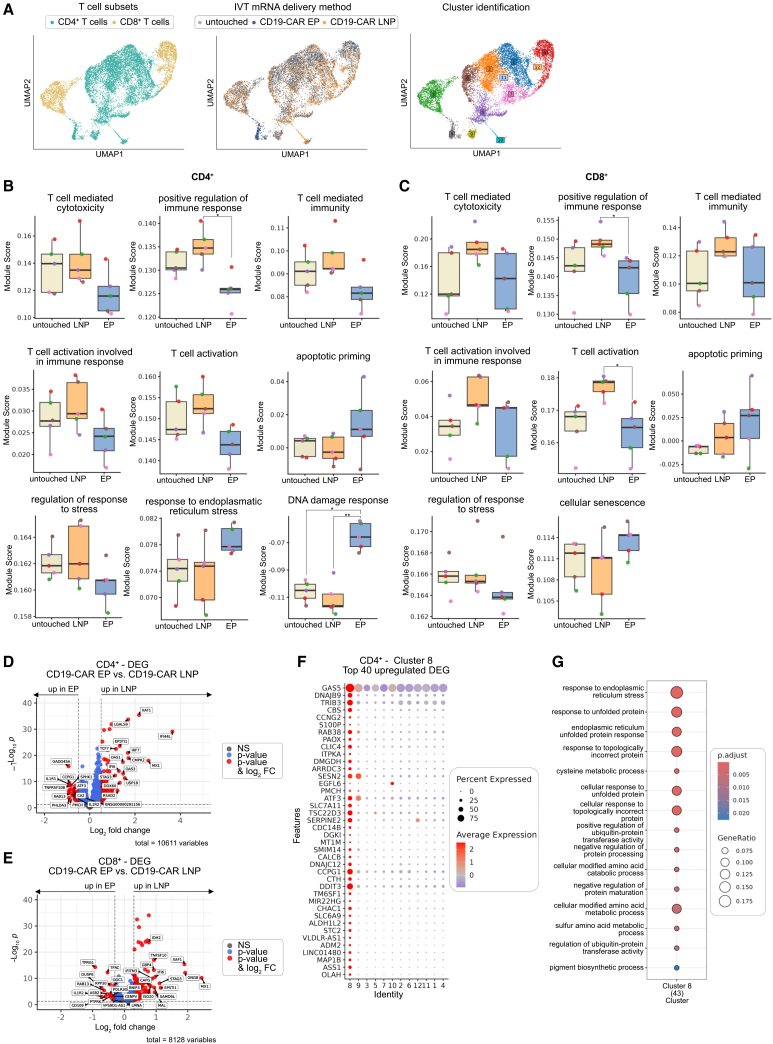
- scRNA-seq of 10,883 high-quality transcriptomes identified an electroporation-specific CD4+ cluster (cluster 8; 4.48%–16.2% of electroporated CD19-CAR T cells) enriched for ER stress, unfolded protein response, and DNA damage genes including TRIB3, DDIT3, CCPG1, SESN2, DNAJB9, and ATF3; LNP-transfected cells primarily activated interferon-stimulated genes such as IFI44L, MX1, IFI6, DDX60, RSAD2, XAF1, IRF7, and USP18 without stress or apoptotic signatures.
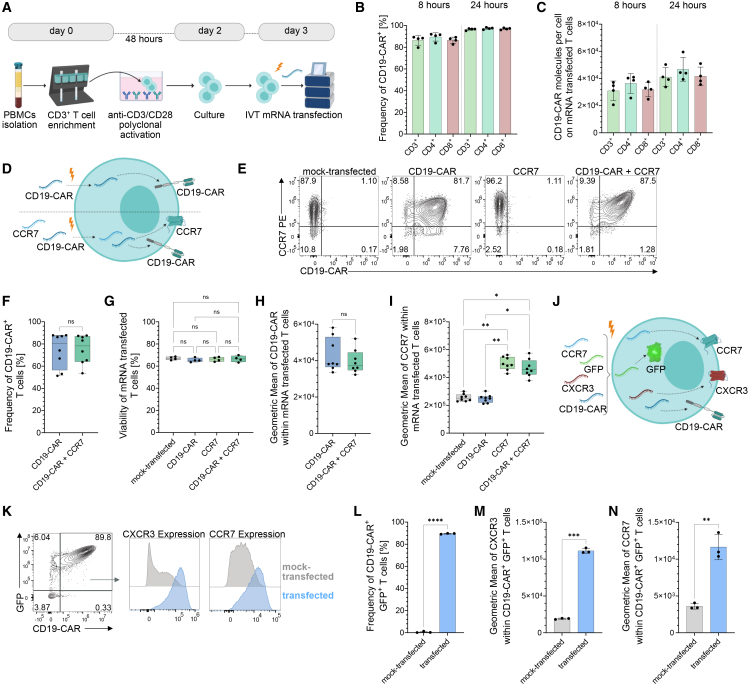
- IVT mRNA multiplexing via electroporation yielded >85% CD19-CAR+ T cells at 8 h and >95% at 24 h; CD19-CAR + CCR7 co-transfection gave a median 78.20% CD19-CAR+ T cells, four-mRNA delivery gave ∼90% CD19-CAR+GFP+ cells at 8 h, and CCR7 mRNA rescued migratory and cytotoxic function in CCR7 knockout T cells.
Methods
- Primary human T cells from healthy donors were isolated from PBMCs, CD3+ enriched by MACS, and polyclonally activated with plate-bound anti-CD3/CD28 for 48 h; on day 3, IVT mRNA encoding CD19-CAR, CCR7, CXCR3, or GFP was delivered by electroporation (Lonza 4D-Nucleofector, program EO-115) or LNP (GenVoy-ILM T-cell kit with ApoE), with mock and untouched controls.
- Functional readouts included transwell migration toward CCL21, live-cell imaging cytotoxicity against NALM6 and Raji target cells, serial killing assays, flow cytometry for activation/exhaustion/cytokines, Luminex cytokine analysis, and targeted scRNA-seq at 24 h post-transfection using 10× Genomics 5′ v2 with hashtag demultiplexing, Seurat clustering, DESeq2 pseudobulk differential expression, and GO module scores.
- Statistical analyses used paired t tests, one-way ANOVA with Tukey’s post hoc test, Friedman test with Dunn’s multiple comparison, two-way repeated-measures ANOVA with Šidák’s multiple-comparison test, and Pearson/Spearman correlation, with n = 3–8 independent donors depending on the assay.
Limitations
- Stated in the paper: results were obtained from a single LNP formulation; differences across electroporation platforms may prevent complete generalization of electroporation-induced phenotypes; the study focused exclusively on ex vivo delivery; direct assessment of persistence and long-term function in advanced animal disease models is still needed; and inter-donor variability was noted in the magnitude of CCR7-mediated killing effects.
- Evident from the text: the work is an in vitro study using healthy-donor T cells with small donor numbers (n = 3–8 across assays), without autoimmune patient samples or in vivo disease models, so clinical translation to persistence, safety, and therapeutic efficacy remains untested.
Model-written summary. Check it against the paper before relying on it.
Integrity signals
Registry
Cites
Statistics
Figures
Verification
Claims the paper makes
1 Valid · 0 Not valid · 35 Not checked · 105 Own results and interpretations
The cited sources support only part of this claim — read each source’s verdict below.
In the paper
“Both transfection methods preserved early differentiated T cell subsets (predominantly Tnaive like and TCM cells) associated with superior functional capacity and metabolic fitness in adoptive T cell therapy.36,37”
§ Lipid nanoparticle mRNA delivery preserves CAR T cell cytotoxicity and limits exhaustion compared to electroporation > Discussion
What the sources say
- Partly supportedcites [36] Klebanoff C.A. Gattinoni L. Restifo N.P. CD8+ T-cell memory in tumor immunology and immunotherapy Immunol. Rev. 211 2006 214 224 10.1111/J.0105-2896.2006.00391.X 16824130 PMC1501075 sourceExperimental — accuracy not yet measured
Our copy of Klebanoff, Gattinoni & Restifo (2006) supports the 'superior functional capacity in adoptive T cell therapy' half for the early-differentiated TCM compartment: the Introduction states that adoptively transferred self/tumor-reactive CD8+ TCM are superior mediators of therapeutic antitumor immunity compared with TEM, and that vigorous in vivo expansion and longer telomere length correlate with persistence and tumor regression after adoptive transfer. However, no passage in our copy addresses 'metabolic fitness' (searched metabolism/glycolysis/fatty-acid oxidation/mitochondrial returned nothing on topic), so that element is unsupported. The 'Tnaive like' component is also not established as superior here — naive CD8+ T cells appear only in a speculative proposal for TCR transduction, and the review explicitly cautions that less differentiated T cells with low-avidity TCR 'might not be the optimal target' and that TCM superiority over TEM 'has not been uniformly observed in all models'. (LLM, conf=0.78)
- Not checked yetcites [37] Sallusto F. Lenig D. Förster R. Lipp M. Lanzavecchia A. Two subsets of memory T lymphocytes with distinct homing potentials and effector functions Nature 401 1999 708 712 10.1038/44385 10537110 source
Checked before — its earlier verdict is held back until a new check runs.
plainstates an association- Asserted: passes — The authors put it forward as true.
- Checkable: passes — It can be checked against evidence.
- Load-bearing: unclear — It is unclear whether the paper’s conclusions depend on it.
- Based: passes — The paper gives a reason why it holds.
- Partly supported
In the paper
“The identification of an electroporation-specific CD4+ T cell cluster (cluster 8) characterized by upregulation of cell stress response and DNA damage response genes (TRIB3, DDIT3, CCPG1, SESN2, DNAJB9, and ATF3)55,56,62,63,64”
§ Lipid nanoparticle mRNA delivery preserves CAR T cell cytotoxicity and limits exhaustion compared to electroporation > Discussion
What the sources say
- Not checked yetcites [55] Fan F. Jin S. Amundson S.A. Tong T. Fan W. Zhao H. Zhu X. Mazzacurati L. Li X. Petrik K.L. ATF3 induction following DNA damage is regulated by distinct signaling pathways and over-expression of ATF3 protein suppresses cells growth Oncogene 21 2002 7488 7496 10.1038/sj.onc.1205896 12386811 source
Checked before — its earlier verdict is held back until a new check runs.
- Check pendingcites [56] Smith M.D. Harley M.E. Kemp A.J. Wills J. Lee M. Arends M. von Kriegsheim A. Behrends C. Wilkinson S. CCPG1 Is a Non-canonical Autophagy Cargo Receptor Essential for ER-Phagy and Pancreatic ER Proteostasis Dev. Cell 44 2018 217 232.e11 10.1016/J.DEVCEL.2017.11.024 29290589 PMC5791736 source
- Not checked yetcites [62] Shang S. Yang Y.W. Chen F. Yu L. Shen S.H. Li K. Cui B. Lv X.X. Zhang C. Yang C. TRIB3 reduces CD8+ T cell infiltration and induces immune evasion by repressing the STAT1-CXCL10 axis in colorectal cancer Sci. Transl. Med. 14 2022 eabf0992 10.1126/SCITRANSLMED.ABF0992 34985967 source
Checked before — its earlier verdict is held back until a new check runs.
- Check pendingcites [63] Yu X. Xu X. Dong W. Yang C. Luo Y. He Y. Jiang C. Wu Y. Wang J. DDIT3/CHOP mediates the inhibitory effect of ER stress on chondrocyte differentiation by AMPKα-SIRT1 pathway Biochim. Biophys. Acta. Mol. Cell Res. 1869 2022 119265 10.1016/J.BBAMCR.2022.119265 35381294 source
- Could not verifycites [64] Lee H.J. Kim J.M. Kim K.H. Heo J.I. Kwak S.J. Han J.A. Genotoxic stress/p53-induced DNAJB9 inhibits the pro-apoptotic function of p53 Cell Death Differ. 22 2015 86 95 10.1038/CDD.2014.116 25146923 PMC4262772 sourceExperimental — accuracy not yet measured
Our copy of Lee et al. (2015, Cell Death Differ) is a molecular-cell-biology study of DNAJB9 regulation in SK-N-SH, U2OS, H1299, EJ-p53 and p53-null/-WT MEF lines; it contains no T cells, no electroporation and no cluster/single-cell transcriptomic analysis, so it cannot bear on the existence of an 'electroporation-specific CD4+ T cell cluster 8'. Searches for 'TRIB3, DDIT3, CCPG1, SESN2, ATF3' returned no passages — none of the other five genes in the claim's list is mentioned anywhere in our copy. The only related content is the Abstract and Discussion ('DNAJB9 is induced by p53 under genotoxic conditions') establishing DNAJB9 as an ER co-chaperone induced by tunicamycin/thapsigargin and by p53 via the Ras/Raf/ERK pathway, i.e. generic stress-gene background rather than the attributed cluster finding. (LLM, conf=0.70)
plainstates an association- Asserted: passes — The authors put it forward as true.
- Checkable: passes — It can be checked against evidence.
- Load-bearing: passes — The paper’s conclusions depend on it.
- Based: passes — The paper gives a reason why it holds.
- Not checked yet
A result the paper reports from its own data — it cites no other source for it, so there is none to check. The quote shows it is in the paper.
In the paper
“At 8 h post-transfection, approximately 90% of T cells co-expressed CD19-CAR and GFP (Figures 1K and 1L)”
§ Lipid nanoparticle mRNA delivery preserves CAR T cell cytotoxicity and limits exhaustion compared to electroporation > Results > IVT mRNA multiplexing enables efficient multi-protein expression in CAR T cells
plain- Asserted: passes — The authors put it forward as true.
- Checkable: passes — It can be checked against evidence.
- Load-bearing: passes — The paper’s conclusions depend on it.
- Based: passes — The paper gives a reason why it holds.
A result the paper reports from its own data — it cites no other source for it, so there is none to check. The quote shows it is in the paper.
In the paper
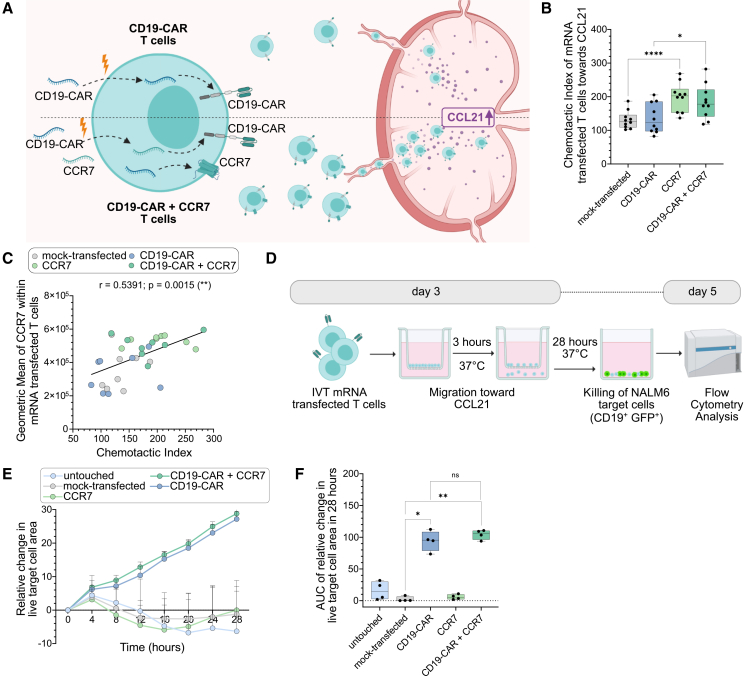
“In the absence of CCL21, both migration and subsequent target-cell killing were minimal (Figure S2B)”
§ Lipid nanoparticle mRNA delivery preserves CAR T cell cytotoxicity and limits exhaustion compared to electroporation > Results > CCR7 IVT mRNA co-delivery improves lymphatic tissue-associated chemotaxis and functionality of mRNA-engineered CD19-CAR T cells
plain- Asserted: passes — The authors put it forward as true.
- Checkable: passes — It can be checked against evidence.
- Load-bearing: passes — The paper’s conclusions depend on it.
- Based: passes — The paper gives a reason why it holds.
A result the paper reports from its own data — it cites no other source for it, so there is none to check. The quote shows it is in the paper.
In the paper
“Flow cytometric analysis confirmed consistently high transfection efficiencies (>85% CD19-CAR+ T cells at 8 h, >95% at 24 h post-transfection) across tested mRNA concentrations (1–3 μg)”
§ Lipid nanoparticle mRNA delivery preserves CAR T cell cytotoxicity and limits exhaustion compared to electroporation > Results > IVT mRNA multiplexing enables efficient multi-protein expression in CAR T cells
plainstates a cause- Asserted: passes — The authors put it forward as true.
- Checkable: passes — It can be checked against evidence.
- Load-bearing: unclear — It is unclear whether the paper’s conclusions depend on it.
- Based: passes — The paper gives a reason why it holds.
60 more claims
Create a free account to see all 141 claims and to verify the 99 references still open.
- It may state two separate claims as one. 65
- Probably not a substantial claim. 21
- The quote only partly states this claim. 1
Claims other papers make about this one
Each is checked against this paper’s own text: does it say what the citing paper says it does?
In the citing paper
“In complex workflows, LNP-mediated mRNA delivery may offer advantages over electroporation for CAR T cell engineering, and our study extends this to a serial multi-round delivery context where the cell yield advantage compounds across transfection rounds.86”
From Human T cell engineering via serial delivery of mRNA encapsulated within lipid nanoparticles (2026) · cites this paper as [86]
In the citing paper
“Donors were not age- or sex-matched across experiments, and the number of donors was selected based on conventions in the primary T cell delivery literature rather than a formal power calculation.24,86,90,93,102”
From Human T cell engineering via serial delivery of mRNA encapsulated within lipid nanoparticles (2026) · cites this paper as [86]
Self-check
Percentages, sums and reported differences re-computed from the paper’s own numbers.
Each contradiction between two passages listed here was confirmed by an independent check.
Rated minor: it would not touch a result — a value no result rests on, a p-value that stays on the same side of the significance level, or a conflict that is clerical, resolved elsewhere in the paper, or outside its own findings.
In the paper
§ Lipid nanoparticle mRNA delivery preserves CAR T cell cytotoxicity and limits exhaustion compared to electroporation > Results > IVT mRNA multiplexing enables efficient multi-protein expression in CAR T cells
“and viability (∼70% viability at 24 h; Figure 1G). Co-transfection yielded a median expression of 78.20% CD19-CAR+ T cells (range 53.60%–87.60%; Figure 1F)”
§ Lipid nanoparticle mRNA delivery preserves CAR T cell cytotoxicity and limits exhaustion compared to electroporation > Results > IVT mRNA multiplexing enables efficient multi-protein expression in CAR T cells
“(F) Viability of T cells following single and dual mRNA transfection, assessed by live/dead staining 8 h post-transfection. (G–I) Quantification of CD19-CAR-only versus CD19-CAR + CCR7 co-expression: CD19-CAR+ frequency (G)”
Rated minor: it would not touch a result — a value no result rests on, a p-value that stays on the same side of the significance level, or a conflict that is clerical, resolved elsewhere in the paper, or outside its own findings.
In the paper
§ Lipid nanoparticle mRNA delivery preserves CAR T cell cytotoxicity and limits exhaustion compared to electroporation > Results > CCR7 IVT mRNA co-delivery improves lymphatic tissue-associated chemotaxis and functionality of mRNA-engineered CD19-CAR T cells
“NALM6 target T cells (CD19+ GFP+)”
§ Lipid nanoparticle mRNA delivery preserves CAR T cell cytotoxicity and limits exhaustion compared to electroporation > Results > LNP-transfected CAR T cells demonstrate superior functional fitness despite lower CAR expression
“Both LNP-transfected and electroporated CD19-CAR T cells demonstrated comparable killing across both B cell lines”
Citations
Cites
Two subsets of memory T lymphocytes with distinct homing potentials and effector functions
Sallusto, F., Lenig, D., Förster, R., Lipp, M., & Lanzavecchia, A. (1999) · Nature · doi:10.1038/44385 · Cited by 5,846
Lipid nanoparticles for mRNA delivery
Hou, X., Zaks, T., Langer, R., & Dong, Y. (2021) · Nature Reviews Materials · doi:10.1038/s41578-021-00358-0 · Cited by 4,076
Homing and cellular traffic in lymph nodes
von Andrian, U. H., & Mempel, T. R. (2003) · Nature Reviews Immunology · doi:10.1038/nri1222 · Cited by 1,281
CD19 CAR T-Cell Therapy in Autoimmune Disease — A Case Series with Follow-up
Müller, F., Taubmann, J., Bucci, L., Wilhelm, A., Bergmann, C., Völkl, S., Aigner, M., Rothe, T., Minopoulou, I., Tur, C., et al. (2024) · New England Journal of Medicine · doi:10.1056/nejmoa2308917 · Cited by 1,095
Self-citationAnti-CD19 CAR T cell therapy for refractory systemic lupus erythematosus
Mackensen, A., Müller, F., Mougiakakos, D., Böltz, S., Wilhelm, A., Aigner, M., Völkl, S., Simon, D., Kleyer, A., Munoz, L., et al. (2022) · Nature Medicine · doi:10.1038/s41591-022-02017-5 · Cited by 1,092
Self-citationFalse discovery rates: a new deal
Stephens, M. (2016) · Biostatistics · doi:10.1093/biostatistics/kxw041 · Cited by 1,067
Beatty, G. L., Haas, A. R., Maus, M. V., Torigian, D. A., Soulen, M. C., Plesa, G., Chew, A., Zhao, Y., Levine, B. L., Albelda, S. M., et al. (2014) · Cancer Immunology Research · doi:10.1158/2326-6066.cir-13-0170 · Cited by 864
Viral and nonviral delivery systems for gene delivery
Nayerossadat, N., Maedeh, T., & Ali, P. (2012) · Advanced Biomedical Research · doi:10.4103/2277-9175.98152 · Cited by 858
Clinical manufacturing of CAR T cells: foundation of a promising therapy
Wang, X., & Rivière, I. (2016) · Molecular Therapy - Oncolytics · doi:10.1038/mto.2016.15 · Cited by 637 · cited 1×
“75 This process is time-consuming, costly, and highly dependent on the specific electroporation hardware.”
Ionizable Lipid Nanoparticle-Mediated mRNA Delivery for Human CAR T Cell Engineering
Billingsley, M. M., Singh, N., Ravikumar, P., Zhang, R., June, C. H., & Mitchell, M. J. (2020) · Nano Letters · doi:10.1021/acs.nanolett.9b04246 · Cited by 636
CD19-Targeted CAR T Cells in Refractory Systemic Lupus Erythematosus
Mougiakakos, D., Krönke, G., Völkl, S., Kretschmann, S., Aigner, M., Kharboutli, S., Böltz, S., Manger, B., Mackensen, A., & Schett, G. (2021) · New England Journal of Medicine · doi:10.1056/nejmc2107725 · Cited by 610
Self-citationMetabolic Regulation of T Cell Longevity and Function in Tumor Immunotherapy
Kishton, R. J., Sukumar, M., & Restifo, N. P. (2017) · Cell Metabolism · doi:10.1016/j.cmet.2017.06.016 · Cited by 548 · cited 1×
“74 Our results suggest that delivery platforms which prioritize functional durability, rather than absolute CAR abundance, may ultimately be more advantageous for clinical efficacy.”
Schalper, K. A., Carleton, M., Zhou, M., Chen, T., Feng, Y., Huang, S.-P., Walsh, A. M., Baxi, V., Pandya, D., Baradet, T., et al. (2020) · Nature Medicine · doi:10.1038/s41591-020-0856-x · Cited by 548
Thi, T. T. H., Suys, E. J. A., Lee, J. S., Nguyen, D. H., Park, K. D., & Truong, N. P. (2021) · Vaccines · doi:10.3390/vaccines9040359 · Cited by 525
CD8 + T‐cell memory in tumor immunology and immunotherapy
Klebanoff, C. A., Gattinoni, L., & Restifo, N. P. (2006) · Immunological Reviews · doi:10.1111/j.0105-2896.2006.00391.x · Cited by 511 · cited 3×
“CCR7 overexpression may additionally promote central memory-like T cell phenotypes, associated with improved persistence and functionality, 36,37 particularly relevant given reduced abundance in elderly patients, limiting product quality in autologous settings.”
CAR T therapy beyond cancer: the evolution of a living drug
Baker, D. J., Arany, Z., Baur, J. A., Epstein, J. A., & June, C. H. (2023) · Nature · doi:10.1038/s41586-023-06243-w · Cited by 504
CAR T-cell Therapy: A New Era in Cancer Immunotherapy
Miliotou, A. N., & Papadopoulou, L. C. (2018) · Current Pharmaceutical Biotechnology · doi:10.2174/1389201019666180418095526 · Cited by 480
Van Tendeloo, V. F. I., Ponsaerts, P., Lardon, F., Nijs, G., Lenjou, M., Van Broeckhoven, C., Van Bockstaele, D. R., & Berneman, Z. N. (2001) · Blood · doi:10.1182/blood.v98.1.49 · Cited by 468 · cited 2×
“Electroporation remains widely used for ex vivo CAR T cell engineering 39–42 but poses hurdles for broad clinical adoption, including the need for leukapheresis, extensive cell manipulation, expansion, and reinfusion.”
Smith, M. D., Harley, M. E., Kemp, A. J., Wills, J., Lee, M., Arends, M., von Kriegsheim, A., Behrends, C., & Wilkinson, S. (2018) · Developmental Cell · doi:10.1016/j.devcel.2017.11.024 · Cited by 444
CAR T-cell therapy in autoimmune diseases
Schett, G., Mackensen, A., & Mougiakakos, D. (2023) · The Lancet · doi:10.1016/s0140-6736(23)01126-1 · Cited by 430
Reframing Immune-Mediated Inflammatory Diseases through Signature Cytokine Hubs
Schett, G., McInnes, I. B., & Neurath, M. F. (2021) · New England Journal of Medicine · doi:10.1056/nejmra1909094 · Cited by 355
Preparing for CAR T cell therapy: patient selection, bridging therapies and lymphodepletion
Amini, L., Silbert, S. K., Maude, S. L., Nastoupil, L. J., Ramos, C. A., Brentjens, R. J., Sauter, C. S., Shah, N. N., & Abou-el-Enein, M. (2022) · Nature Reviews Clinical Oncology · doi:10.1038/s41571-022-00607-3 · Cited by 335
Santomasso, B., Bachier, C., Westin, J., Rezvani, K., & Shpall, E. J. (2019) · American Society of Clinical Oncology Educational Book · doi:10.1200/edbk_238691 · Cited by 330
In vivo CAR T cell generation to treat cancer and autoimmune disease
Hunter, T. L., Bao, Y., Zhang, Y., Matsuda, D., Riener, R., Wang, A., Li, J. J., Soldevila, F., Chu, D. S. H., Nguyen, D. P., et al. (2025) · Science · doi:10.1126/science.ads8473 · Cited by 330
Memory T cells: strategies for optimizing tumor immunotherapy
Liu, Q., Sun, Z., & Chen, L. (2020) · Protein & Cell · doi:10.1007/s13238-020-00707-9 · Cited by 326
CAR-T cell manufacturing: Major process parameters and next-generation strategies
Ayala Ceja, M., Khericha, M., Harris, C. M., Puig-Saus, C., & Chen, Y. Y. (2024) · Journal of Experimental Medicine · doi:10.1084/jem.20230903 · Cited by 303
Secondary Cancers after Chimeric Antigen Receptor T-Cell Therapy
Verdun, N., & Marks, P. (2024) · New England Journal of Medicine · doi:10.1056/nejmp2400209 · Cited by 296
High-Efficiency Transfection of Primary Human and Mouse T Lymphocytes Using RNA Electroporation
Zhao, Y., Zheng, Z., Cohen, C. J., Gattinoni, L., Palmer, D. C., Restifo, N. P., Rosenberg, S. A., & Morgan, R. A. (2006) · Molecular Therapy · doi:10.1016/j.ymthe.2005.07.688 · Cited by 283 · cited 1×
“Electroporation, the current standard for ex vivo T cell modification, 39,40 enables direct cytoplasmic delivery and translation of naked mRNA via transient membrane permeabilization.”
Lipid nanoparticles for delivery of RNA therapeutics: Current status and the role of in vivo imaging
Jung, H. N., Lee, S.-Y., Lee, S., Youn, H., & Im, H.-J. (2022) · Theranostics · doi:10.7150/thno.77259 · Cited by 282
Smith, L. K., Boukhaled, G. M., Condotta, S. A., Mazouz, S., Guthmiller, J. J., Vijay, R., Butler, N. S., Bruneau, J., Shoukry, N. H., Krawczyk, C. M., et al. (2018) · Immunity · doi:10.1016/j.immuni.2018.01.006 · Cited by 281
Granit, V., Benatar, M., Kurtoglu, M., Miljković, M. D., Chahin, N., Sahagian, G., Feinberg, M. H., Slansky, A., Vu, T., Jewell, C. M., et al. (2023) · The Lancet Neurology · doi:10.1016/s1474-4422(23)00194-1 · Cited by 280
Billingsley, M. M., Gong, N., Mukalel, A. J., Thatte, A. S., El‐Mayta, R., Patel, S. K., Metzloff, A. E., Swingle, K. L., Han, X., Xue, L., et al. (2024) · Small · doi:10.1002/smll.202304378 · Cited by 268
A Review on Electroporation-Based Intracellular Delivery
Shi, J., Ma, Y., Zhu, J., Chen, Y., Sun, Y., Yao, Y., Yang, Z., & Xie, J. (2018) · Molecules · doi:10.3390/molecules23113044 · Cited by 261
PH Domain-Only Protein PHLDA3 Is a p53-Regulated Repressor of Akt
Kawase, T., Ohki, R., Shibata, T., Tsutsumi, S., Kamimura, N., Inazawa, J., Ohta, T., Ichikawa, H., Aburatani, H., Tashiro, F., et al. (2009) · Cell · doi:10.1016/j.cell.2008.12.002 · Cited by 237
Age related human T cell subset evolution and senescence
Li, M., Yao, D., Zeng, X., Kasakovski, D., Zhang, Y., Chen, S., Zha, X., Li, Y., & Xu, L. (2019) · Immunity & Ageing · doi:10.1186/s12979-019-0165-8 · Cited by 230 · cited 1×
“38 These considerations underscore the potential of mRNA-based CAR T cell engineering to fine-tune T cell function, trafficking, and phenotype, and the need to elucidate the comparative effects of mRNA delivery strategies on T cell functionality.”
Lipid-Based Nanocarriers for RNA Delivery
Xue, H., Guo, P., Wen, W.-C., & Wong, H. (2015) · Current Pharmaceutical Design · doi:10.2174/1381612821666150531164540 · Cited by 201
Fan, F., Jin, S., Amundson, S. A., Tong, T., Fan, W., Zhao, H., Zhu, X., Mazzacurati, L., Li, X., Petrik, K. L., et al. (2002) · Oncogene · doi:10.1038/sj.onc.1205896 · Cited by 198
CD19-CAR T-cell therapy induces deep tissue depletion of B cells
Tur, C., Eckstein, M., Velden, J., Rauber, S., Bergmann, C., Auth, J., Bucci, L., Corte, G., Hagen, M., Wirsching, A., et al. (2025) · Annals of the Rheumatic Diseases · doi:10.1136/ard-2024-226142 · Cited by 187
Cytokine Release Syndrome: Current Perspectives
Murthy, H., Iqbal, M., Chavez, J. C., & Kharfan-Dabaja, M. A. (2019) · ImmunoTargets and Therapy · doi:10.2147/itt.s202015 · Cited by 178
Leaman, D. W., Chawla-Sarkar, M., Vyas, K., Reheman, M., Tamai, K., Toji, S., & Borden, E. C. (2002) · Journal of Biological Chemistry · doi:10.1074/jbc.m204851200 · Cited by 176
Value and affordability of CAR T-cell therapy in the United States
Fiorenza, S., Ritchie, D. S., Ramsey, S. D., Turtle, C. J., & Roth, J. A. (2020) · Bone Marrow Transplantation · doi:10.1038/s41409-020-0956-8 · Cited by 167
Shang, S., Yang, Y.-W., Chen, F., Yu, L., Shen, S.-H., Li, K., Cui, B., Lv, X.-X., Zhang, C., Yang, C., et al. (2022) · Science Translational Medicine · doi:10.1126/scitranslmed.abf0992 · Cited by 157
Hanna, B. S., Llaó-Cid, L., Iskar, M., Roessner, P. M., Klett, L. C., Wong, J. K. L., Paul, Y., Ioannou, N., Öztürk, S., Mack, N., et al. (2021) · Immunity · doi:10.1016/j.immuni.2021.11.004 · Cited by 134
Optimizing CAR-T cell therapy for solid tumors: current challenges and potential strategies
Ai, K., Liu, B., Chen, X., Huang, C., Yang, L., Zhang, W., Weng, J., Du, X., Wu, K., & Lai, P. (2024) · Journal of Hematology & Oncology · doi:10.1186/s13045-024-01625-7 · Cited by 133
Zhang, B., Wang, Y., Yuan, Y., Sun, J., Liu, L., Huang, D., Hu, J., Wang, M., Li, S., Song, W., et al. (2020) · Annals of the Rheumatic Diseases · doi:10.1136/annrheumdis-2020-217844 · Cited by 129
Lipid nanoparticles outperform electroporation in mRNA-based CAR T cell engineering
Kitte, R., Rabel, M., Geczy, R., Park, S., Fricke, S., Koehl, U., & Tretbar, U. S. (2023) · Molecular Therapy Methods & Clinical Development · doi:10.1016/j.omtm.2023.101139 · Cited by 125
Systematic Review on CAR-T Cell Clinical Trials Up to 2022: Academic Center Input
Wang, V., Gauthier, M., Decot, V., Reppel, L., & Bensoussan, D. (2023) · Cancers · doi:10.3390/cancers15041003 · Cited by 124
B-cell depletion in autoimmune diseases
Schett, G., Nagy, G., Krönke, G., & Mielenz, D. (2024) · Annals of the Rheumatic Diseases · doi:10.1136/ard-2024-225727 · Cited by 119
Self-citationIrving, M., Lanitis, E., Migliorini, D., Ivics, Z., & Guedan, S. (2021) · Human Gene Therapy · doi:10.1089/hum.2021.173 · Cited by 113
Xin, T., Cheng, L., Zhou, C., Zhao, Y., Hu, Z., & Wu, X. (2022) · Frontiers in Oncology · doi:10.3389/fonc.2022.809754 · Cited by 110
GADD45 in Stress Signaling, Cell Cycle Control, and Apoptosis
Humayun, A., & Fornace, A. J. (2022) · Advances in experimental medicine and biology · doi:10.1007/978-3-030-94804-7_1 · Cited by 98
T Cell Fitness and Autologous CAR T Cell Therapy in Haematologic Malignancy
Mehta, P. H., Fiorenza, S., Koldej, R. M., Jaworowski, A., Ritchie, D. S., & Quinn, K. M. (2021) · Frontiers in Immunology · doi:10.3389/fimmu.2021.780442 · Cited by 95
Multifunctional mRNA-Based CAR T Cells Display Promising Antitumor Activity Against Glioblastoma
Meister, H., Look, T., Roth, P., Pascolo, S., Sahin, U., Lee, S., Hale, B. D., Snijder, B., Regli, L., Ravi, V. M., et al. (2022) · Clinical Cancer Research · doi:10.1158/1078-0432.ccr-21-4384 · Cited by 87
Nonviral RNA chimeric antigen receptor–modified T cells in patients with Hodgkin lymphoma
Svoboda, J., Rheingold, S. R., Gill, S. I., Grupp, S. A., Lacey, S. F., Kulikovskaya, I., Suhoski, M. M., Melenhorst, J. J., Loudon, B., Mato, A. R., et al. (2018) · Blood · doi:10.1182/blood-2018-03-837609 · Cited by 84
Chimeric antigen receptor therapy meets mRNA technology
Wu, J., Wu, W., Zhou, B., & Li, B. (2024) · Trends in Biotechnology · doi:10.1016/j.tibtech.2023.08.005 · Cited by 84
CD19-targeting CAR T cells protect from ANCA-induced acute kidney injury
Lodka, D., Zschummel, M., Bunse, M., Rousselle, A., Sonnemann, J., Kettritz, R., Höpken, U. E., & Schreiber, A. (2024) · Annals of the Rheumatic Diseases · doi:10.1136/ard-2023-224875 · Cited by 82
Interactions between Retroviruses and the Host Cell Genome
Poletti, V., & Mavilio, F. (2018) · Molecular Therapy - Methods & Clinical Development · doi:10.1016/j.omtm.2017.10.001 · Cited by 76
Wagner, D. L., Koehl, U., Chmielewski, M., Scheid, C., & Stripecke, R. (2022) · Frontiers in Immunology · doi:10.3389/fimmu.2022.865424 · Cited by 65
Genotoxic stress/p53-induced DNAJB9 inhibits the pro-apoptotic function of p53
Lee, H. J., Kim, J. M., Kim, K. H., Heo, J. I., Kwak, S. J., & Han, J. A. (2015) · Cell Death & Differentiation · doi:10.1038/cdd.2014.116 · Cited by 60
Dabkeviciene, D., Jonusiene, V., Zitkute, V., Zalyte, E., Grigaitis, P., Kirveliene, V., & Sasnauskiene, A. (2015) · Medical Oncology · doi:10.1007/s12032-015-0703-y · Cited by 55
Bertin, S., Lozano-Ruiz, B., Bachiller, V, García-Martínez, I., Herdman, S., Zapater, P., Francés, R., Such, J., Lee, J., Raz, E., et al. (2015) · Mucosal Immunology · doi:10.1038/mi.2014.84 · Cited by 52
Advances in promoting chimeric antigen receptor T cell trafficking and infiltration of solid tumors
Hong, M., Talluri, S., & Chen, Y. Y. (2023) · Current Opinion in Biotechnology · doi:10.1016/j.copbio.2023.103020 · Cited by 51
Minopoulou, I., Wilhelm, A., Albach, F., Kleyer, A., Wiebe, E., Schallenberg, S., Fleischmann, A., Frick, M., Damm, F., Gogolok, J., et al. (2025) · Annals of the Rheumatic Diseases · doi:10.1016/j.ard.2025.01.008 · Cited by 50
Self-citationVollmer, T., Schlickeiser, S., Amini, L., Schulenberg, S., Wendering, D. J., Banday, V., Jurisch, A., Noster, R., Kunkel, D., Brindle, N. R., et al. (2021) · Science Translational Medicine · doi:10.1126/scitranslmed.abb3735 · Cited by 45
Self-citationSchomer, N. T., Jiang, Z. K., Lloyd, M. I., Klingemann, H., & Boissel, L. (2022) · Cytotherapy · doi:10.1016/j.jcyt.2022.02.006 · Cited by 41
Vu, T., Durmus, H., Rivner, M., Shroff, S., Ragole, T., Myers, B., Pasnoor, M., Small, G., Karam, C., Vullaganti, M., et al. (2026) · Nature Medicine · doi:10.1038/s41591-025-04171-y · Cited by 37
Phlda3 regulates beta cell survival during stress
Bensellam, M., Chan, J. Y., Lee, K., Joglekar, M. V., Hardikar, A. A., Loudovaris, T., Thomas, H. E., Jonas, J., & Laybutt, D. R. (2019) · Scientific Reports · doi:10.1038/s41598-019-49289-5 · Cited by 34
Xiao, K., Lai, Y., Yuan, W., Li, S., Liu, X., Xiao, Z., & Xiao, H. (2024) · Interdisciplinary Medicine · doi:10.1002/inmd.20230036 · Cited by 31
Albach, F. N., Minopoulou, I., Wilhelm, A., Biesen, R., Kleyer, A., Wiebe, E., Fleischmann, A., Frick, M., Damm, F., Gogolok, J., et al. (2025) · Rheumatology · doi:10.1093/rheumatology/keaf077 · Cited by 29
Self-citationEarly-phenotype CAR-T cells for the treatment of pediatric cancers
Meyran, D., Terry, R. L., Zhu, J. J., Haber, M., Ziegler, D. S., Ekert, P. G., Trapani, J. A., Darcy, P. K., & Neeson, P. J. (2021) · Annals of Oncology · doi:10.1016/j.annonc.2021.07.018 · Cited by 24
Yu, X., Xu, X., Dong, W., Yang, C., Luo, Y., He, Y., Jiang, C., Wu, Y., & Wang, J. (2022) · Biochimica et Biophysica Acta (BBA) - Molecular Cell Research · doi:10.1016/j.bbamcr.2022.119265 · Cited by 23
Strategies for simultaneous and successive delivery of RNA
Moradian, H., Lendlein, A., & Gossen, M. (2020) · Journal of Molecular Medicine · doi:10.1007/s00109-020-01956-1 · Cited by 21
Self-citationDrzeniek, N. M., Kahwaji, N., Picht, S., Dimitriou, I. M., Schlickeiser, S., Moradian, H., Geissler, S., Schmueck‐Henneresse, M., Gossen, M., & Volk, H. (2024) · Advanced Science · doi:10.1002/advs.202308447 · Cited by 18
Self-citationvon Auw, N., Serfling, R., Kitte, R., Hilger, N., Zhang, C., Gebhardt, C., Dünkel, A., Franz, P., Koehl, U., Fricke, S., et al. (2023) · Scientific Reports · doi:10.1038/s41598-023-45197-x · Cited by 17
Drzeniek, N. M., Kahwaji, N., Schlickeiser, S., Reinke, P., Geißler, S., Volk, H.-D., & Gossen, M. (2023) · Biomaterials · doi:10.1016/j.biomaterials.2022.121971 · Cited by 16
Self-citationAybey, B., Brors, B., & Staub, E. (2025) · Journal of Translational Medicine · doi:10.1186/s12967-025-06628-7 · Cited by 10
Kahwaji, N., Kotzian, N., Prinz, J. M., Pu, Y., Kath, J., Picht, S., Hiller, A. L., Klaas, A., Dunne, C. M., Launspach, M., et al. (2026) · Molecular Therapy Nucleic Acids · doi:10.1016/j.omtn.2025.102805 · Cited by 9
Self-citationMinopoulou, I., Wilhelm, A., Albach, F. N., Kleyer, A., Wiebe, E., Fleischmann, A., Frick, M., Damm, F., Borie, D., Casteleyn, V., et al. (2025) · Annals of the Rheumatic Diseases · doi:10.1016/j.ard.2025.06.231 · Cited by 1
Self-citation
Cited by
Human T cell engineering via serial delivery of mRNA encapsulated within lipid nanoparticles
Ramamurthy, A., Scimonelli, G., Murphy, W. L., & Saha, K. (2026) · Molecular Therapy Nucleic Acids · doi:10.1016/j.omtn.2026.103081
CAR-based therapies in systemic autoimmunity: from deep immune depletion toward durable immune reset
Zhang, H., Wu, B., Wan, H., Wu, K.-L., Tao, S., Zhou, Z., & Peng, Z. (2026) · International Immunopharmacology · doi:10.1016/j.intimp.2026.117461
Huang, C., Zhang, X. L., Teng, Y., Zhang, Z., Wang, B., Gu, P., Deng, X., Wang, D., Xiao, H., Zou, L., et al. (2026) · International Journal of Nanomedicine · doi:10.2147/ijn.s628321
Sun, Y., Xu, C., Lu, C., Ouyang, M., Shen, N., Wang, Y., Li, X., & Han, Y. (2026) · Clinical Rheumatology · doi:10.1007/s10067-026-08426-y
Ren, Y., Lin, H., & Wei, J. (2026) · Journal of Controlled Release · doi:10.1016/j.jconrel.2026.115511
Metadata
- Authors
- Picht, S., Farrera-Sal, M., Hiller, A. L., Brumhard, S., Klaas, A. M., Schulenberg, S., Friedrich, R., Scholz, C., Hemmerling, L., Simon, D. N., Krönke, G., Pichon, C., Sander, L. E., Volk, H.-D., Gossen, M., Schmueck-Henneresse, M., & Drzeniek, N. M.
- Affiliations
- Berlin Institute of Health at Charité - Universitätsmedizin Berlin (DE)
- Humboldt-Universität zu Berlin (DE)
- German Rheumatism Research Centre (DE)
- Université d'Orléans (FR)
- Helmholtz-Zentrum Hereon (DE)
- Corresponding author
- Drzeniek, Norman M.
- ORCID
- Venue
- Molecular Therapy Nucleic Acids
- Publisher
- Elsevier BV
- Published
- 2026-06
- Volume
- 37
- Issue
- 2
- Pages
- 102929
- ISSN
- 2162-2531 (ISSN-L)
- PMC
- PMC13139981
- OpenAlex
- W7151581709
- Cited by
- 7
- References
- 78
- Citations by year
- 2026: 7
- FWCI
- 14.86
- Type
- journal article
- Language
- en
- Open access
- gold
- doi.org
- Licence
- cc-by
- www.elsevier.com/tdm/userlicense/1.0/ (tdm)
- www.elsevier.com/legal/tdmrep-license (tdm)
- creativecommons.org/licenses/by/4.0/ (vor)
- Locations
- Molecular Therapy — Nucleic Acids (publishedVersion, cc-by)
- PubMed Central (publishedVersion, cc-by)
- PubMed (publishedVersion)
- OPUS FAU (Kooperativer Bibliotheksverbund Berlin-Brandenburg (KOBV), on behalf of the Universitätsbibliothek Erlangen-Nürnberg) (submittedVersion, cc-by)
- Funders
- Federal Ministry of Education and Research Bonn Office
- Horizon Europe (101156595)
- Berlin-Brandenburger Centrum für Regenerative Therapien
- Stiftung Charité
- Topics
- Health Sciences › Medicine › Oncology › CAR-T cell therapy research
- Life Sciences › Biochemistry, Genetics and Molecular Biology › Molecular Biology › RNA Interference and Gene Delivery
- Life Sciences › Immunology and Microbiology › Immunology › Immunotherapy and Immune Responses
- Keywords
- chimeric antigen receptor T cells, lipid nanoparticles, electroporation, in vitro transcribed mRNA, CAR-T cell exhaustion, cytotoxicity, CAR-T cell engineering, autoimmune disease, transfection efficiency, senescence, chemotaxis, single-cell transcriptomics
About these checks
Registry, retraction, Cites and statistics results are computed, not judged, with one exception: a printed reference that no index lists is read once by a model before it counts as a citation error. Claims are extracted by a model and kept only when their quote appears verbatim in the text; each cited source is then checked, with a model’s help, for whether it says what the claim relies on. Those verdicts can be wrong — read the claim’s quote and the cited source before relying on one.
The claim verdicts this report counts are experimental: their accuracy is not yet measured.
A language model drew the claims from the paper on 2026-11-21, under version 3 of the claim definition (model deepseek-v4.1-flash, prompt extract-v3).
A second model labelled each claim on 2026-11-21 (model jev-1.13-20260917, definition revision gold-guideline-v0.2).
Cited sources are checked with a language model’s help (qwen3.8-omni-flash).
Statistics and arithmetic are recomputed, not judged.
Confidence bands are shown only for fields calibrated on our annotated test set. None is calibrated yet, so no band is shown.
What counts as a claim ›How we measure confidence ›How we check this ›
Are you an author, or do you see a problem with this page? Request a review
Data sources
Bibliographic data: Semantic Scholar, OpenAlex, Crossref.
Contains information from the Semantic Scholar Academic Graph Datasets, made available under the ODC Attribution License (ODC-BY 1.0).
Semantic Scholar’s data is described in: Kinney, R., et al. (2023). The Semantic Scholar Open Data Platform. arXiv:2301.10140.
