

The DOI matches its Crossref record; 38 of the 40 references it cites were found in a registry or an index.
Longitudinal associations between problematic social media use and depressive symptoms in adolescent girls
Open accessAbstract
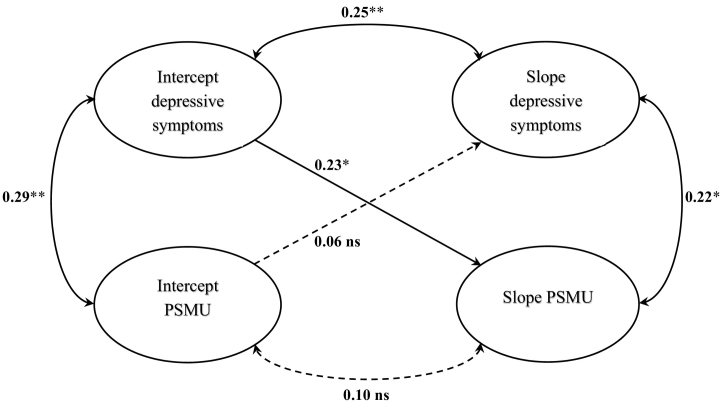
The primary aim of the current study was to examine longitudinal relation between problematic social media use (PSMU) and depressive symptoms in adolescent girls. Adolescent girls (n = 397) were assessed in three time points across two years. PSMU and depressive symptoms were subjectively assessed at three waves spaced 2 years apart. Latent growth models were used to test whether changes in PSMU were related to changes in depressive symptoms, and whether baseline PSMU predicted changes in depressive symptoms and vice versa. Results revealed baseline PSMU was positively associated with baseline depressive symptoms (β = 0.29, p < 0.01), and changes in PSMU were related to changes in depressive symptoms (β = 0.22, p < 0.05). In addition, baseline depressive symptoms were predictive of changes in PSMU (β = 0.23, p < 0.05), but baseline PSMU did not predict changes in depressive symptoms. These findings provide evidence of positive associations between increasing PSMU and depressive symptoms and suggest that interventions should target reduction of PSMU to prevent adolescents' mental health problems.
Overview
The claims and statistics of this paper haven’t been checked yet.
Run the check — free, no account needed. It reads the open-access text and checks the sources it cites.
Integrity signals
Registry
Cites
Statistics
Figures
Verification
Claims the paper makes
The claims and statistics of this paper haven’t been checked yet.
Run the check — free, no account needed. It reads the open-access text and checks the sources it cites.
Claims other papers make about this one
Each is checked against this paper’s own text: does it say what the citing paper says it does?
The source backs part of the claim, not all of it — or backs it for a different population, condition or comparison.
In the citing paper
“Another study found that the more time adolescents spent on social media, the more depressed they became (Raudsepp & Kais, 2019).”
From Ethics of the Attention Economy: The Problem of Social Media Addiction (2021) · cites this paper as Raudsepp & Kais, 2019
Experimental — accuracy not yet measuredIn the citing paper
“Similarly, Raudsepp and Kais's (35) 2-year study of adolescent girls revealed that baseline levels of depressive symptoms predicted problematic social media use, whereas prior social media use did not predict depressive symptoms.”
From Does Social Media Use Increase Depressive Symptoms? A Reverse Causation Perspective (2021) · cites this paper as [35]
In the citing paper
“A handful of studies that have approached questions around screen time using longitudinal methods observe either no or very small effects for the impact of screen time on experiences such as depressive symptoms [21,45]. This holds when exploring specific forms of screen activities such as video games [46], social media [5,6,47,48], and passive screen use [21].”
From The Conceptual and Methodological Mayhem of “Screen Time” (2020) · cites this paper as [48]
Self-check
Percentages, sums and reported differences re-computed from the paper’s own numbers.
The self-check needs the paper’s full text.
Citations
Cites
Hu, L., & Bentler, P. M. (1999) · Structural Equation Modeling A Multidisciplinary Journal · doi:10.1080/10705519909540118 · Cited by 108,788
The CES-D Scale: A Self-Report Depression Scale for Research in the General Population
Radloff, L. S. (1977) · Applied Psychological Measurement · doi:10.1177/014662167700100306 · Cited by 53,267
Cohen, J. (1992) · Psychological Bulletin · doi:10.1037//0033-2909.112.1.155 · Cited by 8,771
Internet paradox: A social technology that reduces social involvement and psychological well-being?
Kraut, R., Patterson, M., Lundmark, V., Kiesler, S., Mukophadhyay, T., & Scherlis, W. (1998) · American Psychologist · doi:10.1037/0003-066x.53.9.1017 · Cited by 4,793
Development of a Facebook Addiction Scale
Andreassen, C. S., Torsheim, T., Brunborg, G. S., & Pallesen, S. (2012) · Psychological Reports · doi:10.2466/02.09.18.pr0.110.2.501-517 · Cited by 1,884
Bollen, K. A., & Curran, P. J. (2005) · Wiley series in probability and statistics · doi:10.1002/0471746096 · Cited by 1,824
Social networking sites and addiction: Ten lessons learned
Kuss, D., & Griffiths, M. (2017) · International Journal of Environmental Research and Public Health · doi:10.3390/ijerph14030311 · Cited by 1,603
Andreassen, C. S., Pallesen, S., & Griffiths, M. D. (2017) · Addictive Behaviors · doi:10.1016/j.addbeh.2016.03.006 · Cited by 1,504
Latent Curve Models: A Structural Equation Perspective
Horan, P. M. (2006) · Contemporary Sociology A Journal of Reviews · doi:10.1177/009430610603500650 · Cited by 1,214
Online Social Network Site Addiction: A Comprehensive Review
Andreassen, C. S. (2015) · Current Addiction Reports · doi:10.1007/s40429-015-0056-9 · Cited by 1,212
Cited by
Sorted by citations
Adolescents’ Intense and Problematic Social Media Use and Their Well-Being in 29 Countries
Boer, M., van den Eijnden, R. J. J. M., Boniel-Nissim, M., Wong, S.-L., Inchley, J. C., Badura, P., Craig, W. M., Gobina, I., Kleszczewska, D., Klanšček, H. J., et al. (2020) · Journal of Adolescent Health · doi:10.1016/j.jadohealth.2020.02.014 · Cited by 434
“Although some longitudinal studies provide evidence for a causal pathway whereby problematic SMUwould negativelyaffect (mental)wellbeing [12,13], other research suggests a reverse [47] or bidirectional pathway [48].”
BackgroundEthics of the Attention Economy: The Problem of Social Media Addiction
Bhargava, V. R., & Velasquez, M. (2021) · Business Ethics Quarterly · doi:10.1017/beq.2020.32 · Cited by 292
“Another study found that the more time adolescents spent on social media, the more depressed they became (Raudsepp & Kais, 2019).”
BackgroundThe Conceptual and Methodological Mayhem of “Screen Time”
K. Kaye, L., Orben, A., A. Ellis, D., C. Hunter, S., & Houghton, S. (2020) · International Journal of Environmental Research and Public Health · doi:10.3390/ijerph17103661 · Cited by 304
Fabris, M. A., Marengo, D., Longobardi, C., & Settanni, M. (2020) · Addictive Behaviors · doi:10.1016/j.addbeh.2020.106364 · Cited by 287
Marttila, E., Koivula, A., & Räsänen, P. (2020) · Telematics and Informatics · doi:10.1016/j.tele.2020.101556 · Cited by 246
Metadata
- Authors
- Raudsepp, L., & Kais, K.
- Affiliations
- University of Tartu (EE)
- Corresponding author
- Raudsepp, Lennart
- ORCID
- Raudsepp, Lennart
- Venue
- Preventive Medicine Reports
- Publisher
- Elsevier BV
- Published
- 2019-09
- Volume
- 15
- Pages
- 100925
- ISSN
- 2211-3355 (ISSN-L)
- PMC
- PMC6603436
- OpenAlex
- W2952745509
- Cited by
- 114
- References
- 40
- Citations by year
- 2026: 10 · 2025: 27 · 2024: 18 · 2023: 10 · 2022: 16 · 2021: 20 · 2020: 11 · 2019: 1
- FWCI
- 24.11
- Type
- journal article
- Language
- en
- Open access
- gold
- doi.org
- Licence
- Locations
- Preventive Medicine Reports (publishedVersion, cc-by)
- Europe PMC (PubMed Central) (publishedVersion, cc-by)
- PubMed Central (publishedVersion, cc-by)
- PubMed (publishedVersion)
- DOAJ (DOAJ: Directory of Open Access Journals) (submittedVersion, cc-by-sa)
- Funders
- Tartu Ülikool
- Topics
- Social Sciences › Sociology and Political Science › Impact of Technology on Adolescents
- Social Sciences › Psychology › Clinical Psychology › Child and Adolescent Psychosocial and Emotional Development
- Social Sciences › Psychology › Social Psychology › Mental Health via Writing
- Keywords
- social media addiction, depressive symptoms, adolescent girls, longitudinal associations, mental health, social media use, prevention interventions
About these checks
Registry, retraction, Cites and statistics results are computed, not judged, with one exception: a printed reference that no index lists is read once by a model before it counts as a citation error. Claims are extracted by a model and kept only when their quote appears verbatim in the text; each cited source is then checked, with a model’s help, for whether it says what the claim relies on. Those verdicts can be wrong — read the claim’s quote and the cited source before relying on one.
Statistics and arithmetic are recomputed, not judged.
Confidence bands are shown only for fields calibrated on our annotated test set. None is calibrated yet, so no band is shown.
What counts as a claim ›How we measure confidence ›How we check this ›
Are you an author, or do you see a problem with this page? Request a review
