

The DOI matches its Crossref record; 59 of the 59 references it cites were found in a registry or an index.
Hair cortisol concentrations in war-affected adolescents: A prospective intervention trial
Open accessAbstract
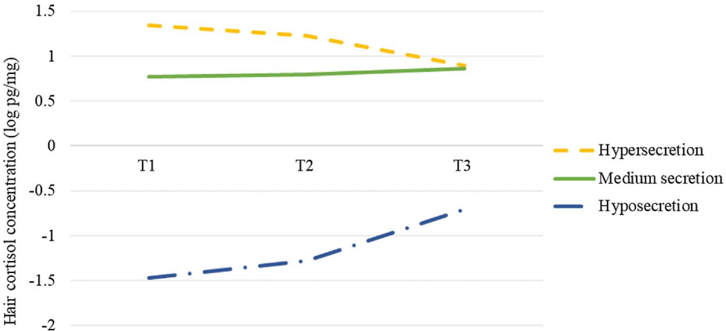
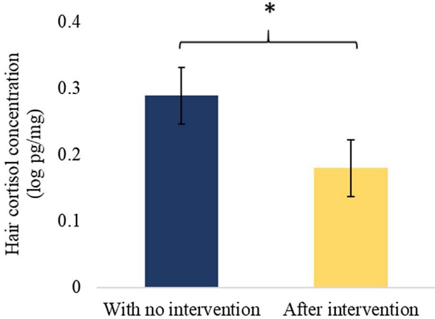
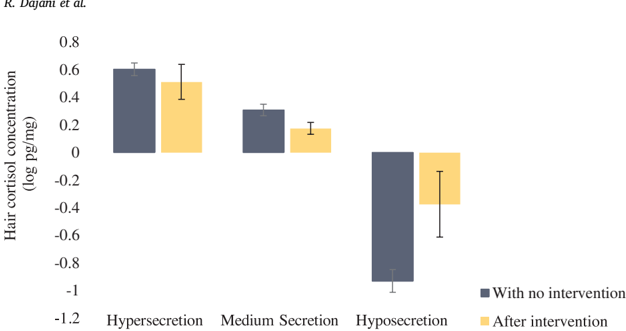
Temporal examinations of the biological signature of stress or trauma in war-affected populations are seldom undertaken. Moreover, few studies have examined whether stress biomarkers track biological sensitivity to brief interventions targeting the improvement of psychosocial wellbeing. Our study is the first to prospectively examine, in war-affected adolescents, the associations between hair cortisol concentrations (HCC) and self-reports of stress, insecurity, posttraumatic reactions, and lifetime trauma. We conducted a randomized controlled trial to test the impact of an 8-week intervention based on profound stress attunement. We collected data for a gender-balanced sample of 733 Syrian refugee (n = 411) and Jordanian non-refugee (n = 322) adolescents (12-18 years), at three time-points. We used growth mixture models to classify cortisol trajectories, and growth models to evaluate intervention impact on stress physiology. We observed three trajectories of HCC: hypersecretion, medium secretion, and hyposecretion (9.6%, 87.5% and 2.9% of the cohort, respectively). For every one percent increase in levels of insecurity, adolescents were 0.02 times more likely to have a trajectory of hypersecretion (95% CI: 1.00, 1.03, p = 0.01). For each additional symptom of posttraumatic stress reported, they were 0.07 times less likely to show hyposecretion (95% CI: 0.89, 0.98, p = 0.01). Indeed, stronger posttraumatic stress reactions were associated with a pattern of within-individual cortisol dysregulation and medium secretion. Overall, HCC decreased by a third in response to the intervention (95% CI: -0.19, -0.03, p = 0.01). While the intervention decreased HCC for youth with hypersecretion and medium secretion, it increased HCC for youth with hyposecretion (95% CI: 0.22, 1.16, p = 0.004), relative to controls. This suggests a beneficial regularization of cortisol levels, corroborating self-reports of improved psychosocial wellbeing. We did not find evidence to suggest that gender, resilience, or posttraumatic stress disorder influenced the strength or direction of responses to the intervention. This robust impact evaluation exemplifies the utility of biomarkers for tracking physiological changes in response to interventions over time. It enhances the understanding of trajectories of endocrine response in adverse environments and patterns of stress responsivity to ecological improvement.
Overview
The claims and statistics of this paper haven’t been checked yet.
Run the check — free, no account needed. It reads the open-access text and checks the sources it cites.
Integrity signals
Registry
Cites
Statistics
Figures

Verification
Claims the paper makes
The claims and statistics of this paper haven’t been checked yet.
Run the check — free, no account needed. It reads the open-access text and checks the sources it cites.
Claims other papers make about this one
Each is checked against this paper’s own text: does it say what the citing paper says it does?
The cited source says what the claim attributes to it.
In the citing paper
“In recent years, HCC has also been used as a secondary outcome of psychological interventions [44, 45].”
Self-check
Percentages, sums and reported differences re-computed from the paper’s own numbers.
The self-check needs the paper’s full text.
Citations
Cites
A Global Measure of Perceived Stress
Cohen, S., Kamarck, T., & Mermelstein, R. (1983) · Journal of Health and Social Behavior · doi:10.2307/2136404 · Cited by 32,807
The Lifelong Effects of Early Childhood Adversity and Toxic Stress
Shonkoff, J. P., Garner, A. S., THE COMMITTEE ON PSYCHOSOCIAL ASPECTS OF CHILD AND FAMILY HEALTH, C. O. E. C., Siegel, B. S., Dobbins, M. I., Earls, M. F., Garner, A. S., McGuinn, L., Pascoe, J., & Wood, D. L. (2012) · Pediatrics · doi:10.1542/peds.2011-2663 · Cited by 5,164
An Introduction to Latent Class Growth Analysis and Growth Mixture Modeling
Jung, T., & Wickrama, K. A. S. (2007) · Social and Personality Psychology Compass · doi:10.1111/j.1751-9004.2007.00054.x · Cited by 3,228
Childhood adversities and adult psychopathology in the WHO World Mental Health Surveys
Kessler, R. C., McLaughlin, K. A., Green, J. G., Gruber, M. J., Sampson, N. A., Zaslavsky, A. M., Aguilar-Gaxiola, S., Alhamzawi, A. O., Alonso, J., Angermeyer, M., et al. (2010) · British Journal of Psychiatry · doi:10.1192/bjp.bp.110.080499 · Cited by 2,640
Miller, G. E., Chen, E., & Zhou, E. S. (2007) · Psychological Bulletin · doi:10.1037/0033-2909.133.1.25 · Cited by 2,467
BOYCE, W. T., & ELLIS, B. J. (2005) · Development and Psychopathology · doi:10.1017/s0954579405050145 · Cited by 2,078
The potential role of hypocortisolism in the pathophysiology of stress-related bodily disorders
Heim, C., Ehlert, U., & Hellhammer, D. H. (2000) · Psychoneuroendocrinology · doi:10.1016/s0306-4530(99)00035-9 · Cited by 1,688
Miller, K. E., & Rasmussen, A. (2010) · Social Science & Medicine · doi:10.1016/j.socscimed.2009.09.029 · Cited by 1,524
The Adaptive Calibration Model of stress responsivity
Del Giudice, M., Ellis, B. J., & Shirtcliff, E. A. (2011) · Neuroscience & Biobehavioral Reviews · doi:10.1016/j.neubiorev.2010.11.007 · Cited by 1,373
Twelve frequently asked questions about growth curve modeling
Curran, P. J., Obeidat, K., & Losardo, D. (2010) · Journal of Cognition and Development · doi:10.1080/15248371003699969 · Cited by 1,246
Research works printed but not linked: 1
- Haushofer, 2017, Peace of mind: health insurance reduces stress and cortisol levels – evidence from a randomized experiment in Kenya, JEL
Cited by
Sorted by citations
Items 101–107 of 107
Nissen, A., Hynek, K. A., Scales, D., Hilden, P. K., & Straiton, M. (2022) · Figshare · doi:10.6084/m9.figshare.20624929
Roos, R., Witteveen, A. B., Ayuso-Mateos, J. L., Barbui, C., Bryant, R. A., Félez-Nóbrega, M., Figueiredo, N., Kalisch, R., Haro, J. M., McDaid, D., et al. (2023) · Figshare · doi:10.6084/m9.figshare.24494112
Glass, D. J., Godwin, J., Koehn, J., Dajani, R. B., Hadfield, K., Panter‐Brick, C., & Martin, M. A. (2026) · Psychoneuroendocrinology · doi:10.1016/j.psyneuen.2026.107757
Self-citationMukherjee, S., Govindula, A., Nampoothiri, M., Arora, D. S., & Mudgal, J. (2026) · Biochemical and Biophysical Research Communications · doi:10.1016/j.bbrc.2026.153557
Biology, conflict, and mental health: New Insights on a Critical and Growing Global Issue
Jankovic‐Rankovic, J., & Gettler, L. T. (2026) · Psychoneuroendocrinology · doi:10.1016/j.psyneuen.2026.107843
Jankovic‐Rankovic, J., Oka, R., Meyer, J. S., & Gettler, L. T. (2026) · American Journal of Human Biology · doi:10.1002/ajhb.70284
Frost, A., Shartle, K., Gallis, J. A., Carías, M. E., Lin, W.-C., Collins, A. J., Aikat, D., Hagaman, A. K., Bhalotra, S. R., Baranov, V., et al. (2026) · Stress and Health · doi:10.1002/smi.70239
Metadata
- Authors
- Dajani, R., Hadfield, K., van Uum, S., Greff, M., & Panter-Brick, C.
- Affiliations
- Harvard University (US)
- Queen Mary University of London (GB)
- Western University (CA)
- Venue
- Psychoneuroendocrinology
- Publisher
- Elsevier BV
- Published
- 2018-03
- Volume
- 89
- Pages
- 138-146
- ISSN
- 0306-4530 (ISSN-L)
- OpenAlex
- W2780117356
- Cited by
- 108
- References
- 59
- Citations by year
- 2026: 7 · 2025: 12 · 2024: 16 · 2023: 9 · 2022: 20 · 2021: 10 · 2020: 17 · 2019: 14 · 2018: 3
- FWCI
- 5.06
- Type
- journal article
- Language
- en
- Open access
- hybrid
- doi.org
- Licence
- Locations
- Psychoneuroendocrinology (publishedVersion, cc-by-nc-nd)
- PubMed (publishedVersion)
- Queen Mary Research Online (Queen Mary University of London) (submittedVersion)
- Funders
- Elrha’s Research for Health in Humanitarian Crises
- Wellcome Trust
- UK Government
- Topics
- Life Sciences › Neuroscience › Behavioral Neuroscience › Stress Responses and Cortisol
- Social Sciences › Psychology › Clinical Psychology › Migration, Health and Trauma
- Social Sciences › Psychology › Clinical Psychology › Posttraumatic Stress Disorder Research
- Keywords
- hair cortisol, Syrian refugees, trauma exposure, post-traumatic stress, hypersecretion, hyposecretion, stress biomarkers, psychosocial well-being, resilience, gender differences, cortisol dysregulation, intervention impact evaluation, Jordanian adolescents, post-traumatic stress disorder
- MeSH terms
- Armed Conflicts, Adolescent, Female, Hair, Humans, Hydrocortisone, Male, Prospective Studies, Refugees, Sex Factors, Stress, Physiological, Stress Disorders, Post-Traumatic, Stress, Psychological, Biomarkers
About these checks
Registry, retraction, Cites and statistics results are computed, not judged, with one exception: a printed reference that no index lists is read once by a model before it counts as a citation error. Claims are extracted by a model and kept only when their quote appears verbatim in the text; each cited source is then checked, with a model’s help, for whether it says what the claim relies on. Those verdicts can be wrong — read the claim’s quote and the cited source before relying on one.
Statistics and arithmetic are recomputed, not judged.
Confidence bands are shown only for fields calibrated on our annotated test set. None is calibrated yet, so no band is shown.
What counts as a claim ›How we measure confidence ›How we check this ›
Are you an author, or do you see a problem with this page? Request a review
