

A stratigraphic framework for abrupt climatic changes during the Last Glacial period based on three synchronized Greenland ice-core records: refining and extending the INTIMATE event stratigraphy
Open accessThe DOI matches its Crossref record; 91 of the 91 references it cites were found in a registry or an index; none of the 54 sources its claims cite is checked for support yet.
Abstract
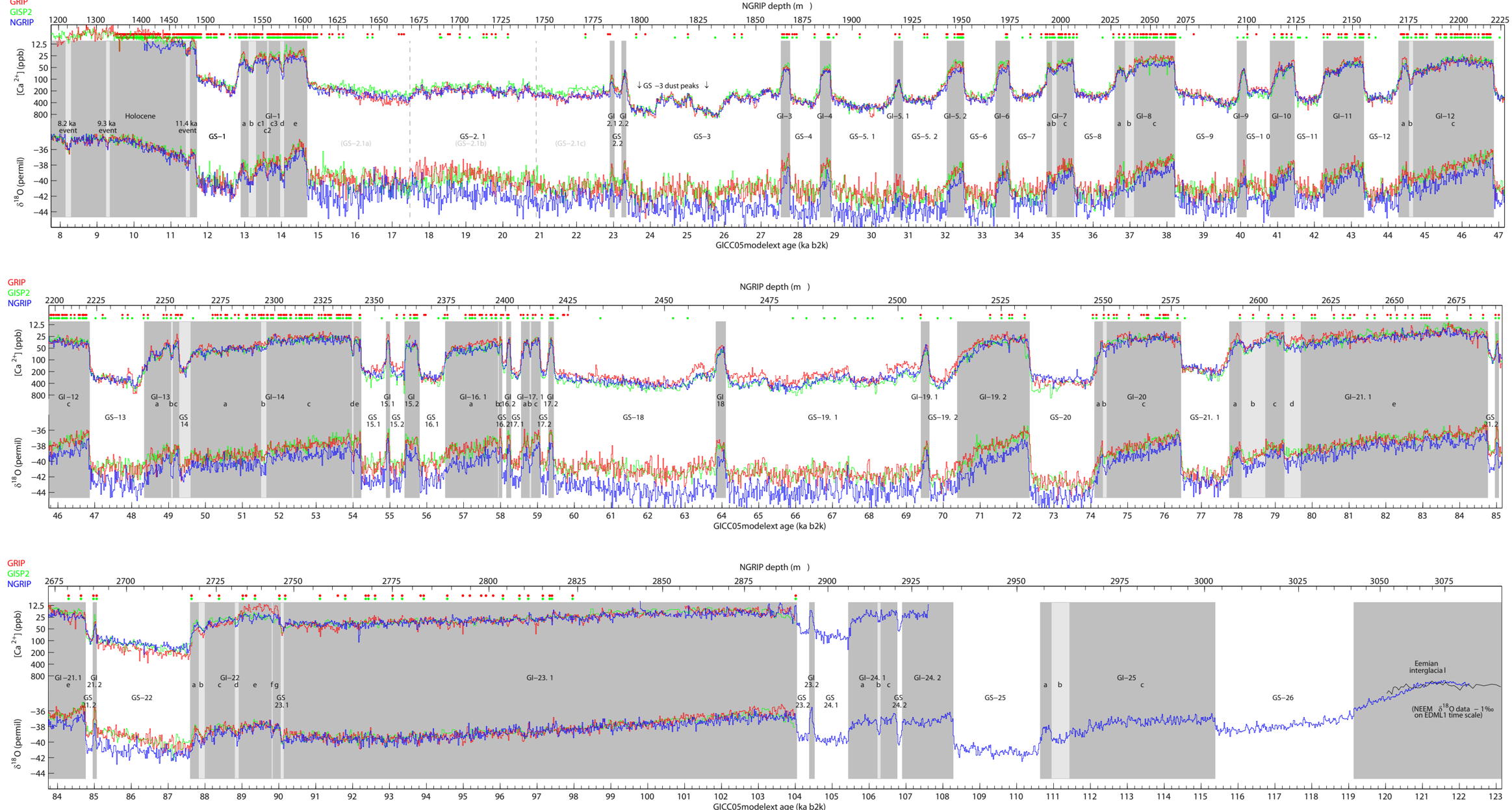
Due to their outstanding resolution and well-constrained chronologies, Greenland ice-core records provide a master record of past climatic changes throughout the Last Interglacial–Glacial cycle in the North Atlantic region. As part of the INTIMATE (INTegration of Ice-core, MArine and TErrestrial records) project, protocols have been proposed to ensure consistent and robust correlation between different records of past climate. A key element of these protocols has been the formal definition and ordinal numbering of the sequence of Greenland Stadials (GS) and Greenland Interstadials (GI) within the most recent glacial period. The GS and GI periods are the Greenland expressions of the characteristic Dansgaard–Oeschger events that represent cold and warm phases of the North Atlantic region, respectively. We present here a more detailed and extended GS/GI template for the whole of the Last Glacial period. It is based on a synchronization of the NGRIP, GRIP, and GISP2 ice-core records that allows the parallel analysis of all three records on a common time scale. The boundaries of the GS and GI periods are defined based on a combination of stable-oxygen isotope ratios of the ice (δ18O, reflecting mainly local temperature) and calcium ion concentrations (reflecting mainly atmospheric dust loading) measured in the ice. The data not only resolve the well-known sequence of Dansgaard–Oeschger events that were first defined and numbered in the ice-core records more than two decades ago, but also better resolve a number of short-lived climatic oscillations, some defined here for the first time. Using this revised scheme, we propose a consistent approach for discriminating and naming all the significant abrupt climatic events of the Last Glacial period that are represented in the Greenland ice records. The final product constitutes an extended and better resolved Greenland stratotype sequence, against which other proxy records can be compared and correlated. It also provides a more secure basis for investigating the dynamics and fundamental causes of these climatic perturbations.
Overview
CoChat Summary
TL;DR
This paper presents a revised and extended INTIMATE event stratigraphy for Greenland stadials (GS) and interstadials (GI) during the Last Glacial, based on synchronized NGRIP, GRIP, and GISP2 ice-core records on the GICC05modelext time scale. It refines and extends the GS/GI numbering, resolves additional short-lived events and sub-events, and provides a stratotype for correlating other proxy records.
Key findings
- The synchronized three-core template defines GS/GI boundaries using both δ¹⁸O and calcium ion concentration ([Ca²⁺]) at 20-year resolution; it covers 104–8 ka b2k with three cores and extends to c. 120 ka b2k using NGRIP supported by preliminary NEEM data.
- New or revised events include GI-5.1 at c. 30.7 ka b2k within the former GS-5, splitting it into GS-5.1, GI-5.1, and GS-5.2 and renaming former GI-5 to GI-5.2; GI-2 is split into GI-2.1 and GI-2.2 bracketing GS-2.2; GI-1c is subdivided into GI-1c1, GI-1c2, and GI-1c3; GI-7, GI-8, and GI-12 are subdivided; and additional short events include GI-15.1, GI-16.2, GI-17.1/17.2, GI-19.1, and GI-21.1/21.2.
- Sub-events are defined by the criteria that they register in all three cores for at least two consecutive 20-year data points (≥40 years) and involve a δ¹⁸O shift of 1‰ and a factor 2 change in [Ca²⁺]; interstadial onsets typically show δ¹⁸O changing by about 4‰ over one or two 20-year data points and [Ca²⁺] changing by up to an order of magnitude.
- Some intervals are treated as quasi-stadial or super-interstadial: GS-14 is regarded as quasi-stadial between GI-13 and GI-14, GS-23.1 as quasi-stadial, and the period 104–87.6 ka b2k as one super-interstadial of 16.5 kyr; the 11.4 ka event is defined at 11.40–11.52 ka b2k.
Methods
- Data: δ¹⁸O and [Ca²⁺] records from NGRIP, GRIP, and GISP2 on the common GICC05modelext time scale; GICC05 is annual-layer counted in NGRIP to 60 ka b2k and extended by an ice-flow model below, then transferred to GRIP and GISP2 using volcanic reference horizons; all records are resampled to 20-year resolution.
- Event definition: visual inspection by several investigators of the 20-year dataset, with onsets placed at the first clear mark of a transition; δ¹⁸O and [Ca²⁺] are used together, and uncertainties are estimated from transition steepness and agreement between proxies; preliminary NEEM data support definitions between GS-24.1 and GS-25.
- Analysis: event numbering and naming follow principles of meaningfulness, completeness, conservatism/uniqueness, and consistency; a Bayesian statistical classification method has been initiated but is not yet applied in this paper.
Limitations
- Stated: below 104 ka b2k, GRIP and GISP2 cannot be synchronized to GICC05modelext; below 107.6 ka b2k only NGRIP δ¹⁸O data are available, so event classification becomes less certain; GI-25 sub-events are tentative because the NEEM core lacks ice from 110–116 ka b2k.
- Stated: the GS-2 subdivision is only marginally supported and may reflect site differences between Summit (GRIP/GISP2) and NGRIP rather than a regional signal; GS-3 dust peaks show decoupled δ¹⁸O and [Ca²⁺] and provide no basis for subdivision; some existing definitions are retained for compatibility even where [Ca²⁺] supports older onsets.
- Evident: event boundaries depend on visual inspection and somewhat arbitrary sub-event thresholds; relative dating precision is better than 20 years over most of the combined records but varies with match-point spacing; the Bayesian classification approach is not yet applied, and independent dating for other archives remains a broader challenge.
Model-written summary. Check it against the paper before relying on it.
Integrity signals
Registry
Cites
Statistics
Figures
Verification
Claims the paper makes
0 Valid · 2 Not valid · 37 Not checked · 71 Own results and interpretations
A result the paper reports from its own data — it cites no other source for it, so there is none to check. The quote shows it is in the paper.
In the paper
“This apparent decoupling of d 18 O and [Ca 2þ ] is not observed elsewhere in the record.”
§ A stratigraphic framework for abrupt climatic changes during the Last Glacial period based on three synchronized Greenland ice-core records: refining and extending the INTIMATE event stratigraphy > 4.3. Stadial substructure
plain- Asserted: passes — The authors put it forward as true.
- Checkable: passes — It can be checked against evidence.
- Load-bearing: passes — The paper’s conclusions depend on it.
- Based: passes — The paper gives a reason why it holds.
A result the paper reports from its own data — it cites no other source for it, so there is none to check. The quote shows it is in the paper.
In the paper
“although GS-2b (designated GS-2.1b in Fig. 1) is characterized by slightly lower [Ca 2þ ] values than GS-2a and GS-2c”
§ A stratigraphic framework for abrupt climatic changes during the Last Glacial period based on three synchronized Greenland ice-core records: refining and extending the INTIMATE event stratigraphy > 4.3. Stadial substructure
plain- Asserted: passes — The authors put it forward as true.
- Checkable: passes — It can be checked against evidence.
- Load-bearing: unclear — It is unclear whether the paper’s conclusions depend on it.
- Based: passes — The paper gives a reason why it holds.
A result the paper reports from its own data — it cites no other source for it, so there is none to check. The quote shows it is in the paper.
In the paper
“It is now clear that several interstadials show internal structure that resembles that of GI-1.”
§ A stratigraphic framework for abrupt climatic changes during the Last Glacial period based on three synchronized Greenland ice-core records: refining and extending the INTIMATE event stratigraphy > 1. Introduction
boostedstates an association- Asserted: passes — The authors put it forward as true.
- Checkable: passes — It can be checked against evidence.
- Load-bearing: passes — The paper’s conclusions depend on it.
- Based: passes — The paper gives a reason why it holds.
A check of a cited source is scheduled, or we don’t hold its full text yet; the claim is checked once it runs.
In the paper
“In addition, beyond 48 ka b2k, the DeO variability reflected in the Greenland records includes a number of short-lived events of similar amplitude to those recognized in the initial schemes of Johnsen et al. (1992) and Dansgaard et al. (1993).”
§ A stratigraphic framework for abrupt climatic changes during the Last Glacial period based on three synchronized Greenland ice-core records: refining and extending the INTIMATE event stratigraphy > 1. Introduction
What the sources say
- Not checked yetcites Johnsen et al., 1992 matched to “Irregular glacial interstadials recorded in a new Greenland ice core” (1992) source
A check is scheduled.
- Not checked yetcites Dansgaard et al., 1993 matched to “Evidence for general instability of past climate from a 250-kyr ice-core record” (1993) source
A check is scheduled.
plainstates an association- Asserted: passes — The authors put it forward as true.
- Checkable: passes — It can be checked against evidence.
- Load-bearing: unclear — It is unclear whether the paper’s conclusions depend on it.
- Based: passes — The paper gives a reason why it holds.
- Not checked yet
A result the paper reports from its own data — it cites no other source for it, so there is none to check. The quote shows it is in the paper.
In the paper
“we find that no other stadials exhibit structures that would warrant formal sub-divisions”
§ A stratigraphic framework for abrupt climatic changes during the Last Glacial period based on three synchronized Greenland ice-core records: refining and extending the INTIMATE event stratigraphy > 4.3. Stadial substructure
plain- Asserted: passes — The authors put it forward as true.
- Checkable: passes — It can be checked against evidence.
- Load-bearing: passes — The paper’s conclusions depend on it.
- Based: passes — The paper gives a reason why it holds.
37 more claims
Create a free account to see all 110 claims and to verify the 47 references still open.
- It may state two separate claims as one. 51
- Probably not a substantial claim. 33
- The quote only partly states this claim. 1
Claims other papers make about this one
Each is checked against this paper’s own text: does it say what the citing paper says it does?
In the citing paper
“In Greenland ice cores, the water stable isotope data (e.g.δ 18 O ice ) record two unusually short and small Greenland interstadials, GI-2.1 and GI-2.2 (Rasmussen et al., 2014), briefly interrupting the long cold period formed by the two Greenland stadials GS-2 and GS-3 (Fig. 1a).”
From Synchronizing ice-core and U ∕ Th timescales in the Last Glacial Maximum using Hulu Cave 14 C and new 10 Be measurements from Greenland and Antarctica (2023) · cites this paper as Rasmussen et al., 2014
In the citing paper
“While δ 18 O ice does not show a clear imprint of the Heinrich events, Greenland ice-core calcium data show two periods of heightened concentration during GS-3 (Fig. 1a; Rasmussen et al., 2014) that could be related to atmospheric reorganization around HE-2 (Adolphi et al., 2018), although there is debate about this attribution (Hughes and Gibbard, 2015).”
From Synchronizing ice-core and U ∕ Th timescales in the Last Glacial Maximum using Hulu Cave 14 C and new 10 Be measurements from Greenland and Antarctica (2023) · cites this paper as Rasmussen et al., 2014
In the citing paper
“The shift in IntCal20 now moves absolute calendar dates older by about 50 years and in the direction of the Holocene boundary as observed in Greenland ice, dated at 11,653 ± 99 cal BP (maximum counting error (MCE), equivalent to 2-σ, Rasmussen et al. 2014).”
From Recent Developments in Calibration for Archaeological and Environmental Samples (2020) · cites this paper as Rasmussen et al. 2014
In the citing paper
“With the development of the Greenland Ice Core Chronology 2005 (GICC05) that placed the GRIP, NGRIP, and GISP2 ice cores on a common time scale (Rasmussen et al., 2006(Rasmussen et al., , 2014)), the age of the onset of the last stadial (Fig. 1), termed the Greenland Stadial 1 (GS-1), was established as 12,846 ± 4 yr [BP 1950, GICC05 or 12,896 ± 4 yr [b2k, GICC05].”
From Comprehensive refutation of the Younger Dryas Impact Hypothesis (YDIH) (2023) · cites this paper as Rasmussen et al., 2014
In the citing paper
“The calibrated ages of the tree samples are consistent with sharp increase in Greenland δ 18 O values between the cooler GI-1b (the IACP, see Sections 3.3 and 9.2) and the warmer GI-1a interval (Rasmussen et al., 2014).”
From Comprehensive refutation of the Younger Dryas Impact Hypothesis (YDIH) (2023) · cites this paper as Rasmussen et al., 2014
4 more claims about this paper
Create a free account to see every claim other papers make about this one.
Self-check
Percentages, sums and reported differences re-computed from the paper’s own numbers.
Each contradiction between two passages listed here was confirmed by an independent check.
Rated minor: it would not touch a result — a value no result rests on, a p-value that stays on the same side of the significance level, or a conflict that is clerical, resolved elsewhere in the paper, or outside its own findings.
In the paper
§ A stratigraphic framework for abrupt climatic changes during the Last Glacial period based on three synchronized Greenland ice-core records: refining and extending the INTIMATE event stratigraphy > 5.1. Adjusting the existing event stratigraphy (8e48 ka b2k)
“The 8.2 ka and 9.2 ka events have been subject to detailed investigations based on data from several ice cores (Rasmussen et al., 2007), and we recommend no changes to the previously published definitions.”
§ A stratigraphic framework for abrupt climatic changes during the Last Glacial period based on three synchronized Greenland ice-core records: refining and extending the INTIMATE event stratigraphy > 5.1. Adjusting the existing event stratigraphy (8e48 ka b2k)
“In line with the naming of the 8.2 ka and 9.3 ka events, we refer to this event as the '11.4 ka event'.”
Rated minor: it would not touch a result — a value no result rests on, a p-value that stays on the same side of the significance level, or a conflict that is clerical, resolved elsewhere in the paper, or outside its own findings.
In the paper
§ A stratigraphic framework for abrupt climatic changes during the Last Glacial period based on three synchronized Greenland ice-core records: refining and extending the INTIMATE event stratigraphy > 5.1. Adjusting the existing event stratigraphy (8e48 ka b2k)
“However, the cold episode at 13.60e13.64ka b2k within GI-1c fulfils the criteria for classification as a sub-event”
§ A stratigraphic framework for abrupt climatic changes during the Last Glacial period based on three synchronized Greenland ice-core records: refining and extending the INTIMATE event stratigraphy > 6. Discussion and final remarks
“Start of GI-1c1 | 1554.75 13,600 b | 156 | 13 | | | Start of GI-1c2 | 1557.08 13,660 b | 158 | 13 | |”
Rated minor: it would not touch a result — a value no result rests on, a p-value that stays on the same side of the significance level, or a conflict that is clerical, resolved elsewhere in the paper, or outside its own findings.
In the paper
§ A stratigraphic framework for abrupt climatic changes during the Last Glacial period based on three synchronized Greenland ice-core records: refining and extending the INTIMATE event stratigraphy > 2. The INTIMATE approach
“(NEEM δ 18 O data -1‰ on EDML1 time scale)”
§ A stratigraphic framework for abrupt climatic changes during the Last Glacial period based on three synchronized Greenland ice-core records: refining and extending the INTIMATE event stratigraphy > 2. The INTIMATE approach
“In the Eemian interglacial, NGRIP data are extended by NEEM d 18 O data offset by 2‰ (NEEM community members, 2013).”
Citations
Cites
Evidence for general instability of past climate from a 250-kyr ice-core record
Dansgaard, W., Johnsen, S. J., Clausen, H. B., Dahl-Jensen, D., Gundestrup, N. S., Hammer, C. U., Hvidberg, C. S., Steffensen, J. P., Sveinbjörnsdottir, A. E., Jouzel, J., et al. (1993) · Nature · doi:10.1038/364218a0 · Cited by 4,762
Self-citationHigh-resolution record of Northern Hemisphere climate extending into the last interglacial period
North Greenland Ice Core Project members (2004) · Nature · doi:10.1038/nature02805 · Cited by 3,170
Heinrich, H. (1988) · Quaternary Research · doi:10.1016/0033-5894(88)90057-9 · Cited by 2,459
A new Greenland ice core chronology for the last glacial termination
Rasmussen, S. O., Andersen, K. K., Svensson, A. M., Steffensen, J. P., Vinther, B. M., Clausen, H. B., Siggaard‐Andersen, M. ‐., Johnsen, S. J., Larsen, L. B., Dahl‐Jensen, D., et al. (2006) · Journal of Geophysical Research: Atmospheres · doi:10.1029/2005jd006079 · Cited by 2,304
Self-citationSea-level fluctuations during the last glacial cycle
Siddall, M., Rohling, E. J., Almogi-Labin, A., Hemleben, C., Meischner, D., Schmelzer, I., & Smeed, D. A. (2003) · Nature · doi:10.1038/nature01690 · Cited by 1,626 · cited 2×
“Another feature of the 68 e 48 ka b2k period is that sea level was rising at the highest rate around 60 e 55 ka b2k, at the time where ‘ fl ickering ’ behaviour is most prevalent in the Greenland records (Siddall et al., 2003).”
Bond, G., Heinrich, H., Broecker, W., Labeyrie, L., McManus, J., Andrews, J., Huon, S., Jantschik, R., Clasen, S., Simet, C., et al. (1992) · Nature · doi:10.1038/360245a0 · Cited by 1,603
Hemming, S. R. (2004) · Reviews of Geophysics · doi:10.1029/2003rg000128 · Cited by 1,526
Irregular glacial interstadials recorded in a new Greenland ice core
Johnsen, S. J., Clausen, H. B., Dansgaard, W., Fuhrer, K., Gundestrup, N., Hammer, C. U., Iversen, P., Jouzel, J., Stauffer, B., & steffensen, J. P. (1992) · Nature · doi:10.1038/359311a0 · Cited by 1,466
Self-citationOne-to-one coupling of glacial climate variability in Greenland and Antarctica
Members, E. C. (2006) · Nature · doi:10.1038/nature05301 · Cited by 1,305
Abrupt increase in Greenland snow accumulation at the end of the Younger Dryas event
Alley, R. B., Meese, D. A., Shuman, C. A., Gow, A. J., Taylor, K. C., Grootes, P. M., White, J. W. C., Ram, M., Waddington, E. D., Mayewski, P. A., et al. (1993) · Nature · doi:10.1038/362527a0 · Cited by 1,206
Cited by
Items 901–1,000 of 2,483
Peti, L., Fitzsimmons, K. E., Hopkins, J. L., Nilsson, A., Fujioka, T., Fink, D. W., Mifsud, C., Christl, M., Muscheler, R., & Augustinus, P. C. (2020) · Geochronology · doi:10.5194/gchron-2-367-2020 · Cited by 14
Zhi, D., Shi, X., Zou, J., Zou, X., Dou, R., Wu, Y., Liu, Y., Ge, C., & Gorbarenko, S. A. (2021) · Global and Planetary Change · doi:10.1016/j.gloplacha.2021.103456 · Cited by 14
Ballantyne, C. K., Fabel, D., Gheorghiu, D. M., Rodés, Á., Shanks, R., & Xu, S. (2017) · Boreas · doi:10.1111/bor.12242 · Cited by 14
Young, D. S., Green, C. P., Batchelor, R., Austin, P., Elias, S. A., Athersuch, J., & Lincoln, P. C. (2020) · Journal of Quaternary Science · doi:10.1002/jqs.3258 · Cited by 14
Spagnolo, V., Crezzini, J., Falguères, C., Tombret, O., Garbé, L., Bahain, J., Giaccio, B., Arrighi, S., Aureli, D., Ekberg, I., et al. (2024) · Quaternary Science Reviews · doi:10.1016/j.quascirev.2024.108628 · Cited by 14
Patiño, L. F., Velez, M. I., Weber, M., Velásquez-Ruiz, C., David, S., Rueda, M., Riascos, I. M. C., & Arboleda, D. (2020) · Journal of Quaternary Science · doi:10.1002/jqs.3249 · Cited by 14
O'Connell, M. A. (2021) · Review of Palaeobotany and Palynology · doi:10.1016/j.revpalbo.2021.104377 · Cited by 14
Avery, R. S., Kemp, A. E. S., Bull, J. M., Pearce, R., Vardy, M. E., Fielding, J. J., & Cotterill, C. J. (2019) · Quaternary Science Reviews · doi:10.1016/j.quascirev.2019.105894 · Cited by 14
García‐Moreiras, I., Delgado, C., Martínez‐Carreño, N., García‐Gil, S., & Sobrino, C. M. (2019) · Global and Planetary Change · doi:10.1016/j.gloplacha.2019.02.015 · Cited by 14
Chen, Q., Cheng, X., Cai, Y., Luo, Q., Zhang, J., Tang, L., Hu, Y., Ren, J., Wang, P., Wang, Y., et al. (2022) · Frontiers in Earth Science · doi:10.3389/feart.2022.863829 · Cited by 14
Detection of abrupt changes in East Asian monsoon from Chinese loess and speleothem records
Rousseau, D., Bagniewski, W., & Sun, Y. (2023) · Global and Planetary Change · doi:10.1016/j.gloplacha.2023.104154 · Cited by 14
Scourse, J. D. (2024) · Journal of Quaternary Science · doi:10.1002/jqs.3611 · Cited by 14
Prud’homme, C., Moine, O., Mathieu, J., Saulnier, S., & Antoine, P. (2018) · Boreas · doi:10.1111/bor.12359 · Cited by 14
Łanczont, M., Komar, M., Madeyska, T. R., Mroczek, P., Standzikowski, K., Hołub, B., Fedorowicz, S., Sytnyk, O., Bogucki, A. B., Dmytruk, R., et al. (2021) · Quaternary International · doi:10.1016/j.quaint.2021.10.013 · Cited by 14
Straus, L. G., & Langlais, M. (2020) · HAL · Cited by 14
Late Pleistocene and Holocene aeolian activity in the Deliblato Sands, Serbia
Sípos, G., Marković, S. B., Gavrilov, M. B., Balla, A., Filyó, D., Bartyik, T., Mészáros, M., Tóth, O., van Leeuwen, B., Lukić, T., et al. (2021) · Quaternary Research · doi:10.1017/qua.2021.67 · Cited by 14
Bertran, P., Stadelmaier, K. H., & Ludwig, P. (2022) · Journal of Quaternary Science · doi:10.1002/jqs.3434 · Cited by 14
The Pyrenees: environments and landforms in the aftermath of the LGM (18.9–14.6 ka)
Delmas, M., Gunnell, Y., Calvet, M., Reixach, T., & Oliva, M. (2022) · Elsevier eBooks · doi:10.1016/b978-0-323-91899-2.00040-1 · Cited by 14
Valbuena, Á. A., Iriarte-Chiapusso, M.-J., & García-Ibaibarriaga, N. (2020) · Quaternary International · doi:10.1016/j.quaint.2020.07.004 · Cited by 14
Palmer, J. G., Turney, C. S. M., Cook, E. R., Fenwick, P., Thomas, Z., Helle, G., Jones, R., Clement, A., Hogg, A., Southon, J., et al. (2016) · Quaternary Science Reviews · doi:10.1016/j.quascirev.2016.10.003 · Cited by 6
Medina‐Elizalde, M., Perritano, S., DeCesare, M., Polanco-Martínez, J. M., Lases-Hernández, F., Marks, G. S., & McGee, D. (2022) · Paleoceanography and Paleoclimatology · doi:10.1029/2021pa004346 · Cited by 13
Thanh, D. N., Chen, Y., Chiang, H.-W., Shen, C., Wang, X., Doan, L. D., Yuan, S., Lone, M. A., Yu, T., Lin, Y., et al. (2020) · Journal of Asian Earth Sciences X · doi:10.1016/j.jaesx.2020.100027 · Cited by 13
Hoebe, P., Peeters, H., & Arnoldussen, S. (2023) · Journal of Archaeological Science Reports · doi:10.1016/j.jasrep.2023.103944 · Cited by 13
The Kola Peninsula and Russian Lapland: A review of Late Weichselian glaciation
Boyes, B. M., Linch, L. D., Pearce, D. M., Kolka, V. V., & Nash, D. J. (2021) · Quaternary Science Reviews · doi:10.1016/j.quascirev.2021.107087 · Cited by 13
Ancrenaz, A., Braucher, R., Defive, E., Poiraud, A., & Steiger, J. (2022) · Quaternary Science Reviews · doi:10.1016/j.quascirev.2022.107500 · Cited by 13
Crombé, P., Storme, A., Perdaen, Y., & Vandendriessche, H. (2023) · Quaternary Science Reviews · doi:10.1016/j.quascirev.2023.108295 · Cited by 13
Korsakova, O., Kolka, V. V., Tolstobrov, D. S., Savelieva, L. A., Kosova, A. L., Petrov, A., & Semyonova, L. (2021) · Journal of Quaternary Science · doi:10.1002/jqs.3397 · Cited by 13
Duñó-Iglesias, P., Ramírez‐Pedraza, I., Rivals, F., Mirea, I. C., Faur, L., Constantin, S., & Robu, M. (2023) · Palaeogeography Palaeoclimatology Palaeoecology · doi:10.1016/j.palaeo.2023.111988 · Cited by 13
Late Quaternary environmental change in eastern Beringia
Monteath, A., Edwards, M. E., FROESE, D. G., Anderson, L., Gaglioti, B. V., Cocker, S. L., Brigham‐Grette, J., Wooller, M. J., Finney, B. P., & Abbott, M. B. (2025) · Quaternary Science Reviews · doi:10.1016/j.quascirev.2025.109527 · Cited by 13
Heaton, T. (2022) · Journal of the Royal Statistical Society Series C (Applied Statistics) · doi:10.1111/rssc.12599 · Cited by 13
Li, B., Lu, J., Монахов, В. Г., Kang, H. J., Xu, Y., An, B., Ghani, M. U., Li, M., Peng, W., & Ma, X. (2021) · Mammalian Biology · doi:10.1007/s42991-020-00092-0 · Cited by 13
Sperlich, P., Schaefer, H., Fletcher, S. E. M., Guillevic, M., Lassey, K. R., Sapart, C., Röckmann, T., & Blunier, T. (2015) · Global Biogeochemical Cycles · doi:10.1002/2014gb005007 · Cited by 13
Self-citationPleistocene Hypothesis – Moving Savanna Perceptual Preference Hypothesis Beyond Savanna
Rathmann, J., Korpela, K., & Stojakowits, P. (2022) · Frontiers in Psychology · doi:10.3389/fpsyg.2022.901799 · Cited by 13
Clumped‐Isotope Constraint on Upper‐Tropospheric Cooling During the Last Glacial Maximum
Banerjee, A., Yeung, L. Y., Murray, L. T., Tie, X., Tierney, J. E., & LeGrande, A. N. (2022) · AGU Advances · doi:10.1029/2022av000688 · Cited by 13
Peresani, M., Ravazzi, C., Pini, R., Margaritora, D., Cocilova, A., Delpiano, D., Bertola, S., Castellano, L., Fogliazza, F., Martino, G., et al. (2018) · Quaternary Research · doi:10.1017/qua.2018.76 · Cited by 13
Modelled sensitivity of Monte San Lorenzo ice cap, Patagonian Andes, to past and present climate
Martin, J. R. V., Davies, B. J., Jones, R. S., & Thorndycraft, V. R. (2022) · Frontiers in Earth Science · doi:10.3389/feart.2022.831631 · Cited by 13
Zeeden, C., Obreht, I., Vereş, D., Kaboth‐Bahr, S., Hošek, J., Marković, S. B., Bösken, J., Lehmkuhl, F., Rolf, C., & Hambach, U. (2020) · Scientific Reports · doi:10.1038/s41598-020-61528-8 · Cited by 13
Segawa, T., Rey‐Iglesia, A., Lorenzen, E. D., & Westbury, M. V. (2024) · Proceedings of the Royal Society B Biological Sciences · doi:10.1098/rspb.2023.2411 · Cited by 13
Datema, M., Sangiorgi, F., de Vernal, A., Reichart, G., Lourens, L. J., & Sluijs, A. (2017) · Marine Micropaleontology · doi:10.1016/j.marmicro.2017.08.003 · Cited by 13
Azennoud, K., Baali, A., Mesquita‐Joanes, F., Asmi, H. E., & Brahim, Y. A. (2023) · Sedimentary Geology · doi:10.1016/j.sedgeo.2023.106376 · Cited by 13
Fersi, W., Penaud, A., Wary, M., Toucanne, S., Waelbroeck, C., Rossignol, L., & Eynaud, F. (2021) · Global and Planetary Change · doi:10.1016/j.gloplacha.2021.103552 · Cited by 13
Charton, L., Combourieu‐Nebout, N., Bertini, A., Lebreton, V., Peyron, O., Robles, M., Sassoon, D., & Moncel, M. (2025) · Quaternary Science Reviews · doi:10.1016/j.quascirev.2025.109345 · Cited by 13
Dufour, É., Neer, W. V., Vermeersch, P., & Patterson, W. P. (2017) · Quaternary International · doi:10.1016/j.quaint.2017.09.026 · Cited by 13
The terminations of the glacial cycles
Palacios, D., Hughes, P. D., Goñi, M. F. S., García-Ruiz, J. M., & Andrés, N. (2022) · Elsevier eBooks · doi:10.1016/b978-0-323-91899-2.00002-4 · Cited by 13
Zöld Cave and the Late Epigravettian in Eastern Central Europe
Béres, S., Cserpák, F., Hoyo, M. M., Repiszky, T., Sázelová, S., Wilczyński, J., & Lengyel, G. (2020) · Quaternary International · doi:10.1016/j.quaint.2020.09.050 · Cited by 13
Lewis, C. F. M., & Todd, B. J. (2018) · Boreas · doi:10.1111/bor.12351 · Cited by 13
Mas, B., Allué, E., de la Torre, M. S., Parque, Ó., Tejero, J.-M., Mangado, X., & Pericot, J. M. F. I. (2018) · Journal of Archaeological Science Reports · doi:10.1016/j.jasrep.2018.10.002 · Cited by 13
Volcanoes and climate: the triggering of preboreal Jökulhlaups in Iceland
Vliet‐Lanoë, B. V., Knudsen, Ó., Guðmundsson, A., Guillou, H., Chazot, G., Langlade, J., Liorzou, C., & Nonnotte, P. (2020) · International Journal of Earth Sciences · doi:10.1007/s00531-020-01833-9 · Cited by 13
Stojak, J., & Jędrzejewska, B. (2022) · Mammal Review · doi:10.1111/mam.12298 · Cited by 13
Pétillon, J., Laroulandie, V., Boudadi‐Maligne, M., Dumontier, P., Ferrier, C., Kuntz, D., Langlais, M., Mallye, J., Mistrot, V., Normand, C., et al. (2017) · Gallia préhistoire · doi:10.4000/galliap.559 · Cited by 13
Turú, V., Carrasco, R. M., Sáez, J. A. L., Pontevedra‐Pombal, X., Pedraza, J., Luelmo-Lautenschlaeger, R., Díaz, S. P., Echeverria, A., Frigola, J., Alba‐Sánchez, F., et al. (2021) · CATENA · doi:10.1016/j.catena.2021.105689 · Cited by 13
Matthews, J. A., Linge, H. C., Nesje, A., Wilson, P., Mourne, R. W., Winkler, S., Owen, G., Hill, J., Haselberger, S., & Olsen, J. (2023) · Boreas · doi:10.1111/bor.12644 · Cited by 13
Late Neanderthal “menu” from northern to southern Italy: freshwater and terrestrial animal resources
Romandini, M., Silvestrini, S., Real, C., Lugli, F., Tassoni, L., Carrera, L., Badino, F., Bortolini, E., Marciani, G., Delpiano, D., et al. (2023) · Quaternary Science Reviews · doi:10.1016/j.quascirev.2023.108233 · Cited by 13
Chen, N., Xu, T., Dou, J., Jie, D., Gao, G., & Yang, Z. (2024) · Quaternary Science Reviews · doi:10.1016/j.quascirev.2024.109084 · Cited by 13
Brancaleoni, G., Shnaider, S. V., Osipova, E., Danukalova, G., Kurbanov, R., Deput, E., kyzy, S. A., Abdykanova, A., & Krajcarz, M. T. (2021) · Geoarchaeology · doi:10.1002/gea.21892 · Cited by 13
Iron in the NEEM ice core relative to Asian loess records over the last glacial–interglacial cycle
Xiao, C., Du, Z., Handley, M. J., Mayewski, P. A., Cao, J., Schüpbach, S., Zhang, T., Petit, J., Li, C., Han, Y., et al. (2020) · National Science Review · doi:10.1093/nsr/nwaa144 · Cited by 13
Verhegge, J., Storme, A., Cruz, F., & Crombé, P. (2020) · Geoarchaeology · doi:10.1002/gea.21815 · Cited by 13
Łanczont, M., Połtowicz-Bobak, M., Bobak, D., Mroczek, P., Nowak, A., Komar, M., & Standzikowski, K. (2020) · Quaternary International · doi:10.1016/j.quaint.2020.08.028 · Cited by 13
Shchetnikov, A. A., Вячеславовна, Б. Е., & Константинович, К. С. (2019) · Journal of Asian Earth Sciences · doi:10.1016/j.jseaes.2019.01.025 · Cited by 13
Dörschner, N., Fitzsimmons, K. E., Blasco, R., Finlayson, G., Vidal, J. R., Rosell, J., Hublin, J., & Finlayson, C. (2018) · Quaternary International · doi:10.1016/j.quaint.2018.02.020 · Cited by 13
Borzenkova, I. I., Borisova, O. K., Жильцова, Е. Л., & Сапелко, Т. В. (2017) · Journal Ice and Snow · doi:10.15356/2076-6734-2017-1-117-132 · Cited by 13
Lagged atmospheric circulation response in the Black Sea region to Greenland Interstadial 10
Czymzik, M., Nowaczyk, N. R., Dellwig, O., Wegwerth, A., Muscheler, R., Christl, M., & Arz, H. W. (2020) · Proceedings of the National Academy of Sciences · doi:10.1073/pnas.2005520117 · Cited by 14
Identification of Atlantic water inflow on the north Svalbard shelf during the Holocene
Peral, M., Austin, W. E. N., & Noormets, R. (2021) · Journal of Quaternary Science · doi:10.1002/jqs.3374 · Cited by 13
Cui, J., Zhao, J., Dong, X., Pérez‐Mejías, C., Lu, J., Tian, Y., Wang, J., Pan, L., Zhang, H., & Cheng, H. (2023) · Quaternary Research · doi:10.1017/qua.2023.43 · Cited by 13
Fernandez, G., Costa, A., Giaccio, B., Natale, J., Palladino, D. M., & Sottili, G. (2025) · Communications Earth & Environment · doi:10.1038/s43247-025-01998-8 · Cited by 13
Supereruption doublet at a climate transition
Paine, A. R., Wadsworth, F. B., & Baldini, J. U. L. (2021) · Communications Earth & Environment · doi:10.1038/s43247-021-00293-6 · Cited by 13
Hofmann, F. M., Steiner, M., Hergarten, S., Aster Team, & Preusser, F. (2023) · Quaternary Research · doi:10.1017/qua.2023.53 · Cited by 13
Rigaud, J.-P., Simek, J. F., Delpech, F., & Texier, J. (2016) · Paléo · doi:10.4000/paleo.3149 · Cited by 13
Paleoenvironment Variability during Termination I at the Reykjanes Ridge, North Atlantic
Matul, A. G., Barash, M. S., Khusid, T. A., Behera, P., & Tiwari, M. (2018) · Geosciences · doi:10.3390/geosciences8100375 · Cited by 13
Dzieduszyńska, D., & Petera‐Zganiacz, J. (2018) · Bulletin of the Geological Society of Finland · doi:10.17741/bgsf/90.2.006 · Cited by 13
Carbon burial records during the last ~40,000 years in sediments of the Liaohe Delta wetland, China
Zhao, G., Ye, S., Laws, E. A., He, L., Yuan, H., Ding, X., & Wang, J. (2019) · Estuarine Coastal and Shelf Science · doi:10.1016/j.ecss.2019.106291 · Cited by 13
Lost in transition: Between late pleistocene and Early Holocene around the adriatic
Tomasso, A., Serradimigni, M., Ricci, G., & Mihailović, D. (2019) · Quaternary International · doi:10.1016/j.quaint.2019.07.033 · Cited by 13
Impact of climatic extremes on Alpine ecosystems during MIS 3
Stojakowits, P., Mayr, C., Lücke, A., Wissel, H., Hedenäs, L., Lempe, B., Friedmann, A., & Diersche, V. (2020) · Quaternary Science Reviews · doi:10.1016/j.quascirev.2020.106333 · Cited by 13
Nigst, P. R., Libois, T., Haesaerts, P., Bosch, M. D., Branscombe, T., Chirica, V., & Noiret, P. (2021) · Quaternary International · doi:10.1016/j.quaint.2020.10.046 · Cited by 13
Vinnepand, M., Fischer, P., Jöris, O., Hambach, U., Zeeden, C., Schulte, P., Fitzsimmons, K. E., Prud’homme, C., Perić, Z. M., Schirmer, W., et al. (2022) · CATENA · doi:10.1016/j.catena.2022.106076 · Cited by 13
Sirocko, F., Krebsbach, F., Albert, J., Britzius, S., Schenk, F., & Förster, M. W. (2024) · Quaternary · doi:10.3390/quat7020021 · Cited by 13
Taller, A., & Conard, N. J. (2022) · PaleoAnthropology · doi:10.48738/2022.iss1.103 · Cited by 13
Mayr, C., Matzke‐Karasz, R., Stojakowits, P., Lowick, S. E., Zolitschka, B., Heigl, T., Mollath, R., Theuerkauf, M., Weckend, M.-O., Bäumler, R., et al. (2017) · E&G Quaternary Science Journal · doi:10.5194/egqsj-66-73-2017 · Cited by 13
Oyabu, I., Iizuka, Y., Fischer, H., Schüpbach, S., Gfeller, G., Svensson, A. M., Fukui, M., Steffensen, J. P., & Hansson, M. (2015) · Journal of Geophysical Research Atmospheres · doi:10.1002/2015jd023290 · Cited by 13
Self-citationChronology and Faunal Remains of the Khayrgas Cave (Eastern Siberia, Russia)
Kuzmin, Y. V., Kosintsev, P. A., Stepanov, A. D., Boeskorov, G. G., & Cruz, R. J. (2017) · Radiocarbon · doi:10.1017/rdc.2016.39 · Cited by 12
Mateo-Beneito, A., Florescu, G., Tátosová, J., Carter, V. A., Chiverrell, R. C., Heiri, O., Vasiliev, I., Kuosmanen, N., & Kuneš, P. (2024) · Quaternary Science Reviews · doi:10.1016/j.quascirev.2024.108647 · Cited by 12
Trasune, L., Väliranta, M., Stivriņš, N., Amon, L., Schenk, F., & Salonen, J. S. (2024) · Quaternary Science Reviews · doi:10.1016/j.quascirev.2024.108811 · Cited by 12
Wang, Y., Sun, W., Zhang, E., Liu, E., Meng, X., Ni, Z., & Zhang, W. (2024) · Palaeogeography Palaeoclimatology Palaeoecology · doi:10.1016/j.palaeo.2024.112543 · Cited by 12
Stefaniak, K., Kovalchuk, O., Ratajczak‐Skrzatek, U., Kropczyk, A., Mackiewicz, P., Kłys, G., Krajcarz, M., Krajcarz, M. T., Nadachowski, A., Lipecki, G., et al. (2023) · Quaternary International · doi:10.1016/j.quaint.2023.02.004 · Cited by 12
Moore, C. R., Brooks, M. J., Dunbar, J. S., Hemmings, C. A., Langworthy, K. A., West, A., LeCompte, M. A., Adedeji, V., Kennett, J. P., & Feathers, J. K. (2023) · Scientific Reports · doi:10.1038/s41598-023-50074-8 · Cited by 12
Blaesild, P., Hallgren, F., & Nielsen, A. B. (2024) · Palaeogeography Palaeoclimatology Palaeoecology · doi:10.1016/j.palaeo.2024.112106 · Cited by 12
Late-Weichselian (Vistulian) environmental changes in NE Poland – Evidence from Lake Suchar Wielki
Fiłoc, M., Kupryjanowicz, M., Suchora, M., Luoto, T. P., & Nevalainen, L. (2023) · CATENA · doi:10.1016/j.catena.2023.107546 · Cited by 12
Pedersen, J., Assmann, J. J., Normand, S., Karger, D. N., & Riede, F. (2023) · Current Anthropology · doi:10.1086/726700 · Cited by 12
Changes in climate drove vegetation and land use dynamics at the onset of farming in Europe
van Vugt, L., Gobet, E., Morales‐Molino, C., Ganz, K., Giagkoulis, T., Knetge, A. B., Lotter, A. F., Vogel, H., Grosjean, M., Bogaard, A., et al. (2025) · Quaternary Research · doi:10.1017/qua.2024.40 · Cited by 12
Evidence of Site-Specific and Male-Biased Germline Mutation Rate in a Wild Songbird
Zhang, H., Lundberg, M., Tarka, M., Hasselquist, D., & Hansson, B. (2023) · Genome Biology and Evolution · doi:10.1093/gbe/evad180 · Cited by 12
Fasser, N., Visentin, D., Duches, R., Peresani, M., & Fontana, F. (2024) · Quaternary International · doi:10.1016/j.quaint.2024.04.006 · Cited by 12
Dulfer, H. E., Margold, M., Engel, Z., Braucher, R., & Aster Team (2021) · Quaternary Research · doi:10.1017/qua.2020.122 · Cited by 12
The potential of Hudson Valley glacial floods to drive abrupt climate change
Pendleton, S. L., Condron, A., & Donnelly, J. P. (2021) · Communications Earth & Environment · doi:10.1038/s43247-021-00228-1 · Cited by 12
Riechers, K., Gottwald, G. A., & Boers, N. (2024) · Journal of Climate · doi:10.1175/jcli-d-23-0308.1 · Cited by 12
Ocean Productivity in the Gulf of Cadiz Over the Last 50 kyr
Penaud, A., Eynaud, F., Étourneau, J., Bonnin, J., de Vernal, A., Zaragosi, S., Kim, J., Kang, S., Gal, J., Oliveiraa, D., et al. (2022) · Paleoceanography and Paleoclimatology · doi:10.1029/2021pa004316 · Cited by 12
Socio-ecological impact of monogenetic volcanism in the La Garrotxa Volcanic Field (NE Iberia)
Revelles, J., Martí, J., Burjachs, F., Finsinger, W., Iriarte, E., Mesquita‐Joanes, F., Pla‐Rabès, S., Planagumà, L., Rodrigo, M. A., Alcalde, G., et al. (2023) · Scientific Reports · doi:10.1038/s41598-023-35072-0 · Cited by 12
Britzius, S., & Sirocko, F. (2023) · Quaternary · doi:10.3390/quat6030044 · Cited by 12
Ирдэмовна, Х. Ф., Shchetnikov, A. A., Sato, T., Erbajeva, M. A., Semenei, E. Y., Анатольевна, Л. Е., Yoshida, K., Katō, H., Filinov, I. I., Tumurov, E., et al. (2016) · Quaternary International · doi:10.1016/j.quaint.2016.06.026 · Cited by 12
Tóth, M., Heiri, O., Vincze, I., Braun, M., Szabó, Z., & Magyari, E. K. (2021) · Quaternary Research · doi:10.1017/qua.2021.36 · Cited by 12
Sobrino, C. M., Cartelle, V., Martínez‐Carreño, N., Rego, P. R., & Gil, S. G. (2021) · CATENA · doi:10.1016/j.catena.2021.105847 · Cited by 12
Metadata
- Authors
- Rasmussen, S. O., Bigler, M., Blockley, S. P., Blunier, T., Buchardt, S. L., Clausen, H. B., Cvijanovic, I., Dahl-Jensen, D., Johnsen, S. J., Fischer, H., Gkinis, V., Guillevic, M., Hoek, W. Z., Lowe, J. J., Pedro, J. B., Popp, T., Seierstad, I. K., Steffensen, J. P., Svensson, A. M., Vallelonga, P., Vinther, B. M., Walker, M. J. C., Wheatley, J. J., & Winstrup, M.
- Affiliations
- University of Copenhagen (DK)
- University of Bern (CH)
- Royal Holloway University of London (GB)
- Utrecht University (NL)
- Aberystwyth University (GB)
- University of Sheffield (GB)
- Corresponding author
- Rasmussen, Sune O.
- ORCID
- Venue
- Quaternary Science Reviews
- Publisher
- Elsevier BV
- Published
- 2014-12
- Volume
- 106
- Pages
- 14-28
- ISSN
- 0277-3791 (ISSN-L)
- OpenAlex
- W2007331923
- Semantic Scholar
- 63a77c21038b7488e096aef634a22722ed8451b1
- Cited by
- 2,478
- References
- 91
- Citations by year
- 2026: 216 · 2025: 229 · 2024: 219 · 2023: 269 · 2022: 273 · 2021: 313 · 2020: 235 · 2019: 204 · 2018: 183 · 2017: 137 · 2016: 113 · 2015: 71 · 2014: 16
- FWCI
- 48.17
- Type
- journal article
- Language
- en
- Open access
- hybrid
- doi.org
- Licence
- cc-by-nc-sa
- www.elsevier.com/tdm/userlicense/1.0/ (tdm)
- www.elsevier.com/legal/tdmrep-license (tdm)
- creativecommons.org/licenses/by-nc-sa/3.0/ (vor)
- Locations
- Quaternary Science Reviews (publishedVersion, cc-by-nc-sa)
- Research at the University of Copenhagen (University of Copenhagen) (publishedVersion)
- Helmholtz Centre for Ocean Research Kiel (GEOMAR) (acceptedVersion, other-oa)
- HAL (submittedVersion, other-oa)
- Bern Open Repository and Information System (University of Bern) (submittedVersion, cc-by-nc-sa)
- Utrecht University Repository (Utrecht University) (submittedVersion, other-oa)
- Oskar-Bordeaux (Universite de Bordeaux) (submittedVersion)
- Funders
- Joint Institute for the Study of the Atmosphere and Ocean (JISAO)
- Topics
- Physical Sciences › Earth and Planetary Sciences › Atmospheric Science › Geology and Paleoclimatology Research
- Physical Sciences › Earth and Planetary Sciences › Atmospheric Science › Cryospheric studies and observations
- Physical Sciences › Environmental Science › Global and Planetary Change › Climate variability and models
- Keywords
- last glacial period, abrupt climate change, Dansgaard-Oeschger events, Greenland Stadials, Greenland Interstadials, NGRIP, grip, GISP2, stable oxygen isotopes, calcium ion concentration, atmospheric dust, North Atlantic climate
About these checks
Registry, retraction, Cites and statistics results are computed, not judged, with one exception: a printed reference that no index lists is read once by a model before it counts as a citation error. Claims are extracted by a model and kept only when their quote appears verbatim in the text; each cited source is then checked, with a model’s help, for whether it says what the claim relies on. Those verdicts can be wrong — read the claim’s quote and the cited source before relying on one.
A language model drew the claims from the paper on 2026-11-23, under version 3 of the claim definition (model deepseek-v4.1-flash, prompt extract-v3).
A second model labelled each claim on 2026-11-23 (model jev-1.13-20260917, definition revision gold-guideline-v0.2).
Statistics and arithmetic are recomputed, not judged.
Confidence bands are shown only for fields calibrated on our annotated test set. None is calibrated yet, so no band is shown.
What counts as a claim ›How we measure confidence ›How we check this ›
Are you an author, or do you see a problem with this page? Request a review
Data sources
Bibliographic data: Semantic Scholar, OpenAlex, Crossref.
Contains information from the Semantic Scholar Academic Graph Datasets, made available under the ODC Attribution License (ODC-BY 1.0).
Semantic Scholar’s data is described in: Kinney, R., et al. (2023). The Semantic Scholar Open Data Platform. arXiv:2301.10140.
