

A stratigraphic framework for abrupt climatic changes during the Last Glacial period based on three synchronized Greenland ice-core records: refining and extending the INTIMATE event stratigraphy
Open accessThe DOI matches its Crossref record; 91 of the 91 references it cites were found in a registry or an index; none of the 54 sources its claims cite is checked for support yet.
Abstract
Due to their outstanding resolution and well-constrained chronologies, Greenland ice-core records provide a master record of past climatic changes throughout the Last Interglacial–Glacial cycle in the North Atlantic region. As part of the INTIMATE (INTegration of Ice-core, MArine and TErrestrial records) project, protocols have been proposed to ensure consistent and robust correlation between different records of past climate. A key element of these protocols has been the formal definition and ordinal numbering of the sequence of Greenland Stadials (GS) and Greenland Interstadials (GI) within the most recent glacial period. The GS and GI periods are the Greenland expressions of the characteristic Dansgaard–Oeschger events that represent cold and warm phases of the North Atlantic region, respectively. We present here a more detailed and extended GS/GI template for the whole of the Last Glacial period. It is based on a synchronization of the NGRIP, GRIP, and GISP2 ice-core records that allows the parallel analysis of all three records on a common time scale. The boundaries of the GS and GI periods are defined based on a combination of stable-oxygen isotope ratios of the ice (δ18O, reflecting mainly local temperature) and calcium ion concentrations (reflecting mainly atmospheric dust loading) measured in the ice. The data not only resolve the well-known sequence of Dansgaard–Oeschger events that were first defined and numbered in the ice-core records more than two decades ago, but also better resolve a number of short-lived climatic oscillations, some defined here for the first time. Using this revised scheme, we propose a consistent approach for discriminating and naming all the significant abrupt climatic events of the Last Glacial period that are represented in the Greenland ice records. The final product constitutes an extended and better resolved Greenland stratotype sequence, against which other proxy records can be compared and correlated. It also provides a more secure basis for investigating the dynamics and fundamental causes of these climatic perturbations.
Overview
CoChat Summary
TL;DR
This paper presents a revised and extended INTIMATE event stratigraphy for Greenland stadials (GS) and interstadials (GI) during the Last Glacial, based on synchronized NGRIP, GRIP, and GISP2 ice-core records on the GICC05modelext time scale. It refines and extends the GS/GI numbering, resolves additional short-lived events and sub-events, and provides a stratotype for correlating other proxy records.
Key findings
- The synchronized three-core template defines GS/GI boundaries using both δ¹⁸O and calcium ion concentration ([Ca²⁺]) at 20-year resolution; it covers 104–8 ka b2k with three cores and extends to c. 120 ka b2k using NGRIP supported by preliminary NEEM data.
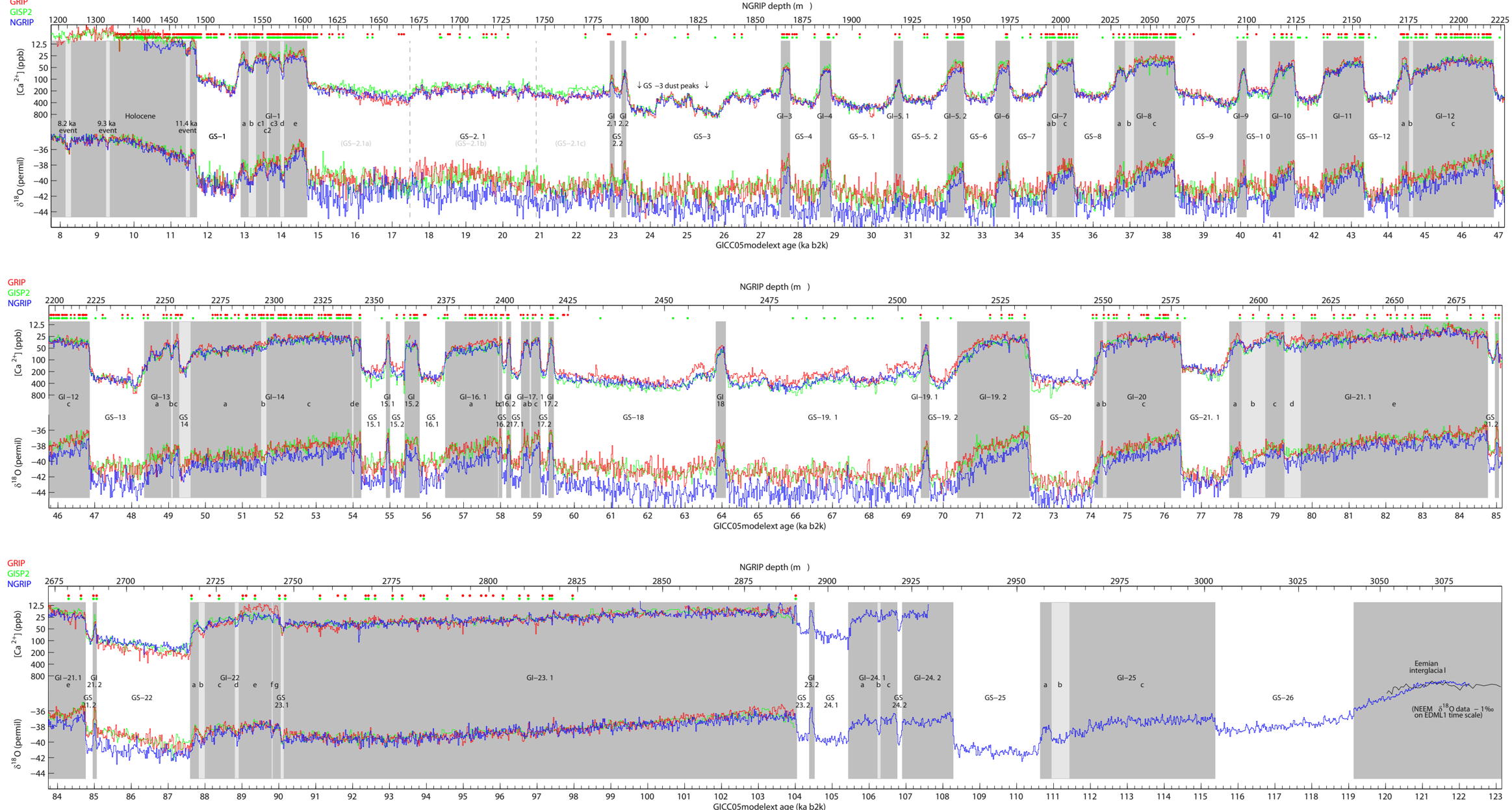
- New or revised events include GI-5.1 at c. 30.7 ka b2k within the former GS-5, splitting it into GS-5.1, GI-5.1, and GS-5.2 and renaming former GI-5 to GI-5.2; GI-2 is split into GI-2.1 and GI-2.2 bracketing GS-2.2; GI-1c is subdivided into GI-1c1, GI-1c2, and GI-1c3; GI-7, GI-8, and GI-12 are subdivided; and additional short events include GI-15.1, GI-16.2, GI-17.1/17.2, GI-19.1, and GI-21.1/21.2.
- Sub-events are defined by the criteria that they register in all three cores for at least two consecutive 20-year data points (≥40 years) and involve a δ¹⁸O shift of 1‰ and a factor 2 change in [Ca²⁺]; interstadial onsets typically show δ¹⁸O changing by about 4‰ over one or two 20-year data points and [Ca²⁺] changing by up to an order of magnitude.
- Some intervals are treated as quasi-stadial or super-interstadial: GS-14 is regarded as quasi-stadial between GI-13 and GI-14, GS-23.1 as quasi-stadial, and the period 104–87.6 ka b2k as one super-interstadial of 16.5 kyr; the 11.4 ka event is defined at 11.40–11.52 ka b2k.
Methods
- Data: δ¹⁸O and [Ca²⁺] records from NGRIP, GRIP, and GISP2 on the common GICC05modelext time scale; GICC05 is annual-layer counted in NGRIP to 60 ka b2k and extended by an ice-flow model below, then transferred to GRIP and GISP2 using volcanic reference horizons; all records are resampled to 20-year resolution.
- Event definition: visual inspection by several investigators of the 20-year dataset, with onsets placed at the first clear mark of a transition; δ¹⁸O and [Ca²⁺] are used together, and uncertainties are estimated from transition steepness and agreement between proxies; preliminary NEEM data support definitions between GS-24.1 and GS-25.
- Analysis: event numbering and naming follow principles of meaningfulness, completeness, conservatism/uniqueness, and consistency; a Bayesian statistical classification method has been initiated but is not yet applied in this paper.
Limitations
- Stated: below 104 ka b2k, GRIP and GISP2 cannot be synchronized to GICC05modelext; below 107.6 ka b2k only NGRIP δ¹⁸O data are available, so event classification becomes less certain; GI-25 sub-events are tentative because the NEEM core lacks ice from 110–116 ka b2k.
- Stated: the GS-2 subdivision is only marginally supported and may reflect site differences between Summit (GRIP/GISP2) and NGRIP rather than a regional signal; GS-3 dust peaks show decoupled δ¹⁸O and [Ca²⁺] and provide no basis for subdivision; some existing definitions are retained for compatibility even where [Ca²⁺] supports older onsets.
- Evident: event boundaries depend on visual inspection and somewhat arbitrary sub-event thresholds; relative dating precision is better than 20 years over most of the combined records but varies with match-point spacing; the Bayesian classification approach is not yet applied, and independent dating for other archives remains a broader challenge.
Model-written summary. Check it against the paper before relying on it.
Integrity signals
Registry
Cites
Statistics
Figures
Verification
Claims the paper makes
0 Valid · 2 Not valid · 37 Not checked · 71 Own results and interpretations
A result the paper reports from its own data — it cites no other source for it, so there is none to check. The quote shows it is in the paper.
In the paper
“This apparent decoupling of d 18 O and [Ca 2þ ] is not observed elsewhere in the record.”
§ A stratigraphic framework for abrupt climatic changes during the Last Glacial period based on three synchronized Greenland ice-core records: refining and extending the INTIMATE event stratigraphy > 4.3. Stadial substructure
plain- Asserted: passes — The authors put it forward as true.
- Checkable: passes — It can be checked against evidence.
- Load-bearing: passes — The paper’s conclusions depend on it.
- Based: passes — The paper gives a reason why it holds.
A result the paper reports from its own data — it cites no other source for it, so there is none to check. The quote shows it is in the paper.
In the paper
“although GS-2b (designated GS-2.1b in Fig. 1) is characterized by slightly lower [Ca 2þ ] values than GS-2a and GS-2c”
§ A stratigraphic framework for abrupt climatic changes during the Last Glacial period based on three synchronized Greenland ice-core records: refining and extending the INTIMATE event stratigraphy > 4.3. Stadial substructure
plain- Asserted: passes — The authors put it forward as true.
- Checkable: passes — It can be checked against evidence.
- Load-bearing: unclear — It is unclear whether the paper’s conclusions depend on it.
- Based: passes — The paper gives a reason why it holds.
A result the paper reports from its own data — it cites no other source for it, so there is none to check. The quote shows it is in the paper.
In the paper
“It is now clear that several interstadials show internal structure that resembles that of GI-1.”
§ A stratigraphic framework for abrupt climatic changes during the Last Glacial period based on three synchronized Greenland ice-core records: refining and extending the INTIMATE event stratigraphy > 1. Introduction
boostedstates an association- Asserted: passes — The authors put it forward as true.
- Checkable: passes — It can be checked against evidence.
- Load-bearing: passes — The paper’s conclusions depend on it.
- Based: passes — The paper gives a reason why it holds.
A check of a cited source is scheduled, or we don’t hold its full text yet; the claim is checked once it runs.
In the paper
“In addition, beyond 48 ka b2k, the DeO variability reflected in the Greenland records includes a number of short-lived events of similar amplitude to those recognized in the initial schemes of Johnsen et al. (1992) and Dansgaard et al. (1993).”
§ A stratigraphic framework for abrupt climatic changes during the Last Glacial period based on three synchronized Greenland ice-core records: refining and extending the INTIMATE event stratigraphy > 1. Introduction
What the sources say
- Not checked yetcites Johnsen et al., 1992 matched to “Irregular glacial interstadials recorded in a new Greenland ice core” (1992) source
A check is scheduled.
- Not checked yetcites Dansgaard et al., 1993 matched to “Evidence for general instability of past climate from a 250-kyr ice-core record” (1993) source
A check is scheduled.
plainstates an association- Asserted: passes — The authors put it forward as true.
- Checkable: passes — It can be checked against evidence.
- Load-bearing: unclear — It is unclear whether the paper’s conclusions depend on it.
- Based: passes — The paper gives a reason why it holds.
- Not checked yet
A result the paper reports from its own data — it cites no other source for it, so there is none to check. The quote shows it is in the paper.
In the paper
“we find that no other stadials exhibit structures that would warrant formal sub-divisions”
§ A stratigraphic framework for abrupt climatic changes during the Last Glacial period based on three synchronized Greenland ice-core records: refining and extending the INTIMATE event stratigraphy > 4.3. Stadial substructure
plain- Asserted: passes — The authors put it forward as true.
- Checkable: passes — It can be checked against evidence.
- Load-bearing: passes — The paper’s conclusions depend on it.
- Based: passes — The paper gives a reason why it holds.
37 more claims
Create a free account to see all 110 claims and to verify the 47 references still open.
- It may state two separate claims as one. 51
- Probably not a substantial claim. 33
- The quote only partly states this claim. 1
Claims other papers make about this one
Each is checked against this paper’s own text: does it say what the citing paper says it does?
In the citing paper
“In Greenland ice cores, the water stable isotope data (e.g.δ 18 O ice ) record two unusually short and small Greenland interstadials, GI-2.1 and GI-2.2 (Rasmussen et al., 2014), briefly interrupting the long cold period formed by the two Greenland stadials GS-2 and GS-3 (Fig. 1a).”
From Synchronizing ice-core and U ∕ Th timescales in the Last Glacial Maximum using Hulu Cave 14 C and new 10 Be measurements from Greenland and Antarctica (2023) · cites this paper as Rasmussen et al., 2014
In the citing paper
“While δ 18 O ice does not show a clear imprint of the Heinrich events, Greenland ice-core calcium data show two periods of heightened concentration during GS-3 (Fig. 1a; Rasmussen et al., 2014) that could be related to atmospheric reorganization around HE-2 (Adolphi et al., 2018), although there is debate about this attribution (Hughes and Gibbard, 2015).”
From Synchronizing ice-core and U ∕ Th timescales in the Last Glacial Maximum using Hulu Cave 14 C and new 10 Be measurements from Greenland and Antarctica (2023) · cites this paper as Rasmussen et al., 2014
In the citing paper
“The shift in IntCal20 now moves absolute calendar dates older by about 50 years and in the direction of the Holocene boundary as observed in Greenland ice, dated at 11,653 ± 99 cal BP (maximum counting error (MCE), equivalent to 2-σ, Rasmussen et al. 2014).”
From Recent Developments in Calibration for Archaeological and Environmental Samples (2020) · cites this paper as Rasmussen et al. 2014
In the citing paper
“With the development of the Greenland Ice Core Chronology 2005 (GICC05) that placed the GRIP, NGRIP, and GISP2 ice cores on a common time scale (Rasmussen et al., 2006(Rasmussen et al., , 2014)), the age of the onset of the last stadial (Fig. 1), termed the Greenland Stadial 1 (GS-1), was established as 12,846 ± 4 yr [BP 1950, GICC05 or 12,896 ± 4 yr [b2k, GICC05].”
From Comprehensive refutation of the Younger Dryas Impact Hypothesis (YDIH) (2023) · cites this paper as Rasmussen et al., 2014
In the citing paper
“The calibrated ages of the tree samples are consistent with sharp increase in Greenland δ 18 O values between the cooler GI-1b (the IACP, see Sections 3.3 and 9.2) and the warmer GI-1a interval (Rasmussen et al., 2014).”
From Comprehensive refutation of the Younger Dryas Impact Hypothesis (YDIH) (2023) · cites this paper as Rasmussen et al., 2014
4 more claims about this paper
Create a free account to see every claim other papers make about this one.
Self-check
Percentages, sums and reported differences re-computed from the paper’s own numbers.
Each contradiction between two passages listed here was confirmed by an independent check.
Rated minor: it would not touch a result — a value no result rests on, a p-value that stays on the same side of the significance level, or a conflict that is clerical, resolved elsewhere in the paper, or outside its own findings.
In the paper
§ A stratigraphic framework for abrupt climatic changes during the Last Glacial period based on three synchronized Greenland ice-core records: refining and extending the INTIMATE event stratigraphy > 5.1. Adjusting the existing event stratigraphy (8e48 ka b2k)
“The 8.2 ka and 9.2 ka events have been subject to detailed investigations based on data from several ice cores (Rasmussen et al., 2007), and we recommend no changes to the previously published definitions.”
§ A stratigraphic framework for abrupt climatic changes during the Last Glacial period based on three synchronized Greenland ice-core records: refining and extending the INTIMATE event stratigraphy > 5.1. Adjusting the existing event stratigraphy (8e48 ka b2k)
“In line with the naming of the 8.2 ka and 9.3 ka events, we refer to this event as the '11.4 ka event'.”
Rated minor: it would not touch a result — a value no result rests on, a p-value that stays on the same side of the significance level, or a conflict that is clerical, resolved elsewhere in the paper, or outside its own findings.
In the paper
§ A stratigraphic framework for abrupt climatic changes during the Last Glacial period based on three synchronized Greenland ice-core records: refining and extending the INTIMATE event stratigraphy > 5.1. Adjusting the existing event stratigraphy (8e48 ka b2k)
“However, the cold episode at 13.60e13.64ka b2k within GI-1c fulfils the criteria for classification as a sub-event”
§ A stratigraphic framework for abrupt climatic changes during the Last Glacial period based on three synchronized Greenland ice-core records: refining and extending the INTIMATE event stratigraphy > 6. Discussion and final remarks
“Start of GI-1c1 | 1554.75 13,600 b | 156 | 13 | | | Start of GI-1c2 | 1557.08 13,660 b | 158 | 13 | |”
Rated minor: it would not touch a result — a value no result rests on, a p-value that stays on the same side of the significance level, or a conflict that is clerical, resolved elsewhere in the paper, or outside its own findings.
In the paper
§ A stratigraphic framework for abrupt climatic changes during the Last Glacial period based on three synchronized Greenland ice-core records: refining and extending the INTIMATE event stratigraphy > 2. The INTIMATE approach
“(NEEM δ 18 O data -1‰ on EDML1 time scale)”
§ A stratigraphic framework for abrupt climatic changes during the Last Glacial period based on three synchronized Greenland ice-core records: refining and extending the INTIMATE event stratigraphy > 2. The INTIMATE approach
“In the Eemian interglacial, NGRIP data are extended by NEEM d 18 O data offset by 2‰ (NEEM community members, 2013).”
Citations
Cites
Evidence for general instability of past climate from a 250-kyr ice-core record
Dansgaard, W., Johnsen, S. J., Clausen, H. B., Dahl-Jensen, D., Gundestrup, N. S., Hammer, C. U., Hvidberg, C. S., Steffensen, J. P., Sveinbjörnsdottir, A. E., Jouzel, J., et al. (1993) · Nature · doi:10.1038/364218a0 · Cited by 4,762
Self-citationHigh-resolution record of Northern Hemisphere climate extending into the last interglacial period
North Greenland Ice Core Project members (2004) · Nature · doi:10.1038/nature02805 · Cited by 3,170
Heinrich, H. (1988) · Quaternary Research · doi:10.1016/0033-5894(88)90057-9 · Cited by 2,459
A new Greenland ice core chronology for the last glacial termination
Rasmussen, S. O., Andersen, K. K., Svensson, A. M., Steffensen, J. P., Vinther, B. M., Clausen, H. B., Siggaard‐Andersen, M. ‐., Johnsen, S. J., Larsen, L. B., Dahl‐Jensen, D., et al. (2006) · Journal of Geophysical Research: Atmospheres · doi:10.1029/2005jd006079 · Cited by 2,304
Self-citationSea-level fluctuations during the last glacial cycle
Siddall, M., Rohling, E. J., Almogi-Labin, A., Hemleben, C., Meischner, D., Schmelzer, I., & Smeed, D. A. (2003) · Nature · doi:10.1038/nature01690 · Cited by 1,626 · cited 2×
“Another feature of the 68 e 48 ka b2k period is that sea level was rising at the highest rate around 60 e 55 ka b2k, at the time where ‘ fl ickering ’ behaviour is most prevalent in the Greenland records (Siddall et al., 2003).”
Bond, G., Heinrich, H., Broecker, W., Labeyrie, L., McManus, J., Andrews, J., Huon, S., Jantschik, R., Clasen, S., Simet, C., et al. (1992) · Nature · doi:10.1038/360245a0 · Cited by 1,603
Hemming, S. R. (2004) · Reviews of Geophysics · doi:10.1029/2003rg000128 · Cited by 1,526
Irregular glacial interstadials recorded in a new Greenland ice core
Johnsen, S. J., Clausen, H. B., Dansgaard, W., Fuhrer, K., Gundestrup, N., Hammer, C. U., Iversen, P., Jouzel, J., Stauffer, B., & steffensen, J. P. (1992) · Nature · doi:10.1038/359311a0 · Cited by 1,466
Self-citationOne-to-one coupling of glacial climate variability in Greenland and Antarctica
Members, E. C. (2006) · Nature · doi:10.1038/nature05301 · Cited by 1,305
Abrupt increase in Greenland snow accumulation at the end of the Younger Dryas event
Alley, R. B., Meese, D. A., Shuman, C. A., Gow, A. J., Taylor, K. C., Grootes, P. M., White, J. W. C., Ram, M., Waddington, E. D., Mayewski, P. A., et al. (1993) · Nature · doi:10.1038/362527a0 · Cited by 1,206
Cited by
Items 1,001–1,100 of 2,483
Çep, B., Schürch, B., Münzel, S. C., & Frick, J. A. (2021) · PLoS ONE · doi:10.1371/journal.pone.0257041 · Cited by 12
Mirosław‐Grabowska, J., Borówka, R. K., Radzikowska, M., Sławińska, J., Hrynowiecka, A., Sobczyk, A., Stachowicz‐Rybka, R., & Stefaniak, K. (2021) · Quaternary International · doi:10.1016/j.quaint.2021.11.023 · Cited by 12
Ilyashuk, E. A., Ilyashuk, B. P., Heiri, O., & Spötl, C. (2022) · Quaternary Science Advances · doi:10.1016/j.qsa.2022.100050 · Cited by 12
Hines, S. K. V., Eiler, J. M., Southon, J. R., & Adkins, J. F. (2019) · Paleoceanography and Paleoclimatology · doi:10.1029/2019pa003568 · Cited by 12
Şenkul, Ç., Gürboğa, Ş., Doğan, M., & Doğan, T. (2021) · Quaternary International · doi:10.1016/j.quaint.2021.08.010 · Cited by 13
Gravettian cranial morphology and human group affinities during the European Upper Palaeolithic
Mounier, A., Heuzé, Y., Samsel, M., Vasilyev, S. V., Klaric, L., & Villotte, S. (2020) · Scientific Reports · doi:10.1038/s41598-020-78841-x · Cited by 12
Roux, E. G. (2019) · theses.fr (ABES) · doi:10.70675/34ce58d0z371fz414fz8b6czc734838c82e6 · Cited by 12
Stefaniak, K., Lipecki, G., Nadachowski, A., Semba, A., Ratajczak‐Skrzatek, U., Kotowski, A., Roblíčková, M., Wojtal, P., Shpansky, А. V., Malikov, D. G., et al. (2019) · Historical Biology · doi:10.1080/08912963.2019.1666374 · Cited by 12
Zhang, R., Yang, X., Zhang, H., Zhang, R., Yan, Y., Zuli, S., & Wang, Y. (2021) · Palaeogeography Palaeoclimatology Palaeoecology · doi:10.1016/j.palaeo.2021.110390 · Cited by 12
Şekeryapan, C., Streurman, H. J., van der Plicht, J., Woldring, H., van der Veen, Y., & Boomer, I. (2019) · CATENA · doi:10.1016/j.catena.2019.104437 · Cited by 12
Datema, M., Sangiorgi, F., de Vernal, A., Reichart, G., Lourens, L. J., & Sluijs, A. (2019) · Paleoceanography and Paleoclimatology · doi:10.1029/2018pa003497 · Cited by 12
Larix during the Mid‐Pleniglacial (Greenland Interstadial 8) on Kotelny Island, northern Siberia
Geel, B. V., Protopopov, A. V., Protopopova, V., Pavlov, I. S., van der Plicht, J., & van Reenen, G. B. A. (2016) · Boreas · doi:10.1111/bor.12216 · Cited by 12
Пономарев, Д. В., & Puzachenko, A. Y. (2015) · Quaternary International · doi:10.1016/j.quaint.2015.05.047 · Cited by 12
SEAMUS (v1.20): a Δ 14 C-enabled, single-specimen sediment accumulation simulator
Lougheed, B. C. (2020) · Geoscientific model development · doi:10.5194/gmd-13-155-2020 · Cited by 12
Teixeira, M., Terrinha, P., Roque, C., Voelker, A. H. L., Silva, P. F., Salgueiro, E., Abrantes, F. F., Naughton, F., Mena, A., Ercilla, G., et al. (2020) · Sedimentary Geology · doi:10.1016/j.sedgeo.2020.105737 · Cited by 12
Túri, M., Hubay, K., Molnár, M., Braun, M., László, E., Futó, I., & Palcsu, L. (2021) · Journal of Paleolimnology · doi:10.1007/s10933-021-00202-z · Cited by 12
Kalińska, E., Weckwerth, P., & Alexanderson, H. (2022) · Earth-Science Reviews · doi:10.1016/j.earscirev.2022.104272 · Cited by 12
Delayed and rapid deglaciation of alpine valleys in the Sawatch Range, southern Rocky Mountains, USA
Tulenko, J. P., Caffee, W., Schweinsberg, A. D., Briner, J. P., & Leonard, E. M. (2020) · Geochronology · doi:10.5194/gchron-2-245-2020 · Cited by 12
Haynes, G., Klimowicz, J., & Wojtal, P. (2018) · Quaternary Research · doi:10.1017/qua.2018.60 · Cited by 12
The pleistocene-holocene transition in Southwestern France: A focus on the laborian
Langlais, M., Chevallier, A., Cheung, C. F., Jacquier, J., Marquebielle, B., & Naudinot, N. (2019) · Quaternary International · doi:10.1016/j.quaint.2019.09.045 · Cited by 12
Ntinou, M. (2020) · Quaternary International · doi:10.1016/j.quaint.2020.11.002 · Cited by 12
Luminescence Sensitivity of Rhine Valley Loess: Indicators of Source Variability?
Fitzsimmons, K. E., Perić, Z. M., Nowatzki, M., Lindauer, S., Vinnepand, M., Prud’homme, C., Dave, A. K., Vött, A., & Fischer, P. (2021) · Quaternary · doi:10.3390/quat5010001 · Cited by 12
Harland, R., Asteman, I. P., Morley, A., Morris, A., Harris, A., & Howe, J. (2016) · Heliyon · doi:10.1016/j.heliyon.2016.e00114 · Cited by 12
Verbruggen, F., Bourgeois, I., Cruz, F., Boudin, M., & Crombé, P. (2018) · Review of Palaeobotany and Palynology · doi:10.1016/j.revpalbo.2018.05.004 · Cited by 12
Miebach, A., Power, M. J., Resag, T. R., Netzel, T., Colombaroli, D., & Litt, T. (2022) · Global and Planetary Change · doi:10.1016/j.gloplacha.2022.103774 · Cited by 11
Anderson, L. (2019) · theses.fr (ABES) · doi:10.70675/9244f694zbd6cz4385zac49z458b02a759cd · Cited by 11
Holmes, J. A., Leuenberger, M., Molloy, K., & O'Connell, M. A. (2019) · Boreas · doi:10.1111/bor.12425 · Cited by 11
Climate influence on the early human occupation of South America during the late Pleistocene
Becerra‐Valdivia, L. (2025) · Nature Communications · doi:10.1038/s41467-025-58134-5 · Cited by 11
Controls on luminescence signals in lake sediment cores: A study from Lake Suigetsu, Japan
Rex, C. L., Staff, R. A., Sanderson, D. C. W., Cresswell, A. J., Marshall, M., Hyodo, M., Horiuchi, D., Tada, R., & Nakagawa, T. (2022) · Quaternary Geochronology · doi:10.1016/j.quageo.2022.101319 · Cited by 11
McGuire, A. M., Lane, C. S., Roucoux, K. H., Albert, P. G., & Kearney, R. J. (2022) · Journal of Quaternary Science · doi:10.1002/jqs.3452 · Cited by 12
Ramezani, E., de Klerk, P., Mrotzek, A., & Joosten, H. (2023) · Quaternary Science Reviews · doi:10.1016/j.quascirev.2023.108352 · Cited by 11
Adameková, K., & Petřík, J. (2022) · CATENA · doi:10.1016/j.catena.2022.106510 · Cited by 11
Paus, A., Brooks, S. J., Haflidason, H., & Halvorsen, L. S. (2023) · Quaternary Science Reviews · doi:10.1016/j.quascirev.2023.108347 · Cited by 11
Roberts, P., Hixon, S., Hamilton, R., Lucas, M., Ilgner, J., Marzo, S., Hawkins, S., Luu, S., Gosden, C., Spriggs, M., et al. (2023) · Journal of Quaternary Science · doi:10.1002/jqs.3555 · Cited by 11
Mercury records covering the past 90 000 years from lakes Prespa and Ohrid, SE Europe
Paine, A. R., Fendley, I., Frieling, J., Mather, T. A., Lacey, J. H., Wagner, B., Robinson, S. A., Pyle, D. M., Francke, A., Them, T. R., et al. (2024) · Biogeosciences · doi:10.5194/bg-21-531-2024 · Cited by 11
Human response to the Younger Dryas along the southern North Sea basin, Northwest Europe
Crombé, P., Pironneau, C., Robert, P., van der Sloot, P., Boudin, M., Groote, I. D., Verheyden, S., & Vandendriessche, H. (2024) · Scientific Reports · doi:10.1038/s41598-024-68686-z · Cited by 11
Rychel, J., Sokołowski, R., Sieradz, D., Hrynowiecka, A., Mirosław‐Grabowska, J., Sienkiewicz, E., Niska, M., Szymanek, M., Zbucki, Ł., Ciołko, U., et al. (2022) · Journal of Quaternary Science · doi:10.1002/jqs.3477 · Cited by 11
Banks, W. E., Vignoles, A. L., Lacarrière, J., Morala, A., & Klaric, L. (2024) · Quaternary · doi:10.3390/quat7020026 · Cited by 11
Buller, A. M., Edeltin, L., Ollivier, V., Joannin, S., Peyron, O., Lauer, T., Frahm, E., Brittingham, A., Hren, M. T., Sirdeys, N., et al. (2024) · Journal of Archaeological Science Reports · doi:10.1016/j.jasrep.2024.104540 · Cited by 11
Paleoclimate Perspectives on Contemporary Climate Change
Harrison, S. P., Bartlein, P. J., Cruz‐Silva, E., Haas, O., Jackson, S. T., Kaushal, N., Liu, M., Magri, D., Robson, D. T., Vettoretti, G., et al. (2025) · Annual Review of Environment and Resources · doi:10.1146/annurev-environ-112922-110121 · Cited by 11
Ice core evidence for the Los Chocoyos supereruption disputes millennial-scale climate impact
Innes, H. M., Hutchison, W. R., Sigl, M., Crick, L., Abbott, P. M., Bigler, M., Chellman, N. J., Davies, S. M., Kutterolf, S., McConnell, J. R., et al. (2025) · Communications Earth & Environment · doi:10.1038/s43247-025-02095-6 · Cited by 13
Self-citationShatsillo, A. V., Rud’ko, S. V., Latysheva, I. V., Rud’ko, D. V., Fedyukin, I. V., & Малышев, С. В. (2019) · Izvestiya Physics of the Solid Earth · doi:10.1134/s1069351319060065 · Cited by 11
Gorbarenko, S. A., Shi, X., Liu, Y., Bosin, A. A., Vasilenko, Y. P., Artemova, A. V., Yanchenko, E. A., Zou, J., Yao, Z., & Kirichenko, I. S. (2024) · Frontiers in Earth Science · doi:10.3389/feart.2024.1415180 · Cited by 11
Barrett, S., Drescher‐Schneider, R., Starnberger, R., & Spötl, C. (2018) · Quaternary Research · doi:10.1017/qua.2018.26 · Cited by 11
Gorbarenko, S. A., Shi, X., Zou, J., Velivetskaya, T. A., Artemova, A. V., Liu, Y., Yanchenko, E. A., & Vasilenko, Y. P. (2018) · Global and Planetary Change · doi:10.1016/j.gloplacha.2018.09.014 · Cited by 11
Zonal Indian Ocean Variability Drives Millennial‐Scale Precipitation Changes in Northern Madagascar
Tiger, B. H., Burns, S. J., Dawson, R. R., Scroxton, N., Godfrey, L. R., Ranivoharimanana, L., Faina, P., & McGee, D. (2023) · Paleoceanography and Paleoclimatology · doi:10.1029/2023pa004626 · Cited by 11
Balco, G., DeJong, B. D., Ridge, J. C., Bierman, P. R., & Rood, D. H. (2021) · Geochronology · doi:10.5194/gchron-3-1-2021 · Cited by 11
Maschenko, E. N., Potapova, O., Heintzman, P. D., Kapp, J. D., Shapiro, B., Protopopov, A. V., Boeskorov, G. G., Pavlov, I. S., Плотников, В. В., Дмитриевич, К. С., et al. (2021) · Paleontological Journal · doi:10.1134/s003103012111006x · Cited by 11
Bayesian analysis of early warning signals using a time-dependent model
Myrvoll-Nilsen, E., Hallali, L., & Rypdal, M. W. (2025) · Earth System Dynamics · doi:10.5194/esd-16-1539-2025 · Cited by 11
Strang splitting for parametric inference in second-order stochastic differential equations
Pilipovic, P., Samson, A., & Ditlevsen, S. (2025) · Stochastic Processes and their Applications · doi:10.1016/j.spa.2025.104650 · Cited by 11
Chevallier, A. (2015) · theses.fr (ABES) · doi:10.70675/390f334aza725z479ezb22cz7e435955c88d · Cited by 11
Maier, J., Burdanowitz, N., Schmiedl, G., & Gaye, B. (2025) · Climate of the past · doi:10.5194/cp-21-279-2025 · Cited by 11
Kouli, K., Triantaphyllou, M., Κουκουσιούρα, Ό., Dimiza, M. D., Parinos, C., Panagiotopoulos, I. P., Τσουρού, Θ., Gogou, A., Mavrommatis, N., Syrides, G. E., et al. (2021) · Water · doi:10.3390/w13111505 · Cited by 11
Александрович, Г. В., Bronnikova, M. A., Хохлова, О. С., Cherkashina, A., & Turchinskaia, S. (2020) · CATENA · doi:10.1016/j.catena.2020.104817 · Cited by 11
Climatic assessment of circum-Arctic permafrost zonation over the last 122 kyr
Saitô, K., Okuno, J., Machiya, H., Iwahana, G., Ohno, H., & Yokohata, T. (2021) · Polar Science · doi:10.1016/j.polar.2021.100765 · Cited by 11
Leontaritis, A. D., Pavlopoulos, K. P., Marrero, S. M., Ribolini, A., Hughes, P. D., & Spagnolo, M. (2021) · Geomorphology · doi:10.1016/j.geomorph.2022.108335 · Cited by 11
Vidal-Matutano, P., & Pardo-Gordó, S. (2020) · Archaeological and Anthropological Sciences · doi:10.1007/s12520-019-00993-3 · Cited by 11
The Pyrenees: glacial landforms from the Bølling–Allerød Interstadial (14.6–12.9 ka)
Delmas, M., Oliva, M., Gunnell, Y., Fernandes, M., Reixach, T., Fernández‐Fernández, J. M., & Calvet, M. (2022) · Elsevier eBooks · doi:10.1016/b978-0-323-91899-2.00050-4 · Cited by 11
Britzius, S., & Sirocko, F. (2022) · Palaeogeography Palaeoclimatology Palaeoecology · doi:10.1016/j.palaeo.2022.110981 · Cited by 11
Spötl, C., Reimer, P. J., Rabeder, G., & Scholz, D. (2014) · Journal of Quaternary Science · doi:10.1002/jqs.2747 · Cited by 11
Kang, S., Wang, X., Wang, N., & Huang, H. (2024) · Global and Planetary Change · doi:10.1016/j.gloplacha.2024.104600 · Cited by 11
Late Pleistocene pedogenesis and loess magnetism in northwestern Ukraine
Bonchkovskyi, O. S., & Hlavatskyi, D. (2025) · Quaternary Research · doi:10.1017/qua.2024.51 · Cited by 11
van Hateren, J. A., Kasse, C., van der Woude, J., Schokker, J., Prins, M. A., & van Balen, R. T. (2022) · Quaternary Science Reviews · doi:10.1016/j.quascirev.2022.107554 · Cited by 11
Farkas, B., Sípos, G., Bartyik, T., Józsa, E., Czigány, S., Balogh, R., Varga, G., Kovács, J., & Fábián, S. Á. (2023) · Permafrost and Periglacial Processes · doi:10.1002/ppp.2190 · Cited by 11
Welling, C. (2024) · The Cryosphere · doi:10.5194/tc-18-3433-2024 · Cited by 11
Sea Level Changes During Marine Isotopic Stage 3 (MIS 3) in Argentina
Isla, F. I., & Schnack, E. J. (2016) · Springer earth system sciences · doi:10.1007/978-3-319-40000-6_8 · Cited by 11
Abrook, A. M., Matthews, I., Milner, A. M., Candy, I., Palmer, A., & Timms, R. (2019) · Scottish Journal of Geology · doi:10.1144/sjg2019-006 · Cited by 11
Woronko, B., & Dąbski, M. (2022) · Springer eBooks · doi:10.1007/978-3-031-14895-8_12 · Cited by 11
Jackson, R., Frederichs, T. W., Schulz, H., & Kučera, M. (2023) · Earth and Planetary Science Letters · doi:10.1016/j.epsl.2023.118191 · Cited by 11
Ducasse, S., Pétillon, J., Aubry, T., Chauvière, F.-X., Castel, J., Detrain, L., Langlais, M., Morala, A., Banks, W. E., & Lenoble, A. (2020) · Radiocarbon · doi:10.1017/rdc.2020.50 · Cited by 11
Carvalho, M., Jones, E. L., Ellis, M. G., Cascalheira, J., Bicho, N., Meiggs, D., Benedetti, M., Friedl, L., & Haws, J. (2022) · Journal of Quaternary Science · doi:10.1002/jqs.3363 · Cited by 10
Radiocarbon and U-series age constraints for the Lateglacial rock art of Sicily
Maida, G. D., Mannino, M. A., Zilhão, J., Hoffmann, D. L., García-Diez, M., Pastoors, A., Standish, C. D., Pike, A. W. G., Olsen, J., Schimmenti, V., et al. (2020) · Quaternary Science Reviews · doi:10.1016/j.quascirev.2020.106524 · Cited by 10
Sergiou, S., Geraga, M., Pechlivanidou, S., Gawthorpe, R. L., Ninnemann, U. S., Meckler, A.-N., Modestou, S., Angelopoulou, D., Antoniou, D., Diz, P., et al. (2024) · Marine Geology · doi:10.1016/j.margeo.2024.107340 · Cited by 10
Lapellegerie, P., Millet, L., Rius, D., Duprat‐Oualid, F., Luoto, T. P., & Heiri, O. (2024) · Quaternary Science Reviews · doi:10.1016/j.quascirev.2024.109016 · Cited by 10
Verbruggen, F., Hoek, W. Z., Verhegge, J., Bourgeois, I., Boudin, M., Kubiak-Martens, L., Ryssaert, C., & Crombé, P. (2022) · Vegetation History and Archaeobotany · doi:10.1007/s00334-022-00894-x · Cited by 10
Self-citationLefebvre, A., Pétillon, J., Cueto, M., Fernández, E. Á., Cabal, P. A., Peredo, R. O., Berganza, E., & Marín-Arroyo, A. B. (2022) · Journal of Archaeological Science · doi:10.1016/j.jas.2022.105708 · Cited by 10
Höhn, L., Leunda, M., Gobet, E., Tinner, W., & Schwörer, C. (2022) · Boreas · doi:10.1111/bor.12578 · Cited by 10
Martin‐Jones, C., Lane, C. S., Blaauw, M., Mark, D. F., Verschuren, D., der Meeren, T. V., Daele, M. V., Wynton, H. L., Blegen, N., Kisaka, M., et al. (2024) · Quaternary Science Reviews · doi:10.1016/j.quascirev.2023.108476 · Cited by 11
Vidaller, I., Moreno, A., González‐Sampériz, P., Pla‐Rabès, S., Medialdea, A., del Val, M., López‐Moreno, J. I., & Valero-Garces, B. L. (2024) · CATENA · doi:10.1016/j.catena.2024.108059 · Cited by 10
Paquin, S., Albouy, B., Hinz, M., & Burke, A. M. (2023) · Themes in contemporary archaeology · doi:10.1007/978-3-031-34336-0_3 · Cited by 10
Miller, N. R., Banner, J. L., Feng, W., Gonzales, A. N., & Kozdon, R. (2021) · Quaternary Science Reviews · doi:10.1016/j.quascirev.2021.107244 · Cited by 10
Beyond the cold steppes: Neanderthal landscapes and the neglect of flora
Carrión, J., Amorós, G., Amorós, A., & Marín-Arroyo, A. B. (2025) · Quaternary Science Reviews · doi:10.1016/j.quascirev.2025.109673 · Cited by 10
Crest, Y. (2017) · theses.fr (ABES) · doi:10.70675/fcb31421zc96dz4cbdza9efzb2acd2c306e1 · Cited by 10
U-series in situ dating of secondary carbonates associated with rock paintings using LA-MC-ICPMS
Jiao, Y., Liu, Y., Lu, Z., Grün, R., & Shao, Q. (2024) · Quaternary Geochronology · doi:10.1016/j.quageo.2024.101552 · Cited by 10
Deng, J., Wu, Z., Zhang, M., Huang, N. E., Wang, S., & Qiao, F. (2018) · Quaternary Science Reviews · doi:10.1016/j.quascirev.2018.05.019 · Cited by 10
Effect of temperature on carbon accumulation in northern lake systems over the past 21,000 years
Pfalz, G., Diekmann, B., Freytag, J.-C., & Biskaborn, B. K. (2023) · Frontiers in Earth Science · doi:10.3389/feart.2023.1233713 · Cited by 10
Marco, Y. C., Vidal-Matutano, P., Morales, J., Henríquez-Valido, P., Potì, A., Kehl, M., Linstädter, J., Weniger, G., & Mikdad, A. (2018) · Environmental Archaeology · doi:10.1080/14614103.2018.1538088 · Cited by 10
Marco, Y. C., Jordà, G. P., Kherbouche, F., & Peña‐Chocarro, L. (2021) · Review of Palaeobotany and Palynology · doi:10.1016/j.revpalbo.2021.104562 · Cited by 10
Brugger, S. O., Chellman, N. J., McConnell, C., & McConnell, J. R. (2022) · The Holocene · doi:10.1177/09596836221131711 · Cited by 10
Питулько, В. В., & Pavlova, E. Y. (2023) · Quaternary · doi:10.3390/quat6040056 · Cited by 10
Zaremba, N. J., & Scholz, C. A. (2019) · Palaeogeography Palaeoclimatology Palaeoecology · doi:10.1016/j.palaeo.2019.109286 · Cited by 10
Ro, S., Park, J., Yoo, H., Han, C., Lee, A., Lee, Y., Kim, M., Han, Y., Svensson, A. M., Shin, J., et al. (2024) · Scientific Reports · doi:10.1038/s41598-024-52546-x · Cited by 10
Self-citationAtlantic Ocean thermal forcing of Central American rainfall over 140,000 years
Lucia, G., Zanchettin, D., Winter, A., Cheng, H., Rubino, A., Vásquez, O. J., Bernal, J. P., Cu-Xi, M., & Lachniet, M. S. (2024) · Nature Communications · doi:10.1038/s41467-024-54856-0 · Cited by 10
Holocene climatic events linked to environmental changes at Lake Komořany Basin, Czech Republic
Houfková, P., Bešta, T., Bernardová, A., Vondrák, D., Pokorný, P., & Novák, J. (2017) · The Holocene · doi:10.1177/0959683616683250 · Cited by 10
Casanova-Arenillas, S., Rodríguez‐Tovar, F. J., & Martínez-Ruiz, F. (2021) · Marine Geology · doi:10.1016/j.margeo.2021.106673 · Cited by 10
Brashear, C., Jones, T. R., Morris, V., Vaughn, B. H., Roberts, W. H. G., Skorski, W. B., Hughes, A. G., Nunn, R. M., Rasmussen, S. O., Cuffey, K. M., et al. (2025) · Climate of the past · doi:10.5194/cp-21-529-2025 · Cited by 10
Self-citationGolovanova, L. V., Владимировна, Д. Е., Doronichev, V. B., Tselmovich, V. A., & Shirobokov, I. G. (2021) · Izvestiya Atmospheric and Oceanic Physics · doi:10.1134/s0001433821070070 · Cited by 10
Couette, P., Lajeunesse, P., Ghienne, J., Dorschel, B., Gebhardt, C., Hebbeln, D., & Brouard, É. (2023) · Quaternary Science Reviews · doi:10.1016/j.quascirev.2022.107949 · Cited by 10
Central European warm phases recorded by episodic speleothem growth during MIS 3
Klose, J., Weber, M., & Scholz, D. (2024) · Communications Earth & Environment · doi:10.1038/s43247-024-01863-0 · Cited by 10
Metadata
- Authors
- Rasmussen, S. O., Bigler, M., Blockley, S. P., Blunier, T., Buchardt, S. L., Clausen, H. B., Cvijanovic, I., Dahl-Jensen, D., Johnsen, S. J., Fischer, H., Gkinis, V., Guillevic, M., Hoek, W. Z., Lowe, J. J., Pedro, J. B., Popp, T., Seierstad, I. K., Steffensen, J. P., Svensson, A. M., Vallelonga, P., Vinther, B. M., Walker, M. J. C., Wheatley, J. J., & Winstrup, M.
- Affiliations
- University of Copenhagen (DK)
- University of Bern (CH)
- Royal Holloway University of London (GB)
- Utrecht University (NL)
- Aberystwyth University (GB)
- University of Sheffield (GB)
- Corresponding author
- Rasmussen, Sune O.
- ORCID
- Venue
- Quaternary Science Reviews
- Publisher
- Elsevier BV
- Published
- 2014-12
- Volume
- 106
- Pages
- 14-28
- ISSN
- 0277-3791 (ISSN-L)
- OpenAlex
- W2007331923
- Semantic Scholar
- 63a77c21038b7488e096aef634a22722ed8451b1
- Cited by
- 2,478
- References
- 91
- Citations by year
- 2026: 216 · 2025: 229 · 2024: 219 · 2023: 269 · 2022: 273 · 2021: 313 · 2020: 235 · 2019: 204 · 2018: 183 · 2017: 137 · 2016: 113 · 2015: 71 · 2014: 16
- FWCI
- 48.17
- Type
- journal article
- Language
- en
- Open access
- hybrid
- doi.org
- Licence
- cc-by-nc-sa
- www.elsevier.com/tdm/userlicense/1.0/ (tdm)
- www.elsevier.com/legal/tdmrep-license (tdm)
- creativecommons.org/licenses/by-nc-sa/3.0/ (vor)
- Locations
- Quaternary Science Reviews (publishedVersion, cc-by-nc-sa)
- Research at the University of Copenhagen (University of Copenhagen) (publishedVersion)
- Helmholtz Centre for Ocean Research Kiel (GEOMAR) (acceptedVersion, other-oa)
- HAL (submittedVersion, other-oa)
- Bern Open Repository and Information System (University of Bern) (submittedVersion, cc-by-nc-sa)
- Utrecht University Repository (Utrecht University) (submittedVersion, other-oa)
- Oskar-Bordeaux (Universite de Bordeaux) (submittedVersion)
- Funders
- Joint Institute for the Study of the Atmosphere and Ocean (JISAO)
- Topics
- Physical Sciences › Earth and Planetary Sciences › Atmospheric Science › Geology and Paleoclimatology Research
- Physical Sciences › Earth and Planetary Sciences › Atmospheric Science › Cryospheric studies and observations
- Physical Sciences › Environmental Science › Global and Planetary Change › Climate variability and models
- Keywords
- last glacial period, abrupt climate change, Dansgaard-Oeschger events, Greenland Stadials, Greenland Interstadials, NGRIP, grip, GISP2, stable oxygen isotopes, calcium ion concentration, atmospheric dust, North Atlantic climate
About these checks
Registry, retraction, Cites and statistics results are computed, not judged, with one exception: a printed reference that no index lists is read once by a model before it counts as a citation error. Claims are extracted by a model and kept only when their quote appears verbatim in the text; each cited source is then checked, with a model’s help, for whether it says what the claim relies on. Those verdicts can be wrong — read the claim’s quote and the cited source before relying on one.
A language model drew the claims from the paper on 2026-11-23, under version 3 of the claim definition (model deepseek-v4.1-flash, prompt extract-v3).
A second model labelled each claim on 2026-11-23 (model jev-1.13-20260917, definition revision gold-guideline-v0.2).
Statistics and arithmetic are recomputed, not judged.
Confidence bands are shown only for fields calibrated on our annotated test set. None is calibrated yet, so no band is shown.
What counts as a claim ›How we measure confidence ›How we check this ›
Are you an author, or do you see a problem with this page? Request a review
Data sources
Bibliographic data: Semantic Scholar, OpenAlex, Crossref.
Contains information from the Semantic Scholar Academic Graph Datasets, made available under the ODC Attribution License (ODC-BY 1.0).
Semantic Scholar’s data is described in: Kinney, R., et al. (2023). The Semantic Scholar Open Data Platform. arXiv:2301.10140.
