

The DOI matches its Crossref record; 80 of the 82 references it cites were found in a registry or an index.
AKR-001, an Fc-FGF21 Analog, Showed Sustained Pharmacodynamic Effects on Insulin Sensitivity and Lipid Metabolism in Type 2 Diabetes Patients
Open accessAbstract
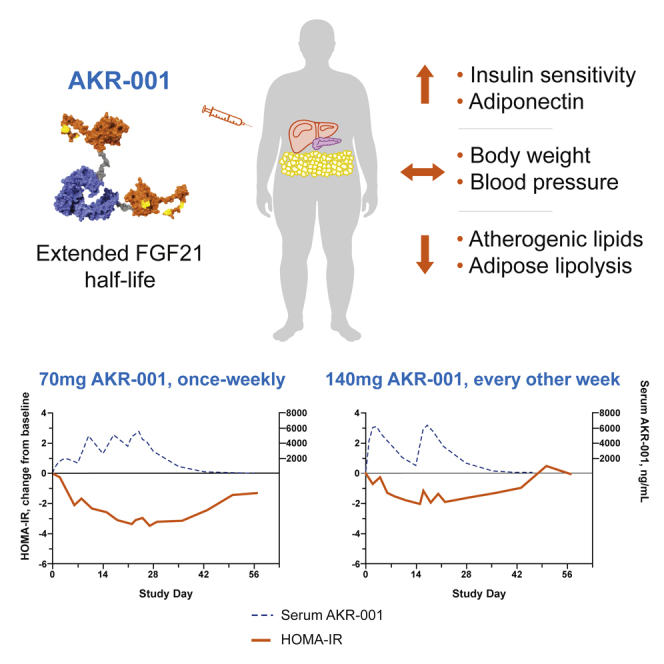
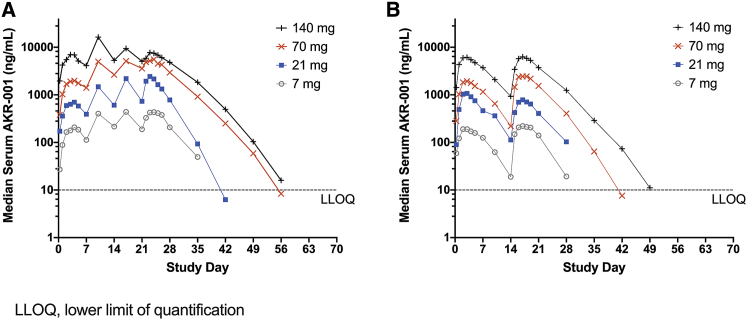
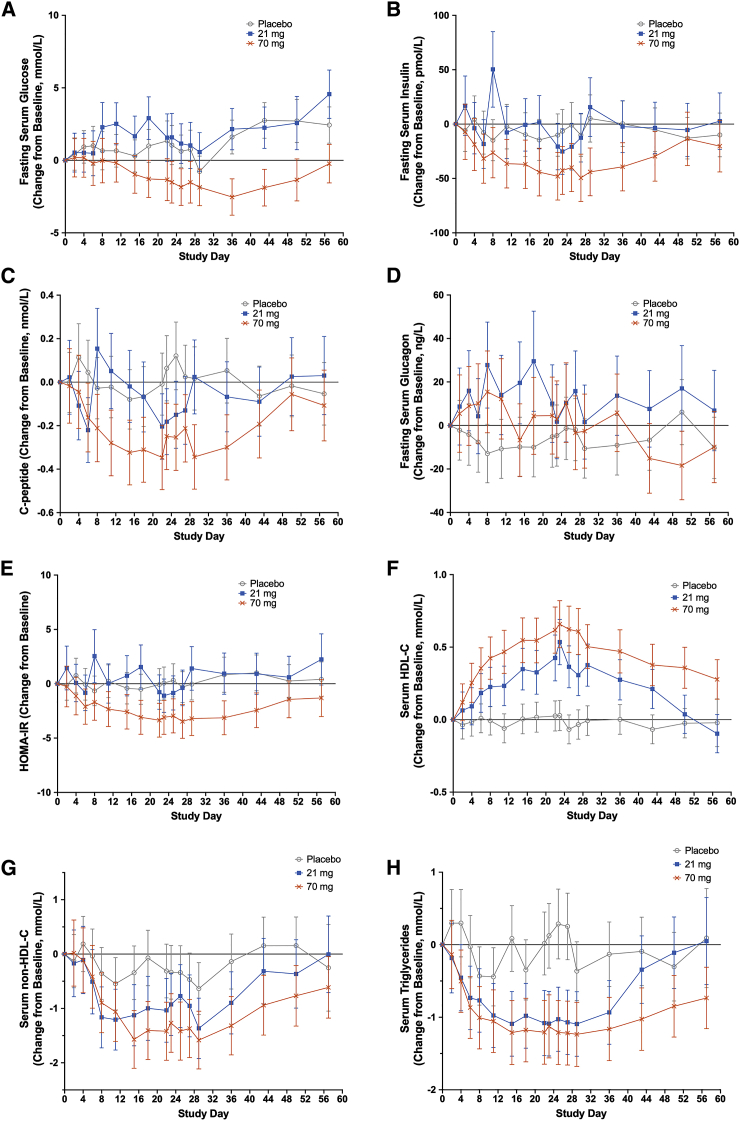
Experimental fibroblast growth factor 21 (FGF21) analogs can improve lipid profiles in patients with metabolic diseases. However, their effects on markers of insulin sensitivity appear to be minimal, potentially because of insufficient exposure. Systemic drug levels vary from sub-pharmacological to demonstrating pharmacodynamic effects but with dose-limiting adverse events. Here we report results from a phase 1 multiple ascending dose study of AKR-001, an Fc-FGF21 fusion protein engineered for sustained systemic pharmacologic exposure, in individuals with type 2 diabetes. With a half-life of 3-3.5 days, the peak-to-trough ratio under steady-state conditions is approximately 2 following QW dosing. AKR-001 appears to demonstrate pharmacodynamic effects on serum markers of insulin sensitivity and acceptable tolerability up to and including 70 mg QW. Positive trends in lipoprotein profile, including triglycerides, non-high-density lipoprotein (non-HDL) cholesterol, HDL-C, and apolipoproteins B and C3 are consistent with other FGF21 analogs. AKR-001's clinical profile supports further evaluation as a treatment for metabolic diseases.
Overview
The claims and statistics of this paper haven’t been checked yet.
Run the check — free, no account needed. It reads the open-access text and checks the sources it cites.
Integrity signals
Registry
Cites
Statistics
Figures
Verification
Claims the paper makes
The claims and statistics of this paper haven’t been checked yet.
Run the check — free, no account needed. It reads the open-access text and checks the sources it cites.
Claims other papers make about this one
Each is checked against this paper’s own text: does it say what the citing paper says it does?
The cited source doesn’t support the claim as written.
In the citing paper
“Administration of the FGF21 analogues AKR-001 (ref. 88) and pegbelfermin89 in humans with NASH results in marked absolute decreases in liver fat (up to 70%) and significant amelioration of liver fibrosis88,89.”
From Metabolic messengers: FGF21 (2021) · cites this paper as [88]
Checked by a reasoning model — may be wrong.
Experimental — accuracy not yet measuredThe cited source says what the claim attributes to it.
In the citing paper
“two other FGF21 analogues, AKR-001 (also known as efruxifermin)88 and pegbelfermin89,90, have not been found to significantly decrease body weight in people with obesity or type 2 diabetes.”
From Metabolic messengers: FGF21 (2021) · cites this paper as [88]
The cited source says what the claim attributes to it.
In the citing paper
“most adverse effects associated with FGF21-analogue administration are gastrointestinal81,87,88.”
From Metabolic messengers: FGF21 (2021) · cites this paper as [88]
The check wasn’t confident either way, so it gives no verdict — never disputed.
In the citing paper
“PF-05231023 has been found to increase markers of bone turnover in humans81, whereas AKR-001 (ref. 88) and pegbelfermin89 have not.”
From Metabolic messengers: FGF21 (2021) · cites this paper as [88]
Experimental — accuracy not yet measuredIn the citing paper
“all analogues consistently have a pronounced ability to decrease plasma triglyceride levels, in many cases by as much as ~70% (refs. 81,87–91).”
From Metabolic messengers: FGF21 (2021) · cites this paper as [88]
In the citing paper
“some compounds do not significantly affect insulin sensitivity81, while others significantly increase insulin sensitivity in people with type 2 diabetes87,88.”
From Metabolic messengers: FGF21 (2021) · cites this paper as [88]
In the citing paper
“the magnitude of the glucose-lowering effects of FGF21 analogues is clearly lower in humans than rodents81,87–91, perhaps because of differences in brown adipose tissue metabolism between species65.”
From Metabolic messengers: FGF21 (2021) · cites this paper as [88]
In the citing paper
“Pharmacological administration of FGF21 or FGF21 analogues exerts lipid-lowering effects through accelerated lipoprotein catabolism108, suppression of postprandial lipolysis in adipose tissues88, decreased hepatic endoplasmic reticulum and oxidative stress109,110, and increased beta-oxidation of lipids in the liver62”
From Metabolic messengers: FGF21 (2021) · cites this paper as [88]
In the citing paper
“clinical studies in patients with obesity and type 2 diabetes have found that FGF21-analogue administration markedly induces plasma adiponectin levels81,87–89”
From Metabolic messengers: FGF21 (2021) · cites this paper as [88]
Self-check
Percentages, sums and reported differences re-computed from the paper’s own numbers.
The self-check needs the paper’s full text.
Citations
Cites
Liraglutide and Cardiovascular Outcomes in Type 2 Diabetes
Marso, S. P., Daniels, G. H., Brown-Frandsen, K., Kristensen, P., Mann, J. F. E., Nauck, M. A., Nissen, S. E., Pocock, S., Poulter, N. R., Ravn, L. S., et al. (2016) · New England Journal of Medicine · doi:10.1056/nejmoa1603827 · Cited by 7,629
Global burden of NAFLD and NASH: trends, predictions, risk factors and prevention
Younossi, Z., Anstee, Q. M., Marietti, M., Hardy, T., Henry, L., Eslam, M., George, J., & Bugianesi, E. (2018) · Nature Reviews Gastroenterology & Hepatology · doi:10.1038/nrgastro.2017.109 · Cited by 5,249
Donnelly, K. L., Smith, C. I., Schwarzenberg, S. J., Jessurun, J., Boldt, M. D., & Parks, E. J. (2005) · Journal of Clinical Investigation · doi:10.1172/jci23621 · Cited by 3,604
AIC model selection using Akaike weights
Wagenmakers, E.-J., & Farrell, S. (2004) · Psychonomic Bulletin & Review · doi:10.3758/bf03206482 · Cited by 2,684
Neuschwander-Tetri, B. A., Loomba, R., Sanyal, A. J., Lavine, J. E., Van Natta, M. L., Abdelmalek, M. F., Chalasani, N., Dasarathy, S., Diehl, A. M., Hameed, B., et al. (2015) · The Lancet · doi:10.1016/s0140-6736(14)61933-4 · Cited by 2,237
Molecular mechanisms of hepatic lipid accumulation in non-alcoholic fatty liver disease
Ipsen, D. H., Lykkesfeldt, J., & Tveden-Nyborg, P. (2018) · Cellular and Molecular Life Sciences · doi:10.1007/s00018-018-2860-6 · Cited by 1,471
Cause, Pathogenesis, and Treatment of Nonalcoholic Steatohepatitis
Diehl, A. M., & Day, C. (2017) · New England Journal of Medicine · doi:10.1056/nejmra1503519 · Cited by 1,283
Adiponectin, a Therapeutic Target for Obesity, Diabetes, and Endothelial Dysfunction
Elumalai, A., & Jain, S. K. (2017) · International Journal of Molecular Sciences · doi:10.3390/ijms18061321 · Cited by 1,206
Xu, J., Lloyd, D. J., Hale, C., Stanislaus, S., Chen, M., Sivits, G., Vonderfecht, S., Hecht, R., Li, Y.-S., Lindberg, R. A., et al. (2009) · Diabetes · doi:10.2337/db08-0392 · Cited by 1,151
Loss-of-Function Mutations in APOC3, Triglycerides, and Coronary Disease
The TG and HDL Working Group of the Exome Sequencing Project, N. H. (2014) · New England Journal of Medicine · doi:10.1056/nejmoa1307095 · Cited by 1,071
Lambert, J. E., Ramos–Roman, M. A., Browning, J. D., & Parks, E. J. (2014) · Gastroenterology · doi:10.1053/j.gastro.2013.11.049 · Cited by 1,069 · cited 1×
“Male, N (%) 6 (67) 6 (75) 3 (43) 3 (50) 2 (33) 5 (56) 3 (50) 2 (33) 5 (83) 4 (67)”
Effects of anacetrapib in patients with atherosclerotic vascular disease
The HPS3/TIMI55–REVEAL Collaborative Group (2017) · New England Journal of Medicine · doi:10.1056/nejmoa1706444 · Cited by 1,047
Understanding the Physiology of FGF21
Fisher, F. M., & Maratos-Flier, E. (2016) · Annual Review of Physiology · doi:10.1146/annurev-physiol-021115-105339 · Cited by 912
The effects of LY2405319, an FGF21 analog, in obese human subjects with type 2 diabetes
Gaich, G., Chien, J. Y., Fu, H., Glass, L. C., Deeg, M. A., Holland, W. L., Kharitonenkov, A., Bumol, T., Schilske, H. K., & Moller, D. E. (2013) · Cell Metabolism · doi:10.1016/j.cmet.2013.08.005 · Cited by 885
Thiazolidinedione Use, Fluid Retention, and Congestive Heart Failure
Nesto, R. W., Bell, D. S. H., Bonow, R. O., Fonseca, V. A., Grundy, S. M., Horton, E. S., Winter, M. L., Porte, D., Semenkovich, C. F., Smith, S. E., et al. (2003) · Circulation · doi:10.1161/01.cir.0000103683.99399.7e · Cited by 831
Obesity Is a Fibroblast Growth Factor 21 (FGF21)-Resistant State
Fisher, F. M., Chui, P. C., Antonellis, P. J., Bina, H. A., Kharitonenkov, A., Flier, J. S., & Maratos-Flier, E. (2010) · Diabetes · doi:10.2337/db10-0193 · Cited by 830
Dapagliflozin improves muscle insulin sensitivity but enhances endogenous glucose production
Merovci, A., Solis-Herrera, C., Daniele, G., Eldor, R., Fiorentino, T. V., Tripathy, D., Xiong, J., Perez, Z., Norton, L., Abdul-Ghani, M. A., et al. (2014) · Journal of Clinical Investigation · doi:10.1172/jci70704 · Cited by 795
The metabolic state of diabetic monkeys is regulated by fibroblast growth factor-21
Kharitonenkov, A., Wroblewski, V. J., Koester, A., Chen, Y.-F., Clutinger, C. K., Tigno, X. T., Hansen, B. C., Shanafelt, A. B., & Etgen, G. J. (2007) · Endocrinology · doi:10.1210/en.2006-1168 · Cited by 738
Lin, Z., Tian, H., Lam, K. S. L., Lin, S., Hoo, R. C. L., Konishi, M., Itoh, N., Wang, Y., Bornstein, S. R., Xu, A., et al. (2013) · Cell Metabolism · doi:10.1016/j.cmet.2013.04.005 · Cited by 691
βKlotho is required for metabolic activity of fibroblast growth factor 21
Ogawa, Y., Kurosu, H., Yamamoto, M., Nandi, A., Rosenblatt, K. P., Goetz, R., Eliseenkova, A. V., Mohammadi, M., & Kuro-o, M. (2007) · Proceedings of the National Academy of Sciences · doi:10.1073/pnas.0701600104 · Cited by 617
Increased Fibroblast Growth Factor 21 in Obesity and Nonalcoholic Fatty Liver Disease
Dushay, J., Chui, P. C., Gopalakrishnan, G. S., Varela–Rey, M., Crawley, M., Fisher, F. M., Badman, M. K., Martinez–Chantar, M. L., & Maratos–Flier, E. (2010) · Gastroenterology · doi:10.1053/j.gastro.2010.04.054 · Cited by 607
Sanyal, A., Charles, E. D., Neuschwander-Tetri, B. A., Loomba, R., Harrison, S. A., Abdelmalek, M. F., Lawitz, E. J., Halegoua-DeMarzio, D., Kundu, S., Noviello, S., et al. (2018) · The Lancet · doi:10.1016/s0140-6736(18)31785-9 · Cited by 550
Standards of Medical Care in Diabetes—2019 Abridged for Primary Care Providers
American Diabetes Association (2019) · Clinical Diabetes · doi:10.2337/cd18-0105 · Cited by 539
An FGF21-Adiponectin-Ceramide Axis Controls Energy Expenditure and Insulin Action in Mice
Holland, W., Adams, A., Brozinick, J., Bui, H., Miyauchi, Y., Kusminski, C., Bauer, S., Wade, M., Singhal, E., Cheng, C. C., et al. (2013) · Cell Metabolism · doi:10.1016/j.cmet.2013.03.019 · Cited by 525
Talukdar, S., Zhou, Y., Li, D., Rossulek, M., Dong, J., Somayaji, V., Weng, Y., Clark, R., Lanba, A., Owen, B. M., et al. (2016) · Cell Metabolism · doi:10.1016/j.cmet.2016.02.001 · Cited by 496
Self-citationWei, W., Dutchak, P. A., Wang, X., Ding, X., Wang, X., Bookout, A. L., Goetz, R., Mohammadi, M., Gerard, R. D., Dechow, P. C., et al. (2012) · Proceedings of the National Academy of Sciences · doi:10.1073/pnas.1200797109 · Cited by 426
Harrison, S. A., Rinella, M. E., Abdelmalek, M. F., Trotter, J. F., Paredes, A. H., Arnold, H. L., Kugelmas, M., Bashir, M. R., Jaros, M. J., Ling, L., et al. (2018) · The Lancet · doi:10.1016/s0140-6736(18)30474-4 · Cited by 425
Inhibition of Growth Hormone Signaling by the Fasting-Induced Hormone FGF21
Inagaki, T., Lin, V. Y., Goetz, R., Mohammadi, M., Mangelsdorf, D. J., & Kliewer, S. A. (2008) · Cell Metabolism · doi:10.1016/j.cmet.2008.05.006 · Cited by 409
Hotta, Y., Nakamura, H., Konishi, M., Murata, Y., Takagi, H., Matsumura, S., Inoue, K., Fushiki, T., & Itoh, N. (2009) · Endocrinology · doi:10.1210/en.2009-0119 · Cited by 352
FGF21 Regulates Sweet and Alcohol Preference
Talukdar, S., Owen, B. M., Song, P., Hernandez, G., Zhang, Y., Zhou, Y., Scott, W. T., Paratala, B., Turner, T., Smith, A., et al. (2016) · Cell Metabolism · doi:10.1016/j.cmet.2015.12.008 · Cited by 342
Xu, J., Stanislaus, S., Chinookoswong, N., Lau, Y. Y., Hager, T., Patel, J., Ge, H., Weiszmann, J., Lu, S.-C., Graham, M., et al. (2009) · American Journal of Physiology-Endocrinology and Metabolism · doi:10.1152/ajpendo.00348.2009 · Cited by 340
FGF21 gene therapy as treatment for obesity and insulin resistance
Jiménez, V., Jambrina, C., Casana, E., Sacristan, V., MUÑOZ, S. A., Darriba, S., Rodó, J., Mallol, C., García, M., León, X., et al. (2018) · EMBO Molecular Medicine · doi:10.15252/emmm.201708791 · Cited by 319
Barrows, B. R., & Parks, E. J. (2006) · The Journal of Clinical Endocrinology & Metabolism · doi:10.1210/jc.2005-1709 · Cited by 282
The Glucagon Receptor Is Required for the Adaptive Metabolic Response to Fasting
Longuet, C., Sinclair, E. M., Maida, A., Baggio, L. L., Maziarz, M., Charron, M. J., & Drucker, D. J. (2008) · Cell Metabolism · doi:10.1016/j.cmet.2008.09.008 · Cited by 272
The breadth of FGF21's metabolic actions are governed by FGFR1 in adipose tissue
Adams, A. C., Yang, C., Coskun, T., Cheng, C. C., Gimeno, R. E., Luo, Y., & Kharitonenkov, A. (2013) · Molecular Metabolism · doi:10.1016/j.molmet.2012.08.007 · Cited by 266
Fisher, F. M., Chui, P. C., Nasser, I. A., Popov, Y., Cunniff, J. C., Lundasen, T., Kharitonenkov, A., Schuppan, D., Flier, J. S., & Maratos-Flier, E. (2014) · Gastroenterology · doi:10.1053/j.gastro.2014.07.044 · Cited by 263
Charles, E. D., Neuschwander‐Tetri, B. A., Pablo Frias, J., Kundu, S., Luo, Y., Tirucherai, G. S., & Christian, R. (2019) · Obesity · doi:10.1002/oby.22344 · Cited by 257
Schlein, C., Talukdar, S., Heine, M., Fischer, A. W., Krott, L. M., Nilsson, S. K., Brenner, M. B., Heeren, J., & Scheja, L. (2016) · Cell Metabolism · doi:10.1016/j.cmet.2016.01.006 · Cited by 252 · cited 1×
“Geo mean fasting IGF-1, ng/mL (% CV) 135 (47) 155 (29) 114 (29) 156 (20) 113 (33) 147 (32) 164 (38) 129 (47) 112 (53) 183 (36)”
FGF21 attenuates lipolysis in human adipocytes – A possible link to improved insulin sensitivity
Arner, P., Pettersson, A., Mitchell, P. J., Dunbar, J. D., Kharitonenkov, A., & Rydén, M. (2008) · FEBS Letters · doi:10.1016/j.febslet.2008.04.038 · Cited by 234
Fructose ingestion acutely stimulates circulating FGF21 levels in humans
Dushay, J. R., Toschi, E., Mitten, E. K., Fisher, F. M., Herman, M. A., & Maratos-Flier, E. (2015) · Molecular Metabolism · doi:10.1016/j.molmet.2014.09.008 · Cited by 233
Byun, S., Seok, S., Kim, Y., Zhang, Y., Yau, P. M., Iwamori, N., Xu, H. E., Ma, J., KEMPER, B. W., & Kemper, J. K. (2020) · Nature Communications · doi:10.1038/s41467-020-14384-z · Cited by 218
Harrison, S. A., Rinella, M. E., Abdelmalek, M. F., Jf, T., Paredes, A. H., Arnold, H. L., Kugelmas, M., Bashir, M. R., Jaros, M. J., Li, L., et al. (2018) · Yearbook of pediatric endocrinology · doi:10.1530/ey.15.15.7 · Cited by 188
A liver stress-endocrine nexus promotes metabolic integrity during dietary protein dilution
Maida, A., Zota, A., Sjøberg, K. A., Schumacher, J., Sijmonsma, T. P., Pfenninger, A., Christensen, M. M., Gantert, T., Fuhrmeister, J., Rothermel, U., et al. (2016) · Journal of Clinical Investigation · doi:10.1172/jci85946 · Cited by 170
LY2405319, an engineered FGF21 variant, improves the metabolic status of diabetic monkeys
Adams, A. C., Halstead, C. A., Hansen, B. C., Irizarry, A. R., Martin, J. A., Myers, S. R., Reynolds, V. L., Smith, H. W., Wroblewski, V. J., & Kharitonenkov, A. (2013) · PLoS ONE · doi:10.1371/journal.pone.0065763 · Cited by 169
Rational Design of a Fibroblast Growth Factor 21-Based Clinical Candidate, LY2405319
Kharitonenkov, A., Beals, J. M., Micanovic, R., Strifler, B. A., Rathnachalam, R., Wroblewski, V. J., Li, S., Köester, A., Ford, A. M., Coşkun, T., et al. (2013) · PLoS ONE · doi:10.1371/journal.pone.0058575 · Cited by 168
Intestinal bile acid physiology and pathophysiology
Martínez‐Augustin, O., & de Medina, F. S. (2008) · World Journal of Gastroenterology · doi:10.3748/wjg.14.5630 · Cited by 167
Pan, X., Shao, Y., Wu, F., Wang, Y., Xiong, R., Zheng, J., Tian, H., Wang, B., Wang, Y., Zhang, Y., et al. (2018) · Cell Metabolism · doi:10.1016/j.cmet.2018.04.002 · Cited by 163
Long-Acting FGF21 Has Enhanced Efficacy in Diet-Induced Obese Mice and in Obese Rhesus Monkeys
Véniant, M. M., Komorowski, R., Chen, P., Stanislaus, S., Winters, K., Hager, T., Zhou, L., Wada, R., Hecht, R. I., & Xu, J. (2012) · Endocrinology · doi:10.1210/en.2012-1211 · Cited by 148
Kim, A. M., Somayaji, V. R., Dong, J. Q., Rolph, T. P., Weng, Y., Chabot, J. R., Gropp, K. E., Talukdar, S., & Calle, R. A. (2017) · Diabetes, Obesity and Metabolism · doi:10.1111/dom.13023 · Cited by 145
Self-citationRuan, C., Kong, L., Chen, X.-H., Ma, Y., Pan, X., Zhang, Z.-B., & Gao, P. (2018) · Cell Metabolism · doi:10.1016/j.cmet.2018.06.013 · Cited by 127
Changing use of antidiabetic drugs in the UK: trends in prescribing 2000–2017
Wilkinson, S., Douglas, I., Stirnadel-Farrant, H. A., Fogarty, D. G., Pokrajac, A., Smeeth, L. L., & Tomlinson, L. A. (2018) · BMJ Open · doi:10.1136/bmjopen-2018-022768 · Cited by 116
Stanislaus, S., Hecht, R. I., Yie, J., Hager, T., Hall, M. P., Spahr, C. S., Wang, W., Weiszmann, J., Li, Y., Deng, L., et al. (2017) · Endocrinology · doi:10.1210/en.2016-1917 · Cited by 114
Lee, J. H., Kang, Y. E., Chang, J. Y., Park, K. C., Kim, H.-W., Kim, J. T., Kim, H. J., Yi, H., Shong, M., Chung, H. K., et al. (2016) · PubMed Central · Cited by 101
Frayling, T. M., Beaumont, R. N., Jones, S. E., Yaghootkar, H., Tuke, M. A., Ruth, K. S., Casanova, F., West, B., Locke, J., Sharp, S., et al. (2018) · Cell Reports · doi:10.1016/j.celrep.2018.03.070 · Cited by 101
Barb, D., Bril, F., Kalavalapalli, S., & Cusi, K. J. (2019) · The Journal of Clinical Endocrinology & Metabolism · doi:10.1210/jc.2018-02414 · Cited by 100
Lee, W. S., & Kim, J. (2015) · PPAR Research · doi:10.1155/2015/271983 · Cited by 97
Okazaki, H., Goldstein, J. L., Brown, M. S., & Liang, G. (2009) · Journal of Biological Chemistry · doi:10.1074/jbc.m109.079459 · Cited by 95
Søberg, S., Andersen, E. S., Dalsgaard, N. B., Jarlhelt, I., Hansen, N. L., Hoffmann, N., Vilsbøll, T., Chenchar, A., Jensen, M., Grevengoed, T. J., et al. (2018) · Molecular Metabolism · doi:10.1016/j.molmet.2018.03.010 · Cited by 94
Examining the safety of PPAR agonists – current trends and future prospects
Bortolini, M., Wright, M. B., Bopst, M., & Balas, B. I. (2012) · Expert Opinion on Drug Safety · doi:10.1517/14740338.2013.741585 · Cited by 76
Fibroblast activation protein in liver fibrosis
Gorrell, M. D. (2018) · Frontiers in bioscience · doi:10.2741/4706 · Cited by 76
Sniderman, A. D., Islam, S., McQueen, M., Pencina, M. J., Furberg, C. D., Thanassoulis, G., & Yusuf, S. (2016) · Journal of the American Heart Association · doi:10.1161/jaha.116.003665 · Cited by 68
Increased FGF21 plasma levels in humans with sepsis and SIRS
Gariani, K., Drifte, G., Dunn-Siegrist, I., Pugin, J., & Jornayvaz, F. R. (2013) · Endocrine Connections · doi:10.1530/ec-13-0040 · Cited by 65
Adiponectin Regulation of Stellate Cell Activation via PPARγ-Dependent and -Independent Mechanisms
Shafiei, M. S., Shetty, S., Scherer, P. E., & Rockey, D. C. (2011) · American Journal Of Pathology · doi:10.1016/j.ajpath.2011.02.035 · Cited by 61
FGF21 Is Not a Major Mediator for Bone Homeostasis or Metabolic Actions of PPARα and PPARγ Agonists
Li, X., Stanislaus, S., Asuncion, F., Niu, Q.-T., Chinookoswong, N., Villasenor, K., Wang, J., Wong, P., Boyce, R., Dwyer, D., et al. (2017) · Journal of Bone and Mineral Research · doi:10.1002/jbmr.2936 · Cited by 61
A Functional Interplay between IGF-1 and Adiponectin
Orrù, S., Nigro, E., Mandola, A., Alfieri, A., Buono, P., Daniele, A., Mancini, A., & Imperlini, E. (2017) · International Journal of Molecular Sciences · doi:10.3390/ijms18102145 · Cited by 54
Shi, Y., Wang, S., Peng, H., Lv, Y., Li, W., Cheng, S., & Liu, J. (2018) · International Journal of Biological Sciences · doi:10.7150/ijbs.28873 · Cited by 53
FGF21 acts as a negative regulator of bile acid synthesis
Chen, M. M., Hale, C., Stanislaus, S., Xu, J., & Véniant, M. M. (2018) · Journal of Endocrinology · doi:10.1530/joe-17-0727 · Cited by 51
FGF21 ameliorates the neurocontrol of blood pressure in the high fructose-drinking rats
He, J., Zhao, M., Xia, J.-J., Guan, J., Liu, Y., Wang, L.-Q., Song, D.-X., Qu, M.-Y., Zuo, M., Wen, X., et al. (2016) · Scientific Reports · doi:10.1038/srep29582 · Cited by 41
Glucagon secretion in relation to insulin sensitivity in healthy subjects
Åhrén, B. (2005) · Diabetologia · doi:10.1007/s00125-005-0056-8 · Cited by 40
Adiponectin inhibits hepatic stellate cell activation by targeting the PTEN/AKT pathway
Kumar, P., Raeman, R., Chopyk, D. M., Smith, T., Verma, K., Liu, Y., & Anania, F. A. (2018) · Biochimica et Biophysica Acta (BBA) - Molecular Basis of Disease · doi:10.1016/j.bbadis.2018.08.012 · Cited by 37
Lipids and disorders of lipoprotein metabolism
Bayly, G. R. (2014) · Elsevier eBooks · doi:10.1016/b978-0-7020-5140-1.00037-7 · Cited by 37
Regulation of fibroblast growth factor 15/19 and 21 on metabolism: in the fed or fasted state
Guan, D., Zhao, L., Chen, D., Yu, B., & Yu, J. (2016) · Journal of Translational Medicine · doi:10.1186/s12967-016-0821-0 · Cited by 36
Targher, G., Chonchol, M., Pichiri, I., & Zoppini, G. (2011) · Journal of Endocrinological Investigation · doi:10.3275/7614 · Cited by 30
Liu, A., Galoosian, A., Kaswala, D. H., Li, A. A., Gadiparthi, C., Cholankeril, G. T., Kim, D., & Ahmed, A. (2018) · Journal of Clinical and Translational Hepatology · doi:10.14218/jcth.2018.00010 · Cited by 29
Blood Glucose and Hormonal Responses to Small and Large Meals in Healthy Young and Older Women
Melanson, K. J., Greenberg, A. S., Ludwig, D. S., Saltzman, E. J., Dallal, G. E., & Roberts, S. B. (1998) · The Journals of Gerontology Series A · doi:10.1093/gerona/53a.4.b299 · Cited by 28
DePaoli, A. M., PHUNG, V., Bashir, M. R., Morrow, L., Beysen, C., Yan, A. Z., Ling, L., Baxter, B. A., Luskey, K. L., & Olefsky, J. M. (2019) · Diabetes · doi:10.2337/db19-140-lb · Cited by 28
Jiang, J., Wang, Y., Ling, Y., Kayoumu, A., Liu, C., & Gao, X. (2016) · Lipids in Health and Disease · doi:10.1186/s12944-015-0171-6 · Cited by 23
LY2605541—A Preferential Hepato-Specific Insulin Analogue
Madsbad, S. (2014) · Diabetes · doi:10.2337/db13-1646 · Cited by 20
Ramamoorthy, P. (2015) · Jaypee Brothers Medical Publishers (P) Ltd. eBooks · doi:10.5005/jp/books/12728_28 · Cited by 11
Tirucherai, G., Mora, J. R., Revankar, R., & Charles, E. D. (2019) · Journal of Hepatology · doi:10.1016/s0618-8278(19)31589-0 · Cited by 5
Research works printed but not linked: 1
- Charles, 2016, A phase 1 study of BMS-986036 (pegylated FGF21) in healthy obese subjects, Hepatology, 64, 546A
Cited by
Sorted by citations
Harrison, S. A., Ruane, P. J., Freilich, B. L., Neff, G., Patil, R., Behling, C. A., Hu, C., Fong, E., de Temple, B., Tillman, E. J., et al. (2021) · Nature Medicine · doi:10.1038/s41591-021-01425-3 · Cited by 368
Self-citationFlippo, K. H., & Potthoff, M. J. (2021) · Nature Metabolism · doi:10.1038/s42255-021-00354-2 · Cited by 311
Treatment of type 2 diabetes: challenges, hopes, and anticipated successes
Nauck, M. A., Wefers, J., & Meier, J. J. (2021) · The Lancet Diabetes & Endocrinology · doi:10.1016/s2213-8587(21)00113-3 · Cited by 315
Harrison, S. A., Frias, J. P., Neff, G., Abrams, G. A., Lucas, K. J., Sanchez, W., Gogia, S., Sheikh, M. Y., Behling, C., Bedossa, P., et al. (2023) · The Lancet Gastroenterology & Hepatology · doi:10.1016/s2468-1253(23)00272-8 · Cited by 276
Self-citationAn adipocentric perspective on the development and progression of non-alcoholic fatty liver disease
Lee, E., Korf, H., & Vidal‐Puig, A. (2023) · Journal of Hepatology · doi:10.1016/j.jhep.2023.01.024 · Cited by 235
Metadata
- Authors
- Kaufman, A., Abuqayyas, L., Denney, W. S., Tillman, E. J., & Rolph, T.
- Affiliations
- Amgen (United States) (US)
- Corresponding author
- Rolph, Tim
- Venue
- Cell Reports Medicine
- Publisher
- Elsevier BV
- Published
- 2020-07
- Volume
- 1
- Issue
- 4
- Pages
- 100057
- ISSN
- 2666-3791 (ISSN-L)
- PMC
- PMC7659583
- OpenAlex
- W3044370932
- Cited by
- 131
- References
- 82
- Citations by year
- 2026: 12 · 2025: 24 · 2024: 25 · 2023: 21 · 2022: 26 · 2021: 19 · 2020: 4
- FWCI
- 5.67
- Type
- journal article
- Language
- en
- Open access
- gold
- doi.org
- Licence
- Locations
- Cell Reports Medicine (publishedVersion, cc-by-nc-nd)
- PubMed Central (publishedVersion, cc-by-nc-nd)
- PubMed (publishedVersion)
- DOAJ (DOAJ: Directory of Open Access Journals) (submittedVersion, cc-by-sa)
- Funders
- Pfizer
- Topics
- Life Sciences › Biochemistry, Genetics and Molecular Biology › Molecular Biology › Fibroblast Growth Factor Research
- Health Sciences › Medicine › Endocrinology, Diabetes and Metabolism › Diabetes Treatment and Management
- Health Sciences › Medicine › Endocrinology, Diabetes and Metabolism › Diabetes, Cardiovascular Risks, and Lipoproteins
- Keywords
- FGF21 analogs, type 2 diabetes, insulin sensitivity, lipid metabolism, pharmacodynamics, pharmacokinetics, lipoprotein profile, triglycerides, non-HDL cholesterol, apolipoprotein B, apolipoprotein C-III, tolerability
- MeSH terms
- Adult, Blood Glucose, Body Weight, Diabetes Mellitus, Type 2, Double-Blind Method, Female, Fibroblast Growth Factors, Humans, Insulin, Insulin Resistance, Lipids, Male, Middle Aged, Obesity, Recombinant Fusion Proteins, Triglycerides, United States, Placebo Effect, Lipid Metabolism
About these checks
Registry, retraction, Cites and statistics results are computed, not judged, with one exception: a printed reference that no index lists is read once by a model before it counts as a citation error. Claims are extracted by a model and kept only when their quote appears verbatim in the text; each cited source is then checked, with a model’s help, for whether it says what the claim relies on. Those verdicts can be wrong — read the claim’s quote and the cited source before relying on one.
Statistics and arithmetic are recomputed, not judged.
Confidence bands are shown only for fields calibrated on our annotated test set. None is calibrated yet, so no band is shown.
What counts as a claim ›How we measure confidence ›How we check this ›
Are you an author, or do you see a problem with this page? Request a review
