

Technological transitions as evolutionary reconfiguration processes: a multi-level perspective and a case-study
Open accessThe DOI matches its Crossref record; 86 of the 94 references it cites were found in a registry or an index; 1 of the 45 sources its claims cite were checked for support.
Overview
CoChat Summary
TL;DR
Geels proposes a multi-level perspective on technological transitions, combining evolutionary economics and technology studies around niches, sociotechnical regimes, and landscape. He illustrates it with a qualitative longitudinal case study of the transition from sailing ships to steamships, 1780–1900, identifying niche-cumulation, technological add-on/hybridisation, and riding along with market growth.
Key findings
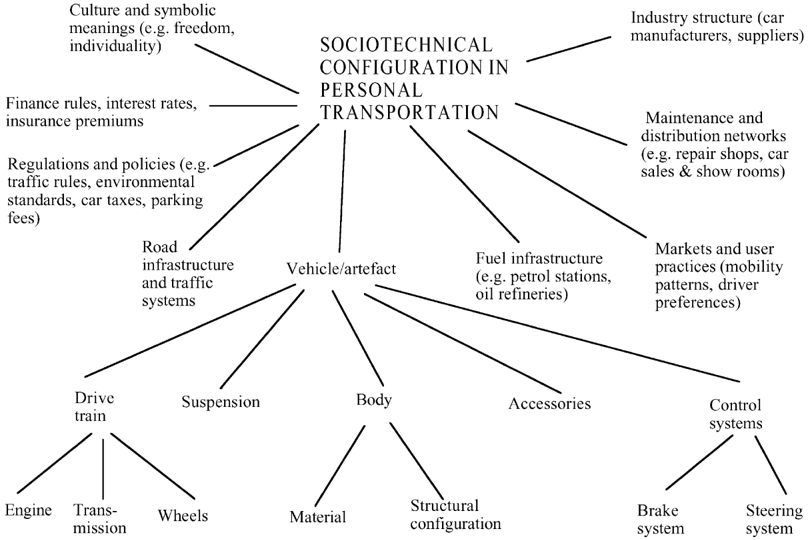
- Technological transitions are major, long-term changes in how societal functions are fulfilled; they involve not only technology but also user practices, regulation, industrial networks, infrastructure, and symbolic meaning or culture.
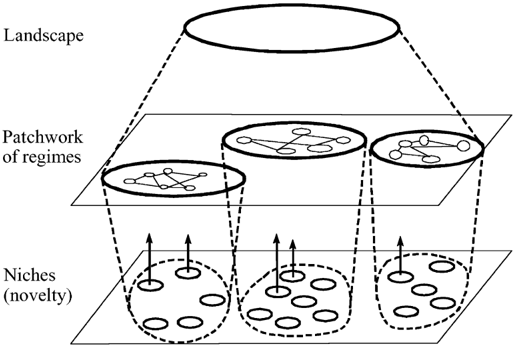
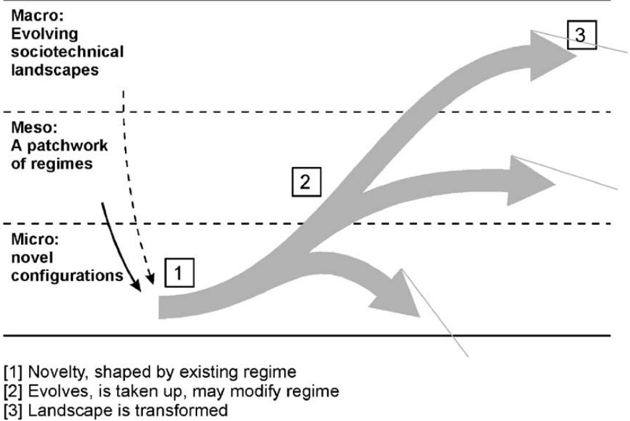
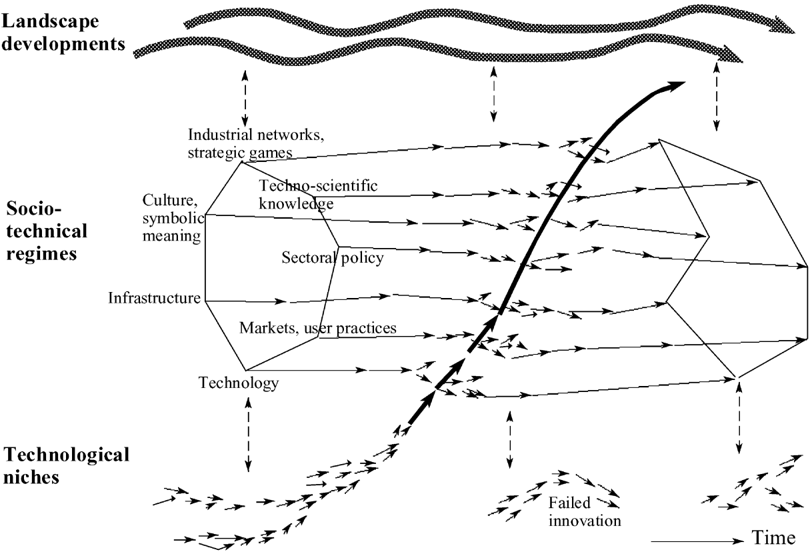
- The multi-level perspective treats niches as loci of radical variety, sociotechnical regimes as selection/retention mechanisms, and the landscape as slower external structure; breakthroughs occur when developments at multiple levels align and create a “window of opportunity.”
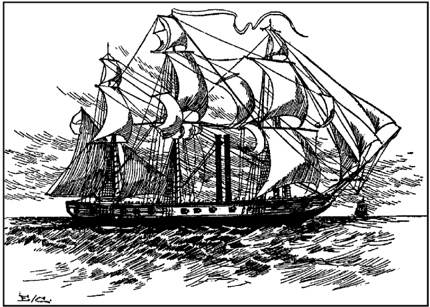
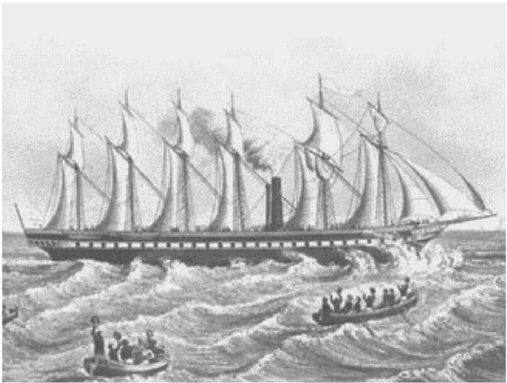
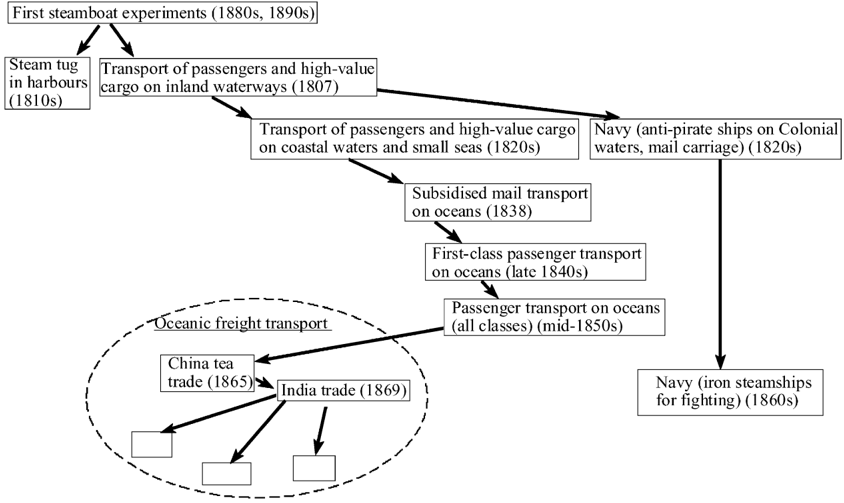
- In the steamship case, breakthrough followed niche-cumulation through inland waterways, coastal routes, mail subsidies, passenger transport, and freight; mechanisms included steam engines as auxiliary add-ons to sailing ships, hybrid sail/steam and iron/wood forms, and riding along with market growth.
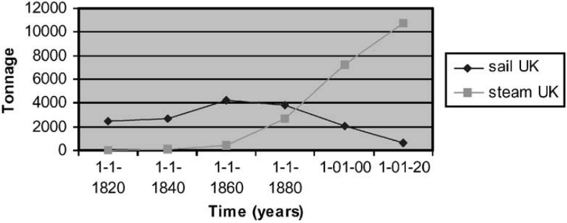
- Reported numbers include: European emigrants travelling by steamer rose from 45% in 1863 to 81% in 1866; compound engines enabled fuel-consumption reductions of 60%; the distance margin where steam was competitive reached 3000–3500 miles by the late 1860s; during the steamship mania (1869–1874), steamers rose from 17% to 31% of British registered tonnage.
Methods
- The paper uses “appreciative theory,” synthesising insights from evolutionary economics and technology studies into a multi-level perspective.
- It presents a qualitative longitudinal case study of the transition from sailing ships to steamships, 1780–1900, focused on Great Britain.
- The case is written in a mosaic style, shifting across markets, ship designs, insurance rules, actor groups, institutions, mail subsidies, persistent/emerging problems, and management practices to illustrate the conceptual framework.
Limitations
- The paper states that the multi-level perspective is fairly complex, requires many data, often qualitative, and that sociotechnical regimes are a broad unit of analysis with difficult-to-draw precise boundaries; boundary work deserves more attention.
- The paper states that the single case study has a drawback because 19th-century craft-based innovation differs from 20th-century science-based innovation, and the perspective would be more robust with more case studies varied over time periods and sectors.
- Evident in the text: the empirical analysis is focused on Great Britain and shipping, and the mechanisms are illustrated through selected historical examples rather than formal comparative or quantitative testing.
Model-written summary. Check it against the paper before relying on it.
Integrity signals
Registry
Cites
Statistics
Figures
Verification
Claims the paper makes
1 Valid · 5 Not valid · 42 Not checked · 63 Own results and interpretations
The cited sources support only part of this claim — read each source’s verdict below.
In the paper
“Aspecific mechanism in the breakthrough of radical innovations is technological add-on and hybridisation . It means that new technologies in their early phase physically link up with established technologies, often to solve particular bottlenecks. Thus, old and new technologies do not immediately compete head on, but form some sort of symbiosis (see also Pistorius and Utterback, 1997).”
What the sources say
- Partly supportedcites Pistorius and Utterback, 1997 matched to “Multi-mode interaction among technologies” (1997) sourceExperimental — accuracy not yet measured
Split into 2 atoms — 0 confirmed, 2 partially supported, 0 disputed, 0 misattributed, 0 unverifiable. Expand the claim to see per-atom verdicts.
plainstates a cause- Asserted: passes — The authors put it forward as true.
- Checkable: passes — It can be checked against evidence.
- Load-bearing: passes — The paper’s conclusions depend on it.
- Based: passes — The paper gives a reason why it holds.
- Partly supported
A result the paper states — it cites no source for it, so there is none to check. The quote shows it is in the paper.
In the paper
“These subsidies created a protective environment for the use and development of oceanic steamships.”
plainstates a cause- Asserted: passes — The authors put it forward as true.
- Checkable: passes — It can be checked against evidence.
- Load-bearing: unclear — It is unclear whether the paper’s conclusions depend on it.
- Based: passes — The paper gives a reason why it holds.
- Rests on an assumption not shown here.
In the paper
“Between 1838 and 1862 a global network of British intercontinental steam companies was created on the basis of imperial mail subsidies (Broeze, 1982).”
What the sources say
- Not matchedcites Broeze, 1982
An author–year citation the paper’s reference list doesn’t settle. We don’t search these by name.
plainstates a cause- Asserted: passes — The authors put it forward as true.
- Checkable: passes — It can be checked against evidence.
- Load-bearing: unclear — It is unclear whether the paper’s conclusions depend on it.
- Based: passes — The paper gives a reason why it holds.
- Rests on an assumption not shown here.
- Not matched
A result the paper states — it cites no source for it, so there is none to check. The quote shows it is in the paper.
In the paper
“Another innovation in the late 18th century shipping regime was the emergence of new social groups: professional shipowners, shipbrokers and insurance companies.”
plain- Asserted: passes — The authors put it forward as true.
- Checkable: passes — It can be checked against evidence.
- Load-bearing: unclear — It is unclear whether the paper’s conclusions depend on it.
- Based: passes — The paper gives a reason why it holds.
- Rests on an assumption not shown here.
A result the paper states — it cites no source for it, so there is none to check. The quote shows it is in the paper.
In the paper
“The emergence of professional shipowners was stimulated by the French Wars (1789-1815) which pushed up freight prices as demand for ships increased.”
plainstates a cause- Asserted: passes — The authors put it forward as true.
- Checkable: passes — It can be checked against evidence.
- Load-bearing: unclear — It is unclear whether the paper’s conclusions depend on it.
- Based: passes — The paper gives a reason why it holds.
- Rests on an assumption not shown here.
24 more claims
Create a free account to see all 111 claims and every source verdict.
- Probably not a substantial claim. 28
- It may state two separate claims as one. 69
- The quote only partly states this claim. 2
Claims other papers make about this one
Each is checked against this paper’s own text: does it say what the citing paper says it does?
In the citing paper
“The model of Geels (2002) describes new technologies as arising and maturing within existing technology systems [18].”
From Lessons Learned From a Living Lab on the Broad Adoption of eHealth in Primary Health Care (2018) · cites this paper as [18]
In the citing paper
“The multi-level perspective (Rip and Kemp, 1998;Geels, 2002;Geels, 2004;Geels and Schot, 2007) is a framework for understanding sustainability transitions that provides an overall view of the multi-dimensional complexity of changes in socio-technical systems.”
From Ontologies, socio-technical transitions (to sustainability), and the multi-level perspective (2010) · cites this paper as Geels, 2002
Citations
Cites
An Evolutionary Theory of Economic Change.
Loasby, B. J., Nelson, R. R., & Winter, S. G. (1983) · The Economic Journal · doi:10.2307/2232409 · Cited by 21,366
(1934) · SSRN Electronic Journal · Cited by 7,609
Technological Discontinuities and Organizational Environments
Tushman, M. L., & Anderson, P. (1986) · Administrative Science Quarterly · doi:10.2307/2392832 · Cited by 6,112
von Hippel, E. (2007) · Das Summa Summarum des Management · doi:10.1007/978-3-8349-9320-5_10 · Cited by 5,098
Technical Change and Economic Theory.
Swann, P., & Dosi, G. (1989) · The Economic Journal · doi:10.2307/2234048 · Cited by 4,041
Shaping Technology, Building Society: Studies in Sociotechnical Change.
Lynch, M., Bijker, W. E., & Law, J. (1993) · Contemporary Sociology · doi:10.2307/2074370 · Cited by 3,540
Technological Discontinuities and Dominant Designs: A Cyclical Model of Technological Change
Anderson, P., & Tushman, M. L. (1990) · Administrative Science Quarterly · doi:10.2307/2393511 · Cited by 3,255
Bijker, W. E., Hughes, T. P., & Pinch, T. (1987) · Cited by 2,957
Kemp, R., Schot, J., & Hoogma, R. (1998) · Technology Analysis & Strategic Management · doi:10.1080/09537329808524310 · Cited by 2,860
Innovation: Mapping the winds of creative destruction
Abernathy, W. J., & Clark, K. B. (1985) · Research Policy · doi:10.1016/0048-7333(85)90021-6 · Cited by 2,791
Research works printed but not linked: 9
- Broeze, F.J.A., 1982. The international diffusion of ocean steam navigation: the myth of the retardation of Netherlands steam navigation to the East Indies. Economisch-en Sociaal-Historisch Jaarboek 45, 77-95.
- Callon, M. (Ed.), 1998. The Laws of the Market. Blackwell, Oxford.
- Garrat, G.R.M., Goodman, D.C., Russel, C.A., 1973. Science and Engineering, Units 14 and 15. Open University Press, Bletchley.
- Jackson, G., 1998. Ports, ships and government in the nineteenth and twentieth centuries. In: Van Royen, P.C., Fischer, L.R., Williams, D.M. (Eds.), Proceedings of the Second International Congress of Maritime History on Frutta di Mare: Evolution and revolution in the maritime world in the 19th and 20th centuries. Amsterdam/Rotterdam, The Netherlands, 5-8 June, 1996. Batavian Lion International, Amsterdam, pp. 161-176.
- Lundvall, B.A., 1988. Innovation as an interactive process: from user-producer interaction to the national system of innovation. In: Dosi, G., Freeman, C., Nelson, R., Silverberg, G., Soete, L. (Eds.), Technical Change and Economic Theory. Pinter, London, pp. 349-369.
- Maddocks, M., 1982. De Grote Oversteek. Time-Life, London. Mayntz, R., Hughes, T.P. (Eds.), 1988. The Development of Large
- Mokyr, J., 1990. The Lever of Riches. Oxford University Press, New York.
- Rip, A., Kemp, R., 1996. Towards a Theory of Socio-Technical Change. Mimeo University of Twente, Report prepared for Batelle Pacific Northwest Laboratories, Washington, DC. (An edited version has been published as book chapter Rip and Kemp 1998).
- Sloan, E.W., 1998. Private enterprise as public utility: the management of capital in two centuries of shipping business. In: Van Royen, P.C., Fischer, L.R., Williams, D.M. (Eds.), Proceedings of the Second International Congress of Maritime History on Frutta di Mare: Evolution and Revolution in the Maritime World in the 19th and 20th Centuries. Amsterdam/Rotterdam, The Netherlands, 5-8 June, 1996. Batavian Lion International, Amsterdam, pp. 89-100.
Cited by
Items 2,501–2,600 of 7,210
Sandin, S., Neij, L., & Mickwitz, P. (2019) · Energy Sustainability and Society · doi:10.1186/s13705-019-0203-6 · Cited by 26
Strøm‐Andersen, N. (2019) · Sustainability · doi:10.3390/su11185044 · Cited by 33
Genus, A., & Nor, M. A. M. (2007) · Asia Pacific Business Review · doi:10.1080/13602380601010573 · Cited by 25
Yücel, G., & Meza, C. M. C. (2008) · Computational and Mathematical Organization Theory · doi:10.1007/s10588-008-9032-4 · Cited by 22
Scientometric Mapping as a Strategic Intelligence Tool for the Governance of Emerging Technologies.Preprint
Rotolo, D., Ràfols, I., Hopkins, M. M., & Leydesdorff, L. (2016) · SSRN Electronic Journal · doi:10.2139/ssrn.2742125 · Cited by 21
Wigboldus, S., & Leeuwis, C. (2013) · Wageningen University & Research Publications · Cited by 53
Towards a Typology of Intermediaries in Transitions: A Systematic ReviewPreprint
Kivimaa, P., Boon, W., Hyysalo, S., & Klerkx, L. (2017) · SSRN Electronic Journal · doi:10.2139/ssrn.3034188 · Cited by 18
Kronvall, A., Haupt, W., & Kern, K. (2023) · Environmental Policy and Governance · doi:10.1002/eet.2086 · Cited by 30
How sustainable are cultural organizations? A global benchmark
Müller, M., & Grieshaber, J. (2024) · Sustainability Science Practice and Policy · doi:10.1080/15487733.2024.2312660 · Cited by 17
“…interpretative frames for meaning-making such as ideologies; the meso level refers to so-called “socio-technical regimes,” such as transportation and heat generation, while the micro level encompasses “niches,” protected spaces of experimentation, often at the local level (e.g., Geels 2002, 2011).”
Dumont, B., Barlagne, C., Cassart, P., Duval, J. E., Fanchone, A., Gourdine, J.-L., Huguenin‐Elie, O., Kazakova-Mateva, Y., Klötzli, J., LÜSCHER, A., et al. (2024) · animal · doi:10.1016/j.animal.2024.101367 · Cited by 30
Sardo, S., & Pfotenhauer, S. M. (2025) · Research Policy · doi:10.1016/j.respol.2025.105198 · Cited by 30
“Geels (Geels, 2002), for instance, investigated how steamships developed against an existing path-dependent sailing ship regime, with the latter gradually but steadily losing ground to the former due to a combination of protected niches, strategic market positioning, and greater economic efficiency.”
The multiple roles of religious actors in advancing a sustainable future
Koehrsen, J., & Ives, C. D. (2025) · AMBIO · doi:10.1007/s13280-025-02166-0 · Cited by 40
“Finally, broader societal conditions can open windows of opportunity to facilitate impactful action in sustainability transitions (Geels 2002; Tongur and Engwall 2017; Geels et al. 2022).”
Lanfranchi, G., Crupi, A., & Césaroni, F. (2025) · Corporate Social Responsibility and Environmental Management · doi:10.1002/csr.70098 · Cited by 45
The Governance of Innovations in the Energy Sector
Fuchs, G. (2014) · Science & Technology Studies · doi:10.23987/sts.55333 · Cited by 26
Ince, R., & Marvin, S. (2019) · Local Environment · doi:10.1080/13549839.2019.1648401 · Cited by 20
Qudrat‐Ullah, H., Akrofi, M. M., & Kayal, A. A. (2020) · Energies · doi:10.3390/en13082028 · Cited by 19
Ylä‐Anttila, T., Gronow, A., Karimo, A., Goodman, J. R., & da Rimini, F. (2020) · Society & Natural Resources · doi:10.1080/08941920.2020.1802540 · Cited by 34
Tapping into nature’s benefits: values, effort and the struggle to co-produce pine resin
Heinze, A., Kuyper, T. W., García‐Barrios, L., Ramírez-Marcial, N., & Bongers, F. (2021) · Ecosystems and People · doi:10.1080/26395916.2021.1892827 · Cited by 17
Wallis, H., Bamberg, S., Schulte, M., & Matthies, E. (2021) · European Psychologist · doi:10.1027/1016-9040/a000436 · Cited by 23
Gomes, G. M., Moreira, N. G., Iritani, D. R., do Amaral, W. A. N., & Ometto, A. R. (2021) · Fashion Practice · doi:10.1080/17569370.2021.1987645 · Cited by 20
“These complex interactions and holistic changes are studied by sociotechnical systems (Genus and Coles 2008), that is, how the interplay between organizations, their stakeholders, existing knowledge and technologies, and the material flows happens in a system (Geels 2002).”
BackgroundInfluentialFostering transitions in landscape policies: A multi-level perspective
Barbanente, A., & Grassini, L. (2021) · Land Use Policy · doi:10.1016/j.landusepol.2021.105869 · Cited by 24
van den Berg, L., Teixeira, H. M., Behagel, J. H., Verschoor, G., Turnhout, E., Cardoso, I. M., & Botelho, M. I. V. (2022) · Geoforum · doi:10.1016/j.geoforum.2022.02.011 · Cited by 23
Vicarious scale and instrumental imaginaries in community sustainable transitions
Aiken, G. T., Eadson, W., Hobson, K., & Dinnie, L. (2022) · Global Environmental Change · doi:10.1016/j.gloenvcha.2022.102543 · Cited by 21
“Most prominently, this theory of change is embedded in the Multi-Level Perspective (Geels, 2002), which has made influential and valuable contributions to understanding how transformative change happens.”
BackgroundPhilpott, A., & Windemer, R. (2022) · Energy Research & Social Science · doi:10.1016/j.erss.2022.102763 · Cited by 18
“Co-ownership also makes community energy dependent on large companies and reinforces the existing sociotechnical regime which has produced a highly centralised energy system and works against the founding principles of community owned energy to an extent [8,37].”
BackgroundExploring the multi-level perspective in municipal solid waste management transition
Iyamu, H. O., Anda, M., & Ho, G. (2022) · Habitat International · doi:10.1016/j.habitatint.2022.102664 · Cited by 22
Jørgensen, G., Fryd, O., Lund, A. A., Andersen, P. S., & Herslund, L. B. (2022) · Frontiers in Sustainable Cities · doi:10.3389/frsc.2022.906960 · Cited by 25
“…projects, transition theory is a relevant framework, the main point being that existing socio-technical systems (regimes) tend to preserve themselves, but that smaller innovative projects (niches) over time might induce change in a whole socio-technical system (Geels, 2002; Hodson et al., 2017).”
BackgroundGoedeking, N. (2023) · Energy Research & Social Science · doi:10.1016/j.erss.2023.103084 · Cited by 18
Eikelenboom, M., & van Marrewijk, A. H. (2023) · Environmental Innovation and Societal Transitions · doi:10.1016/j.eist.2023.100748 · Cited by 24
Beswick-Parsons, R., Jackson, P., & Evans, D. M. (2023) · Geoforum · doi:10.1016/j.geoforum.2023.103844 · Cited by 21
Jayaweera, R., Rohracher, H., Becker, A. C., Nop, S., & Waibel, M. (2023) · Energy Research & Social Science · doi:10.1016/j.erss.2023.103312 · Cited by 19
Christensen, T. H., Halkier, B., Gram‐Hanssen, K., Freudendal-Pedersen, M., & Juvik, A. K. (2023) · Journal of Consumer Culture · doi:10.1177/14695405231207599 · Cited by 20
“…and infrastructures for practice changes, as discussed in for instance technological transition theories such as the multi-level perspective (Geels, 2002), as we have deliberately focused on dynamics of routinization and re fl exivity related to the performances of practices, and as we, like…”
BackgroundDeveloping the agroecological niche in Nicaragua: The roles of knowledge flows and intermediaries
Schiller, K., Klerkx, L., Centeno, D. J. S., & Poortvliet, P. M. (2023) · Proceedings of the National Academy of Sciences · doi:10.1073/pnas.2206195120 · Cited by 22
“Developments within niches and between niches and regimes occur against a background of broader social, political, economic, and cultural changes outside of actors’ reach—the sociotechnical landscape (44).”
BackgroundUnpacking scaling in agricultural research for development: The role of social capital
Barón, D. M., Busck, A. G., & Prager, S. D. (2024) · Journal of Rural Studies · doi:10.1016/j.jrurstud.2024.103296 · Cited by 21
Environmental transition dynamics under external conflict risk: New evidence from European countries
Bakkar, Y., Jabeur, S. B., Mohammed, K. S., & Arfi, W. B. (2024) · Journal of Cleaner Production · doi:10.1016/j.jclepro.2024.143510 · Cited by 19
Rataj, O., Kemp, R., & Mordaszewska, K. (2024) · Business Strategy and the Environment · doi:10.1002/bse.3957 · Cited by 30
No easy way out: towards a framework concept of long-term governance
Scheer, D., Venghaus, S., Sardo, S., Stark, S., Kuppler, S., Schmidt, M., & Hoyer-Klick, C. (2025) · Energy Sustainability and Society · doi:10.1186/s13705-025-00513-3 · Cited by 33
“Against this background, several strands of research have emerged, such as strategic niche management [30, 31], transition management [32–34], and the multi-level perspective (MLP) approach [29, 35, 36].”
The entanglement of consumer expectations and (eco) innovation sequences: the case of orange juice
Foster, C., McMeekin, A., & Mylan, J. (2012) · Technology Analysis and Strategic Management · doi:10.1080/09537325.2012.663963 · Cited by 17
Sustainability, Globalization, and the Energy Sector Europe in a Global Perspective
Waisman, H., Cassen, C., Hamdi-Chérif, M., & Hourcade, J.-C. (2014) · The Journal of Environment & Development · doi:10.1177/1070496513516466 · Cited by 21
Introduction: on governance, systems and change
Borrás, S., & Edler, J. (2014) · Edward Elgar Publishing eBooks · doi:10.4337/9781784710194.00010 · Cited by 37
Seoane, M. F. V., & Marín, A. (2017) · Mundo Agrario · doi:10.24215/15155994e049 · Cited by 28
Inter- and Transdisciplinarity in Bioeconomy
Knierim, A., Laschewski, L., & Boyarintseva, O. A. (2017) · Springer eBooks · doi:10.1007/978-3-319-68152-8_4 · Cited by 27
Is the Swedish wastewater sector ready for a transition to source separation?
McConville, J. R., Kvarnström, E., Jonsson, H., Kärrman, E., & Johansson, M. (2017) · Desalination and Water Treatment · doi:10.5004/dwt.2017.20881 · Cited by 26
Bolson, J., Sukop, M. C., Arabi, M., Pivo, G., & Lanier, A. L. (2018) · Water Resources Research · doi:10.1029/2017wr021191 · Cited by 19
The Governance of Demand-Responsive Transit Systems—A Multi-level Perspective
Sharmeen, F., & Meurs, H. (2018) · The urban book series · doi:10.1007/978-3-319-96526-0_11 · Cited by 17
The Multi-Pattern Approach for Systematic Analysis of Transition Pathways
de Haan, F. J., & Rogers, B. (2019) · Sustainability · doi:10.3390/su11020318 · Cited by 18
Kilpeläinen, S., Aalto, P., Toivanen, P., Lehtonen, P., & Holttinen, H. (2019) · Review of Policy Research · doi:10.1111/ropr.12347 · Cited by 25
Venugopal, A., & Shukla, D. (2019) · Sustainable Development · doi:10.1002/sd.1955 · Cited by 18
Repairing the Broken Earth: N.K. Jemisin on race and environment in transitions
Iles, A. (2019) · Elementa Science of the Anthropocene · doi:10.1525/elementa.364 · Cited by 22
Assessing opportunities for scaling out, up and deep of win-win solutions for a sustainable world
Omann, I., Kammerlander, M., Jäger, J., Bisaro, A., & Tàbara, J. D. (2019) · Climatic Change · doi:10.1007/s10584-019-02503-9 · Cited by 21
Schwarzinger, S., Bird, D. N., & Skjølsvold, T. M. (2019) · Sustainability · doi:10.3390/su11216162 · Cited by 19
Pellicer-Sifres, V. (2020) · Innovation The European Journal of Social Science Research · doi:10.1080/13511610.2019.1705146 · Cited by 20
Hernández, M. A. S. (2020) · Land Use Policy · doi:10.1016/j.landusepol.2020.104922 · Cited by 21
APOLLO: A Fuzzy Multi-criteria Group Decision-Making Tool in Support of Climate Policy
Labella, Á., Koasidis, K., Νίκας, Α., et al. (2020) · International Journal of Computational Intelligence Systems · doi:10.2991/ijcis.d.200924.002 · Cited by 17
Veldhuizen, C. (2020) · Technological Forecasting and Social Change · doi:10.1016/j.techfore.2020.120374 · Cited by 23
Brömmelstroet, M. T., Николаева, А., Nello‐Deakin, S., et al. (2020) · Transportation Research Interdisciplinary Perspectives · doi:10.1016/j.trip.2020.100247 · Cited by 17
Fraske, T., & Bienzeisler, B. (2020) · Sustainability Science Practice and Policy · doi:10.1080/15487733.2020.1840804 · Cited by 24
Innovation Pathways for Age-Friendly Homes in Europe
Sengers, F., & Peine, A. (2021) · International Journal of Environmental Research and Public Health · doi:10.3390/ijerph18031139 · Cited by 25
Larbi, M., Kellett, J., Palazzo, E., & Mehdipour, A. (2021) · Planning Practice & Research · doi:10.1080/02697459.2021.1919430 · Cited by 15
Fathoni, H. S., Boer, R., & Sulistiyanti (2021) · Global Environmental Change · doi:10.1016/j.gloenvcha.2021.102371 · Cited by 25
Nygaard, K., Graversgaard, M., Dalgaard, T., Jacobsen, B. H., & Schaper, S. (2021) · Water · doi:10.3390/w13223313 · Cited by 25
“Understood as a special version of innovation systems, the sociotechnological transition theory, with its multilevel model, has the same focus [79].”
BackgroundKitagawa, F., & Vidmar, M. (2022) · Regional Studies · doi:10.1080/00343404.2022.2045267 · Cited by 29
“The conceptual starting point for OAAT is the framework to examine ‘multilevel perspective’ (MLP) on transitions (Geels, 2002) as a means to understand the interaction of actors, technology, and institutions (Geels, 2004).”
BackgroundBünger, A., & Schiller, D. (2022) · Sustainability Science · doi:10.1007/s11625-022-01184-1 · Cited by 24
“Actors in socio‑technical transformations and their constitutive characteristics Socio-technical transformations are often viewed from a MLP (Geels 2002).”
BackgroundInfluentialHo, E. (2015) · Energy Research & Social Science · doi:10.1016/j.erss.2015.07.016 · Cited by 20
Japan's 2014 Strategic Energy Plan: A Planned Energy System Transition
Kucharski, J. B., & Unesaki, H. (2017) · Journal of Energy · doi:10.1155/2017/4107614 · Cited by 30
Lyytimäki, J. M., Vikström, S., & Furman, E. (2018) · International Journal of Sustainable Development & World Ecology · doi:10.1080/13504509.2018.1460632 · Cited by 21
Towards Realising SDGs in the University of Helsinki
Korhonen‐Kurki, K., Koivuranta, R., Kuitto, V., et al. (2019) · Sustainable development goals series · doi:10.1007/978-3-030-26157-3_2 · Cited by 17
Alternative societal solutions to pharmaceuticals in the aquatic environment
Wöhler, L., Hoekstra, A. Y., Hogeboom, R. J., Brugnach, M., & Krol, M. S. (2020) · Journal of Cleaner Production · doi:10.1016/j.jclepro.2020.124350 · Cited by 19
Kokshagina, O., & Keränen, J. (2021) · Journal of Business and Industrial Marketing · doi:10.1108/jbim-08-2020-0380 · Cited by 24
Rossi, A., & Brunori, G. (2010) · CINECA IRIS Institutial research information system (University of Pisa) · doi:10.13140/2.1.2684.8649 · Cited by 33
Arapostathis, S., & Pearson, P. J. G. (2019) · Environmental Innovation and Societal Transitions · doi:10.1016/j.eist.2019.05.001 · Cited by 21
Creative Destruction or Mere Niche Creation? Innovation Policy Mixes for Sustainability TransitionsPreprint
Kivimaa, P., & Kern, F. (2016) · SSRN Electronic Journal · doi:10.2139/ssrn.2743173 · Cited by 18
Rataj, O., Alcorta, L., Raes, J., Yilmaz, E., Riccardo, L. E., & Sansini, F. (2024) · Sustainable Production and Consumption · doi:10.1016/j.spc.2024.11.025 · Cited by 27
Fischer, L., & Losacker, S. (2025) · Environmental Innovation and Societal Transitions · doi:10.1016/j.eist.2025.100996 · Cited by 22
Scaling agrivoltaics: planning, legal, and market pathways to readiness
Taylor, M. E., McDonnell, N., Davies, P. J., & Trück, S. (2025) · Sustainability Science · doi:10.1007/s11625-025-01668-w · Cited by 31
“Sustainability transition studies have been a focus of academic inquiry for almost three decades to reveal the structural underpinnings that lead to socio-technical change (Geels 2002; Loorbach 2002; Rotmans et al. 2001).”
Rauner, Y., & Stummer, H. (2025) · Digital Business · doi:10.1016/j.digbus.2025.100135 · Cited by 28
Kihoro, E., Schut, M., McGuire, E., Gebreyes, M. G., & Leeuwis, C. (2025) · Agricultural Systems · doi:10.1016/j.agsy.2025.104427 · Cited by 26
Bibri, S. E., Huang, J., Omar, O., Krogstie, J., & Yiğitcanlar, T. (2026) · Sustainable Cities and Society · doi:10.1016/j.scs.2026.107408 · Cited by 23
Perrin, C., Soulard, C., & Chia, E. A. (2016) · Revue d’Économie Régionale & Urbaine · doi:10.3917/reru.164.0713 · Cited by 16
Mourik, R. M., Breukers, S., van Summeren, L. F. M., & Wieczorek, A. J. (2019) · Elsevier eBooks · doi:10.1016/b978-0-12-818567-4.00009-0 · Cited by 24
Broto, V. C. (2019) · Cambridge University Press eBooks · doi:10.1017/9781108297868 · Cited by 129
van Duuren, D., van Alphen, H.-J., Koop, S., & de Bruin, E. (2019) · Water · doi:10.3390/w11081709 · Cited by 22
Peace Ecology in the Anthropocene
Brauch, H. G. (2021) · The anthropocene: Politik - economics - society - science · doi:10.1007/978-3-030-62316-6_2 · Cited by 20
Did Human Culture Emerge in a Cultural Evolutionary Transition in Individuality?
Davison, D. R., Andersson, C., Michod, R. E., & Kuhn, S. L. (2021) · Biological Theory · doi:10.1007/s13752-021-00382-x · Cited by 22
“Cultural niche construction focuses on complex causal feedback loops between cultural behavior and persistent environmental features (Laland and Brown 2006; Smith 2007; Laland and O’Brien 2015), and networked, recombining and cascading features in general are central in many theories of innovation in modern and ancien…”
BackgroundThe Bioeconomy Transition Process: Sailing through Storms and Doldrums in Unknown Waters
Pyka, A., Ari, E., Alva-Ferrari, A., & Urmetzer, S. (2021) · Journal of Innovation Economics & Management · doi:10.3917/jie.pr1.0110 · Cited by 22
Ortiz-Valverde, R., & Peris, J. (2022) · Sustainability · doi:10.3390/su14052695 · Cited by 26
Business Model Innovations for Renewable Energy Prosumer Development in Germany
Xia-Bauer, C., Vondung, F., Thomas, S., & Moser, R. (2022) · Sustainability · doi:10.3390/su14137545 · Cited by 18
Barbier, R., Yahia, S. B., Masson, P. L., & Weil, B. (2022) · IEEE Transactions on Engineering Management · doi:10.1109/tem.2022.3184248 · Cited by 19
Mohammed, S., Desha, C., & Goonetilleke, A. (2022) · Technological Forecasting and Social Change · doi:10.1016/j.techfore.2022.122084 · Cited by 19
Wittenberg, J., Gernert, M., Bilali, H. E., & Strassner, C. (2022) · Sustainability · doi:10.3390/su142013595 · Cited by 28
“El Bilali and Probst [34] therefore suggest an integrated framework to accommodate agro-food transitions that combines MLP with elements of other transition frameworks.”
BackgroundJain, S., Islam, H. A., Goossen, M. C., & Nair, A. (2022) · Research Policy · doi:10.1016/j.respol.2022.104672 · Cited by 24
“…the locus of radical innovation, technological regimes which are maintained and reinforced through lock-in mechanisms, and the wider socio-technical landscape that comprises deep structural trends, which are even more difficult to change, and are exogenous to both regimes and niches (Geels, 2002).”
InfluentialExploring multi-level interactions in electric vehicle niche evolution in India
Dutt, D. (2022) · Transportation Research Part D Transport and Environment · doi:10.1016/j.trd.2022.103538 · Cited by 21
Aguerre, V., & Bianco, M. (2022) · Journal of Rural Studies · doi:10.1016/j.jrurstud.2022.12.003 · Cited by 16
Ilieva, R. T., Fraser, K. T., & Cohen, N. (2023) · Cities · doi:10.1016/j.cities.2023.104222 · Cited by 20
“…emergency in New York, in this paper, we present and draw on two conceptual frameworks – the multi-level perspective on R.T. Ilieva et al. Cities 136 (2023) 104222 sociotechnical transitions (e.g., Geels, 2002; Raven, 2006) and the multiple streams theory of policy change (Kingdon & Stano, 1984).”
BackgroundMethodInfluentialA methodology for using a multilevel perspective framework to analyze complex systems
Deviney, A. V., Classen, J. J., & Bruce, J. (2023) · Methodological Innovations · doi:10.1177/20597991231160280 · Cited by 26
“However, the importance of user preferences to the transition process is also emphasized, despite that regimes are portrayed as internally stable systems driven to change through landscape pressure (Geels, 2002).”
BackgroundInfluentialMicro-foundations of dynamic capabilities to facilitate university technology transfer
Ma, Z., Augustijn, K. D., de Esch, I. J. P., & Bossink, B. A. G. (2023) · PLoS ONE · doi:10.1371/journal.pone.0283777 · Cited by 27
Dernat, S., Dumont, B., & Vollet, D. (2023) · Agricultural Systems · doi:10.1016/j.agsy.2023.103685 · Cited by 30
van Dokkum, H. P., Loeber, A., & Grin, J. (2023) · Technological Forecasting and Social Change · doi:10.1016/j.techfore.2023.122685 · Cited by 19
The future is present: Prefiguration in policy and technology experimentation
Haugland, B. T. (2023) · Environmental Innovation and Societal Transitions · doi:10.1016/j.eist.2023.100750 · Cited by 23
Gallaher, A., Graziano, M., Axon, S., & Bertana, A. (2023) · Renewable and Sustainable Energy Reviews · doi:10.1016/j.rser.2023.113766 · Cited by 18
Analysing transitions in-the-making: A case study of aviation in Sweden
Christley, E., Karakaya, E., & Urban, F. (2023) · Environmental Innovation and Societal Transitions · doi:10.1016/j.eist.2023.100790 · Cited by 23
“…the field focused on historical case studies, reconstructing transitions dynamics over several decades (Zolfagharian et al., 2019; K ¨ ohler et al., 2019) to develop theoretical frameworks such as the multi-level perspective (Geels, 2002) and technological innovation system (Bergek et al., 2008).”
Background
Metadata
- Authors
- Geels, F. W.
- Affiliations
- University of Twente (NL)
- Corresponding author
- Geels, Frank W.
- ORCID
- Geels, Frank W.
- Venue
- Research Policy
- Publisher
- Elsevier BV
- Published
- 2002-12
- Volume
- 31
- Issue
- 8-9
- Pages
- 1257-1274
- ISSN
- 0048-7333 (ISSN-L)
- OpenAlex
- W2099330597
- Cited by
- 7,275
- References
- 94
- Citations by year
- 2026: 983 · 2025: 624 · 2024: 502 · 2023: 504 · 2022: 503 · 2021: 598 · 2020: 526 · 2019: 417 · 2018: 493 · 2017: 357 · 2016: 301 · 2015: 293 · 2014: 241 · 2013: 201 · 2012: 204
- FWCI
- 16.68
- Type
- journal article
- Language
- en
- Open access
- bronze
- doi.org
- Licence
- www.elsevier.com/tdm/userlicense/1.0/ (tdm)
- Locations
- Research Policy (publishedVersion)
- Research Explorer (The University of Manchester) (submittedVersion, other-oa)
- University of Twente Research Information (submittedVersion)
- TU/e Research Portal (submittedVersion)
- RePEc: Research Papers in Economics (submittedVersion)
- Figshare (submittedVersion, cc-by)
- University of Twente Research Information (submittedVersion, other-oa)
- Funders
- Nederlandse Organisatie voor Wetenschappelijk Onderzoek
- Topics
- Physical Sciences › Environmental Science › Global and Planetary Change › Sustainability and Climate Change Governance
- Social Sciences › Decision Sciences › Management Science and Operations Research › Innovation Diffusion and Forecasting
- Social Sciences › Economics, Econometrics and Finance › Economics and Econometrics › Economic Theory and Institutions
- Keywords
- technological transition, multi-level perspective, evolutionary economics, technology studies, hybridization, market growth, industrial networks, user practices, regulation, infrastructure
About these checks
Registry, retraction, Cites and statistics results are computed, not judged, with one exception: a printed reference that no index lists is read once by a model before it counts as a citation error. Claims are extracted by a model and kept only when their quote appears verbatim in the text; each cited source is then checked, with a model’s help, for whether it says what the claim relies on. Those verdicts can be wrong — read the claim’s quote and the cited source before relying on one.
The claim verdicts this report counts are experimental: their accuracy is not yet measured.
A language model drew the claims from the paper on 2026-10-10, under version 3 of the claim definition (model deepseek-v4.1-flash, prompt extract-v3).
A second model labelled each claim on 2026-10-10 (model jev-1.13-20260917, definition revision gold-guideline-v0.2).
Cited sources are checked with a language model’s help (gpt-6-sol).
Statistics and arithmetic are recomputed, not judged.
Confidence bands are shown only for fields calibrated on our annotated test set. None is calibrated yet, so no band is shown.
What counts as a claim ›How we measure confidence ›How we check this ›
Are you an author, or do you see a problem with this page? Request a review
Data sources
Bibliographic data: Semantic Scholar, OpenAlex, Crossref.
Contains information from the Semantic Scholar Academic Graph Datasets, made available under the ODC Attribution License (ODC-BY 1.0).
Semantic Scholar’s data is described in: Kinney, R., et al. (2023). The Semantic Scholar Open Data Platform. arXiv:2301.10140.
