

Technological transitions as evolutionary reconfiguration processes: a multi-level perspective and a case-study
Open accessThe DOI matches its Crossref record; 86 of the 94 references it cites were found in a registry or an index; 1 of the 45 sources its claims cite were checked for support.
Overview
CoChat Summary
TL;DR
Geels proposes a multi-level perspective on technological transitions, combining evolutionary economics and technology studies around niches, sociotechnical regimes, and landscape. He illustrates it with a qualitative longitudinal case study of the transition from sailing ships to steamships, 1780–1900, identifying niche-cumulation, technological add-on/hybridisation, and riding along with market growth.
Key findings
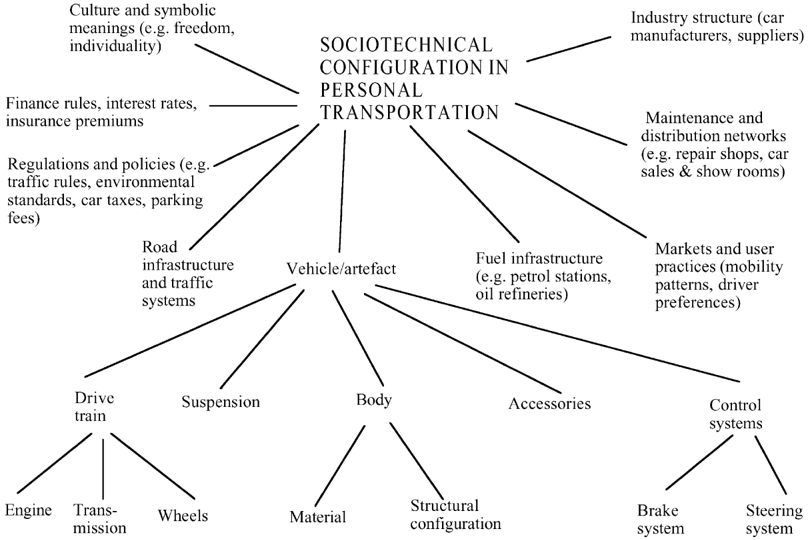
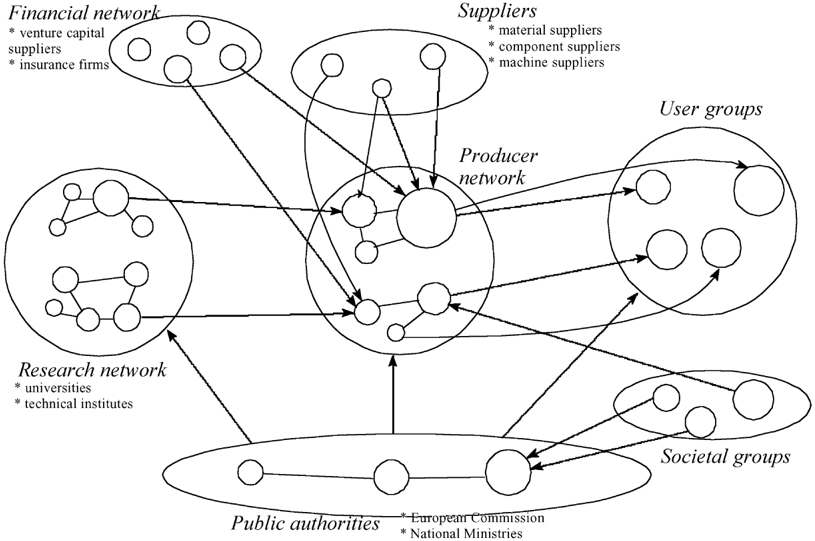
- Technological transitions are major, long-term changes in how societal functions are fulfilled; they involve not only technology but also user practices, regulation, industrial networks, infrastructure, and symbolic meaning or culture.
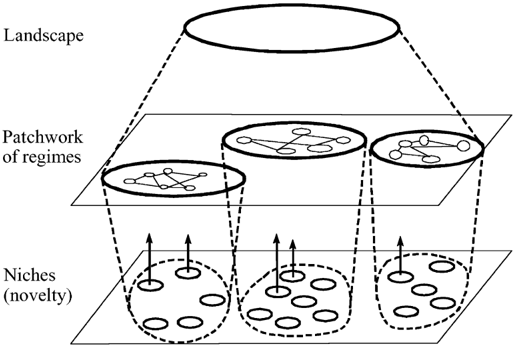
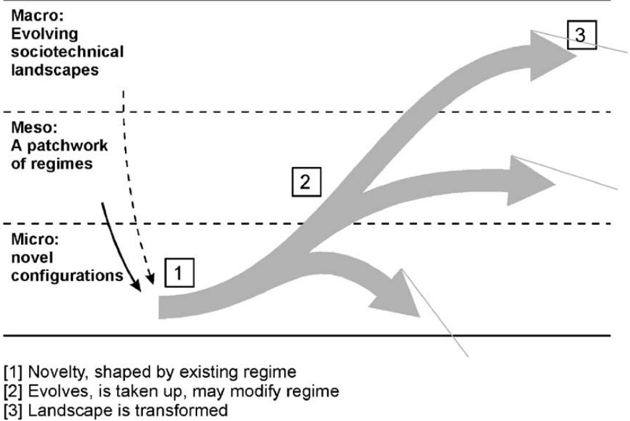
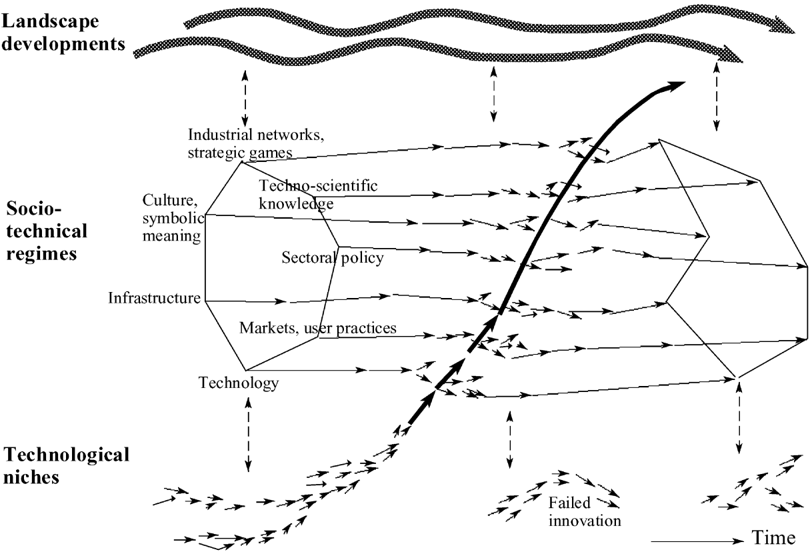
- The multi-level perspective treats niches as loci of radical variety, sociotechnical regimes as selection/retention mechanisms, and the landscape as slower external structure; breakthroughs occur when developments at multiple levels align and create a “window of opportunity.”
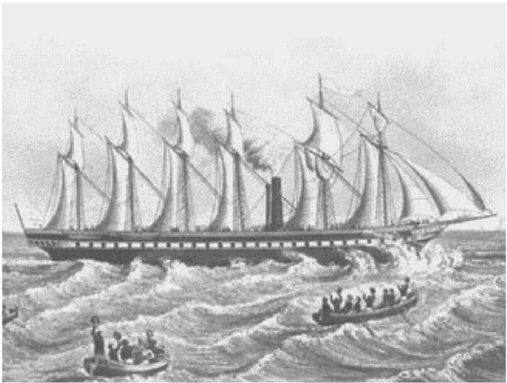
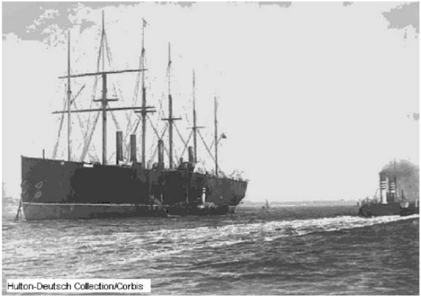
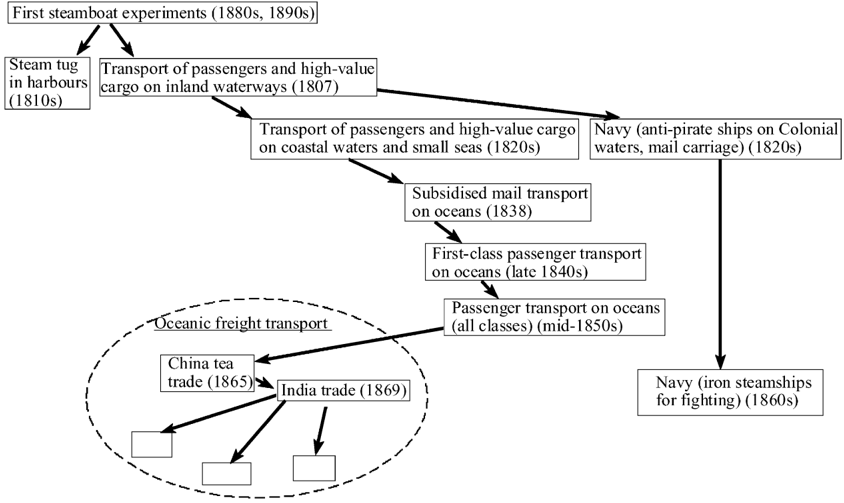
- In the steamship case, breakthrough followed niche-cumulation through inland waterways, coastal routes, mail subsidies, passenger transport, and freight; mechanisms included steam engines as auxiliary add-ons to sailing ships, hybrid sail/steam and iron/wood forms, and riding along with market growth.
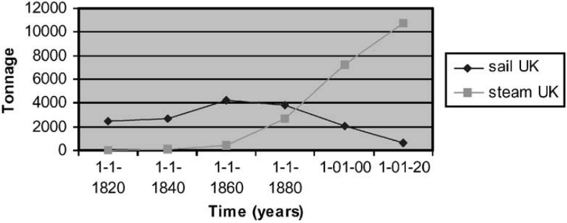
- Reported numbers include: European emigrants travelling by steamer rose from 45% in 1863 to 81% in 1866; compound engines enabled fuel-consumption reductions of 60%; the distance margin where steam was competitive reached 3000–3500 miles by the late 1860s; during the steamship mania (1869–1874), steamers rose from 17% to 31% of British registered tonnage.
Methods
- The paper uses “appreciative theory,” synthesising insights from evolutionary economics and technology studies into a multi-level perspective.
- It presents a qualitative longitudinal case study of the transition from sailing ships to steamships, 1780–1900, focused on Great Britain.
- The case is written in a mosaic style, shifting across markets, ship designs, insurance rules, actor groups, institutions, mail subsidies, persistent/emerging problems, and management practices to illustrate the conceptual framework.
Limitations
- The paper states that the multi-level perspective is fairly complex, requires many data, often qualitative, and that sociotechnical regimes are a broad unit of analysis with difficult-to-draw precise boundaries; boundary work deserves more attention.
- The paper states that the single case study has a drawback because 19th-century craft-based innovation differs from 20th-century science-based innovation, and the perspective would be more robust with more case studies varied over time periods and sectors.
- Evident in the text: the empirical analysis is focused on Great Britain and shipping, and the mechanisms are illustrated through selected historical examples rather than formal comparative or quantitative testing.
Model-written summary. Check it against the paper before relying on it.
Integrity signals
Registry
Cites
Statistics
Figures

Verification
Claims the paper makes
1 Valid · 5 Not valid · 42 Not checked · 63 Own results and interpretations
The cited sources support only part of this claim — read each source’s verdict below.
In the paper
“Aspecific mechanism in the breakthrough of radical innovations is technological add-on and hybridisation . It means that new technologies in their early phase physically link up with established technologies, often to solve particular bottlenecks. Thus, old and new technologies do not immediately compete head on, but form some sort of symbiosis (see also Pistorius and Utterback, 1997).”
What the sources say
- Partly supportedcites Pistorius and Utterback, 1997 matched to “Multi-mode interaction among technologies” (1997) sourceExperimental — accuracy not yet measured
Split into 2 atoms — 0 confirmed, 2 partially supported, 0 disputed, 0 misattributed, 0 unverifiable. Expand the claim to see per-atom verdicts.
plainstates a cause- Asserted: passes — The authors put it forward as true.
- Checkable: passes — It can be checked against evidence.
- Load-bearing: passes — The paper’s conclusions depend on it.
- Based: passes — The paper gives a reason why it holds.
- Partly supported
A result the paper states — it cites no source for it, so there is none to check. The quote shows it is in the paper.
In the paper
“These subsidies created a protective environment for the use and development of oceanic steamships.”
plainstates a cause- Asserted: passes — The authors put it forward as true.
- Checkable: passes — It can be checked against evidence.
- Load-bearing: unclear — It is unclear whether the paper’s conclusions depend on it.
- Based: passes — The paper gives a reason why it holds.
- Rests on an assumption not shown here.
In the paper
“Between 1838 and 1862 a global network of British intercontinental steam companies was created on the basis of imperial mail subsidies (Broeze, 1982).”
What the sources say
- Not matchedcites Broeze, 1982
An author–year citation the paper’s reference list doesn’t settle. We don’t search these by name.
plainstates a cause- Asserted: passes — The authors put it forward as true.
- Checkable: passes — It can be checked against evidence.
- Load-bearing: unclear — It is unclear whether the paper’s conclusions depend on it.
- Based: passes — The paper gives a reason why it holds.
- Rests on an assumption not shown here.
- Not matched
A result the paper states — it cites no source for it, so there is none to check. The quote shows it is in the paper.
In the paper
“Another innovation in the late 18th century shipping regime was the emergence of new social groups: professional shipowners, shipbrokers and insurance companies.”
plain- Asserted: passes — The authors put it forward as true.
- Checkable: passes — It can be checked against evidence.
- Load-bearing: unclear — It is unclear whether the paper’s conclusions depend on it.
- Based: passes — The paper gives a reason why it holds.
- Rests on an assumption not shown here.
A result the paper states — it cites no source for it, so there is none to check. The quote shows it is in the paper.
In the paper
“The emergence of professional shipowners was stimulated by the French Wars (1789-1815) which pushed up freight prices as demand for ships increased.”
plainstates a cause- Asserted: passes — The authors put it forward as true.
- Checkable: passes — It can be checked against evidence.
- Load-bearing: unclear — It is unclear whether the paper’s conclusions depend on it.
- Based: passes — The paper gives a reason why it holds.
- Rests on an assumption not shown here.
24 more claims
Create a free account to see all 111 claims and every source verdict.
- Probably not a substantial claim. 28
- It may state two separate claims as one. 69
- The quote only partly states this claim. 2
Claims other papers make about this one
Each is checked against this paper’s own text: does it say what the citing paper says it does?
In the citing paper
“The model of Geels (2002) describes new technologies as arising and maturing within existing technology systems [18].”
From Lessons Learned From a Living Lab on the Broad Adoption of eHealth in Primary Health Care (2018) · cites this paper as [18]
In the citing paper
“The multi-level perspective (Rip and Kemp, 1998;Geels, 2002;Geels, 2004;Geels and Schot, 2007) is a framework for understanding sustainability transitions that provides an overall view of the multi-dimensional complexity of changes in socio-technical systems.”
From Ontologies, socio-technical transitions (to sustainability), and the multi-level perspective (2010) · cites this paper as Geels, 2002
Citations
Cites
An Evolutionary Theory of Economic Change.
Loasby, B. J., Nelson, R. R., & Winter, S. G. (1983) · The Economic Journal · doi:10.2307/2232409 · Cited by 21,366
(1934) · SSRN Electronic Journal · Cited by 7,609
Technological Discontinuities and Organizational Environments
Tushman, M. L., & Anderson, P. (1986) · Administrative Science Quarterly · doi:10.2307/2392832 · Cited by 6,112
von Hippel, E. (2007) · Das Summa Summarum des Management · doi:10.1007/978-3-8349-9320-5_10 · Cited by 5,098
Technical Change and Economic Theory.
Swann, P., & Dosi, G. (1989) · The Economic Journal · doi:10.2307/2234048 · Cited by 4,041
Shaping Technology, Building Society: Studies in Sociotechnical Change.
Lynch, M., Bijker, W. E., & Law, J. (1993) · Contemporary Sociology · doi:10.2307/2074370 · Cited by 3,540
Technological Discontinuities and Dominant Designs: A Cyclical Model of Technological Change
Anderson, P., & Tushman, M. L. (1990) · Administrative Science Quarterly · doi:10.2307/2393511 · Cited by 3,255
Bijker, W. E., Hughes, T. P., & Pinch, T. (1987) · Cited by 2,957
Kemp, R., Schot, J., & Hoogma, R. (1998) · Technology Analysis & Strategic Management · doi:10.1080/09537329808524310 · Cited by 2,860
Innovation: Mapping the winds of creative destruction
Abernathy, W. J., & Clark, K. B. (1985) · Research Policy · doi:10.1016/0048-7333(85)90021-6 · Cited by 2,791
Research works printed but not linked: 9
- Broeze, F.J.A., 1982. The international diffusion of ocean steam navigation: the myth of the retardation of Netherlands steam navigation to the East Indies. Economisch-en Sociaal-Historisch Jaarboek 45, 77-95.
- Callon, M. (Ed.), 1998. The Laws of the Market. Blackwell, Oxford.
- Garrat, G.R.M., Goodman, D.C., Russel, C.A., 1973. Science and Engineering, Units 14 and 15. Open University Press, Bletchley.
- Jackson, G., 1998. Ports, ships and government in the nineteenth and twentieth centuries. In: Van Royen, P.C., Fischer, L.R., Williams, D.M. (Eds.), Proceedings of the Second International Congress of Maritime History on Frutta di Mare: Evolution and revolution in the maritime world in the 19th and 20th centuries. Amsterdam/Rotterdam, The Netherlands, 5-8 June, 1996. Batavian Lion International, Amsterdam, pp. 161-176.
- Lundvall, B.A., 1988. Innovation as an interactive process: from user-producer interaction to the national system of innovation. In: Dosi, G., Freeman, C., Nelson, R., Silverberg, G., Soete, L. (Eds.), Technical Change and Economic Theory. Pinter, London, pp. 349-369.
- Maddocks, M., 1982. De Grote Oversteek. Time-Life, London. Mayntz, R., Hughes, T.P. (Eds.), 1988. The Development of Large
- Mokyr, J., 1990. The Lever of Riches. Oxford University Press, New York.
- Rip, A., Kemp, R., 1996. Towards a Theory of Socio-Technical Change. Mimeo University of Twente, Report prepared for Batelle Pacific Northwest Laboratories, Washington, DC. (An edited version has been published as book chapter Rip and Kemp 1998).
- Sloan, E.W., 1998. Private enterprise as public utility: the management of capital in two centuries of shipping business. In: Van Royen, P.C., Fischer, L.R., Williams, D.M. (Eds.), Proceedings of the Second International Congress of Maritime History on Frutta di Mare: Evolution and Revolution in the Maritime World in the 19th and 20th Centuries. Amsterdam/Rotterdam, The Netherlands, 5-8 June, 1996. Batavian Lion International, Amsterdam, pp. 89-100.
Cited by
Items 2,801–2,900 of 7,210
Schmitt, M., Häußling, R., & Kaip, E. (2023) · Urban Climate · doi:10.1016/j.uclim.2023.101507 · Cited by 19
Dijkstra, H., & Planko, J. (2023) · Sustainable Production and Consumption · doi:10.1016/j.spc.2023.05.028 · Cited by 20
Woodward, A., Burchert, S., Barry, A. S., Broerse, J. E. W., Sondorp, E., Bold, A., Ruberl, A., Hessling, J. M., Knaevelsrud, C., Roberts, B., et al. (2023) · SSM - Mental Health · doi:10.1016/j.ssmmh.2023.100231 · Cited by 19
“A protected space where actors experiment with innovations (Geels, 2002; Schot, 1998).”
BackgroundInfluentialCadiou, J., Aubert, P., & Meynard, J.-M. (2023) · Futures · doi:10.1016/j.futures.2023.103218 · Cited by 14
University as an opportunity space enabler in a regional entrepreneurial ecosystem
Rinkinen, S., Konsti‐Laakso, S., & Lahikainen, K. (2023) · European Planning Studies · doi:10.1080/09654313.2023.2246522 · Cited by 28
“When it comes to research-based innovations, the goal of universities is to produce radical innovations that can act as seeds of change for society-level socio-technical transitions (Geels 2002; 2004).”
BackgroundTurning the tanker? Exploring the preconditions for change in the global petrochemical industry
Rootzén, J., Nyberg, T., Karltorp, K., & Åhman, M. (2023) · Energy Research & Social Science · doi:10.1016/j.erss.2023.103256 · Cited by 17
Moujaes, G. (2023) · Science and Public Policy · doi:10.1093/scipol/scad056 · Cited by 48
Hidayat, R., & Cowie, J. (2023) · Transportation research procedia · doi:10.1016/j.trpro.2023.11.041 · Cited by 21
do Lago, A. C., Chaparro, T. S., & Lumbreras, J. (2023) · Sustainability · doi:10.3390/su152416665 · Cited by 17
Gomes, G. M., Moreira, N. G., & Ometto, A. R. (2023) · Circular Economy and Sustainability · doi:10.1007/s43615-023-00332-8 · Cited by 23
“During this initial step, researchers drew a multilevel perspective scenario, based on Geels [67], and identified the main barriers and windows of opportunity for the transition to a CE in the Brazilian textile and apparel industry [68].”
Baumgarten, S., Aarts, N., Fliervoet, J., & Krabbenborg, L. (2024) · Environmental Management · doi:10.1007/s00267-024-01958-6 · Cited by 17
“Transition management research underscores the signi fi cance of such deliberate experimentation within “ protected ” spaces to explore the interdependencies and feedback loops in socio-ecological systems and to deal with uncertainty (Cumming et al. 2013; Geels, 2002).”
The hydrogen field in 2035: A Delphi study forecasting dominant technology bundles
Leypoldt, L., Dienhart, C., Caferoglu, H., Salge, T. O., & Antons, D. (2024) · Technological Forecasting and Social Change · doi:10.1016/j.techfore.2024.123593 · Cited by 32
Ma, M., Li, J., Song, J., & Chen, X. (2024) · Communications Earth & Environment · doi:10.1038/s43247-024-01786-w · Cited by 17
Tomai, M., Papachristos, G., & Ramani, S. V. (2024) · Environmental Innovation and Societal Transitions · doi:10.1016/j.eist.2024.100928 · Cited by 28
Actor-network theory-based applications in sustainability: A systematic literature review
Aka, K. G. (2024) · Cleaner Production Letters · doi:10.1016/j.clpl.2024.100084 · Cited by 19
Brouwer, B., Bergem, R. V., Renes, S., Kamp, L. M., & Hoppe, T. (2024) · Energy Research & Social Science · doi:10.1016/j.erss.2024.103891 · Cited by 15
Community-based energy governance and the political: Towards a post-foundational energy democracy
Koga, H., Petrova, S., & Bouzarovski, S. (2024) · Progress in Environmental Geography · doi:10.1177/27539687241307955 · Cited by 24
“This is particularly evident in our understanding of community, which serves as a foundation for various theoretical frameworks — whether niche (Geels 2002), local (Purcell 2006), more-than-human publics (Marres 2007), assemblage (Eadson and van Veelen 2021), or other positionings of community in…”
Vangansbeke, P., Gorissen, L., Nevens, F., & Verheyen, K. (2014) · Forest Policy and Economics · doi:10.1016/j.forpol.2014.07.006 · Cited by 14
Assessing Sustainability Transition in the US Electrical Power System
Jiusto, S., & McCauley, S. M. (2010) · Sustainability · doi:10.3390/su2020551 · Cited by 16
Barriers to the Uptake of Human-based Test Methods, and how to Overcome Them
Archibald, K., Drake, T., & Coleman, R. (2015) · Alternatives to Laboratory Animals · doi:10.1177/026119291504300504 · Cited by 14
Understanding energy-related regimes: A participatory approach from central Australia
Foran, T., Fleming, D. A., Spandonide, B., Williams, R., & Race, D. (2016) · Energy Policy · doi:10.1016/j.enpol.2016.01.014 · Cited by 17
Kundu, D. K., Vliet, B. J. M. V., & Gupta, A. (2016) · Asian Journal of Technology Innovation · doi:10.1080/19761597.2016.1190286 · Cited by 15
Borghei, B., & Magnusson, T. (2016) · International Journal of Automotive Technology and Management · doi:10.1504/ijatm.2016.080787 · Cited by 18
Reinventing the bicycle: how calculative practices shape urban environmental governance
Jensen, J. S., Cashmore, M., & Elle, M. (2017) · Environmental Politics · doi:10.1080/09644016.2017.1311089 · Cited by 21
Permacultures of transformation: steps to a cultural ecology of environmental action
Ford, L., & Henfrey, T. (2018) · Journal of Political Ecology · doi:10.2458/v25i1.22758 · Cited by 13
Wyss, R., Mühlemeier, S., & Binder, C. R. (2018) · Energies · doi:10.3390/en11092263 · Cited by 16
Fostering innovation in area-based initiatives for deprived neighbourhoods: a multi-level approach
Barbanente, A., & Grassini, L. (2019) · International Planning Studies · doi:10.1080/13563475.2019.1578200 · Cited by 18
Essential elements at play in local environmental policy change: A guide for the perplexed
Pivo, G., Henry, A. D., & Berger, L. (2020) · Environmental Science & Policy · doi:10.1016/j.envsci.2020.01.023 · Cited by 16
Social innovation in the shadow of policy failure: Energy efficiency in self-build housing
Lane, M., van der Horst, D., Tingey, M., et al. (2020) · Global Transitions · doi:10.1016/j.glt.2020.08.001 · Cited by 13
A Combined Multi-Level Perspective and Agent-Based Modeling in Low-Carbon Transition Analysis
Wu, X., Zhao, S., Shen, Y., Madani, H., & Chen, Y. (2020) · Energies · doi:10.3390/en13195050 · Cited by 18
Khodke, A., Watabe, A., & Mehdi, N. (2021) · Sustainability · doi:10.3390/su13084339 · Cited by 15
Giganti, P., & Falcone, P. M. (2021) · AIMS energy · doi:10.3934/energy.2021035 · Cited by 17
Intercept of Financial, Economic and Educational Transformations: Bibliometric Analysis
Novikov, V. (2021) · Financial Markets Institutions and Risks · doi:10.21272/fmir.5(2).120-129.2021 · Cited by 13
How to Save a Million Species? Transformative Governance through Prioritization
Visseren-Hamakers, I. J., Cashore, B. W., Loorbach, D. A., Kok, M., de Koning, S., Vullers, P., & van Veen, A. (2022) · Cambridge University Press eBooks · doi:10.1017/9781108856348.005 · Cited by 32
Rethinking Urban Sustainability and Resilience
Simon, D., Griffith, C. A., & Nagendra, H. (2018) · Cambridge University Press eBooks · doi:10.1017/9781316647554.009 · Cited by 22
Hernberg, H. (2021) · Planning Practice and Research · doi:10.1080/02697459.2021.2001730 · Cited by 13
“These include ‘regime’, constituting the dominant societal functions and ‘rules’, and ‘niche’, from which radical innovations emerge (Geels, 2002; Smith et al ., 2010).”
Yang, J., Zhang, W., Zhao, D., Zhao, C., & Yuan, J. (2021) · Resources Conservation and Recycling · doi:10.1016/j.resconrec.2021.106127 · Cited by 15
Exploring the circular economy through coatings in transport
Cherrington, R., Marshall, J. E., Alexander, A. T., & Goodship, V. (2022) · Sustainable Production and Consumption · doi:10.1016/j.spc.2022.04.016 · Cited by 18
“The emergence and evolution of radical breakthroughs occurs at the micro level where niche innovations occur (Geels, 2002).”
BackgroundSanz, E. S., Cardona, A., & Napoléone, C. (2022) · Journal of Agricultural and Environmental Ethics · doi:10.1007/s10806-022-09880-9 · Cited by 17
“It works on three analytical levels: the niche level, where small networks of actors develop radical innovations or new technology on the margins of the regime (Geels & Schot, 2007) (small firms processing local products in our case); the regime level, where established practices and norms maintain existing sociotechn…”
BackgroundInfluentialWigboldus, S., McEwan, M. A., van Schagen, B., Okike, I., MOURIK, T. A. V., Rietveld, A. M., Amole, T. A., Asfaw, F., Hundayehu, M. C., Iradukunda, F., et al. (2022) · Environment Development and Sustainability · doi:10.1007/s10668-022-02394-4 · Cited by 19
“Over the past decade, the multi-level perspective (MLP) on socio-technical innovations (Geels, 2002) has increasingly been used to interpret processes that introduce agricultural innovations (Blesh & Wolf, 2014; Hinrichs 2014; Morrissey et al., 2014) and related scaling processes (Wigboldus et …”
BackgroundLindsay, J., Lane, R., Raven, R. P. J. M., & Reynolds, D. (2022) · Sustainability Science Practice and Policy · doi:10.1080/15487733.2022.2088004 · Cited by 13
“As Geels (2002) has noted, disasters have a tendency to catalyze processes of social change by disrupting regimes and making room for novel ways of doing things.”
BackgroundTowards a more resource-efficient solar future in the EU: An actor-centered approach
Koese, M., Blanco, C. F., Breeman, G. E., & Vijver, M. G. (2022) · Environmental Innovation and Societal Transitions · doi:10.1016/j.eist.2022.09.001 · Cited by 21
Social entrepreneurship and sustainable development: The Yiwu case
Yan, Y., Si, S., Zhu, W., & Zhang, Y. (2022) · Elementa Science of the Anthropocene · doi:10.1525/elementa.2022.00010 · Cited by 18
Institutional logics and the adoption and implementation of remote patient monitoring
Hidefjäll, P., Laurell, H., Johansson, J., & Barlow, J. (2023) · Innovation · doi:10.1080/14479338.2022.2162907 · Cited by 15
“…literature rooted in a more socio-technical multi-level perspective has paid explicit attention to multi-level institutional aspects of adoption, such as the dynamics among micro-level niches, socio-technical regimes and societal landscapes (Fuenfschilling & Truffer, 2014; Geels, 2002, 2005).”
Waltermann, J., & Henkel, S. (2023) · Transportation Research Interdisciplinary Perspectives · doi:10.1016/j.trip.2022.100743 · Cited by 22
A governance framework to manage the food-environment-livelihood trilemma of alternative proteins
Søndergaard, N., Fernandes, J. F. A., Potent, J., Karl, K., Furtado, M., & Baethgen, W. (2023) · One Earth · doi:10.1016/j.oneear.2023.06.008 · Cited by 15
Magnusson, D. (2013) · Cited by 13
Chalak, A., Hecht, J., Reid, S., et al. (2012) · Environmental Science & Policy · doi:10.1016/j.envsci.2012.02.003 · Cited by 13
Adoption of Novelties in a Pluralist Society: Exploring an Agropark Case Study
Hoes, A.-C., & Regeer, B. J. (2014) · Journal of Environmental Policy & Planning · doi:10.1080/1523908x.2014.880635 · Cited by 13
The transformation of pulp and paper industries: the role of local networks and institutions
Novotny, M., & Nuur, C. (2013) · International Journal of Innovation and Regional Development · doi:10.1504/ijird.2013.052507 · Cited by 13
Adaptation to Climate Change: A Framework for Analysis with Examples from the Netherlands
Vellinga, P., Marinova, N., & van Loon-Steensma, J. M. (2009) · Built Environment · doi:10.2148/benv.35.4.452 · Cited by 18
Sica, E. (2015) · International Journal of Innovation and Sustainable Development · doi:10.1504/ijisd.2016.073417 · Cited by 13
Fu, Q., Zhao, K., Liu, D., et al. (2016) · Water Resources Management · doi:10.1007/s11269-016-1273-2 · Cited by 13
Mainstreaming of Sustainable Cotton in the German Clothing Industry
Hansen, E. G., & Schaltegger, S. (2016) · Environmental footprints and eco-design of products and processes · doi:10.1007/978-981-10-0522-0_2 · Cited by 16
A material lens on socio-technical transitions: The case of steel in Australian buildings
Santos, D., & Lane, R. (2017) · Geoforum · doi:10.1016/j.geoforum.2017.03.020 · Cited by 18
Sustainable consumption, energy and failed transitions: the problem of adaptation
Hess, D. J. (2013) · Edward Elgar Publishing eBooks · doi:10.4337/9781781001349.00018 · Cited by 14
Low-carbon China: Emerging phenomena and implications for innovation governance
Ely, A., Geall, S., & Dai, Y. (2018) · Environmental Innovation and Societal Transitions · doi:10.1016/j.eist.2018.05.001 · Cited by 14
Hubeau, M., Vanderplanken, K., Vandermoere, F., Rogge, E., Huylenbroeck, G. V., & Marchand, F. (2019) · Environmental Innovation and Societal Transitions · doi:10.1016/j.eist.2019.04.002 · Cited by 20
Grönwall, J., & Jönsson, A. M. (2017) · KTH Publication Database DiVA (KTH Royal Institute of Technology) · Cited by 13
Opportunities for Socially Responsible Industry 4.s
Hahn, K. (2020) · IEEE Engineering Management Review · doi:10.1109/emr.2020.2969407 · Cited by 16
Uhde, H., & Malima, G. (2020) · Energy Research & Social Science · doi:10.1016/j.erss.2020.101577 · Cited by 15
Acheilas, I., Hooimeijer, F., & Ersoy, A. (2020) · Energies · doi:10.3390/en13112750 · Cited by 13
Dominant design and evolution of technological trajectories: The case of tank technology, 1915–1998
Kim, J., Yoon, J., & Lee, J. (2020) · Journal of Evolutionary Economics · doi:10.1007/s00191-020-00697-1 · Cited by 13
Fostering a local energy transition in a post-socialist policy setting
Young, J., & Brans, M. (2020) · Environmental Innovation and Societal Transitions · doi:10.1016/j.eist.2020.05.003 · Cited by 19
Julsrud, T. E., & Denstadli, J. M. (2020) · Environmental Innovation and Societal Transitions · doi:10.1016/j.eist.2020.09.003 · Cited by 15
Misquitta, K., & Birkenholtz, T. L. (2021) · Water International · doi:10.1080/02508060.2020.1858696 · Cited by 14
Thirty years of climate mitigation: lessons from the 1989 options appraisal for the UK
Lees, E., & Eyre, N. (2021) · Energy Efficiency · doi:10.1007/s12053-021-09951-2 · Cited by 13
Tarkowski, M., & Puzdrakiewicz, K. (2021) · Sustainability · doi:10.3390/su132313183 · Cited by 16
The Transition of Cities towards Innovations in Mobility: Searching for a Global Perspective
Molina, C. M., Rey-Tienda, S., & Suárez, E. (2022) · International Journal of Environmental Research and Public Health · doi:10.3390/ijerph19127197 · Cited by 17
“This represents the broadest socio-technical context [45,46].”
BackgroundSustainable regeneration: a guiding vision towards low-carbon transition?
Hunt, M., & Laurentis, C. D. (2014) · Local Environment · doi:10.1080/13549839.2014.894964 · Cited by 16
The Dutch Pork Chain: A Commodity System Resisting Threats from the Market and Society
Greef, K. H. D., & Casabianca, F. (2009) · Outlook on Agriculture · doi:10.5367/000000009788632395 · Cited by 13
Sustainable Peace in the Anthropocene: Towards Political Geoecology and Peace Ecology
Brauch, H. G. (2016) · Hexagon series on human and environmental security and peace · doi:10.1007/978-3-319-43884-9_9 · Cited by 17
Cainelli, G., Mazzanti, M., & Borghesi, S. (2012) · RePEc: Research Papers in Economics · Cited by 18
The adoption of Industry 4.0- technologies in manufacturing : a multiple case study
Nilsen, S., & Nyberg, E. A. (2016) · DiVA (Digitala Vetenskapliga Arkivet) · Cited by 26
Domino Effects in the Earth System -- The role of wanted social tipping pointsPreprint
Smith, E. K., Eder, C., Donges, J. F., Heitzig, J., Κατσανίδου, Α., Wiedermann, M., & Winkelmann, R. (2022) · OSF Preprints (OSF Preprints) · doi:10.31219/osf.io/d8scb · Cited by 13
Porto, P. M. B. V., Leroy-Freitas, D., Cohim, E., de Vasconcelos, R. N., Franca-Rocha, W., Muñoz, R., & Molinos‐Senante, M. (2025) · Energy Reports · doi:10.1016/j.egyr.2025.04.015 · Cited by 15
Freed, S., Voss, R. C., Falk, T., Rietveld, A. M., Alary, V., Chimonyo, V. G. P., Frija, A., Djurfeldt, N. G., Lestrelin, G., Singh, S., et al. (2025) · Agricultural Systems · doi:10.1016/j.agsy.2025.104399 · Cited by 14
Financing the Green Transition: How Green Finance and Renewable Energy Drive CO2 Mitigation
Elhaj, M., Mabrouk, F., & Alotaibi, L. (2025) · Energies · doi:10.3390/en18215563 · Cited by 18
Cracks in the wall of a car-oriented local mobility system – Results of an urban living lab
Rollin, P., Bamberg, S., Ketterl, C., & Weiland, S. (2021) · Journal of Environmental Psychology · doi:10.1016/j.jenvp.2021.101678 · Cited by 15
Towards transformative policy in Finland and Sweden: some viewpoints from practice
Serger, S. S., & Palmberg, C. (2022) · Edward Elgar Publishing eBooks · doi:10.4337/9781788970815.00012 · Cited by 13
Kemmerzell, J. (2022) · Springer eBooks · doi:10.1007/978-3-030-43250-8_11 · Cited by 21
Mayerfeld, D., Keeley, K. O., Rickenbach, M. G., Rissman, A. R., & Ventura, S. J. (2023) · Frontiers in Sustainable Food Systems · doi:10.3389/fsufs.2023.983376 · Cited by 13
“…actors’ knowledge, agency, and coordination are constrained or supported by contextual factors, is often analyzed in sustainability literature with what is called a multilevel perspective (Geels, 2002, 2011; Klerkx et al., 2010; Elzen et al., 2011; Ingram, 2015; Wigboldus et al., 2016).”
BackgroundKim, N., & Yang, S.-W. (2023) · Systems · doi:10.3390/systems11040166 · Cited by 14
(Re)framing technology: The evolution from biogas to biomethane in Austria
Kriechbaum, M., Terler, N., Stürmer, B., & Stern, T. (2023) · Environmental Innovation and Societal Transitions · doi:10.1016/j.eist.2023.100724 · Cited by 18
Manktelow, C., Hoppe, T., Bickerstaff, K., Itten, A. V., Fremouw, M., & Naik, M. (2023) · Energy Research & Social Science · doi:10.1016/j.erss.2023.103061 · Cited by 16
Frugal Engineering of Advanced Frugal Innovations for Global Sustainability Entrepreneurship
Rao, B. C., & Liefner, I. (2023) · The Journal of Entrepreneurship · doi:10.1177/09713557231201130 · Cited by 13
“SMBs may much more easily try out advanced frugal options within their smaller niches (Geels, 2002; Unruh, 2000).”
BackgroundBuscher, J., Bakunowitsch, J., & Specht, K. (2023) · Sustainability · doi:10.3390/su152215861 · Cited by 18
Recreating the Construction Sector for Circularity
Huuhka, S., Aarikka‐Stenroos, L., Lahdensivu, J., Jonker‐Hoffrén, P., Arnold, V., Stenberg, E., Blok, R., Gudmundsson, K., Teuffel, P., & Mettke, A. (2023) · Routledge eBooks · doi:10.4324/9781003267492-4 · Cited by 21
Schröder, A., & Klinger, T. S. (2023) · Environmental Innovation and Societal Transitions · doi:10.1016/j.eist.2023.100800 · Cited by 21
Tsvetkova, A., Hellström, M., Schwartz, H. G., Rabetino, R., & Syed, H. (2024) · Marine Policy · doi:10.1016/j.marpol.2023.106002 · Cited by 17
Identifying levers of urban neighbourhood transformation using serious games
Schuur, J. S., Switalski, M., Salliou, N., & Grêt‐Regamey, A. (2024) · npj Urban Sustainability · doi:10.1038/s42949-023-00138-5 · Cited by 15
Brazzola, N., Moretti, C., Sievert, K., Patt, A., & Lilliestam, J. (2024) · Environmental Research Letters · doi:10.1088/1748-9326/ad3b1f · Cited by 14
“…a sociotechnical systems approach to compare the DAC development pathways, building on the multi-level perspective on sociotechnical transitions [69, 74, 75], and emphasising not only the technologies but in particular the social embedding of technologies in a complex system that includes all…”
BackgroundModelling induced innovation for the low-carbon energy transition: a menu of options
Pasqualino, R., Peñasco, C., Barbrook-Johnson, P., de Moura, F. S., Kolesnikov, S. A., Hafner, S., Nijsse, F. J. M. M., Lamperti, F., Hinder, B., Melekh, Y., et al. (2024) · Environmental Research Letters · doi:10.1088/1748-9326/ad4c79 · Cited by 16
“By mimicking the characteristics of a socio-technical transition framework, the model can be calibrated between niche and regime level of technology diffusion [38, 47, 159].”
BackgroundMethodIrene, J., Daniels, C. U., Kelly, M., Irene, B., Frank, R., & Okpara, K. (2024) · Local Environment · doi:10.1080/13549839.2024.2376546 · Cited by 21
“…the Multi-Level Perspective – MLP and Social Practice Theory – SPT used in most sociotechnical studies provide further empirical support for analysing the complex social interactions and embeddedness of social actors especially in culturally diverse environment (Geels 2002; Schot and Kanger 2018).”
Liang, N., & Coral, J. S. (2024) · Sustainability · doi:10.3390/su16146165 · Cited by 23
Ahmadov, T., Durst, S., & Gerstlberger, W. D. (2024) · The Bottom Line Managing Library Finances · doi:10.1108/bl-12-2023-0320 · Cited by 20
Kivimaa, P., & Sivonen, M. H. (2024) · Energy Research & Social Science · doi:10.1016/j.erss.2024.103775 · Cited by 22
Agri-food systems in transition: Potentialities and challenges of moving towards circular models
Stempfle, S., Carlucci, D., Borrello, M., Cembalo, L., Gennaro, B. D., Roselli, L., & Giannoccaro, G. (2024) · Journal of Cleaner Production · doi:10.1016/j.jclepro.2024.144005 · Cited by 19
Accelerating transitions? Planning for decarbonisation in local and regional energy systems
Poulter, H., Britton, J., Rattle, I., et al. (2024) · Energy Research & Social Science · doi:10.1016/j.erss.2024.103875 · Cited by 12
Persson, B. M., Andersson, J., & Forsberg, P. (2025) · Futures & Foresight Science · doi:10.1002/ffo2.209 · Cited by 17
Metadata
- Authors
- Geels, F. W.
- Affiliations
- University of Twente (NL)
- Corresponding author
- Geels, Frank W.
- ORCID
- Geels, Frank W.
- Venue
- Research Policy
- Publisher
- Elsevier BV
- Published
- 2002-12
- Volume
- 31
- Issue
- 8-9
- Pages
- 1257-1274
- ISSN
- 0048-7333 (ISSN-L)
- OpenAlex
- W2099330597
- Cited by
- 7,275
- References
- 94
- Citations by year
- 2026: 983 · 2025: 624 · 2024: 502 · 2023: 504 · 2022: 503 · 2021: 598 · 2020: 526 · 2019: 417 · 2018: 493 · 2017: 357 · 2016: 301 · 2015: 293 · 2014: 241 · 2013: 201 · 2012: 204
- FWCI
- 16.68
- Type
- journal article
- Language
- en
- Open access
- bronze
- doi.org
- Licence
- www.elsevier.com/tdm/userlicense/1.0/ (tdm)
- Locations
- Research Policy (publishedVersion)
- Research Explorer (The University of Manchester) (submittedVersion, other-oa)
- University of Twente Research Information (submittedVersion)
- TU/e Research Portal (submittedVersion)
- RePEc: Research Papers in Economics (submittedVersion)
- Figshare (submittedVersion, cc-by)
- University of Twente Research Information (submittedVersion, other-oa)
- Funders
- Nederlandse Organisatie voor Wetenschappelijk Onderzoek
- Topics
- Physical Sciences › Environmental Science › Global and Planetary Change › Sustainability and Climate Change Governance
- Social Sciences › Decision Sciences › Management Science and Operations Research › Innovation Diffusion and Forecasting
- Social Sciences › Economics, Econometrics and Finance › Economics and Econometrics › Economic Theory and Institutions
- Keywords
- technological transition, multi-level perspective, evolutionary economics, technology studies, hybridization, market growth, industrial networks, user practices, regulation, infrastructure
About these checks
Registry, retraction, Cites and statistics results are computed, not judged, with one exception: a printed reference that no index lists is read once by a model before it counts as a citation error. Claims are extracted by a model and kept only when their quote appears verbatim in the text; each cited source is then checked, with a model’s help, for whether it says what the claim relies on. Those verdicts can be wrong — read the claim’s quote and the cited source before relying on one.
The claim verdicts this report counts are experimental: their accuracy is not yet measured.
A language model drew the claims from the paper on 2026-10-10, under version 3 of the claim definition (model deepseek-v4.1-flash, prompt extract-v3).
A second model labelled each claim on 2026-10-10 (model jev-1.13-20260917, definition revision gold-guideline-v0.2).
Cited sources are checked with a language model’s help (gpt-6-sol).
Statistics and arithmetic are recomputed, not judged.
Confidence bands are shown only for fields calibrated on our annotated test set. None is calibrated yet, so no band is shown.
What counts as a claim ›How we measure confidence ›How we check this ›
Are you an author, or do you see a problem with this page? Request a review
Data sources
Bibliographic data: Semantic Scholar, OpenAlex, Crossref.
Contains information from the Semantic Scholar Academic Graph Datasets, made available under the ODC Attribution License (ODC-BY 1.0).
Semantic Scholar’s data is described in: Kinney, R., et al. (2023). The Semantic Scholar Open Data Platform. arXiv:2301.10140.
