

Technological transitions as evolutionary reconfiguration processes: a multi-level perspective and a case-study
Open accessThe DOI matches its Crossref record; 86 of the 94 references it cites were found in a registry or an index; 1 of the 45 sources its claims cite were checked for support.
Overview
CoChat Summary
TL;DR
Geels proposes a multi-level perspective on technological transitions, combining evolutionary economics and technology studies around niches, sociotechnical regimes, and landscape. He illustrates it with a qualitative longitudinal case study of the transition from sailing ships to steamships, 1780–1900, identifying niche-cumulation, technological add-on/hybridisation, and riding along with market growth.
Key findings
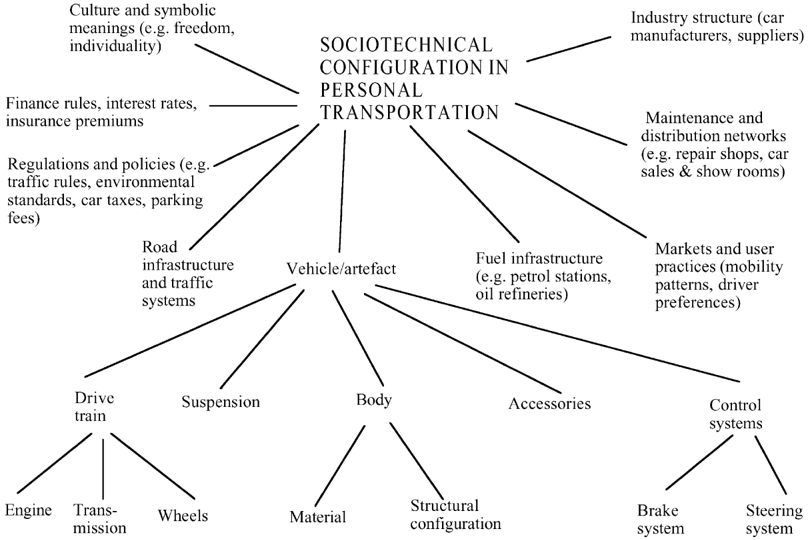
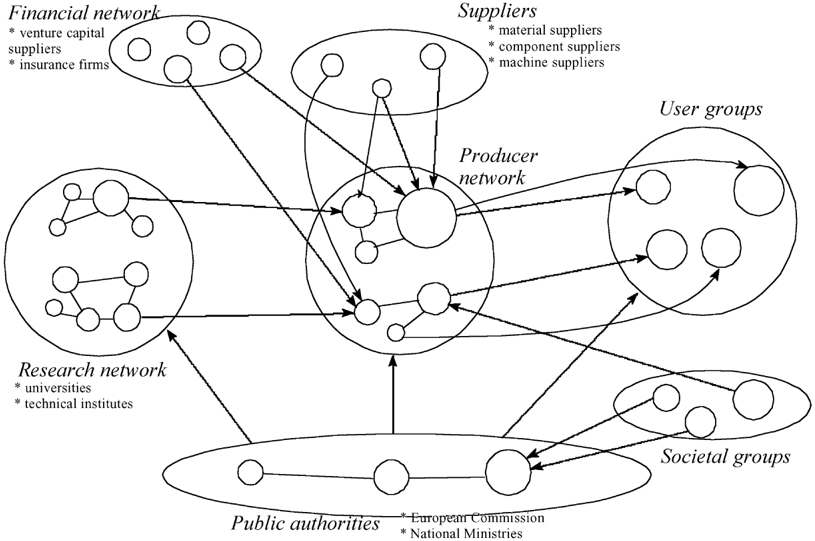
- Technological transitions are major, long-term changes in how societal functions are fulfilled; they involve not only technology but also user practices, regulation, industrial networks, infrastructure, and symbolic meaning or culture.
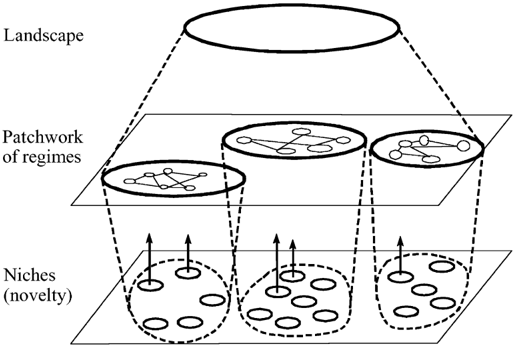
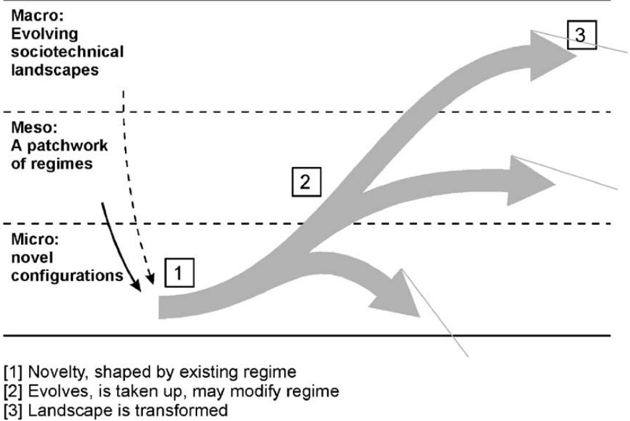
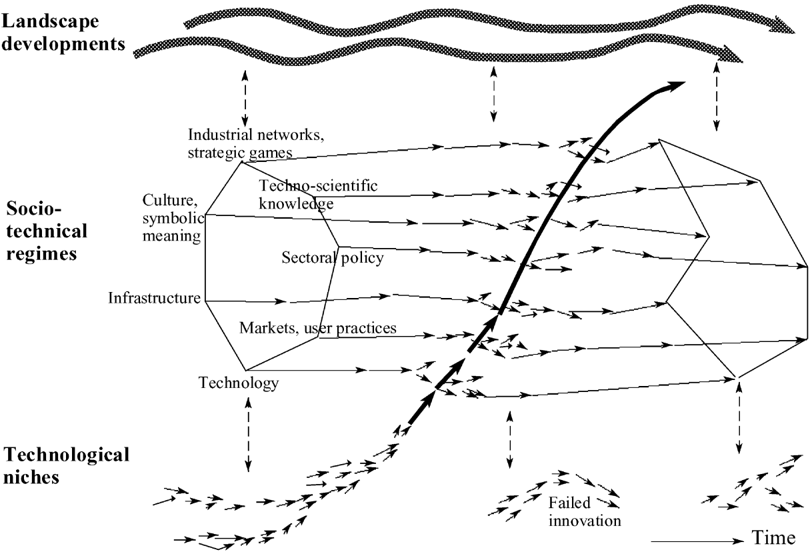
- The multi-level perspective treats niches as loci of radical variety, sociotechnical regimes as selection/retention mechanisms, and the landscape as slower external structure; breakthroughs occur when developments at multiple levels align and create a “window of opportunity.”
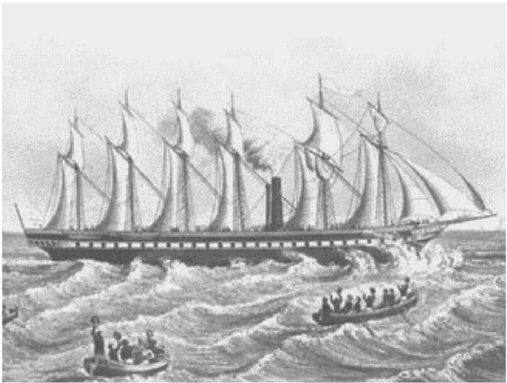
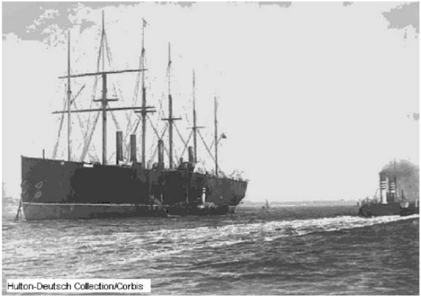
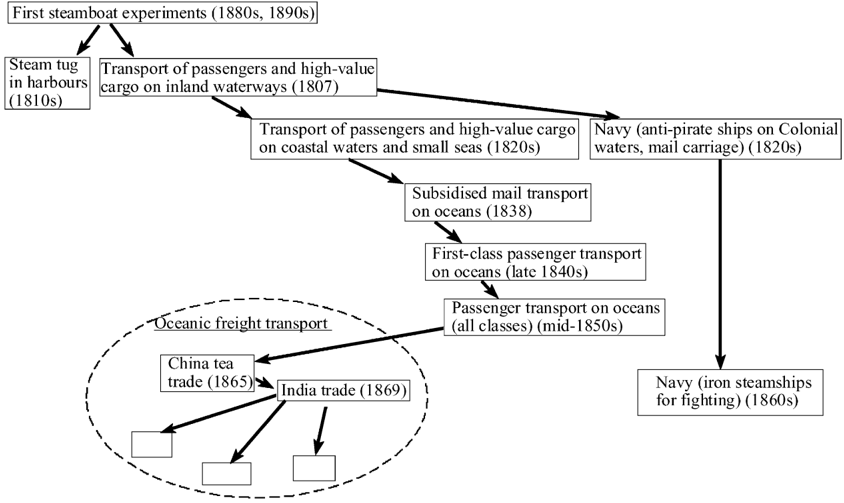
- In the steamship case, breakthrough followed niche-cumulation through inland waterways, coastal routes, mail subsidies, passenger transport, and freight; mechanisms included steam engines as auxiliary add-ons to sailing ships, hybrid sail/steam and iron/wood forms, and riding along with market growth.
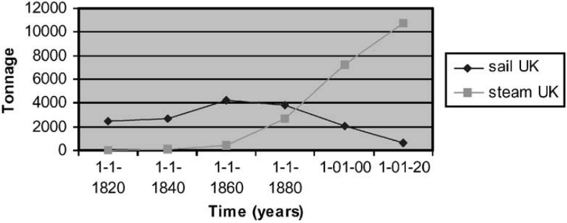
- Reported numbers include: European emigrants travelling by steamer rose from 45% in 1863 to 81% in 1866; compound engines enabled fuel-consumption reductions of 60%; the distance margin where steam was competitive reached 3000–3500 miles by the late 1860s; during the steamship mania (1869–1874), steamers rose from 17% to 31% of British registered tonnage.
Methods
- The paper uses “appreciative theory,” synthesising insights from evolutionary economics and technology studies into a multi-level perspective.
- It presents a qualitative longitudinal case study of the transition from sailing ships to steamships, 1780–1900, focused on Great Britain.
- The case is written in a mosaic style, shifting across markets, ship designs, insurance rules, actor groups, institutions, mail subsidies, persistent/emerging problems, and management practices to illustrate the conceptual framework.
Limitations
- The paper states that the multi-level perspective is fairly complex, requires many data, often qualitative, and that sociotechnical regimes are a broad unit of analysis with difficult-to-draw precise boundaries; boundary work deserves more attention.
- The paper states that the single case study has a drawback because 19th-century craft-based innovation differs from 20th-century science-based innovation, and the perspective would be more robust with more case studies varied over time periods and sectors.
- Evident in the text: the empirical analysis is focused on Great Britain and shipping, and the mechanisms are illustrated through selected historical examples rather than formal comparative or quantitative testing.
Model-written summary. Check it against the paper before relying on it.
Integrity signals
Registry
Cites
Statistics
Figures

Verification
Claims the paper makes
1 Valid · 5 Not valid · 42 Not checked · 63 Own results and interpretations
The cited sources support only part of this claim — read each source’s verdict below.
In the paper
“Aspecific mechanism in the breakthrough of radical innovations is technological add-on and hybridisation . It means that new technologies in their early phase physically link up with established technologies, often to solve particular bottlenecks. Thus, old and new technologies do not immediately compete head on, but form some sort of symbiosis (see also Pistorius and Utterback, 1997).”
What the sources say
- Partly supportedcites Pistorius and Utterback, 1997 matched to “Multi-mode interaction among technologies” (1997) sourceExperimental — accuracy not yet measured
Split into 2 atoms — 0 confirmed, 2 partially supported, 0 disputed, 0 misattributed, 0 unverifiable. Expand the claim to see per-atom verdicts.
plainstates a cause- Asserted: passes — The authors put it forward as true.
- Checkable: passes — It can be checked against evidence.
- Load-bearing: passes — The paper’s conclusions depend on it.
- Based: passes — The paper gives a reason why it holds.
- Partly supported
A result the paper states — it cites no source for it, so there is none to check. The quote shows it is in the paper.
In the paper
“These subsidies created a protective environment for the use and development of oceanic steamships.”
plainstates a cause- Asserted: passes — The authors put it forward as true.
- Checkable: passes — It can be checked against evidence.
- Load-bearing: unclear — It is unclear whether the paper’s conclusions depend on it.
- Based: passes — The paper gives a reason why it holds.
- Rests on an assumption not shown here.
In the paper
“Between 1838 and 1862 a global network of British intercontinental steam companies was created on the basis of imperial mail subsidies (Broeze, 1982).”
What the sources say
- Not matchedcites Broeze, 1982
An author–year citation the paper’s reference list doesn’t settle. We don’t search these by name.
plainstates a cause- Asserted: passes — The authors put it forward as true.
- Checkable: passes — It can be checked against evidence.
- Load-bearing: unclear — It is unclear whether the paper’s conclusions depend on it.
- Based: passes — The paper gives a reason why it holds.
- Rests on an assumption not shown here.
- Not matched
A result the paper states — it cites no source for it, so there is none to check. The quote shows it is in the paper.
In the paper
“Another innovation in the late 18th century shipping regime was the emergence of new social groups: professional shipowners, shipbrokers and insurance companies.”
plain- Asserted: passes — The authors put it forward as true.
- Checkable: passes — It can be checked against evidence.
- Load-bearing: unclear — It is unclear whether the paper’s conclusions depend on it.
- Based: passes — The paper gives a reason why it holds.
- Rests on an assumption not shown here.
A result the paper states — it cites no source for it, so there is none to check. The quote shows it is in the paper.
In the paper
“The emergence of professional shipowners was stimulated by the French Wars (1789-1815) which pushed up freight prices as demand for ships increased.”
plainstates a cause- Asserted: passes — The authors put it forward as true.
- Checkable: passes — It can be checked against evidence.
- Load-bearing: unclear — It is unclear whether the paper’s conclusions depend on it.
- Based: passes — The paper gives a reason why it holds.
- Rests on an assumption not shown here.
24 more claims
Create a free account to see all 111 claims and every source verdict.
- Probably not a substantial claim. 28
- It may state two separate claims as one. 69
- The quote only partly states this claim. 2
Claims other papers make about this one
Each is checked against this paper’s own text: does it say what the citing paper says it does?
In the citing paper
“The model of Geels (2002) describes new technologies as arising and maturing within existing technology systems [18].”
From Lessons Learned From a Living Lab on the Broad Adoption of eHealth in Primary Health Care (2018) · cites this paper as [18]
In the citing paper
“The multi-level perspective (Rip and Kemp, 1998;Geels, 2002;Geels, 2004;Geels and Schot, 2007) is a framework for understanding sustainability transitions that provides an overall view of the multi-dimensional complexity of changes in socio-technical systems.”
From Ontologies, socio-technical transitions (to sustainability), and the multi-level perspective (2010) · cites this paper as Geels, 2002
Citations
Cites
An Evolutionary Theory of Economic Change.
Loasby, B. J., Nelson, R. R., & Winter, S. G. (1983) · The Economic Journal · doi:10.2307/2232409 · Cited by 21,366
(1934) · SSRN Electronic Journal · Cited by 7,609
Technological Discontinuities and Organizational Environments
Tushman, M. L., & Anderson, P. (1986) · Administrative Science Quarterly · doi:10.2307/2392832 · Cited by 6,112
von Hippel, E. (2007) · Das Summa Summarum des Management · doi:10.1007/978-3-8349-9320-5_10 · Cited by 5,098
Technical Change and Economic Theory.
Swann, P., & Dosi, G. (1989) · The Economic Journal · doi:10.2307/2234048 · Cited by 4,041
Shaping Technology, Building Society: Studies in Sociotechnical Change.
Lynch, M., Bijker, W. E., & Law, J. (1993) · Contemporary Sociology · doi:10.2307/2074370 · Cited by 3,540
Technological Discontinuities and Dominant Designs: A Cyclical Model of Technological Change
Anderson, P., & Tushman, M. L. (1990) · Administrative Science Quarterly · doi:10.2307/2393511 · Cited by 3,255
Bijker, W. E., Hughes, T. P., & Pinch, T. (1987) · Cited by 2,957
Kemp, R., Schot, J., & Hoogma, R. (1998) · Technology Analysis & Strategic Management · doi:10.1080/09537329808524310 · Cited by 2,860
Innovation: Mapping the winds of creative destruction
Abernathy, W. J., & Clark, K. B. (1985) · Research Policy · doi:10.1016/0048-7333(85)90021-6 · Cited by 2,791
Research works printed but not linked: 9
- Broeze, F.J.A., 1982. The international diffusion of ocean steam navigation: the myth of the retardation of Netherlands steam navigation to the East Indies. Economisch-en Sociaal-Historisch Jaarboek 45, 77-95.
- Callon, M. (Ed.), 1998. The Laws of the Market. Blackwell, Oxford.
- Garrat, G.R.M., Goodman, D.C., Russel, C.A., 1973. Science and Engineering, Units 14 and 15. Open University Press, Bletchley.
- Jackson, G., 1998. Ports, ships and government in the nineteenth and twentieth centuries. In: Van Royen, P.C., Fischer, L.R., Williams, D.M. (Eds.), Proceedings of the Second International Congress of Maritime History on Frutta di Mare: Evolution and revolution in the maritime world in the 19th and 20th centuries. Amsterdam/Rotterdam, The Netherlands, 5-8 June, 1996. Batavian Lion International, Amsterdam, pp. 161-176.
- Lundvall, B.A., 1988. Innovation as an interactive process: from user-producer interaction to the national system of innovation. In: Dosi, G., Freeman, C., Nelson, R., Silverberg, G., Soete, L. (Eds.), Technical Change and Economic Theory. Pinter, London, pp. 349-369.
- Maddocks, M., 1982. De Grote Oversteek. Time-Life, London. Mayntz, R., Hughes, T.P. (Eds.), 1988. The Development of Large
- Mokyr, J., 1990. The Lever of Riches. Oxford University Press, New York.
- Rip, A., Kemp, R., 1996. Towards a Theory of Socio-Technical Change. Mimeo University of Twente, Report prepared for Batelle Pacific Northwest Laboratories, Washington, DC. (An edited version has been published as book chapter Rip and Kemp 1998).
- Sloan, E.W., 1998. Private enterprise as public utility: the management of capital in two centuries of shipping business. In: Van Royen, P.C., Fischer, L.R., Williams, D.M. (Eds.), Proceedings of the Second International Congress of Maritime History on Frutta di Mare: Evolution and Revolution in the Maritime World in the 19th and 20th Centuries. Amsterdam/Rotterdam, The Netherlands, 5-8 June, 1996. Batavian Lion International, Amsterdam, pp. 89-100.
Cited by
Items 3,801–3,900 of 7,210
Watson, A. (2022) · Energy Policy · doi:10.1016/j.enpol.2022.113088 · Cited by 6
Designing for Human Behaviour in a Systemic World
Maier, A. M., & Cash, P. J. (2022) · Springer eBooks · doi:10.1007/978-3-030-81159-4_16 · Cited by 7
Vidal, A., Lurette, A., Moulin, C., & Nozières-Petit, M.-O. (2022) · Agroecology and Sustainable Food Systems · doi:10.1080/21683565.2022.2106010 · Cited by 6
“This approach differs from the sociotechnical (Geels 2011, 2002; Geels and Schot 2007) and socioecological (Holling 2001) system approaches in that it accounts for the relationships between agents, the farmers’ objectives and, above all, their impact on the transformations of the biotechnical…”
MethodNguyen, N. T. D., & Hoang, N. T. (2022) · Global Business Review · doi:10.1177/09721509221137205 · Cited by 8
Agroecología política: crítica de la ecología política al capitalismo agroalimentario
Petersen, P. F. (2022) · Agrociencia Uruguay · doi:10.31285/agro.26.972 · Cited by 16
Luna, M. M. M., & Zambon, M. M. (2023) · Greening of industry networks studies · doi:10.1007/978-3-031-25436-9_7 · Cited by 7
Entrepreneurship and alignment work in the Swedish water and sanitation sector
Blomkvist, P., Karpouzoglou, T., Nilsson, D., & Wallin, J. (2023) · Technology in Society · doi:10.1016/j.techsoc.2023.102280 · Cited by 7
Bates, A., Lai, M., & Thao, W. (2023) · Carbon Management · doi:10.1080/17583004.2023.2235577 · Cited by 6
“Geels describes the nature of socio-technical system regimes, in which the “ rules ” that are followed by actors in a system are nested among a broad landscape of deeper structural trends of society, such as infrastructure, and among protected spaces for radical or niche innovations [35].”
BackgroundDigital Transformation for SMEs Development Based at Four Levels of Analysis – A Literature Review
Fauzi, F., Siregar, H., Barus, B., & Indraprahasta, G. S. (2023) · ABAC Journal · doi:10.59865/abacj.2023.52 · Cited by 14
Orientational Knowledge in the Adoption and Use of Robots in Care Services
Melkas, H., Pekkarinen, S., & Hennala, L. (2024) · Knowledge and space · doi:10.1007/978-3-031-39101-9_2 · Cited by 5
Spatan, S., Peter, D., Thiele, G., Wolfram, M., Ehnert, F., Scherbaum, S., Schulz, M., & Surrey, C. (2024) · PLOS Sustainability and Transformation · doi:10.1371/journal.pstr.0000097 · Cited by 8
Transforming the food system in ‘unprotected space’: the case of diverse grain networks in England
Walton, S. (2024) · Agriculture and Human Values · doi:10.1007/s10460-023-10535-2 · Cited by 5
“MLP is a framework for understanding how sociotechnical transitions occur, with much of its focus placed on the role of niches—small and emerging pockets of socio-technical innovation that operate on the boundaries of the dominant socio-technical regime (Geels 2002).”
BackgroundAccelerating the sustainability transition of brown regions: Unlocking the speed factor
Basilico, S., & Grashof, N. (2024) · Environmental Innovation and Societal Transitions · doi:10.1016/j.eist.2024.100840 · Cited by 10
AgrOptim: A novel multi-objective simulation optimization framework for extensive cropping systems
Ghersa, F., Figarola, L. A., Castro, R., & Ferraro, D. O. (2024) · Computers and Electronics in Agriculture · doi:10.1016/j.compag.2024.109119 · Cited by 8
Kanninen, V., Ryöppy, S., Lähtinen, K., & Toppinen, A. (2024) · Building Research & Information · doi:10.1080/09613218.2024.2376251 · Cited by 8
“According to the Multi-Level Perspective (MLP) framework (Geels, 2002), structures for a systemic socio-technical change may be depicted through interactions between a niche level, a regime level, and a landscape level.”
Sustainable Energy Practices in Thailand and Japan: A Comparative Analysis
Hnin, S. W., Javed, A., Karnjana, J., Jeenanunta, C., & Kohda, Y. (2024) · Sustainability · doi:10.3390/su16166877 · Cited by 6
Daniel, P. A. (2024) · International Journal of Project Management · doi:10.1016/j.ijproman.2024.102638 · Cited by 5
$$\text {CO}_2$$-based methane: an overlooked solution for the energy transition
Servin-Balderas, I., Wetser, K., ter Heijne, A., Buisman, C. J. N., & Hamelers, H. V. M. (2024) · Energy Sustainability and Society · doi:10.1186/s13705-024-00485-w · Cited by 7
“Nevertheless, drawing boundaries in these complex and interactive systems where several dimensions must be aligned to form a new sociotechnical regime is a difficult task [8] because technology and human complexity should be considered [11].”
Influentialvan Uden, M., Wamelink, H., van Bueren, E., & Heurkens, E. (2024) · Cleaner Production Letters · doi:10.1016/j.clpl.2024.100083 · Cited by 5
How To Normatively Transform Food Systems: Propositions of a Holistic Framework of Politics
Abdulai, A., & Béné, C. (2025) · Cambridge University Press eBooks · doi:10.1017/9781009509633 · Cited by 4
Fostering energy efficiency dynamics through ex-ante strategic niche management: the UK perspective
Thakore, R., Goulding, J. S., & Toogood, M. (2013) · CLOK (University of Central Lancashire) · Cited by 7
Policies for Energy System Transformations: Objectives and Instruments
Jaccard, M., Agbemabiese, L., Azar, C., de Oliveira, A., Fischer, C., Fisher, B. S., Hughes, A., Ohadi, M. M., Yamaji, K., Zhang, X., et al. (2012) · Cambridge University Press eBooks · doi:10.1017/cbo9780511793677.028 · Cited by 16
A STORY OF BREAKTHROUGH. THE CASE OF COMMON RAIL DEVELOPMENT
Petruzzelli, A. M. (2015) · International Journal of Innovation Management · doi:10.1142/s1363919615500346 · Cited by 6
A system dynamic and multi-criteria evaluation of innovations in environmental services
Gallouj, F., Hyytinen, K., Nieminen, M., Ruutu, S., & Toivonen, M. (2015) · ECONOMICS AND POLICY OF ENERGY AND THE ENVIRONMENT · doi:10.3280/efe2014-003003 · Cited by 5
Transitioning of Urban Water Distribution Systems
Sempewo, J. I., Vairavamoorthy, K., & Grimshaw, F. (2010) · World Environmental and Water Resources Congress (EWRI) · doi:10.1061/41114(371)372 · Cited by 5
Baigorrotegui, G., Gumucio, C. P., & Estenssoro, F. (2014) · Sociologias · doi:10.1590/15174522-016003704 · Cited by 9
Ceschin, F. (2015) · Springer eBooks · doi:10.1007/978-1-4471-6590-3_18 · Cited by 5
Industrial ecology for sustainableurban development- the case of Hammarby Sjöstad
Iveroth, S. P. (2014) · Cited by 5
Policies for Capacity Development
Mytelka, L. K., Aguayo, F., Boyle, G., Breukers, S., de Scheemaker, G., Gelil, I. A., Kemp, R., Monkelbaan, J., Rossini, C., Watson, J., et al. (2012) · Cambridge University Press eBooks · doi:10.1017/cbo9780511793677.031 · Cited by 8
Towards a strategic framework for promoting environmental innovations
Quitzow, R. (2012) · Refubium (Universitätsbibliothek der Freien Universität Berlin) · doi:10.17169/refubium-22495 · Cited by 7
Mallett, A. (2016) · Review of Policy Research · doi:10.1111/ropr.12183 · Cited by 5
21st Century Men and the Digital Amalgamation of Life
Biniok, P., & Hülsmann, I. (2016) · Springer eBooks · doi:10.1007/978-3-658-13137-1_5 · Cited by 8
Governing Energy Transitions: Transition Goals in the Swiss Energy Sector
Verhoog, R., & Finger, M. (2016) · Springer eBooks · doi:10.1007/978-3-319-32268-1_7 · Cited by 7
Challenge Lab – Learning by Engaging in Society’s Sustainability Transitions
Holmberg, J., & Larsson, J. (2017) · Chalmers Publication Library (Chalmers University of Technology) · Cited by 5
Innovation Under a Protected Label of Origin: Institutional Change in Cognac
Moodysson, J., & Sack, L. (2018) · Knowledge and space · doi:10.1007/978-3-319-75328-7_7 · Cited by 5
Giddens, A., & Sutton, P. W. (2018) · Journal of Economic Sociology · doi:10.17323/1726-3247-2018-5-41-65 · Cited by 6
Unternehmensnetzwerke für nachhaltige Gewerbegebiete
Heimann, D. (2018) · Standort · doi:10.1007/s00548-018-0557-6 · Cited by 5
Sulfur in the Sky with Diamonds: An Inquiry into the Feasibility of Solar Geoengineering
Grasso, M. E. (2019) · Global Policy · doi:10.1111/1758-5899.12646 · Cited by 7
Die infrastrukturelle Umsetzung der Energiewende
Canzler, W. (2018) · dms – der moderne staat – Zeitschrift für Public Policy Recht und Management · doi:10.3224/dms.v11i2.10 · Cited by 5
Dynamic modelling of energy transitions using a coupled modelling-narrative approach
Moallemi, E. A., Aye, L., George, B. A., et al. (2015) · International Congress on Modelling and Simulation (MODSIM) · doi:10.36334/modsim.2015.m6.moallemi · Cited by 5
Community Oriented-Rural Tourism Development Model
Thakuri, I. B. M., & Nepal, G. (2018) · American Economic & Social Review · doi:10.46281/aesr.v2i1.149 · Cited by 5
A Co-evolution Framework towards Stable Designs from Radical Innovations for Organizations Using IT
Kompella, L. (2019) · Journal of technology management & innovation · doi:10.4067/s0718-27242019000200044 · Cited by 7
An introduction: mapping the field(s) of sustainable innovation
Boons, F. (2019) · Edward Elgar Publishing eBooks · doi:10.4337/9781788112574.00005 · Cited by 5
Krätzig, O., FRANZKOWIAK, V., & Sick, N. (2019) · International Journal of Innovation Management · doi:10.1142/s1363919619400061 · Cited by 8
Muñoz, M. (2019) · Información tecnológica · doi:10.4067/s0718-07642019000600233 · Cited by 5
Geographische Handelsforschung im Zeitalter der Digitalisierung: Eine Bestandsaufnahme
Neiberger, C., Mensing, M., & Kubon, J. (2020) · ZFW – Advances in Economic Geography · doi:10.1515/zfw-2019-0018 · Cited by 8
Balanzó, A., Nupia, C. M., & Centeno, J. P. (2020) · OPERA · doi:10.18601/16578651.n27.02 · Cited by 5
Considering the Human-Dimension to Make Sustainable Transitions Actionable
Reyes, M. E. L., Zwagers, W. A., & Mulder, I. J. (2020) · Sustainability · doi:10.3390/su12218813 · Cited by 5
Stakeholders’ Influence Towards Sustainability Transition in Textile Industries
Chari, A., Despeisse, M., Barletta, I., Johansson, B., & Siewers, E. J. (2020) · Sustainable production, life cycle engineering and management · doi:10.1007/978-981-15-6779-7_17 · Cited by 7
Frey, U. J., Wassermann, S., & Deissenroth, M. (2020) · Energies · doi:10.3390/en14010018 · Cited by 5
Developing capacities for agricultural innovation systems
Toillier, A., Guillonnet, R., Bucciarelli, M., & Hawkins, R. (2020) · Agrinatura and FAO eBooks · doi:10.4060/cb1251en · Cited by 12
Controversy and doxa: sustainable food policy and the English vegetable sector?
Moorhouse, J., & Brennan, R. (2021) · Journal of Business and Industrial Marketing · doi:10.1108/jbim-01-2020-0053 · Cited by 5
Hernández, J. L. S. (2021) · Boletín de la Asociación de Geógrafos Españoles · doi:10.21138/bage.3080 · Cited by 7
R&D tax credits can be a significant source of taxpayer support for fossil fuel innovation
McDowall, W. (2021) · Environmental Research Letters · doi:10.1088/1748-9326/ac0379 · Cited by 5
Sustainability as transmutation: an alchemical interpretation of a transformation to sustainability
Robinson, J. (2021) · Sustainability Science · doi:10.1007/s11625-021-00987-y · Cited by 6
“At a deeper stratum, the emerging field of transitions studies calls for changes in socio-technical systems, institutional design and arrangements, and governance systems (Geels 2002; Markard et al.”
BackgroundFood System Sustainability Metrics: Policies, Quantification, and the Role of Complexity Sciences
Matos, J. V., & Lopes, R. J. (2021) · Sustainability · doi:10.3390/su132212408 · Cited by 7
A Comprehensive Planning Method for Low-Carbon Energy Transition in Rapidly Growing Cities
Xiao, Y., Yang, H., Zhao, Y., Geng, K., Ma, L., Li, Z., & Ni, W. (2022) · Sustainability · doi:10.3390/su14042063 · Cited by 6
Developing legume‐supported cropping systems in Europe: Have we overlooked something?
Murphy‐Bokern, D. (2022) · Annals of Applied Biology · doi:10.1111/aab.12764 · Cited by 5
Roggema, R. (2013) · Springer theses · doi:10.1007/978-94-007-7152-9_4 · Cited by 6
Benner, M., Marklund, G., & Serger, S. S. (2022) · Edward Elgar Publishing eBooks · doi:10.4337/9781788970815 · Cited by 11
Energy Governance in Europe: Introduction
Knodt, M., & Kemmerzell, J. (2022) · Springer eBooks · doi:10.1007/978-3-030-43250-8_35 · Cited by 6
Peker, E. (2022) · European Planning Studies · doi:10.1080/09654313.2022.2125794 · Cited by 5
“The MLP outlines this transition process with three levels of conceptualization, namely: (i) niche innovations, (ii) socio-technical regimes and (iii) socio-technical landscape (Rip and Kemp 1998; Geels 2002; Geels and Schot 2007).”
BackgroundExnovation: imagining sustainable transitions differently in Brussels
Fossati, E. C., Sureau, S., Pel, B., Bauler, T., & Achten, W. (2021) · Brussels Studies · doi:10.4000/brussels.6327 · Cited by 9
Mundler, P., & Boulianne, M. (2022) · Géocarrefour · doi:10.4000/geocarrefour.20809 · Cited by 12
Varjú, V., Bodor, Á., & Grünhut, Z. (2023) · City Culture and Society · doi:10.1016/j.ccs.2023.100523 · Cited by 4
Saleh, N., & Upham, P. (2023) · Renewable and Sustainable Energy Transition · doi:10.1016/j.rset.2023.100071 · Cited by 6
“The latter includes all aspects of regularized human behavior, including (of relevance here) preferences, norms, skills, technical capabilities, and prevalent client-patron relationships [31], [32].”
BackgroundBlümel, C. D. (2023) · Futures · doi:10.1016/j.futures.2023.103302 · Cited by 4
Patwardhan, A., Azevedo, I. L., Foran, T., Patankar, M., Rao, A. B., Raven, R. P. J. M., Samaras, C., Smith, A., Verbong, G. P. J., Walawalkar, R., et al. (2012) · Cambridge University Press eBooks · doi:10.1017/cbo9780511793677.022 · Cited by 14
Comparing systemic approaches to innovation for sustainability and competitiveness 1
Coenen, L., & López, F. J. D. (2008) · Cited by 9
Toh, Y., Jamaludin, A. B., He, S., et al. (2015) · International Journal of Mobile Learning and Organisation · doi:10.1504/ijmlo.2015.074517 · Cited by 5
An assessment method for system innovation and transition (AMSIT)1
Bos, M. W., Hofman, E., & Kuhlmann, S. (2016) · International Journal of Foresight and Innovation Policy · doi:10.1504/ijfip.2016.084515 · Cited by 5
Mühlemeier, S., Wyss, R., & Binder, C. R. (2017) · Zeitschrift für Energiewirtschaft · doi:10.1007/s12398-017-0205-z · Cited by 8
On the importance of power struggles in the diffusion of social innovations
Hölsgens, R. (2016) · European Public & Social Innovation Review · doi:10.31637/epsir.16-2.1 · Cited by 7
O’Connor, Y., O’Sullivan, T., Gallagher, J., Heavin, C., Hardy, V., & O’Donoghue, J. (2017) · The Electronic Journal of Information Systems in Developing Countries · doi:10.1002/isd2.12011 · Cited by 11
Smart, Resilient, and Transition Cities
Galderisi, A., & Colucci, Á. (2018) · Elsevier eBooks · doi:10.1016/b978-0-12-811477-3.00004-3 · Cited by 5
Tuliao, K. V., Chen, C., & Yeh, Y. Y. (2019) · Business Ethics A European Review · doi:10.1111/beer.12262 · Cited by 6
Bertossi, F., & Robert, J. (2019) · Développement durable et territoires · doi:10.4000/developpementdurable.15444 · Cited by 5
The Bioeconomy from the Point of View of Innovation Economics
Pyka, A. (2020) · Springer eBooks · doi:10.1007/978-3-662-60390-1_6 · Cited by 5
Creative education & political systems their common effect on sustainable business attitudes
Looser, S., & Mohr, S. (2020) · The International Journal of Management Education · doi:10.1016/j.ijme.2020.100383 · Cited by 5
Energy innovation and the sustainability transition
Hannon, M., & Bolton, R. (2021) · Elsevier eBooks · doi:10.1016/b978-0-12-814712-2.00008-7 · Cited by 6
Drivers and Barriers for the Valorization of the Apricot Pit
Boumali, N. E. I., Mamine, F., Montaigne, É., & Arbouche, F. (2020) · International Journal of Fruit Science · doi:10.1080/15538362.2020.1862733 · Cited by 7
Sebastiani, R., & Anzivino, A. (2021) · The ICT and Evolution of Work · doi:10.1007/978-981-33-4126-5_4 · Cited by 5
COVID-19 in Three Global Cities: Comparing Impacts and Outcomes
Marcotullio, P. J., & Schmeltz, M. T. (2021) · Journal of Extreme Events · doi:10.1142/s2345737621500135 · Cited by 6
Live with Risk While Reducing Vulnerability
Romero‐Lankao, P., Wilhelmi, O. V., & Chester, M. (2018) · Cambridge University Press eBooks · doi:10.1017/9781316647554.006 · Cited by 5
Energy Governance in the Czech Republic
Osička, J., Zapletalová, V., Černoch, F., et al. (2019) · Springer eBooks · doi:10.1007/978-3-319-73526-9_6-1 · Cited by 5
Sustainability Innovations in the Electricity Sector
Negro, S. O., Hekkert, M. P., Jansen, D., Ostertag, K., Walz, R., Studies, I., & Studies, S. I. (2011) · Sustainability and innovation · doi:10.1007/978-3-7908-2730-9 · Cited by 5
Verbong, G. G., Mourik, R. R., & Raven, R. P. J. M. (2006) · TU/e Research Portal · Cited by 5
Le traiettorie reticolari dell'innovazione territoriale
Lombardi, M., & Bellanca, N. (2011) · SOCIOLOGIA DEL LAVORO · doi:10.3280/sl2011-122002 · Cited by 5
The international economics of resources and resource policy
Bleischwitz, R., Welfens, P. J. J., & Zhang, Z. (2010) · International Economics and Economic Policy · doi:10.1007/s10368-010-0172-x · Cited by 7
Rotterdam case study of the transition to a fuel cell transport system
van den Bosch, S., Brezet, H. C., & Vergragt, P. J. (2005) · Fuel Cells Bulletin · doi:10.1016/s1464-2859(05)70659-3 · Cited by 5
Peltoniemi, M. (2005) · doi:10.1109/icsssm.2005.1500118 · Cited by 5
Frisian solar boat design. A multi-level innovation analysis
Joore, P., & Wachter, A. (2009) · Conference record of the IEEE Photovoltaic Specialists Conference · doi:10.1109/pvsc.2009.5411383 · Cited by 5
Regulatory acceptance and use of serology for inactivated veterinary rabies vaccines
Schiffelers, M.-J. W. A. (2015) · ALTEX · doi:10.14573/altex.1501261 · Cited by 5
Building Sustainable Peace by Moving Towards Sustainability Transition
Brauch, H. G. (2016) · The anthropocene: Politik - economics - society - science · doi:10.1007/978-3-319-30990-3_7 · Cited by 4
An evolutionary model for the rural tourism study: the Tuscany case
Randelli, F., Romei, P., & Tortora, M. (2022) · Florence Research (University of Florence) · doi:10.20373/2283-3102/117 · Cited by 5
Niches: Small-Scale Interventions or Radical Innovations to Build Up Internal Momentum
Doyon, A. (2018) · Springer eBooks · doi:10.1007/978-981-10-7320-5_5 · Cited by 7
The “laborless fuel”: Landscape, energy transitions and natural gas in the postwar U.S.
Sica, C. E. (2021) · Environment and Planning E Nature and Space · doi:10.1177/2514848620987129 · Cited by 5
Mobil statt fossil : Evaluationen, Strategien und Visionen einer neuen AutomobilitätPreprint
Aigle, T., Braun-Thürmann, H., Marz, L., et al. (2007) · RePEc: Research Papers in Economics · Cited by 5
Evolutionary Modelling of Transitions to Sustainable Development
Safarzyńska, K. (2010) · Digital Academic REpository of VU University Amsterdam (Vrije Universiteit Amsterdam) · Cited by 8
Scotland's Rubbish: Domestic Recycling, Policy and Practice in Everyday Life
Stewart, F. A. (2011) · ERA · Cited by 13
Metadata
- Authors
- Geels, F. W.
- Affiliations
- University of Twente (NL)
- Corresponding author
- Geels, Frank W.
- ORCID
- Geels, Frank W.
- Venue
- Research Policy
- Publisher
- Elsevier BV
- Published
- 2002-12
- Volume
- 31
- Issue
- 8-9
- Pages
- 1257-1274
- ISSN
- 0048-7333 (ISSN-L)
- OpenAlex
- W2099330597
- Cited by
- 7,275
- References
- 94
- Citations by year
- 2026: 983 · 2025: 624 · 2024: 502 · 2023: 504 · 2022: 503 · 2021: 598 · 2020: 526 · 2019: 417 · 2018: 493 · 2017: 357 · 2016: 301 · 2015: 293 · 2014: 241 · 2013: 201 · 2012: 204
- FWCI
- 16.68
- Type
- journal article
- Language
- en
- Open access
- bronze
- doi.org
- Licence
- www.elsevier.com/tdm/userlicense/1.0/ (tdm)
- Locations
- Research Policy (publishedVersion)
- Research Explorer (The University of Manchester) (submittedVersion, other-oa)
- University of Twente Research Information (submittedVersion)
- TU/e Research Portal (submittedVersion)
- RePEc: Research Papers in Economics (submittedVersion)
- Figshare (submittedVersion, cc-by)
- University of Twente Research Information (submittedVersion, other-oa)
- Funders
- Nederlandse Organisatie voor Wetenschappelijk Onderzoek
- Topics
- Physical Sciences › Environmental Science › Global and Planetary Change › Sustainability and Climate Change Governance
- Social Sciences › Decision Sciences › Management Science and Operations Research › Innovation Diffusion and Forecasting
- Social Sciences › Economics, Econometrics and Finance › Economics and Econometrics › Economic Theory and Institutions
- Keywords
- technological transition, multi-level perspective, evolutionary economics, technology studies, hybridization, market growth, industrial networks, user practices, regulation, infrastructure
About these checks
Registry, retraction, Cites and statistics results are computed, not judged, with one exception: a printed reference that no index lists is read once by a model before it counts as a citation error. Claims are extracted by a model and kept only when their quote appears verbatim in the text; each cited source is then checked, with a model’s help, for whether it says what the claim relies on. Those verdicts can be wrong — read the claim’s quote and the cited source before relying on one.
The claim verdicts this report counts are experimental: their accuracy is not yet measured.
A language model drew the claims from the paper on 2026-10-10, under version 3 of the claim definition (model deepseek-v4.1-flash, prompt extract-v3).
A second model labelled each claim on 2026-10-10 (model jev-1.13-20260917, definition revision gold-guideline-v0.2).
Cited sources are checked with a language model’s help (gpt-6-sol).
Statistics and arithmetic are recomputed, not judged.
Confidence bands are shown only for fields calibrated on our annotated test set. None is calibrated yet, so no band is shown.
What counts as a claim ›How we measure confidence ›How we check this ›
Are you an author, or do you see a problem with this page? Request a review
Data sources
Bibliographic data: Semantic Scholar, OpenAlex, Crossref.
Contains information from the Semantic Scholar Academic Graph Datasets, made available under the ODC Attribution License (ODC-BY 1.0).
Semantic Scholar’s data is described in: Kinney, R., et al. (2023). The Semantic Scholar Open Data Platform. arXiv:2301.10140.
