

Technological transitions as evolutionary reconfiguration processes: a multi-level perspective and a case-study
Open accessThe DOI matches its Crossref record; 86 of the 94 references it cites were found in a registry or an index; 1 of the 45 sources its claims cite were checked for support.
Overview
CoChat Summary
TL;DR
Geels proposes a multi-level perspective on technological transitions, combining evolutionary economics and technology studies around niches, sociotechnical regimes, and landscape. He illustrates it with a qualitative longitudinal case study of the transition from sailing ships to steamships, 1780–1900, identifying niche-cumulation, technological add-on/hybridisation, and riding along with market growth.
Key findings
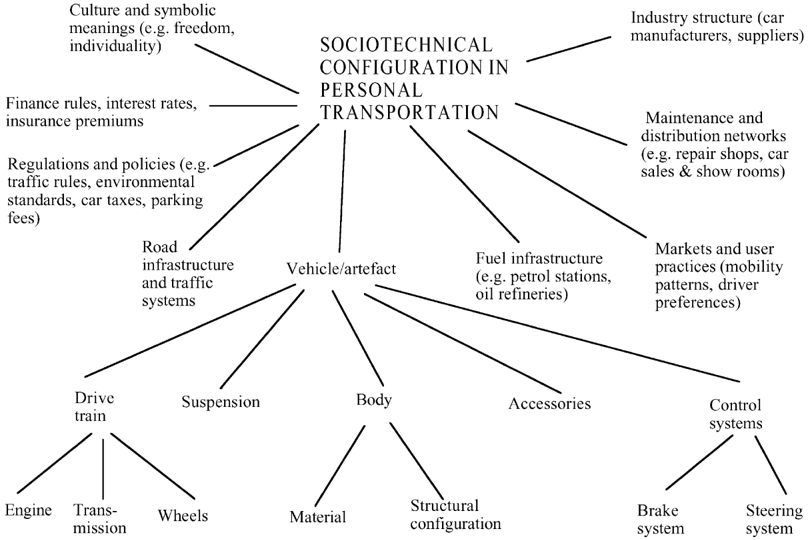
- Technological transitions are major, long-term changes in how societal functions are fulfilled; they involve not only technology but also user practices, regulation, industrial networks, infrastructure, and symbolic meaning or culture.
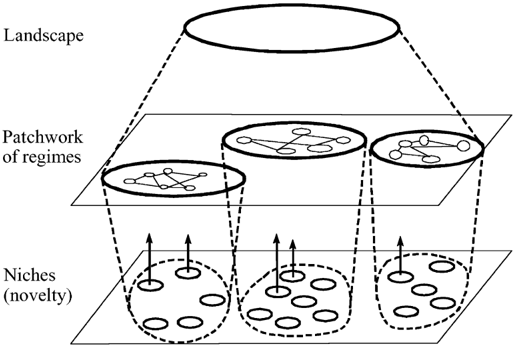
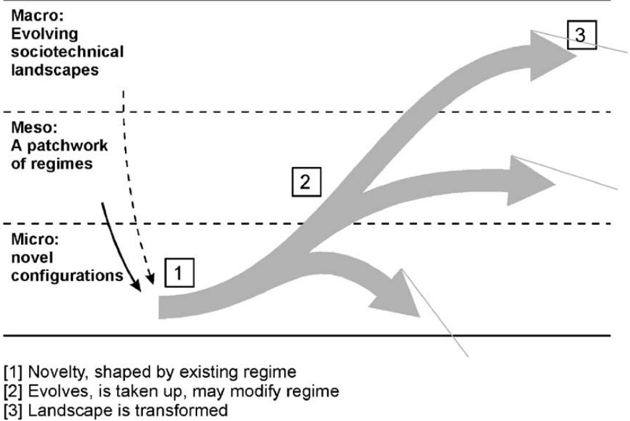
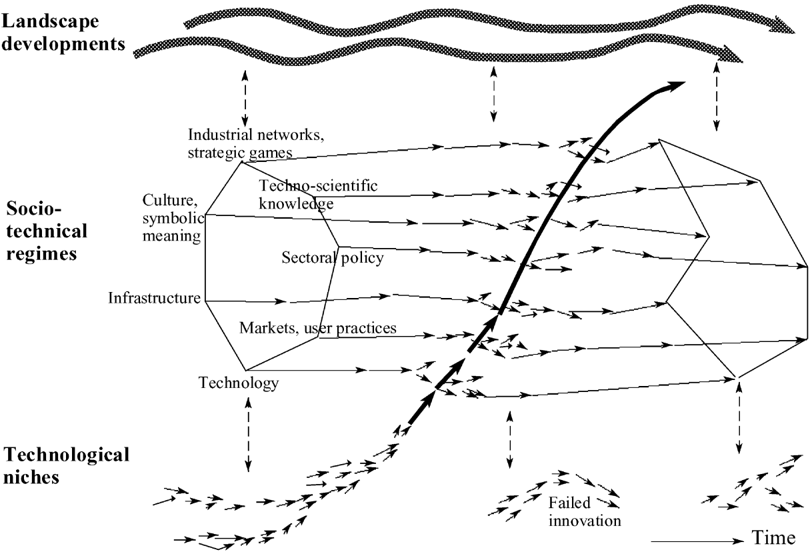
- The multi-level perspective treats niches as loci of radical variety, sociotechnical regimes as selection/retention mechanisms, and the landscape as slower external structure; breakthroughs occur when developments at multiple levels align and create a “window of opportunity.”
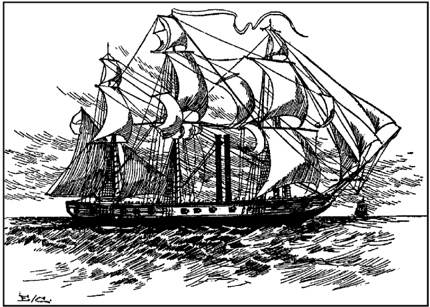
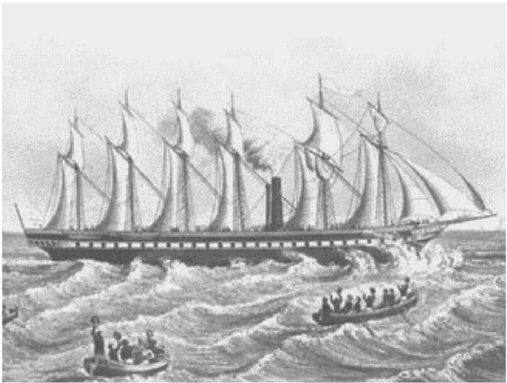
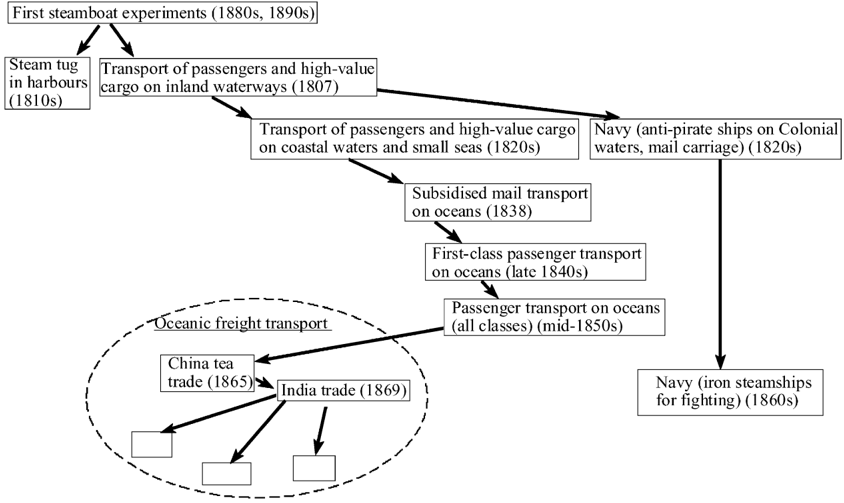
- In the steamship case, breakthrough followed niche-cumulation through inland waterways, coastal routes, mail subsidies, passenger transport, and freight; mechanisms included steam engines as auxiliary add-ons to sailing ships, hybrid sail/steam and iron/wood forms, and riding along with market growth.
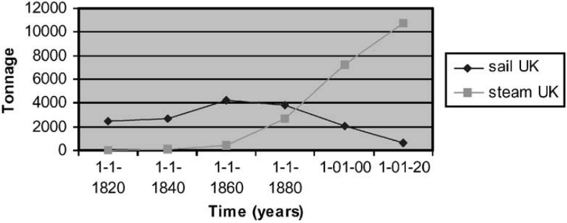
- Reported numbers include: European emigrants travelling by steamer rose from 45% in 1863 to 81% in 1866; compound engines enabled fuel-consumption reductions of 60%; the distance margin where steam was competitive reached 3000–3500 miles by the late 1860s; during the steamship mania (1869–1874), steamers rose from 17% to 31% of British registered tonnage.
Methods
- The paper uses “appreciative theory,” synthesising insights from evolutionary economics and technology studies into a multi-level perspective.
- It presents a qualitative longitudinal case study of the transition from sailing ships to steamships, 1780–1900, focused on Great Britain.
- The case is written in a mosaic style, shifting across markets, ship designs, insurance rules, actor groups, institutions, mail subsidies, persistent/emerging problems, and management practices to illustrate the conceptual framework.
Limitations
- The paper states that the multi-level perspective is fairly complex, requires many data, often qualitative, and that sociotechnical regimes are a broad unit of analysis with difficult-to-draw precise boundaries; boundary work deserves more attention.
- The paper states that the single case study has a drawback because 19th-century craft-based innovation differs from 20th-century science-based innovation, and the perspective would be more robust with more case studies varied over time periods and sectors.
- Evident in the text: the empirical analysis is focused on Great Britain and shipping, and the mechanisms are illustrated through selected historical examples rather than formal comparative or quantitative testing.
Model-written summary. Check it against the paper before relying on it.
Integrity signals
Registry
Cites
Statistics
Figures
Verification
Claims the paper makes
1 Valid · 5 Not valid · 42 Not checked · 63 Own results and interpretations
The cited sources support only part of this claim — read each source’s verdict below.
In the paper
“Aspecific mechanism in the breakthrough of radical innovations is technological add-on and hybridisation . It means that new technologies in their early phase physically link up with established technologies, often to solve particular bottlenecks. Thus, old and new technologies do not immediately compete head on, but form some sort of symbiosis (see also Pistorius and Utterback, 1997).”
What the sources say
- Partly supportedcites Pistorius and Utterback, 1997 matched to “Multi-mode interaction among technologies” (1997) sourceExperimental — accuracy not yet measured
Split into 2 atoms — 0 confirmed, 2 partially supported, 0 disputed, 0 misattributed, 0 unverifiable. Expand the claim to see per-atom verdicts.
plainstates a cause- Asserted: passes — The authors put it forward as true.
- Checkable: passes — It can be checked against evidence.
- Load-bearing: passes — The paper’s conclusions depend on it.
- Based: passes — The paper gives a reason why it holds.
- Partly supported
A result the paper states — it cites no source for it, so there is none to check. The quote shows it is in the paper.
In the paper
“These subsidies created a protective environment for the use and development of oceanic steamships.”
plainstates a cause- Asserted: passes — The authors put it forward as true.
- Checkable: passes — It can be checked against evidence.
- Load-bearing: unclear — It is unclear whether the paper’s conclusions depend on it.
- Based: passes — The paper gives a reason why it holds.
- Rests on an assumption not shown here.
In the paper
“Between 1838 and 1862 a global network of British intercontinental steam companies was created on the basis of imperial mail subsidies (Broeze, 1982).”
What the sources say
- Not matchedcites Broeze, 1982
An author–year citation the paper’s reference list doesn’t settle. We don’t search these by name.
plainstates a cause- Asserted: passes — The authors put it forward as true.
- Checkable: passes — It can be checked against evidence.
- Load-bearing: unclear — It is unclear whether the paper’s conclusions depend on it.
- Based: passes — The paper gives a reason why it holds.
- Rests on an assumption not shown here.
- Not matched
A result the paper states — it cites no source for it, so there is none to check. The quote shows it is in the paper.
In the paper
“Another innovation in the late 18th century shipping regime was the emergence of new social groups: professional shipowners, shipbrokers and insurance companies.”
plain- Asserted: passes — The authors put it forward as true.
- Checkable: passes — It can be checked against evidence.
- Load-bearing: unclear — It is unclear whether the paper’s conclusions depend on it.
- Based: passes — The paper gives a reason why it holds.
- Rests on an assumption not shown here.
A result the paper states — it cites no source for it, so there is none to check. The quote shows it is in the paper.
In the paper
“The emergence of professional shipowners was stimulated by the French Wars (1789-1815) which pushed up freight prices as demand for ships increased.”
plainstates a cause- Asserted: passes — The authors put it forward as true.
- Checkable: passes — It can be checked against evidence.
- Load-bearing: unclear — It is unclear whether the paper’s conclusions depend on it.
- Based: passes — The paper gives a reason why it holds.
- Rests on an assumption not shown here.
24 more claims
Create a free account to see all 111 claims and every source verdict.
- Probably not a substantial claim. 28
- It may state two separate claims as one. 69
- The quote only partly states this claim. 2
Claims other papers make about this one
Each is checked against this paper’s own text: does it say what the citing paper says it does?
In the citing paper
“The model of Geels (2002) describes new technologies as arising and maturing within existing technology systems [18].”
From Lessons Learned From a Living Lab on the Broad Adoption of eHealth in Primary Health Care (2018) · cites this paper as [18]
In the citing paper
“The multi-level perspective (Rip and Kemp, 1998;Geels, 2002;Geels, 2004;Geels and Schot, 2007) is a framework for understanding sustainability transitions that provides an overall view of the multi-dimensional complexity of changes in socio-technical systems.”
From Ontologies, socio-technical transitions (to sustainability), and the multi-level perspective (2010) · cites this paper as Geels, 2002
Citations
Cites
An Evolutionary Theory of Economic Change.
Loasby, B. J., Nelson, R. R., & Winter, S. G. (1983) · The Economic Journal · doi:10.2307/2232409 · Cited by 21,366
(1934) · SSRN Electronic Journal · Cited by 7,609
Technological Discontinuities and Organizational Environments
Tushman, M. L., & Anderson, P. (1986) · Administrative Science Quarterly · doi:10.2307/2392832 · Cited by 6,112
von Hippel, E. (2007) · Das Summa Summarum des Management · doi:10.1007/978-3-8349-9320-5_10 · Cited by 5,098
Technical Change and Economic Theory.
Swann, P., & Dosi, G. (1989) · The Economic Journal · doi:10.2307/2234048 · Cited by 4,041
Shaping Technology, Building Society: Studies in Sociotechnical Change.
Lynch, M., Bijker, W. E., & Law, J. (1993) · Contemporary Sociology · doi:10.2307/2074370 · Cited by 3,540
Technological Discontinuities and Dominant Designs: A Cyclical Model of Technological Change
Anderson, P., & Tushman, M. L. (1990) · Administrative Science Quarterly · doi:10.2307/2393511 · Cited by 3,255
Bijker, W. E., Hughes, T. P., & Pinch, T. (1987) · Cited by 2,957
Kemp, R., Schot, J., & Hoogma, R. (1998) · Technology Analysis & Strategic Management · doi:10.1080/09537329808524310 · Cited by 2,860
Innovation: Mapping the winds of creative destruction
Abernathy, W. J., & Clark, K. B. (1985) · Research Policy · doi:10.1016/0048-7333(85)90021-6 · Cited by 2,791
Research works printed but not linked: 9
- Broeze, F.J.A., 1982. The international diffusion of ocean steam navigation: the myth of the retardation of Netherlands steam navigation to the East Indies. Economisch-en Sociaal-Historisch Jaarboek 45, 77-95.
- Callon, M. (Ed.), 1998. The Laws of the Market. Blackwell, Oxford.
- Garrat, G.R.M., Goodman, D.C., Russel, C.A., 1973. Science and Engineering, Units 14 and 15. Open University Press, Bletchley.
- Jackson, G., 1998. Ports, ships and government in the nineteenth and twentieth centuries. In: Van Royen, P.C., Fischer, L.R., Williams, D.M. (Eds.), Proceedings of the Second International Congress of Maritime History on Frutta di Mare: Evolution and revolution in the maritime world in the 19th and 20th centuries. Amsterdam/Rotterdam, The Netherlands, 5-8 June, 1996. Batavian Lion International, Amsterdam, pp. 161-176.
- Lundvall, B.A., 1988. Innovation as an interactive process: from user-producer interaction to the national system of innovation. In: Dosi, G., Freeman, C., Nelson, R., Silverberg, G., Soete, L. (Eds.), Technical Change and Economic Theory. Pinter, London, pp. 349-369.
- Maddocks, M., 1982. De Grote Oversteek. Time-Life, London. Mayntz, R., Hughes, T.P. (Eds.), 1988. The Development of Large
- Mokyr, J., 1990. The Lever of Riches. Oxford University Press, New York.
- Rip, A., Kemp, R., 1996. Towards a Theory of Socio-Technical Change. Mimeo University of Twente, Report prepared for Batelle Pacific Northwest Laboratories, Washington, DC. (An edited version has been published as book chapter Rip and Kemp 1998).
- Sloan, E.W., 1998. Private enterprise as public utility: the management of capital in two centuries of shipping business. In: Van Royen, P.C., Fischer, L.R., Williams, D.M. (Eds.), Proceedings of the Second International Congress of Maritime History on Frutta di Mare: Evolution and Revolution in the Maritime World in the 19th and 20th Centuries. Amsterdam/Rotterdam, The Netherlands, 5-8 June, 1996. Batavian Lion International, Amsterdam, pp. 89-100.
Cited by
Items 3,901–4,000 of 7,210
Editorial: Progress in energy demand reduction – from here to 2050
Hammond, G. P. (2014) · Proceedings of the Institution of Civil Engineers - Energy · doi:10.1680/ener.167.3.89 · Cited by 6
Socio-technische systeeminnovaties en transities: van theoretische inzichten naar beleidsvertaling
Paredis, E. (2009) · Ghent University Academic Bibliography (Ghent University) · Cited by 5
Inducing large-scale diffusion of innovation : An integrated actor- and system-level approach
Mignon, I. (2016) · Linköping studies in science and technology. Dissertations · doi:10.3384/diss.diva-131029 · Cited by 14
Barriers to Eco-Innovation in the LED Sector: A Multilevel PerspectivePreprint
Gossart, C., & Ozaygen, A. S. (2016) · SSRN Electronic Journal · doi:10.2139/ssrn.2875847 · Cited by 7
Industrial Ecology Approaches to Improve Metal Management : Three Modeling Experiments
Sinha, R. (2014) · KTH Publication Database DiVA (KTH Royal Institute of Technology) · Cited by 5
Actors, Decision-Making, and Institutions in Quantitative System ModellingPreprint
Cian, E. D., Dasgupta, S., Hof, A. F., van Sluisveld, M. A. E., Köhler, J., Pfluger, B., & van Vuuren, D. P. (2017) · SSRN Electronic Journal · doi:10.2139/ssrn.3038695 · Cited by 5
Lacey‐Barnacle, M. (2019) · ORCA Online Research @Cardiff (Cardiff University) · Cited by 10
Building movements for transformation : defending and advancing agroecology in Brazil
van den Berg, L. (2020) · doi:10.18174/531633 · Cited by 7
User-Made Immobilities: A Transitions PerspectivePreprint
Kanger, L., & Schot, J. (2016) · SSRN Electronic Journal · doi:10.2139/ssrn.2807044 · Cited by 5
Exploring the Smart City Adoption Process: Evidence from the Belgian urban contextPreprint
Margherita, E. G., Esposito, G., Escobar, S. D., & Crutzen, N. (2021) · arXiv (Cornell University) · doi:10.48550/arxiv.2101.05670 · Cited by 11
Fossati, E. C., & Fransolet, A. (2021) · SSRN Electronic Journal · doi:10.2139/ssrn.3913620 · Cited by 12
Knowledge Spillovers between Clean and Dirty TechnologiesPreprint
Jee, S. J., & Srivastav, S. (2022) · SSRN Electronic Journal · doi:10.2139/ssrn.4233536 · Cited by 5
Ranga, M., & Kim, S. Y. (2023) · Frontiers in Research Metrics and Analytics · doi:10.3389/frma.2023.1146039 · Cited by 10
“…frame” that also considers persistent environmental and social challenges and the need for sustainable transitions and transformative change (e.g., Geels, 2002, 2004; Kivimaa and Kern, 2016; Fagerberg, 2018; Tödtling and Trippl, 2018; Diercks et al., 2019; Coenen and Morgan, 2020; Ghosh et…”
BackgroundThe (Re)Design of Ecosystems to Face Grand Challenges—Toward the Management of Creative Evolution
Fritzsche, A., Masson, P. L., Müller‐Seitz, G., Ollila, S., & Velamuri, V. K. (2025) · Creativity and Innovation Management · doi:10.1111/caim.70022 · Cited by 6
Wang, M. (2007) · ERA · Cited by 5
van Zandwijk, K., Donkers, A., Alkemade, F., Petrova, E., & Pauwels, P. (2026) · Technology in Society · doi:10.1016/j.techsoc.2026.103496 · Cited by 5
The Transition to Sustainable Energy and Institutional Inertia
Samadi, A. H., & Alipourian, M. (2024) · Contributions to economics · doi:10.1007/978-3-031-51175-2_11 · Cited by 11
Ho, M., Price, H. C. W., Evans, T., & O’Sullivan, E. (2025) · Technological Forecasting and Social Change · doi:10.1016/j.techfore.2025.124010 · Cited by 11
“Metaphorically, innovation theorists understand the importance of different types of knowledge transmissions (the arrows in the linear model and Kline and Rosenberg’s chain-linked model) are going to change over time (Geels, 2002).”
Billaud, O., Porcher, E., & Maclouf, É. (2025) · People and Nature · doi:10.1002/pan3.10778 · Cited by 5
Schmidt-Scheele, R., & Mattes, J. (2025) · Environmental Innovation and Societal Transitions · doi:10.1016/j.eist.2025.100994 · Cited by 12
From innovation to exnovation: insights from post-growth food enterprises in Australia
Chakori, S., Grigg, N., Biely, K., Hinton, J. B., Plumecocq, G., Richards, R., & Robra, B. (2025) · Ecological Economics · doi:10.1016/j.ecolecon.2025.108785 · Cited by 7
Saari, U. A., Suominen, A., Rissanen, M., Tietze, F., & Salolainen, M. (2025) · Business Strategy and the Environment · doi:10.1002/bse.70203 · Cited by 6
Powering a fair future: can energy efficiency unlock a just transition in Africa?
Mumuni, S., & Issah, I. (2025) · International Journal of Sustainable Development & World Ecology · doi:10.1080/13504509.2025.2559808 · Cited by 4
“According to the theory, it uses a multi-level approach in which niche innovations destabilize the current dominant systems under the pressure of landscapes and focuses on the interaction between the institutions, technology, market, and social forces (Geels 2002).”
Iandolo, F., Sala, A. L., Maielli, G., & Vito, P. (2025) · Technology in Society · doi:10.1016/j.techsoc.2025.103095 · Cited by 7
Emenyu, A. P., Pienkowski, T., Cunliffe, A. M., Lenton, T. M., & Powell, T. (2025) · Earth System Dynamics · doi:10.5194/esd-16-1699-2025 · Cited by 9
Gonzalez, H. (2025) · Environmental Innovation and Societal Transitions · doi:10.1016/j.eist.2025.101062 · Cited by 4
Trencher, G., Duygan, M., Rinscheid, A., Rosenbloom, D., & Newell, P. J. (2025) · PLoS ONE · doi:10.1371/journal.pone.0334512 · Cited by 6
“Predominantly focused on cases across Europe and North America, this body of work has explored the decline of coal extraction [18,29], coal-fired and nuclear power [19,21,31,57,58], fossil-fuel heating [59] and legacy transport systems such as tramways and steamships [32,55,60].”
Geopolitical disruptions and maritime transitions: Environmental and economic costs of rerouting
Sun, R., Abouarghoub, W., Demir, E., & Potter, A. T. (2025) · Transportation Research Part A Policy and Practice · doi:10.1016/j.tra.2025.104737 · Cited by 25
“While these niche innovations have not yet displaced the dominant fossil fuel system, the visible cracks in the regime architecture have opened a genuine window of opportunity for their expansion and broader recognition (Geels, 2012; Geels et al., 2017).”
Pacini, C., & Bauknecht, D. (2025) · Energy Research & Social Science · doi:10.1016/j.erss.2025.104423 · Cited by 5
Rethinking transitions through dual-regime dynamics: The emergence of the flying car sector in China
Tsou, C.-T. (2025) · Technological Forecasting and Social Change · doi:10.1016/j.techfore.2025.124435 · Cited by 5
Svensson-Höglund, S., Russell, J. D., Richter, J. L., Kambanou, M. L., Velenturf, A. P. M., Grousset, R., Milios, L., Goldmark, S., Friant, M. C., Gallego‐Schmid, A., et al. (2025) · Frontiers in Sustainability · doi:10.3389/frsus.2025.1698624 · Cited by 4
Circular economy transition barriers in the construction and demolition sector
Alzara, M., Elnasser, A. A., Abdelshakor, M., & Ehab, A. (2025) · PLoS ONE · doi:10.1371/journal.pone.0338631 · Cited by 4
The Dual Brokerage Role of Digital Platforms in the Transition to a Circular Economy
Do, Q., & Stevenson, M. (2025) · Journal of Operations Management · doi:10.1002/joom.70025 · Cited by 10
Benetti, S., Rodrigues, D. D., & Grasso, M. E. (2026) · Energy Strategy Reviews · doi:10.1016/j.esr.2025.102018 · Cited by 4
Trivedi, A., & Juyal, S. A. (2026) · Climate change management · doi:10.1007/978-3-032-03484-7_18 · Cited by 4
Jessen, S., & Giacometti, A. (2026) · Regional Studies · doi:10.1080/00343404.2025.2602692 · Cited by 4
Deep transitions and the evolution of the digital meta-regime
Johnstone, P., Kanger, L., & Schot, J. (2026) · Technological Forecasting and Social Change · doi:10.1016/j.techfore.2026.124526 · Cited by 4
Castro, G. D. R., Fernández, M. C. G., & Colsa, Á. U. (2026) · Technovation · doi:10.1016/j.technovation.2026.103480 · Cited by 5
Song, H., & Chen, W. (2026) · Energy Strategy Reviews · doi:10.1016/j.esr.2026.102087 · Cited by 4
No systems transformation without systems literacy: Insights from CGIAR
Ewell, H. L. D., Leñero, E. M. V., Bailey, A., Woltering, L., Schiller, K., & Hellin, J. (2026) · Agricultural Systems · doi:10.1016/j.agsy.2026.104662 · Cited by 4
Khalfan, M. M. A., Lara, J. C. F., Saradara, S. M., Jin, R., & Hosseini, M. R. (2026) · Environment Development and Sustainability · doi:10.1007/s10668-026-07435-w · Cited by 8
Dentoni, D., Roglić, M., Williams, A. N., & Bansal, P. (2026) · Journal of Management · doi:10.1177/01492063261417581 · Cited by 7
“Huang (2019), for example, built upon Geels (2002) to interpret the emerging process at an urban level in response to the national and global regime changes.”
InfluentialLindblad, F., & Gustafsson, Å. (2026) · Environmental Development · doi:10.1016/j.envdev.2026.101463 · Cited by 7
Long waves and the sustainability transition
Swilling, M. (2019) · Elsevier eBooks · doi:10.1016/b978-0-12-816635-2.00003-1 · Cited by 8
Holzer, D., Popowicz, M., Rauter, R., Silberschneider, K., & Stern, T. (2023) · Sustainable Production and Consumption · doi:10.1016/j.spc.2023.10.014 · Cited by 9
Gao, X., Zhang, G., Nie, Y. G., Xi, X., & Feng, Y. (2024) · Environmental Science and Pollution Research · doi:10.1007/s11356-024-32207-2 · Cited by 4
“Social networks have emerged as a valuable tool for analyzing interactions across various levels and agents (Frank 2002; Peck and Parker 2016).”
Konig, C. C., Saes, M. S. M., & Schnaider, P. S. B. (2024) · The International Food and Agribusiness Management Review · doi:10.22434/ifamr2023.0049 · Cited by 4
Securing the future: Analysing the protein transition in Singapore
Pay, C., & Gianoli, A. (2024) · Cities · doi:10.1016/j.cities.2024.105072 · Cited by 7
Ethical consumption: Theoretical concepts and a contribution to the debate
Андриановна, Ш. М. (2024) · Voprosy Ekonomiki · doi:10.32609/0042-8736-2024-7-53-80 · Cited by 12
Aguerre, V., & Bianco, M. (2024) · Revista de Economia e Sociologia Rural · doi:10.1590/1806-9479.2023.279500en · Cited by 4
Oates, L., & Sudmant, A. H. (2024) · Urban Planning · doi:10.17645/up.8302 · Cited by 4
The ideational impacts of Indonesia's renewable energy project failures
Wibisono, H., Lovett, J. C., Chairani, M. S., & Suryani, S. (2024) · Energy Sustainable Development/Energy for sustainable development · doi:10.1016/j.esd.2024.101587 · Cited by 12
Nerland, R., Solbu, G., Hansen, K., & Nilsen, H. R. (2025) · Sustainability Science · doi:10.1007/s11625-024-01618-y · Cited by 7
The role of households in sustainability transitions: An infrastructural inversion
Berker, T., Sutcliffe, T. E., & Woods, R. (2025) · Environmental Innovation and Societal Transitions · doi:10.1016/j.eist.2025.100984 · Cited by 4
Barriers to sustainable transition in the fashion industry: insights from India
Kiran, P. (2025) · Sustainability Science Practice and Policy · doi:10.1080/15487733.2025.2466286 · Cited by 9
“These rules are embedded in the institutions and infrastructures through manufacturing processes, product characteristics, procedures, production process technologies, and so forth (Geels 2002; Rip and Kemp 1998).”
Trapped in the transition: result controls and social inequity in long-term energy agreements
Dodd, T., Nelson, T., & Dumay, J. (2025) · Accounting Auditing & Accountability Journal · doi:10.1108/aaaj-12-2022-6227 · Cited by 5
The regimes of ethical hacking: moral projects and the emergence of a market for vulnerability
Bozzini, D. (2025) · Information Communication & Society · doi:10.1080/1369118x.2025.2498683 · Cited by 6
Khan, I. H., & Munawer, T. (2025) · Discover Environment · doi:10.1007/s44274-025-00248-0 · Cited by 6
The Bioeconomy Transition Process: Sailing through Storms and Doldrums in Unknown Waters
Pyka, A., Ari, E., Alva-Ferrari, A., & Urmetzer, S. (2022) · Journal of Innovation Economics & Management · doi:10.3917/e.jie.pr1.0110 · Cited by 6
Ojöng, N., Gill‐Wiehl, A., & Agbe, E. A. (2025) · Sustainable Development · doi:10.1002/sd.70009 · Cited by 6
Energising the Polis? Analysing transition challenges to energy communities in Greece
Pantazis, K., & Busch, H. (2025) · Environmental Innovation and Societal Transitions · doi:10.1016/j.eist.2025.101055 · Cited by 11
Schürer, D. (2025) · Sustainability Science · doi:10.1007/s11625-025-01758-9 · Cited by 7
Koehrsen, J., Buzzi, A., & Hearn, A. X. (2025) · Sustainability Science · doi:10.1007/s11625-025-01766-9 · Cited by 8
Die Transformation zur wissensbasierten Bioökonomie
Pyka, A., & Buchmann, T. O. (2016) · Springer eBooks · doi:10.1007/978-3-658-16042-5_17 · Cited by 4
Place in Transitions—Concepts for When it Matters: Essentially, Accidentally, Locus and Nexus
de Haan, F. (2017) · Theory and practice of urban sustainability transitions · doi:10.1007/978-981-10-4792-3_2 · Cited by 4
SUSTAINABILITY TRANSITIONS IN BOSNIAN AGRO-FOOD SYSTEM
Luketina, R., Bilali, H. E., Berjan, S., & Wurzinger, M. (2018) · The Journal Agriculture and Forestry · doi:10.17707/agricultforest.64.4.04 · Cited by 4
A phase model for the low-carbon transformation of energy systems in the MENA region
Fischedick, M., Holtz, G., Fink, T., Amroune, S., & Wehinger, F. (2020) · Energy Transitions · doi:10.1007/s41825-020-00027-w · Cited by 7
Stephenson, J. R. (2020) · Cambridge University Press eBooks · doi:10.1017/9781108554558.016 · Cited by 4
Wang, L., & Wells, P. (2021) · Energies · doi:10.3390/en14041116 · Cited by 6
Spatial perspectives on niche empowerment: an agent-based model
Tani, A., Lopolito, A., & Morone, P. (2021) · Regional Studies · doi:10.1080/00343404.2021.1893290 · Cited by 4
Agriculteurs, exploitations et territoires de la transition vers une alimentation relocalisée
Baysse-Lainé, A. (2021) · Bulletin de l Association de géographes français · doi:10.4000/bagf.7355 · Cited by 7
Réinvestir la cuisine et le « fait maison » ?
Dasgupta, A., Zirari, H., Bricas, N., Walser, M., & Soula, A. (2021) · Éditions Quæ eBooks · doi:10.35690/978-2-7592-3353-3/c16 · Cited by 5
Stöhr, J., & Herzig, C. (2022) · British Food Journal · doi:10.1108/bfj-08-2021-0953 · Cited by 5
Trade Policy Uncertainty and Medical Innovation: Evidence from Developing Nations
Shabbir, M. N., Wang, L., & Arshad, M. U. (2022) · Economies · doi:10.3390/economies10090224 · Cited by 6
Guerrero, D. F., Henkes, R. P., Alba, M. F., Ramírez-Rodríguez, S., & Puig, L. R. (2022) · Economía Agraria y Recursos Naturales · doi:10.7201/earn.2022.02.04 · Cited by 4
“, 2021; Schot & Steinmueller, 2018) which, as discussed in more detail below, is grounded in the multi-level perspective of change in socio-technical regimes (Geels, 2002).”
BackgroundLiso, N. D., Arima, S., & Filatrella, G. (2023) · Industrial and Corporate Change · doi:10.1093/icc/dtad012 · Cited by 4
Okonkwo, E. (2023) · Journal of Geography Politics and Society · doi:10.26881/jpgs.2023.1.05 · Cited by 6
Aulagnier, A. (2023) · Environmental Science & Policy · doi:10.1016/j.envsci.2023.04.006 · Cited by 4
Nature-inclusive urban development: lessons learned in three real estate projects in Dutch cities
Mattijssen, T., Dijkshoorn-Dekker, M. W. C., Kortstee, H. J. M., Polman, N. B. P., & Snep, R. P. H. (2023) · International Journal of Urban Sustainable Development · doi:10.1080/19463138.2023.2216654 · Cited by 7
IMR – 7th INDAM CONFERENCE PAPER: Future of workplace design from a socio-technical perspective
Venkatachalam, P., & Mishra, R. (2023) · IIMB Management Review · doi:10.1016/j.iimb.2022.12.006 · Cited by 6
“MLP or the theory of socio-technical transitions (Geels, 2002) explains transitions involving social and technical subsystems as interaction between three levels through a current regime of practice, niche innovations that bring in radical changes in the regime, and the socio-technical landscape that includes emerging…”
BackgroundMethodInfluentialFanaian, S., & Fanaian, F. (2023) · Environmental Research Communications · doi:10.1088/2515-7620/acdc86 · Cited by 8
“C om m un.5 (2023)065012 S Fan aian an d F Fan aian regimes includewidely accepted norms of functioning), and niches (innovative experiments) (Geels 2002).”
BackgroundWhat can accelerate technological convergence of hydrogen energy: a regional perspective
Lee, W. S. (2023) · Frontiers in Energy Research · doi:10.3389/fenrg.2023.1162732 · Cited by 6
“As technological evolution is a process of variation, selection, and retention (Geels, 2002), ETTC has been proposed and utilized as a theoretical framework to analyze such technological changes.”
MethodIoT and Blockchain: A Review and a Technical-Legal-Social Acceptance Model
Guerra, K., Koh, C. E., Prybutok, V. R., & Johnson, V. (2023) · Journal of Computer Information Systems · doi:10.1080/08874417.2023.2259334 · Cited by 5
“…the results of this systematic literature review and on previous research that, in the context of system innovation and the technological transition, has underlined the existence of “socio-tech-nical regimes” influenced by “policy,” “infrastructure,” “culture,” “industry,” and “technology 43,44 .””
Evolution of ride-hailing platforms regulations in India: a multi-level perspective
Verma, R. K., Ilavarasan, P. V., & Kar, A. K. (2024) · Digital Policy Regulation and Governance · doi:10.1108/dprg-06-2023-0086 · Cited by 7
The strategic challenges of the decarbonisation of the manufacturing industry
Gajdzik, B., & Piontek, B. (2024) · Economics and Environment · doi:10.34659/eis.2023.87.4.680 · Cited by 18
Haag, S., Apfel, D., & Herbes, C. (2024) · Energy Research & Social Science · doi:10.1016/j.erss.2024.103598 · Cited by 4
Institutional voids and business model convergence in the recycling industry
Daou, A., Salamoun, R., & Abdallah, C. (2024) · Environmental Innovation and Societal Transitions · doi:10.1016/j.eist.2024.100882 · Cited by 5
Experimental Networks: A Missing Link in Facilitating Systemic Transitions Through Projects?
Miterev, M., & Engwall, M. (2024) · Project Management Journal · doi:10.1177/87569728241264507 · Cited by 7
“…typically unfold progressively over a long period of time — from exploring emergent, potentially destabilizing technologies in protected niches and pilots to increasingly commercially viable con fi gurations via gradual processes of learning and adaptation (Berggren et al., 2015; Geels, 2002).”
InfluentialUnderstanding Business Models in the Brazilian Context of Electric Mobility: A Proposed Framework
Có, M. A., Consoni, F. L., Carneiro, M. C., Fernandes, G., Nunes, R. B., & Donadel, C. B. (2024) · Urban Science · doi:10.3390/urbansci8030092 · Cited by 8
“The transportation of people using fossil fuel-based vehicles forms a complex system that integrates natural resources and technological artifacts built and shaped by society to meet social demands [1].”
BackgroundMöglichkeiten und Grenzen politischer Steuerung in der Verkehrspolitik
Sack, D., Straßheim, H., & Zimmermann, K. (2024) · Springer eBooks · doi:10.1007/978-3-658-37804-2_18-1 · Cited by 4
Johansen, K., & Upham, P. (2024) · Renewable and Sustainable Energy Reviews · doi:10.1016/j.rser.2024.114912 · Cited by 5
Selection and adoption of water purification technologies in the bottled water industry in India
Sharma, A., & Bhaduri, S. (2024) · Cleaner Water · doi:10.1016/j.clwat.2024.100039 · Cited by 5
Development of Innovation Monitoring and Innovation Indicators in the Past 50 Years
Frietsch, R., Reiß, T., & Schmoch, U. (2024) · Sustainability and innovation · doi:10.1007/978-3-031-66100-6_3 · Cited by 12
Mourre, M.-L., Gonzalez, C., & Djedidi, A. (2024) · Recherche et Applications en Marketing (English Edition) · doi:10.1177/20515707241266350 · Cited by 5
“Similar to Geels’ (2002) Multi-Level Perspective (MLP) approach, our results highlight the driving role of “alternatives” that act as stimuli for the evolution of the entire system: if some alternative systems fail, others manage to stabilize and increase their influence.”
InfluentialBeyond the ‘Developmental State’: Prosperity and Conflict after the EPRDF
Lavers, T., Terrefe, B., & Gebresenbet, F. (2024) · Oxford University Press eBooks · doi:10.1093/oso/9780192871213.003.0009 · Cited by 4
Arora, S., Narayanarao, B., Mittal, N., & Vadekkal, R. S. (2024) · Agriculture and Human Values · doi:10.1007/s10460-024-10666-0 · Cited by 7
“Here distinctions are made between socio-technical regimes structured around dominant incumbent forces and lower-level niches in which potentially radical innovations are protected and nurtured (Geels 2002; Smith and Raven 2012).”
The concept of Finnish civil defence shelters
Koivukoski, J. (2025) · International Journal of Emergency Services · doi:10.1108/ijes-06-2024-0039 · Cited by 4
Realising value from big data analytics: The process of affordance actualisation
Farouk, F. M., Schınckus, C., & Smith, S. (2025) · Digital Business · doi:10.1016/j.digbus.2025.100108 · Cited by 6
Wang, S., Bai, X., van der Heijden, J., & Tong, X. (2025) · npj Urban Sustainability · doi:10.1038/s42949-025-00193-0 · Cited by 4
Sustainable energy experiments and demonstrations: Reviewing research, market and societal trends
Hasanefendic, S., Hoogstraaten, M. J., Bloemendal, M., Boon, W., Brezet, H. C., Chappin, M. M. H., Coenen, L., Dai, Y., Elzinga, R., Femenías, P., et al. (2025) · Energy Research & Social Science · doi:10.1016/j.erss.2025.104018 · Cited by 10
Metadata
- Authors
- Geels, F. W.
- Affiliations
- University of Twente (NL)
- Corresponding author
- Geels, Frank W.
- ORCID
- Geels, Frank W.
- Venue
- Research Policy
- Publisher
- Elsevier BV
- Published
- 2002-12
- Volume
- 31
- Issue
- 8-9
- Pages
- 1257-1274
- ISSN
- 0048-7333 (ISSN-L)
- OpenAlex
- W2099330597
- Cited by
- 7,275
- References
- 94
- Citations by year
- 2026: 983 · 2025: 624 · 2024: 502 · 2023: 504 · 2022: 503 · 2021: 598 · 2020: 526 · 2019: 417 · 2018: 493 · 2017: 357 · 2016: 301 · 2015: 293 · 2014: 241 · 2013: 201 · 2012: 204
- FWCI
- 16.68
- Type
- journal article
- Language
- en
- Open access
- bronze
- doi.org
- Licence
- www.elsevier.com/tdm/userlicense/1.0/ (tdm)
- Locations
- Research Policy (publishedVersion)
- Research Explorer (The University of Manchester) (submittedVersion, other-oa)
- University of Twente Research Information (submittedVersion)
- TU/e Research Portal (submittedVersion)
- RePEc: Research Papers in Economics (submittedVersion)
- Figshare (submittedVersion, cc-by)
- University of Twente Research Information (submittedVersion, other-oa)
- Funders
- Nederlandse Organisatie voor Wetenschappelijk Onderzoek
- Topics
- Physical Sciences › Environmental Science › Global and Planetary Change › Sustainability and Climate Change Governance
- Social Sciences › Decision Sciences › Management Science and Operations Research › Innovation Diffusion and Forecasting
- Social Sciences › Economics, Econometrics and Finance › Economics and Econometrics › Economic Theory and Institutions
- Keywords
- technological transition, multi-level perspective, evolutionary economics, technology studies, hybridization, market growth, industrial networks, user practices, regulation, infrastructure
About these checks
Registry, retraction, Cites and statistics results are computed, not judged, with one exception: a printed reference that no index lists is read once by a model before it counts as a citation error. Claims are extracted by a model and kept only when their quote appears verbatim in the text; each cited source is then checked, with a model’s help, for whether it says what the claim relies on. Those verdicts can be wrong — read the claim’s quote and the cited source before relying on one.
The claim verdicts this report counts are experimental: their accuracy is not yet measured.
A language model drew the claims from the paper on 2026-10-10, under version 3 of the claim definition (model deepseek-v4.1-flash, prompt extract-v3).
A second model labelled each claim on 2026-10-10 (model jev-1.13-20260917, definition revision gold-guideline-v0.2).
Cited sources are checked with a language model’s help (gpt-6-sol).
Statistics and arithmetic are recomputed, not judged.
Confidence bands are shown only for fields calibrated on our annotated test set. None is calibrated yet, so no band is shown.
What counts as a claim ›How we measure confidence ›How we check this ›
Are you an author, or do you see a problem with this page? Request a review
Data sources
Bibliographic data: Semantic Scholar, OpenAlex, Crossref.
Contains information from the Semantic Scholar Academic Graph Datasets, made available under the ODC Attribution License (ODC-BY 1.0).
Semantic Scholar’s data is described in: Kinney, R., et al. (2023). The Semantic Scholar Open Data Platform. arXiv:2301.10140.
