

The DOI matches its Crossref record; 42 of the 42 references it cites were found in a registry or an index.
The Healthy Activity Program (HAP), a lay counsellor-delivered brief psychological treatment for severe depression, in primary care in India: a randomised controlled trial
Open accessAbstract
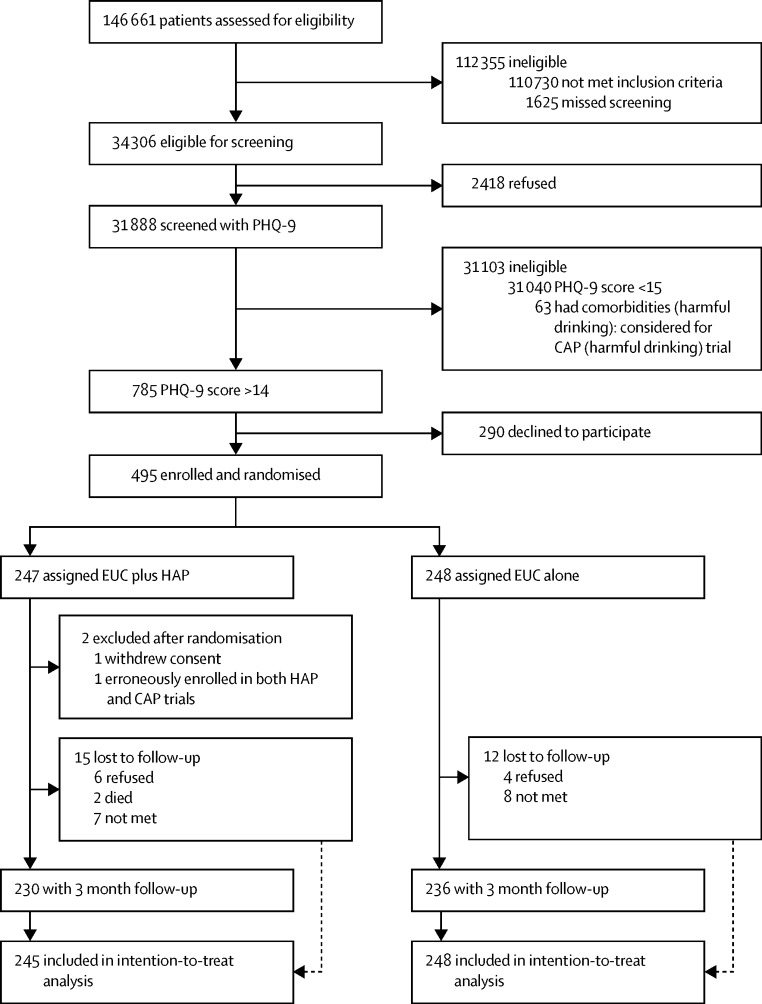
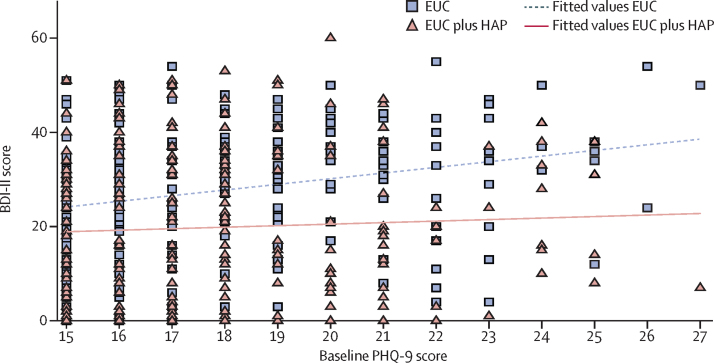
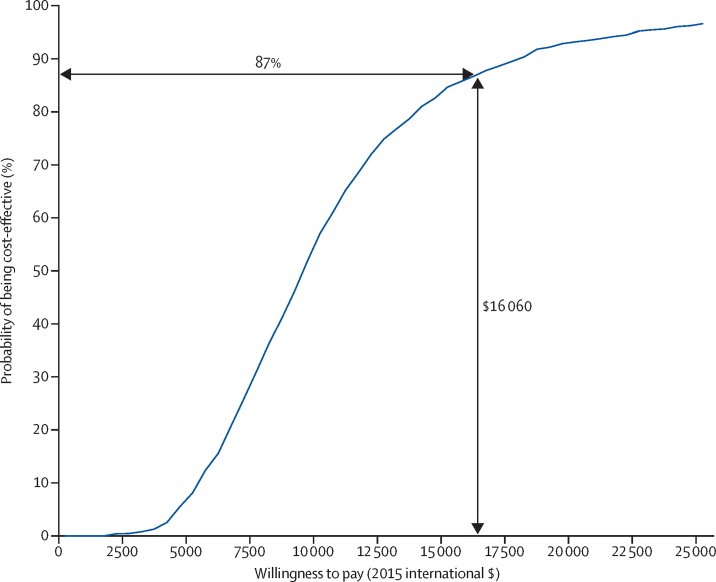
BACKGROUND: Although structured psychological treatments are recommended as first-line interventions for depression, only a small fraction of people globally receive these treatments because of poor access in routine primary care. We assessed the effectiveness and cost-effectiveness of a brief psychological treatment (Healthy Activity Program [HAP]) for delivery by lay counsellors to patients with moderately severe to severe depression in primary health-care settings. METHODS: In this randomised controlled trial, we recruited participants aged 18-65 years scoring more than 14 on the Patient Health Questionnaire 9 (PHQ-9) indicating moderately severe to severe depression from ten primary health centres in Goa, India. Pregnant women or patients who needed urgent medical attention or were unable to communicate clearly were not eligible. Participants were randomly allocated (1:1) to enhanced usual care (EUC) alone or EUC combined with HAP in randomly sized blocks (block size four to six [two to four for men]), stratified by primary health centre and sex, and allocation was concealed with use of sequential numbered opaque envelopes. Physicians providing EUC were masked. Primary outcomes were depression symptom severity on the Beck Depression Inventory version II and remission from depression (PHQ-9 score of <10) at 3 months in the intention-to-treat population, assessed by masked field researchers. Secondary outcomes were disability, days unable to work, behavioural activation, suicidal thoughts or attempts, intimate partner violence, and resource use and costs of illness. We assessed serious adverse events in the per-protocol population. This trial is registered with the ISRCTN registry, number ISRCTN95149997. FINDINGS: Between Oct 28, 2013, and July 29, 2015, we enrolled and randomly allocated 495 participants (247 [50%] to the EUC plus HAP group [two of whom were subsequently excluded because of protocol violations] and 248 [50%] to the EUC alone group), of whom 466 (95%) completed the 3 month primary outcome assessment (230 [49%] in the EUC plus HAP group and 236 [51%] in the EUC alone group). Participants in the EUC plus HAP group had significantly lower symptom severity (Beck Depression Inventory version II in EUC plus HAP group 19·99 [SD 15·70] vs 27·52 [13·26] in EUC alone group; adjusted mean difference -7·57 [95% CI -10·27 to -4·86]; p<0·0001) and higher remission (147 [64%] of 230 had a PHQ-9 score of <10 in the HAP plus EUC group vs 91 [39%] of 236 in the EUC alone group; adjusted prevalence ratio 1·61 [1·34-1·93]) than did those in the EUC alone group. EUC plus HAP showed better results than did EUC alone for the secondary outcomes of disability (adjusted mean difference -2·73 [-4·39 to -1·06]; p=0·001), days out of work (-2·29 [-3·84 to -0·73]; p=0·004), intimate partner physical violence in women (0·53 [0·29-0·96]; p=0·04), behavioural activation (2·17 [1·34-3·00]; p<0·0001), and suicidal thoughts or attempts (0·61 [0·45-0·83]; p=0·001). The incremental cost per quality-adjusted life-year gained was $9333 (95% CI 3862-28 169; 2015 international dollars), with an 87% chance of being cost-effective in the study setting. Serious adverse events were infrequent and similar between groups (nine [4%] in the EUC plus HAP group vs ten [4%] in the EUC alone group; p=1·00). INTERPRETATION: HAP delivered by lay counsellors plus EUC was better than EUC alone was for patients with moderately severe to severe depression in routine primary care in Goa, India. HAP was readily accepted by this previously untreated population and was cost-effective in this setting. HAP could be a key strategy to reduce the treatment gap for depressive disorders, the leading mental health disorder worldwide. FUNDING: Wellcome Trust.
Overview
The claims and statistics of this paper haven’t been checked yet.
Run the check — free, no account needed. It reads the open-access text and checks the sources it cites.
Integrity signals
Registry
Cites
Statistics
Figures
Verification
Claims the paper makes
The claims and statistics of this paper haven’t been checked yet.
Run the check — free, no account needed. It reads the open-access text and checks the sources it cites.
Claims other papers make about this one
Each is checked against this paper’s own text: does it say what the citing paper says it does?
The source backs part of the claim, not all of it — or backs it for a different population, condition or comparison.
In the citing paper
“In India, brief psychological therapy delivered by lay health workers to young people living with severe depression was found to be costeffective at both 3-month and 12-month follow-up from a health system perspective, and was found to be costsaving when considering impacts on subsistence activity and employment. 450,451”
From The Lancet Psychiatry Commission on youth mental health (2024) · cites this paper as [450]
Experimental — accuracy not yet measuredIn the citing paper
“HAP is an evidence-based brief psychological treatment for moderate to severe depression designed for delivery in primary care settings by lay counsellors who do not have formal training in mental health care (Patel et al., 2017).”
From Acceptability and feasibility of digital technology for training community health workers to deliver brief psychological treatment for depression in rural India (2019) · cites this paper as Patel et al., 2017
In the citing paper
“One such intervention is the Healthy Activity Program (HAP), a brief psychological treatment for depression delivered by non-specialist counsellors that achieved moderate effect on reducing depressive symptoms and emerged as cost-effective in routine primary care attenders (Patel et al., 2017; Weobong et al., 2017).”
From Acceptability and feasibility of digital technology for training community health workers to deliver brief psychological treatment for depression in rural India (2019) · cites this paper as Patel et al., 2017
In the citing paper
“HAP was designed and tested in Goa state in India, and is supported with robust evidence showing its clinical effectiveness and cost-effectiveness for reducing depressive symptoms in primary care settings delivered by lay counselors (Patel et al., 2017).”
From Acceptability and feasibility of digital technology for training community health workers to deliver brief psychological treatment for depression in rural India (2019) · cites this paper as Patel et al., 2017
In the citing paper
“One such intervention is the Healthy Activity Program (HAP), a brief psychological treatment for depression delivered by non-specialist counsellors that achieved moderate effect on reducing depressive symptoms and emerged as cost-effective in routine primary care attenders (Patel et al., 2017; Weobong et al., 2017).”
From Acceptability and feasibility of digital technology for training community health workers to deliver brief psychological treatment for depression in rural India (2019) · cites this paper as Patel et al., 2017
In the citing paper
“There is evidence that a psychosocial intervention reduced the occurrence of IPV in a program that was targeted to both men and women [43].”
Self-check
Percentages, sums and reported differences re-computed from the paper’s own numbers.
The self-check needs the paper’s full text.
Citations
Cites
Grand challenges in global mental health
Collins, P. Y., Patel, V., Joestl, S. S., March, D., Insel, T. R., Daar, A. S., Bordin, I. A., Costello, E. J., Durkin, M., Fairburn, C., et al. (2011) · Nature · doi:10.1038/475027a · Cited by 2,043
Self-citationWang, P. S., Aguilar-Gaxiola, S., Alonso, J., Angermeyer, M. C., Borges, G., Bromet, E. J., Bruffaerts, R., de Girolamo, G., de Graaf, R., Gureje, O., et al. (2007) · The Lancet · doi:10.1016/s0140-6736(07)61414-7 · Cited by 1,655
Sterne, J. A. C. (2001) · BMJ · doi:10.1136/bmj.322.7280.226 · Cited by 1,466
Scaling-up treatment of depression and anxiety: a global return on investment analysis
Chisholm, D., Sweeny, K., Sheehan, P., Rasmussen, B., Smit, F., Cuijpers, P., & Saxena, S. (2016) · The Lancet Psychiatry · doi:10.1016/s2215-0366(16)30024-4 · Cited by 1,451
Making choices in health: who guide to cost-effectiveness analysis
(2004) · Revista Española de Salud Pública · doi:10.1590/s1135-57272004000300012 · Cited by 1,258
Ferrari, A. J., Somerville, A. J., Baxter, A. J., Norman, R., Patten, S. B., Vos, T., & Whiteford, H. A. (2013) · Psychological Medicine · doi:10.1017/s0033291712001511 · Cited by 1,230
Whiteford, H. A., Ferrari, A. J., Degenhardt, L., Feigin, V., & Vos, T. (2015) · PLOS ONE · doi:10.1371/journal.pone.0116820 · Cited by 1,175
Allocation concealment in randomised trials: defending against deciphering
Schulz, K. F., & Grimes, D. A. (2002) · The Lancet · doi:10.1016/s0140-6736(02)07750-4 · Cited by 923
Patel, V., Chisholm, D., Parikh, R., Charlson, F. J., Degenhardt, L., Dua, T., Ferrari, A. J., Hyman, S., Laxminarayan, R., Levin, C., et al. (2016) · The Lancet · doi:10.1016/s0140-6736(15)00390-6 · Cited by 889
Self-citationThe Origins and Current Status of Behavioral Activation Treatments for Depression
Dimidjian, S., Barrera, M., Martell, C., Muñoz, R. F., & Lewinsohn, P. M. (2011) · Annual Review of Clinical Psychology · doi:10.1146/annurev-clinpsy-032210-104535 · Cited by 785
Self-citation
Cited by
Sorted by citations
Poverty, depression, and anxiety: Causal evidence and mechanisms
Ridley, M., Rao, G., Schilbach, F., & Patel, V. (2020) · Science · doi:10.1126/science.aay0214 · Cited by 1,220
Self-citationSocial Determinants of Mental Health: Where We Are and Where We Need to Go
Alegria, M. M., NeMoyer, A., Falgas‐Bagué, I., Wang, Y., & Álvarez, K. (2018) · Current Psychiatry Reports · doi:10.1007/s11920-018-0969-9 · Cited by 1,006
Psychological Treatments for the World: Lessons from Low- and Middle-Income Countries
Singla, D. R., Kohrt, B. A., Murray, L. K., Anand, A., Chorpita, B. F., & Patel, V. (2017) · Annual Review of Clinical Psychology · doi:10.1146/annurev-clinpsy-032816-045217 · Cited by 913
Self-citationSagar, R., Dandona, R., Gururaj, G., Dhaliwal, R. S., Singh, A., Ferrari, A., Dua, T., Ganguli, A., Varghese, M., Chakma, J. K., et al. (2020) · The Lancet Psychiatry · doi:10.1016/s2215-0366(19)30475-4 · Cited by 886
Self-citationThe Lancet Psychiatry Commission on youth mental health
McGorry, P. D., Mei, C., Dalal, N., Alvarez-Jimenez, M., Blakemore, S.-J., Browne, V., Dooley, B., Hickie, I. B., Jones, P. B., McDaid, D., et al. (2024) · The Lancet Psychiatry · doi:10.1016/s2215-0366(24)00163-9 · Cited by 663
Self-citation
Metadata
- Authors
- Patel, V., Weobong, B., Weiss, H. A., Anand, A., Bhat, B., Katti, B., Dimidjian, S., Araya, R., Hollon, S. D., King, M., Vijayakumar, L., Park, A.-L., McDaid, D., Wilson, T., Velleman, R., Kirkwood, B. R., & Fairburn, C. G.
- Affiliations
- London School of Hygiene & Tropical Medicine (GB)
- Sangath (IN)
- University of Colorado Boulder (US)
- Vanderbilt University (US)
- University College London (GB)
- The University of Melbourne (AU)
- London School of Economics and Political Science (GB)
- Rutgers, The State University of New Jersey (US)
- University of Oxford (GB)
- Corresponding author
- Patel, Vikram
- ORCID
- Venue
- The Lancet
- Publisher
- Elsevier BV
- Published
- 2017-01
- Volume
- 389
- Issue
- 10065
- Pages
- 176-185
- ISSN
- 0099-5355 (ISSN-L)
- 0140-6736
- PMC
- PMC5236064
- OpenAlex
- W2563551484
- Cited by
- 448
- References
- 42
- Citations by year
- 2026: 35 · 2025: 47 · 2024: 42 · 2023: 51 · 2022: 54 · 2021: 64 · 2020: 51 · 2019: 52 · 2018: 25 · 2017: 25
- FWCI
- 54.96
- Type
- journal article
- Language
- en
- Open access
- hybrid
- doi.org
- Locations
- The Lancet (publishedVersion, cc-by)
- PubMed Central (publishedVersion, cc-by)
- PubMed (publishedVersion)
- LSHTM Research Online (London School of Hygiene and Tropical Medicine) (acceptedVersion)
- London School of Economics and Political Science Research Online (London School of Economics and Political Science) (submittedVersion)
- UCL Discovery (University College London) (submittedVersion)
- Research Portal (King's College London) (submittedVersion, cc-by)
- Greater South Information System
- Funders
- Wellcome Trust Senior Research Fellowship grant to VP (091834)
- Topics
- Health Sciences › Medicine › Psychiatry and Mental health › Mental Health Treatment and Access
- Social Sciences › Psychology › Clinical Psychology › Psychotherapy Techniques and Applications
- Social Sciences › Psychology › Experimental and Cognitive Psychology › Anxiety, Depression, Psychometrics, Treatment, Cognitive Processes
- Keywords
- severe depression, primary care, access to mental health care, cost-effectiveness, behavioral activation, depression remission, suicidal ideation, intimate partner violence, resource utilization (health care), India, low- and middle-income countries, adverse events, PHQ-9
- MeSH terms
- Counselors, Adolescent, Adult, Aged, Major Depressive Disorder, Female, Humans, India, Male, Middle Aged, Primary Health Care, Psychiatric Status Rating Scales, Psychotherapy, Treatment Outcome
About these checks
Registry, retraction, Cites and statistics results are computed, not judged, with one exception: a printed reference that no index lists is read once by a model before it counts as a citation error. Claims are extracted by a model and kept only when their quote appears verbatim in the text; each cited source is then checked, with a model’s help, for whether it says what the claim relies on. Those verdicts can be wrong — read the claim’s quote and the cited source before relying on one.
Statistics and arithmetic are recomputed, not judged.
Confidence bands are shown only for fields calibrated on our annotated test set. None is calibrated yet, so no band is shown.
What counts as a claim ›How we measure confidence ›How we check this ›
Are you an author, or do you see a problem with this page? Request a review
