

Comparative efficacy and acceptability of 21 antidepressant drugs for the acute treatment of adults with major depressive disorder: a systematic review and network meta-analysis
Open accessThe DOI matches its Crossref record; 32 of the 33 references it cites were found in a registry or an index; 15 of the 26 sources its claims cite were checked for support.
Abstract
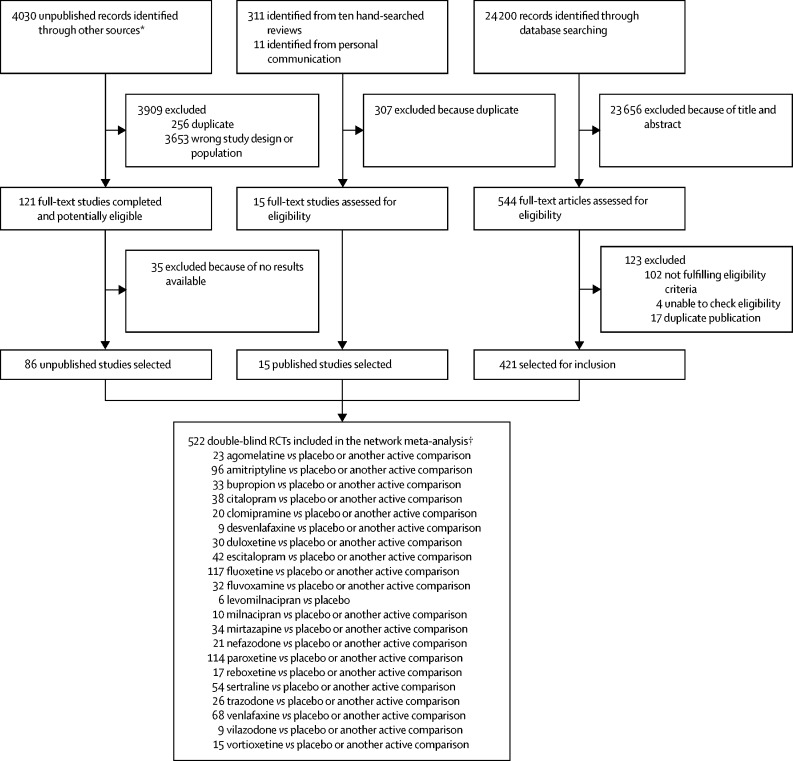
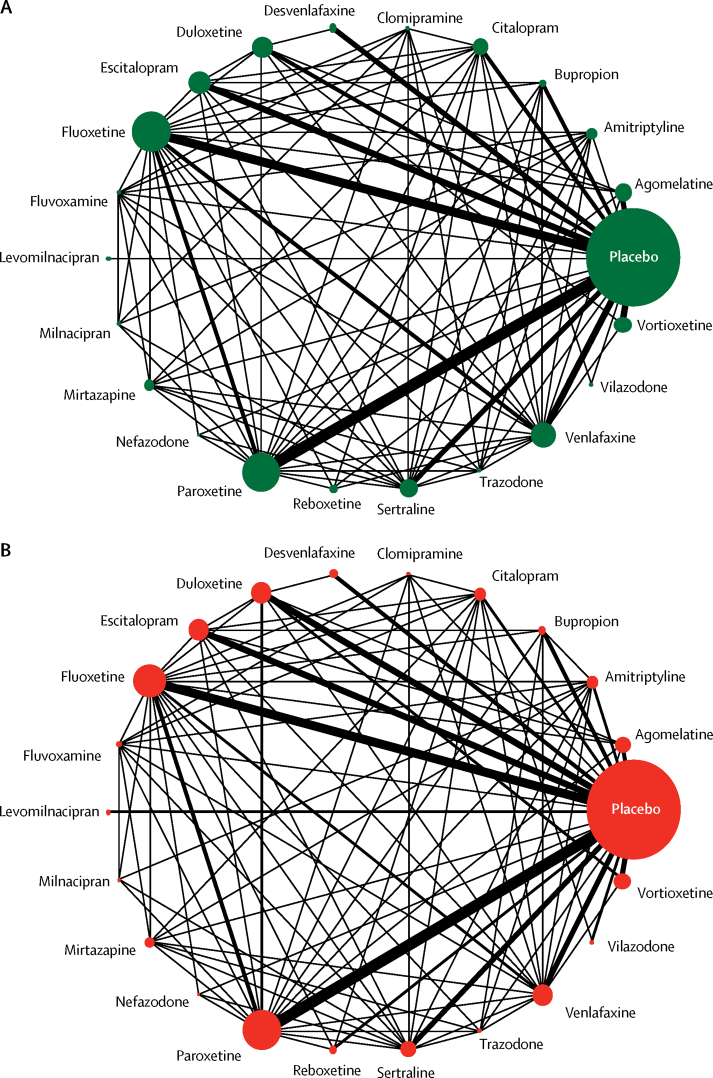
Summary Background Major depressive disorder is one of the most common, burdensome, and costly psychiatric disorders worldwide in adults. Pharmacological and non-pharmacological treatments are available; however, because of inadequate resources, antidepressants are used more frequently than psychological interventions. Prescription of these agents should be informed by the best available evidence. Therefore, we aimed to update and expand our previous work to compare and rank antidepressants for the acute treatment of adults with unipolar major depressive disorder. Methods We did a systematic review and network meta-analysis. We searched Cochrane Central Register of Controlled Trials, CINAHL, Embase, LILACS database, MEDLINE, MEDLINE In-Process, PsycINFO, the websites of regulatory agencies, and international registers for published and unpublished, double-blind, randomised controlled trials from their inception to Jan 8, 2016. We included placebo-controlled and head-to-head trials of 21 antidepressants used for the acute treatment of adults (≥18 years old and of both sexes) with major depressive disorder diagnosed according to standard operationalised criteria. We excluded quasi-randomised trials and trials that were incomplete or included 20% or more of participants with bipolar disorder, psychotic depression, or treatment-resistant depression; or patients with a serious concomitant medical illness. We extracted data following a predefined hierarchy. In network meta-analysis…
Overview
CoChat Summary
TL;DR
In this systematic review and network meta-analysis of 522 double-blind randomised trials (116,477 participants), all 21 antidepressants were more efficacious than placebo for acute treatment of adults with major depressive disorder, though effect sizes were mostly modest. Some drugs showed more favourable efficacy/acceptability profiles, but many comparative estimates had wide credible intervals and certainty of evidence was moderate to very low.
Key findings
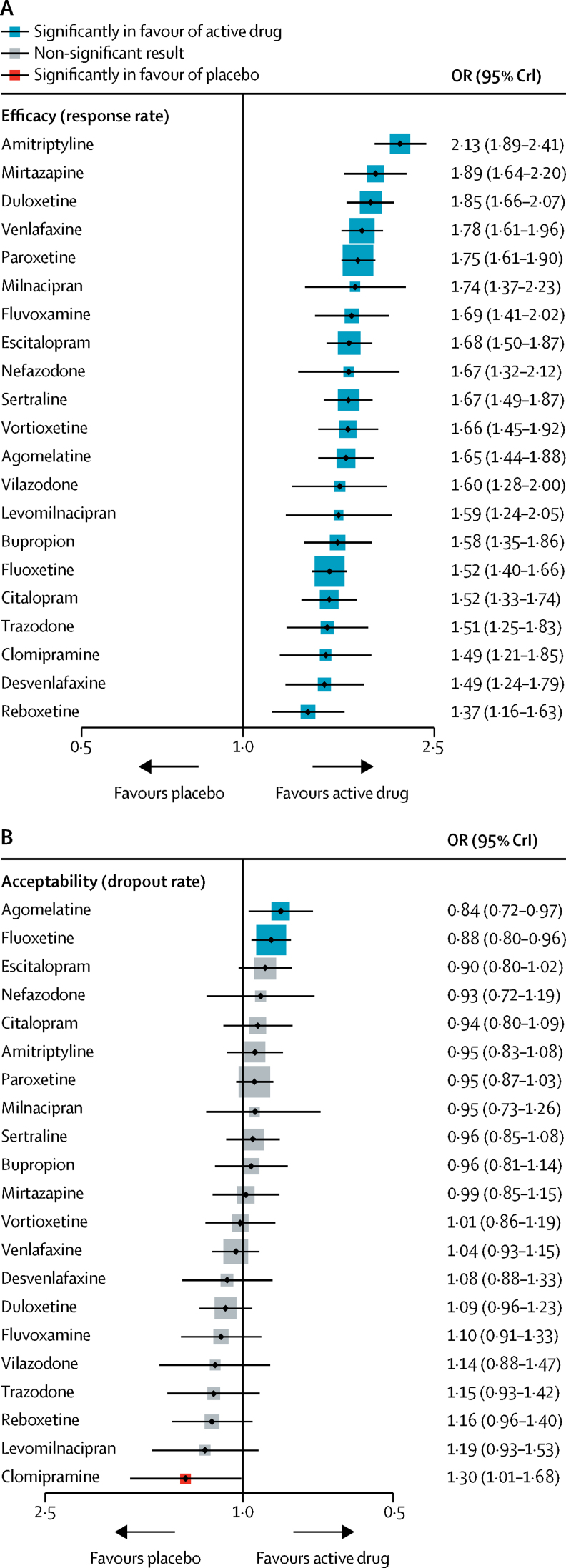
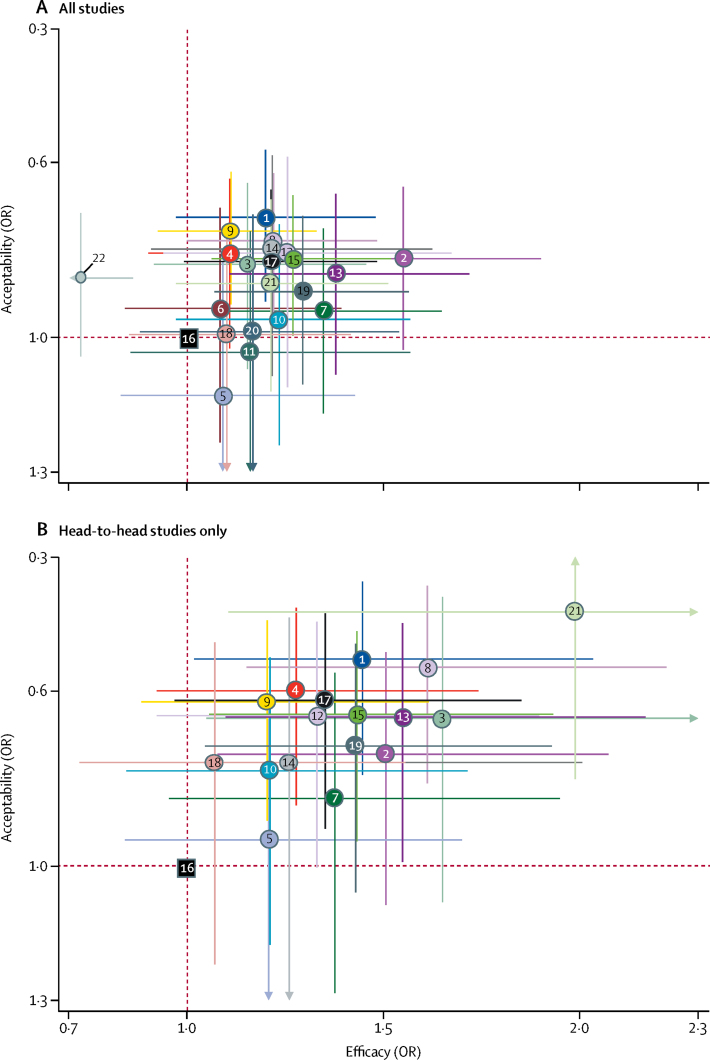
- Across 522 trials and 116,477 participants, all antidepressants were more effective than placebo, with ORs ranging from 2·13 (95% CrI 1·89–2·41) for amitriptyline to 1·37 (1·16–1·63) for reboxetine.
- For acceptability, only agomelatine (OR 0·84, 95% CrI 0·72–0·97) and fluoxetine (0·88, 0·80–0·96) were associated with fewer dropouts than placebo, whereas clomipramine was worse than placebo (1·30, 1·01–1·68).
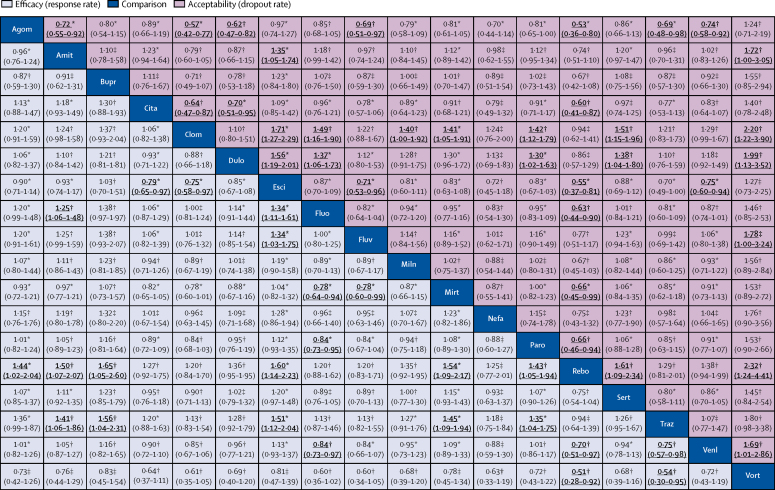
- In head-to-head studies, agomelatine, amitriptyline, escitalopram, mirtazapine, paroxetine, venlafaxine, and vortioxetine were more effective than other antidepressants (ORs 1·19–1·96), while fluoxetine, fluvoxamine, reboxetine, and trazodone were least efficacious (0·51–0·84). For acceptability, agomelatine, citalopram, escitalopram, fluoxetine, sertraline, and vortioxetine were more tolerable (0·43–0·77), while amitriptyline, clomipramine, duloxetine, fluvoxamine, reboxetine, trazodone, and venlafaxine had the highest dropout rates (1·30–2·32).
- Risk of bias was high in 46 (9%) of 522 trials, moderate in 380 (73%), and low in 96 (18%); certainty of evidence was moderate to very low, and differences between active drugs ranged from 1·15 to 1·55 for efficacy and 0·64 to 0·83 for acceptability, with wide CrIs on most comparative analyses.
Methods
- Systematic review and network meta-analysis; searched Cochrane Central Register of Controlled Trials, CINAHL, Embase, LILACS, MEDLINE, MEDLINE In-Process, PsycINFO, regulatory agency websites, and international registers from inception to Jan 8, 2016.
- Included double-blind randomised controlled trials of 21 antidepressants or placebo as oral monotherapy for acute treatment of adults (≥18 years, both sexes) with major depressive disorder diagnosed by standard operationalised criteria; excluded quasi-randomised trials and trials with ≥20% bipolar disorder, psychotic depression, treatment-resistant depression, or serious concomitant medical illness.
- Primary outcomes were efficacy (response rate, ≥50% reduction on a standardised observer-rating scale) and acceptability (all-cause treatment discontinuation); estimated summary ORs using random-effects pairwise and network meta-analysis, assessed risk of bias and GRADE certainty, and ranked treatments with SUCRA; PROSPERO CRD42012002291.
Limitations
- Stated by the paper: many comparisons were low or very low certainty (e.g., involving amitriptyline, bupropion, venlafaxine); many trials did not report adequate information about randomisation and allocation concealment; analyses covered only average treatment effects and could not investigate individual-patient modifiers; patients with psychotic or treatment-resistant depression were excluded; trials were short duration; unpublished data were incomplete for some drugs; no formal cost-effectiveness analysis; and results cannot guide next-step choices after first treatment failure.
- Evident from the text: most comparative analyses had wide credible intervals; 9% of trials were high risk of bias and 73% moderate; network meta-analysis depends on transitivity and consistency assumptions; and placebo-controlled versus head-to-head results differed, including a novelty effect favouring experimental drugs.
Model-written summary. Check it against the paper before relying on it.
Integrity signals
Registry
Cites
Statistics
Figures
Verification
Claims the paper makes
15 Valid · 0 Not valid · 10 Not checked · 93 Own results and interpretations
Every source the paper cites for this claim was checked and supports it.
In the paper
“However, there is a long-lasting debate and concern about their efficacy and effectiveness, because short-term benefits are, on average, modest; and because long-term balance of benefits and harms is often understudied.4”
§ Comparative efficacy and acceptability of 21 antidepressant drugs for the acute treatment of adults with major depressive disorder: a systematic review and network meta-analysis > Introduction
What the sources say
- Supportedcites [4] Ioannidis JP Effectiveness of antidepressants: an evidence myth constructed from a thousand randomized trials? Philos Ethics Humanit Med 3 2008 14 18505564 PMC2412901 source
The Abstract explicitly states that the long-term balance of antidepressants’ benefits and harms is understudied. The Background sections on short follow-up and unknown harms explain that trials are typically brief and provide limited information on harms. (LLM, conf=0.95)
plain- Asserted: passes — The authors put it forward as true.
- Checkable: passes — It can be checked against evidence.
- Load-bearing: unclear — It is unclear whether the paper’s conclusions depend on it.
- Based: passes — The paper gives a reason why it holds.
- Supported
The cited sources support only part of this claim — read each source’s verdict below.
In the paper
“We considered only double-blind trials because we included placebo in the network meta-analysis, and because this study design increases methodological rigour by minimising performance and ascertainment biases.7”
§ Comparative efficacy and acceptability of 21 antidepressant drugs for the acute treatment of adults with major depressive disorder: a systematic review and network meta-analysis > Methods > Search strategy and selection criteria
What the sources say
- Partly supportedcites [7] Hróbjartsson A Thomsen AS Emanuelsson F Observer bias in randomized clinical trials with measurement scale outcomes: a systematic review of trials with both blinded and nonblinded assessors CMAJ 185 2013 E201 E211 23359047 PMC3589328 sourceExperimental — accuracy not yet measured
The Abstract says blinding outcome assessors helps avoid ascertainment bias, and the Conclusion reports a high risk of bias when assessors are not blinded in trials with subjective measurement-scale outcomes. The paper does not establish that double-blind design minimises performance bias; it also cautions in the Abstract that “double-blind” is an ambiguous term. (LLM, conf=0.87)
plainstates a cause- Asserted: passes — The authors put it forward as true.
- Checkable: passes — It can be checked against evidence.
- Load-bearing: passes — The paper’s conclusions depend on it.
- Based: passes — The paper gives a reason why it holds.
- Partly supported
A result the paper reports from its own data — it cites no other source for it, so there is none to check. The quote shows it is in the paper.
In the paper
“We found that all antidepressants included in the meta-analysis were more efficacious than placebo in adults with major depressive disorder”
§ Comparative efficacy and acceptability of 21 antidepressant drugs for the acute treatment of adults with major depressive disorder: a systematic review and network meta-analysis > Discussion
plainstates a cause- Asserted: passes — The authors put it forward as true.
- Checkable: passes — It can be checked against evidence.
- Load-bearing: passes — The paper’s conclusions depend on it.
- Based: passes — The paper gives a reason why it holds.
A result the paper reports from its own data — it cites no other source for it, so there is none to check. The quote shows it is in the paper.
In the paper
“Adjusting for this novelty effect diminished the differences between antidepressants.”
§ Comparative efficacy and acceptability of 21 antidepressant drugs for the acute treatment of adults with major depressive disorder: a systematic review and network meta-analysis > Results
plainstates a cause- Asserted: passes — The authors put it forward as true.
- Checkable: passes — It can be checked against evidence.
- Load-bearing: passes — The paper’s conclusions depend on it.
- Based: passes — The paper gives a reason why it holds.
A result the paper reports from its own data — it cites no other source for it, so there is none to check. The quote shows it is in the paper.
In the paper
“In our analyses, funding by industry was not associated with substantial differences in terms of response or dropout rates.”
§ Comparative efficacy and acceptability of 21 antidepressant drugs for the acute treatment of adults with major depressive disorder: a systematic review and network meta-analysis > Discussion
plain- Asserted: passes — The authors put it forward as true.
- Checkable: passes — It can be checked against evidence.
- Load-bearing: unclear — It is unclear whether the paper’s conclusions depend on it.
- Based: passes — The paper gives a reason why it holds.
49 more claims
Create a free account to see all 118 claims and every source verdict.
- Probably not a substantial claim. 39
- It may state two separate claims as one. 33
Claims other papers make about this one
Each is checked against this paper’s own text: does it say what the citing paper says it does?
The source backs part of the claim, not all of it — or backs it for a different population, condition or comparison.
In the citing paper
“Previous findings suggest that escitalopram and vortioxetine have inherently greater efficacy and acceptability than other antidepressants.7”
From A Randomized Controlled Study of Efficacy and Cognitive Function Improvement of Vortioxetine and Escitalopram in Patients with Depression in Chinese Han Nationality (2024) · cites this paper as [7]
Experimental — accuracy not yet measuredThe source backs part of the claim, not all of it — or backs it for a different population, condition or comparison.
In the citing paper
“Antidepressants are more efficacious than placebo in LLD127.”
From Mechanisms and treatment of late-life depression (2019) · cites this paper as [127]
Experimental — accuracy not yet measuredThe source backs part of the claim, not all of it — or backs it for a different population, condition or comparison.
In the citing paper
“It is wellestablished that psychotherapies and pharmaco logical therapies are effective in the treatment of adult depres sion.”
From A network meta‐analysis of the effects of psychotherapies, pharmacotherapies and their combination in the treatment of adult depression (2020) · cites this paper as [6]
Experimental — accuracy not yet measuredThe source backs part of the claim, not all of it — or backs it for a different population, condition or comparison.
In the citing paper
“The primary limitation of all the available evidence on the effects of antidepressants is that the majority of previous trials assessing the effects of antidepressants have been at high or unclear risk of bias.”
From Should antidepressants be used for major depressive disorder? (2020) · cites this paper as [35]
Experimental — accuracy not yet measuredThe source backs part of the claim, not all of it — or backs it for a different population, condition or comparison.
In the citing paper
“Results of a network meta-analysis of adults with acute MDD also revealed that desvenlafaxine, paroxetine, venlafaxine, and vortioxetine had good efficacy and acceptability [8].”
From Antidepressants for the treatment of adults with major depressive disorder in the maintenance phase: a systematic review and network meta-analysis (2023) · cites this paper as [8]
Experimental — accuracy not yet measured
27 more claims about this paper
Create a free account to see every claim other papers make about this one.
Self-check
Percentages, sums and reported differences re-computed from the paper’s own numbers.
Each contradiction between two passages listed here was confirmed by an independent check.
Rated minor: it would not touch a result — a value no result rests on, a p-value that stays on the same side of the significance level, or a conflict that is clerical, resolved elsewhere in the paper, or outside its own findings.
In the paper
§ Comparative efficacy and acceptability of 21 antidepressant drugs for the acute treatment of adults with major depressive disorder: a systematic review and network meta-analysis > Results
“Only levomilnacipran was not directly compared with at least another active drug in any of the networks.”
§ Comparative efficacy and acceptability of 21 antidepressant drugs for the acute treatment of adults with major depressive disorder: a systematic review and network meta-analysis > Results
“Desvenlafaxine, levomilnacipran, and vilazodone were not included in the head-to-head analysis because these three antidepressants had only placebo-controlled trials.”
Citations
Cites
Salanti, G., Ades, A. E., & Ioannidis, J. P. A. (2011) · Journal of Clinical Epidemiology · doi:10.1016/j.jclinepi.2010.03.016 · Cited by 3,766
Self-citationChecking consistency in mixed treatment comparison meta-analysis
Dias, S., Welton, N. J., Caldwell, D. M., & Ades, A. E. (2010) · Statistics in Medicine · doi:10.1002/sim.3767 · Cited by 2,521
Graphical tools for network meta-analysis in STATA
Chaimani, A., Higgins, J. P. T., Mavridis, D., Spyridonos, P., & Salanti, G. (2013) · PLoS ONE · doi:10.1371/journal.pone.0076654 · Cited by 2,473
Self-citationSelective publication of antidepressant trials and its influence on apparent efficacy
Turner, E. H., Matthews, A. M., Linardatos, E., Tell, R. A., & Rosenthal, R. (2008) · New England Journal of Medicine · doi:10.1056/nejmsa065779 · Cited by 2,435
Self-citationThapar, A., Collishaw, S., Pine, D. S., & Thapar, A. K. (2012) · The Lancet · doi:10.1016/s0140-6736(11)60871-4 · Cited by 2,365
Kassebaum, N. J., Arora, M., Barber, R. M., Bhutta, Z. A., Brown, J., Carter, A., Casey, D. C., Charlson, F. J., Coates, M. M., Coggeshall, M., et al. (2016) · The Lancet · doi:10.1016/s0140-6736(16)31460-x · Cited by 2,163
Consistency and inconsistency in network meta-analysis: concepts and models for multi-arm studies
Higgins, J. P. T., Jackson, D., Barrett, J. K., Lu, G., Ades, A. E., & White, I. R. (2012) · Research Synthesis Methods · doi:10.1002/jrsm.1044 · Cited by 2,098
Self-citationMurray, C. J. L., Barber, R. M., Foreman, K. J., Ozgoren, A. A., Abd-Allah, F., Abera, S. F., Aboyans, V., Abraham, J. P., Abubakar, I., Abu-Raddad, L. J., et al. (2015) · The Lancet · doi:10.1016/s0140-6736(15)61340-x · Cited by 1,964
The BUGS project: evolution, critique and future directions
Lunn, D., Spiegelhalter, D., Thomas, A., & Best, N. (2009) · Statistics in Medicine · doi:10.1002/sim.3680 · Cited by 1,876
Cipriani, A., Furukawa, T. A., Salanti, G., Geddes, J. R., Higgins, J. P., Churchill, R., Watanabe, N., Nakagawa, A., Omori, I. M., McGuire, H., et al. (2009) · The Lancet · doi:10.1016/s0140-6736(09)60046-5 · Cited by 1,654
Self-citation
Cited by
Items 3,401–3,500 of 3,536
Rethinking Serotonin in Depression: Toward a Modern Clinical Framework
Sheppert, A. P. (2026) · Cureus · doi:10.7759/cureus.111172
Yeung, Y.-Y., Ramanpong, J., & Yu, C.-P. (2026) · Journal of Environmental Psychology · doi:10.1016/j.jenvp.2026.103123
Marcus, S. C., Bowden, C. F., Lynch, K. G., & Olfson, M. (2026) · BMJ Open · doi:10.1136/bmjopen-2026-121721 · Cited by 1
Jiang, X., Fan, Y., Cui, Y., Cui, L., & Liu, G. (2026) · Frontiers in Neurology · doi:10.3389/fneur.2026.1810716 · Cited by 1
Is gut health the new frontier in treating depression?
de Bianchi, L. S. (2026) · Postgraduate Quarterly · doi:10.53841/bpspgq.2026.1.1.37
Complementary and integrative medicine and women’s health
Edwards, E., Belfer, I., Kelly, B., Sekai, C., & Jean‐Francois, B. (2026) · Elsevier eBooks · doi:10.1016/b978-0-443-45863-7.00005-6
Sohrabi, H., Mahmoudi-Maleki, R., Majidi, M. R., & Mokhtarzadeh, A. A. (2026) · Chemical Engineering Journal · doi:10.1016/j.cej.2026.178843
A Multi-Model Artificial Intelligence Framework for Knowledge Extraction from Patient Drug ReviewsPreprint
Akinwumi, P. O., Qian, M., Babatope, O. A., & Olorunsogbon, T. A. (2026) · Research Square · doi:10.21203/rs.3.rs-9560387/v1
The use of humor in depression: An integration of benefits and risks
Braniecka, A. (2026) · Clinical Psychology Review · doi:10.1016/j.cpr.2026.102781
Highlighting a Systemic Bias in the Responder Odds Ratio
Ghomi, H. T., & Stegenga, J. (2026) · Journal of Evaluation in Clinical Practice · doi:10.1111/jep.70518
Tan, C., Qiao, M., Ma, Y., Wang, X., Xing, M., Sun, S., Shi, Y., Wang, Y., Fang, J., & Yongsheng, Y. (2026) · Frontiers in Microbiology · doi:10.3389/fmicb.2026.1820578
“While the monoamine hypothesis dominates current pathophysiology models (Zhang W. et al., 2021), antidepressants based on it achieve remission in only 50–70% of patients and are often limited by side effects, withdrawal, and recurrence (Locher et al., 2017; Cipriani et al., 2018).”
Zhao, Y., Yin, Z., Zhang, Y., Wang, X., Liu, C., Wx, W., & Rong, P. (2026) · CNS Neuroscience & Therapeutics · doi:10.1002/cns.70920
Chen, Y., Liu, Y., Tong, R., Lin, L., Zhu, M., Huang, X., & Wu, T. (2026) · Frontiers in Molecular Neuroscience · doi:10.3389/fnmol.2026.1865663 · Cited by 1
Gao, Y., Zhang, J., Ma, J., & Lyu, Z. (2026) · Frontiers in Psychiatry · doi:10.3389/fpsyt.2026.1871522
Bo-wen, Z., Jin, D.-J., & Ya-ping, Z. (2026) · hLife · doi:10.1016/j.hlife.2026.06.005
BEYOND AESTHETICS: BOTULINUM TOXIN TYPE A AS AN EMERGING ANTIDEPRESSANT STRATEGY
Dutkiewicz, D., Kowalski, J., Yarbou, A. E., Mallah, R., Kozdroń, D. J., Nieścioruk, M. W., Szczepańska, P., Tokarczyk, M., & Samujilik, A. (2026) · International Journal of Innovative Technologies in Social Science · doi:10.31435/ijitss.2(50).2026.5358
Gougeon, A., Grenier, E., Cau, V., Cuzol, P., Rabeyron, T., Berna, F. S., & Boussageon, R. (2026) · Psychiatry Research · doi:10.1016/j.psychres.2026.117326
Chen, K., Li, X., Chen, H., He, Y., Huang, Y., Wang, W. Y., Ran, S., Huang, Z., Qiu, K., Shu, X., et al. (2026) · Psychoradiology · doi:10.1093/psyrad/kkag025
Интернета-опрос — новый способ изучения переносимости антидепрессантов
Юрьевич, Д. М., & Польская, Е. А. (2026) · Бюллетень Национального научно-исследовательского института общественного здоровья имени Н. А. Семашко · doi:10.69541/nriph.2026.02.014
Massey, H. C., Denton, H., Bibby-Jones, A.-M., Bremner, S. A., Violato, M., Burlingham, A., Cunningham, R., Hasnaoui, S., Harper, C. M., Robertson, S., et al. (2026) · NIHR Open Research · doi:10.3310/nihropenres.14073.1
邹承光, & Li, G. (2026) · ALPHA PSYCHIATRY · doi:10.31083/ap49487
McCurry, K. L., Brown, V. M., Bansal, V., Goyal, S., Casas, B. R., & Chiu, P. H. (2026) · Biological Psychiatry · doi:10.1016/j.biopsych.2026.06.027
Zhao, L., Yang, Y., Cai, B., Wu, K., Gong, Y., Chen, Q., Li, X., & Luo, J. (2026) · ALPHA PSYCHIATRY · doi:10.31083/ap49803
Serotonin reuptake inhibition rapidly enhances affect-reward coupling and improves mood over timePreprint
Mills, R., Durand, A., Croal, M., Rutledge, R. B., & Mason, L. (2026) · bioRxiv (Cold Spring Harbor Laboratory) · doi:10.64898/2026.07.03.736315
Belay, Y. B., Mihalopoulos, C., Engel, L., & Lee, Y. Y. (2026) · Applied Health Economics and Health Policy · doi:10.1007/s40258-026-01055-1
Benefit packages design based on the optimization of depression burden: Evidence from urban China
Niu, B., Zhang, Y., Chen, Y., 刘婷婷, & Liu, J. (2026) · Journal of Management Science and Engineering · doi:10.1016/j.jmse.2026.06.003
Khutwad, D. D., Otari, K. V., & Kale, A. Y. (2026) · Biosciences Biotechnology Research Asia · doi:10.13005/bbra/3519
Jarczewski, J., Mucha, P. T., Dumała, S., & Tomczyk, M. (2026) · Nucleosides Nucleotides & Nucleic Acids · doi:10.1080/15257770.2026.2699383
Tomar, M. (2026) · Premier Journal of Psychology · doi:10.70389/pjp.100011
Yao, Y.-Q., Zhi-yi, X., Guo, B., Wang, C., Hong, H., Chen, Z.-G., & Tang, S.-S. (2026) · Acta Pharmacologica Sinica · doi:10.1038/s41401-026-01874-x · Cited by 1
Liu, X., Lin, T.-F., Jiang, Y.-W., Luo, S., Chen, S., Chai, Y., Yang, Z., Wei, Y., Wang, H., Li, X., et al. (2026) · Psychological Medicine · doi:10.1017/s0033291726104942
Maß, R., Backhaus, K., & Unkelbach, B. K. (2026) · Psychiatrische Praxis · doi:10.1055/a-2892-1260
Chen, W.-L., Lin, Y.-J., Liu, W.-J., Tsai, C.-I., Chiang, P., & Lee, C.-L. (2026) · Journal of Herbal Medicine · doi:10.1016/j.hermed.2026.101126
Clayton, A. H., Alva, G., Bowman, P., Crown, E., Das, B., Doghramji, P. P., Kempf, B., Muzyk, A. J., Schreiber, J., & Miller, J. J. (2026) · Current Medical Research and Opinion · doi:10.1080/03007995.2026.2700073
Delattre, B., Buckman, J. E. J., Harmer, C. J., & Murphy, S. E. (2026) · Psychological Medicine · doi:10.1017/s0033291726104991
Ostuzzi, G., Gastaldon, C., Zaccoletti, D., Bartoli, F., Belnome, G., Carrà, G., Cavallotti, S., Cristea, I. A., D’Agostino, A., Fazio, P. D., et al. (2026) · BMJ Open · doi:10.1136/bmjopen-2026-119492
Noort, A., van Eeden, W. A., Rucci, P., Corda, C., Giltay, E. J., & Driessen, E. (2026) · Journal of Affective Disorders · doi:10.1016/j.jad.2026.122279
Zhu, X., Gan, K., Chen, X., Feng, L., Feng, Y., Zhang, L., & Wang, G. (2026) · Depression and Anxiety · doi:10.1155/da/9897990
The emerging field of cognitive brain–computer interfaces
Sáez, I. (2026) · Trends in Cognitive Sciences · doi:10.1016/j.tics.2026.06.012 · Cited by 5
Are antidepressants held to a different standard?
Wadoo, O., Khan, Y. S., Latoo, J., Gania, A. M., & Alabdulla, M. (2026) · BJPsych Open · doi:10.1192/bjo.2026.12043
Mužić, R., Nyberg, F., Wettermark, B., & Hajiebrahimi, M. (2026) · Social Psychiatry and Psychiatric Epidemiology · doi:10.1007/s00127-026-03169-2
Li, D., Shang, C., Li, Y., Zhao, R., Zhang, C., Li, N., Jin, N., Fan, S., Ma, C., Wang, Z., et al. (2026) · Comprehensive physiology · doi:10.1002/cph4.70222
Zhang, G., Gao, L., Ji, H., Zhang, T., Ma, X., & Zhao, Y. (2026) · Revista Brasileira de Farmacognosia · doi:10.1007/s43450-026-00785-6
Residual depression symptoms following nature-based exercise therapies among U.S. service members
Otis, N. P., Glassman, L. H., Kline, A. C., Elliott, K. T. K., Michalewicz-Kragh, B., & Walter, K. H. (2026) · Frontiers in Physiology · doi:10.3389/fphys.2026.1788999
Aziz, M. A., Maruf, A. A., Bolton, J. M., Kowalec, K., Eltonsy, S., & Leong, C. (2026) · Journal of Clinical Psychopharmacology · doi:10.1097/jcp.0000000000002217
Zhang, F., Qian, J.-J., Chen, W., Zhu, B.-L., Jin, F., Shen, J.-Y., Jiang, B., Fan, H., & Zhao, H. (2026) · European Journal of Pharmacology · doi:10.1016/j.ejphar.2026.179170
Pharmakotherapeutische Behandlung der Posttraumatischen Belastungsstörung
Schmidt, U., Schellong, J., Bergemann, N., Frommberger, U., & Roepke, S. (2026) · Trauma und Gewalt · doi:10.21706/tg-20-3-190
Zacharis, K., Alexakis, I. A. A. C., & Alexakis, C. (2026) · Obstetrics and gynecology. · doi:10.5772/intechopen.1017018
Hyponatremia risk with antidepressant use: A retrospective study
Lien, T.-P., Liu, W., Tang, L.-Y., Yin, C.-H., Chen, J.-S., Chen, Y.-S., Li, Y.-C., Su, K., Chang, R.-I., & Chang, C. (2026) · Journal of the Chinese Medical Association · doi:10.1097/jcma.0000000000001409
The Psychological Effects of Exercise: Neurobiological Mechanisms and Clinical Applications
Msheik, A., Peralta, R., Mokdad, Z. A., Hussein, M., Illeyan, A., Alsaad, N., Sada, F. A., Al-Maadhadi, M., Hajjali, A. A., Alkubaisi, A., et al. (2026) · IntechOpen eBooks · doi:10.5772/intechopen.1016110
Lin, Y.-H., Liu, Y., Liao, C., et al. (2026) · Biomedical Journal · doi:10.1016/j.bj.2026.101019
Ioannou, M., Wold, A. B., Karan, L., Larsson, A., Poth, I., Ladjemi, G., Nuri, Y., Daniilidou, V. P., Falk, Ö., Szabó, Z., et al. (2026) · General Hospital Psychiatry · doi:10.1016/j.genhosppsych.2026.07.010
Kim, J.-H., Lee, K., & Jo, S.-H. (2026) · Annals of Clinical Psychiatry · doi:10.1177/10401237261473599
Chen, Q., Guo, Z., Zhu, D., Wang, F., Sun, C., Li, R., Yin, D., Li, C., Xia, B., Li, W., et al. (2026) · Nutrients · doi:10.3390/nu18152468 · Cited by 1
“Antidepressant drugs and psychotherapy remain the clinical first‑line options, but they are effective in only a subset of patients and are often accompanied by delayed onset of action, adverse effects, and a high risk of relapse [3,4].”
Ali, N. M., & Mohammed, A. A. (2026) · AIP conference proceedings · doi:10.1063/5.0330388
Tortelli, A. (2026) · Frontiers in Psychiatry · doi:10.3389/fpsyt.2026.1773564
Seifert, J., Stübner, S., Dabbert, D., Greil, W., Maier, H. B., Grohmann, R., & Toto, S. (2026) · International Journal of Bipolar Disorders · doi:10.1186/s40345-026-00435-9
“In so, the limited efficacy of ADD in acute BD-DE is consistent with evidence from unipolar depression, where ADD also only show modest effect sizes (Cipriani et al. 2018).”
Hampf, C., Deckert, J., Walther, S., Weber, H., Unterecker, S., & Scherf‐Clavel, M. (2026) · Translational Psychiatry · doi:10.1038/s41398-026-04316-8
Aboukaoud, M., Hoch, B., & Amiaz, R. (2026) · Journal of Psychopharmacology · doi:10.1177/02698811261470450
Wang, Y., Li, C., He, X., Ren, Y., Du, Z., Peng, Z., Liu, L., Yu, H., & Yang, X. (2026) · Journal of Affective Disorders · doi:10.1016/j.jad.2026.122349
REBT in the Treatment of Depression
Terjesen, M. D. (2026) · Elsevier eBooks · doi:10.1016/b978-0-443-29009-1.00151-7
Lin, K., Wang, P., Li, S., Ma, C., Wen, D., Wang, X., & Liao, L. (2026) · Frontiers in Immunology · doi:10.3389/fimmu.2026.1712425
Amygdala astrocyte primary cilium mechanisms contribute to stress behaviours
Pelaz, S. G., Mitsui, K., Kołosowska, N., Fritch, H. A., Neupane, C., Hull, V. L., Alonso-Gardón, M., Pandey, V., Wang, L., Kawaguchi, R., et al. (2026) · Nature · doi:10.1038/s41586-026-10874-0 · Cited by 1
Yun, J., Park, S., Park, K., Kim, C., Mountjoy, M. L., Stuart, M. C., & Rhie, S. J. (2026) · International Journal of Clinical Pharmacy · doi:10.1007/s11096-026-02206-z
(2020) · Elsevier eBooks · doi:10.1016/b978-3-437-24035-5.00022-5
Multidimensional characterization of the physiological and behavioral effects of TCB-2 in micePreprint
Yamamoto, M., Inoue, H., Hayashi, K., Aota, I., Matsumoto, J., Yamada, K., & Toda, K. (2026) · bioRxiv (Cold Spring Harbor Laboratory) · doi:10.64898/2026.08.01.742216
Karadimas, P. (2026) · Methodos series · doi:10.1007/978-3-032-28597-3_5
Zhang, J., Gao, X., Qu, Y., & Liu, J. (2026) · Frontiers in Medicine · doi:10.3389/fmed.2026.1867631
Seo, Y., & Woo, J. (2026) · International Journal of Molecular Sciences · doi:10.3390/ijms27167111
“Adverse effects, sexual dysfunction and withdrawal symptoms are clinically important, yet they do not justify unsupervised substitution in severe depression, suicidality, psychosis or bipolar-spectrum illness [136,137].”
Reproductive Life Cycle and Depression in Women
Kim, K.-M., & Jung, Y. (2026) · Springer eBooks · doi:10.1007/978-981-92-1331-3_4
Lee, J. G., & Park, Y.-M. (2026) · Springer eBooks · doi:10.1007/978-981-92-1331-3_11
Treatment Selection for Major Depressive Disorder in Veterans Health Administration Outpatients
Aslan, M., Tylee, D. S., Chen, P., Yi, D., Li, Y., Mutalik, P., Yan, L., Huang, X., Polimanti, R. A., Wang, Z., et al. (2026) · JAMA Network Open · doi:10.1001/jamanetworkopen.2026.28853
Zhang, C., Wang, L., Sun, W., Liu, N., Li, S., Wang, X., Li, Y., Lu, C., Chi, J., Li, S., et al. (2026) · Neuroscience Letters · doi:10.1016/j.neulet.2026.138708
Yang, G., Liu, X., Liu, R., Liang, Y., He, X., Xu, X., Zhang, H., & Chen, J. (2026) · Environmental Science & Technology · doi:10.1021/acs.est.6c09884
Allgemeine Psychopharmakotherapie
Vernaleken, I., Schneider, F., & Niebling, W. (2026) · Springer eBooks · doi:10.1007/978-3-662-70668-8_10
Johnson, E., Hyde, A. M., Corrick, S., Isley, S., Wright, G., Ezekowitz, J. A., Zheng, Y., Lee‐Baggley, D., Spiers, J. A., Spence, J. C., et al. (2026) · PLoS Medicine · doi:10.1371/journal.pmed.1005198
“…with the lower bound of the confidence interval exceeding the established minimum clinically important difference (MCID) of 1.5 to 1.7 points [31], and were comparable to antidepressant trials in chronic disease (standardized mean difference (SMD) ~ 0.3) [32] and structured psychotherapy [33,34].”
InfluentialSchröder, H. C., Wiens, M., Wang, S., Neufurth, M., Louw, S., Johnson, O., Hoff, S., Wang, X., Müller, W. E. G., Kapewangolo, P. T., et al. (2026) · BMC Complementary Medicine and Therapies · doi:10.1186/s12906-026-05540-x
Liu, C., Li, Y., Cao, X., Ye, Z., Shi, Q., Chen, F., Li, Z., Guo, J., & Qiu, T. (2026) · International Journal of Molecular Sciences · doi:10.3390/ijms27177532
“However, treatments developed on the basis of these mechanisms remain insufficiently effective in a substantial proportion of patients, indicating persistent gaps in our understanding of the core biological mechanisms underlying depression [4].”
Chaurasia, A., Chaurasia, G. K., Verma, A. K., Tiwari, R. K., & Verma, S. (2026) · IntechOpen eBooks · doi:10.5772/intechopen.1016767
Min, J., Shin, S., Park, S., Yun, J., Park, K., & Rhie, S. J. (2026) · Pharmaceuticals · doi:10.3390/ph19091332
“However, SNRIs, such as venlafaxine and duloxetine, are associated with dose-dependent blood pressure elevations due to noradrenergic activity, and NaSSAs, such as mirtazapine, frequently induce dose-limiting somnolence and weight gain [5].”
InfluentialZhu, H., Chen, Y., Song, X., Chen, Z., Zhang, J., Pu, X., Wang, J., & Rong, P. (2026) · Brain Behavior and Immunity · doi:10.1016/j.bbi.2026.106980
Potential for Genomics to Help Guide Preventive Strategies in Psychiatry
Musliner, K. L., Schulte, E. C., Breen, G. D., Fanelli, G., Forstner, A. J., Jansen, P. R., Kendall, K. M., Luykx, J. J., Millischer, V., Papiol, S., et al. (2026) · JAMA Psychiatry · doi:10.1001/jamapsychiatry.2026.2583 · Cited by 1
“66,67 Genetic variation in drug-metabolizing enzymes such as CYP2D6 and CYP2C19 has a well-established and often clinically meaningful impact on pharmacokinetic parameters (e.g., drug plasma levels), with differences in drug exposure of up to several-fold across metabolizer groups.”
A Rare Case of Hypoglycemia Induced by Selective Serotonin Reuptake Inhibitors (SSRIs) Therapy
D, M., Natarajan, V., Baskar, G., Sundar, S., Nambi, S., Ryntathiang, I., & Jothinathan, M. K. D. (2026) · Malaysian Journal of Medicine and Health Sciences · doi:10.47836/mjmhs.22.s5.30
d’Andrea, G., Cavallotto, C., Allegretti, R., Lupi, M., Carmassi, C., Ventriglio, A., Quattrone, D., Zanardi, R., Barlati, S., Martiadis, V., et al. (2026) · Psychiatry Research · doi:10.1016/j.psychres.2026.117419
Zhang, Y., Zhuang, X., Niu, M., Chen, T., Luo, Y., Luo, Y., Almulla, A. F., Carvalho, A. F., Maes, M. H. J., & Li, J. (2026) · medRxiv · doi:10.64898/2026.08.28.26361493
Microgliopathy in poststroke depression: exploring mechanisms and therapeutic strategies
Yang, C., Wu, S., Cao, H., Yin, Y., Zhang, Y., Zhang, L., Chen, R., & Tao, X. (2026) · Neuroscience · doi:10.1016/j.neuroscience.2026.08.046
List of essential medicines for French psychiatry
Javelot, H., Rousseau-Voisin, A., Maoût, M. L., Sujol, G., Honoré, S., Beauger, D., Gourion, D., & Yrondi, A. (2026) · L Encéphale · doi:10.1016/j.encep.2026.04.011
Wang, H. N., Huang, C. K., Huang, Y.-E., Huang, Y. T., Chan, S. H., & Tseng, J. (2026) · Revista Española de Medicina Nuclear e Imagen Molecular · doi:10.1016/j.remn.2026.500341
Zhang, L., Chen, J., Tang, G., Chen, M., Fan, X., Wang, Y., Fan, Y., Wen, H., Li, X., & Xie, X. (2026) · RSC Advances · doi:10.1039/d6ra06461b
Riaz, S., Khuda, F., Nasim, A., Qazi, R., Alnemari, R. M., & Alsubaie, N. (2026) · Psychiatry Research · doi:10.1016/j.psychres.2026.117432
Bukovsky, D., Song, J., Shewchuk, H., Carmona-Torres, E., Crawford, E., Dillon, W., Graff‐Guerrero, A., Kyte, S., Rutka, J. A., Sulway, S., et al. (2026) · Journal of Vestibular Research · doi:10.1177/09574271261468395
Sloan, M. E., Bahji, A., Crockford, D. N., Danilewitz, M., Jutras‐Aswad, D., & Tang, V. M. (2026) · The Canadian Journal of Psychiatry · doi:10.1177/07067437261483871
Seo, Y., & Park, C. S. (2026) · Pharmaceutics · doi:10.3390/pharmaceutics18091112
“First-line agents such as selective serotonin and serotonin–norepinephrine reuptake inhibitors achieve full remission in only about one-third of patients, act with a delayed onset of two to four weeks, and frequently produce adverse effects that undermine adherence [2].”
Haimi, M., Almeida‐Antunes, N., Ferreira, S., & Rocha, N. (2026) · JMIR Mental Health · doi:10.2196/92522
“The pooled effect of home-based tDCS overlaps with the lower end-of-effect ranges reported for established depression treatments [57,58], but no claim of superiority is supported; number-needed-to-treat figures vary substantially with outcome definition, comparator, and severity threshold.”
Tringali, G., Engmann, O., Stein, G. X. F. N., Cannizzaro, C., & Brancato, A. (2026) · Current Molecular Pharmacology · doi:10.1016/j.cmp.2026.08.004
He, J.-P., Su, X.-Y., Men, J., Cui, J.-M., & Zhang, L.-N. (2026) · Physiological Research · doi:10.33549/physiolres.935743
Creatine Uncovered: Expanding Its Role from Fitness Supplement to Therapeutic Agent
Gonzalez, M., & Ruiz, J. (2024) · Journal of Applied Pharmaceutical Technologies and Systems · doi:10.68159/i981004315
Śnieżek, J., & Polak-Szczybyło, E. (2026) · Nutrients · doi:10.3390/nu18182940
“…pharmacological treatments for major depressive disorder (MDD), anxiety disorders, obsessive compulsive disorder, post-traumatic stress disorder, and several other psychiatric conditions in which alterations in serotonergic neurotransmission play an important pathophysiological role [16].”
Dinger, U., & Schauenburg, H. (2026) · Elsevier eBooks · doi:10.1016/b978-3-437-21352-6.00010-9
Metadata
- Authors
- Cipriani, A., Furukawa, T. A., Salanti, G., Chaimani, A., Atkinson, L. Z., Ogawa, Y., Leucht, S., Ruhe, H. G., Turner, E. H., Higgins, J. P. T., Egger, M., Takeshima, N., Hayasaka, Y., Imai, H., Shinohara, K., Tajika, A., Ioannidis, J. P. A., & Geddes, J. R.
- Affiliations
- Oxford Health NHS Foundation Trust (GB)
- Kyoto University (JP)
- University of Bern (CH)
- Inserm (FR)
- Warneford Hospital (GB)
- Technical University of Munich (DE)
- Oregon Health & Science University (US)
- University of Bristol (GB)
- Stanford University (US)
- Corresponding author
- Cipriani, Andrea
- ORCID
- Venue
- The Lancet
- Publisher
- Elsevier BV
- Published
- 2018-04
- Volume
- 391
- Issue
- 10128
- Pages
- 1357-1366
- ISSN
- 0099-5355 (ISSN-L)
- 0140-6736
- PMC
- PMC5889788
- OpenAlex
- W2788337440
- Cited by
- 3,541
- References
- 33
- Citations by year
- 2026: 383 · 2025: 472 · 2024: 469 · 2023: 426 · 2022: 399 · 2021: 423 · 2020: 475 · 2019: 322 · 2018: 163
- FWCI
- 40.44
- Type
- journal article
- Language
- en
- Open access
- hybrid
- doi.org
- Licence
- cc-by
- www.elsevier.com/tdm/userlicense/1.0/ (tdm)
- creativecommons.org/licenses/by/4.0/ (vor)
- Locations
- The Lancet (publishedVersion, cc-by)
- FOCUS The Journal of Lifelong Learning in Psychiatry (publishedVersion, cc-by)
- Europe PMC (PubMed Central) (publishedVersion, cc-by)
- PubMed Central (publishedVersion, cc-by)
- PubMed (publishedVersion)
- PubMed Central (publishedVersion)
- Institutional Repositories DataBase (IRDB) (submittedVersion, cc-by)
- Bern Open Repository and Information System (University of Bern) (submittedVersion, cc-by)
- mediaTUM – the media and publications repository of the Technical University Munich (Technical University Munich) (submittedVersion)
- mediaTUM – the media and publications repository of the Technical University Munich (Technical University Munich) (submittedVersion, other-oa)
- Kyoto University Research Information Repository (Kyoto University) (submittedVersion, cc-by)
- Radboud Repository (Radboud University) (submittedVersion)
- Explore Bristol Research (submittedVersion, cc-by)
- Radboud Repository (Radboud University) (submittedVersion, other-oa)
- Funders
- National Institute for Health and Care Research (BRC‐1215‐20005, NF-SI-0617-10145)
- Japan Society for the Promotion of Science (17K19808, 16K09033)
- Topics
- Health Sciences › Medicine › Pharmacology (medical) › Treatment of Major Depression
- Health Sciences › Medicine › Psychiatry and Mental health › Mental Health Treatment and Access
- Social Sciences › Psychology › Clinical Psychology › Psychotherapy Techniques and Applications
- Keywords
- major depressive disorder, antidepressants, acute treatment, antidepressant efficacy, treatment discontinuation, placebo response, amitriptyline, reboxetine, agomelatine, fluoxetine, venlafaxine, escitalopram, mirtazapine, paroxetine, sertraline, bupropion
- MeSH terms
- Antidepressive Agents, Major Depressive Disorder, Double-Blind Method, Humans, Patient Dropouts, Randomized Controlled Trials as Topic, Treatment Outcome, Evidence-Based Medicine
About these checks
Registry, retraction, Cites and statistics results are computed, not judged, with one exception: a printed reference that no index lists is read once by a model before it counts as a citation error. Claims are extracted by a model and kept only when their quote appears verbatim in the text; each cited source is then checked, with a model’s help, for whether it says what the claim relies on. Those verdicts can be wrong — read the claim’s quote and the cited source before relying on one.
The claim verdicts this report counts are experimental: their accuracy is not yet measured.
A language model drew the claims from the paper on 2026-10-10, under version 3 of the claim definition (model deepseek-v4.1-flash, prompt extract-v3).
A second model labelled each claim on 2026-10-10 (model jev-1.13-20260917, definition revision gold-guideline-v0.2).
Cited sources are checked with a language model’s help (gpt-6-sol).
Statistics and arithmetic are recomputed, not judged.
Confidence bands are shown only for fields calibrated on our annotated test set. None is calibrated yet, so no band is shown.
What counts as a claim ›How we measure confidence ›How we check this ›
Are you an author, or do you see a problem with this page? Request a review
Data sources
Bibliographic data: Semantic Scholar, OpenAlex, Crossref.
Contains information from the Semantic Scholar Academic Graph Datasets, made available under the ODC Attribution License (ODC-BY 1.0).
Semantic Scholar’s data is described in: Kinney, R., et al. (2023). The Semantic Scholar Open Data Platform. arXiv:2301.10140.
