

Comparative efficacy and acceptability of 21 antidepressant drugs for the acute treatment of adults with major depressive disorder: a systematic review and network meta-analysis
Open accessThe DOI matches its Crossref record; 32 of the 33 references it cites were found in a registry or an index; 15 of the 26 sources its claims cite were checked for support.
Abstract
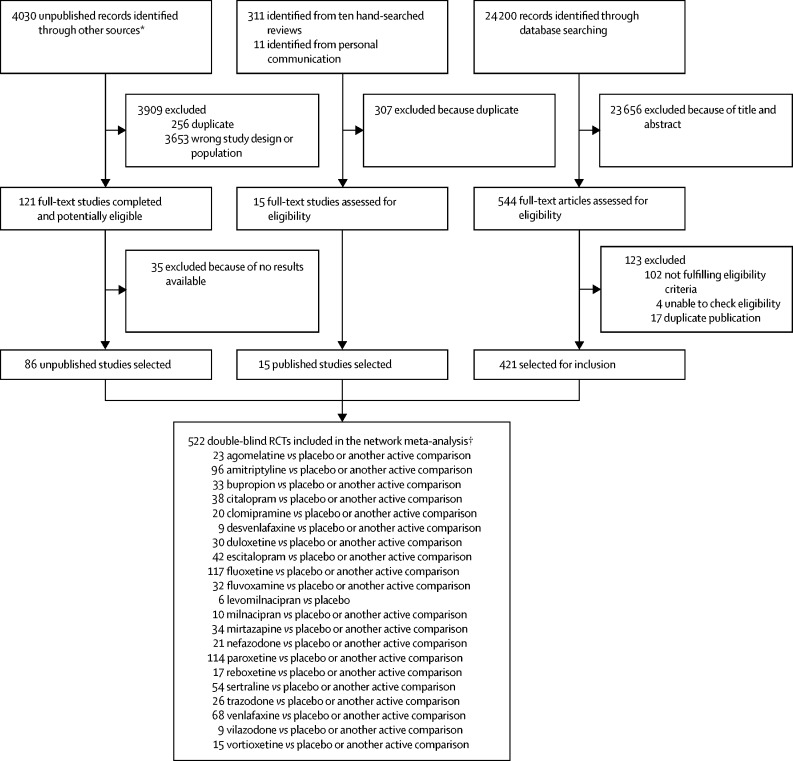
Summary Background Major depressive disorder is one of the most common, burdensome, and costly psychiatric disorders worldwide in adults. Pharmacological and non-pharmacological treatments are available; however, because of inadequate resources, antidepressants are used more frequently than psychological interventions. Prescription of these agents should be informed by the best available evidence. Therefore, we aimed to update and expand our previous work to compare and rank antidepressants for the acute treatment of adults with unipolar major depressive disorder. Methods We did a systematic review and network meta-analysis. We searched Cochrane Central Register of Controlled Trials, CINAHL, Embase, LILACS database, MEDLINE, MEDLINE In-Process, PsycINFO, the websites of regulatory agencies, and international registers for published and unpublished, double-blind, randomised controlled trials from their inception to Jan 8, 2016. We included placebo-controlled and head-to-head trials of 21 antidepressants used for the acute treatment of adults (≥18 years old and of both sexes) with major depressive disorder diagnosed according to standard operationalised criteria. We excluded quasi-randomised trials and trials that were incomplete or included 20% or more of participants with bipolar disorder, psychotic depression, or treatment-resistant depression; or patients with a serious concomitant medical illness. We extracted data following a predefined hierarchy. In network meta-analysis…
Overview
CoChat Summary
TL;DR
In this systematic review and network meta-analysis of 522 double-blind randomised trials (116,477 participants), all 21 antidepressants were more efficacious than placebo for acute treatment of adults with major depressive disorder, though effect sizes were mostly modest. Some drugs showed more favourable efficacy/acceptability profiles, but many comparative estimates had wide credible intervals and certainty of evidence was moderate to very low.
Key findings
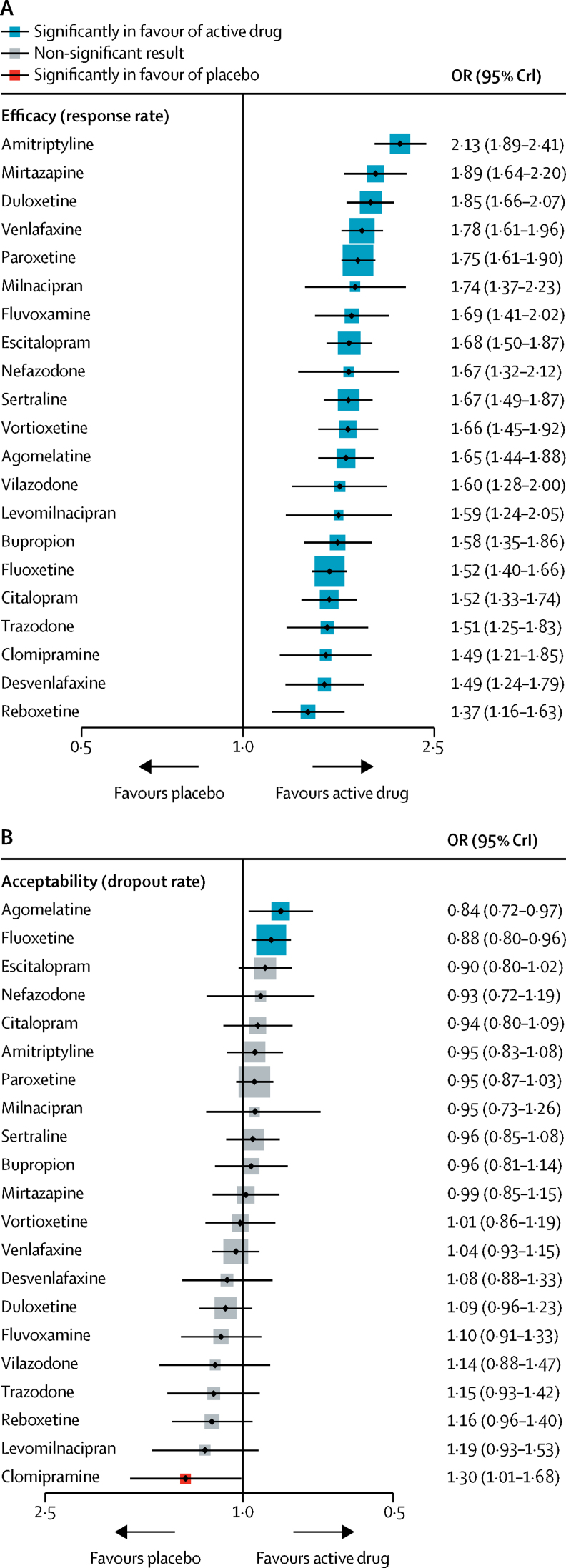
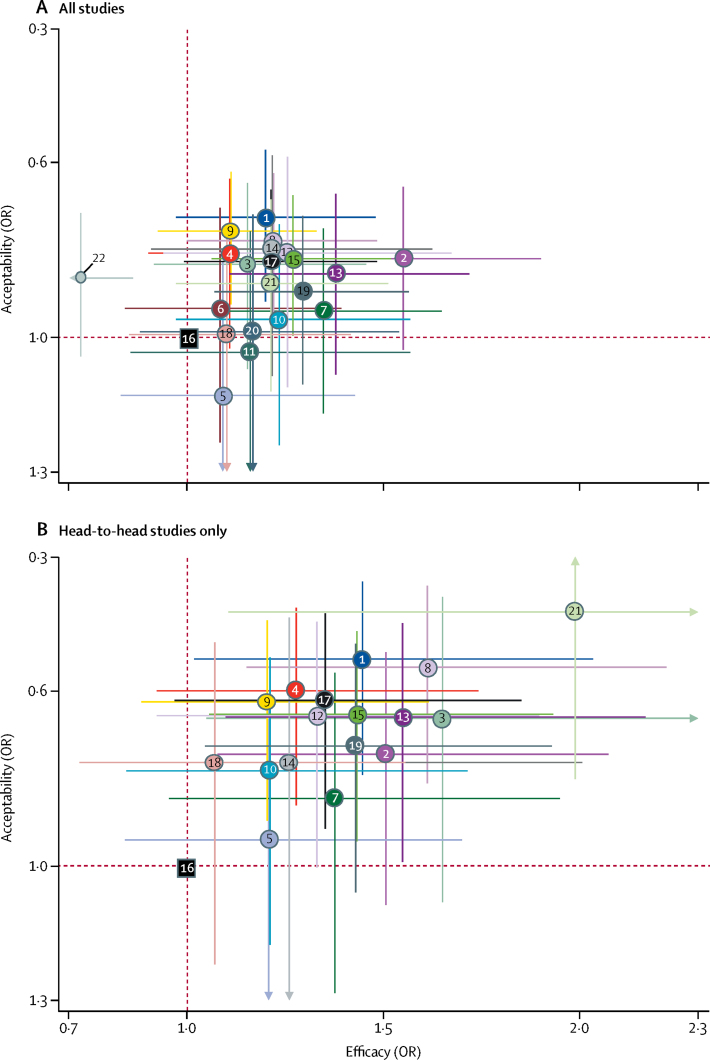
- Across 522 trials and 116,477 participants, all antidepressants were more effective than placebo, with ORs ranging from 2·13 (95% CrI 1·89–2·41) for amitriptyline to 1·37 (1·16–1·63) for reboxetine.
- For acceptability, only agomelatine (OR 0·84, 95% CrI 0·72–0·97) and fluoxetine (0·88, 0·80–0·96) were associated with fewer dropouts than placebo, whereas clomipramine was worse than placebo (1·30, 1·01–1·68).
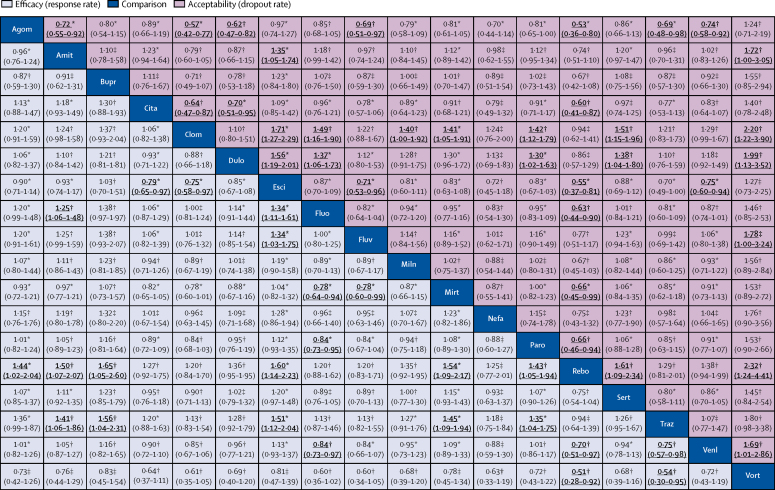
- In head-to-head studies, agomelatine, amitriptyline, escitalopram, mirtazapine, paroxetine, venlafaxine, and vortioxetine were more effective than other antidepressants (ORs 1·19–1·96), while fluoxetine, fluvoxamine, reboxetine, and trazodone were least efficacious (0·51–0·84). For acceptability, agomelatine, citalopram, escitalopram, fluoxetine, sertraline, and vortioxetine were more tolerable (0·43–0·77), while amitriptyline, clomipramine, duloxetine, fluvoxamine, reboxetine, trazodone, and venlafaxine had the highest dropout rates (1·30–2·32).
- Risk of bias was high in 46 (9%) of 522 trials, moderate in 380 (73%), and low in 96 (18%); certainty of evidence was moderate to very low, and differences between active drugs ranged from 1·15 to 1·55 for efficacy and 0·64 to 0·83 for acceptability, with wide CrIs on most comparative analyses.
Methods
- Systematic review and network meta-analysis; searched Cochrane Central Register of Controlled Trials, CINAHL, Embase, LILACS, MEDLINE, MEDLINE In-Process, PsycINFO, regulatory agency websites, and international registers from inception to Jan 8, 2016.
- Included double-blind randomised controlled trials of 21 antidepressants or placebo as oral monotherapy for acute treatment of adults (≥18 years, both sexes) with major depressive disorder diagnosed by standard operationalised criteria; excluded quasi-randomised trials and trials with ≥20% bipolar disorder, psychotic depression, treatment-resistant depression, or serious concomitant medical illness.
- Primary outcomes were efficacy (response rate, ≥50% reduction on a standardised observer-rating scale) and acceptability (all-cause treatment discontinuation); estimated summary ORs using random-effects pairwise and network meta-analysis, assessed risk of bias and GRADE certainty, and ranked treatments with SUCRA; PROSPERO CRD42012002291.
Limitations
- Stated by the paper: many comparisons were low or very low certainty (e.g., involving amitriptyline, bupropion, venlafaxine); many trials did not report adequate information about randomisation and allocation concealment; analyses covered only average treatment effects and could not investigate individual-patient modifiers; patients with psychotic or treatment-resistant depression were excluded; trials were short duration; unpublished data were incomplete for some drugs; no formal cost-effectiveness analysis; and results cannot guide next-step choices after first treatment failure.
- Evident from the text: most comparative analyses had wide credible intervals; 9% of trials were high risk of bias and 73% moderate; network meta-analysis depends on transitivity and consistency assumptions; and placebo-controlled versus head-to-head results differed, including a novelty effect favouring experimental drugs.
Model-written summary. Check it against the paper before relying on it.
Integrity signals
Registry
Cites
Statistics
Figures
Verification
Claims the paper makes
15 Valid · 0 Not valid · 10 Not checked · 93 Own results and interpretations
Every source the paper cites for this claim was checked and supports it.
In the paper
“However, there is a long-lasting debate and concern about their efficacy and effectiveness, because short-term benefits are, on average, modest; and because long-term balance of benefits and harms is often understudied.4”
§ Comparative efficacy and acceptability of 21 antidepressant drugs for the acute treatment of adults with major depressive disorder: a systematic review and network meta-analysis > Introduction
What the sources say
- Supportedcites [4] Ioannidis JP Effectiveness of antidepressants: an evidence myth constructed from a thousand randomized trials? Philos Ethics Humanit Med 3 2008 14 18505564 PMC2412901 source
The Abstract explicitly states that the long-term balance of antidepressants’ benefits and harms is understudied. The Background sections on short follow-up and unknown harms explain that trials are typically brief and provide limited information on harms. (LLM, conf=0.95)
plain- Asserted: passes — The authors put it forward as true.
- Checkable: passes — It can be checked against evidence.
- Load-bearing: unclear — It is unclear whether the paper’s conclusions depend on it.
- Based: passes — The paper gives a reason why it holds.
- Supported
The cited sources support only part of this claim — read each source’s verdict below.
In the paper
“We considered only double-blind trials because we included placebo in the network meta-analysis, and because this study design increases methodological rigour by minimising performance and ascertainment biases.7”
§ Comparative efficacy and acceptability of 21 antidepressant drugs for the acute treatment of adults with major depressive disorder: a systematic review and network meta-analysis > Methods > Search strategy and selection criteria
What the sources say
- Partly supportedcites [7] Hróbjartsson A Thomsen AS Emanuelsson F Observer bias in randomized clinical trials with measurement scale outcomes: a systematic review of trials with both blinded and nonblinded assessors CMAJ 185 2013 E201 E211 23359047 PMC3589328 sourceExperimental — accuracy not yet measured
The Abstract says blinding outcome assessors helps avoid ascertainment bias, and the Conclusion reports a high risk of bias when assessors are not blinded in trials with subjective measurement-scale outcomes. The paper does not establish that double-blind design minimises performance bias; it also cautions in the Abstract that “double-blind” is an ambiguous term. (LLM, conf=0.87)
plainstates a cause- Asserted: passes — The authors put it forward as true.
- Checkable: passes — It can be checked against evidence.
- Load-bearing: passes — The paper’s conclusions depend on it.
- Based: passes — The paper gives a reason why it holds.
- Partly supported
A result the paper reports from its own data — it cites no other source for it, so there is none to check. The quote shows it is in the paper.
In the paper
“We found that all antidepressants included in the meta-analysis were more efficacious than placebo in adults with major depressive disorder”
§ Comparative efficacy and acceptability of 21 antidepressant drugs for the acute treatment of adults with major depressive disorder: a systematic review and network meta-analysis > Discussion
plainstates a cause- Asserted: passes — The authors put it forward as true.
- Checkable: passes — It can be checked against evidence.
- Load-bearing: passes — The paper’s conclusions depend on it.
- Based: passes — The paper gives a reason why it holds.
A result the paper reports from its own data — it cites no other source for it, so there is none to check. The quote shows it is in the paper.
In the paper
“Adjusting for this novelty effect diminished the differences between antidepressants.”
§ Comparative efficacy and acceptability of 21 antidepressant drugs for the acute treatment of adults with major depressive disorder: a systematic review and network meta-analysis > Results
plainstates a cause- Asserted: passes — The authors put it forward as true.
- Checkable: passes — It can be checked against evidence.
- Load-bearing: passes — The paper’s conclusions depend on it.
- Based: passes — The paper gives a reason why it holds.
A result the paper reports from its own data — it cites no other source for it, so there is none to check. The quote shows it is in the paper.
In the paper
“In our analyses, funding by industry was not associated with substantial differences in terms of response or dropout rates.”
§ Comparative efficacy and acceptability of 21 antidepressant drugs for the acute treatment of adults with major depressive disorder: a systematic review and network meta-analysis > Discussion
plain- Asserted: passes — The authors put it forward as true.
- Checkable: passes — It can be checked against evidence.
- Load-bearing: unclear — It is unclear whether the paper’s conclusions depend on it.
- Based: passes — The paper gives a reason why it holds.
49 more claims
Create a free account to see all 118 claims and every source verdict.
- Probably not a substantial claim. 39
- It may state two separate claims as one. 33
Claims other papers make about this one
Each is checked against this paper’s own text: does it say what the citing paper says it does?
The source backs part of the claim, not all of it — or backs it for a different population, condition or comparison.
In the citing paper
“Previous findings suggest that escitalopram and vortioxetine have inherently greater efficacy and acceptability than other antidepressants.7”
From A Randomized Controlled Study of Efficacy and Cognitive Function Improvement of Vortioxetine and Escitalopram in Patients with Depression in Chinese Han Nationality (2024) · cites this paper as [7]
Experimental — accuracy not yet measuredThe source backs part of the claim, not all of it — or backs it for a different population, condition or comparison.
In the citing paper
“Antidepressants are more efficacious than placebo in LLD127.”
From Mechanisms and treatment of late-life depression (2019) · cites this paper as [127]
Experimental — accuracy not yet measuredThe source backs part of the claim, not all of it — or backs it for a different population, condition or comparison.
In the citing paper
“It is wellestablished that psychotherapies and pharmaco logical therapies are effective in the treatment of adult depres sion.”
From A network meta‐analysis of the effects of psychotherapies, pharmacotherapies and their combination in the treatment of adult depression (2020) · cites this paper as [6]
Experimental — accuracy not yet measuredThe source backs part of the claim, not all of it — or backs it for a different population, condition or comparison.
In the citing paper
“The primary limitation of all the available evidence on the effects of antidepressants is that the majority of previous trials assessing the effects of antidepressants have been at high or unclear risk of bias.”
From Should antidepressants be used for major depressive disorder? (2020) · cites this paper as [35]
Experimental — accuracy not yet measuredThe source backs part of the claim, not all of it — or backs it for a different population, condition or comparison.
In the citing paper
“Results of a network meta-analysis of adults with acute MDD also revealed that desvenlafaxine, paroxetine, venlafaxine, and vortioxetine had good efficacy and acceptability [8].”
From Antidepressants for the treatment of adults with major depressive disorder in the maintenance phase: a systematic review and network meta-analysis (2023) · cites this paper as [8]
Experimental — accuracy not yet measured
27 more claims about this paper
Create a free account to see every claim other papers make about this one.
Self-check
Percentages, sums and reported differences re-computed from the paper’s own numbers.
Each contradiction between two passages listed here was confirmed by an independent check.
Rated minor: it would not touch a result — a value no result rests on, a p-value that stays on the same side of the significance level, or a conflict that is clerical, resolved elsewhere in the paper, or outside its own findings.
In the paper
§ Comparative efficacy and acceptability of 21 antidepressant drugs for the acute treatment of adults with major depressive disorder: a systematic review and network meta-analysis > Results
“Only levomilnacipran was not directly compared with at least another active drug in any of the networks.”
§ Comparative efficacy and acceptability of 21 antidepressant drugs for the acute treatment of adults with major depressive disorder: a systematic review and network meta-analysis > Results
“Desvenlafaxine, levomilnacipran, and vilazodone were not included in the head-to-head analysis because these three antidepressants had only placebo-controlled trials.”
Citations
Cites
Salanti, G., Ades, A. E., & Ioannidis, J. P. A. (2011) · Journal of Clinical Epidemiology · doi:10.1016/j.jclinepi.2010.03.016 · Cited by 3,766
Self-citationChecking consistency in mixed treatment comparison meta-analysis
Dias, S., Welton, N. J., Caldwell, D. M., & Ades, A. E. (2010) · Statistics in Medicine · doi:10.1002/sim.3767 · Cited by 2,521
Graphical tools for network meta-analysis in STATA
Chaimani, A., Higgins, J. P. T., Mavridis, D., Spyridonos, P., & Salanti, G. (2013) · PLoS ONE · doi:10.1371/journal.pone.0076654 · Cited by 2,473
Self-citationSelective publication of antidepressant trials and its influence on apparent efficacy
Turner, E. H., Matthews, A. M., Linardatos, E., Tell, R. A., & Rosenthal, R. (2008) · New England Journal of Medicine · doi:10.1056/nejmsa065779 · Cited by 2,435
Self-citationThapar, A., Collishaw, S., Pine, D. S., & Thapar, A. K. (2012) · The Lancet · doi:10.1016/s0140-6736(11)60871-4 · Cited by 2,365
Kassebaum, N. J., Arora, M., Barber, R. M., Bhutta, Z. A., Brown, J., Carter, A., Casey, D. C., Charlson, F. J., Coates, M. M., Coggeshall, M., et al. (2016) · The Lancet · doi:10.1016/s0140-6736(16)31460-x · Cited by 2,163
Consistency and inconsistency in network meta-analysis: concepts and models for multi-arm studies
Higgins, J. P. T., Jackson, D., Barrett, J. K., Lu, G., Ades, A. E., & White, I. R. (2012) · Research Synthesis Methods · doi:10.1002/jrsm.1044 · Cited by 2,098
Self-citationMurray, C. J. L., Barber, R. M., Foreman, K. J., Ozgoren, A. A., Abd-Allah, F., Abera, S. F., Aboyans, V., Abraham, J. P., Abubakar, I., Abu-Raddad, L. J., et al. (2015) · The Lancet · doi:10.1016/s0140-6736(15)61340-x · Cited by 1,964
The BUGS project: evolution, critique and future directions
Lunn, D., Spiegelhalter, D., Thomas, A., & Best, N. (2009) · Statistics in Medicine · doi:10.1002/sim.3680 · Cited by 1,876
Cipriani, A., Furukawa, T. A., Salanti, G., Geddes, J. R., Higgins, J. P., Churchill, R., Watanabe, N., Nakagawa, A., Omori, I. M., McGuire, H., et al. (2009) · The Lancet · doi:10.1016/s0140-6736(09)60046-5 · Cited by 1,654
Self-citation
Cited by
Items 701–800 of 3,536
von Glischinski, M., von Brachel, R., Thiele, C., & Hirschfeld, G. H. F. (2021) · Journal of Affective Disorders · doi:10.1016/j.jad.2021.05.041 · Cited by 33
Use of Sertraline in Hemodialysis Patients
Kubanek, A., Paul, P., Przybylak, M., Kanclerz, K., Rojek, J. J., Renke, M., Bidzan, L., & Grabowski, J. (2021) · Medicina · doi:10.3390/medicina57090949 · Cited by 34
Vos, C. F., Aarnoutse, R. E., de Coul, M. J. M. O., Spijker, J., Groothedde-Kuyvenhoven, M. M., Mihăescu, R., Wessels‐Basten, S. J. W., Rovers, J. J. E., ter Hark, S. E., Schene, A. H., et al. (2021) · BMC Psychiatry · doi:10.1186/s12888-021-03490-x · Cited by 34
de Anta, L., Álvarez-Mon, M. Á., Ortega, M. A., Salazar, C., Donat‐Vargas, C., Santoma-Vilaclara, J., Martin-Martinez, M., Lahera, G., Gutiérrez-Rojas, L., Rodríguez–Jiménez, R., et al. (2022) · Journal of Personalized Medicine · doi:10.3390/jpm12020155 · Cited by 27
Antidepressants and Vertebral and Hip Risk Fracture: An Updated Systematic Review and Meta-Analysis
de Filippis, R., Mercurio, M., Spina, G., Fazio, P. D., Segura‐Garcìa, C., Familiari, F., Gasparini, G., & Galasso, O. (2022) · Healthcare · doi:10.3390/healthcare10050803 · Cited by 38
Petersen, K. K., Drewes, A. M., Olesen, A. E., Ammitzbøll, N., Bertoli, D., Brock, C., & Arendt‐Nielsen, L. (2022) · European Journal of Pain · doi:10.1002/ejp.1988 · Cited by 29
Dong, Z., Xie, Q., Xu, F., Shen, X., Hao, Y., Li, J., Xu, H., Peng, Q., & Kuang, W. (2022) · Frontiers in Pharmacology · doi:10.3389/fphar.2022.974949 · Cited by 31
Cao, H., Yang, D., Nie, K., Lin, R., Peng, L., Zhou, C., Zhang, M., Zeng, Y., Liu, L., & Huang, W. (2023) · European Journal of Pharmacology · doi:10.1016/j.ejphar.2023.175670 · Cited by 34
Ketamine and the Disinhibition Hypothesis: Neurotrophic Factor-Mediated Treatment of Depression
Borsellino, P., Krider, R. I., Chea, D., Grinnell, R., & Vida, T. A. (2023) · Pharmaceuticals · doi:10.3390/ph16050742 · Cited by 34
Su, W., Hu, T., & Jiang, C. (2023) · Current Neuropharmacology · doi:10.2174/1570159x21666230809112028 · Cited by 29
Parikh, S. V., Aaronson, S. T., Mathew, S. J., Alva, G., DeBattista, C., Kanes, S., Lasser, R. A., Bullock, A. E., Kotecha, M., Jung, J., et al. (2023) · Neuropsychopharmacology · doi:10.1038/s41386-023-01751-9 · Cited by 38
van Ravenzwaaij, D., & Ioannidis, J. P. A. (2019) · BMC Medical Research Methodology · doi:10.1186/s12874-019-0865-y · Cited by 29
Self-citationWróbel, A., Serefko, A., Szopa, A., Ulrich, D., Poleszak, E., & Rechberger, T. (2020) · Frontiers in Pharmacology · doi:10.3389/fphar.2020.01002 · Cited by 26
Moorkoth, S., Prathyusha, N. S., Manandhar, S., Xue, Y., Sankhe, R., Pai, K. S. R., & Kumar, N. (2021) · Pharmacological Reports · doi:10.1007/s43440-021-00252-0 · Cited by 35
Lorentzen, R., Kjær, J. N., Østergaard, S. D., & Madsen, M. M. (2020) · Acta Psychiatrica Scandinavica · doi:10.1111/acps.13154 · Cited by 25
Kishi, T., Sakuma, K., Hatano, M., Okuya, M., Matsuda, Y., Kato, M., & Iwata, N. (2023) · Molecular Psychiatry · doi:10.1038/s41380-022-01920-0 · Cited by 26
Effects of Urban Forest Therapy Program on Depression Patients
Yeon, P., Kim, I.-O., Kang, S.-N., Lee, N.-E., Kim, G.-Y., Min, G.-M., Chung, C.-Y., Lee, J.-S., Kim, J.-G., & Shin, W.-S. (2022) · International Journal of Environmental Research and Public Health · doi:10.3390/ijerph20010507 · Cited by 30
Geng, L., Li, B., Lin, L., Li, X., & Ban, J. (2024) · Biomedicine & Pharmacotherapy · doi:10.1016/j.biopha.2024.116339 · Cited by 29
RetractedZaidi, A., Shami, R., Sewell, I. J., Cao, X., Giacobbe, P., Rabin, J. S., Goubran, M., Hamani, C., Swardfager, W., Davidson, B., et al. (2024) · EClinicalMedicine · doi:10.1016/j.eclinm.2024.102760 · Cited by 32
Depression with immuno-metabolic dysregulation: Testing pragmatic criteria to stratify patients
Zwiep, J. C., Milaneschi, Y., Giltay, E. J., Vinkers, C. H., Penninx, B. W. J. H., & Lamers, F. (2024) · Brain Behavior and Immunity · doi:10.1016/j.bbi.2024.11.033 · Cited by 34
Hopkin, G., Au, A., Collier, V. J., Yudkin, J. S., Basu, S., & Naci, H. (2019) · Medical Decision Making · doi:10.1177/0272989x19835239 · Cited by 26
DNA methylation in stress and depression: from biomarker to therapeutics
Sales, A. J., Guimarães, F. S., & Joca, S. R. L. (2021) · Acta Neuropsychiatrica · doi:10.1017/neu.2021.18 · Cited by 30
Mental health stigma: the role of dualism, uncertainty, causation and treatability
Latoo, J., Mistry, M., Alabdulla, M., Wadoo, O., Jan, F., Munshi, T. A., Iqbal, Y., & Haddad, P. M. (2021) · General Psychiatry · doi:10.1136/gpsych-2021-100498 · Cited by 35
Antidepressants for COVID-19: A systematic review
Zheng, W., Sun, H., Cai, H. X., Zhang, Q., Ng, C. H., & Xiang, Y. (2022) · Journal of Affective Disorders · doi:10.1016/j.jad.2022.03.059 · Cited by 25
Heinz, M. V., Price, G. D., Ruan, F., Klein, R. J., Nemesure, M. D., Lopez, A., & Jacobson, N. C. (2022) · JAMA Network Open · doi:10.1001/jamanetworkopen.2022.5403 · Cited by 32
Baldwin, D. S., Necking, O., Schmidt, S. N., Ren, H., & Reines, E. H. (2022) · Journal of Affective Disorders · doi:10.1016/j.jad.2022.05.098 · Cited by 28
Chauhan, M., Parry, R., & Bobo, W. V. (2022) · Neuropsychiatric Disease and Treatment · doi:10.2147/ndt.s279342 · Cited by 25
Electric/Magnetic Intervention for Bone Regeneration: A Systematic Review and Network Meta-Analysis
Zhu, F., Liu, W., Li, P., Zhao, H., Deng, X., & Wang, H. (2022) · Tissue Engineering Part B Reviews · doi:10.1089/ten.teb.2022.0127 · Cited by 27
Antiviral and Anti-Inflammatory Activities of Fluoxetine in a SARS-CoV-2 Infection Mouse Model
Péricat, D., Leon‐Icaza, S. A., Rico, M. S., Mühle, C., Zoicas, I., Schumacher, F., Planès, R., Mazars, R., Gros, G., Carpinteiro, A., et al. (2022) · International Journal of Molecular Sciences · doi:10.3390/ijms232113623 · Cited by 28
UPLC Technique in Pharmacy—An Important Tool of the Modern Analyst
Gumułka, P., Żandarek, J., Dąbrowska, M., & Starek, M. (2022) · Processes · doi:10.3390/pr10122498 · Cited by 26
McIntosh, G. E., Liu, E. S., Allan, M., & Grech, L. (2023) · Neurology Clinical Practice · doi:10.1212/cpj.0000000000200154 · Cited by 31
Agomelatine: A Potential Multitarget Compound for Neurodevelopmental Disorders
Savino, R., Polito, A. N., Marsala, G., Ventriglio, A., Salvatore, M. D., de Stefano, M. I., Valenzano, A. A., Marinaccio, L., Bellomo, A., Cibelli, G., et al. (2023) · Brain Sciences · doi:10.3390/brainsci13050734 · Cited by 30
Kato, M., Nakagome, K., Baba, T., Sonoyama, T., Okutsu, D., Yamanaka, H., Shimizu, R., Motomiya, T., & Inoue, T. (2023) · Psychiatry and Clinical Neurosciences · doi:10.1111/pcn.13569 · Cited by 32
The separation distress hypothesis of depression – an update and systematic review
Watt, D. F. (2023) · Neuropsychoanalysis · doi:10.1080/15294145.2023.2240340 · Cited by 26
Zhao, S., Liang, S., Tao, J., Ye, P., Chen, S., Wai, H. K.-F., Chung, F.-Y., Sin, Z. Y., Wong, M. K. L., Haqq, A. M., et al. (2024) · Nutrition Reviews · doi:10.1093/nutrit/nuad171 · Cited by 34
Drozd, R., Rychlik, M., Fijałkowska, A., & Ryguła, R. (2018) · Behavioural Brain Research · doi:10.1016/j.bbr.2018.10.003 · Cited by 29
Meta-Review: Network Meta-Analyses in Child and Adolescent Psychiatry
Cortese, S., Tomlinson, A., & Cipriani, A. (2018) · Journal of the American Academy of Child & Adolescent Psychiatry · doi:10.1016/j.jaac.2018.07.891 · Cited by 28
Self-citationA discrete-choice experiment to assess treatment modality preferences of patients with depression
Lokkerbol, J., Geomini, A., van Voorthuijsen, J., van Straten, A., Tiemens, B. G., Smit, F., Risseeuw, A., & Hiligsmann, M. (2018) · Journal of Medical Economics · doi:10.1080/13696998.2018.1555404 · Cited by 31
Dada, R., Tolahunase, M., & Sagar, R. (2018) · Indian Journal of Psychiatry · doi:10.4103/psychiatry.indianjpsychiatry_398_17 · Cited by 30
Knorr, U., Madsen, J. M., & Kessing, L. V. (2019) · Experimental and Clinical Psychopharmacology · doi:10.1037/pha0000264 · Cited by 25
Can Machine Learning Approaches Lead Toward Personalized Cognitive Training?
Shani, R., Tal, S., Zilcha‐Mano, S., & Okon‐Singer, H. (2019) · Frontiers in Behavioral Neuroscience · doi:10.3389/fnbeh.2019.00064 · Cited by 35
Insight into Concept and Progress on Pharmaceutical Co-Crystals: An overview
Vemuri, V. D., & Lankalapalli, S. (2019) · Indian Journal of Pharmaceutical Education and Research · doi:10.5530/ijper.53.4s.147 · Cited by 26
Berardis, D. D., Fornaro, M., Anastasia, A., Vellante, F., Olivieri, L., Rapini, G., Serroni, N., Orsolini, L., Valchera, A., Carano, A., et al. (2020) · Brazilian Journal of Psychiatry · doi:10.1590/1516-4446-2019-0690 · Cited by 29
Subermaniam, K., Yow, Y., Lim, S., Koh, O. H., & Wong, K.-H. (2020) · Saudi Journal of Biological Sciences · doi:10.1016/j.sjbs.2020.04.042 · Cited by 28
Lengvenytė, A., Olié, É., Strumila, R., Navickas, A., González-Pinto, A. M., & Courtet, P. (2021) · The World Journal of Biological Psychiatry · doi:10.1080/15622975.2021.1907712 · Cited by 27
The pharmacogenetics of CYP2D6 and CYP2C19 in a case series of antidepressant responses
Kee, P. S., Maggo, S. D. S., Kennedy, M. A., & Chin, P. K. L. (2023) · Frontiers in Pharmacology · doi:10.3389/fphar.2023.1080117 · Cited by 34
A comprehensive overview of post-stroke depression treatment options
Raggi, A., Serretti, A., & Ferri, R. (2023) · International Clinical Psychopharmacology · doi:10.1097/yic.0000000000000532 · Cited by 24
Psilocybin for major depressive disorder: a systematic review of randomized controlled studies
Li, L., Mo, Y., Shi, Z.-M., Huang, X., Ning, Y.-P., Wu, H., Yang, X.-H., & Zheng, W. (2024) · Frontiers in Psychiatry · doi:10.3389/fpsyt.2024.1416420 · Cited by 30
Wall, M. B., Demetriou, L., Giribaldi, B., Roseman, L., Ertl, N., Erritzøe, D., Nutt, D. J., & Carhart-Harris, R. L. (2025) · American Journal of Psychiatry · doi:10.1176/appi.ajp.20230751 · Cited by 27
Ebaditabar, M., Djafarian, K., SaeidiFard, N., & Shab‐Bidar, S. (2019) · Clinical Nutrition ESPEN · doi:10.1016/j.clnesp.2019.10.017 · Cited by 29
Maneeton, B., Maneeton, N., Woottiluk, P., & Likhitsathian, S. (2020) · Current Neuropharmacology · doi:10.2174/1570159x18666200221113134 · Cited by 28
Approach to Evaluating and Managing Adult Attention-Deficit/Hyperactivity Disorder in Primary Care
Huang, H. Y., Huang, H., Spottswood, M., & Ghaemi, S. N. (2020) · Harvard Review of Psychiatry · doi:10.1097/hrp.0000000000000248 · Cited by 28
Dumitru, A., Rocchi, L., Saini, F., Rothwell, J. C., Roiser, J. P., David, A. S., Richieri, R. M., Lewis, G., & Lewis, G. (2020) · Cognitive Affective & Behavioral Neuroscience · doi:10.3758/s13415-020-00834-0 · Cited by 27
Rosenberger, K. J., Xing, A., Murad, M. H., Chu, H., & Lin, L. (2021) · Journal of General Internal Medicine · doi:10.1007/s11606-020-06357-1 · Cited by 25
Psychiatric Medication Users by Age and Sex in the United States, 1999–2018
Johansen, M. E. (2021) · The Journal of the American Board of Family Medicine · doi:10.3122/jabfm.2021.04.200596 · Cited by 24
Consistently Modest Antidepressant Effects in Clinical Trials: the Role of Regulatory Requirements
Khan, A., Mar, K. F., & Brown, W. A. (2025) · Psychopharmacology Bulletin · doi:10.64719/pb.4412 · Cited by 27
Ciccolo, J. T., Louie, M. E., SantaBarbara, N. J., Webster, C. T., Whitworth, J. W., Nosrat, S., Chrastek, M., DUNSIGER, S. I., Carey, M. P., & Busch, A. M. (2022) · BMC Psychiatry · doi:10.1186/s12888-022-03935-x · Cited by 28
Symptomatic versus disease‐modifying effects of psychiatric drugs
Ghaemi, S. N. (2022) · Acta Psychiatrica Scandinavica · doi:10.1111/acps.13459 · Cited by 30
Adams, D., Hastings, R. P., Maidment, I., Shah, C. P., & Langdon, P. E. (2023) · BMC Psychiatry · doi:10.1186/s12888-022-04479-w · Cited by 31
Li, Z., Liu, S., Wu, Q., Li, J., Yang, Q., Wang, X., Peng, P., Wang, Q., Liu, Y., Li, M., et al. (2023) · The International Journal of Neuropsychopharmacology · doi:10.1093/ijnp/pyad018 · Cited by 30
Tröger, A., Miguel, C., Čihařová, M., de Ponti, N., Durman, G., Cuijpers, P. J., & Karyotaki, E. (2023) · Journal of Affective Disorders · doi:10.1016/j.jad.2023.10.047 · Cited by 25
Laferton, J. A. C., Vijapura, S., Baer, L., Clain, A. J., Cooper, A. R., Papakostas, G. I., Price, L. H., Carpenter, L. L., Tyrka, A. R., Fava, M., et al. (2018) · Frontiers in Psychiatry · doi:10.3389/fpsyt.2018.00424 · Cited by 25
Glucocorticoids negatively regulates chaperone mediated autophagy and microautophagy
Sato, M., Ueda, E., Konno, A., Hirai, H., Kurauchi, Y., Hisatsune, A., Katsuki, H., & Seki, T. (2020) · Biochemical and Biophysical Research Communications · doi:10.1016/j.bbrc.2020.04.132 · Cited by 26
Randomized Controlled Trial of the Marriage Checkup: Depression Outcomes
Gray, T. D., Hawrilenko, M., & Cordova, J. V. (2020) · Journal of Marital and Family Therapy · doi:10.1111/jmft.12411 · Cited by 24
Johnson, E., Corrick, S., Isley, S., Vandermeer, B., Dolgoy, N., Bates, J., Godfrey, E., Soltys, C., Muir, C., Vohra, S., et al. (2024) · PLOS Digital Health · doi:10.1371/journal.pdig.0000435 · Cited by 24
Chen, H., He, Q., Wang, M., Wang, X., Pu, C., Li, S., & Li, M. (2022) · Journal of Affective Disorders · doi:10.1016/j.jad.2022.09.027 · Cited by 27
Converging circuits between pain and depression: the ventral tegmental area as a therapeutic hub
Flores-García, M., Rizzo, A., Garçon-Poca, M. Z., Fernández‐Dueñas, V., & Bonaventura, J. (2023) · Frontiers in Pharmacology · doi:10.3389/fphar.2023.1278023 · Cited by 29
Liu, Y., Zhao, G., Guo, J., Qu, H., Kong, L., & Yue, W. (2024) · Journal of Affective Disorders · doi:10.1016/j.jad.2024.09.074 · Cited by 37
Yan, B., Zhou, J., Yan, F., Gao, M., Tang, J., Huang, L., & Luo, Y. (2025) · Journal of Cerebral Blood Flow & Metabolism · doi:10.1177/0271678x241311695 · Cited by 25
Lo, C. W. H., Gillett, A. C., Iveson, M. H., Kamp, M., Fabbri, C., Wong, W. L. E., Handley, D., Pain, O., Vassos, E., Wray, N. R., et al. (2025) · Biological Psychiatry Global Open Science · doi:10.1016/j.bpsgos.2025.100502 · Cited by 23
Gaspar, F. W., Zaidel, C. S., & Dewa, C. S. (2019) · Psychiatric Services · doi:10.1176/appi.ps.201800275 · Cited by 24
Psychische Erkrankungen und Diabetes mellitus (Update 2019)
Abrahamian, H., Kautzky‐Willer, A., Rießland-Seifert, A., Fasching, P., Ebenbichler, C. F., Kautzky, A., Hofmann, P., & Toplak, H. (2019) · Wiener klinische Wochenschrift · doi:10.1007/s00508-019-1458-9 · Cited by 28
Yang, L., Shergis, J. L., Di, Y. M., Zhang, A. L., Lu, C., Guo, X., Fang, Z., Xue, C. C., & Li, Y. (2019) · The Journal of Alternative and Complementary Medicine · doi:10.1089/acm.2019.0105 · Cited by 27
Thiele, S., Sörensen, A., Weis, J., Braun, F., Meyer, P. T., Coenen, V. A., & Döbrössy, M. D. (2020) · Stereotactic and Functional Neurosurgery · doi:10.1159/000504860 · Cited by 25
Liu, T., Zhou, N., Xu, R., Cao, Y.-G., Zhang, Y., Liu, Z., Zheng, X., & Feng, W. (2020) · Artificial Cells Nanomedicine and Biotechnology · doi:10.1080/21691401.2020.1774597 · Cited by 27
Individual response to antidepressants for depression in adults-a meta-analysis and simulation study
Munkholm, K., Homan, S., & Homan, P. (2020) · PLoS ONE · doi:10.1371/journal.pone.0237950 · Cited by 24
Zangani, C., Giordano, B., Stein, H., Bonora, S., D’Agostino, A., & Ostinelli, E. G. (2021) · Human Psychopharmacology Clinical and Experimental · doi:10.1002/hup.2801 · Cited by 21
Hafez, H. M., Ibrahim, M. A., Abdelzaher, W. Y., Gad, A. A., Hafez, S. M. N. A., & Abdel-Gaber, S. A. (2021) · International Immunopharmacology · doi:10.1016/j.intimp.2021.108174 · Cited by 24
Aldosary, F., Norris, S., Tremblay, P., James, J. S., Ritchie, J., & Blier, P. (2021) · The International Journal of Neuropsychopharmacology · doi:10.1093/ijnp/pyab086 · Cited by 25
Rossi, G. N., Hallak, J. E. C., Bouso, J. C., & SANTOS, R. G. D. (2022) · Expert Opinion on Drug Safety · doi:10.1080/14740338.2022.2066650 · Cited by 29
Teng, T., Zhang, Z., Yin, B., Guo, T., Wang, X., Hu, J., Ran, X., Dai, Q., & Zhou, X. (2022) · Translational Psychiatry · doi:10.1038/s41398-022-01951-9 · Cited by 27
Network Meta-analysis of Different Treatments for Vestibular Migraine
Chen, J.-J., Zeng, B., Su, K., Wu, Y., Tu, Y., Stubbs, B., Chen, T., Zeng, B., Chen, Y., Hsu, C., et al. (2023) · CNS Drugs · doi:10.1007/s40263-023-01037-0 · Cited by 28
Richards, D., Duffy, D. J., Burke, J., Anderson, M., Connell, S., & Timulák, L. (2018) · JMIR Mental Health · doi:10.2196/10204 · Cited by 27
“Consequently, numerous interventions, both psychological [3] and pharmacological [4], have been implemented to reduce its prevalence.”
Ketamine and rapid acting antidepressants: Are we ready to cure, rather than treat depression?
Abdallah, C. G., & Krystal, J. H. (2020) · Behavioural Brain Research · doi:10.1016/j.bbr.2020.112628 · Cited by 23
Blumenthal, J. A., Babyak, M. A., Craighead, W. E., Davidson, J. R. T., Hinderliter, A. L., Hoffman, B. M., Doraiswamy, P. M., & Sherwood, A. (2020) · Depression and Anxiety · doi:10.1002/da.23088 · Cited by 25
Endomba, F. T., Temgoua, M. N., & Bigna, J. J. (2020) · BMJ Open · doi:10.1136/bmjopen-2020-037975 · Cited by 33
The antidepressant standoff: Why it continues and how to resolve it
Ormel, J., Spinhoven, P., de Vries, Y. A., Cramer, A. O. J., Siegle, G. J., Bockting, C. L. H., & Hollon, S. D. (2020) · Psychological Medicine · doi:10.1017/s0033291719003295 · Cited by 22
“Given this utilization, the hundreds of double-blind placebocontrolled AD trials (Cipriani et al., 2018), and the prominent recommendation of ADMs in clinical guidelines, one would expect that ADMs are universally considered effective and worth their side effects.”
InfluentialDuffy, L., Bacon, F., Clarke, C. S., Donkor, Y., Freemantle, N., Gilbody, S., Hunter, R., Kendrick, T., Kessler, D., King, M., et al. (2019) · Trials · doi:10.1186/s13063-019-3390-8 · Cited by 22
SSRI Treatment Response Prediction in Depression Based on Brain Activation by Emotional Stimuli
Preuss, A., Bolliger, B., Schicho, W., Hättenschwiler, J., Seifritz, E., Brühl, A. B., & Herwig, U. (2020) · Frontiers in Psychiatry · doi:10.3389/fpsyt.2020.538393 · Cited by 22
Yang, H., Liu, Y.-W., Kuo, S.-C., et al. (2020) · American Journal of Therapeutics · doi:10.1097/mjt.0000000000001265 · Cited by 22
Coliță, C.-I., Hermann, D. M., Fîlfan, M., Coliță, D., Doeppner, T. R., Tica, O. S., Glăvan, D., & Popa‐Wagner, A. (2024) · Clocks & Sleep · doi:10.3390/clockssleep6040043 · Cited by 32
Emotion regulation: From neural circuits to a transdiagnostic perspective
Morawetz, C., Hemetsberger, F. J., Laird, A. R., & Kohn, N. (2024) · Neuroscience & Biobehavioral Reviews · doi:10.1016/j.neubiorev.2024.105960 · Cited by 32
Shen, J., Zhu, K., Ma, R., Hu, W., Tan, X., Deng, N., Zhou, X., Li, C., Li, C., Xu, C., et al. (2025) · Information Fusion · doi:10.1016/j.inffus.2025.103772 · Cited by 35
Jensen, M. P., Ziff, O. J., Banerjee, G., Ambler, G., & Werring, D. J. (2019) · European Stroke Journal · doi:10.1177/2396987319827211 · Cited by 24
Pharmaco-epidemiology of antidepressant exposure in a UK cohort record-linkage study
Hafferty, J. D., Wigmore, E. M., Howard, D. M., Adams, M. J., Clarke, T., Campbell, A., MacIntyre, D. J., Nicodemus, K. K., Lawrie, S. M., Porteous, D. J., et al. (2019) · Journal of Psychopharmacology · doi:10.1177/0269881119827888 · Cited by 24
Is Sertraline a Good Pharmacological Strategy to Control Anger? Results of a Systematic Review
Romero‐Martínez, Á., Murciano-Martí, S., & Moya‐Albiol, L. (2019) · Behavioral Sciences · doi:10.3390/bs9050057 · Cited by 23
de Abreu, M. S., Giacomini, A. C. V. V., Genário, R., Rech, N., Carboni, J., Lakstygal, A. M., Amstislavskaya, T. G., Demin, K. A., Leonard, B. E., Vlok, M., et al. (2020) · Pharmacology Biochemistry and Behavior · doi:10.1016/j.pbb.2020.172928 · Cited by 25
Fluoxetine to improve functional outcomes in patients after acute stroke: the FOCUS RCT
Dennis, M. S., Forbes, J., Graham, C., Hackett, M. L., Hankey, G. J., House, A. O., Lewis, S. C., Lundström, E., Sandercock, P. A., & Mead, G. E. (2020) · Health Technology Assessment · doi:10.3310/hta24220 · Cited by 27
Erre, G. L., Sebastiani, M., Fenu, M. A., Zinellu, A., Floris, A., Cavagna, L., Renzoni, E. A., Manfredi, A., Passiu, G., Woodman, R. J., et al. (2020) · Journal of Clinical Medicine · doi:10.3390/jcm9082560 · Cited by 25
Brexanolone in Postpartum Depression: Post Hoc Analyses to Help Inform Clinical Decision-Making
Gerbasi, M. E., Meltzer-Brody, S. E., Acaster, S., Fridman, M., Bonthapally, V., Hodgkins, P., Kanes, S., & Eldar‐Lissai, A. (2021) · Journal of Women s Health · doi:10.1089/jwh.2020.8483 · Cited by 30
Metadata
- Authors
- Cipriani, A., Furukawa, T. A., Salanti, G., Chaimani, A., Atkinson, L. Z., Ogawa, Y., Leucht, S., Ruhe, H. G., Turner, E. H., Higgins, J. P. T., Egger, M., Takeshima, N., Hayasaka, Y., Imai, H., Shinohara, K., Tajika, A., Ioannidis, J. P. A., & Geddes, J. R.
- Affiliations
- Oxford Health NHS Foundation Trust (GB)
- Kyoto University (JP)
- University of Bern (CH)
- Inserm (FR)
- Warneford Hospital (GB)
- Technical University of Munich (DE)
- Oregon Health & Science University (US)
- University of Bristol (GB)
- Stanford University (US)
- Corresponding author
- Cipriani, Andrea
- ORCID
- Venue
- The Lancet
- Publisher
- Elsevier BV
- Published
- 2018-04
- Volume
- 391
- Issue
- 10128
- Pages
- 1357-1366
- ISSN
- 0099-5355 (ISSN-L)
- 0140-6736
- PMC
- PMC5889788
- OpenAlex
- W2788337440
- Cited by
- 3,541
- References
- 33
- Citations by year
- 2026: 383 · 2025: 472 · 2024: 469 · 2023: 426 · 2022: 399 · 2021: 423 · 2020: 475 · 2019: 322 · 2018: 163
- FWCI
- 40.44
- Type
- journal article
- Language
- en
- Open access
- hybrid
- doi.org
- Licence
- cc-by
- www.elsevier.com/tdm/userlicense/1.0/ (tdm)
- creativecommons.org/licenses/by/4.0/ (vor)
- Locations
- The Lancet (publishedVersion, cc-by)
- FOCUS The Journal of Lifelong Learning in Psychiatry (publishedVersion, cc-by)
- Europe PMC (PubMed Central) (publishedVersion, cc-by)
- PubMed Central (publishedVersion, cc-by)
- PubMed (publishedVersion)
- PubMed Central (publishedVersion)
- Institutional Repositories DataBase (IRDB) (submittedVersion, cc-by)
- Bern Open Repository and Information System (University of Bern) (submittedVersion, cc-by)
- mediaTUM – the media and publications repository of the Technical University Munich (Technical University Munich) (submittedVersion)
- mediaTUM – the media and publications repository of the Technical University Munich (Technical University Munich) (submittedVersion, other-oa)
- Kyoto University Research Information Repository (Kyoto University) (submittedVersion, cc-by)
- Radboud Repository (Radboud University) (submittedVersion)
- Explore Bristol Research (submittedVersion, cc-by)
- Radboud Repository (Radboud University) (submittedVersion, other-oa)
- Funders
- National Institute for Health and Care Research (BRC‐1215‐20005, NF-SI-0617-10145)
- Japan Society for the Promotion of Science (17K19808, 16K09033)
- Topics
- Health Sciences › Medicine › Pharmacology (medical) › Treatment of Major Depression
- Health Sciences › Medicine › Psychiatry and Mental health › Mental Health Treatment and Access
- Social Sciences › Psychology › Clinical Psychology › Psychotherapy Techniques and Applications
- Keywords
- major depressive disorder, antidepressants, acute treatment, antidepressant efficacy, treatment discontinuation, placebo response, amitriptyline, reboxetine, agomelatine, fluoxetine, venlafaxine, escitalopram, mirtazapine, paroxetine, sertraline, bupropion
- MeSH terms
- Antidepressive Agents, Major Depressive Disorder, Double-Blind Method, Humans, Patient Dropouts, Randomized Controlled Trials as Topic, Treatment Outcome, Evidence-Based Medicine
About these checks
Registry, retraction, Cites and statistics results are computed, not judged, with one exception: a printed reference that no index lists is read once by a model before it counts as a citation error. Claims are extracted by a model and kept only when their quote appears verbatim in the text; each cited source is then checked, with a model’s help, for whether it says what the claim relies on. Those verdicts can be wrong — read the claim’s quote and the cited source before relying on one.
The claim verdicts this report counts are experimental: their accuracy is not yet measured.
A language model drew the claims from the paper on 2026-10-10, under version 3 of the claim definition (model deepseek-v4.1-flash, prompt extract-v3).
A second model labelled each claim on 2026-10-10 (model jev-1.13-20260917, definition revision gold-guideline-v0.2).
Cited sources are checked with a language model’s help (gpt-6-sol).
Statistics and arithmetic are recomputed, not judged.
Confidence bands are shown only for fields calibrated on our annotated test set. None is calibrated yet, so no band is shown.
What counts as a claim ›How we measure confidence ›How we check this ›
Are you an author, or do you see a problem with this page? Request a review
Data sources
Bibliographic data: Semantic Scholar, OpenAlex, Crossref.
Contains information from the Semantic Scholar Academic Graph Datasets, made available under the ODC Attribution License (ODC-BY 1.0).
Semantic Scholar’s data is described in: Kinney, R., et al. (2023). The Semantic Scholar Open Data Platform. arXiv:2301.10140.
