

Comparative efficacy and acceptability of 21 antidepressant drugs for the acute treatment of adults with major depressive disorder: a systematic review and network meta-analysis
Open accessThe DOI matches its Crossref record; 32 of the 33 references it cites were found in a registry or an index; 15 of the 26 sources its claims cite were checked for support.
Abstract
Summary Background Major depressive disorder is one of the most common, burdensome, and costly psychiatric disorders worldwide in adults. Pharmacological and non-pharmacological treatments are available; however, because of inadequate resources, antidepressants are used more frequently than psychological interventions. Prescription of these agents should be informed by the best available evidence. Therefore, we aimed to update and expand our previous work to compare and rank antidepressants for the acute treatment of adults with unipolar major depressive disorder. Methods We did a systematic review and network meta-analysis. We searched Cochrane Central Register of Controlled Trials, CINAHL, Embase, LILACS database, MEDLINE, MEDLINE In-Process, PsycINFO, the websites of regulatory agencies, and international registers for published and unpublished, double-blind, randomised controlled trials from their inception to Jan 8, 2016. We included placebo-controlled and head-to-head trials of 21 antidepressants used for the acute treatment of adults (≥18 years old and of both sexes) with major depressive disorder diagnosed according to standard operationalised criteria. We excluded quasi-randomised trials and trials that were incomplete or included 20% or more of participants with bipolar disorder, psychotic depression, or treatment-resistant depression; or patients with a serious concomitant medical illness. We extracted data following a predefined hierarchy. In network meta-analysis…
Overview
CoChat Summary
TL;DR
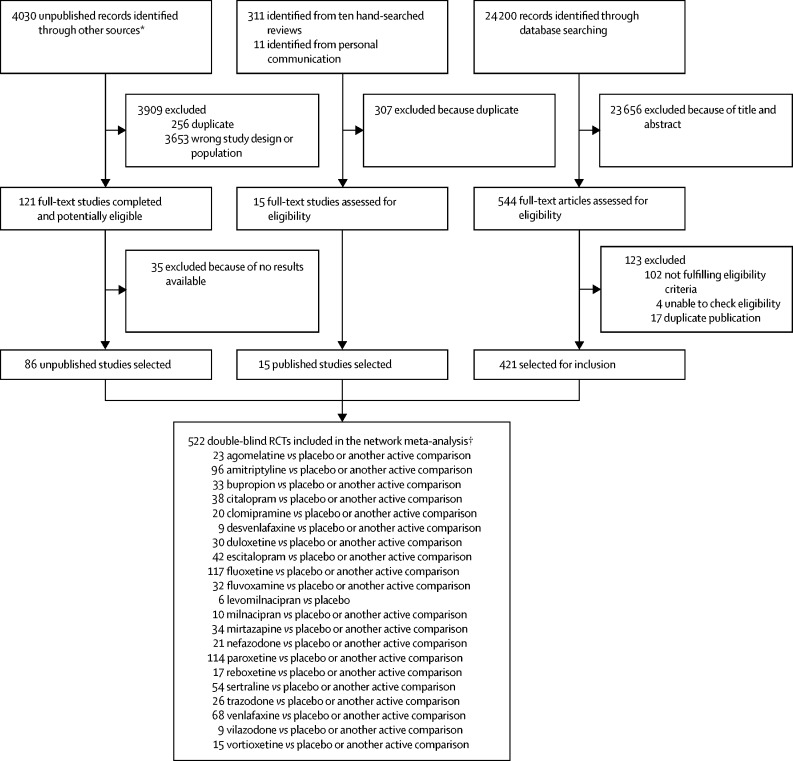
In this systematic review and network meta-analysis of 522 double-blind randomised trials (116,477 participants), all 21 antidepressants were more efficacious than placebo for acute treatment of adults with major depressive disorder, though effect sizes were mostly modest. Some drugs showed more favourable efficacy/acceptability profiles, but many comparative estimates had wide credible intervals and certainty of evidence was moderate to very low.
Key findings
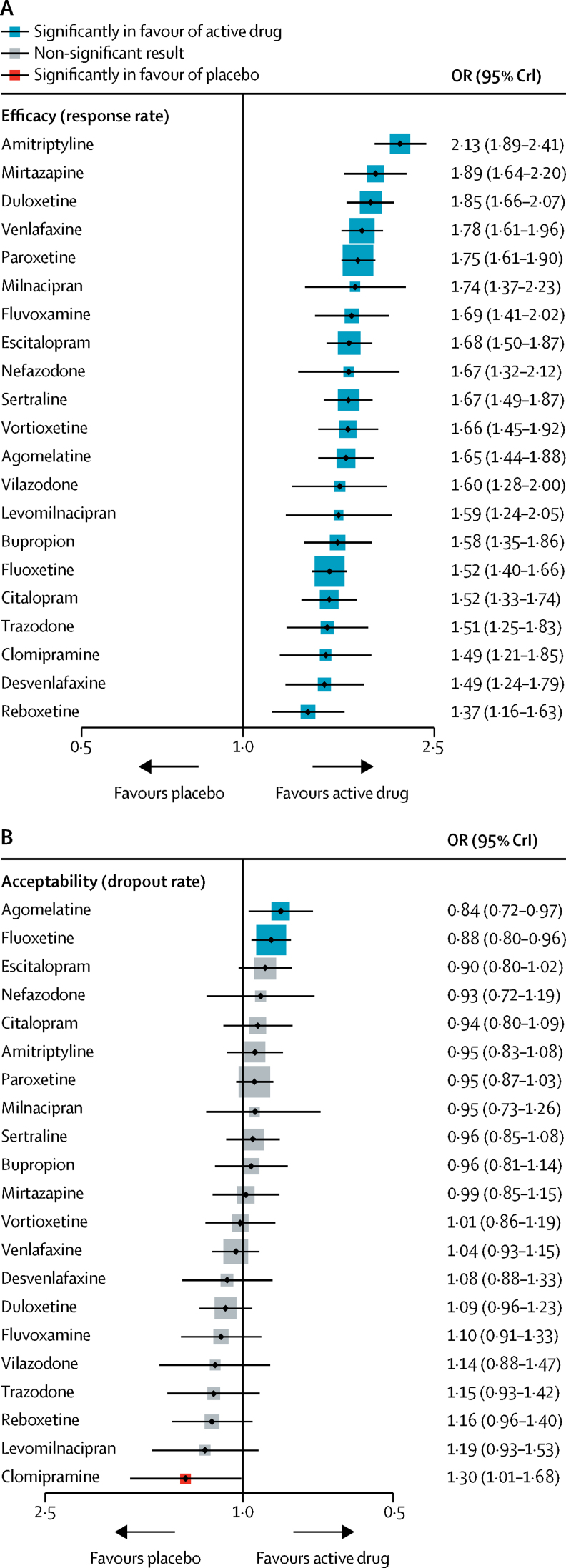
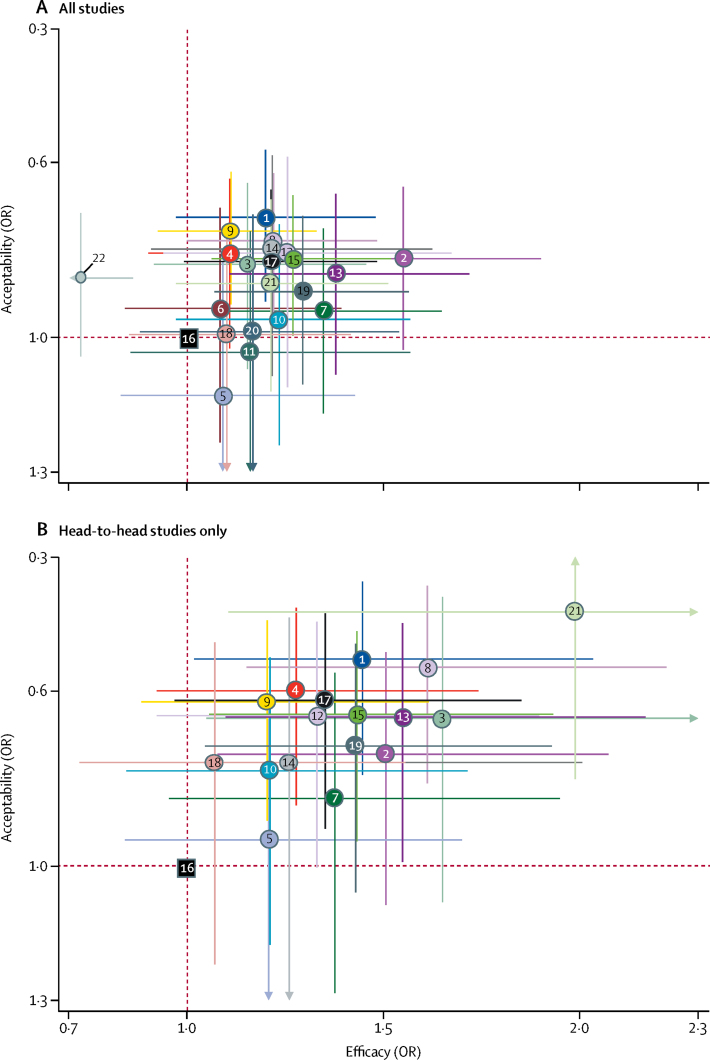
- Across 522 trials and 116,477 participants, all antidepressants were more effective than placebo, with ORs ranging from 2·13 (95% CrI 1·89–2·41) for amitriptyline to 1·37 (1·16–1·63) for reboxetine.
- For acceptability, only agomelatine (OR 0·84, 95% CrI 0·72–0·97) and fluoxetine (0·88, 0·80–0·96) were associated with fewer dropouts than placebo, whereas clomipramine was worse than placebo (1·30, 1·01–1·68).
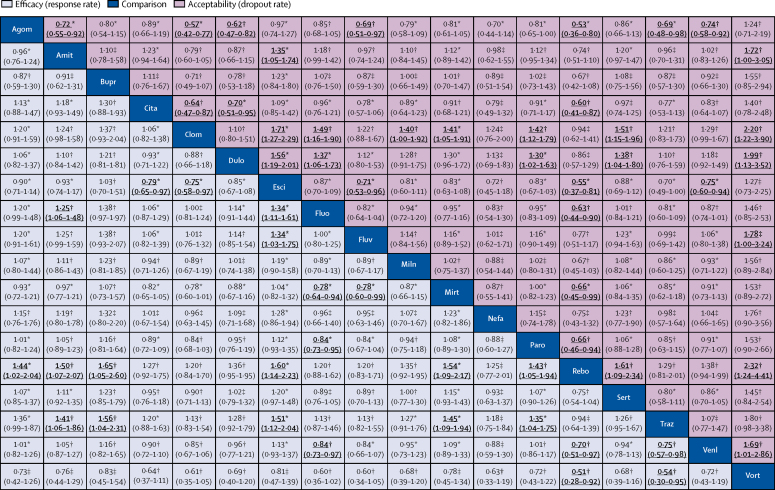
- In head-to-head studies, agomelatine, amitriptyline, escitalopram, mirtazapine, paroxetine, venlafaxine, and vortioxetine were more effective than other antidepressants (ORs 1·19–1·96), while fluoxetine, fluvoxamine, reboxetine, and trazodone were least efficacious (0·51–0·84). For acceptability, agomelatine, citalopram, escitalopram, fluoxetine, sertraline, and vortioxetine were more tolerable (0·43–0·77), while amitriptyline, clomipramine, duloxetine, fluvoxamine, reboxetine, trazodone, and venlafaxine had the highest dropout rates (1·30–2·32).
- Risk of bias was high in 46 (9%) of 522 trials, moderate in 380 (73%), and low in 96 (18%); certainty of evidence was moderate to very low, and differences between active drugs ranged from 1·15 to 1·55 for efficacy and 0·64 to 0·83 for acceptability, with wide CrIs on most comparative analyses.
Methods
- Systematic review and network meta-analysis; searched Cochrane Central Register of Controlled Trials, CINAHL, Embase, LILACS, MEDLINE, MEDLINE In-Process, PsycINFO, regulatory agency websites, and international registers from inception to Jan 8, 2016.
- Included double-blind randomised controlled trials of 21 antidepressants or placebo as oral monotherapy for acute treatment of adults (≥18 years, both sexes) with major depressive disorder diagnosed by standard operationalised criteria; excluded quasi-randomised trials and trials with ≥20% bipolar disorder, psychotic depression, treatment-resistant depression, or serious concomitant medical illness.
- Primary outcomes were efficacy (response rate, ≥50% reduction on a standardised observer-rating scale) and acceptability (all-cause treatment discontinuation); estimated summary ORs using random-effects pairwise and network meta-analysis, assessed risk of bias and GRADE certainty, and ranked treatments with SUCRA; PROSPERO CRD42012002291.
Limitations
- Stated by the paper: many comparisons were low or very low certainty (e.g., involving amitriptyline, bupropion, venlafaxine); many trials did not report adequate information about randomisation and allocation concealment; analyses covered only average treatment effects and could not investigate individual-patient modifiers; patients with psychotic or treatment-resistant depression were excluded; trials were short duration; unpublished data were incomplete for some drugs; no formal cost-effectiveness analysis; and results cannot guide next-step choices after first treatment failure.
- Evident from the text: most comparative analyses had wide credible intervals; 9% of trials were high risk of bias and 73% moderate; network meta-analysis depends on transitivity and consistency assumptions; and placebo-controlled versus head-to-head results differed, including a novelty effect favouring experimental drugs.
Model-written summary. Check it against the paper before relying on it.
Integrity signals
Registry
Cites
Statistics
Figures
Verification
Claims the paper makes
15 Valid · 0 Not valid · 10 Not checked · 93 Own results and interpretations
Every source the paper cites for this claim was checked and supports it.
In the paper
“However, there is a long-lasting debate and concern about their efficacy and effectiveness, because short-term benefits are, on average, modest; and because long-term balance of benefits and harms is often understudied.4”
§ Comparative efficacy and acceptability of 21 antidepressant drugs for the acute treatment of adults with major depressive disorder: a systematic review and network meta-analysis > Introduction
What the sources say
- Supportedcites [4] Ioannidis JP Effectiveness of antidepressants: an evidence myth constructed from a thousand randomized trials? Philos Ethics Humanit Med 3 2008 14 18505564 PMC2412901 source
The Abstract explicitly states that the long-term balance of antidepressants’ benefits and harms is understudied. The Background sections on short follow-up and unknown harms explain that trials are typically brief and provide limited information on harms. (LLM, conf=0.95)
plain- Asserted: passes — The authors put it forward as true.
- Checkable: passes — It can be checked against evidence.
- Load-bearing: unclear — It is unclear whether the paper’s conclusions depend on it.
- Based: passes — The paper gives a reason why it holds.
- Supported
The cited sources support only part of this claim — read each source’s verdict below.
In the paper
“We considered only double-blind trials because we included placebo in the network meta-analysis, and because this study design increases methodological rigour by minimising performance and ascertainment biases.7”
§ Comparative efficacy and acceptability of 21 antidepressant drugs for the acute treatment of adults with major depressive disorder: a systematic review and network meta-analysis > Methods > Search strategy and selection criteria
What the sources say
- Partly supportedcites [7] Hróbjartsson A Thomsen AS Emanuelsson F Observer bias in randomized clinical trials with measurement scale outcomes: a systematic review of trials with both blinded and nonblinded assessors CMAJ 185 2013 E201 E211 23359047 PMC3589328 sourceExperimental — accuracy not yet measured
The Abstract says blinding outcome assessors helps avoid ascertainment bias, and the Conclusion reports a high risk of bias when assessors are not blinded in trials with subjective measurement-scale outcomes. The paper does not establish that double-blind design minimises performance bias; it also cautions in the Abstract that “double-blind” is an ambiguous term. (LLM, conf=0.87)
plainstates a cause- Asserted: passes — The authors put it forward as true.
- Checkable: passes — It can be checked against evidence.
- Load-bearing: passes — The paper’s conclusions depend on it.
- Based: passes — The paper gives a reason why it holds.
- Partly supported
A result the paper reports from its own data — it cites no other source for it, so there is none to check. The quote shows it is in the paper.
In the paper
“We found that all antidepressants included in the meta-analysis were more efficacious than placebo in adults with major depressive disorder”
§ Comparative efficacy and acceptability of 21 antidepressant drugs for the acute treatment of adults with major depressive disorder: a systematic review and network meta-analysis > Discussion
plainstates a cause- Asserted: passes — The authors put it forward as true.
- Checkable: passes — It can be checked against evidence.
- Load-bearing: passes — The paper’s conclusions depend on it.
- Based: passes — The paper gives a reason why it holds.
A result the paper reports from its own data — it cites no other source for it, so there is none to check. The quote shows it is in the paper.
In the paper
“Adjusting for this novelty effect diminished the differences between antidepressants.”
§ Comparative efficacy and acceptability of 21 antidepressant drugs for the acute treatment of adults with major depressive disorder: a systematic review and network meta-analysis > Results
plainstates a cause- Asserted: passes — The authors put it forward as true.
- Checkable: passes — It can be checked against evidence.
- Load-bearing: passes — The paper’s conclusions depend on it.
- Based: passes — The paper gives a reason why it holds.
A result the paper reports from its own data — it cites no other source for it, so there is none to check. The quote shows it is in the paper.
In the paper
“In our analyses, funding by industry was not associated with substantial differences in terms of response or dropout rates.”
§ Comparative efficacy and acceptability of 21 antidepressant drugs for the acute treatment of adults with major depressive disorder: a systematic review and network meta-analysis > Discussion
plain- Asserted: passes — The authors put it forward as true.
- Checkable: passes — It can be checked against evidence.
- Load-bearing: unclear — It is unclear whether the paper’s conclusions depend on it.
- Based: passes — The paper gives a reason why it holds.
49 more claims
Create a free account to see all 118 claims and every source verdict.
- Probably not a substantial claim. 39
- It may state two separate claims as one. 33
Claims other papers make about this one
Each is checked against this paper’s own text: does it say what the citing paper says it does?
The source backs part of the claim, not all of it — or backs it for a different population, condition or comparison.
In the citing paper
“Previous findings suggest that escitalopram and vortioxetine have inherently greater efficacy and acceptability than other antidepressants.7”
From A Randomized Controlled Study of Efficacy and Cognitive Function Improvement of Vortioxetine and Escitalopram in Patients with Depression in Chinese Han Nationality (2024) · cites this paper as [7]
Experimental — accuracy not yet measuredThe source backs part of the claim, not all of it — or backs it for a different population, condition or comparison.
In the citing paper
“Antidepressants are more efficacious than placebo in LLD127.”
From Mechanisms and treatment of late-life depression (2019) · cites this paper as [127]
Experimental — accuracy not yet measuredThe source backs part of the claim, not all of it — or backs it for a different population, condition or comparison.
In the citing paper
“It is wellestablished that psychotherapies and pharmaco logical therapies are effective in the treatment of adult depres sion.”
From A network meta‐analysis of the effects of psychotherapies, pharmacotherapies and their combination in the treatment of adult depression (2020) · cites this paper as [6]
Experimental — accuracy not yet measuredThe source backs part of the claim, not all of it — or backs it for a different population, condition or comparison.
In the citing paper
“The primary limitation of all the available evidence on the effects of antidepressants is that the majority of previous trials assessing the effects of antidepressants have been at high or unclear risk of bias.”
From Should antidepressants be used for major depressive disorder? (2020) · cites this paper as [35]
Experimental — accuracy not yet measuredThe source backs part of the claim, not all of it — or backs it for a different population, condition or comparison.
In the citing paper
“Results of a network meta-analysis of adults with acute MDD also revealed that desvenlafaxine, paroxetine, venlafaxine, and vortioxetine had good efficacy and acceptability [8].”
From Antidepressants for the treatment of adults with major depressive disorder in the maintenance phase: a systematic review and network meta-analysis (2023) · cites this paper as [8]
Experimental — accuracy not yet measured
27 more claims about this paper
Create a free account to see every claim other papers make about this one.
Self-check
Percentages, sums and reported differences re-computed from the paper’s own numbers.
Each contradiction between two passages listed here was confirmed by an independent check.
Rated minor: it would not touch a result — a value no result rests on, a p-value that stays on the same side of the significance level, or a conflict that is clerical, resolved elsewhere in the paper, or outside its own findings.
In the paper
§ Comparative efficacy and acceptability of 21 antidepressant drugs for the acute treatment of adults with major depressive disorder: a systematic review and network meta-analysis > Results
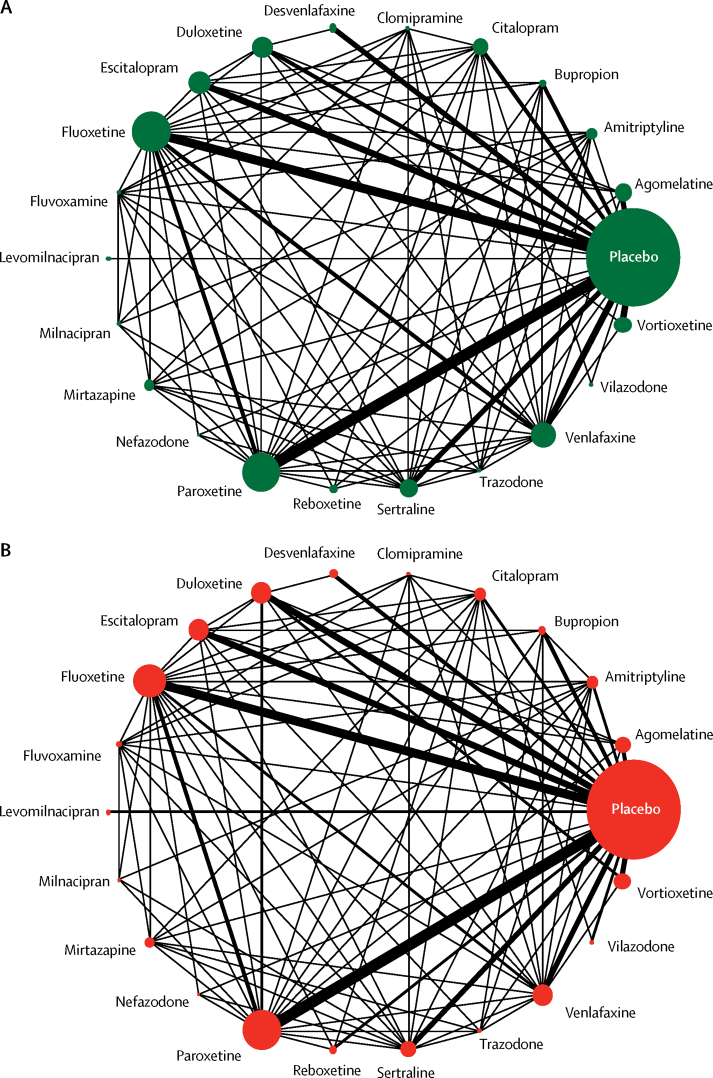
“Only levomilnacipran was not directly compared with at least another active drug in any of the networks.”
§ Comparative efficacy and acceptability of 21 antidepressant drugs for the acute treatment of adults with major depressive disorder: a systematic review and network meta-analysis > Results
“Desvenlafaxine, levomilnacipran, and vilazodone were not included in the head-to-head analysis because these three antidepressants had only placebo-controlled trials.”
Citations
Cites
Salanti, G., Ades, A. E., & Ioannidis, J. P. A. (2011) · Journal of Clinical Epidemiology · doi:10.1016/j.jclinepi.2010.03.016 · Cited by 3,766
Self-citationChecking consistency in mixed treatment comparison meta-analysis
Dias, S., Welton, N. J., Caldwell, D. M., & Ades, A. E. (2010) · Statistics in Medicine · doi:10.1002/sim.3767 · Cited by 2,521
Graphical tools for network meta-analysis in STATA
Chaimani, A., Higgins, J. P. T., Mavridis, D., Spyridonos, P., & Salanti, G. (2013) · PLoS ONE · doi:10.1371/journal.pone.0076654 · Cited by 2,473
Self-citationSelective publication of antidepressant trials and its influence on apparent efficacy
Turner, E. H., Matthews, A. M., Linardatos, E., Tell, R. A., & Rosenthal, R. (2008) · New England Journal of Medicine · doi:10.1056/nejmsa065779 · Cited by 2,435
Self-citationThapar, A., Collishaw, S., Pine, D. S., & Thapar, A. K. (2012) · The Lancet · doi:10.1016/s0140-6736(11)60871-4 · Cited by 2,365
Kassebaum, N. J., Arora, M., Barber, R. M., Bhutta, Z. A., Brown, J., Carter, A., Casey, D. C., Charlson, F. J., Coates, M. M., Coggeshall, M., et al. (2016) · The Lancet · doi:10.1016/s0140-6736(16)31460-x · Cited by 2,163
Consistency and inconsistency in network meta-analysis: concepts and models for multi-arm studies
Higgins, J. P. T., Jackson, D., Barrett, J. K., Lu, G., Ades, A. E., & White, I. R. (2012) · Research Synthesis Methods · doi:10.1002/jrsm.1044 · Cited by 2,098
Self-citationMurray, C. J. L., Barber, R. M., Foreman, K. J., Ozgoren, A. A., Abd-Allah, F., Abera, S. F., Aboyans, V., Abraham, J. P., Abubakar, I., Abu-Raddad, L. J., et al. (2015) · The Lancet · doi:10.1016/s0140-6736(15)61340-x · Cited by 1,964
The BUGS project: evolution, critique and future directions
Lunn, D., Spiegelhalter, D., Thomas, A., & Best, N. (2009) · Statistics in Medicine · doi:10.1002/sim.3680 · Cited by 1,876
Cipriani, A., Furukawa, T. A., Salanti, G., Geddes, J. R., Higgins, J. P., Churchill, R., Watanabe, N., Nakagawa, A., Omori, I. M., McGuire, H., et al. (2009) · The Lancet · doi:10.1016/s0140-6736(09)60046-5 · Cited by 1,654
Self-citation
Cited by
Items 201–300 of 3,536
Kuzminskaite, E., Gathier, A. W., Cuijpers, P., Penninx, B. W. J. H., Ammerman, R. T., Brakemeier, E.-L., Bruijniks, S., Carletto, S., Chakrabarty, T., Douglas, K., et al. (2022) · The Lancet Psychiatry · doi:10.1016/s2215-0366(22)00227-9 · Cited by 92
Chen, X., He, H., Xie, K., Zhang, L., & Cao, C. (2023) · Obesity Reviews · doi:10.1111/obr.13666 · Cited by 122
Van Leeuwen, E., van Driel, M. L., Horowitz, M. A., Kendrick, T., Donald, M., De Sutter, A. I., Robertson, L., & Christiaens, T. (2021) · Cochrane Database of Systematic Reviews · doi:10.1002/14651858.cd013495.pub2 · Cited by 90
Efficacy and safety of duloxetine in osteoarthritis: a systematic review and meta-analysis
Osani, M. C., & Bannuru, R. R. (2019) · The Korean Journal of Internal Medicine · doi:10.3904/kjim.2018.460 · Cited by 107
Efficacy of bio- and neurofeedback for depression: a meta-analysis
Fernández‐Álvarez, J., Grassi, M., Colombo, D., Botella, C., Cipresso, P., Perna, G., & Riva, G. (2021) · Psychological Medicine · doi:10.1017/s0033291721004396 · Cited by 123
Farag, H., Yunusa, I. U., Goswami, H. H., Sultan, I., Doucette, J. A., & Eguale, T. (2022) · JAMA Network Open · doi:10.1001/jamanetworkopen.2022.12939 · Cited by 115
Chen, Y.-J., Li, X., Ma, H.-K., Zhang, X., Wang, B.-W., Guo, T.-T., Xiao, Y., Bing, Z., Ge, L., Yang, K., et al. (2019) · Journal of Pain and Symptom Management · doi:10.1016/j.jpainsymman.2019.09.010 · Cited by 98
Efficacy of psilocybin for treating symptoms of depression: systematic review and meta-analysis
Metaxa, A.-M., & Clarke, M. J. (2024) · BMJ · doi:10.1136/bmj-2023-078084 · Cited by 121
Esketamine Treatment for Depression in Adults: A PRISMA Systematic Review and Meta-Analysis
Fountoulakis, K. N., Saitis, A., & Schatzberg, A. F. (2025) · American Journal of Psychiatry · doi:10.1176/appi.ajp.20240515 · Cited by 90
Perez, N., Langlest, F., Mallet, L., De Pieri, M., Sentissi, O., Thorens, G., Seragnoli, F., Zullino, D., Kirschner, M., Kaiser, S., et al. (2023) · European Neuropsychopharmacology · doi:10.1016/j.euroneuro.2023.07.011 · Cited by 88
Ketamine and the Future of Rapid-Acting Antidepressants
Riggs, L. M., & Gould, T. D. (2021) · Annual Review of Clinical Psychology · doi:10.1146/annurev-clinpsy-072120-014126 · Cited by 87
Scott, F., Hampsey, E., Gnanapragasam, S., Carter, B., Marwood, L., Taylor, R. W., Emre, C., Korotkova, L., Martín-Dombrowski, J., Cleare, A. J., et al. (2023) · Journal of Psychopharmacology · doi:10.1177/02698811221104058 · Cited by 87
Translating the BDI and BDI-II into the HAMD and vice versa with equipercentile linking
Furukawa, T. A., Reijnders, M., Kishimoto, S., Sakata, M., DeRubeis, R. J., Dimidjian, S., Dozois, D. J. A., Hegerl, U., Hollon, S. D., Jarrett, R. B., et al. (2020) · Epidemiology and Psychiatric Sciences · doi:10.1017/s2045796019000088 · Cited by 86
“…will allow researchers to convert these scales onto the common scale so that they would need less assumption when they conduct IPD meta-analysis (Furukawa et al ., 2018); without the conversion the only way to pool individual data was via stand-ardisation assuming a consistent and common…”
Self-citationGenerating comparative evidence on new drugs and devices after approval
Cipriani, A., Ioannidis, J. P. A., Rothwell, P. M., Glasziou, P., Li, T., Hernandez, A. F., Tomlinson, A., Simes, J., & Naci, H. (2020) · The Lancet · doi:10.1016/s0140-6736(19)33177-0 · Cited by 87
Self-citationGosmann, N. P., Costa, M. D. A., Jaeger, M. D. B., Motta, L. S., Frozi, J., Spanemberg, L., Manfro, G. G., Cuijpers, P., Pine, D. S., & Salum, G. A. (2021) · PLOS Medicine · doi:10.1371/journal.pmed.1003664 · Cited by 85
Tozzi, L., Goldstein‐Piekarski, A. N., Korgaonkar, M. S., & Williams, L. M. (2019) · Biological Psychiatry · doi:10.1016/j.biopsych.2019.08.005 · Cited by 94
“The lack of quantitative tests for identifying interventions for individual patients often makes treatment choice a years-long trial-and-error process (2).”
Latest updates on the serotonergic system in depression and anxiety
Lin, J., Liu, W., Guan, J., Cui, J., Shi, R., Wang, L., Chen, D., & Liu, Y. (2023) · Frontiers in Synaptic Neuroscience · doi:10.3389/fnsyn.2023.1124112 · Cited by 113
Omega-3 fatty acids for depression in adults
Appleton, K. M., Voyias, P. D., Sallis, H. M., Dawson, S., Ness, A. R., Churchill, R., & Perry, R. (2021) · Cochrane Database of Systematic Reviews · doi:10.1002/14651858.cd004692.pub5 · Cited by 84
Chahal, R., Gotlib, I. H., & Guyer, A. E. (2020) · Journal of Child Psychology and Psychiatry · doi:10.1111/jcpp.13250 · Cited by 89
“Placebos have been associated with symptom improvement (although to a lesser degree than have antidepressants) in depressed adolescents (Locher et al., 2017) and adults (Cipriani et al., 2018).”
Browning, M., Kingslake, J., Dourish, C. T., Goodwin, G. M., Harmer, C. J., & Dawson, G. R. (2019) · European Neuropsychopharmacology · doi:10.1016/j.euroneuro.2018.11.1102 · Cited by 83
Xu, S., Huang, C., Yuan, X., & Yu, S. (2021) · Angewandte Chemie International Edition · doi:10.1002/anie.202016941 · Cited by 83
The brain-gut-microbiota interplay in depression: A key to design innovative therapeutic approaches
Varesi, A., Campagnoli, L. I. M., Chirumbolo, S., Candiano, B., Carrara, A., Ricevuti, G., Esposito, C., & Pascale, A. (2023) · Pharmacological Research · doi:10.1016/j.phrs.2023.106799 · Cited by 94
Melatonin: Facts, Extrapolations and Clinical Trials
Boutin, J. A., Kennaway, D. J., & Jockers, R. (2023) · Biomolecules · doi:10.3390/biom13060943 · Cited by 103
Pan, F., Shen, Z., Jiao, J., Chen, J., Li, S., Lu, J., Duan, J., Wei, N., Shang, D., Hu, S., et al. (2020) · Clinical Pharmacology & Therapeutics · doi:10.1002/cpt.1858 · Cited by 81
Bizzozero‐Peroni, B., Martínez‐Vizcaíno, V., Fernández‐Rodríguez, R., Jiménez‐López, E., de Arenas‐Arroyo, S. N., Saz‐Lara, A., Goñi, V. D., & Mesas, A. E. (2024) · Nutrition Reviews · doi:10.1093/nutrit/nuad176 · Cited by 115
Fava, M., Thase, M. E., Trivedi, M. H., Ehrich, E., Martin, W. F., Memisoglu, A., Nangia, N., Stanford, A. D., Yu, M., & Pathak, S. (2020) · Molecular Psychiatry · doi:10.1038/s41380-018-0284-1 · Cited by 80
Zhou, X., Zhang, Y., Furukawa, T. A., Cuijpers, P., Pu, J., Weisz, J. R., Yang, L., Hetrick, S. E., Del Giovane, C., Cohen, D., et al. (2019) · JAMA Psychiatry · doi:10.1001/jamapsychiatry.2018.3070 · Cited by 80
Self-citationZhao, D., Pan, J., Yang, W., Han, Y., Zeng, L., Liang, G., & Liu, J. L. (2021) · Arthroscopy The Journal of Arthroscopic and Related Surgery · doi:10.1016/j.arthro.2021.02.045 · Cited by 86
Dorow, M., Löbner, M., Pabst, A., Stein, J., & Riedel-Heller, S. G. (2018) · Frontiers in Psychiatry · doi:10.3389/fpsyt.2018.00181 · Cited by 80
Lea, T., Amada, N. M., Jungaberle, H., Schecke, H., Scherbaum, N., & Klein, M. (2020) · Psychopharmacology · doi:10.1007/s00213-020-05477-0 · Cited by 93
“…example, one-third of depressed patients do not respond to currently available psychiatric medications (Conway et al. 2017), and treatment engagement and adherence for mental and substance use disorders is typically well below 50% (Cipriani et al. 2018; Milward et al. 2014; Whiteford et al. 2014).”
Generating comparative evidence on new drugs and devices before approval
Naci, H., Salcher‐Konrad, M., Kesselheim, A. S., Wieseler, B., Rochaix, L., Redberg, R. F., Salanti, G., Jackson, E., Garner, S. E., Stroup, T. S., et al. (2020) · The Lancet · doi:10.1016/s0140-6736(19)33178-2 · Cited by 93
Self-citationHuhn, M., Nikolakopoulou, A., Schneider‐Thoma, J., Krause, M., Samara, M. T., Peter, N. L., Arndt, T. J., Bäckers, L., Rothe, P., Cipriani, A., et al. (2020) · FOCUS The Journal of Lifelong Learning in Psychiatry · doi:10.1176/appi.focus.18306 · Cited by 103
Self-citationCabana‐Domínguez, J., Torrico, B., Reif, A., Fernàndez‐Castillo, N., & Cormand, B. (2022) · Translational Psychiatry · doi:10.1038/s41398-021-01771-3 · Cited by 100
Is depression the missing link between inflammatory mediators and cancer?
Polityńska, B., Pokorska, O., Wojtukiewicz, A. M., Sawicka, M., Mysliwiec, M., Honn, K. V., Tucker, S. C., & Wojtukiewicz, M. Z. (2022) · Pharmacology & Therapeutics · doi:10.1016/j.pharmthera.2022.108293 · Cited by 89
Efthimiou, O., Taipale, H. T., Raduà, J., Schneider‐Thoma, J., Pinzón-Espinosa, J., Ortuño, M., Vinkers, C. H., Mittendorfer‐Rutz, E., Cardoner, N., Tanskanen, A., et al. (2024) · The Lancet Psychiatry · doi:10.1016/s2215-0366(23)00366-8 · Cited by 106
Self-citationFischer Fumeaux, C. J., Morisod Harari, M., Weisskopf, E., Eap, C. B., Epiney, M., Vial, Y., Csajka, C., Bickle Graz, M., & Panchaud, A. (2019) · Expert Opinion on Drug Safety · doi:10.1080/14740338.2019.1658740 · Cited by 79
Jahangard, L., Sadeghi, A., Ahmadpanah, M., Holsboer-Trachsler, E., Sadeghi Bahmani, D., Haghighi, M., & Brand, S. (2018) · Journal of Psychiatric Research · doi:10.1016/j.jpsychires.2018.09.016 · Cited by 79
The Challenges of Improving Treatments for Depression
Cuijpers, P. (2018) · JAMA · doi:10.1001/jama.2018.17824 · Cited by 78
Solmi, M., Miola, A., Croatto, G., Pigato, G., Favaro, A., Fornaro, M., Berk, M., Smith, L., Quevedo, J., Maes, M., et al. (2021) · Brazilian Journal of Psychiatry · doi:10.1590/1516-4446-2020-0935 · Cited by 78
Lauschke, V. M., & Ingelman‐Sundberg, M. (2019) · European Journal of Pharmaceutical Sciences · doi:10.1016/j.ejps.2019.01.024 · Cited by 88
Elyoseph, Z., Levkovich, I., & Shinan-Altman, S. (2024) · Family Medicine and Community Health · doi:10.1136/fmch-2023-002583 · Cited by 77
Guy, A., Brown, M., Lewis, S., & Horowitz, M. (2020) · Therapeutic Advances in Psychopharmacology · doi:10.1177/2045125320967183 · Cited by 77
Li, Y.-T., Xu, H., Ye, J.-Z., Wu, W.-R., Shi, D., Fang, D.-Q., Liu, Y., & Li, L.-J. (2019) · World Journal of Gastroenterology · doi:10.3748/wjg.v25.i33.4999 · Cited by 77
Pharmacokinetic considerations for current state-of-the-art antidepressants
Wyska, E. (2019) · Expert Opinion on Drug Metabolism & Toxicology · doi:10.1080/17425255.2019.1669560 · Cited by 82
“In turn, monoamine oxidase inhibitors by inhibition of monoamine catabolism may cause many drug–drug interactions as well as interactions with dietary tyramine [6].”
InfluentialKossmeier, M., Tran, U. S., & Voracek, M. (2020) · BMC Medical Research Methodology · doi:10.1186/s12874-020-0911-9 · Cited by 91
Gut Microbiota Changes in Patients With Major Depressive Disorder Treated With Vortioxetine
Ye, X., Wang, D., Zhu, H., Wang, D., Li, J., Tang, Y., & Wu, J. (2021) · Frontiers in Psychiatry · doi:10.3389/fpsyt.2021.641491 · Cited by 96
“Heads up” for creatine supplementation and its potential applications for brain health and function
Candow, D. G., Forbes, S. C., Ostojic, S. M., Prokopidis, K., Stock, M. S., Harmon, K. K., & Faulkner, P. (2023) · Sports Medicine · doi:10.1007/s40279-023-01870-9 · Cited by 78
Ribera, C., Sánchez‐Ortí, J. V., Clarke, G. A., Marx, W., Mörkl, S., & Balanzá‐Martínez, V. (2024) · Neuroscience & Biobehavioral Reviews · doi:10.1016/j.neubiorev.2024.105561 · Cited by 100
“Despite recent advances, response to standard treatments is often suboptimal in terms of achieving full symptom remission or does not always meet patient needs regarding functional outcomes and quality of life (Cipriani et al., 2018; Pinto et al., 2020).”
Leśniewska, A., & Przybylski, P. (2024) · European Journal of Medicinal Chemistry · doi:10.1016/j.ejmech.2024.116556 · Cited by 98
Tundo, A., de Filippis, R., & Crescenzo, F. D. (2019) · Acta Psychiatrica Scandinavica · doi:10.1111/acps.13055 · Cited by 82
Guo, Y., Gan, X., Zhou, H., Zhou, H., Pu, S., Xia, L., Ren, C., Feng, T., & Tang, H. (2020) · Life Sciences · doi:10.1016/j.lfs.2020.118582 · Cited by 74
Medeiros, G. C., Gould, T. D., Prueitt, W. L., Nanavati, J., Grunebaum, M. F., Farber, N. B., Singh, B., Selvaraj, S., Machado-Vieira, R., Achtyes, E. D., et al. (2022) · Molecular Psychiatry · doi:10.1038/s41380-022-01652-1 · Cited by 75
Sleep deprivation as treatment for depression: systematic review and meta-analysis
Ioannou, M., Wartenberg, C., Greenbrook, J. T. V., Larson, T., Magnusson, K., Schmitz, L., Sjögren, P., Stadig, I., Szabó, Z., & Steingrimsson, S. (2021) · Acta Psychiatrica Scandinavica · doi:10.1111/acps.13253 · Cited by 75
Aftab, A., Lee, E. E., Klaus, F., Daly, R., Wu, T.-C., Tu, X., Huege, S., & Jeste, D. V. (2019) · The Journal of Clinical Psychiatry · doi:10.4088/jcp.19m13064 · Cited by 74
Han, C., Wang, S., Bahk, W., Lee, S.-J., Patkar, A. A., Masand, P. S., Mandelli, L., Pae, C., & Serretti, A. (2018) · Clinical Psychopharmacology and Neuroscience · doi:10.9758/cpn.2018.16.4.469 · Cited by 85
Epigenetics: A missing link between early life stress and depression
Juruena, M. F., Gadelrab, R., Cleare, A. J., & Young, A. H. (2021) · Progress in Neuro-Psychopharmacology and Biological Psychiatry · doi:10.1016/j.pnpbp.2020.110231 · Cited by 74
Associations between education levels and prevalence of depressive symptoms: NHANES (2005–2018)
Li, L., Sun, W., Luo, J., & Huang, H. (2022) · Journal of Affective Disorders · doi:10.1016/j.jad.2022.01.010 · Cited by 102
Biselli, T., Lange, S. S., Sablottny, L., Steffen, J., & Walther, A. (2021) · European Journal of Neuroscience · doi:10.1111/ejn.14603 · Cited by 72
Theta burst stimulation for depression: a systematic review and network and pairwise meta-analysis
Kishi, T., Ikuta, T., Sakuma, K., Hatano, M., Matsuda, Y., Wilkening, J., Goya-Maldonado, R., Tik, M., Williams, N. R., Kito, S., et al. (2024) · Molecular Psychiatry · doi:10.1038/s41380-024-02630-5 · Cited by 74
Syme, K., & Hagen, E. H. (2019) · American Journal of Physical Anthropology · doi:10.1002/ajpa.23965 · Cited by 92
Allida, S., Cox, K. L., Hsieh, C.-F., Lang, H., House, A., & Hackett, M. L. (2020) · Cochrane Database of Systematic Reviews · doi:10.1002/14651858.cd003437.pub4 · Cited by 71
Suchting, R., Tirumalaraju, V., Gareeb, R., Bockmann, T., de Dios, C., Aickareth, J., Pinjari, O., Soares, J. C., Cowen, P. J., & Selvaraj, S. (2021) · Journal of Affective Disorders · doi:10.1016/j.jad.2021.01.021 · Cited by 73
Wang, X., Wang, Z.-T., Hu, H., Qu, Y., Wang, M.-M., Shen, X., Xu, W., Dong, Q., Tan, L., & Yu, J.-T. (2021) · The Journal of Prevention of Alzheimer s Disease · doi:10.14283/jpad.2021.27 · Cited by 88
Mikola, T., Marx, W., Lane, M. M., Hockey, M., Loughman, A., Rajapolvi, S., Rocks, T., O'Neil, A. E., Mischoulon, D., Valkonen‐Korhonen, M., et al. (2022) · Critical Reviews in Food Science and Nutrition · doi:10.1080/10408398.2022.2096560 · Cited by 102
New trends in personalized treatment of depression
Sampogna, G., Toni, C., Catapano, P., Rocca, B. D., Vincenzo, M. D., Luciano, M., & Fiorillo, A. (2023) · Current Opinion in Psychiatry · doi:10.1097/yco.0000000000000903 · Cited by 88
Bschor, T., Nagel, L., Unger, J., Schwarzer, G., & Baethge, C. (2024) · JAMA Psychiatry · doi:10.1001/jamapsychiatry.2024.0994 · Cited by 84
A mechanistic account of serotonin’s impact on mood
Michely, J., Eldar, E., Martin, I. M., & Dolan, R. J. (2020) · Nature Communications · doi:10.1038/s41467-020-16090-2 · Cited by 72
Rewiring of the Serotonin System in Major Depression
Vahid-Ansari, F., & Albert, P. R. (2021) · Frontiers in Psychiatry · doi:10.3389/fpsyt.2021.802581 · Cited by 88
How Oxidative Stress Induces Depression?
Ji, N., Lei, M., Chen, Y., Tian, S., Li, C., & Zhang, B. (2023) · ASN NEURO · doi:10.1177/17590914231181037 · Cited by 93
Karlsson, W. K., Ostinelli, E. G., Zhuang, Z. A., Kokoti, L., Christensen, R. H., Al‐Khazali, H. M., Deligianni, C. I., Tomlinson, A., Ashina, H., de la Torre, E. R., et al. (2024) · BMJ · doi:10.1136/bmj-2024-080107 · Cited by 106
Self-citationMatsuyama, Y., Jürges, H., Dewey, M. E., & Listl, S. (2021) · Epidemiology and Psychiatric Sciences · doi:10.1017/s2045796021000287 · Cited by 86
Pharmacogenomics: A road ahead for precision medicine in psychiatry
Pardiñas, A. F., Owen, M. J., & Walters, J. (2021) · Neuron · doi:10.1016/j.neuron.2021.09.011 · Cited by 91
Forns, J., Pottegård, A., Reinders, T., Poblador‐Plou, B., Morros, R., Brandt, L., Cainzos‐Achirica, M., Hellfritzsch, M., Schink, T., Prados‐Torres, A., et al. (2019) · Journal of Affective Disorders · doi:10.1016/j.jad.2019.02.010 · Cited by 86
“The results of the present study, which highlight citalopram as the most commonly prescribed among study antidepressant initiators in all populations but in Aragon (Spain), where escitalopram was the most often prescribed antidepressant, are in accordance with clinical guidelines to manage major depressive disorder in…”
Arakawa, R., Stenkrona, P., Takano, A., Svensson, J., Andersson, M., Nag, S., Asami, Y., Hirano, Y., Halldin, C., & Lundberg, J. (2019) · International Journal of Neuropsychopharmacology · doi:10.1093/ijnp/pyz003 · Cited by 70
Die Rolle von Placebo- und Nocebomechanismen bei depressiven Erkrankungen und ihrer Therapie
Rief, W. (2020) · Der Nervenarzt · doi:10.1007/s00115-020-00940-x · Cited by 71
Lee, A. R. Y. B., Tariq, A., Lau, G., Tok, N. W. K., Tam, W., & Ho, C. S. H. (2022) · Nutrients · doi:10.3390/nu14030656 · Cited by 89
Noone, C., Leahy, J., Morrissey, E. C., Newell, J., Newell, M., Dwyer, C. P., Murphy, J., Doyle, F., Murphy, A. W., & Molloy, G. J. (2020) · European Journal of Preventive Cardiology · doi:10.1177/2047487319879786 · Cited by 84
Efficacy of journaling in the management of mental illness: a systematic review and meta-analysis
Sohal, M., Singh, P., Dhillon, B. S., & Gill, H. S. (2022) · Family Medicine and Community Health · doi:10.1136/fmch-2021-001154 · Cited by 70
Doleman, B., Mathiesen, O., Sutton, A. J., Cooper, N. J., Lund, J. N., & Williams, J. P. (2023) · British Journal of Anaesthesia · doi:10.1016/j.bja.2023.02.041 · Cited by 94
Duan, W., Cao, D., Wang, S., & Cheng, J. (2023) · Chemical Reviews · doi:10.1021/acs.chemrev.3c00375 · Cited by 85
Gutsmiedl, K., Krause, M., Bighelli, I., Schneider‐Thoma, J., & Leucht, S. (2020) · BMC Psychiatry · doi:10.1186/s12888-020-02514-2 · Cited by 88
Self-citationHiggins, G. A., Carroll, N. K., Brown, M., MacMillan, C., Silenieks, L. B., Thevarkunnel, S., Izhakova, J., Magomedova, L., DeLannoy, I., & Sellers, E. M. (2021) · Frontiers in Pharmacology · doi:10.3389/fphar.2021.640241 · Cited by 69
Heterogeneity of treatment effects in trials on psychotherapy of depression.
Kaiser, T., Volkmann, C., Volkmann, A., Karyotaki, E., Cuijpers, P., & Brakemeier, E.-L. (2022) · Clinical Psychology: Science and Practice · doi:10.1037/cps0000079 · Cited by 76
Giluk (2009) · doi:10.1017/s003329172000389x · Cited by 68
Hengartner, M. P., Jakobsen, J. C., Sørensen, A., & Plöderl, M. (2020) · PLOS ONE · doi:10.1371/journal.pone.0229381 · Cited by 66
Allopregnanolone in mood disorders: Mechanism and therapeutic development
Chen, S., Gao, L., Li, X., & Ye, Y. (2021) · Pharmacological Research · doi:10.1016/j.phrs.2021.105682 · Cited by 75
Cuijpers, P., Oud, M., Karyotaki, E., Noma, H., Quero, S., Cipriani, A., Arroll, B., & Furukawa, T. A. (2021) · The Annals of Family Medicine · doi:10.1370/afm.2676 · Cited by 67
Self-citationGut microbiome: A potential indicator for predicting treatment outcomes in major depressive disorder
Dong, Z., Shen, X., Hao, Y., Li, J., Xu, H., Li, Y., & Kuang, W. (2022) · Frontiers in Neuroscience · doi:10.3389/fnins.2022.813075 · Cited by 75
Sickness behaviour and depression: An updated model of peripheral-central immunity interactions
Turkheimer, F., Veronese, M., Mondelli, V., Cash, D., & Pariante, C. M. (2023) · Brain Behavior and Immunity · doi:10.1016/j.bbi.2023.03.031 · Cited by 73
Probiotics for the treatment of depression and its comorbidities: A systemic review
Gao, J., Zhao, N., Cheng, Y., Lei, W., Wang, Y., Liu, X., Zheng, N., Shao, L., Chen, X., Sun, Y., et al. (2023) · Frontiers in Cellular and Infection Microbiology · doi:10.3389/fcimb.2023.1167116 · Cited by 87
De Diego-Adeliño, J., Crespo, J. M., Mora, F., Neyra, A., Iborra, P., Gutiérrez-Rojas, L., & Salonia, S. F. (2022) · Expert Opinion on Drug Safety · doi:10.1080/14740338.2022.2019705 · Cited by 67
Antidepressant use and risk of adverse outcomes: population-based cohort study
Bansal, N., Hudda, M., Payne, R. A., Smith, D. J., Kessler, D., & Wiles, N. (2022) · BJPsych Open · doi:10.1192/bjo.2022.563 · Cited by 66
Sørensen, A., Ruhé, H. G., & Munkholm, K. (2022) · Molecular Psychiatry · doi:10.1038/s41380-021-01285-w · Cited by 65
Self-citationDealing with missing outcome data in meta‐analysis
Mavridis, D., & White, I. R. (2020) · Research Synthesis Methods · doi:10.1002/jrsm.1349 · Cited by 65
Pharmacological management of post-stroke depression
Castilla‐Guerra, L., Moreno, M. D. C. F., Esparrago-Llorca, G., & Colmenero-Camacho, M. Á. (2019) · Expert Review of Neurotherapeutics · doi:10.1080/14737175.2020.1707666 · Cited by 74
“A recent meta-analysis [44] compared 21 antidepressants with placebo or each other, directly within trials and indirectly across trials.”
Culturally adapted psychotherapies for depressed adults: A systematic review and meta-analysis
Anik, E., West, R. M., Cardno, A. G., & Mir, G. (2021) · Journal of Affective Disorders · doi:10.1016/j.jad.2020.09.051 · Cited by 65
Lee, M. T., Peng, W.-H., Kan, H.-W., Wu, C.-C., Wang, D.-W., & Ho, Y.-C. (2022) · Biomedicines · doi:10.3390/biomedicines10051005 · Cited by 65
Lopez, R. B., Denny, B. T., & Fagundes, C. P. (2018) · Neuroscience & Biobehavioral Reviews · doi:10.1016/j.neubiorev.2018.10.019 · Cited by 65
Krause, M., Gutsmiedl, K., Bighelli, I., Schneider-Thoma, J., Chaimani, A., & Leucht, S. (2019) · European Neuropsychopharmacology · doi:10.1016/j.euroneuro.2019.07.130 · Cited by 65
Self-citationManosso, L. M., Camargo, A., Dafré, A. L., & Rodrigues, A. L. S. (2020) · Nutritional Neuroscience · doi:10.1080/1028415x.2020.1853417 · Cited by 69
Metadata
- Authors
- Cipriani, A., Furukawa, T. A., Salanti, G., Chaimani, A., Atkinson, L. Z., Ogawa, Y., Leucht, S., Ruhe, H. G., Turner, E. H., Higgins, J. P. T., Egger, M., Takeshima, N., Hayasaka, Y., Imai, H., Shinohara, K., Tajika, A., Ioannidis, J. P. A., & Geddes, J. R.
- Affiliations
- Oxford Health NHS Foundation Trust (GB)
- Kyoto University (JP)
- University of Bern (CH)
- Inserm (FR)
- Warneford Hospital (GB)
- Technical University of Munich (DE)
- Oregon Health & Science University (US)
- University of Bristol (GB)
- Stanford University (US)
- Corresponding author
- Cipriani, Andrea
- ORCID
- Venue
- The Lancet
- Publisher
- Elsevier BV
- Published
- 2018-04
- Volume
- 391
- Issue
- 10128
- Pages
- 1357-1366
- ISSN
- 0099-5355 (ISSN-L)
- 0140-6736
- PMC
- PMC5889788
- OpenAlex
- W2788337440
- Cited by
- 3,541
- References
- 33
- Citations by year
- 2026: 383 · 2025: 472 · 2024: 469 · 2023: 426 · 2022: 399 · 2021: 423 · 2020: 475 · 2019: 322 · 2018: 163
- FWCI
- 40.44
- Type
- journal article
- Language
- en
- Open access
- hybrid
- doi.org
- Licence
- cc-by
- www.elsevier.com/tdm/userlicense/1.0/ (tdm)
- creativecommons.org/licenses/by/4.0/ (vor)
- Locations
- The Lancet (publishedVersion, cc-by)
- FOCUS The Journal of Lifelong Learning in Psychiatry (publishedVersion, cc-by)
- Europe PMC (PubMed Central) (publishedVersion, cc-by)
- PubMed Central (publishedVersion, cc-by)
- PubMed (publishedVersion)
- PubMed Central (publishedVersion)
- Institutional Repositories DataBase (IRDB) (submittedVersion, cc-by)
- Bern Open Repository and Information System (University of Bern) (submittedVersion, cc-by)
- mediaTUM – the media and publications repository of the Technical University Munich (Technical University Munich) (submittedVersion)
- mediaTUM – the media and publications repository of the Technical University Munich (Technical University Munich) (submittedVersion, other-oa)
- Kyoto University Research Information Repository (Kyoto University) (submittedVersion, cc-by)
- Radboud Repository (Radboud University) (submittedVersion)
- Explore Bristol Research (submittedVersion, cc-by)
- Radboud Repository (Radboud University) (submittedVersion, other-oa)
- Funders
- National Institute for Health and Care Research (BRC‐1215‐20005, NF-SI-0617-10145)
- Japan Society for the Promotion of Science (17K19808, 16K09033)
- Topics
- Health Sciences › Medicine › Pharmacology (medical) › Treatment of Major Depression
- Health Sciences › Medicine › Psychiatry and Mental health › Mental Health Treatment and Access
- Social Sciences › Psychology › Clinical Psychology › Psychotherapy Techniques and Applications
- Keywords
- major depressive disorder, antidepressants, acute treatment, antidepressant efficacy, treatment discontinuation, placebo response, amitriptyline, reboxetine, agomelatine, fluoxetine, venlafaxine, escitalopram, mirtazapine, paroxetine, sertraline, bupropion
- MeSH terms
- Antidepressive Agents, Major Depressive Disorder, Double-Blind Method, Humans, Patient Dropouts, Randomized Controlled Trials as Topic, Treatment Outcome, Evidence-Based Medicine
About these checks
Registry, retraction, Cites and statistics results are computed, not judged, with one exception: a printed reference that no index lists is read once by a model before it counts as a citation error. Claims are extracted by a model and kept only when their quote appears verbatim in the text; each cited source is then checked, with a model’s help, for whether it says what the claim relies on. Those verdicts can be wrong — read the claim’s quote and the cited source before relying on one.
The claim verdicts this report counts are experimental: their accuracy is not yet measured.
A language model drew the claims from the paper on 2026-10-10, under version 3 of the claim definition (model deepseek-v4.1-flash, prompt extract-v3).
A second model labelled each claim on 2026-10-10 (model jev-1.13-20260917, definition revision gold-guideline-v0.2).
Cited sources are checked with a language model’s help (gpt-6-sol).
Statistics and arithmetic are recomputed, not judged.
Confidence bands are shown only for fields calibrated on our annotated test set. None is calibrated yet, so no band is shown.
What counts as a claim ›How we measure confidence ›How we check this ›
Are you an author, or do you see a problem with this page? Request a review
Data sources
Bibliographic data: Semantic Scholar, OpenAlex, Crossref.
Contains information from the Semantic Scholar Academic Graph Datasets, made available under the ODC Attribution License (ODC-BY 1.0).
Semantic Scholar’s data is described in: Kinney, R., et al. (2023). The Semantic Scholar Open Data Platform. arXiv:2301.10140.
