

Effects of aspirin on risks of vascular events and cancer according to bodyweight and dose: analysis of individual patient data from randomised trials
Open accessThe DOI matches its Crossref record; 49 of the 49 references it cites were found in a registry or an index.
Abstract
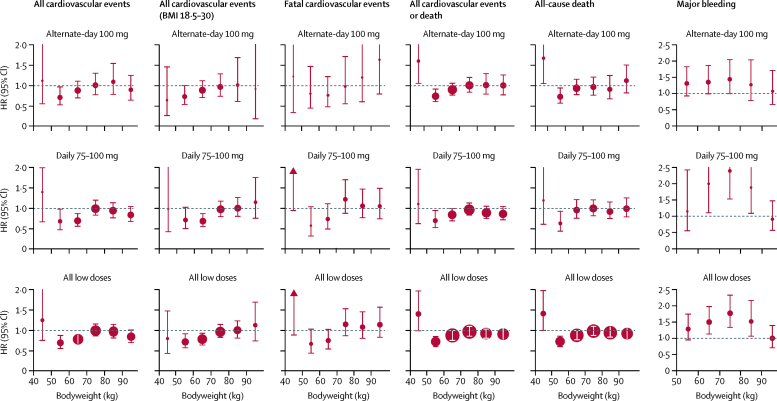
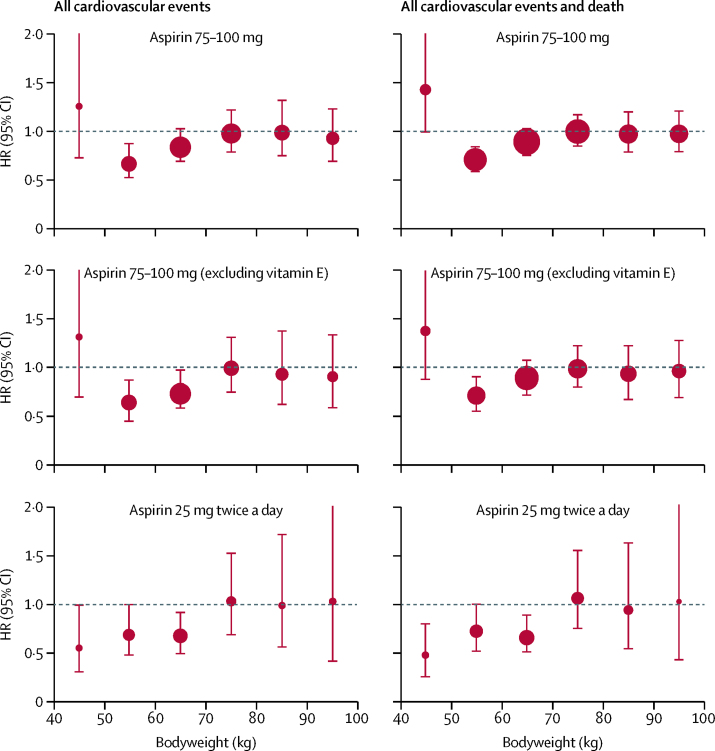
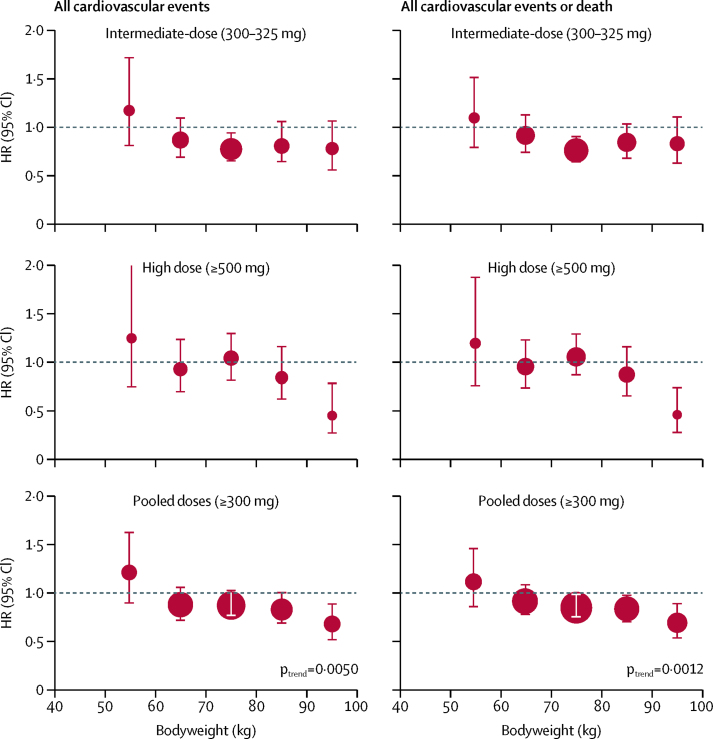
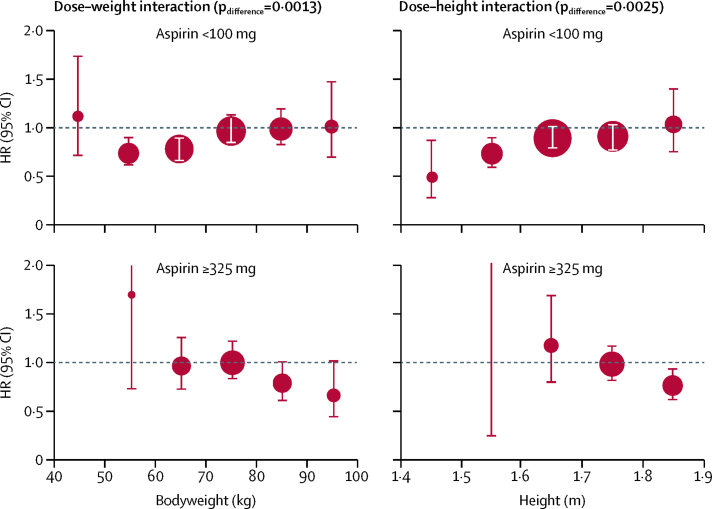
Background A one-dose-fits-all approach to use of aspirin has yielded only modest benefits in long-term prevention of cardiovascular events, possibly due to underdosing in patients of large body size and excess dosing in patients of small body size, which might also affect other outcomes. Methods Using individual patient data, we analysed the modifying effects of bodyweight (10 kg bands) and height (10 cm bands) on the effects of low doses (≤100 mg) and higher doses (300–325 mg or ≥500 mg) of aspirin in randomised trials of aspirin in primary prevention of cardiovascular events. We stratified the findings by age, sex, and vascular risk factors, and validated them in trials of aspirin in secondary prevention of stroke. Additionally, we assessed whether any weight or height dependence was evident for the effect of aspirin on 20-year risk of colorectal cancer or any in-trial cancer. Results Among ten eligible trials of aspirin in primary prevention (including 117 279 participants), bodyweight varied four-fold and trial median weight ranged from 60·0 kg to 81·2 kg (p<0·0001). The ability of 75–100 mg aspirin to reduce cardiovascular events decreased with increasing weight (p interaction =0·0072), with benefit seen in people weighing 50–69 kg (hazard ratio [HR] 0·75 [95% CI 0·65–0·85]) but not in those weighing 70 kg or more (0·95 [0·86–1·04]; 1·09 [0·93–1·29] for vascular death). Furthermore, the case fatality of a first cardiovascular event was increased by low-dose aspirin in people weighing 70 kg or more (odds ratio 1·33 [95% CI 1·08–1·64], p=0·0082). Higher doses of aspirin (≥325 mg) had the opposite interaction with bodyweight (difference p interaction =0·0013), reducing cardiovascular events only at higher weight (p interaction =0·017). Findings were similar in men and women, in people with diabetes, in trials of aspirin in secondary prevention, and in relation to height (p interaction =0·0025 for cardiovascular events). Aspirin-mediated reductions in long-term risk of colorectal cancer were also weight dependent (p interaction =0·038). Stratification by body size also revealed harms due to excess dosing: risk of sudden death was increased by aspirin in people at low weight for dose (p interaction =0·0018) and risk of all-cause death was increased in people weighing less than 50 kg who were receiving 75–100 mg aspirin (HR 1·52 [95% CI 1·04–2·21], p=0·031). In participants aged 70 years or older, the 3-year risk of cancer was also increased by aspirin (1·20 [1·03–1·47], p=0·02), particularly in those weighing less than 70 kg (1·31 [1·07–1·61], p=0·009) and consequently in women (1·44 [1·11–1·87], p=0·0069). Interpretation Low doses of aspirin (75–100 mg) were only effective in preventing vascular events in patients weighing less than 70 kg, and had no benefit in the 80% of men and nearly 50% of all women weighing 70 kg or more. By contrast, higher doses of aspirin were only effective in patients weighing 70 kg or more. Given that aspirin's effects on other outcomes, including cancer, also showed interactions with body size, a one-dose-fits-all approach to aspirin is unlikely to be optimal, and a more tailored strategy is required. Funding Wellcome Trust and National Institute for Health Research Oxford Biomedical Research Centre.
Overview
The claims and statistics of this paper haven’t been checked yet.
Free: it reads the open-access text and checks the first 5 claims that cite a source we can check. Create a free account to check every claim.
Integrity signals
Registry
Cites
Statistics
Figures
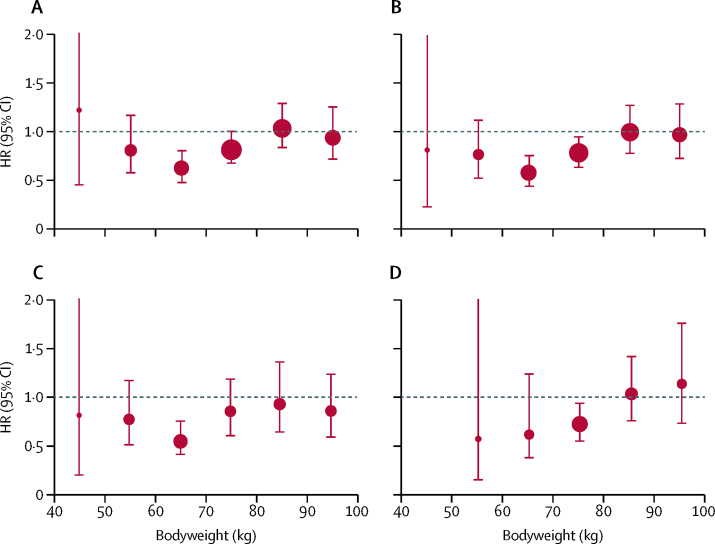
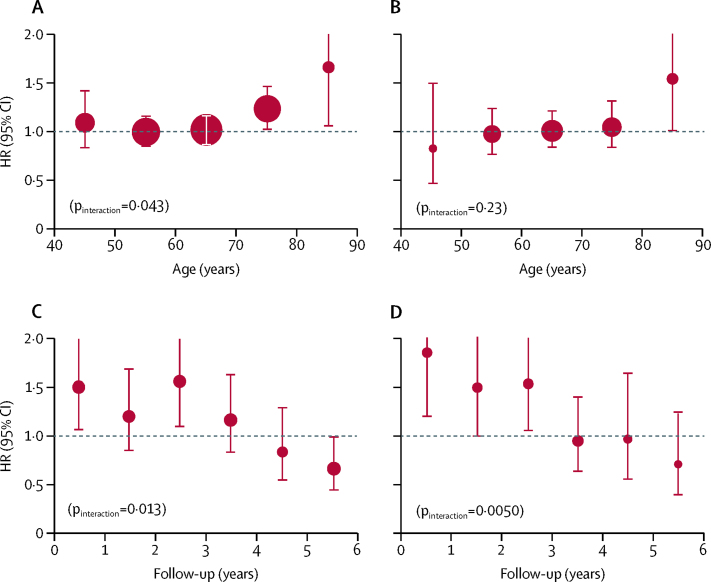
Verification
Claims the paper makes
The claims and statistics of this paper haven’t been checked yet.
Free: it reads the open-access text and checks the first 5 claims that cite a source we can check. Create a free account to check every claim.
Claims other papers make about this one
Each is checked against this paper’s own text: does it say what the citing paper says it does?
The cited source says what the claim attributes to it.
In the citing paper
“A recent analysis suggesting a greater benefit of low-dose aspirin use on the incidence of vascular events among persons with a body weight of less than 70 kg was not confirmed in exploratory subgroup analyses (and, indeed, a trend in the opposite direction was observed).”
From Effects of aspirin for primary prevention in persons with diabetes mellitus (2018) · cites this paper as [19]
The cited source says what the claim attributes to it.
In the citing paper
“Another meta-analysis raised the hypothesis that low-dose aspirin efficacy is reduced in those weighing >70 kg (196); however, the ASCEND trial found benefit of low-dose aspirin in those in this weight range, which would not validate this suggested hypothesis (179).”
From 10. Cardiovascular Disease and Risk Management: Standards of Care in Diabetes—2025 (2025) · cites this paper as [196]
In the citing paper
“Another meta-analysis raised the hypothesis that low-dose aspirin ef fi cacy is reduced in those weighing > 70 kg (161); however, the ASCEND trial found bene fi t of low-dose aspirin in those in this weight range, which would thus not validate this suggested hypothesis (144).”
From 10. Cardiovascular Disease and Risk Management: Standards of Care in Diabetes—2023 (2023) · cites this paper as [161]
Self-check
Percentages, sums and reported differences re-computed from the paper’s own numbers.
The self-check needs the paper’s full text.
Citations
Cites
Zhang, Q., Wang, C., Zheng, M., Li, Y., Li, J., Zhang, L., Shang, X., & Yan, C. (2015) · Cerebrovascular Diseases · doi:10.1159/000369778 · Cited by 11,533
Collaboration, A. T. (2002) · BMJ · doi:10.1136/bmj.324.7329.71 · Cited by 6,943
Hansson, L., Zanchetti, A., Carruthers, S. G., Dahlöf, B., Elmfeldt, D., Julius, S., Ménard, J., Rahn, K. H., Wedel, H., & Westerling, S. (1998) · The Lancet · doi:10.1016/s0140-6736(98)04311-6 · Cited by 5,728
Final Report on the Aspirin Component of the Ongoing Physicians' Health Study
Steering Committee of the Physicians' Health Study Research Group* (1989) · New England Journal of Medicine · doi:10.1056/nejm198907203210301 · Cited by 2,264
A Randomized Trial of Low-Dose Aspirin in the Primary Prevention of Cardiovascular Disease in Women
Ridker, P. M., Cook, N. R., Lee, I.-M., Gordon, D., Gaziano, J. M., Manson, J. E., Hennekens, C. H., & Buring, J. E. (2005) · New England Journal of Medicine · doi:10.1056/nejmoa050613 · Cited by 1,945
Self-citationEAFT (European Atrial Fibrillation Trial) Study Group (1993) · The Lancet · doi:10.1016/0140-6736(93)92358-z · Cited by 1,741
Rothwell, P. M., Fowkes, F. G. R., Belch, J. F., Ogawa, H., Warlow, C. P., & Meade, T. W. (2011) · The Lancet · doi:10.1016/s0140-6736(10)62110-1 · Cited by 1,497
Self-citationRothwell, P. M., Wilson, M., Elwin, C.-E., Norrving, B., Algra, A., Warlow, C. P., & Meade, T. W. (2010) · The Lancet · doi:10.1016/s0140-6736(10)61543-7 · Cited by 1,351
Self-citationThe United Kingdom transient ischaemic attack (UK-TIA) aspirin trial: final results.
Farrell, B., Godwin, J., Richards, S., & Warlow, C. (1991) · Journal of Neurology, Neurosurgery & Psychiatry · doi:10.1136/jnnp.54.12.1044 · Cited by 1,203
Randomised trial of prophylactic daily aspirin in British male doctors
Peto, R., Gray, R., Collins, R., Wheatley, K., Hennekens, C., Jamrozik, K., Warlow, C., Hafner, B., Thompson, E., Norton, S., et al. (1988) · BMJ · doi:10.1136/bmj.296.6618.313 · Cited by 1,166
Roncaglioni, M. C. (2001) · The Lancet · doi:10.1016/s0140-6736(00)03539-x · Cited by 999
Self-citationBelch, J., MacCuish, A., Campbell, I., Cobbe, S., Taylor, R., Prescott, R., Lee, R., Bancroft, J., MacEwan, S., Shepherd, J., et al. (2008) · BMJ · doi:10.1136/bmj.a1840 · Cited by 977
Self-citationA Randomized Trial of Aspirin and Sulfinpyrazone in Threatened Stroke
The Canadian Cooperative Study Group (1978) · New England Journal of Medicine · doi:10.1056/nejm197807132990201 · Cited by 957
Bibbins-Domingo, K., & on behalf of the U.S. Preventive Services Task Force* (2016) · Annals of Internal Medicine · doi:10.7326/m16-0577 · Cited by 854
Rothwell, P. M., Price, J. F., Fowkes, F. G. R., Zanchetti, A., Roncaglioni, M. C., Tognoni, G., Lee, R., Belch, J. F., Wilson, M., Mehta, Z., et al. (2012) · The Lancet · doi:10.1016/s0140-6736(11)61720-0 · Cited by 839
Self-citationCook, N. R., Lee, I.-M., Gaziano, J. M., Gordon, D., Ridker, P. M., Manson, J. E., Hennekens, C. H., & Buring, J. E. (2005) · JAMA · doi:10.1001/jama.294.1.47 · Cited by 796
Self-citationBerger, J. S., Roncaglioni, M. C., Avanzini, F., Pangrazzi, I., Tognoni, G., & Brown, D. L. (2006) · JAMA · doi:10.1001/jama.295.3.306 · Cited by 789
Self-citation(1991) · New England Journal of Medicine · doi:10.1056/nejm199110313251801 · Cited by 759
Fowkes, F. G. R. (2010) · JAMA · doi:10.1001/jama.2010.221 · Cited by 624
The Salt Collaborative Group (1991) · The Lancet · doi:10.1016/0140-6736(91)92233-r · Cited by 553
JUULMOLLER, S. (1992) · The Lancet · doi:10.1016/0140-6736(92)92619-q · Cited by 517
Kassoff, A. (1992) · JAMA · doi:10.1001/jama.1992.03490100090033 · Cited by 481
Mahaffey, K. W., Wojdyla, D. M., Carroll, K., Becker, R. C., Storey, R. F., Angiolillo, D. J., Held, C., Cannon, C. P., James, S., Pieper, K. S., et al. (2011) · Circulation · doi:10.1161/circulationaha.111.047498 · Cited by 434
Rothwell, P. M., Algra, A., Chen, Z., Diener, H.-C., Norrving, B., & Mehta, Z. (2016) · The Lancet · doi:10.1016/s0140-6736(16)30468-8 · Cited by 403
Self-citationLi, L., Geraghty, O. C., Mehta, Z., & Rothwell, P. M. (2017) · The Lancet · doi:10.1016/s0140-6736(17)30770-5 · Cited by 393
Self-citationSuppression of Thromboxane A2but Not of Systemic Prostacyclin by Controlled-Release Aspirin
Clarke, R. J., Mayo, G., Price, P., & FitzGerald, G. A. (1991) · New England Journal of Medicine · doi:10.1056/nejm199110173251605 · Cited by 346
Ikeda, Y., Shimada, K., Teramoto, T., Uchiyama, S., Yamazaki, T., Oikawa, S., Sugawara, M., Ando, K., Murata, M., Yokoyama, K., et al. (2014) · JAMA · doi:10.1001/jama.2014.15690 · Cited by 301
Aspirin Use and Colorectal Cancer: Post-Trial Follow-up Data from the Physicians' Health Study
Sturmer, T., Glynn, R. J., Lee, I.-M., Manson, J. E., Buring, J. E., & Hennekens, C. H. (1998) · Annals of Internal Medicine · doi:10.7326/0003-4819-128-9-199805010-00003 · Cited by 294
Platelet Response to Low-Dose Enteric-Coated Aspirin in Patients With Stable Cardiovascular Disease
Maree, A. O., Curtin, R. J., Dooley, M., Conroy, R. M., Crean, P., Cox, D., & Fitzgerald, D. J. (2005) · Journal of the American College of Cardiology · doi:10.1016/j.jacc.2005.06.058 · Cited by 228
Capodanno, D., Patel, A., Dharmashankar, K., Ferreiro, J. L., Ueno, M., Kodali, M., Tomasello, S. D., Capranzano, P., Seecheran, N., Darlington, A., et al. (2011) · Circulation: Cardiovascular Interventions · doi:10.1161/circinterventions.110.960187 · Cited by 187
Molecular Pathways: Is AMPK a Friend or a Foe in Cancer?
Hardie, D. G. (2015) · Clinical Cancer Research · doi:10.1158/1078-0432.ccr-14-3300 · Cited by 161
Insulin Resistance as a Determinant of Platelet Activation in Obese Women
Basili, S., Pacini, G., Guagnano, M. T., Manigrasso, M. R., Santilli, F., Pettinella, C., Ciabattoni, G., Patrono, C., & Davì, G. (2006) · Journal of the American College of Cardiology · doi:10.1016/j.jacc.2006.08.040 · Cited by 157
The Multifaceted Clinical Readouts of Platelet Inhibition by Low-Dose Aspirin
Patrono, C. (2015) · Journal of the American College of Cardiology · doi:10.1016/j.jacc.2015.05.012 · Cited by 145
Cook, N. R., Cole, S. R., & Hennekens, C. H. (2002) · American Journal of Epidemiology · doi:10.1093/aje/155.11.1045 · Cited by 99
Self-citationErlinge, D., ten Berg, J. M., Foley, D., Angiolillo, D. J., Wagner, H., Brown, P. B., Zhou, C., Luo, J., Jakubowski, J. A., Moser, B. A., et al. (2012) · Journal of the American College of Cardiology · doi:10.1016/j.jacc.2012.08.964 · Cited by 84
Boutaud, O. G., Sosa, I. R., Amin, T., Oram, D., Adler, D. H., Hwang, H. S., Crews, B. C., Milne, G. L., Harris, B. K., Hoeksema, M., et al. (2016) · Cancer Prevention Research · doi:10.1158/1940-6207.capr-16-0094 · Cited by 62
European stroke prevention study 2: Efficacy and safety data
Diener, H., FORBES, C., RIEKKINEN, P., Sivenius, J., Smets, P., & LOWENTHAL, A. (1997) · Journal of the Neurological Sciences · doi:10.1016/s0022-510x(97)86566-5 · Cited by 48
A Randomized Trial of Aspirin at Clinically Relevant Doses and Nitric Oxide Formation in Humans
Hennekens, C. H., Schneider, W. R., Pokov, A. N., Hetzel, S., DeMets, D. L., Serebruany, V. L., & Schröder, H. (2010) · Journal of Cardiovascular Pharmacology and Therapeutics · doi:10.1177/1074248410375091 · Cited by 39
Type 2 Diabetes, Obesity, and Aspirin Responsiveness
Patrono, C., & Rocca, B. (2017) · Journal of the American College of Cardiology · doi:10.1016/j.jacc.2016.11.049 · Cited by 37
Aspirin Increases Nitric Oxide Formation in Chronic Stable Coronary Disease
Hetzel, S., DeMets, D. L., Schneider, R. M., Borzak, S. L., Schneider, W. R., Serebruany, V. L., Schröder, H., & Hennekens, C. H. (2013) · Journal of Cardiovascular Pharmacology and Therapeutics · doi:10.1177/1074248413482753 · Cited by 31
In Silico Modeling of the Antiplatelet Pharmacodynamics of Low‐dose Aspirin in Health and Disease
Giaretta, A., Rocca, B., Camillo, B. D., Toffolo, G. M., & Patrono, C. (2017) · Clinical Pharmacology & Therapeutics · doi:10.1002/cpt.694 · Cited by 31
Rocca, B., Squellerio, I., Dragani, A., Veglia, F., Pagliaccia, F., Porro, B., Barbieri, S. S., Tremoli, E., Patrono, C., & Cavalca, V. (2014) · Thrombosis and Haemostasis · doi:10.1160/th13-10-0844 · Cited by 24
Colwell, J. A., Bingham, S. F., Abraira, C., Anderson, J. W., Comstock, J. P., Kwaan, H. C., & Nuttall, F. Q. (1989) · Journal of Diabetes and its Complications · doi:10.1016/0891-6632(89)90029-9 · Cited by 12
Research works printed but not linked: 1
- Schrör K Acetylsalicylic acid 2nd edn. 2016 Wiley-VCH Weinheim
Cited by
Cosentino, F., Grant, P. J., Aboyans, V., Bailey, C. J., Ceriello, A., Delgado, V., Federici, M., Filippatos, G., Grobbee, D. E., Hansen, T. B., et al. (2020) · European Heart Journal · doi:10.1093/eurheartj/ehz486 · Cited by 4,763
Arnett, D. K., Blumenthal, R. S., Albert, M. A., Buroker, A. B., Goldberger, Z. D., Hahn, E. J., Himmelfarb, C. D., Khera, A., Lloyd-Jones, D., McEvoy, J. W., et al. (2019) · Circulation · doi:10.1161/cir.0000000000000678 · Cited by 4,536
(2019) · doi:10.1161/cir.0000000000000677 · Cited by 4,501
Kleindorfer, D. O., Towfighi, A., Chaturvedi, S., Cockroft, K. M., Gutierrez, J., Lombardi-Hill, D., Kamel, H., Kernan, W. N., Kittner, S. J., Leira, E. C., et al. (2021) · Stroke · doi:10.1161/str.0000000000000375 · Cited by 3,237
2019 ACC/AHA Guideline on the Primary Prevention of Cardiovascular Disease
Arnett, D. K., Blumenthal, R. S., Albert, M. A., Buroker, A. B., Goldberger, Z. D., Hahn, E. J., Himmelfarb, C. D., Khera, A., Lloyd-Jones, D., McEvoy, J. W., et al. (2019) · Journal of the American College of Cardiology · doi:10.1016/j.jacc.2019.03.010 · Cited by 1,896
Metadata
- Authors
- Rothwell, P. M., Cook, N. R., Gaziano, J. M., Price, J. F., Belch, J. F. F., Roncaglioni, M. C., Morimoto, T., & Mehta, Z.
- Affiliations
- University of Oxford (GB)
- Brigham and Women's Hospital (US)
- Harvard University (US)
- University of Edinburgh (GB)
- Mario Negri Institute for Pharmacological Research (IT)
- Hyogo Medical University (JP)
- Corresponding author
- Rothwell, Peter M
- Venue
- The Lancet
- Publisher
- Elsevier BV
- Published
- 2018-08
- Volume
- 392
- Issue
- 10145
- Pages
- 387-399
- ISSN
- 0099-5355 (ISSN-L)
- 0140-6736
- PMC
- PMC6083400
- OpenAlex
- W2884727639
- Cited by
- 353
- References
- 49
- Citations by year
- 2026: 12 · 2025: 22 · 2024: 29 · 2023: 32 · 2022: 46 · 2021: 51 · 2020: 57 · 2019: 68 · 2018: 36
- FWCI
- 40.10
- Type
- journal article
- Language
- en
- Open access
- hybrid
- doi.org
- Licence
- cc-by
- www.elsevier.com/tdm/userlicense/1.0/ (tdm)
- creativecommons.org/licenses/by/4.0/ (vor)
- Locations
- The Lancet (publishedVersion, cc-by)
- Europe PMC (PubMed Central) (publishedVersion, cc-by)
- PubMed Central (publishedVersion, cc-by)
- PubMed (publishedVersion)
- Discovery Research Portal (University of Dundee) (publishedVersion, cc-by)
- Edinburgh Research Explorer (University of Edinburgh) (submittedVersion, cc-by)
- Funders
- Wellcome Trust
- National Institute for Health and Care Research
- Japan Society for the Promotion of Science (18H03032)
- Topics
- Health Sciences › Medicine › Cardiology and Cardiovascular Medicine › Antiplatelet Therapy and Cardiovascular Diseases
- Health Sciences › Medicine › Pharmacology (medical) › Inflammatory mediators and NSAID effects
- Health Sciences › Medicine › Cardiology and Cardiovascular Medicine › Lipoproteins and Cardiovascular Health
- Keywords
- aspirin, body weight, aspirin dose, cardiovascular events, cancer risk, colorectal cancer, vascular death, case fatality, primary prevention, secondary stroke prevention, dose-response interaction, individual patient data, height, individualized dosing, vascular risk factors, diabetes mellitus, sex differences, cardiovascular mortality, cancer mortality, myocardial infarction
- MeSH terms
- Age Factors, Aged, Aspirin, Body Height, Body Weight, Cardiovascular Diseases, Death, Sudden, Female, Humans, Male, Platelet Aggregation Inhibitors, Risk Factors, Sex Factors, Colorectal Neoplasms, Proportional Hazards Models, Randomized Controlled Trials as Topic, Stroke, Kaplan-Meier Estimate
About these checks
Registry, retraction, Cites and statistics results are computed, not judged, with one exception: a printed reference that no index lists is read once by a model before it counts as a citation error. Claims are extracted by a model and kept only when their quote appears verbatim in the text; each cited source is then checked, with a model’s help, for whether it says what the claim relies on. Those verdicts can be wrong — read the claim’s quote and the cited source before relying on one.
Statistics and arithmetic are recomputed, not judged.
Confidence bands are shown only for fields calibrated on our annotated test set. None is calibrated yet, so no band is shown.
What counts as a claim ›How we measure confidence ›How we check this ›
Are you an author, or do you see a problem with this page? Request a review
Data sources
Bibliographic data: Semantic Scholar, OpenAlex, Crossref.
Contains information from the Semantic Scholar Academic Graph Datasets, made available under the ODC Attribution License (ODC-BY 1.0).
Semantic Scholar’s data is described in: Kinney, R., et al. (2023). The Semantic Scholar Open Data Platform. arXiv:2301.10140.
