

Daily emollient during infancy for prevention of eczema: the BEEP randomised controlled trial
Open accessThe DOI matches its Crossref record; 34 of the 34 references it cites were found in a registry or an index.
Abstract
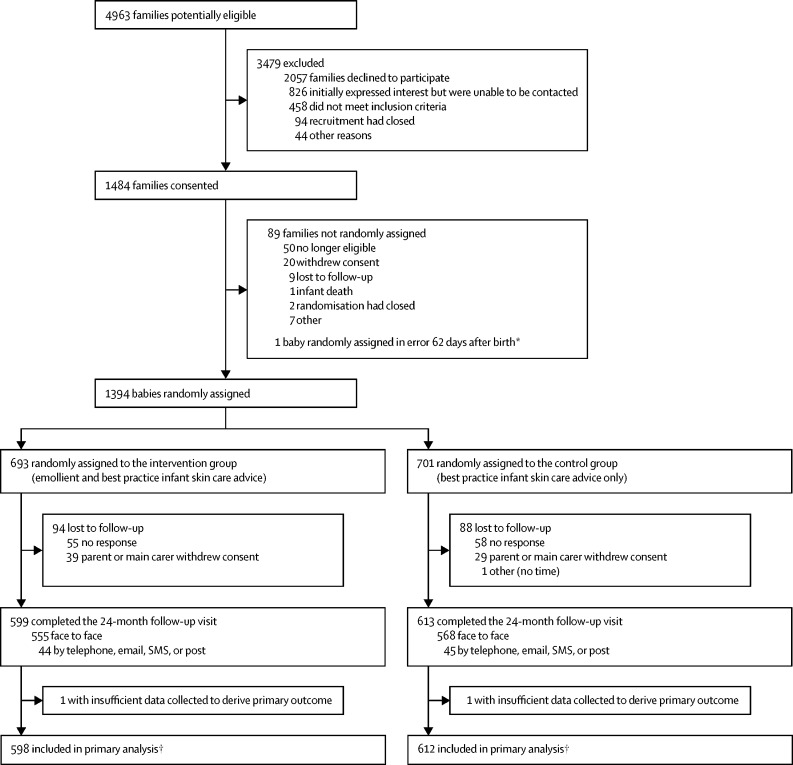
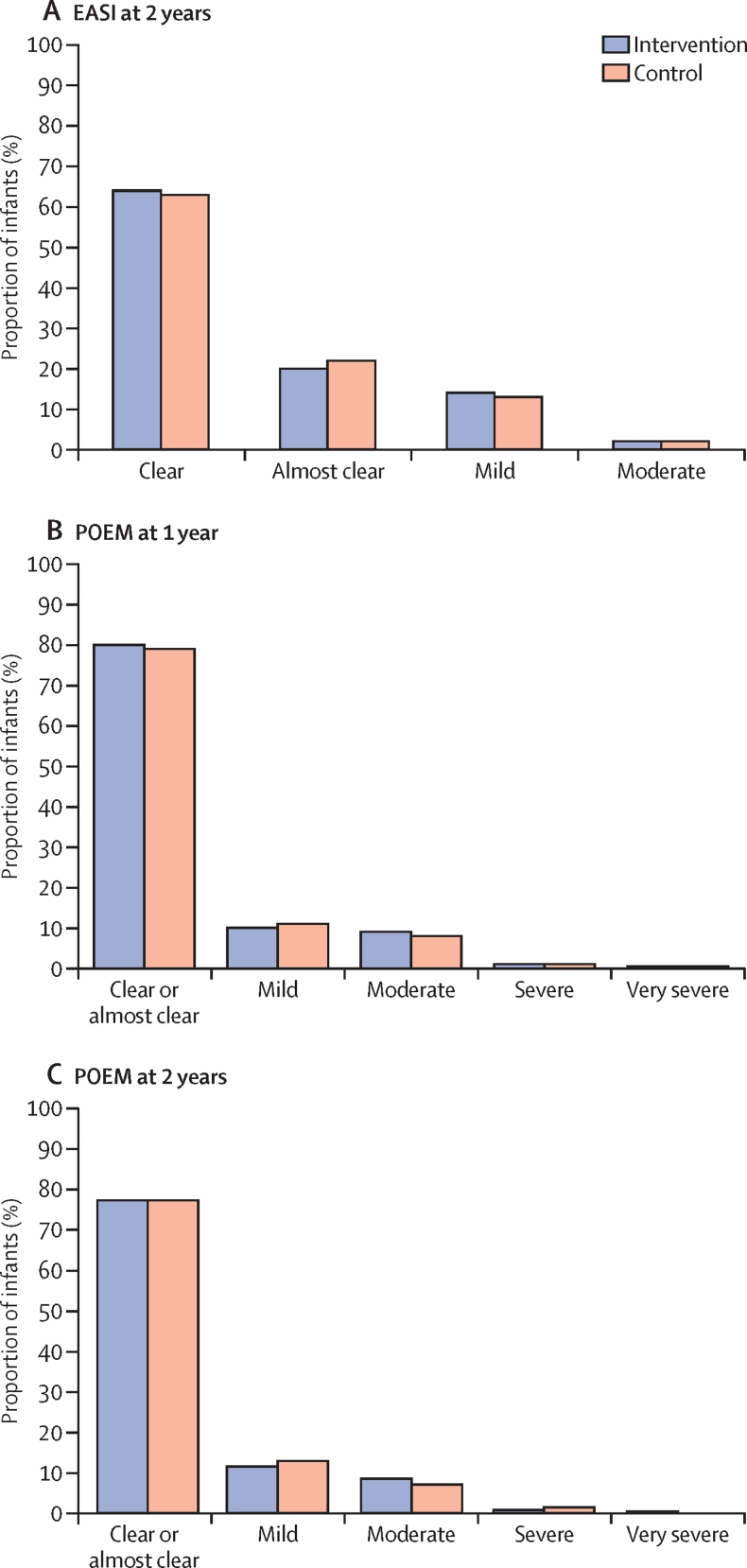
BACKGROUND: Skin barrier dysfunction precedes eczema development. We tested whether daily use of emollient in the first year could prevent eczema in high-risk children. METHODS: We did a multicentre, pragmatic, parallel-group, randomised controlled trial in 12 hospitals and four primary care sites across the UK. Families were approached via antenatal or postnatal services for recruitment of term infants (at least 37 weeks' gestation) at high risk of developing eczema (ie, at least one first-degree relative with parent-reported eczema, allergic rhinitis, or asthma, diagnosed by a doctor). Term newborns with a family history of atopic disease were randomly assigned (1:1) to application of emollient daily (either Diprobase cream or DoubleBase gel) for the first year plus standard skin-care advice (emollient group) or standard skin-care advice only (control group). The randomisation schedule was created using computer-generated code (stratified by recruiting centre and number of first-degree relatives with atopic disease) and participants were assigned to groups using an internet-based randomisation system. The primary outcome was eczema at age 2 years (defined by UK working party criteria) with analysis as randomised regardless of adherence to allocation for participants with outcome data collected, and adjusting for stratification variables. This trial is registered with ISRCTN, ISRCTN21528841. Data collection for long-term follow-up is ongoing, but the trial is closed to recruitment. FINDINGS: 1394 newborns were randomly assigned to study groups between Nov 19, 2014, and Nov 18, 2016; 693 were assigned to the emollient group and 701 to the control group. Adherence in the emollient group was 88% (466 of 532) at 3 months, 82% (427 of 519) at 6 months, and 74% (375 of 506) at 12 months in those with complete questionnaire data. At age 2 years, eczema was present in 139 (23%) of 598 infants with outcome data collected in the emollient group and 150 (25%) of 612 infants in the control group (adjusted relative risk 0·95 [95% CI 0·78 to 1·16], p=0·61; adjusted risk difference -1·2% [-5·9 to 3·6]). Other eczema definitions supported the results of the primary analysis. Mean number of skin infections per child in year 1 was 0·23 (SD 0·68) in the emollient group versus 0·15 (0·46) in the control group; adjusted incidence rate ratio 1·55 (95% CI 1·15 to 2·09). INTERPRETATION: We found no evidence that daily emollient during the first year of life prevents eczema in high-risk children and some evidence to suggest an increased risk of skin infections. Our study shows that families with eczema, asthma, or allergic rhinitis should not use daily emollients to try and prevent eczema in their newborn. FUNDING: National Institute for Health Research Health Technology Assessment.
Overview
The claims and statistics of this paper haven’t been checked yet.
Free: it reads the open-access text and checks the first 5 claims that cite a source we can check. Create a free account to check every claim.
Integrity signals
Registry
Cites
Statistics
Figures
Verification
Claims the paper makes
The claims and statistics of this paper haven’t been checked yet.
Free: it reads the open-access text and checks the first 5 claims that cite a source we can check. Create a free account to check every claim.
Claims other papers make about this one
Each is checked against this paper’s own text: does it say what the citing paper says it does?
The cited source doesn’t support the claim as written.
In the citing paper
“the BEEP study showed that emollients can increase the risk of AD due to the colonization of pathogens on the skin”
From Update on the pathogenesis of atopic dermatitis. (2024) · cites this paper as [11]
Checked by a reasoning model — may be wrong.
Experimental — accuracy not yet measuredThe source backs part of the claim, not all of it — or backs it for a different population, condition or comparison.
In the citing paper
“The skin barrier dysfunction that occurs in AD increases permeability to allergens and irritants, contributing to loss of hydration and persistence of subclinical skin inflammation.”
From Update on the pathogenesis of atopic dermatitis. (2024) · cites this paper as [11]
Experimental — accuracy not yet measuredThe check wasn’t confident either way, so it gives no verdict — never disputed.
In the citing paper
“S. aureus colonization is associated with an increased risk of food allergy.”
From Update on the pathogenesis of atopic dermatitis. (2024) · cites this paper as [11]
Experimental — accuracy not yet measured
Self-check
Percentages, sums and reported differences re-computed from the paper’s own numbers.
The self-check needs the paper’s full text.
Citations
Cites
1 retracted
Kelleher, M., Dunn-Galvin, A., Hourihane, J. O., Murray, D., Campbell, L. E., McLean, W. H. I., & Irvine, A. D. (2015) · Journal of Allergy and Clinical Immunology · doi:10.1016/j.jaci.2014.12.013 · Cited by 225
Self-citationRetractedKyu, H. H., Abate, D., Abate, K. H., Abay, S. M., Abbafati, C., Abbasi, N., Abbastabar, H., Abd-Allah, F., Abdela, J., Abdelalim, A., et al. (2018) · The Lancet · doi:10.1016/s0140-6736(18)32335-3 · Cited by 4,081
Atopic Dermatitis: Global Epidemiology and Risk Factors
Nutten, S. (2015) · Annals of Nutrition and Metabolism · doi:10.1159/000370220 · Cited by 3,055
Filaggrin Mutations Associated with Skin and Allergic Diseases
Irvine, A. D., McLean, W. H. I., & Leung, D. Y. M. (2011) · New England Journal of Medicine · doi:10.1056/nejmra1011040 · Cited by 1,217
Global variations in prevalence of eczema symptoms in children from ISAAC Phase Three
Odhiambo, J. A., Williams, H. C., Clayton, T. O., Robertson, C. F., & Asher, M. I. (2009) · Journal of Allergy and Clinical Immunology · doi:10.1016/j.jaci.2009.10.009 · Cited by 966
Self-citationWILLIAMS, H. C., JBURNEY, P. G., PEMBROKE, A. C., HAY, R. J., & Party, A. D. D. C. W. (1994) · British Journal of Dermatology · doi:10.1111/j.1365-2133.1994.tb08532.x · Cited by 926
Self-citationEmollient enhancement of the skin barrier from birth offers effective atopic dermatitis prevention
Simpson, E. L., Chalmers, J. R., Hanifin, J. M., Thomas, K. S., Cork, M. J., McLean, W. H. I., Brown, S. J., Chen, Z., Chen, Y., & Williams, H. C. (2014) · Journal of Allergy and Clinical Immunology · doi:10.1016/j.jaci.2014.08.005 · Cited by 722
Self-citationSandilands, A., Terron-Kwiatkowski, A., Hull, P. R., O'Regan, G. M., Clayton, T. H., Watson, R. M., Carrick, T., Evans, A. T., Liao, H., Zhao, Y., et al. (2007) · Nature Genetics · doi:10.1038/ng2020 · Cited by 662
Application of moisturizer to neonates prevents development of atopic dermatitis
Horimukai, K., Morita, K., Narita, M., Kondo, M., Kitazawa, H., Nozaki, M., Shigematsu, Y., Yoshida, K., Niizeki, H., Motomura, K.-I., et al. (2014) · Journal of Allergy and Clinical Immunology · doi:10.1016/j.jaci.2014.07.060 · Cited by 607
Hill, D. A., & Spergel, J. M. (2018) · Annals of Allergy, Asthma & Immunology · doi:10.1016/j.anai.2017.10.037 · Cited by 427
Research works printed but not linked: 2
- The National Institute for Health and Care Excellence Postnatal care up to 8 weeks after birth https://www.nice.org.uk/guidance/cg37 2015 32065741
- The National Institute for Health and Care Excellence Atopic eczema in under 12s: diagnosis and management https://www.nice.org.uk/guidance/cg57 2007 34101396
Cited by
Wollenberg, A., Christen‐Zäch, S., Taieb, A., Paul, C., Thyssen, J. P., de Bruin‐Weller, M., Vestergaard, C., Seneschal, J., Werfel, T., Cork, M. J., et al. (2020) · Journal of the European Academy of Dermatology and Venereology · doi:10.1111/jdv.16892 · Cited by 493
Self-citationHalken, S., Muraro, A., de Silva, D., Khaleva, E., Angier, E., Arasi, S., Arshad, H., Bahnson, H. T., Beyer, K., Boyle, R., et al. (2021) · Pediatric Allergy and Immunology · doi:10.1111/pai.13496 · Cited by 445
Self-citationGuttman-Yassky, E., Renert-Yuval, Y., & Brunner, P. M. (2025) · The Lancet · doi:10.1016/s0140-6736(24)02519-4 · Cited by 321
Wollenberg, A., Kinberger, M., Arents, B., Aszodi, N., Avila Valle, G., Barbarot, S., Bieber, T., Brough, H. A., Calzavara Pinton, P., Christen‐Zäch, S., et al. (2022) · Journal of the European Academy of Dermatology and Venereology · doi:10.1111/jdv.18429 · Cited by 289
Self-citationUpdate on the Pathogenesis and Therapy of Atopic Dermatitis
Li, H., Zhang, Z., Zhang, H., Guo, Y., & Yao, Z. (2021) · Clinical Reviews in Allergy & Immunology · doi:10.1007/s12016-021-08880-3 · Cited by 277
“The BEEP randomized controlled trial showed no evidence that daily emollients during the first year of life prevented eczema in high-risk children and there was some evidence to suggest an increased risk of skin infections [72].”
BackgroundBrough, H. A., Nadeau, K. C., Sindher, S. B., Alkotob, S. S., Chan, S., Bahnson, H. T., Leung, D. Y. M., & Lack, G. (2020) · Allergy · doi:10.1111/all.14304 · Cited by 275
Subtypes of atopic dermatitis: From phenotype to endotype
Tokura, Y., & Hayano, S. (2022) · Allergology International · doi:10.1016/j.alit.2021.07.003 · Cited by 244
Skjerven, H. O., Rehbinder, E. M., Vettukattil, R., LeBlanc, M., Granum, B., Haugen, G., Hedlin, G., Landrø, L., Marsland, B. J., Rudi, K., et al. (2020) · The Lancet · doi:10.1016/s0140-6736(19)32983-6 · Cited by 234
Atopic dermatitis: Role of the skin barrier, environment, microbiome, and therapeutic agents
Luger, T., Amagai, M., Dreno, B., Dagnelie, M.-A., Liao, W., Kabashima, K., Schikowski, T., Proksch, E., Elias, P. M., Simon, M., et al. (2021) · Journal of Dermatological Science · doi:10.1016/j.jdermsci.2021.04.007 · Cited by 206
Self-citationThe Skin Barrier and Moisturization: Function, Disruption, and Mechanisms of Repair
Rajkumar, J., Chandan, N., Lio, P., & Shi, V. (2023) · Skin Pharmacology and Physiology · doi:10.1159/000534136 · Cited by 193
Skjerven, H. O., Lie, A., Vettukattil, R., Rehbinder, E. M., LeBlanc, M., Asarnoj, A., Carlsen, K.-H., Despriee, Å. W., Färdig, M., Gerdin, S. W., et al. (2022) · The Lancet · doi:10.1016/s0140-6736(22)00687-0 · Cited by 182
Stefanovic, N., & Irvine, A. D. (2023) · Annals of Allergy Asthma & Immunology · doi:10.1016/j.anai.2023.09.009 · Cited by 175
Disease modification in inflammatory skin disorders: opportunities and challenges
Bieber, T. R. M. (2023) · Nature Reviews Drug Discovery · doi:10.1038/s41573-023-00735-0 · Cited by 141
Skin care interventions in infants for preventing eczema and food allergy
Kelleher, M. M., Cro, S., Cornelius, V., Lodrup Carlsen, K. C., Skjerven, H. O., Rehbinder, E. M., Lowe, A. J., Dissanayake, E., Shimojo, N., Yonezawa, K., et al. (2021) · Cochrane Database of Systematic Reviews · doi:10.1002/14651858.cd013534.pub2 · Cited by 99
Self-citationFood allergy: epidemiology, pathogenesis, diagnosis, prevention, and treatment
Lopes, J. P., & Sicherer, S. (2020) · Current Opinion in Immunology · doi:10.1016/j.coi.2020.03.014 · Cited by 114
Peters, R. L., Guarnieri, I., Tang, M. L. K., Lowe, A. J., Dharmage, S. C., Perrett, K. P., Gurrin, L. C., & Koplin, J. J. (2022) · Journal of Allergy and Clinical Immunology · doi:10.1016/j.jaci.2022.04.008 · Cited by 112
S3 Guideline Allergy Prevention
Kopp, M. V., Muche‐Borowski, C., Abou-Dakn, M., Ahrens, B., Beyer, K., Blümchen, K., Bubel, P., Chaker, A. M., Cremer, M., Ensenauer, R., et al. (2022) · Allergologie select · doi:10.5414/alx02303e · Cited by 128
Early intervention and prevention of allergic diseases
Brough, H. A., Lanser, B. J., Sindher, S., Teng, J. M. C., Leung, D. Y. M., Venter, C., Chan, S., Santos, A. F., Bahnson, H. T., Guttman‐Yassky, E., et al. (2021) · Allergy · doi:10.1111/all.15006 · Cited by 123
Allergy and immunology in young children of Japan: The JECS cohort
Yamamoto‐Hanada, K., Pak, K., Saito‐Abe, M., Yang, L., Sato, M., Irahara, M., Mezawa, H., Sasaki, H., Nishizato, M., Ishitsuka, K., et al. (2020) · World Allergy Organization Journal · doi:10.1016/j.waojou.2020.100479 · Cited by 125
The Role of the Environment and Exposome in Atopic Dermatitis
Stefanovic, N., Irvine, A. D., & Flohr, C. (2021) · Current Treatment Options in Allergy · doi:10.1007/s40521-021-00289-9 · Cited by 94
Self-citationMoisturizer in Patients with Inflammatory Skin Diseases
Kang, S. Y., Um, J., Chung, B. Y., Lee, S., Park, J. S., Kim, J. C., Park, C. W., & Kim, H. O. (2022) · Medicina · doi:10.3390/medicina58070888 · Cited by 115
Skin care interventions in infants for preventing eczema and food allergy
Kelleher, M. M., Phillips, R., Brown, S., Cro, S., Cornelius, V. R., Carlsen, K. C. L., Skjerven, H. O., Rehbinder, E. M., Lowe, A. J., Dissanayake, E., et al. (2022) · Cochrane Database of Systematic Reviews · doi:10.1002/14651858.cd013534.pub3 · Cited by 115
Self-citationEmollients in infancy to prevent atopic dermatitis: A systematic review and meta‐analysis
Zhong, Y., Samuel, M., Bever, H. V., & Tham, E. H. (2021) · Allergy · doi:10.1111/all.15116 · Cited by 111
“…et al., 2018, France23 Total number of infants = 120 Intervention = 60, Control = 60b Not assessed Not reported Not reported NA NA NA NA Chalmers et al., 2020, United Kingdom (BEEP)16 Total number of infants = 1394; Intervention = 693 (pp = 598), Control = 701 (pp = 612) Study period:…”
BackgroundMethodInfluentialDemessant‐Flavigny, A., Connétable, S., Kérob, D., Moreau, M., Aguilar, L., & Wollenberg, A. (2023) · Journal of the European Academy of Dermatology and Venereology · doi:10.1111/jdv.19125 · Cited by 114
“However, it has been suggested that increased skin infections in this aforementioned study may have been due to increased inoculation of pathogens on the infant skin during application of emollients, disturbance of the skin microbiome or emollients making the skin more adhesive to bacteria.(65) Newer emollients termed…”
BackgroundResultChaoimh, C. N., Lad, D., Nico, C., Puppels, G. J., Wong, X. F. C. C., Common, J., Murray, D. M., Irvine, A. D., & Hourihane, J. O. (2022) · Allergy · doi:10.1111/all.15491 · Cited by 110
Food allergy, mechanisms, diagnosis and treatment: Innovation through a multi‐targeted approach
Sindher, S., Long, A. J., Chin, A. R., Hy, A., Sampath, V., Nadeau, K. C., & Chinthrajah, R. S. (2022) · Allergy · doi:10.1111/all.15418 · Cited by 103
“63-65 In contrast, studies employing moisturizers, such as trilipid creams, that do not contain food allergen components and more closely mimic the skin microenvironment have indeed observed reductions in food sensitization 66 accompanied by increases in peanut-specific IgG, decreases in…”
BackgroundSkin barrier defects in atopic dermatitis: From old idea to new opportunity
Yoshida, T., Beck, L. A., & Benedetto, A. D. (2021) · Allergology International · doi:10.1016/j.alit.2021.11.006 · Cited by 104
Targeting Skin Barrier Function in Atopic Dermatitis
van den Bogaard, E. H., Elias, P. M., Goleva, E., Berdyshev, E., Smits, J. P. H., Danby, S. G., Cork, M. J., & Leung, D. Y. M. (2023) · The Journal of Allergy and Clinical Immunology: In Practice · doi:10.1016/j.jaip.2023.02.005 · Cited by 81
Self-citationChristensen, M. O., Barakji, Y. A., Loft, N., Khatib, C. M., Egeberg, A., Thomsen, S. F., Silverberg, J. I., Flohr, C., Maul, J., Schmid‐Grendelmeier, P., et al. (2023) · Journal of the European Academy of Dermatology and Venereology · doi:10.1111/jdv.18919 · Cited by 99
Self-citationAtopic Dermatitis and Food Allergy: A Complex Interplay What We Know and What We Would Like to Learn
Papapostolou, N., Xepapadaki, P. V., Gregoriou, S., & Makris, M. P. (2022) · Journal of Clinical Medicine · doi:10.3390/jcm11144232 · Cited by 95
“Thus, the strategy of early introduction of allergenic foods in infants’ diets may have a beneficial effect in reducing food allergy incidence, but possible effects to AD are yet to be discovered through well-designed RCTs. J. Clin.”
BackgroundResultExploring the skin microbiome in atopic dermatitis pathogenesis and disease modification
Hülpüsch, C., Rohayem, R., Reiger, M., & Traidl‐Hoffmann, C. (2024) · Journal of Allergy and Clinical Immunology · doi:10.1016/j.jaci.2024.04.029 · Cited by 94
From Emollients to Biologicals: Targeting Atopic Dermatitis
Salvati, L., Cosmi, L., & Annunziato, F. (2021) · International Journal of Molecular Sciences · doi:10.3390/ijms221910381 · Cited by 93
Association of frequent moisturizer use in early infancy with the development of food allergy
Perkin, M. R., Logan, K., Marrs, T., Radulović, S., Craven, J., Boyle, R. J., Chalmers, J. R., Williams, H. C., Versteeg, S. A., van Ree, R., et al. (2021) · Journal of Allergy and Clinical Immunology · doi:10.1016/j.jaci.2020.10.044 · Cited by 87
“The study showed that the moisturization intervention did not prevent eczema.(12) At age 2 years, eczema was present in 139 of 598 infants (23%) in the emollient group and 150 of 612 infants (25%) in the control group (adjusted relative risk, 0$95; 95%CI, 0.”
BackgroundSelf-citationSkin biomarkers predict development of atopic dermatitis in infancy
Rinnov, M. R., Halling, A., Gerner, T., Ravn, N. H., Knudgaard, M. H., Trautner, S., Goorden, S. M. I., der Vlugt, K. G., Stet, F. S., Skov, L., et al. (2022) · Allergy · doi:10.1111/all.15518 · Cited by 87
Allergy: Mechanistic insights into new methods of prevention and therapy
Akdiş, C. A., Akdiş, M., Boyd, S. D., Sampath, V., Galli, S. J., & Nadeau, K. C. (2023) · Science Translational Medicine · doi:10.1126/scitranslmed.add2563 · Cited by 88
An Overview of Environmental Risk Factors for Food Allergy
Peters, R. L., Mavoa, S., & Koplin, J. J. (2022) · International Journal of Environmental Research and Public Health · doi:10.3390/ijerph19020722 · Cited by 86
S3 guideline Allergy Prevention
Kopp, M., Muche‐Borowski, C., Abou‐Dakn, M., Ahrens, B., Beyer, K., Blümchen, K., Bubel, P., Chaker, A. M., Cremer, M., Ensenauer, R. E., et al. (2022) · Kölner Universitäts PublikationsServer (Universität zu Köln) · Cited by 84
Management of atopic dermatitis: a narrative review
Goh, M., Yun, J. S. W., & Su, J. C. (2022) · The Medical Journal of Australia · doi:10.5694/mja2.51560 · Cited by 80
English Version of Clinical Practice Guidelines for the Management of Atopic Dermatitis 2021
Saeki, H., Ohya, Y., Furuta, J., Arakawa, H., Ichiyama, S., Katsunuma, T., Katoh, N., Tanaka, A., Tsunemi, Y., Nakahara, T., et al. (2022) · The Journal of Dermatology · doi:10.1111/1346-8138.16527 · Cited by 77
Skin TARC/CCL17 increase precedes the development of childhood atopic dermatitis
Halling, A., Rinnov, M. R., Ruge, I. F., Gerner, T., Ravn, N. H., Knudgaard, M. H., Trautner, S., Loft, N., Skov, L., Thomsen, S. F., et al. (2022) · Journal of Allergy and Clinical Immunology · doi:10.1016/j.jaci.2022.11.023 · Cited by 74
Update on the pathogenesis of atopic dermatitis.
Criado, P. R., Miot, H. A., Bueno-Filho, R., Ianhez, M., Criado, R. F. J., & de Castro, C. C. S. (2024) · Anais brasileiros de dermatologia · doi:10.1016/j.abd.2024.06.001 · Cited by 66
The Role of a Novel Generation of Emollients, ‘Emollients Plus’, in Atopic Dermatitis
Araviiskaia, E., Pincelli, C., Sparavigna, A., & Luger, T. A. (2022) · Clinical Cosmetic and Investigational Dermatology · doi:10.2147/ccid.s389697 · Cited by 68
“33), and the proportion of infants with allergic rhinitis, wheezing, and allergic sensitization to cat dander, grass pollen, and dust mites was similar between groups.(98) The Preventing Atopic Dermatitis and ALLergies in Children (PreventADALL) trial aimed to determine if either regular emollient application from 2 w…”
Maintz, L., Bieber, T. R. M., Simpson, H. D., & Demessant‐Flavigny, A. (2022) · Journal of Personalized Medicine · doi:10.3390/jpm12060893 · Cited by 62
“In the BEEP RCT, in 1394 high-risk newborns, daily use of emollients during the first year of life showed no preventive effect on AD, as assessed at 24 months of age, and an increased risk of skin infections [119].”
BackgroundSchäbitz, A., Eyerich, K., & Garzorz‐Stark, N. (2021) · Journal of Internal Medicine · doi:10.1111/joim.13235 · Cited by 61
English version of clinical practice guidelines for the management of atopic dermatitis 2024
Saeki, H., Ohya, Y., Arakawa, H., Ichiyama, S., Katsunuma, T., Katoh, N., Tanaka, A., Tanizaki, H., Tsunemi, Y., Nakahara, T., et al. (2024) · The Journal of Dermatology · doi:10.1111/1346-8138.17544 · Cited by 59
How to Prevent Atopic Dermatitis (Eczema) in 2024: Theory and Evidence
Chu, D. K., Koplin, J. J., Ahmed, T., Islam, N., Chang, C., & Lowe, A. J. (2024) · The Journal of Allergy and Clinical Immunology In Practice · doi:10.1016/j.jaip.2024.04.048 · Cited by 58
Emollients for prevention of atopic dermatitis: 5‐year findings from the BEEP randomized trial
Bradshaw, L. E., Wyatt, L. A., Brown, S., Haines, R., Montgomery, A. A., Perkin, M. R., Lawton, S., Sach, T., Chalmers, J. R., Ridd, M. J., et al. (2022) · Allergy · doi:10.1111/all.15555 · Cited by 54
“22 Secondary outcomes for AD were consistent with the primary outcome.”
Self-citationSkin Barrier Function in Neonates and Infants
Choi, E. H. (2025) · Allergy Asthma and Immunology Research · doi:10.4168/aair.2025.17.1.32 · Cited by 55
Recent advancements in the atopic dermatitis mechanism
Savva, M., Papadopoulos, N. G., Gregoriou, S., Katsarou, S., Papapostolou, N., Makris, M., & Xepapadaki, P. (2024) · Frontiers in Bioscience-Landmark · doi:10.31083/j.fbl2902084 · Cited by 53
“However, the long-term effect of emollients on the microbiome and skin pH is still debated [98,99].”
BackgroundSkin as the target for allergy prevention and treatment
Marques‐Mejias, A., Bartha, I., Ciaccio, C. E., Chinthrajah, R. S., Chan, S., Hershey, G. K. K., Hui-Beckman, J. W., Kost, L. E., Lack, G., Layhadi, J. A., et al. (2024) · Annals of Allergy Asthma & Immunology · doi:10.1016/j.anai.2023.12.030 · Cited by 52
Atopic Dermatitis: Update on Skin-Directed Management: Clinical Report
Schoch, J. J., Anderson, K., Jones, A. E., Tollefson, M. M., Dermatology, S. O., Wright, T., Hunt, R. D., Lauren, C. T., Boull, C. L., Gupta, D., et al. (2025) · PEDIATRICS · doi:10.1542/peds.2025-071812 · Cited by 52
Liu, S., Deng, T., Cheng, H., Lu, J. G., & Wu, J. (2025) · Pharmaceutics · doi:10.3390/pharmaceutics17060746 · Cited by 50
“Moisturiz-ing agents help maintain skin hydration and repair the skin barrier [124,125].”
Early intervention of atopic dermatitis as a preventive strategy for progression of food allergy
Sweeney, A., Sampath, V., & Nadeau, K. C. (2021) · Allergy Asthma and Clinical Immunology · doi:10.1186/s13223-021-00531-8 · Cited by 49
“The emollients used in the BEEP and PreventADALL studies were petrolatum based, which are now thought to be less effective than trilipid emollients in reducing TEWL.”
BackgroundInfluentialEndotypes of atopic dermatitis and food allergy
Hui-Beckman, J. W., Goleva, E., Berdyshev, E. V., & Leung, D. Y. M. (2022) · Journal of Allergy and Clinical Immunology · doi:10.1016/j.jaci.2022.07.021 · Cited by 49
Atopic March or Atopic Multimorbidity—Overview of Current Research
Kobal, I. M., Plavec, D., Vlašić, Ž., Jerković, I., & Turkalj, M. (2023) · Medicina · doi:10.3390/medicina60010021 · Cited by 46
“At the age two years old, there were no significant difference in AD incidence and/or severity [81].”
BackgroundA new era of atopic eczema research: Advances and highlights
Hülpüsch, C., Weins, A. B., Traidl‐Hoffmann, C., & Reiger, M. (2021) · Allergy · doi:10.1111/all.15058 · Cited by 46
Effect of altered human exposome on the skin and mucosal epithelial barrier integrity
Pat, Y., Öğülür, İ., Yazıcı, D., Mitamura, Y., Cevhertas, L., Küçükkase, O. C., Mesisser, S. S., Akdiş, M., Nadeau, K. C., & Akdiş, C. A. (2022) · Tissue Barriers · doi:10.1080/21688370.2022.2133877 · Cited by 45
“270,271 We recently reported a novel method to assess the in vivo status of the epithelial barrier directly using electrical impedance spectroscopy (EIS).”
MethodEmollients for prevention of atopic dermatitis in infancy
Perrett, K. P., & Peters, R. L. (2020) · The Lancet · doi:10.1016/s0140-6736(19)33174-5 · Cited by 43
Skin Care in Neonates and Infants: A Scoping Review
Wilborn, D., Amin, R., Kottner, J., & Blume‐Peytavi, U. (2023) · Skin Pharmacology and Physiology · doi:10.1159/000529550 · Cited by 43
“…(1) EASI Chalmers et al. 2020 and Dissanayaka et al. 2019 (2) POEM Chalmers et al. 2020 (3) UK Working Party diagnostic criteria for eczema Chalmers et al. 2020, Lowe et al. 2018, McClanahan et al. 2019, and Skjerven et al. 2020 (4) Modification of the UK Working Party’s criteria…”
BackgroundInfluentialDarlenski, R., Kozyrskyj, A. L., Fluhr, J. W., & Caraballo, L. R. (2021) · Journal of Allergy and Clinical Immunology · doi:10.1016/j.jaci.2021.10.002 · Cited by 42
Cutaneous dysbiosis may amplify barrier dysfunction in patients with atopic dermatitis
Hammond, M. I., Gamal, A., Mukherjee, P. K., Damiani, G. B., McCormick, T. S., Ghannoum, M. A., & Nedorost, S. T. (2022) · Frontiers in Microbiology · doi:10.3389/fmicb.2022.944365 · Cited by 38
“Furthermore, the use of emollients was associated with an increased risk of infection and increased incidence of food allergy in infants with increased frequency of application suggested to be caused through transcutaneous sensitization (Chalmers et al., 2020; Perkin et al., 2021).”
BackgroundSchoos, A. M., Chawes, B., Bønnelykke, K., Stokholm, J., Rasmussen, M. A., & Bisgaard, H. F. (2021) · Allergy · doi:10.1111/all.15108 · Cited by 37
An update on recent developments and highlights in food allergy
Locke, A., Hung, L., Upton, J. E. M., O’Mahony, L., Hoang, J. A., & Eiwegger, T. (2023) · Allergy · doi:10.1111/all.15749 · Cited by 36
Allergy Prevention: An Overview of Current Evidence.
Royal, C., & Gray, C. L. (2020) · The Yale Journal of Biology and Medicine · Cited by 36
Management of Severe Atopic Dermatitis in Pediatric Patients
Mancuso, J., Lee, S. S., Paller, A. S., Ohya, Y., & Eichenfield, L. F. (2021) · The Journal of Allergy and Clinical Immunology In Practice · doi:10.1016/j.jaip.2021.02.017 · Cited by 35
Impact of a Decade of Research Into Atopic Dermatitis
Arkwright, P. D., & Koplin, J. J. (2022) · The Journal of Allergy and Clinical Immunology In Practice · doi:10.1016/j.jaip.2022.09.021 · Cited by 35
Oral Mucosa as a Potential Site for Diagnosis and Treatment of Allergic and Autoimmune Diseases
Gómez‐Casado, C., Sánchez‐Solares, J., Izquierdo, E., Díaz‐Perales, A., Barber, D., & Escribese, M. M. (2021) · Foods · doi:10.3390/foods10050970 · Cited by 34
“Although there is growing evidence to support a disrupted and inflamed skin barrier as being responsible for the development of food sensitization [61], results from a large randomized controlled trial for the prevention of food allergy were negative [62].”
BackgroundResultPolygenic prediction of atopic dermatitis improves with atopic training and filaggrin factors
Arehart, C. H., Daya, M., Campbell, M., Boorgula, M. P., Rafaels, N. M., Chavan, S., David, G. L., Hanifin, J. M., Slifka, M. K., Gallo, R. L., et al. (2021) · Journal of Allergy and Clinical Immunology · doi:10.1016/j.jaci.2021.05.034 · Cited by 32
Atopic dermatitis across the life course
Abuabara, K., & Langan, S. (2022) · British Journal of Dermatology · doi:10.1093/bjd/ljac072 · Cited by 32
Dębińska, A., & Sozańska, B. (2023) · Nutrients · doi:10.3390/nu15051070 · Cited by 33
Early‐life risk factors for food allergy: Dietary and environmental factors revisited
Zhang, Q., Zhang, C., Zhang, Y., Liu, Y., Wang, J., Gao, Z., Sun, J., Li, Q., Sun, J., Cui, X., et al. (2023) · Comprehensive Reviews in Food Science and Food Safety · doi:10.1111/1541-4337.13226 · Cited by 31
Moisturizer therapy in prevention of atopic dermatitis and food allergy: To use or disuse?
Katibi, O. S., Cork, M. J., Flohr, C., & Danby, S. G. (2022) · Annals of Allergy Asthma & Immunology · doi:10.1016/j.anai.2022.02.012 · Cited by 29
Self-citationLiang, J., Hu, F., Tang, H., Jiang, F.-H., Sang, Y., Hong, Y., Wang, Q., Nuer, K., & Kang, X. (2022) · Journal of the European Academy of Dermatology and Venereology · doi:10.1111/jdv.18688 · Cited by 30
“…et al. 2019 Skjerven et al. 2020 McClanahan et al. 2019 Glatz et al. 2018 cream Subgroup, DL (I2 = 85.5%, p = 0.001) Techasatian et al. 2022 Chalmers et al. 2020 Simpson et al. 2014 mixed Subgroup, DL (I2 = 8.9%, p = 0.334) Thitthiwong et al. 2020 Lowe et al. 2017 Horimukai et al. 2014…”
BackgroundInfluentialWang, Y., Lu, H., Cheng, L., Guo, W., Hu, Y., Du, X., Liu, X., Xu, M., Liu, Y., Zhang, Y., et al. (2024) · Phytomedicine · doi:10.1016/j.phymed.2024.155856 · Cited by 28
Biotherapeutic Approaches in Atopic Dermatitis
Tham, E. H., Koh, E., Common, J., & Hwang, I. Y. (2020) · Biotechnology Journal · doi:10.1002/biot.201900322 · Cited by 28
Natural Matrine‐Integrated Pollen Delivery Systems for Allergic Contact Dermatitis Treatment
Wang, Y., Cai, L., Zhang, Y., Yan, C., & Zhao, Y. (2025) · Smart Medicine · doi:10.1002/smmd.136 · Cited by 26
Clinical Manifestations of Pediatric Food Allergy: a Contemporary Review
Wang, L., Mu, S., Lin, M.-I., Sung, T.-C., Chiang, B., & Lin, C.-H. (2021) · Clinical Reviews in Allergy & Immunology · doi:10.1007/s12016-021-08895-w · Cited by 27
“Recently, the BEEP (barrier enhancement for eczema prevention) study in the UK and PreventADALL (preventing atopic dermatitis and allergies in children) study in Norway and Sweden reported early life emollient application did not prevent AD [146, 147].”
BackgroundThe Multiple Trajectories of the Allergic March
Vecillas, L. D. L., & Quirce, S. (2024) · Journal of Investigational Allergology and Clinical Immunology · doi:10.18176/jiaci.0983 · Cited by 27
“Moreover, a study of high-risk children [65] demonstrated no reduction in FA at 2 years, and other studies have shown that the preventive effect may differ depending on the type of emollient (eg, food-derived oils, ceramides) [66,67].”
BackgroundStamatas, G. N., Sato, T., Chaoimh, C. N., Oddos, T., Insel, R. A., Hourihane, J. O., & Irvine, A. D. (2024) · Journal of Allergy and Clinical Immunology · doi:10.1016/j.jaci.2024.02.018 · Cited by 27
Atopic diseases—Diagnostics, mechanisms, and exposures
Schoos, A. M. (2024) · Pediatric Allergy and Immunology · doi:10.1111/pai.14198 · Cited by 26
“100,101 Another potentially effective intervention to prevent aeroaller-gen sensitization and allergic rhinitis in children with early-onset, severe AD may be through modulation of the immune response by controlling the route of initial exposure to the allergen, similar to what has been shown with…”
Topical emollient prevents the development of atopic dermatitis and atopic march in mice
Zhang, J., Xu, X., Wang, X., Zhang, L., Hu, M., Le, Y., Chen, L., & Zheng, J. (2023) · Experimental Dermatology · doi:10.1111/exd.14806 · Cited by 24
DeVore, S. B., Gonzalez, T., Sherenian, M. G., Herr, A. B., & Hershey, G. K. K. (2020) · Annals of Allergy Asthma & Immunology · doi:10.1016/j.anai.2020.08.025 · Cited by 25
Techasatian, L., & Kiatchoosakun, P. (2021) · Journal of the European Academy of Dermatology and Venereology · doi:10.1111/jdv.17675 · Cited by 24
Jacobson, M. E., Seshadri, R. S., Morimoto, R., Grinich, E. E., Haag, C. K., Nguyen, K., & Simpson, E. L. (2023) · Journal of the European Academy of Dermatology and Venereology · doi:10.1111/jdv.19699 · Cited by 23
Self-citationManagement of Infant Atopic Eczema to Prevent Severe Eczema and Food Allergy
Yamamoto‐Hanada, K., & Ohya, Y. (2024) · Clinical & Experimental Allergy · doi:10.1111/cea.14515 · Cited by 23
A pragmatic approach to infant feeding for food allergy prevention
McWilliam, V. L., Venter, C., Greenhawt, M., Perrett, K. P., Tang, M. L. K., Koplin, J. J., & Peters, R. L. (2022) · Pediatric Allergy and Immunology · doi:10.1111/pai.13849 · Cited by 22
Grześk-Kaczyńska, M., Petrus-Halicka, J., Kaczyński, S., Bartuzi, Z., & Ukleja-Sokołowska, N. (2024) · Journal of Clinical Medicine · doi:10.3390/jcm13030863 · Cited by 22
Which emollients are effective and acceptable for eczema in children?
Ridd, M. J., Roberts, A., Grindlay, D. J. C., & Williams, H. C. (2019) · BMJ · doi:10.1136/bmj.l5882 · Cited by 22
Self-citationLin, L., Yu, L., Zhang, S., Liu, J., & Xiong, Y. (2023) · Frontiers in Public Health · doi:10.3389/fpubh.2022.1068043 · Cited by 20
Chittock, J., Kay, L. J., Brown, K., Cooke, A., Lavender, T., Cork, M. J., & Danby, S. G. (2023) · Journal of Allergy and Clinical Immunology · doi:10.1016/j.jaci.2023.10.017 · Cited by 19
Self-citationHonap, S., Agrinier, N., Torres, J., Croitoru, K., Lee, S.-H., Turpin, W., Ungaro, R. C., Agrawal, M., Peter, I., Turner, D., et al. (2025) · The Lancet. Gastroenterology & hepatology · doi:10.1016/s2468-1253(24)00439-4 · Cited by 19
Scientific developments in understanding food allergy prevention, diagnosis, and treatment
Hund, S. K., Sampath, V., Zhou, X., Thai, B., Desai, K., & Nadeau, K. C. (2025) · Frontiers in Immunology · doi:10.3389/fimmu.2025.1572283 · Cited by 19
“…of food allergens and regular emollients to prevent atopic dermatitis and found no differences between control and emollient groups in decreasing rates of atopic disease (88); similarly the BEEP study found no differences in rate of FA or food sensitization (milk, egg, or peanuts) at 2 years (89).”
Daily Moisturization for Atopic Dermatitis: Importance, Recommendations, and Moisturizer Choices
Nicol, N. H., Rippke, F., Weber, T. M., & Hebert, A. A. (2021) · The Journal for Nurse Practitioners · doi:10.1016/j.nurpra.2021.06.003 · Cited by 19
Childs, C. E., Munblit, D., Ulfman, L. H., Gómez-Gallego, C., Lehtoranta, L., Recker, T., Salminen, S., Tiemessen, M. M., & Collado, M. C. (2021) · Advances in Nutrition · doi:10.1093/advances/nmab122 · Cited by 19
“Eczema and FA often coexist, and evidence suggests that an impaired skin barrier is a significant risk factor for FA development later in life (20, 21) with loss-of-function variants in the filaggrin gene suggested as a causative factor; moreover, filaggrin mutation is associated with eczema and asthma later in life (…”
BackgroundZhao, Y., Le, Z., Yang, L., Chen, M., Sun, P., Ma, Y., Zhang, D., Ya, Z., & Jia, H. (2023) · Journal of Ethnopharmacology · doi:10.1016/j.jep.2023.117065 · Cited by 18
Primary Prevention of Canine Atopic Dermatitis: Breaking the Cycle—A Narrative Review
Fernandes, B. A. P., Alves, S. P., Schmidt, V. M., Bizarro, A. F., Pinto, M. S. D. N., Pereira, H. M. L., Marto, J. M., & Lourenço, A. M. (2023) · Veterinary Sciences · doi:10.3390/vetsci10110659 · Cited by 19
“It is also important to note that a significant challenge of these studies was defining the application quantities and achieving parents’ compliance with the rigorous and lengthy protocol [58,91].”
BackgroundResultInfluentialTham, E. H., Leung, A. S. Y., Yamamoto‐Hanada, K., Dahdah, L., Trikamjee, T., Warad, V. V., Norris, M. R., Navarrete-Rodriguez, E. M., Levina, D., Samuel, M., et al. (2023) · World Allergy Organization Journal · doi:10.1016/j.waojou.2023.100770 · Cited by 18
“Preliminary evidence has shown that preemptive application of topical emollients may prevent the onset of atopic dermatitis (AD),(6,46) but 2 subsequent large randomized controlled trials conducted in Norway/Sweden (PreventADALL) and the United Kingdom (BEEP) reported negative results.(5,50) A Cochrane systematic revi…”
BackgroundLuger, T. A., Augustin, M., Lambert, J. R., Paul, C. F., Pincelli, C., Torrelo, A., Vestergaard, C., Wahn, U., & Werfel, T. (2020) · Pediatric Allergy and Immunology · doi:10.1111/pai.13422 · Cited by 18
Effects of Early Emollient Use in Children at High Risk of Atopic Dermatitis: A German Pilot Study
Harder, I., Stölzl, D., Sander, N., Hartmann, J. N., Rodríguez, E., Mazur, C., Kerzel, S., Kabesch, M., Küster, D., Schmitt, J. M., et al. (2023) · Acta Dermato Venereologica · doi:10.2340/actadv.v103.5671 · Cited by 17
“While several smaller studies indicated that daily application of basic emollients from birth might prevent or delay AD (6, 9, 13), larger trials did not confirm this (7, 11).”
InfluentialHerman, K. E., Brough, H. A., Pier, J., Venter, C., & Järvinen, K. M. (2024) · The Journal of Allergy and Clinical Immunology In Practice · doi:10.1016/j.jaip.2024.04.029 · Cited by 17
Metadata
- Authors
- Chalmers, J. R., Haines, R. H., Bradshaw, L. E., Montgomery, A. A., Thomas, K. S., Brown, S. J., Ridd, M. J., Lawton, S., Simpson, E. L., Cork, M. J., Sach, T. H., Flohr, C., Mitchell, E. J., Swinden, R., Tarr, S., Davies-Jones, S., Jay, N., Kelleher, M. M., Perkin, M. R., Boyle, R. J., & Williams, H. C.
- Affiliations
- University of Nottingham (GB)
- University of Dundee (GB)
- University of Bristol (GB)
- The Rotherham NHS Foundation Trust (GB)
- Oregon Health & Science University (US)
- University of Sheffield (GB)
- University of East Anglia (GB)
- King's College London (GB)
- Sheffield Children's Hospital (GB)
- Imperial College London (GB)
- St George's, University of London (GB)
- Corresponding author
- Williams, Hywel C
- ORCID
- Chalmers, Joanne R
- Haines, Rachel H
- Bradshaw, Lucy E
- Montgomery, Alan A
- Thomas, Kim S
- Brown, Sara J
- Ridd, Matthew J
- Lawton, Sandra
- Simpson, Eric L
- Cork, Michael J
- Sach, Tracey H
- Flohr, Carsten
- Mitchell, Eleanor J
- Swinden, Richard
- Tarr, Stella
- Jay, Nicola
- Kelleher, Maeve M
- Perkin, Michael R
- Boyle, Robert J
- Williams, Hywel C
- Venue
- The Lancet
- Publisher
- Elsevier BV
- Published
- 2020-03
- Volume
- 395
- Issue
- 10228
- Pages
- 962-972
- ISSN
- 0099-5355 (ISSN-L)
- 0140-6736
- PMC
- PMC7086156
- OpenAlex
- W3009019417
- Semantic Scholar
- d22535fbf5ef7df54f6c48de647e77de5f2b756c
- Cited by
- 317
- References
- 34
- Citations by year
- 2026: 34 · 2025: 37 · 2024: 60 · 2023: 50 · 2022: 61 · 2021: 48 · 2020: 24
- FWCI
- 33.43
- Type
- journal article
- Language
- en
- Open access
- hybrid
- doi.org
- Licence
- cc-by
- www.elsevier.com/tdm/userlicense/1.0/ (tdm)
- www.elsevier.com/legal/tdmrep-license (tdm)
- creativecommons.org/licenses/by/4.0/ (vor)
- Locations
- The Lancet (publishedVersion, cc-by)
- PubMed Central (publishedVersion, cc-by)
- PubMed (publishedVersion)
- Repository@Nottingham (University of Nottingham) (publishedVersion, cc-by)
- Bristol Research (University of Bristol) (publishedVersion, cc-by)
- Discovery Research Portal (University of Dundee) (acceptedVersion, cc-by)
- St George's Online Research Archive (St George's University of London) (acceptedVersion)
- UEA Digital Repository (University of East Anglia) (acceptedVersion)
- ePrints Soton (University of Southampton) (submittedVersion, cc-by)
- Research Portal (King's College London) (submittedVersion, other-oa)
- Edinburgh Research Explorer (University of Edinburgh) (submittedVersion, cc-by)
- Explore Bristol Research (submittedVersion, cc-by)
- Spiral (Imperial College London) (submittedVersion, other-oa)
- Funders
- Eli Lilly and Company
- Pfizer
- GlaxoSmithKline
- Sanofi
- Celgene
- University of Dundee
- Regeneron Pharmaceuticals
- Wellcome Trust (/Z/15/Z, 106865/Z/15/Z)
- Dermira
- National Institute for Health and Care Research (12/67/12, 2014-07-013, PDF-2014-07-013, CDF-2014-07-037, PB-PG-0317-20028, TRF-2017-10-003)
- Department of Health and Social Care
- British Association of Dermatologists
- Imperial College London
- King's College London
- Galderma
- LEO Pharma
- Genentech
- Health Technology Assessment Programme (12/67/12)
- Topics
- Health Sciences › Medicine › Dermatology › Dermatology and Skin Diseases
- Health Sciences › Medicine › Pediatrics, Perinatology and Child Health › Neonatal skin health care
- Health Sciences › Medicine › Dermatology › Contact Dermatitis and Allergies
- Keywords
- emollients, skin barrier dysfunction, atopic diseases, high-risk infants, allergic rhinitis, asthma, infant skin care
- MeSH terms
- Dermatitis, Atopic, Dose-Response Relationship, Drug, Drug Administration Schedule, Eczema, Emollients, Female, Follow-Up Studies, United Kingdom, Humans, Infant, Infant, Newborn, Male, Reference Values, Treatment Outcome, Risk Assessment
About these checks
Registry, retraction, Cites and statistics results are computed, not judged, with one exception: a printed reference that no index lists is read once by a model before it counts as a citation error. Claims are extracted by a model and kept only when their quote appears verbatim in the text; each cited source is then checked, with a model’s help, for whether it says what the claim relies on. Those verdicts can be wrong — read the claim’s quote and the cited source before relying on one.
Statistics and arithmetic are recomputed, not judged.
Confidence bands are shown only for fields calibrated on our annotated test set. None is calibrated yet, so no band is shown.
What counts as a claim ›How we measure confidence ›How we check this ›
Are you an author, or do you see a problem with this page? Request a review
Data sources
Bibliographic data: Semantic Scholar, OpenAlex, Crossref.
Contains information from the Semantic Scholar Academic Graph Datasets, made available under the ODC Attribution License (ODC-BY 1.0).
Semantic Scholar’s data is described in: Kinney, R., et al. (2023). The Semantic Scholar Open Data Platform. arXiv:2301.10140.
