

Daily emollient during infancy for prevention of eczema: the BEEP randomised controlled trial
Open accessThe DOI matches its Crossref record; 34 of the 34 references it cites were found in a registry or an index.
Abstract
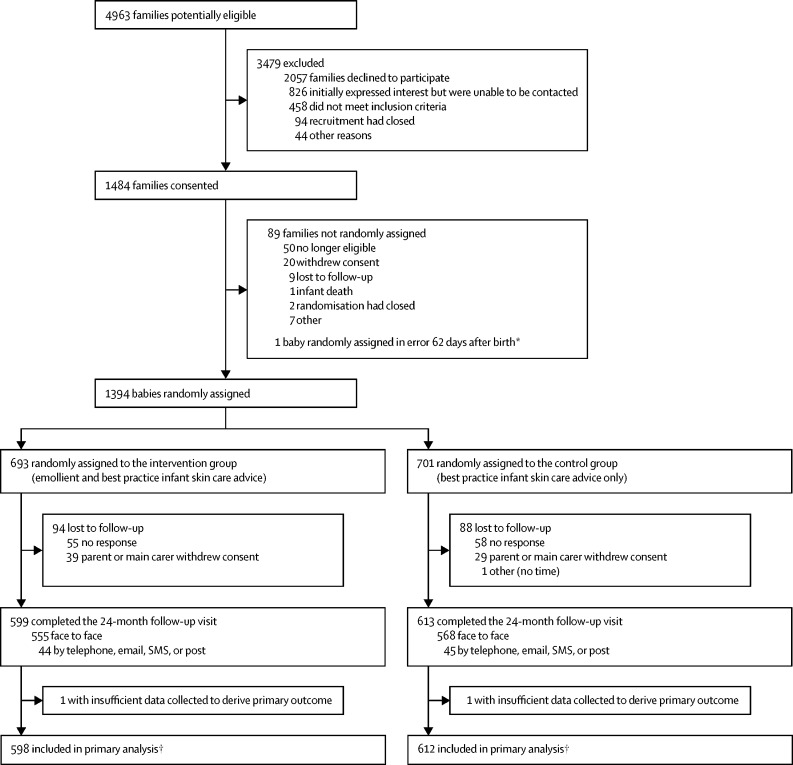
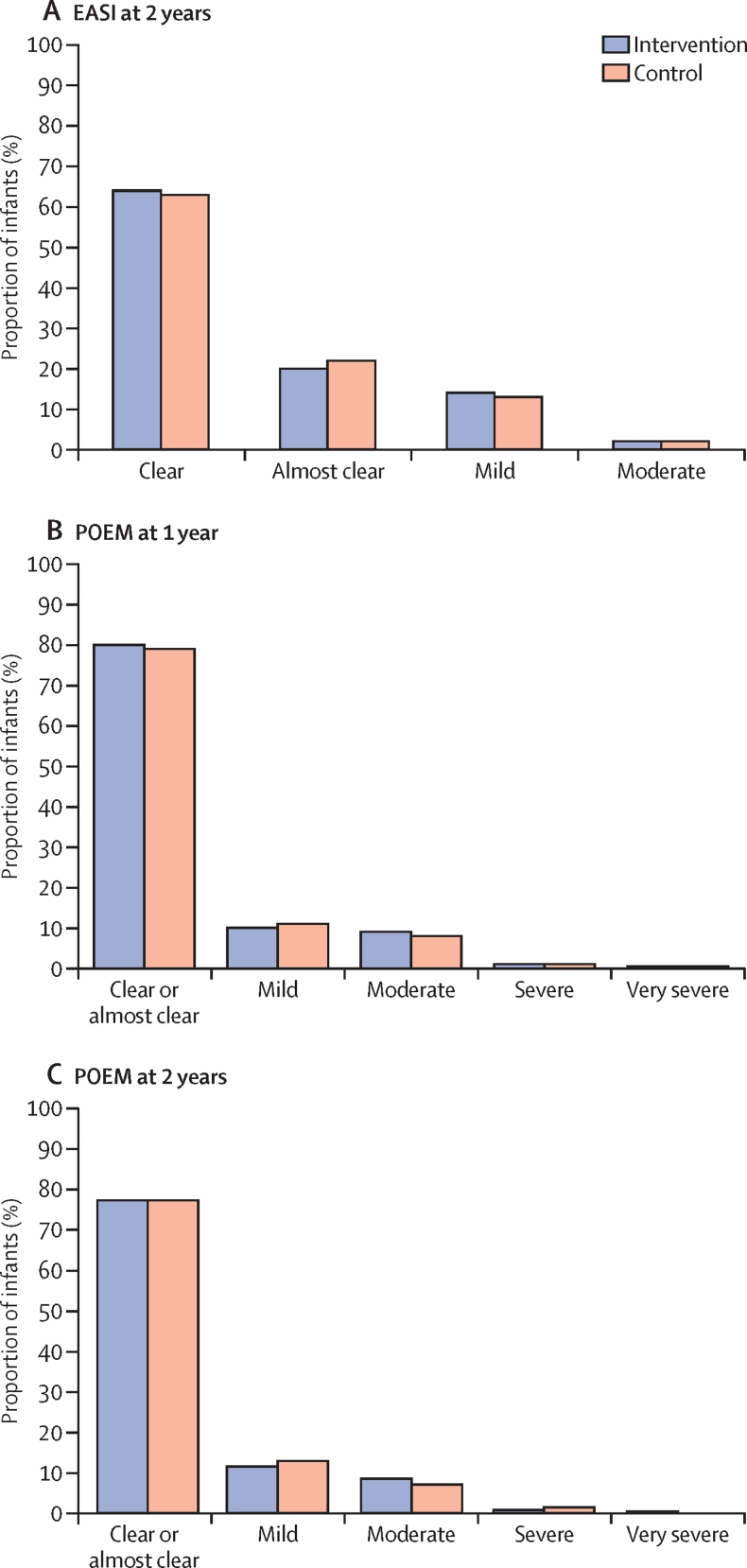
BACKGROUND: Skin barrier dysfunction precedes eczema development. We tested whether daily use of emollient in the first year could prevent eczema in high-risk children. METHODS: We did a multicentre, pragmatic, parallel-group, randomised controlled trial in 12 hospitals and four primary care sites across the UK. Families were approached via antenatal or postnatal services for recruitment of term infants (at least 37 weeks' gestation) at high risk of developing eczema (ie, at least one first-degree relative with parent-reported eczema, allergic rhinitis, or asthma, diagnosed by a doctor). Term newborns with a family history of atopic disease were randomly assigned (1:1) to application of emollient daily (either Diprobase cream or DoubleBase gel) for the first year plus standard skin-care advice (emollient group) or standard skin-care advice only (control group). The randomisation schedule was created using computer-generated code (stratified by recruiting centre and number of first-degree relatives with atopic disease) and participants were assigned to groups using an internet-based randomisation system. The primary outcome was eczema at age 2 years (defined by UK working party criteria) with analysis as randomised regardless of adherence to allocation for participants with outcome data collected, and adjusting for stratification variables. This trial is registered with ISRCTN, ISRCTN21528841. Data collection for long-term follow-up is ongoing, but the trial is closed to recruitment. FINDINGS: 1394 newborns were randomly assigned to study groups between Nov 19, 2014, and Nov 18, 2016; 693 were assigned to the emollient group and 701 to the control group. Adherence in the emollient group was 88% (466 of 532) at 3 months, 82% (427 of 519) at 6 months, and 74% (375 of 506) at 12 months in those with complete questionnaire data. At age 2 years, eczema was present in 139 (23%) of 598 infants with outcome data collected in the emollient group and 150 (25%) of 612 infants in the control group (adjusted relative risk 0·95 [95% CI 0·78 to 1·16], p=0·61; adjusted risk difference -1·2% [-5·9 to 3·6]). Other eczema definitions supported the results of the primary analysis. Mean number of skin infections per child in year 1 was 0·23 (SD 0·68) in the emollient group versus 0·15 (0·46) in the control group; adjusted incidence rate ratio 1·55 (95% CI 1·15 to 2·09). INTERPRETATION: We found no evidence that daily emollient during the first year of life prevents eczema in high-risk children and some evidence to suggest an increased risk of skin infections. Our study shows that families with eczema, asthma, or allergic rhinitis should not use daily emollients to try and prevent eczema in their newborn. FUNDING: National Institute for Health Research Health Technology Assessment.
Overview
The claims and statistics of this paper haven’t been checked yet.
Free: it reads the open-access text and checks the first 5 claims that cite a source we can check. Create a free account to check every claim.
Integrity signals
Registry
Cites
Statistics
Figures
Verification
Claims the paper makes
The claims and statistics of this paper haven’t been checked yet.
Free: it reads the open-access text and checks the first 5 claims that cite a source we can check. Create a free account to check every claim.
Claims other papers make about this one
Each is checked against this paper’s own text: does it say what the citing paper says it does?
The cited source doesn’t support the claim as written.
In the citing paper
“the BEEP study showed that emollients can increase the risk of AD due to the colonization of pathogens on the skin”
From Update on the pathogenesis of atopic dermatitis. (2024) · cites this paper as [11]
Checked by a reasoning model — may be wrong.
Experimental — accuracy not yet measuredThe source backs part of the claim, not all of it — or backs it for a different population, condition or comparison.
In the citing paper
“The skin barrier dysfunction that occurs in AD increases permeability to allergens and irritants, contributing to loss of hydration and persistence of subclinical skin inflammation.”
From Update on the pathogenesis of atopic dermatitis. (2024) · cites this paper as [11]
Experimental — accuracy not yet measuredThe check wasn’t confident either way, so it gives no verdict — never disputed.
In the citing paper
“S. aureus colonization is associated with an increased risk of food allergy.”
From Update on the pathogenesis of atopic dermatitis. (2024) · cites this paper as [11]
Experimental — accuracy not yet measured
Self-check
Percentages, sums and reported differences re-computed from the paper’s own numbers.
The self-check needs the paper’s full text.
Citations
Cites
1 retracted
Kelleher, M., Dunn-Galvin, A., Hourihane, J. O., Murray, D., Campbell, L. E., McLean, W. H. I., & Irvine, A. D. (2015) · Journal of Allergy and Clinical Immunology · doi:10.1016/j.jaci.2014.12.013 · Cited by 225
Self-citationRetractedKyu, H. H., Abate, D., Abate, K. H., Abay, S. M., Abbafati, C., Abbasi, N., Abbastabar, H., Abd-Allah, F., Abdela, J., Abdelalim, A., et al. (2018) · The Lancet · doi:10.1016/s0140-6736(18)32335-3 · Cited by 4,081
Atopic Dermatitis: Global Epidemiology and Risk Factors
Nutten, S. (2015) · Annals of Nutrition and Metabolism · doi:10.1159/000370220 · Cited by 3,055
Filaggrin Mutations Associated with Skin and Allergic Diseases
Irvine, A. D., McLean, W. H. I., & Leung, D. Y. M. (2011) · New England Journal of Medicine · doi:10.1056/nejmra1011040 · Cited by 1,217
Global variations in prevalence of eczema symptoms in children from ISAAC Phase Three
Odhiambo, J. A., Williams, H. C., Clayton, T. O., Robertson, C. F., & Asher, M. I. (2009) · Journal of Allergy and Clinical Immunology · doi:10.1016/j.jaci.2009.10.009 · Cited by 966
Self-citationWILLIAMS, H. C., JBURNEY, P. G., PEMBROKE, A. C., HAY, R. J., & Party, A. D. D. C. W. (1994) · British Journal of Dermatology · doi:10.1111/j.1365-2133.1994.tb08532.x · Cited by 926
Self-citationEmollient enhancement of the skin barrier from birth offers effective atopic dermatitis prevention
Simpson, E. L., Chalmers, J. R., Hanifin, J. M., Thomas, K. S., Cork, M. J., McLean, W. H. I., Brown, S. J., Chen, Z., Chen, Y., & Williams, H. C. (2014) · Journal of Allergy and Clinical Immunology · doi:10.1016/j.jaci.2014.08.005 · Cited by 722
Self-citationSandilands, A., Terron-Kwiatkowski, A., Hull, P. R., O'Regan, G. M., Clayton, T. H., Watson, R. M., Carrick, T., Evans, A. T., Liao, H., Zhao, Y., et al. (2007) · Nature Genetics · doi:10.1038/ng2020 · Cited by 662
Application of moisturizer to neonates prevents development of atopic dermatitis
Horimukai, K., Morita, K., Narita, M., Kondo, M., Kitazawa, H., Nozaki, M., Shigematsu, Y., Yoshida, K., Niizeki, H., Motomura, K.-I., et al. (2014) · Journal of Allergy and Clinical Immunology · doi:10.1016/j.jaci.2014.07.060 · Cited by 607
Hill, D. A., & Spergel, J. M. (2018) · Annals of Allergy, Asthma & Immunology · doi:10.1016/j.anai.2017.10.037 · Cited by 427
Research works printed but not linked: 2
- The National Institute for Health and Care Excellence Postnatal care up to 8 weeks after birth https://www.nice.org.uk/guidance/cg37 2015 32065741
- The National Institute for Health and Care Excellence Atopic eczema in under 12s: diagnosis and management https://www.nice.org.uk/guidance/cg57 2007 34101396
Cited by
Items 201–300 of 340
Zhao, M., Liang, Y., Song, F., Ma, L., Wang, Y., Gao, W., Tian, J., Ying, X., Shen, C., Wang, S., et al. (2022) · BMJ Open · doi:10.1136/bmjopen-2020-048083 · Cited by 3
Newborn Skin Development: Structure and Function
Sidbury, R. (2023) · Elsevier eBooks · doi:10.1016/b978-0-323-82823-9.00091-x · Cited by 3
Boguniewicz, M., Fonacier, L. S., & Leung, D. Y. M. (2023) · Elsevier eBooks · doi:10.1016/b978-0-7020-8165-1.00048-4 · Cited by 3
Chen, C., Yan, S., Wan, B., Yu, Y., Zeng, J., Tan, L., & Lu, J. (2024) · PubMed Central · doi:10.11817/j.issn.1672-7347.2024.240103 · Cited by 2
Yin, Y., & Zhang, X. (2024) · Archives of Dermatological Research · doi:10.1007/s00403-024-03591-z · Cited by 2
Novel approaches to prevent or cure allergic diseases
Zadoo, S., & Davis, C. M. (2025) · Current Opinion in Immunology · doi:10.1016/j.coi.2025.102569 · Cited by 2
Czarnowicki, T., Sugita, K., Yiu, Z. Z. N., Díez-Ribas, S., García‐Jiménez, I., Guttman‐Yassky, E., & Santamaria‐Babí, L. F. (2026) · Allergy · doi:10.1111/all.70347 · Cited by 2
Kuniyoshi, Y. (2026) · European Journal of Pediatrics · doi:10.1007/s00431-026-07192-y · Cited by 2
Almohammadi, A. A. (2026) · Indian Journal of Paediatric Dermatology · doi:10.4103/ijpd.ijpd_189_25 · Cited by 2
Soegiarto, G., Sutanto, H., Elisa, E., Baskoro, A., Fetarayani, D., Endaryanto, A., Pawarti, D. R., Umborowati, M. A., Rahmawati, L. D., Nurani, W. K., et al. (2026) · Allergy medicine. · doi:10.1016/j.allmed.2026.100125 · Cited by 2
Circadian skin pH gates IL-33 and remote food sensitization
Tang, J., Miller, J. P., Shatz, S., Desai, P., O’Connell, M. R., Bennett, L. M., Williams, N., & Yang, R. (2026) · Journal of Investigative Dermatology · doi:10.1016/j.jid.2026.07.032 · Cited by 2
Gartland, T., Kennedy, R., Leins, L., Paea, D., & King, E. (2024) · Journal of the Dermatology Nurses’ Association · doi:10.1097/jdn.0000000000000773 · Cited by 2
“…treatments for AE primarily involve topical corticosteroid (TCS) creams and emollients to reduce inflammation and return skin barrier function (Chalmers et al., 2020; Fishbein et al., 2019; Mostow, 2023) as well as the avoidance of environmental triggers (Kantor & Silverberg, 2017; Krämer &…”
BackgroundTherapeutic Application of Glutinous Rice Ferment Extract for Atopic Eczema
Wang, X., Zhu, L., Chen, M., Zhao, Y., Li, X., Jia, H., & Chen, W. (2024) · Annals of Case Reports · doi:10.29011/2574-7754.101764 · Cited by 2
“Numerous studies have shown that infantile eczema is closely related to skin barrier dysfunction [9-11], and the literature points out that it is mainly manifested as abnormal keratinocyte connections of the skin barrier caused by FLG gene mutations (FLG, filaggrin) [12, 13].”
BackgroundAtopic March: Dermatologic Perspectives
Dhar, S., & Jagadeesan, S. (2022) · Indian Journal of Dermatology · doi:10.4103/ijd.ijd_989_21 · Cited by 2
Sieferle, K., Schaefer, C., & Bitzer, E. M. (2022) · F1000Research · doi:10.12688/f1000research.123571.1 · Cited by 2
Development and Validation of a Prognostic Clinical Risk Score for Subsequent Atopic Dermatitis Risk
Landau, T., Gamrasni, K., Levin, A. V., Barlev, Y., Sanders, O., Benor, S., & Brandwein, M. (2024) · Clinical & Experimental Allergy · doi:10.1111/cea.14567 · Cited by 2
Newborn‐oriented and environmental factors for newborns' skin barrier functions
Murakami, M., Yonezawa, K., Shimizu, S., Haruna, M., Sasagawa, E., & Usui, Y. (2021) · Japan Journal of Nursing Science · doi:10.1111/jjns.12457 · Cited by 2
Food Allergy and Gastrointestinal Syndromes
Nowak-Wegrzyn, A. H., Burks, A. W., & Sampson, H. A. (2022) · Elsevier eBooks · doi:10.1016/b978-0-323-80912-2.00012-3 · Cited by 2
Evaluation of Skin Prick Test Reading Time at 10 versus 15 min in Young Infants
Lie, A., Gerdin, S. W., Skrindo, I., Rehbinder, E. M., Jonassen, C. M., LeBlanc, M., Staff, A. C., Söderhäll, C., Vettukattil, R., Adalen, S., et al. (2022) · International Archives of Allergy and Immunology · doi:10.1159/000522526 · Cited by 2
How primary care providers can help prevent food allergies
Conroy, E. R., & Ponda, P. (2022) · Current Opinion in Pediatrics · doi:10.1097/mop.0000000000001145 · Cited by 3
Eyerich, K., & Ring, J. (2023) · Springer eBooks · doi:10.1007/978-3-031-12499-0_2 · Cited by 2
Lezmi, G., Deschildre, A., Blanc, S., Delmas, M.-C., Divaret‐Chauveau, A., Fayon, M. J., Masson‐Rouchaud, A., Petat, H., Siao-Him-Fa, V., Schweitzer, C., et al. (2024) · Revue des Maladies Respiratoires · doi:10.1016/j.rmr.2024.07.003 · Cited by 2
Highlighting the impact of allergenic components in emollientsPreprint
Ryczaj, K. (2020) · doi:10.22541/au.159969679.93580222 · Cited by 2
Zhong, Y., Samuel, M., Bever, H. V., & Tham, E. H. (2022) · Allergy · doi:10.1111/all.15309 · Cited by 2
From the Cochrane Library: Skin Care Interventions in Infants for Preventing Eczema and Food Allergy
Anderson, J. D., & Sivesind, T. E. (2021) · JMIR Dermatology · doi:10.2196/30197 · Cited by 1
“There are currently a number of ongoing clinical trials assessing skin care interventions for the prevention of atopic dermatitis and food allergy; one trial recently concluded there is no evidence that the use of daily emollients reduces the risk of eczema by the age of 2 years in high-risk patients (patients with fi…”
BackgroundCan early life interventions prevent food allergies?
Ertuğrul, A., & Soyer, Ö. (2023) · The Turkish Journal of Pediatrics · doi:10.24953/turkjped.2023.223 · Cited by 1
Prevention and Management of Food Allergy in Infants
Mathew, M., Wong, K. H., Munoz, J. S., & Leeds, S. (2025) · Immunology and Allergy Clinics of North America · doi:10.1016/j.iac.2025.04.005 · Cited by 1
Analysis of the main characteristics of children's skin moisturizers in the Brazilian market
Branchi, B. R. R., Kiszewski, A. E., & Bonamigo, R. R. (2025) · Jornal de Pediatria · doi:10.1016/j.jped.2025.101438 · Cited by 1
Dumycz, K., Szczukocka-Zych, A., Wawszczak, M., Grzela, K., Feleszko, W., & Kulus, M. (2025) · Biomedicines · doi:10.3390/biomedicines13102377 · Cited by 1
“Standard petroleum-based emollients have failed to reduce AD and FA development, as shown in two large clinical trials: BEEP and PreventADALL [59,60].”
Stratman, E. J., Schaffer, J. V., Miller, S. J., Bruckner, A. L., González, M. E., Zaenglein, A. L., & Roenigk, R. K. (2025) · Pediatric Dermatology · doi:10.1111/pde.70076 · Cited by 1
Diamond‐Smith, N., Murro, R., Flaherman, V. J., & Rudolph, K. E. (2026) · Academic Pediatrics · doi:10.1016/j.acap.2026.103230 · Cited by 1
Alam, M. S., Shafiq, S., Gayathri, V., Maanvizhi, S., Ahmad, J., Ansari, A., & Akhtar, A. (2026) · Mini-Reviews in Medicinal Chemistry · doi:10.2174/0113895575414838251205172531 · Cited by 1
Future directions in atopic dermatitis
Stefanovic, N., & Irvine, A. D. (2026) · Journal of the American Academy of Dermatology · doi:10.1016/j.jaad.2026.01.077 · Cited by 1
Randomized controlled feasibility trial of an intervention to reduce infant bathing
Perkin, M. R., USSHER, M. H., Goldsmith, L. P., Flohr, C., Roberts, A., Cornelius, V. R., Wahlich, C., Willis, K., Chaudhry, U. A. R., Audi, S., et al. (2026) · British Journal of Dermatology · doi:10.1093/bjd/ljag248 · Cited by 1
Self-citationTrial of food allergy IgE tests for Eczema Relief (TIGER): study protocol
Corejova, D., Pope, C., Joyce, K., Gilbertson, A., MacNeill, S., Liu, Y., Harris, R. A., Garfield, K., Coast, J., Müller, I., et al. (2026) · Skin Health and Disease · doi:10.1093/skinhd/vzag085 · Cited by 1
Self-citationManagement of Infected, Non-Responsive Atopic Dermatitis in a Romanian Center
Miulescu, R. G., Roșca, I., Pavel, A. N., Marin, R. C., Constantin, A. T., Costescu, M., Poenaru, E., Popescu, D.-E., & Coman, O. A. (2026) · Journal of Clinical Medicine · doi:10.3390/jcm15135248 · Cited by 1
La médecine personnalisée peut-elle modifier la marche atopique ?
Clark, E., & Caimmi, D. P. (2020) · Revue française d'allergologie · doi:10.1016/s1877-0320(20)30483-8 · Cited by 1
Besonderheiten und Herausforderungen der neonatalen Dermatologie: Eine Einführung in die Problematik
Tantcheva‐Poór, I., Hoemberg, M., Kribs, A., & Peters, F. (2021) · Der Hautarzt · doi:10.1007/s00105-021-04764-x · Cited by 1
Comment prévenir la survenue des maladies allergiques ?
Sabouraud-Leclerc, D. (2021) · Elsevier eBooks · doi:10.1016/b978-2-294-76475-2.00017-8 · Cited by 1
Samayoa, J. A. M., Benítez, L. E. H., Joya, M. G. V., & Meléndez, Z. G. G. (2022) · ALERTA Revista Científica del Instituto Nacional de Salud · doi:10.5377/alerta.v5i1.12563 · Cited by 1
Williams, H. C., McPhee, M., Layfield, C. P., Jones, S., Layfield, C. P., Matin, R., Levell, N. J., Cowdell, F., Burton, T., Adams, L. M., et al. (2022) · Clinical and Experimental Dermatology · doi:10.1111/ced.15140 · Cited by 1
Self-citationUpdate on Nutrition and Food Allergy
De Jong, N. W., & Wichers, H. J. (2022) · MDPI eBooks · doi:10.3390/books978-3-0365-5348-1 · Cited by 1
Stratégies ciblant la peau en prévention des allergies alimentaires
Braun, C., Bégin, P., & Nosbaum, A. (2024) · Revue française d'allergologie · doi:10.1016/j.reval.2024.104192 · Cited by 1
Atopic Dermatitis Part 1: Pathophysiology, Clinical Manifestations, and Associations
King, A., Campione, E.-A., Pennal, A., & Weinstein, M. (2025) · Pediatrics in Review · doi:10.1542/pir.2024-006427 · Cited by 1
Li, S., Liu, Z., Sun, P., Yusun, A., Sun, M., Bao, C., & Zhang, C. (2025) · Rapid Communications in Mass Spectrometry · doi:10.1002/rcm.10128 · Cited by 1
“Various factors involved in the development of atopic dermatitis include a weakened skin barrier, increased activity of skin immune cells, and the surface microbial community [20, 21].”
Xu, X., Ong, Y. K., & Wang, D. Y. (2025) · Springer eBooks · doi:10.1007/978-3-031-93455-1_3 · Cited by 1
Balancing laissez‐faire and paranoia in patients at risk of anaphylaxis
Roberts, G. C. (2020) · Clinical & Experimental Allergy · doi:10.1111/cea.13600 · Cited by 1
Environmental interventions to prevent food allergy
Skjerven, H. O., & Carlsen, K. L. (2023) · Elsevier eBooks · doi:10.1016/b978-0-323-96018-2.00113-9 · Cited by 1
The role of the skin barrier in food allergy prevention
Fay, E., Jones, S. A., Santos, A. F., & Flohr, C. (2024) · Elsevier eBooks · doi:10.1016/b978-0-323-96018-2.00169-3 · Cited by 1
Self-citationMaternal Antibody Transfer and Atopic Sensitization in Offspring
Kothari, A. (2023) · TSpace (University of Toronto) · Cited by 1
Emollients to Prevent Eczema in High-Risk Infants: Integrative Review.
Armstrong, J., Rosinski, N. K., Fial, A., Ansah, S., & Haglund, K. A. (2022) · PubMed · doi:10.1097/nmc.0000000000000809
Prevention of Food Allergy: early introduction of complementary food and oral immune tolerance
Narita, M. (2020) · Nihon Shoni Arerugi Gakkaishi The Japanese Journal of Pediatric Allergy and Clinical Immunology · doi:10.3388/jspaci.34.391
Emollient creams and bath oils do not prevent atopic eczema
Rehbinder, E. M., Skjerven, H. O., & Carlsen, K. C. L. (2021) · Tidsskrift for Den norske legeforening · doi:10.4045/tidsskr.20.0884
Actualités et souvenirs. Du vaccin Covid-19 à la maladie des moules bronchiques idiopathiques…
Dutau, G., Lavaud, F., & Didier, A. P. (2021) · Revue française d'allergologie · doi:10.1016/j.reval.2021.01.001
Issues in medical care for children with allergies from the standpoint of clinics and practitioners
Saito, N. (2021) · Nihon Shoni Arerugi Gakkaishi The Japanese Journal of Pediatric Allergy and Clinical Immunology · doi:10.3388/jspaci.35.51
Advances in the Translational Science of Dermatitis
Bilimoria, S. N., Tegtmeyer, K., & Lio, P. (2021) · Immunology and Allergy Clinics of North America · doi:10.1016/j.iac.2021.04.001
Histoire naturelle des maladies allergiques
Amat, F. (2021) · Elsevier eBooks · doi:10.1016/b978-2-294-76475-2.00016-6
Cuidados de la piel y prevención en dermatitis atópica y alergia a alimentos
Hernández, R. E. H. (2020) · Alergia, Asma e Inmunología Pediátricas · doi:10.35366/95488
Dermatite atopique : épidémiologie et facteurs de risque
Staumont-Sallé, D. (2018) · Cairn.info · doi:10.1684/dm.2021.445
Printemps arabe et liberté d’expression
Ravaz, B. (2012)
Los test actuales en África: ¿selección o medida de los logros reales?
Quansah, K. B. (1985) · Perspectivas: Revista trimestral de educación comparada
Title: A new era of atopic eczema research: Advances and highlightsPreprint
Hülpüsch, C., Weins, A. B., Traidl‐Hoffmann, C., & Reiger, M. (2021) · Authorea · doi:10.22541/au.162024887.79841945/v1
Perkin, M. R., & Flohr, C. (2021) · Journal of Allergy and Clinical Immunology · doi:10.1016/j.jaci.2021.04.038
Self-citationCan emollient use in early infancy prevent eczema?
(2020) · Drug and Therapeutics Bulletin · doi:10.1136/dtb.2020.000064
Management der atopischen Dermatitis im Kindes- und Jugendalter
Abeck, D. (2022) · Aktuelle Dermatologie · doi:10.1055/a-1664-5400
Daily emollient throughout infancy to prevent eczema: A randomised controlled study
Hadi, D. F. (2022) · International Journal of Health Sciences · doi:10.53730/ijhs.v6ns8.13316
Clinical case of early debut of food allergy in a child up to 6 months
Masalskiy, S. S., Smolkin, Y. S., & Юрьевна, С. О. (2022) · Allergology and Immunology in Pediatrics · doi:10.53529/2500-1175-2022-3-5-13
Does 8 weeks of emollients use prevent AD in high-risk infants?
Kämmerer, S. (2022) · doi:10.55788/004ea2ba
Atopische Dermatitis: Neue Ära für optimierte Versorgung erwartet
Willen, C. (2022) · Deutsches Ärzteblatt · doi:10.3238/perseadv.2022.11.11.03
THE ROLE OF SKIN CARE PRODUCTS AND EARLY FOOD FOR THE PREVENTION OF ATOPIC DERMATITIS IN INFANTS
Mozyrska, O. V., & Sliusar, N. A. (2022) · Clinical and Preventive Medicine · doi:10.31612/2616-4868.4(22).2022.09
Brough, H. A., Sindher, S., & Nadeau, K. C. (2023) · Allergy · doi:10.1111/all.15626
Kupkina, A. V., & Mozyrska, O. V. (2023) · Ukrainian Scientific Medical Youth Journal · doi:10.32345/usmyj.1(136).2023.104-110
Using of emollients in children with atopic dermatitis (literature review)
Mochulska, O. M., Hariyan, T., Horishnyi, I. M., & Yarema, N. (2023) · Modern pediatrics Ukraine · doi:10.15574/sp.2023.129.65
Tools for determination of food allergy in epidemiological studies
Peters, R. L., Soriano, V. X., Wijesuriya, R., & Koplin, J. J. (2023) · Elsevier eBooks · doi:10.1016/b978-0-323-96018-2.00046-8
Skin sensitization and food allergy
Das, M., & Geha, R. S. (2023) · Elsevier eBooks · doi:10.1016/b978-0-323-96018-2.00069-9
Eyerich, K., & Ring, J. (2023) · Springer eBooks · doi:10.1007/978-3-031-12499-0_8
Präventive Basistherapie mit Emollientien auf dem Prüfstand
Rohayem, R., & Traidl‐Hoffmann, C. (2023) · Pneumo News · doi:10.1007/s15033-023-3541-1
Atopische Dermatitis: Nahrungsmittelallergien als Folge defekter Hautbarriere
Eckert, N. (2023) · Deutsches Ärzteblatt · doi:10.3238/perseadv.2023.11.17.02
Relationships between food allergy and other atopy
Marques‐Mejias, A., & Lack, G. (2023) · Elsevier eBooks · doi:10.1016/b978-0-323-96018-2.00120-6
Role of Calcineurin Inhibitors in the Management of Atopic Dermatitis in Children
Efendieva, K. E., Namazova-Baranova, L. S., Levina, J. G., Геннадьевна, К. В., Alekseeva, A. A., Vishneva, Е. A., & Станиславович, В. К. (2024) · Вопросы современной педиатрии · doi:10.15690/vsp.v22i6.2666
Ardern‐Jones, M. R., Flohr, C., & Reynolds, N. J. (2024) · Wiley eBooks · doi:10.1002/9781119709268.rook041
Self-citationStaubach, P., Schulz, S., Weyer‐Elberich, V., Peveling‐Oberhag, A., Zimmer, S., Wegner, J., Sohn, A., Mann, C., & Lang, B. M. (2024) · Die Dermatologie · doi:10.1007/s00105-024-05334-7
Prevention of Allergy Developement Based on Skin Barrier Changes and Skin Sensitization in Infancy
Yoshida, K. (2024) · The Nishinihon Journal of Dermatology · doi:10.2336/nishinihonhifu.86.119
Hachai, S., Nilrod, B., Suksawat, Y., & Thitthiwong, P. (2024) · Journal of Southeast Asian Medical Research · doi:10.55374/jseamed.v8.170
“This may have affected the results to differ from the negative studies by Chalmers et al. (14) in the UK and Skjerven et al. (19) in Norway and Sweden,which are situated in or near the cool, temperate, moist forest biome.”
BackgroundResultAtopic Dermatitis and Dry Skin
Benner, K. W. (2024) · The American Pharmacists Association eBooks · doi:10.21019/aphaotc-derm.atopic-dermatitis
Prevention of Atopic Dermatitis in Children: Can It be Done?
Kim, E. J., Sandler, M. L., & Ho, T. (2024) · Current Dermatology Reports · doi:10.1007/s13671-024-00448-6
“The authors found that daily emollient use during the first 12 months of life failed to prevent the development of atopic dermatitis, food allergy, asthma or hay fever at two and five year follow ups [19, 20].”
InfluentialThe Role of Food Allergies (and Testing) in Atopic Dermatitis in Children
Wong, L. S. Y., Hamideh, N., & Brar, K. (2024) · Current Dermatology Reports · doi:10.1007/s13671-024-00452-w
“Based on early emollient use studies in Japan showing prevention of AD [41], 2 large primary prevention studies (PreventADALL and BEEP) aimed to show that early emollient use may be a strategy to prevent not only AD, but also FA development [42, 43].”
Allergies: Un updated review article of food allergy
Alsahli, B. N., Alanazi, A., Alseaib, A. S., Alomayrah, N. M., Alqanoor, N. F. M., Alanazi, S. D., Al-Arej, I. M., & Alrasheedi, M. K. (2023) · International Journal of Health Sciences · doi:10.53730/ijhs.v7ns1.15305
“[26] The PreventADALL27 trial, which included newborns, confirmed that neither intensive emollient use (both paraffin/petroleum-based and emollient bath oil) nor early introduction of complementary feeding diminished the development of AD.”
BackgroundIbbadi, A. K., & Mejbel, F. A. H. (2024) · BIO Web of Conferences · doi:10.1051/bioconf/202413906004
Williams, S. F., Chittock, J., Brown, K., Kay, L. J., Cork, M. J., & Danby, S. G. (2024) · Applied Spectroscopy · doi:10.1177/00037028241298714
“…creams and although some studies have found no link to treatment of infants with emollients and subsequent eczema onset in general populations, 14,15 there is evidence that in children at high risk of eczema, through family history of the condition, early treatment can delay eczema onset and…”
Self-citationCorrelation between dietary calcium intake and eczema in American adult population
Wu, Q., Guo, Z., Zhang, N., & Dong, D. (2024) · Scientific Reports · doi:10.1038/s41598-024-82723-x
Li, Y., Wang, Z., Li, X., Ma, K., & Shi, Z. (2025) · Archives of Dermatological Research · doi:10.1007/s00403-025-03887-8
Emollients: Effects, Evidence, and Side Effects
Nørreslet, L. B., & Olesen, C. M. (2025) · Springer eBooks · doi:10.1007/978-3-319-40221-5_94-3
Effects of Cream Application in Childhood on Skin Barrier and Development of Atopic Diseases
Brough, H. A., Sindher, S., Kelleher, M. M., Sanver, D., Shamji, M. H., Sampath, V., Alkotob, S., Lack, G., & Nadeau, K. C. (2025) · Springer eBooks · doi:10.1007/978-3-031-82689-4_1
Self-citationMODULAÇÃO IMUNOLÓGICA NA DERMATITE ATÓPICA: AVANÇOS TERAPÊUTICOS E PERSPECTIVAS FUTURAS
D’Ávila, M. E. C., & Sousa, N. B. E. (2025) · doi:10.22533/at.ed.0021425050513
Treatment Safety in Pediatric Atopic Dermatitis
Ecalnir, M. (2025) · Dominican Scholar (Dominican University of California) · doi:10.33015/dominican.edu/2025.nurs.st.47
Early Predictors of Atopic Dermatitis and Food Allergy
Sung, M., Kim, B. E., & Leung, D. Y. M. (2025) · Immunology and Allergy Clinics of North America · doi:10.1016/j.iac.2025.06.001
Treatment Strategies for Prevention of Atopic Dermatitis
Ng, P., Leung, A. S. Y., Goleva, E., & Tham, E. H. (2025) · Immunology and Allergy Clinics of North America · doi:10.1016/j.iac.2025.06.004
Targeting Pollutants in the Treatment and Prevention of Atopic Dermatitis
Shobnam, N., & Myles, I. A. (2025) · Immunology and Allergy Clinics of North America · doi:10.1016/j.iac.2025.06.002
Metadata
- Authors
- Chalmers, J. R., Haines, R. H., Bradshaw, L. E., Montgomery, A. A., Thomas, K. S., Brown, S. J., Ridd, M. J., Lawton, S., Simpson, E. L., Cork, M. J., Sach, T. H., Flohr, C., Mitchell, E. J., Swinden, R., Tarr, S., Davies-Jones, S., Jay, N., Kelleher, M. M., Perkin, M. R., Boyle, R. J., & Williams, H. C.
- Affiliations
- University of Nottingham (GB)
- University of Dundee (GB)
- University of Bristol (GB)
- The Rotherham NHS Foundation Trust (GB)
- Oregon Health & Science University (US)
- University of Sheffield (GB)
- University of East Anglia (GB)
- King's College London (GB)
- Sheffield Children's Hospital (GB)
- Imperial College London (GB)
- St George's, University of London (GB)
- Corresponding author
- Williams, Hywel C
- ORCID
- Chalmers, Joanne R
- Haines, Rachel H
- Bradshaw, Lucy E
- Montgomery, Alan A
- Thomas, Kim S
- Brown, Sara J
- Ridd, Matthew J
- Lawton, Sandra
- Simpson, Eric L
- Cork, Michael J
- Sach, Tracey H
- Flohr, Carsten
- Mitchell, Eleanor J
- Swinden, Richard
- Tarr, Stella
- Jay, Nicola
- Kelleher, Maeve M
- Perkin, Michael R
- Boyle, Robert J
- Williams, Hywel C
- Venue
- The Lancet
- Publisher
- Elsevier BV
- Published
- 2020-03
- Volume
- 395
- Issue
- 10228
- Pages
- 962-972
- ISSN
- 0099-5355 (ISSN-L)
- 0140-6736
- PMC
- PMC7086156
- OpenAlex
- W3009019417
- Semantic Scholar
- d22535fbf5ef7df54f6c48de647e77de5f2b756c
- Cited by
- 317
- References
- 34
- Citations by year
- 2026: 34 · 2025: 37 · 2024: 60 · 2023: 50 · 2022: 61 · 2021: 48 · 2020: 24
- FWCI
- 33.43
- Type
- journal article
- Language
- en
- Open access
- hybrid
- doi.org
- Licence
- cc-by
- www.elsevier.com/tdm/userlicense/1.0/ (tdm)
- www.elsevier.com/legal/tdmrep-license (tdm)
- creativecommons.org/licenses/by/4.0/ (vor)
- Locations
- The Lancet (publishedVersion, cc-by)
- PubMed Central (publishedVersion, cc-by)
- PubMed (publishedVersion)
- Repository@Nottingham (University of Nottingham) (publishedVersion, cc-by)
- Bristol Research (University of Bristol) (publishedVersion, cc-by)
- Discovery Research Portal (University of Dundee) (acceptedVersion, cc-by)
- St George's Online Research Archive (St George's University of London) (acceptedVersion)
- UEA Digital Repository (University of East Anglia) (acceptedVersion)
- ePrints Soton (University of Southampton) (submittedVersion, cc-by)
- Research Portal (King's College London) (submittedVersion, other-oa)
- Edinburgh Research Explorer (University of Edinburgh) (submittedVersion, cc-by)
- Explore Bristol Research (submittedVersion, cc-by)
- Spiral (Imperial College London) (submittedVersion, other-oa)
- Funders
- Eli Lilly and Company
- Pfizer
- GlaxoSmithKline
- Sanofi
- Celgene
- University of Dundee
- Regeneron Pharmaceuticals
- Wellcome Trust (/Z/15/Z, 106865/Z/15/Z)
- Dermira
- National Institute for Health and Care Research (12/67/12, 2014-07-013, PDF-2014-07-013, CDF-2014-07-037, PB-PG-0317-20028, TRF-2017-10-003)
- Department of Health and Social Care
- British Association of Dermatologists
- Imperial College London
- King's College London
- Galderma
- LEO Pharma
- Genentech
- Health Technology Assessment Programme (12/67/12)
- Topics
- Health Sciences › Medicine › Dermatology › Dermatology and Skin Diseases
- Health Sciences › Medicine › Pediatrics, Perinatology and Child Health › Neonatal skin health care
- Health Sciences › Medicine › Dermatology › Contact Dermatitis and Allergies
- Keywords
- emollients, skin barrier dysfunction, atopic diseases, high-risk infants, allergic rhinitis, asthma, infant skin care
- MeSH terms
- Dermatitis, Atopic, Dose-Response Relationship, Drug, Drug Administration Schedule, Eczema, Emollients, Female, Follow-Up Studies, United Kingdom, Humans, Infant, Infant, Newborn, Male, Reference Values, Treatment Outcome, Risk Assessment
About these checks
Registry, retraction, Cites and statistics results are computed, not judged, with one exception: a printed reference that no index lists is read once by a model before it counts as a citation error. Claims are extracted by a model and kept only when their quote appears verbatim in the text; each cited source is then checked, with a model’s help, for whether it says what the claim relies on. Those verdicts can be wrong — read the claim’s quote and the cited source before relying on one.
Statistics and arithmetic are recomputed, not judged.
Confidence bands are shown only for fields calibrated on our annotated test set. None is calibrated yet, so no band is shown.
What counts as a claim ›How we measure confidence ›How we check this ›
Are you an author, or do you see a problem with this page? Request a review
Data sources
Bibliographic data: Semantic Scholar, OpenAlex, Crossref.
Contains information from the Semantic Scholar Academic Graph Datasets, made available under the ODC Attribution License (ODC-BY 1.0).
Semantic Scholar’s data is described in: Kinney, R., et al. (2023). The Semantic Scholar Open Data Platform. arXiv:2301.10140.
