

Daily emollient during infancy for prevention of eczema: the BEEP randomised controlled trial
Open accessThe DOI matches its Crossref record; 34 of the 34 references it cites were found in a registry or an index.
Abstract
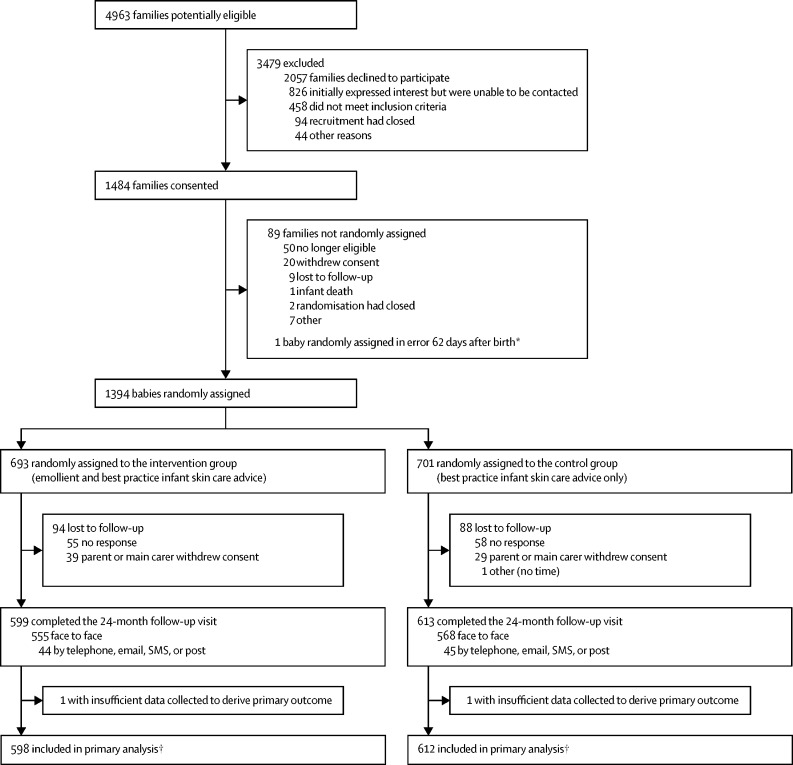
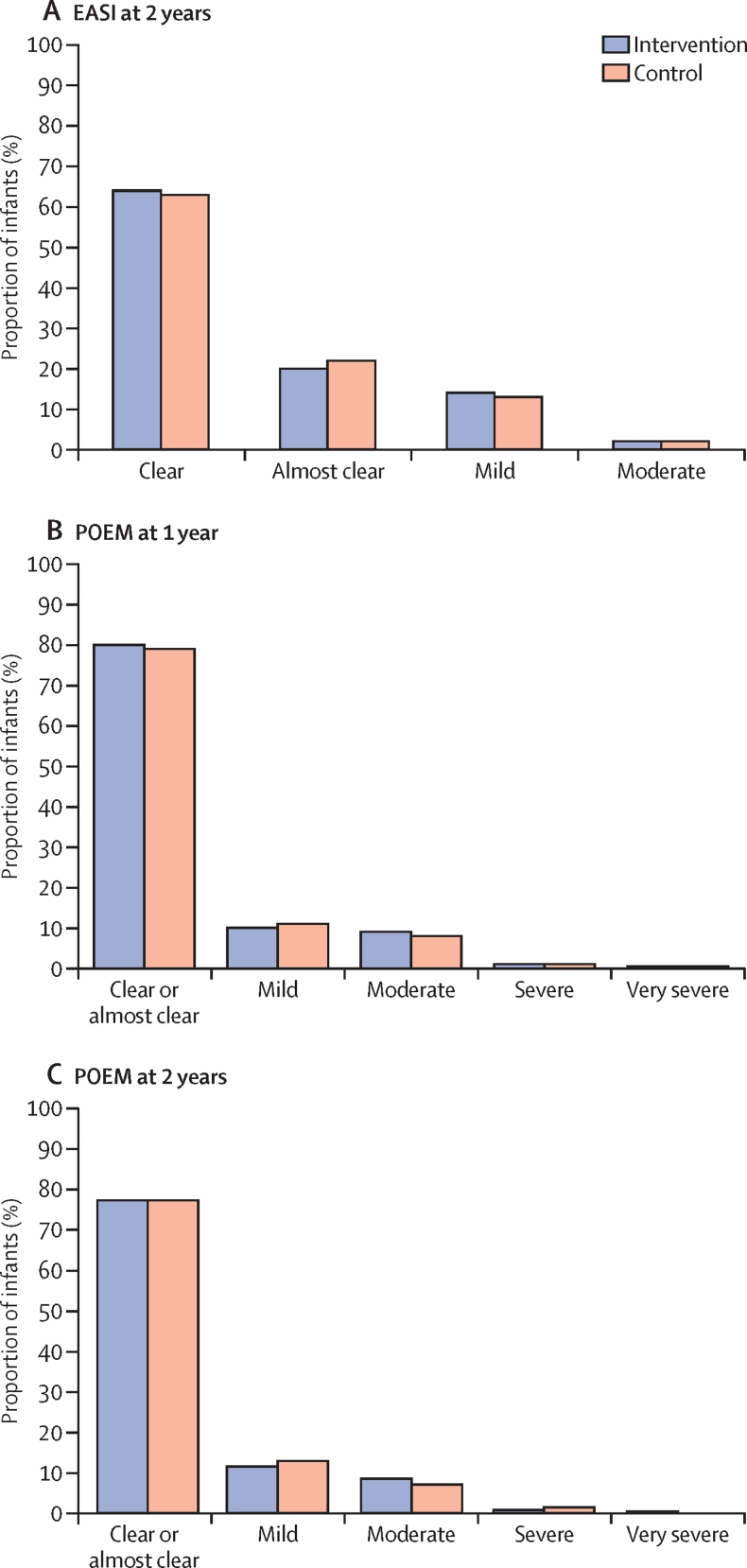
BACKGROUND: Skin barrier dysfunction precedes eczema development. We tested whether daily use of emollient in the first year could prevent eczema in high-risk children. METHODS: We did a multicentre, pragmatic, parallel-group, randomised controlled trial in 12 hospitals and four primary care sites across the UK. Families were approached via antenatal or postnatal services for recruitment of term infants (at least 37 weeks' gestation) at high risk of developing eczema (ie, at least one first-degree relative with parent-reported eczema, allergic rhinitis, or asthma, diagnosed by a doctor). Term newborns with a family history of atopic disease were randomly assigned (1:1) to application of emollient daily (either Diprobase cream or DoubleBase gel) for the first year plus standard skin-care advice (emollient group) or standard skin-care advice only (control group). The randomisation schedule was created using computer-generated code (stratified by recruiting centre and number of first-degree relatives with atopic disease) and participants were assigned to groups using an internet-based randomisation system. The primary outcome was eczema at age 2 years (defined by UK working party criteria) with analysis as randomised regardless of adherence to allocation for participants with outcome data collected, and adjusting for stratification variables. This trial is registered with ISRCTN, ISRCTN21528841. Data collection for long-term follow-up is ongoing, but the trial is closed to recruitment. FINDINGS: 1394 newborns were randomly assigned to study groups between Nov 19, 2014, and Nov 18, 2016; 693 were assigned to the emollient group and 701 to the control group. Adherence in the emollient group was 88% (466 of 532) at 3 months, 82% (427 of 519) at 6 months, and 74% (375 of 506) at 12 months in those with complete questionnaire data. At age 2 years, eczema was present in 139 (23%) of 598 infants with outcome data collected in the emollient group and 150 (25%) of 612 infants in the control group (adjusted relative risk 0·95 [95% CI 0·78 to 1·16], p=0·61; adjusted risk difference -1·2% [-5·9 to 3·6]). Other eczema definitions supported the results of the primary analysis. Mean number of skin infections per child in year 1 was 0·23 (SD 0·68) in the emollient group versus 0·15 (0·46) in the control group; adjusted incidence rate ratio 1·55 (95% CI 1·15 to 2·09). INTERPRETATION: We found no evidence that daily emollient during the first year of life prevents eczema in high-risk children and some evidence to suggest an increased risk of skin infections. Our study shows that families with eczema, asthma, or allergic rhinitis should not use daily emollients to try and prevent eczema in their newborn. FUNDING: National Institute for Health Research Health Technology Assessment.
Overview
The claims and statistics of this paper haven’t been checked yet.
Free: it reads the open-access text and checks the first 5 claims that cite a source we can check. Create a free account to check every claim.
Integrity signals
Registry
Cites
Statistics
Figures
Verification
Claims the paper makes
The claims and statistics of this paper haven’t been checked yet.
Free: it reads the open-access text and checks the first 5 claims that cite a source we can check. Create a free account to check every claim.
Claims other papers make about this one
Each is checked against this paper’s own text: does it say what the citing paper says it does?
The cited source doesn’t support the claim as written.
In the citing paper
“the BEEP study showed that emollients can increase the risk of AD due to the colonization of pathogens on the skin”
From Update on the pathogenesis of atopic dermatitis. (2024) · cites this paper as [11]
Checked by a reasoning model — may be wrong.
Experimental — accuracy not yet measuredThe source backs part of the claim, not all of it — or backs it for a different population, condition or comparison.
In the citing paper
“The skin barrier dysfunction that occurs in AD increases permeability to allergens and irritants, contributing to loss of hydration and persistence of subclinical skin inflammation.”
From Update on the pathogenesis of atopic dermatitis. (2024) · cites this paper as [11]
Experimental — accuracy not yet measuredThe check wasn’t confident either way, so it gives no verdict — never disputed.
In the citing paper
“S. aureus colonization is associated with an increased risk of food allergy.”
From Update on the pathogenesis of atopic dermatitis. (2024) · cites this paper as [11]
Experimental — accuracy not yet measured
Self-check
Percentages, sums and reported differences re-computed from the paper’s own numbers.
The self-check needs the paper’s full text.
Citations
Cites
1 retracted
Kelleher, M., Dunn-Galvin, A., Hourihane, J. O., Murray, D., Campbell, L. E., McLean, W. H. I., & Irvine, A. D. (2015) · Journal of Allergy and Clinical Immunology · doi:10.1016/j.jaci.2014.12.013 · Cited by 225
Self-citationRetractedKyu, H. H., Abate, D., Abate, K. H., Abay, S. M., Abbafati, C., Abbasi, N., Abbastabar, H., Abd-Allah, F., Abdela, J., Abdelalim, A., et al. (2018) · The Lancet · doi:10.1016/s0140-6736(18)32335-3 · Cited by 4,081
Atopic Dermatitis: Global Epidemiology and Risk Factors
Nutten, S. (2015) · Annals of Nutrition and Metabolism · doi:10.1159/000370220 · Cited by 3,055
Filaggrin Mutations Associated with Skin and Allergic Diseases
Irvine, A. D., McLean, W. H. I., & Leung, D. Y. M. (2011) · New England Journal of Medicine · doi:10.1056/nejmra1011040 · Cited by 1,217
Global variations in prevalence of eczema symptoms in children from ISAAC Phase Three
Odhiambo, J. A., Williams, H. C., Clayton, T. O., Robertson, C. F., & Asher, M. I. (2009) · Journal of Allergy and Clinical Immunology · doi:10.1016/j.jaci.2009.10.009 · Cited by 966
Self-citationWILLIAMS, H. C., JBURNEY, P. G., PEMBROKE, A. C., HAY, R. J., & Party, A. D. D. C. W. (1994) · British Journal of Dermatology · doi:10.1111/j.1365-2133.1994.tb08532.x · Cited by 926
Self-citationEmollient enhancement of the skin barrier from birth offers effective atopic dermatitis prevention
Simpson, E. L., Chalmers, J. R., Hanifin, J. M., Thomas, K. S., Cork, M. J., McLean, W. H. I., Brown, S. J., Chen, Z., Chen, Y., & Williams, H. C. (2014) · Journal of Allergy and Clinical Immunology · doi:10.1016/j.jaci.2014.08.005 · Cited by 722
Self-citationSandilands, A., Terron-Kwiatkowski, A., Hull, P. R., O'Regan, G. M., Clayton, T. H., Watson, R. M., Carrick, T., Evans, A. T., Liao, H., Zhao, Y., et al. (2007) · Nature Genetics · doi:10.1038/ng2020 · Cited by 662
Application of moisturizer to neonates prevents development of atopic dermatitis
Horimukai, K., Morita, K., Narita, M., Kondo, M., Kitazawa, H., Nozaki, M., Shigematsu, Y., Yoshida, K., Niizeki, H., Motomura, K.-I., et al. (2014) · Journal of Allergy and Clinical Immunology · doi:10.1016/j.jaci.2014.07.060 · Cited by 607
Hill, D. A., & Spergel, J. M. (2018) · Annals of Allergy, Asthma & Immunology · doi:10.1016/j.anai.2017.10.037 · Cited by 427
Research works printed but not linked: 2
- The National Institute for Health and Care Excellence Postnatal care up to 8 weeks after birth https://www.nice.org.uk/guidance/cg37 2015 32065741
- The National Institute for Health and Care Excellence Atopic eczema in under 12s: diagnosis and management https://www.nice.org.uk/guidance/cg57 2007 34101396
Cited by
Items 301–340 of 340
Skin sensitization and food allergy
Das, M., & Geha, R. S. (2024) · Elsevier eBooks · doi:10.1016/b978-0-323-95488-4.50032-1
Elgharably, N., & Omar, N. (2025) · IntechOpen eBooks · doi:10.5772/intechopen.1012425
Gunnarsson, N. V. (2023) · F1000Research · doi:10.5256/f1000research.135689.r206646
Mansilla‐Polo, M., Estrada, R. B., & Martin‐Santiago, A. (2025) · Actas Dermo-Sifiliográficas · doi:10.1016/j.ad.2025.104545
Review of food allergy in humans and dogs
Millard, J. (2023) · HAL
Dermatite atopique de l’enfant
Lachaume, N., & Beauvais, M. (2025) · EMC - Pédiatrie - Maladies infectieuses · doi:10.1016/s1637-5017(25)46856-2
Risk factors and interventions for pediatric allergic diseases: an umbrella reviewPreprint
Wang, H., Hu, Q., Li, J., Chen, K., Qi, X., Zhang, R., Wang, X., Wang, Y., & Li, Y. (2026) · doi:10.22541/au.176760020.02216191/v1
Adverse Effects of Moisturizers Should Be Considered in Eczema Studies—Reply
Simpson, E. L., Michaels, L. C., & Williams, H. C. (2026) · JAMA Dermatology · doi:10.1001/jamadermatol.2025.5954
Self-citationSmith, L., Hornsey, S., Latter, S. M., Dobson, A., Miller, S., Henaghan‐Sykes, K., Adams, S., Santer, M., & Müller, I. (2026) · BMJ Open · doi:10.1136/bmjopen-2025-101051
The State of Prevention of Atopic Dermatitis: An Updated Review
Kiszluk, A., & Lio, P. (2026) · Pediatric Dermatology · doi:10.1111/pde.70157
Hannon, K., Daly, D., & Smith, V. A. (2026) · Trials · doi:10.1186/s13063-026-09580-z
Atopic dermatitis and the skin microbiome : the preventive perspective
Oshima, R., Ito, T., & 松岡, 悠. (2026) · Nihon Shoni Arerugi Gakkaishi The Japanese Journal of Pediatric Allergy and Clinical Immunology · doi:10.3388/jspaci.40.35
Bi, Y., Pan, F., Zhao, S., Yang, J., Dong, P., Fang, X.-M., Sun, J., & Tian, W. (2026) · Journal of Future Foods · doi:10.1016/j.jfutfo.2026.04.012
Beyond emollients: A review of moisturizers in dermatology
Santhosh, A. R., Vineetha, M., & Ajithkumar, K. (2026) · Journal of Skin and Sexually Transmitted Diseases · doi:10.25259/jsstd_143_2025
Perianal eczema: a review of mechanisms, epidemiology, and treatment progress
Zhang, L., Yang, J., Wang, Q., Wang, L., & Zhang, T. (2026) · Egyptian Journal of Dermatology and Venerology · doi:10.4103/ejdv.ejdv_57_25
Diez actualizaciones puntuales para la guía de dermatitis atópica para México, GUIDAMEX 1.1
Larenas-Linnemann, D. E. S., la Cruz, H. V., Pérez, C. R., Luna-Pech, J. A., Macías-Weinmann, A., Navarrete-Rodriguez, E. M., Del-Rio-Navarro, B. E., Godínez-Aldrete, L., Guevara‐Sanginés, E., Toledo-Bahena, M. E., et al. (2026) · Boletín Médico del Hospital Infantil de México · doi:10.24875/bmhim.26000025
Lachaume, N., & Beauvais, M. (2026) · EMC - Pediatría · doi:10.1016/s1245-1789(26)51712-8
Кіричук, Я., Lopatiuk, M. S., & Крецу, Н. (2026) · ГРААЛЬ НАУКИ · doi:10.36074/grail-of-science.15.05.2026.163
The Role of Emollients in Managing Stasis Eczema: Current Evidence and Clinical Application
Al-Jameel, I., Zhu, Y., & Goon, J. A. (2026) · Dermatologic Therapy · doi:10.1155/dth/3155073
Khurana, P., Murryam, S., Gilman, H., Phillips, K., Benaouda, F., Lawrence, K. P., Aly, M. M. S., Santos, A. F., Jones, S. A., & Flohr, C. (2026) · Skin Health and Disease · doi:10.1093/skinhd/vzag046
“8 Data from the Barrier Enhancement for Eczema Prevention (BEEP) trial 9 and the Enquiring About Tolerance (EAT) study 10 suggest that daily moisturizer application may enhance allergen exposure, potentially through contamination with food proteins.”
Self-citationKaķe, M., & Upeniece, I. (2026) · Dermatologic Therapy · doi:10.1155/dth/2117348
Mustafa, S. S., & Sokol, K. C. (2026) · Immunology and Allergy Clinics of North America · doi:10.1016/j.iac.2026.06.001
Abordatge de la dermatitis atòpica
Cañellas, C. S., Riera, P., Torne, M. M., & Pagès‐Puigdemont, N. (2022) · RACO (Revistes Catalanes amb Accés Obert) (Consorci de Serveis Universitaris de Catalunya)
Tanaka, Y. (2026) · Nihon Shoni Arerugi Gakkaishi The Japanese Journal of Pediatric Allergy and Clinical Immunology · doi:10.3388/jspaci.40.252
Fang, M. M., Gillespie, J. A., Okereke, R., Morris, C. D., Williams, H. C., Henningfield, M. F., Nease, D. E., Dolor, R. J., Ramsey, K., Vu, A., et al. (2026) · British Journal of Dermatology · doi:10.1093/bjd/ljag347
Self-citationHashim, S. H., Abusoliman, A. K., Abaalkhayl, K. A., Asiri, M. I., AlQurashi, H. H., Ali, R. M., Aloufi, S. S., Aldhalaan, S. M., Alharbi, A., Alqahtani, W. S., et al. (2026) · DawnMed Journal of Medical Science · doi:10.64039/djms.2026.2307
Shao, J., Qiu, X., Dou, Y., Hu, C., 戴启刚, & Yuan, B. (2026) · Research Square · doi:10.21203/rs.3.rs-10499742/v1
Wang, H., Hu, Q., Li, J., Chen, K., Qi, X., Zhang, R., Wang, X., Wang, Y., & Li, Y. (2026) · Pediatric Research · doi:10.1038/s41390-026-05452-z
Cascone, S., Klain, A., Grella, C., Cattivera, V., Fabiano, C., Galletta, F., Manti, S., Senatore, A. A., Licari, A., del Giudice, M. M., et al. (2026) · Italian Journal of Pediatric Allergy and Immunology
Umida A.Tashkenbayeva, N. S. S., Сагдуллаевна, С. Н., Yusubaliev, U., Safarov, K. K., Tokhtaev, G. S., & Muzapova, U. R. (2023) · Journal Of Advanced Zoology
Borzutzky, A., Cabalín, C., Fraga, J. P., Fabres, J., Toso, A., Farías, M., Cossio, M.-L., Escalante, M. J., Fajuri, P., Rojas-McKenzie, M., et al. (2026) · Clinical & Experimental Allergy · doi:10.1111/cea.70449
Self-citationБазовая терапия атопического дерматита: очищение и увлажнение кожи. Д.Ш. Мачарадзе
Мачарадзе, Д. Ш. (2024) · Medical Opponent · doi:10.64831/2619-0001.2024.3.273843
Odoi, A., Koplin, J. J., Soriano, V. X., Parker, K. M., Kj, A., Dharmage, S. C., Lee, K. J., Eckert, J., Walsh, A., Young, A., et al. (2026) · Pediatric Allergy and Immunology · doi:10.1111/pai.70528
Beken, B., Carvalho, D., Brough, H. A., Arasi, S., Feleszko, W., García-Abujeta, J. L., Khaleva, E., Moniri, A., Riggioni, C., & Tsabouri, S. (2026) · Pediatric Allergy and Immunology · doi:10.1111/pai.70527
“21 When considering infants at high risk of developing AD, there are randomized controlled studies that showed significant protective effect of daily emollient use for the development of AD, like “Early initiation of short-term emollient use for the prevention of atopic dermatitis in high-risk…”
Signer, B., & Schlapbach, C. (2026) · Journal of Allergy and Clinical Immunology · doi:10.1016/j.jaci.2026.09.033
FOOD ALLERGIES IN EARLY CHILDHOOD EARLY ALLERGEN INTRODUCTION AND PREVENTION STRATEGIES
Akgül, A. H. (2026) · Bidge Yayınları eBooks · doi:10.70269/10.70269/8112135257
Cremin, M. L., Hurley, S., O'Halloran, C., Labrador, M. D. L. A. G., Chaoimh, C. N., Velasco, R., Trujillo, J., Irvine, A. D., & Hourihane, J. O. (2026) · Pediatric Allergy and Immunology · doi:10.1111/pai.70517
Metadata
- Authors
- Chalmers, J. R., Haines, R. H., Bradshaw, L. E., Montgomery, A. A., Thomas, K. S., Brown, S. J., Ridd, M. J., Lawton, S., Simpson, E. L., Cork, M. J., Sach, T. H., Flohr, C., Mitchell, E. J., Swinden, R., Tarr, S., Davies-Jones, S., Jay, N., Kelleher, M. M., Perkin, M. R., Boyle, R. J., & Williams, H. C.
- Affiliations
- University of Nottingham (GB)
- University of Dundee (GB)
- University of Bristol (GB)
- The Rotherham NHS Foundation Trust (GB)
- Oregon Health & Science University (US)
- University of Sheffield (GB)
- University of East Anglia (GB)
- King's College London (GB)
- Sheffield Children's Hospital (GB)
- Imperial College London (GB)
- St George's, University of London (GB)
- Corresponding author
- Williams, Hywel C
- ORCID
- Chalmers, Joanne R
- Haines, Rachel H
- Bradshaw, Lucy E
- Montgomery, Alan A
- Thomas, Kim S
- Brown, Sara J
- Ridd, Matthew J
- Lawton, Sandra
- Simpson, Eric L
- Cork, Michael J
- Sach, Tracey H
- Flohr, Carsten
- Mitchell, Eleanor J
- Swinden, Richard
- Tarr, Stella
- Jay, Nicola
- Kelleher, Maeve M
- Perkin, Michael R
- Boyle, Robert J
- Williams, Hywel C
- Venue
- The Lancet
- Publisher
- Elsevier BV
- Published
- 2020-03
- Volume
- 395
- Issue
- 10228
- Pages
- 962-972
- ISSN
- 0099-5355 (ISSN-L)
- 0140-6736
- PMC
- PMC7086156
- OpenAlex
- W3009019417
- Semantic Scholar
- d22535fbf5ef7df54f6c48de647e77de5f2b756c
- Cited by
- 317
- References
- 34
- Citations by year
- 2026: 34 · 2025: 37 · 2024: 60 · 2023: 50 · 2022: 61 · 2021: 48 · 2020: 24
- FWCI
- 33.43
- Type
- journal article
- Language
- en
- Open access
- hybrid
- doi.org
- Licence
- cc-by
- www.elsevier.com/tdm/userlicense/1.0/ (tdm)
- www.elsevier.com/legal/tdmrep-license (tdm)
- creativecommons.org/licenses/by/4.0/ (vor)
- Locations
- The Lancet (publishedVersion, cc-by)
- PubMed Central (publishedVersion, cc-by)
- PubMed (publishedVersion)
- Repository@Nottingham (University of Nottingham) (publishedVersion, cc-by)
- Bristol Research (University of Bristol) (publishedVersion, cc-by)
- Discovery Research Portal (University of Dundee) (acceptedVersion, cc-by)
- St George's Online Research Archive (St George's University of London) (acceptedVersion)
- UEA Digital Repository (University of East Anglia) (acceptedVersion)
- ePrints Soton (University of Southampton) (submittedVersion, cc-by)
- Research Portal (King's College London) (submittedVersion, other-oa)
- Edinburgh Research Explorer (University of Edinburgh) (submittedVersion, cc-by)
- Explore Bristol Research (submittedVersion, cc-by)
- Spiral (Imperial College London) (submittedVersion, other-oa)
- Funders
- Eli Lilly and Company
- Pfizer
- GlaxoSmithKline
- Sanofi
- Celgene
- University of Dundee
- Regeneron Pharmaceuticals
- Wellcome Trust (/Z/15/Z, 106865/Z/15/Z)
- Dermira
- National Institute for Health and Care Research (12/67/12, 2014-07-013, PDF-2014-07-013, CDF-2014-07-037, PB-PG-0317-20028, TRF-2017-10-003)
- Department of Health and Social Care
- British Association of Dermatologists
- Imperial College London
- King's College London
- Galderma
- LEO Pharma
- Genentech
- Health Technology Assessment Programme (12/67/12)
- Topics
- Health Sciences › Medicine › Dermatology › Dermatology and Skin Diseases
- Health Sciences › Medicine › Pediatrics, Perinatology and Child Health › Neonatal skin health care
- Health Sciences › Medicine › Dermatology › Contact Dermatitis and Allergies
- Keywords
- emollients, skin barrier dysfunction, atopic diseases, high-risk infants, allergic rhinitis, asthma, infant skin care
- MeSH terms
- Dermatitis, Atopic, Dose-Response Relationship, Drug, Drug Administration Schedule, Eczema, Emollients, Female, Follow-Up Studies, United Kingdom, Humans, Infant, Infant, Newborn, Male, Reference Values, Treatment Outcome, Risk Assessment
About these checks
Registry, retraction, Cites and statistics results are computed, not judged, with one exception: a printed reference that no index lists is read once by a model before it counts as a citation error. Claims are extracted by a model and kept only when their quote appears verbatim in the text; each cited source is then checked, with a model’s help, for whether it says what the claim relies on. Those verdicts can be wrong — read the claim’s quote and the cited source before relying on one.
Statistics and arithmetic are recomputed, not judged.
Confidence bands are shown only for fields calibrated on our annotated test set. None is calibrated yet, so no band is shown.
What counts as a claim ›How we measure confidence ›How we check this ›
Are you an author, or do you see a problem with this page? Request a review
Data sources
Bibliographic data: Semantic Scholar, OpenAlex, Crossref.
Contains information from the Semantic Scholar Academic Graph Datasets, made available under the ODC Attribution License (ODC-BY 1.0).
Semantic Scholar’s data is described in: Kinney, R., et al. (2023). The Semantic Scholar Open Data Platform. arXiv:2301.10140.
