

Daily emollient during infancy for prevention of eczema: the BEEP randomised controlled trial
Open accessThe DOI matches its Crossref record; 34 of the 34 references it cites were found in a registry or an index.
Abstract
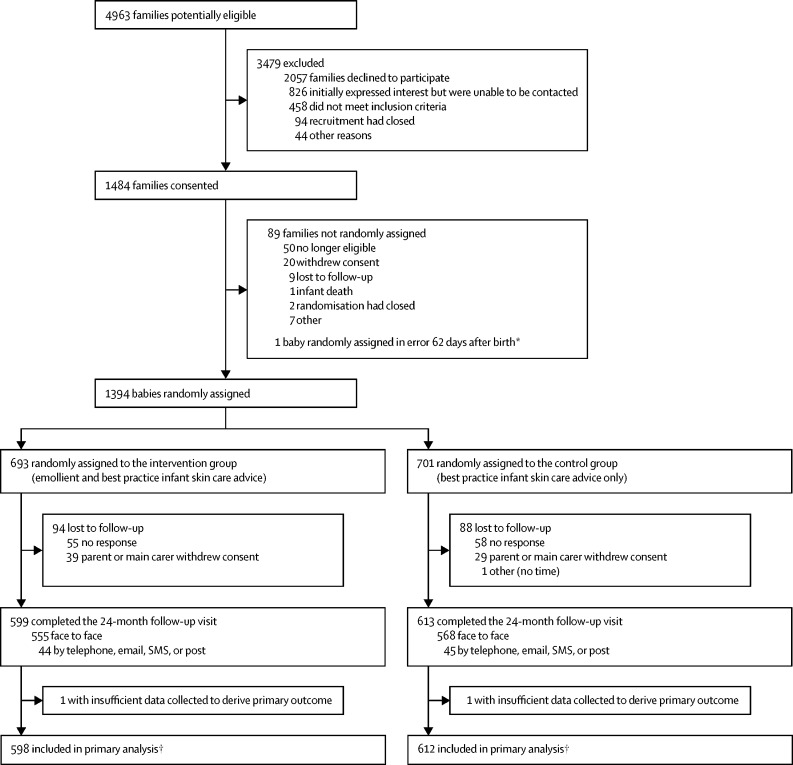
BACKGROUND: Skin barrier dysfunction precedes eczema development. We tested whether daily use of emollient in the first year could prevent eczema in high-risk children. METHODS: We did a multicentre, pragmatic, parallel-group, randomised controlled trial in 12 hospitals and four primary care sites across the UK. Families were approached via antenatal or postnatal services for recruitment of term infants (at least 37 weeks' gestation) at high risk of developing eczema (ie, at least one first-degree relative with parent-reported eczema, allergic rhinitis, or asthma, diagnosed by a doctor). Term newborns with a family history of atopic disease were randomly assigned (1:1) to application of emollient daily (either Diprobase cream or DoubleBase gel) for the first year plus standard skin-care advice (emollient group) or standard skin-care advice only (control group). The randomisation schedule was created using computer-generated code (stratified by recruiting centre and number of first-degree relatives with atopic disease) and participants were assigned to groups using an internet-based randomisation system. The primary outcome was eczema at age 2 years (defined by UK working party criteria) with analysis as randomised regardless of adherence to allocation for participants with outcome data collected, and adjusting for stratification variables. This trial is registered with ISRCTN, ISRCTN21528841. Data collection for long-term follow-up is ongoing, but the trial is closed to recruitment. FINDINGS: 1394 newborns were randomly assigned to study groups between Nov 19, 2014, and Nov 18, 2016; 693 were assigned to the emollient group and 701 to the control group. Adherence in the emollient group was 88% (466 of 532) at 3 months, 82% (427 of 519) at 6 months, and 74% (375 of 506) at 12 months in those with complete questionnaire data. At age 2 years, eczema was present in 139 (23%) of 598 infants with outcome data collected in the emollient group and 150 (25%) of 612 infants in the control group (adjusted relative risk 0·95 [95% CI 0·78 to 1·16], p=0·61; adjusted risk difference -1·2% [-5·9 to 3·6]). Other eczema definitions supported the results of the primary analysis. Mean number of skin infections per child in year 1 was 0·23 (SD 0·68) in the emollient group versus 0·15 (0·46) in the control group; adjusted incidence rate ratio 1·55 (95% CI 1·15 to 2·09). INTERPRETATION: We found no evidence that daily emollient during the first year of life prevents eczema in high-risk children and some evidence to suggest an increased risk of skin infections. Our study shows that families with eczema, asthma, or allergic rhinitis should not use daily emollients to try and prevent eczema in their newborn. FUNDING: National Institute for Health Research Health Technology Assessment.
Overview
The claims and statistics of this paper haven’t been checked yet.
Free: it reads the open-access text and checks the first 5 claims that cite a source we can check. Create a free account to check every claim.
Integrity signals
Registry
Cites
Statistics
Figures
Verification
Claims the paper makes
The claims and statistics of this paper haven’t been checked yet.
Free: it reads the open-access text and checks the first 5 claims that cite a source we can check. Create a free account to check every claim.
Claims other papers make about this one
Each is checked against this paper’s own text: does it say what the citing paper says it does?
The cited source doesn’t support the claim as written.
In the citing paper
“the BEEP study showed that emollients can increase the risk of AD due to the colonization of pathogens on the skin”
From Update on the pathogenesis of atopic dermatitis. (2024) · cites this paper as [11]
Checked by a reasoning model — may be wrong.
Experimental — accuracy not yet measuredThe source backs part of the claim, not all of it — or backs it for a different population, condition or comparison.
In the citing paper
“The skin barrier dysfunction that occurs in AD increases permeability to allergens and irritants, contributing to loss of hydration and persistence of subclinical skin inflammation.”
From Update on the pathogenesis of atopic dermatitis. (2024) · cites this paper as [11]
Experimental — accuracy not yet measuredThe check wasn’t confident either way, so it gives no verdict — never disputed.
In the citing paper
“S. aureus colonization is associated with an increased risk of food allergy.”
From Update on the pathogenesis of atopic dermatitis. (2024) · cites this paper as [11]
Experimental — accuracy not yet measured
Self-check
Percentages, sums and reported differences re-computed from the paper’s own numbers.
The self-check needs the paper’s full text.
Citations
Cites
1 retracted
Kelleher, M., Dunn-Galvin, A., Hourihane, J. O., Murray, D., Campbell, L. E., McLean, W. H. I., & Irvine, A. D. (2015) · Journal of Allergy and Clinical Immunology · doi:10.1016/j.jaci.2014.12.013 · Cited by 225
Self-citationRetractedKyu, H. H., Abate, D., Abate, K. H., Abay, S. M., Abbafati, C., Abbasi, N., Abbastabar, H., Abd-Allah, F., Abdela, J., Abdelalim, A., et al. (2018) · The Lancet · doi:10.1016/s0140-6736(18)32335-3 · Cited by 4,081
Atopic Dermatitis: Global Epidemiology and Risk Factors
Nutten, S. (2015) · Annals of Nutrition and Metabolism · doi:10.1159/000370220 · Cited by 3,055
Filaggrin Mutations Associated with Skin and Allergic Diseases
Irvine, A. D., McLean, W. H. I., & Leung, D. Y. M. (2011) · New England Journal of Medicine · doi:10.1056/nejmra1011040 · Cited by 1,217
Global variations in prevalence of eczema symptoms in children from ISAAC Phase Three
Odhiambo, J. A., Williams, H. C., Clayton, T. O., Robertson, C. F., & Asher, M. I. (2009) · Journal of Allergy and Clinical Immunology · doi:10.1016/j.jaci.2009.10.009 · Cited by 966
Self-citationWILLIAMS, H. C., JBURNEY, P. G., PEMBROKE, A. C., HAY, R. J., & Party, A. D. D. C. W. (1994) · British Journal of Dermatology · doi:10.1111/j.1365-2133.1994.tb08532.x · Cited by 926
Self-citationEmollient enhancement of the skin barrier from birth offers effective atopic dermatitis prevention
Simpson, E. L., Chalmers, J. R., Hanifin, J. M., Thomas, K. S., Cork, M. J., McLean, W. H. I., Brown, S. J., Chen, Z., Chen, Y., & Williams, H. C. (2014) · Journal of Allergy and Clinical Immunology · doi:10.1016/j.jaci.2014.08.005 · Cited by 722
Self-citationSandilands, A., Terron-Kwiatkowski, A., Hull, P. R., O'Regan, G. M., Clayton, T. H., Watson, R. M., Carrick, T., Evans, A. T., Liao, H., Zhao, Y., et al. (2007) · Nature Genetics · doi:10.1038/ng2020 · Cited by 662
Application of moisturizer to neonates prevents development of atopic dermatitis
Horimukai, K., Morita, K., Narita, M., Kondo, M., Kitazawa, H., Nozaki, M., Shigematsu, Y., Yoshida, K., Niizeki, H., Motomura, K.-I., et al. (2014) · Journal of Allergy and Clinical Immunology · doi:10.1016/j.jaci.2014.07.060 · Cited by 607
Hill, D. A., & Spergel, J. M. (2018) · Annals of Allergy, Asthma & Immunology · doi:10.1016/j.anai.2017.10.037 · Cited by 427
Research works printed but not linked: 2
- The National Institute for Health and Care Excellence Postnatal care up to 8 weeks after birth https://www.nice.org.uk/guidance/cg37 2015 32065741
- The National Institute for Health and Care Excellence Atopic eczema in under 12s: diagnosis and management https://www.nice.org.uk/guidance/cg57 2007 34101396
Cited by
Items 101–200 of 340
Soriano, V. X., Allen, K. J., Dharmage, S. C., Shifti, D. M., Perrett, K. P., Wijesuriya, R., Koplin, J. J., & Peters, R. L. (2024) · The Journal of Allergy and Clinical Immunology In Practice · doi:10.1016/j.jaip.2024.07.001 · Cited by 17
Impact of the exposome on food allergy development
Moran, T. P. (2023) · Current Opinion in Allergy and Clinical Immunology · doi:10.1097/aci.0000000000000889 · Cited by 19
Advances and potential of omics studies for understanding the development of food allergy
Sindher, S., Chin, A. R., Aghaeepour, N., Prince, L. S., Maecker, H. T., Shaw, G. M., Stevenson, D. K., Nadeau, K. C., Snyder, M. P., Khatri, P., et al. (2023) · Frontiers in Allergy · doi:10.3389/falgy.2023.1149008 · Cited by 17
Weidinger, S., Aoki, V., Dhar, S., Dlova, N. C., Kabashima, K., Ma, L., Flohr, C., & Irvine, A. D. (2026) · Nature Reviews Disease Primers · doi:10.1038/s41572-026-00703-z · Cited by 18
Self-citationSkin Predictive Biomarkers for the Development of Atopic Dermatitis and Food Allergy in Infants
Kim, J., Kim, B. E., Ahn, K., & Leung, D. Y. M. (2024) · Allergy Asthma and Immunology Research · doi:10.4168/aair.2024.16.4.323 · Cited by 16
Allergens in Atopic Dermatitis
Zhang, J., Li, G., Guo, Q., Yang, Y., Yang, J., Feng, X., & Yao, Z. (2025) · Clinical Reviews in Allergy & Immunology · doi:10.1007/s12016-025-09024-7 · Cited by 17
Gerner, T., Rinnov, M. R., Halling, A., Ravn, N. H., Knudgaard, M. H., Ewertsen, C., Trautner, S., Jakaša, I., Kežić, S., Skov, L., et al. (2022) · Acta Dermato Venereologica · doi:10.2340/actadv.v102.575 · Cited by 16
“Large recent trials have shown that prophylactic emollient application seems not to prevent development of AD, but, in fact, increase the risk of AD (25, 26).”
BackgroundPreclinical Atopic Dermatitis Skin in Infants: An Emerging Research Area
Paller, A. S., Scharschmidt, T. C., Kežić, S., & Irvine, A. D. (2024) · Journal of Investigative Dermatology · doi:10.1016/j.jid.2024.02.021 · Cited by 15
Trajectories of allergic diseases in children: Destination unknown?
Kalb, B., Khaleva, E., Giovannini, M., Adel‐Patient, K., Amat, F., Arasi, S., Lau, S., Nieto, A., Schaub, B., Standl, M., et al. (2025) · Pediatric Allergy and Immunology · doi:10.1111/pai.70131 · Cited by 15
“104,105 A trial conducted in Japan has shown that early treatment of AD with topical steroids to clinically affected and unaffected skin in high risk infants (7–13 weeks) was effective for egg allergy prevention evaluated at 28 weeks, but was associated with adverse effect on growth.”
Topical emollient application in term healthy newborns: A systematic review
Priyadarshi, M., Balachander, B., Gupta, S., & Sankar, M. J. (2022) · Journal of Global Health · doi:10.7189/jogh.12.12002 · Cited by 15
“One study reported no contamination in the comparison group [24] while three studies reported contamination of up to 18% [16], 39% [20] and 13% [23] in their comparison groups.”
BackgroundMethodInfluentialKottner, J., Hillmann, K., Fastner, A., Conzade, R., Heidingsfelder, S., Neumann, K., Blume‐Peytavi, U., & ADAPI Study Group (2022) · Journal of the European Academy of Dermatology and Venereology · doi:10.1111/jdv.18698 · Cited by 15
Scadding, G. K., McDonald, M., Backer, V., Scadding, G., Bernal‐Sprekelsen, M. S., Conti, D. M., Corso, E. D., Diamant, Z., Gray, C. L., Hopkins, C. L., et al. (2024) · Frontiers in Allergy · doi:10.3389/falgy.2023.1291185 · Cited by 16
Fuxench, Z. C. C., Mitra, N., Pozo, D. D., Hoffstad, O., Shin, D. B., & Margolis, D. J. (2023) · Journal of the American Academy of Dermatology · doi:10.1016/j.jaad.2023.11.013 · Cited by 14
Ng, P. S. M., Wee, L. W. Y., Ho, V. P. Y., Colin, T. W., Bishnoi, P., Alagappan, U., Wong, S. M. Y., Gan, E. Y., Quek, B. H., Shen, L., et al. (2021) · Australasian Journal of Dermatology · doi:10.1111/ajd.13703 · Cited by 14
“Of this cohort, 5.9% had mild, 54.6% had moderate, and 39.5% had severe AD.17 In our study, only 8 of the 131 participants tested had FLG LoF mutations, with 6 of them developing AD and 1 with moderateto-severe AD.”
BackgroundResultInfluentialSever, M. L., Calatroni, A., Roberts, G. C., Toit, G. D., Bahnson, H. T., Radulović, S., Larson, D., Byron, M., Santos, A. F., Huffaker, M. F., et al. (2023) · The Journal of Allergy and Clinical Immunology In Practice · doi:10.1016/j.jaip.2023.04.032 · Cited by 14
“27,28 This algorithm was used to guide the deliberations of an expert group who reviewed the available data to define whether participants were or were not food allergic and included the SPT result and more detailed reaction history.”
Landau, T., Gamrasni, K., Barlev, Y., Elizur, A., Benor, S., Mimouni, F. B., & Brandwein, M. (2023) · Allergy · doi:10.1111/all.15839 · Cited by 14
A concept for integrated care pathways for atopic dermatitis—A GA 2 LEN ADCARE initiative
Zuberbier, T., Latiff, A. H. A., Aggelidis, X., Augustin, M., Bălan, R.-G., Bangert, C., Beck, L. A., Bieber, T. R. M., Bernstein, J. A., Bertolín‐Colilla, M., et al. (2023) · Clinical and Translational Allergy · doi:10.1002/clt2.12299 · Cited by 14
Self-citationInuzuka, Y., Yamamoto‐Hanada, K., Kobayashi, T., Pak, K., Toyokuni, K., Ogita, H., Miyoshi, T., Ogawa, K., Sago, H., & Ohya, Y. (2023) · Journal of the European Academy of Dermatology and Venereology · doi:10.1111/jdv.19375 · Cited by 14
“However, Chalmers et al. 12 re-ported that the emollient group developed more skin infections than the control group.”
BackgroundIto, T., & Nakamura, Y. (2024) · International Immunology · doi:10.1093/intimm/dxae038 · Cited by 14
Emollient application from birth to prevent eczema in high-risk children: the BEEP RCT
Bradshaw, L. E., Wyatt, L. A., Brown, S., Haines, R., Montgomery, A. A., Perkin, M. R., Sach, T., Lawton, S., Flohr, C., Ridd, M. J., et al. (2024) · Health Technology Assessment · doi:10.3310/rhdn9613 · Cited by 13
Self-citationCurrent approach to moisturizer and emollient utilization in atopic dermatitis: a review
Maden, S. (2024) · doi:10.37349/eaa.2024.00056 · Cited by 14
Bradshaw, L. E., Haines, R., Thomas, K. S., Chalmers, J. R., Irvine, A. D., Williams, H. C., & Brown, S. (2021) · Clinical & Experimental Allergy · doi:10.1111/cea.14025 · Cited by 13
Self-citationConstant vigilance! Managing threats to the skin barrier
Chu, V., & Ong, P. Y. (2024) · Annals of Allergy Asthma & Immunology · doi:10.1016/j.anai.2024.02.004 · Cited by 13
Role of skin management in the prevention of atopic dermatitis and food allergy
Tham, E. H., Yamamoto‐Hanada, K., Leung, A. S. Y., & Ohya, Y. (2024) · Pediatric Allergy and Immunology · doi:10.1111/pai.14094 · Cited by 13
Prevalence and risk factors for milk allergy overdiagnosis in the BEEP trial cohort
Allen, H. I., Wing, O., Milkova, D., Jackson, E., Li, K., Bradshaw, L. E., Wyatt, L. A., Haines, R., Santer, M., Murphy, A. W., et al. (2024) · Allergy · doi:10.1111/all.16203 · Cited by 13
Self-citationThe atopic march and its prevention
Jimenez, J., & Paller, A. S. (2021) · Annals of Allergy Asthma & Immunology · doi:10.1016/j.anai.2021.04.021 · Cited by 13
Fowler, J. F., Ma, L., Bergman, J. N., Horowitz, P., Lavender, T., Eichenfield, L. F., Draelos, Z. D., Danby, S. G., & Cork, M. J. (2025) · Journal of Dermatological Treatment · doi:10.1080/09546634.2025.2487945 · Cited by 13
“Additionally, emollients can make skin slippery after application, posing a potential slipping risk if deposited in baths, showers, or on hard flooring. using non-slip mats can help prevent slipping (63).”
InfluentialSelf-citationNedorost, S. T., & Hammond, M. I. (2020) · International Journal of Women’s Dermatology · doi:10.1016/j.ijwd.2020.08.004 · Cited by 12
“Use emollients with caution on inflamed skin: Daily head-totoe use of emollients delayed the onset of atopic dermatitis in high-risk neonates in a small study, although larger studies failed to validate this result (Chalmers et al., 2020; Simpson et al., 2014).”
ResultSCHACHNER, L. A., Blume‐Peytavi, U., Andriessen, A., IZAKOVIC, J., Maruani, A., Micali, G., MURASHKIN, N., SALAVASTRU, C., & TORRELO, A. (2022) · Italian Journal of Dermatology and Venereology · doi:10.23736/s2784-8671.21.07172-3 · Cited by 12
Environmental and behavioral mitigation strategies for patients with atopic dermatitis
Shobnam, N., Ratley, G., Zeldin, J., Yadav, M., & Myles, I. A. (2024) · JAAD International · doi:10.1016/j.jdin.2024.07.018 · Cited by 12
“36,37 Overall, the data do not support recommending preventative use of emollients to all patients, but there may be benefit for high-risk children, those with parental atopy.”
BackgroundRidd, M. J., Webb, D., Roberts, K., Santer, M., Chalmers, J. R., Gilbertson, A., Marriage, D., Blair, P. S., Turner, N. L., Garfield, K., et al. (2021) · Clinical & Experimental Allergy · doi:10.1111/cea.13816 · Cited by 12
Self-citationde Jong, N. W., van Splunter, M. E., Emons, J. A. M., Hettinga, K. A., van Wijk, R. G., Wichers, H. J., Savelkoul, H. F. J., Sprikkelman, A. B., van Neerven, R. J. J., Liu, L., et al. (2022) · Nutrients · doi:10.3390/nu14030629 · Cited by 12
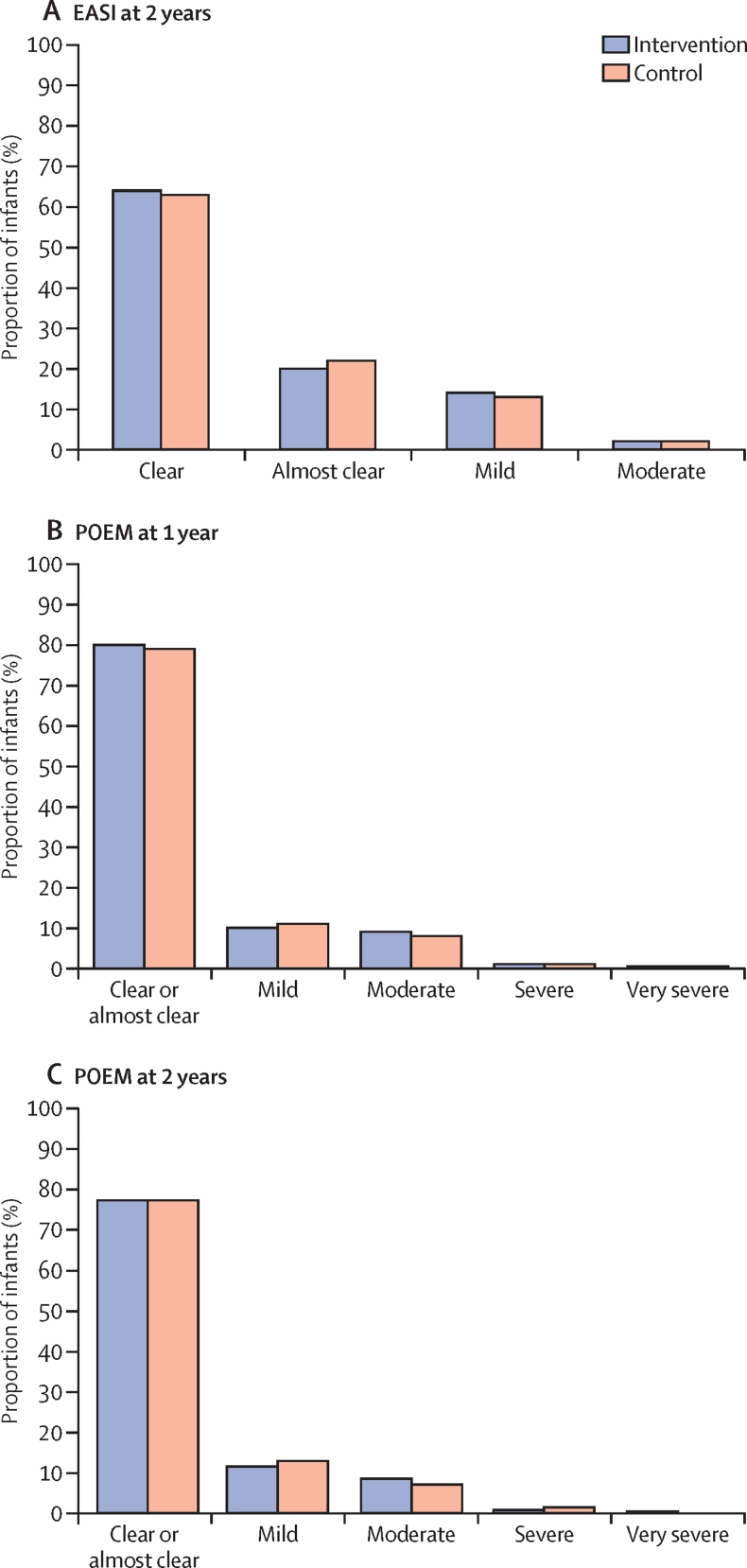
“To measure eczema severity, POEM and eczema area and severity index (EASI) scores were collected [34].”
MethodA global survey on national standard care for newborn bathing
Kido, M., Yonezawa, K., Haruna, M., Tahara‐Sasagawa, E., & Usui, Y. (2023) · Japan Journal of Nursing Science · doi:10.1111/jjns.12558 · Cited by 10
Environmental Interventions for Preventing Atopic Diseases
Pfirrman, S., Devonshire, A. L., & Winslow, A. W. (2024) · Current Allergy and Asthma Reports · doi:10.1007/s11882-024-01141-1 · Cited by 10
“Despite early promise from smaller studies, larger trials have not shown a protective effect of routine emollient application during infancy from atopic dermatitis onset [81, 82].”
Tape Stripping — Searching for Minimally Invasive Biomarkers in Atopic Dermatitis
Zysk, W., & Trzeciak, M. (2024) · Dermatology Practical & Conceptual · doi:10.5826/dpc.1402a123 · Cited by 10
Wintrebert, G., Bradatan, E., Liabeuf, V., Beaumont, P., van der Brempt, X., Dumond, P., Pouessel, G., Mariotte, D., Fardeau, M. F., Demoly, P. M., et al. (2021) · Revue française d'allergologie · doi:10.1016/j.reval.2020.12.002 · Cited by 10
Role of the gut–skin axis in IgE-mediated food allergy and atopic diseases
Suaini, N. H. A., Siah, K. T. H., & Tham, E. H. (2021) · Current Opinion in Gastroenterology · doi:10.1097/mog.0000000000000780 · Cited by 10
Hornsey, S., Dobson, A., Ghio, D., Henaghan‐Sykes, K., Adams, S., Lovegrove, E., Santer, M., & Müller, I. (2024) · Journal of Advanced Nursing · doi:10.1111/jan.16070 · Cited by 10
“…diagnoses/labelling of reflux or allergy and prescriptions (for specialist formula or reflux medication) are similar to findings from other research about labelling and prescribing (Chalmers et al., 2020 ; Mehta et al., 2022 ; Scherer et al., 2013 ; Schoemaker et al., 2015 ; Vincent et al., 2022 ).”
BackgroundResultInfluentialAlenius, H. T., Sinkko, H., Moitinho‐Silva, L., Rodríguez, E., Broderick, C., Alexander, H., Reiger, M., Hjelmsø, M. H., Fyhrquist, N., Oláh, P., et al. (2021) · Experimental Dermatology · doi:10.1111/exd.14446 · Cited by 10
Self-citationLiu, J., Guo, S., Wang, Y., Huang, N., Li, W., Ma, D., Yang, Y., Yang, L., Chen, H., & Zhu, R. (2024) · World Allergy Organization Journal · doi:10.1016/j.waojou.2024.100883 · Cited by 9
“28 Our study showed that 93.4% of the children combined with other allergic disease, indicating that majority were experiencing or had experienced an allergic march.”
BackgroundInfluentialAhlström, M. G., Bjerre, R. D., Ahlström, M. G., Skov, L., & Johansen, J. D. (2024) · Life · doi:10.3390/life14030345 · Cited by 9
“Chalmers et al. [14] randomized 1394 infants at high risk of developing AD to either daily use of moisturizers or no intervention for the first year of living and found no difference in eczema development at age 2 years.”
BackgroundFrequent oil baths and skin barrier during infancy in the PreventADALL study
Rehbinder, E. M., Gerdin, S. W., Hoyer, A., Bradley, M., Carlsen, K. C. L., Granum, B. B., Hedlin, G., Jonassen, C. M., LeBlanc, M., Nordlund, B., et al. (2024) · British Journal of Dermatology · doi:10.1093/bjd/ljae091 · Cited by 9
“The impaired skin barrier may facilitate penetration of allergens, as demonstrated in the BEEP study where emollients increased the risk of allergic sensitization, 28 and in the EAT study, where increasing use of emollients, oils in particular, increased the risk of food allergy.”
BackgroundReal-World LEAP Implementation
Koplin, J. J., Soriano, V. X., & Peters, R. L. (2021) · Current Allergy and Asthma Reports · doi:10.1007/s11882-022-01032-3 · Cited by 9
Guía de dermatitis atópica para México (GUIDAMEX): lineamientos usando metodología ADAPTE
Larenas‐Linnemann, D. E., Pérez, C. R., Luna-Pech, J. A., Macías-Weinmann, A., la Cruz, H. V., Navarrete-Rodriguez, E. M., Del-Rio-Navarro, B. E., Godínez-Aldrete, L., Guevara‐Sanginés, E., Ortega‐Martell, J. A., et al. (2023) · Gaceta Médica de México · doi:10.24875/gmm.m22000690 · Cited by 9
Clinical Benefits of Basic Emollient Therapy for the Management of Patients With Xerosis Cutis
Vestergaard, C., Torrelo, A., & Christen‐Zaech, S. (2025) · International Journal of Dermatology · doi:10.1111/ijd.17792 · Cited by 8
Shedding light on key pharmacological knowledge and strategies for pediatric atopic dermatitis
Moreno, A., Renert‐Yuval, Y., & Guttman‐Yassky, E. (2023) · Expert Review of Clinical Pharmacology · doi:10.1080/17512433.2023.2173172 · Cited by 8
“Nevertheless, results from high profile large studies on moisturizers in newborns/infants from the UK and from Sweden [22] and Norway [26] showed lack of protective effects and lack of AD prevention with daily emollient application during the first year of life [22], with or without modified early complimentary feedin…”
ResultO’Connor, C., Livingstone, V., Hourihane, J. O., Irvine, A. D., Boylan, G. B., & Murray, D. M. (2023) · Pediatric Allergy and Immunology · doi:10.1111/pai.13998 · Cited by 8
Emollients for preventing atopic eczema: Cost‐effectiveness analysis of the BEEP trial
Sach, T., Lartey, S. T., Davies, C. F., Chalmers, J. R., Haines, R., Bradshaw, L. E., Montgomery, A. A., Thomas, K. S., Brown, S., Ridd, M. J., et al. (2023) · Clinical & Experimental Allergy · doi:10.1111/cea.14381 · Cited by 8
“The largest component of the cost was overnight hospital stays, particularly for those infants with admitted.”
Self-citationLandau, T., Gamrasni, K., Levin, A., Barlev, Y., Sanders, O., Benor, S., & Brandwein, M. (2024) · Annals of Allergy Asthma & Immunology · doi:10.1016/j.anai.2024.06.010 · Cited by 8
Food allergy prevention, including early food introduction
Leonard, S. A. (2020) · Journal of Food Allergy · doi:10.2500/jfa.2020.2.200007 · Cited by 8
“One RCT reported no protective effect of soy formula 25 Emollients to repair skin barrier impairment Two multicenter RCT studies 40,41 did not find a decreased the risk of eczema in the first 2 years of life and, therefore, unlikely to prevent food allergen sensitization or allergy Not enough…”
BackgroundPrévention primaire de l’allergie alimentaire du jeune enfant, actualités et propositions
Sabouraud-Leclerc, D., Bradatan, E., Moraly, T., Payot, F., Chabbert, A., Pontcharraud, R., Larue, C., Nemni, A., Juchet, A., Morisset, M., et al. (2022) · Revue française d'allergologie · doi:10.1016/j.reval.2022.01.002 · Cited by 8
Inuzuka, Y., Yamamoto‐Hanada, K., Pak, K., Miyoshi, T., Kobayashi, T., & Ohya, Y. (2022) · Frontiers in Allergy · doi:10.3389/falgy.2022.862620 · Cited by 8
English version of guidelines for the management of asteatosis 2021 in Japan
Saeki, H., Tsunemi, Y., Arai, S., Ichiyama, S., Katoh, N., Kikuchi, K., Kubo, A., Terui, T., Nakahara, T., Futamura, M., et al. (2021) · The Journal of Dermatology · doi:10.1111/1346-8138.16293 · Cited by 7
Food Allergy and Eosinophilic Gastrointestinal Diseases—The Next 10 Years
Turner, P., Tang, M. L. K., & Wood, R. J. K. (2022) · The Journal of Allergy and Clinical Immunology In Practice · doi:10.1016/j.jaip.2022.10.038 · Cited by 7
Islam, N., & Chu, D. K. (2022) · Frontiers in Allergy · doi:10.3389/falgy.2022.1037596 · Cited by 7
Argenziano, G., Cusano, F., Corazza, M., AMATO, S., Amerio, P., Naldi, L., Patruno, C., Pigatto, P. D. M., Quaglino, P., Gisondi, P., et al. (2024) · Italian Journal of Dermatology and Venereology · doi:10.23736/s2784-8671.24.07666-7 · Cited by 7
Self-citationCan an online approach to citizen science revolutionise clinical trials?
Howells, L., Muller, I., Baker, A., Owen, T., Davies, F., Ridd, M., Mitchell, E., Cowdell, F., Leighton, P. A., Roberts, A., et al. (2024) · Bristol Research (University of Bristol) · Cited by 7
Self-citationBraun, C., Vocanson, M., Nicolas, J., & Nosbaum, A. (2020) · Annales de Dermatologie et de Vénéréologie · doi:10.1016/s0151-9638(20)31082-6 · Cited by 7
Comparison of lotions, creams, gels and ointments for the treatment of childhood eczema: the BEE RCT
Ridd, M. J., Wells, S. L., MacNeill, S., Sanderson, E., Webb, D., Banks, J., Sutton, E. J., Shaw, A. R. G., Wilkins, Z., Clayton, J., et al. (2023) · Health Technology Assessment · doi:10.3310/gzqw6681 · Cited by 8
Self-citationKannenberg, S. M. H., Karabus, S. J., Visser, W. I., Aboobaker, J., Kriel, M., Levin, M. E., Magigaba, B. P., Manjra, A. I., Misra, R., Mpofu, P., et al. (2020) · South African Family Practice · doi:10.4102/safp.v62i1.5190 · Cited by 7
Formula milk companies and allergy healthcare professionals in India
Allen, H. I., Gupta, A., Mundell, A., Gupta, N., Thakur, A., Nagarajan, S. A., Munblit, D., Baker, P., & Boyle, R. J. (2023) · Clinical & Experimental Allergy · doi:10.1111/cea.14355 · Cited by 7
Self-citationEmollients for the prevention of atopic dermatitis
Kothari, A., Locke, A., & Eiwegger, T. (2020) · Allergy · doi:10.1111/all.14650 · Cited by 7
Sach, T., Williams, H. C., Allen, H. I., Boyle, R. J., Kelleher, M. M., Brown, S., Cork, M. J., Flohr, C., Jay, N., Lartey, S. T., et al. (2024) · Value in Health · doi:10.1016/j.jval.2024.08.010 · Cited by 6
Self-citationEpidermal Barrier Dysfunction in Atopic Dermatitis
Gomes, T. F., Calado, R., & Gonçalo, M. (2021) · Journal of the Portuguese Society of Dermatology and Venereology · doi:10.29021/spdv.79.3.1405 · Cited by 6
Olabi, B., & Williams, H. C. (2021) · Current Opinion in Allergy and Clinical Immunology · doi:10.1097/aci.0000000000000750 · Cited by 6
“The Barrier Enhancement for Eczema Prevention (BEEP) trial sought to investigate whether daily emollient use in term infants at high risk of developing eczema (having at least one first degree relative with clinically diagnosed eczema, asthma or hayfever) could reduce the risk of developing eczema by the age of 2 year…”
BackgroundSelf-citationPreventing allergies through the skin
Winslow, A. W., & Keet, C. A. (2022) · Annals of Allergy Asthma & Immunology · doi:10.1016/j.anai.2022.04.013 · Cited by 6
Guidelines for treatment of atopic dermatitis
Hadžavdić, S. L., Pustišek, N., Lugović‐Mihić, L., Bulić, S. O., Puizina-Ivić, N., Peternel, S., Polić, M. V., Kulišić, S. M., Tončić, R. J., Murat‐Sušić, S., et al. (2022) · Liječnički vjesnik · doi:10.26800/lv-144-9-10-1 · Cited by 6
A sticky mess—Are moisturizers overused in dermatitis care?
Nedorost, S. T. (2024) · Journal of the American Academy of Dermatology · doi:10.1016/j.jaad.2024.07.1485 · Cited by 5
Prevention of Food Allergy: Harmonizing Perspectives from the East and West
Leung, A. S. Y., & Wong, G. (2025) · Annals of Nutrition and Metabolism · doi:10.1159/000543617 · Cited by 5
“The Barrier Enhancement for Eczema Prevention (BEEP) RCT was conducted in the UK to determine if daily emollient application in the first year of life could prevent eczema and other atopic diseases in high-risk infants [77].”
Xie, Q., Xue, W., & Fu, L. (2025) · Critical Reviews in Food Science and Nutrition · doi:10.1080/10408398.2025.2578315 · Cited by 5
“In fact, these interventions increased risk of skin infections, raising concerns about the adequacy of barrier-focused strategies as standalone measures for allergic disease prevention (Chalmers et al. 2020; Skjerven et al. 2020).”
Resilience of the Skin Microbiome in Atopic Dermatitis During Short-Term Topical Treatment
Ahlström, M. G., Bjerre, R. D., Hu, Y. O. O., Seifert, M., Boulund, F., Skov, L., Johansen, J. D., & Engstrand, L. G. (2025) · International Journal of Molecular Sciences · doi:10.3390/ijms262311737 · Cited by 5
“We used a moisturiser identical to that employed in a large-scale infant study investigating its potential prophylactic effect against eczema development [8].”
Le, L. N., Luu, Q. Q., & Pham, D. L. (2026) · Allergy Asthma and Immunology Research · doi:10.4168/aair.2026.18.1.123 · Cited by 5
“24,25 The observed association may reflect a transient impairment of the skin barrier rather than a persistent defect, warranting further longitudinal investigation.”
Wen, S., Sun, M., Ye, L., Yang, B., Hu, L., & Man, M. (2021) · BioMed Research International · doi:10.1155/2021/5594646 · Cited by 5
“Evidence indicates that emollients can be used as adjuvant interventions in the management of eczematous dermatitis [4, 8, 32, 33].”
Schachner, L. A., Blume‐Peytavi, U., Andriessen, A., Izakovic, J., Maruani, A., Micali, G., Murashkin, N. N., Sălăvăstru, C., & Torrelo, A. (2023) · Italian Journal of Dermatology and Venereology · doi:10.23736/s2784-8671.23.07336-x · Cited by 5
Advances of the exposome at individual levels and prevention in atopic dermatitis
Xian, M., Maskey, A., Kopulos, D., & Li, X.-M. (2024) · International Journal of Dermatology · doi:10.1111/ijd.17559 · Cited by 5
“120,121 In fact, some evidence suggests an increased risk of skin infections associated with early emollient use.”
The peanut snack that triggered a fresh approach to allergy prevention
DeWeerdt, S. (2020) · Nature · doi:10.1038/d41586-020-02782-8 · Cited by 5
Ryczaj, K., Szczukocka-Zych, A., Wawszczak, M., Gawryjołek, J., Krogulska, A., Krawiec, M., Horvath, A., Szajewska, H., Santos, A. F., Bahnson, H. T., et al. (2023) · BMJ Open · doi:10.1136/bmjopen-2023-074168 · Cited by 5
Food Allergy: Searching for the Modern Environmental Culprit.
Eisenstein, A. S., Hilliard, B. K., Silwal, S., & Wang, A. (2020) · The Yale Journal of Biology and Medicine · Cited by 5
Association of egg protein levels in dust with allergy status and related factors
Kojima, R., Miyake, K., Shinohara, R., Kushima, M., Horiuchi, S., Otawa, S., Yokomichi, H., Akiyama, Y., Ooka, T., & Yamagata, Z. (2022) · Pediatrics International · doi:10.1111/ped.15372 · Cited by 5
Kelleher, M. M., Cro, S., Phillips, R., Williams, H. C., Lowe, A. J., & Boyle, R. J. (2022) · Allergy · doi:10.1111/all.15238 · Cited by 5
Self-citationChanges in Skin Barrier Function in Neonates: Daily Variation and Impact of Bathing
Tanaka, F., Hayashi, C., Iida, M., Shinya, K., & Futamura, M. (2024) · Pediatric Dermatology · doi:10.1111/pde.15772 · Cited by 4
“However, large trials have not demonstrated any preventive effect of the use of moisturizers on the prevalence of food allergies, and the conclusions are still debatable [13, 14].”
What Does Long-Term Control in Atopic Dermatitis Look Like?
Narla, S., Fuxench, Z. C. C., Abuabara, K., Beck, L. A., Chovatiya, R., Thaçi, D., & Silverberg, J. I. (2025) · Dermatitis · doi:10.1089/derm.2024.0121 · Cited by 4
Atopic march: modern view on the problem and measures for prevention
Litovkina, A. O., Smolnikov, E. V., Elisyutina, O. G., Викторовна, Х. М., & Fedenko, E. S. (2025) · Russian Journal of Allergy · doi:10.36691/rja17044 · Cited by 4
Prevention of Atopic Dermatitis: What Are We Missing?
Ohya, Y. (2025) · Allergy Asthma and Immunology Research · doi:10.4168/aair.2025.17.4.433 · Cited by 4
“This study was carried out as a feasibility study of the main BEEP trial, 45 and the participants of the intervention group were asked to choose favorable one from three kinds of emollients/ moisturizers.”
Barrier defect in atopic dermatitis – possibilities and limits of basic skin therapy
Roesner, L. M., & Heratizadeh, A. (2021) · Allergologie select · doi:10.5414/alx02268e · Cited by 4
Epicutaneous sensitization. what do we know?
Новик, Г. А., Жданова, М. В., & Demidova, A. (2022) · Bulletin of Siberian Medicine · doi:10.20538/1682-0363-2021-4-180-192 · Cited by 4
Mitchell, E. J., Sprange, K., Treweek, S. P., & Nixon, E. (2022) · Trials · doi:10.1186/s13063-022-06417-3 · Cited by 4
“A variety of strategies were used including providing high-street shopping vouchers, contact via text messages, sending newsletters to families to keep them updated about the trial and sending birthday cards [25].”
MethodSelf-citationLeite, N. S., & de Castro, M. E. P. C. (2022) · Brazilian Journal of Health Review · doi:10.34119/bjhrv5n3-227 · Cited by 5
Maternal Elimination Diet and Symptoms of Cow’s Milk Allergy in Breastfed Infants—Reply
Munblit, D., Palmer, D. J., & Boyle, R. J. (2021) · Archives of Pediatrics and Adolescent Medicine · doi:10.1001/jamapediatrics.2020.5320 · Cited by 4
Self-citationBuckley, D. A. (2024) · Wiley eBooks · doi:10.1002/9781119709268.rook018 · Cited by 4
Skin-lung axis in the atopic march: The immune link from skin to lungs
Zhu, M., Liu, X., Jing, Q., Lei, Y., & Yao, X. (2025) · Chinese Medical Journal - Pulmonary and Critical Care Medicine · doi:10.1016/j.pccm.2025.11.002 · Cited by 3
Chau, C. A., Cyr, S. L., Gupta, R., & Lio, P. (2026) · Clinical Reviews in Allergy & Immunology · doi:10.1007/s12016-025-09131-5 · Cited by 3
Skin intervention for food allergy prevention: recent advances and clinical implications
Yamamoto‐Hanada, K. (2026) · Current Opinion in Allergy and Clinical Immunology · doi:10.1097/aci.0000000000001154 · Cited by 3
Ryczaj, K., Leung, D. Y. M., Venter, C., Sozańska, B., & Brough, H. A. (2026) · Allergy · doi:10.1111/all.70404 · Cited by 3
Role of Actives in Emollients in Atopic Dermatitis
Chandrashekar, B., Luger, T. A., Rajendran, S. C., Parathasaradhi, A., Thomas, J., Ganjoo, A., Sharma, D., Damisetty, R., Ruby, N., Sujay, V., et al. (2024) · Journal of Dermatology and Skin Science · doi:10.29245/2767-5092/2024/1.1178 · Cited by 3
Memory, K. E., MacNeill, S., Thomas, K. S., Santer, M., & Ridd, M. J. (2024) · Clinical and Experimental Dermatology · doi:10.1093/ced/llae328 · Cited by 3
Self-citationBaber, C., Busch, L., Klein, A. L., Infante, V. H. P., Abdul-Jabbar, S., Benaouda, F., Khurana, P., Jones, S. A., Novak, N., Santos, A. F., et al. (2025) · British Journal of Dermatology · doi:10.1093/bjd/ljaf214 · Cited by 3
Self-citationSkin Barrier Abnormalities in Atopic Dermatitis
Frølunde, A. S., Vestergaard, C., & Deleuran, M. S. (2022) · Current Treatment Options in Allergy · doi:10.1007/s40521-022-00310-9 · Cited by 3
Role of moisturizers and cleansers in managing pediatric eczema
Gupta, P., & Sangwan, P. (2025) · Indian Journal of Skin Allergy · doi:10.25259/ijsa_36_2025 · Cited by 3
Atopisches Ekzem: Störfeuer für eine Dreiecksbeziehung
Lauffer, F., & Biedermann, T. (2021) · Deutsches Ärzteblatt · doi:10.3238/persderma.2021.06.18.04 · Cited by 3
Metadata
- Authors
- Chalmers, J. R., Haines, R. H., Bradshaw, L. E., Montgomery, A. A., Thomas, K. S., Brown, S. J., Ridd, M. J., Lawton, S., Simpson, E. L., Cork, M. J., Sach, T. H., Flohr, C., Mitchell, E. J., Swinden, R., Tarr, S., Davies-Jones, S., Jay, N., Kelleher, M. M., Perkin, M. R., Boyle, R. J., & Williams, H. C.
- Affiliations
- University of Nottingham (GB)
- University of Dundee (GB)
- University of Bristol (GB)
- The Rotherham NHS Foundation Trust (GB)
- Oregon Health & Science University (US)
- University of Sheffield (GB)
- University of East Anglia (GB)
- King's College London (GB)
- Sheffield Children's Hospital (GB)
- Imperial College London (GB)
- St George's, University of London (GB)
- Corresponding author
- Williams, Hywel C
- ORCID
- Chalmers, Joanne R
- Haines, Rachel H
- Bradshaw, Lucy E
- Montgomery, Alan A
- Thomas, Kim S
- Brown, Sara J
- Ridd, Matthew J
- Lawton, Sandra
- Simpson, Eric L
- Cork, Michael J
- Sach, Tracey H
- Flohr, Carsten
- Mitchell, Eleanor J
- Swinden, Richard
- Tarr, Stella
- Jay, Nicola
- Kelleher, Maeve M
- Perkin, Michael R
- Boyle, Robert J
- Williams, Hywel C
- Venue
- The Lancet
- Publisher
- Elsevier BV
- Published
- 2020-03
- Volume
- 395
- Issue
- 10228
- Pages
- 962-972
- ISSN
- 0099-5355 (ISSN-L)
- 0140-6736
- PMC
- PMC7086156
- OpenAlex
- W3009019417
- Semantic Scholar
- d22535fbf5ef7df54f6c48de647e77de5f2b756c
- Cited by
- 317
- References
- 34
- Citations by year
- 2026: 34 · 2025: 37 · 2024: 60 · 2023: 50 · 2022: 61 · 2021: 48 · 2020: 24
- FWCI
- 33.43
- Type
- journal article
- Language
- en
- Open access
- hybrid
- doi.org
- Licence
- cc-by
- www.elsevier.com/tdm/userlicense/1.0/ (tdm)
- www.elsevier.com/legal/tdmrep-license (tdm)
- creativecommons.org/licenses/by/4.0/ (vor)
- Locations
- The Lancet (publishedVersion, cc-by)
- PubMed Central (publishedVersion, cc-by)
- PubMed (publishedVersion)
- Repository@Nottingham (University of Nottingham) (publishedVersion, cc-by)
- Bristol Research (University of Bristol) (publishedVersion, cc-by)
- Discovery Research Portal (University of Dundee) (acceptedVersion, cc-by)
- St George's Online Research Archive (St George's University of London) (acceptedVersion)
- UEA Digital Repository (University of East Anglia) (acceptedVersion)
- ePrints Soton (University of Southampton) (submittedVersion, cc-by)
- Research Portal (King's College London) (submittedVersion, other-oa)
- Edinburgh Research Explorer (University of Edinburgh) (submittedVersion, cc-by)
- Explore Bristol Research (submittedVersion, cc-by)
- Spiral (Imperial College London) (submittedVersion, other-oa)
- Funders
- Eli Lilly and Company
- Pfizer
- GlaxoSmithKline
- Sanofi
- Celgene
- University of Dundee
- Regeneron Pharmaceuticals
- Wellcome Trust (/Z/15/Z, 106865/Z/15/Z)
- Dermira
- National Institute for Health and Care Research (12/67/12, 2014-07-013, PDF-2014-07-013, CDF-2014-07-037, PB-PG-0317-20028, TRF-2017-10-003)
- Department of Health and Social Care
- British Association of Dermatologists
- Imperial College London
- King's College London
- Galderma
- LEO Pharma
- Genentech
- Health Technology Assessment Programme (12/67/12)
- Topics
- Health Sciences › Medicine › Dermatology › Dermatology and Skin Diseases
- Health Sciences › Medicine › Pediatrics, Perinatology and Child Health › Neonatal skin health care
- Health Sciences › Medicine › Dermatology › Contact Dermatitis and Allergies
- Keywords
- emollients, skin barrier dysfunction, atopic diseases, high-risk infants, allergic rhinitis, asthma, infant skin care
- MeSH terms
- Dermatitis, Atopic, Dose-Response Relationship, Drug, Drug Administration Schedule, Eczema, Emollients, Female, Follow-Up Studies, United Kingdom, Humans, Infant, Infant, Newborn, Male, Reference Values, Treatment Outcome, Risk Assessment
About these checks
Registry, retraction, Cites and statistics results are computed, not judged, with one exception: a printed reference that no index lists is read once by a model before it counts as a citation error. Claims are extracted by a model and kept only when their quote appears verbatim in the text; each cited source is then checked, with a model’s help, for whether it says what the claim relies on. Those verdicts can be wrong — read the claim’s quote and the cited source before relying on one.
Statistics and arithmetic are recomputed, not judged.
Confidence bands are shown only for fields calibrated on our annotated test set. None is calibrated yet, so no band is shown.
What counts as a claim ›How we measure confidence ›How we check this ›
Are you an author, or do you see a problem with this page? Request a review
Data sources
Bibliographic data: Semantic Scholar, OpenAlex, Crossref.
Contains information from the Semantic Scholar Academic Graph Datasets, made available under the ODC Attribution License (ODC-BY 1.0).
Semantic Scholar’s data is described in: Kinney, R., et al. (2023). The Semantic Scholar Open Data Platform. arXiv:2301.10140.
