

Burden of disease attributable to unsafe drinking water, sanitation, and hygiene in domestic settings: a global analysis for selected adverse health outcomes
Open accessThe DOI matches its Crossref record; 55 of the 58 references it cites were found in a registry or an index; 36 of the 49 sources its claims cite were checked for support.
Abstract
BACKGROUND: Assessments of disease burden are important to inform national, regional, and global strategies and to guide investment. We aimed to estimate the drinking water, sanitation, and hygiene (WASH)-attributable burden of disease for diarrhoea, acute respiratory infections, undernutrition, and soil-transmitted helminthiasis, using the WASH service levels used to monitor the UN Sustainable Development Goals (SDGs) as counterfactual minimum risk-exposure levels. METHODS: We assessed the WASH-attributable disease burden of the four health outcomes overall and disaggregated by region, age, and sex for the year 2019. We calculated WASH-attributable fractions of diarrhoea and acute respiratory infections by country using modelled WASH exposures and exposure-response relationships from two updated meta-analyses. We used the WHO and UNICEF Joint Monitoring Programme for Water Supply, Sanitation and Hygiene public database to estimate population exposure to different WASH service levels. WASH-attributable undernutrition was estimated by combining the population attributable fractions (PAF) of diarrhoea caused by unsafe WASH and the PAF of undernutrition caused by diarrhoea. Soil-transmitted helminthiasis was fully attributed to unsafe WASH. FINDINGS: We estimate that 1·4 (95% CI 1·3-1·5) million deaths and 74 (68-80) million disability-adjusted life-years (DALYs) could have been prevented by safe WASH in 2019 across the four designated outcomes, representing 2·5% of global deaths and 2·9% of global DALYs from all causes. The proportion of diarrhoea that is attributable to unsafe WASH is 0·69 (0·65-0·72), 0·14 (0·13-0·17) for acute respiratory infections, and 0·10 (0·09-0·10) for undernutrition, and we assume that the entire disease burden from soil-transmitted helminthiasis was attributable to unsafe WASH. INTERPRETATION: WASH-attributable burden of disease estimates based on the levels of service established under the SDG framework show that progress towards the internationally agreed goal of safely managed WASH services for all would yield major public-health returns. FUNDING: WHO and Foreign, Commonwealth & Development Office.
Overview
CoChat Summary
TL;DR
Unsafe drinking water, sanitation, and hygiene (WASH) in domestic settings was estimated to account for 1·4 million preventable deaths and 74 million DALYs globally in 2019 across diarrhoea, acute respiratory infections, undernutrition, and soil-transmitted helminthiasis. The analysis uses SDG-aligned safely managed WASH service levels as counterfactual minimum risk-exposure levels and finds the largest burden from diarrhoea.
Key findings
- Across the four outcomes, unsafe WASH was attributable to 1 401 000 deaths (95% CI 1 283 000–1 542 000) and 73 935 000 DALYs (68 248 000–80 186 000) in 2019, representing 2·5% of global deaths and 2·9% of global DALYs from all causes.
- WASH-attributable PAFs were 0·69 (0·65–0·72) for diarrhoea, 0·14 (0·13–0·17) for acute respiratory infections, and 0·10 (0·09–0·10) for undernutrition; soil-transmitted helminthiasis was fully attributed to unsafe WASH (PAF 1·0).
- Diarrhoea accounted for the majority: 1 035 000 deaths (929 000–1 160 000) and 54 590 000 DALYs (50 033 000–59 562 000). Acute respiratory infections accounted for 356 000 deaths (320 000–405 000) and 16 578 000 DALYs (14 257 000–19 481 000).
- Burden varied by income group: 270 000 deaths in LICs, 975 000 in LMICs, 112 000 in UMICs, and 44 000 in HICs, though deaths from unsafe water and sanitation were not estimated for HICs.
Methods
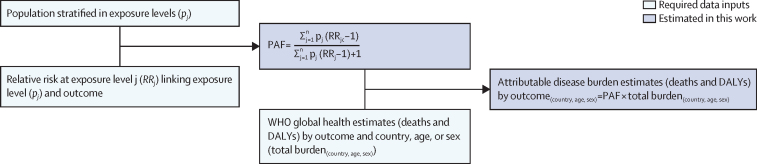
- Comparative risk assessment was used for diarrhoea and acute respiratory infections, combining modelled WASH exposures with exposure–response relationships from two updated meta-analyses; undernutrition was estimated by combining PAFs of diarrhoea attributable to unsafe WASH with PAFs of undernutrition attributable to diarrhoea, and soil-transmitted helminthiasis was fully attributed to unsafe WASH.
- Exposure was estimated using the WHO and UNICEF Joint Monitoring Programme public database, with multilevel modelling for countries lacking sufficient national data; estimates covered males and females of all ages in 183 WHO member states for 2019, representing 99·5% of the global population.
- Analyses were done in Stata version 14, with uncertainty intervals estimated by Monte Carlo simulation; the counterfactual minimum risk-exposure levels aligned as closely as possible with SDG targets 6.1 and 6.2.
Limitations
- The paper states that multiple potentially important health outcomes were excluded due to insufficient data, making underestimation of the true burden probable; the analysis is confined to domestic settings and does not include WASH-attributable burden in schools, health-care facilities, workplaces, detention centres, refugee camps, markets, or other public spaces.
- The paper states that for diarrhoea and acute respiratory infections, most underlying studies were open-label trials with subjective outcomes, risking overestimation of effectiveness, and transportability of tightly controlled intervention results to population-level WASH changes remains uncertain; for undernutrition, the two-step approach captured only the pathway through diarrhoea, and for soil-transmitted helminthiasis, complete attribution assumes all burden could be prevented through safe WASH.
- The paper states that exposure classification relies on nationally representative survey and administrative data that may not fully capture safely managed services, with gaps for higher service levels and some populous countries; adjustments introduce uncertainty and do not adequately account for all aspects such as priority chemicals, wastewater treatment extent, or non-sewered safely managed sanitation. The text also makes evident that the same PAFs were assumed for males and females and across age groups despite documented differences in WASH experiences, and that estimates reflect current climate conditions rather than possible climate-change effects.
Model-written summary. Check it against the paper before relying on it.
Integrity signals
Registry
Cites
Statistics
Figures
Verification
Claims the paper makes
22 Valid · 6 Not valid · 10 Not checked · 92 Own results and interpretations
The cited sources that could be checked couldn’t confirm or dispute this claim.
In the paper
“GBD 20192 used high-quality piped water that is boiled or filtered at point of use as the minimum risk-exposure level for drinking water.”
§ Burden of disease attributable to unsafe drinking water, sanitation, and hygiene in domestic settings: a global analysis for selected adverse health outcomes > Discussion
What the sources say
- Could not verifycites [2] GBD 2019 Risk Factors Collaborators Global burden of 87 risk factors in 204 countries and territories, 1990–2019: a systematic analysis for the Global Burden of Disease Study 2019 Lancet 396 2020 1223 1249 33069327 PMC7566194 sourceExperimental — accuracy not yet measured
The Methods section (‘Determining the TMREL’; page unavailable) explains how GBD 2019 set minimum-risk exposure levels generally, and the risk table lists ‘unsafe water source.’ Neither specifies a drinking-water minimum of high-quality piped water boiled or filtered at point of use. Searches for that description, ‘piped water,’ and ‘boiled’ found no supporting passage in our copy. (LLM, conf=0.74)
plain- Asserted: passes — The authors put it forward as true.
- Checkable: passes — It can be checked against evidence.
- Load-bearing: passes — The paper’s conclusions depend on it.
- Based: passes — The paper gives a reason why it holds.
- Could not verify
Every source the paper cites for this claim was checked and supports it.
In the paper
“Undernutrition can be a consequence of repeated bouts of diarrhoea.5, 13”
§ Burden of disease attributable to unsafe drinking water, sanitation, and hygiene in domestic settings: a global analysis for selected adverse health outcomes > Methods > Undernutrition
What the sources say
- Supportedcites [5] Checkley W Buckley G Gilman RH Multi-country analysis of the effects of diarrhoea on childhood stunting Int J Epidemiol 37 2008 816 830 18567626 PMC2734063 source
The Discussion reports a dose-response relationship between cumulative diarrhoea episodes before age 24 months and stunting at age 24 months. It says this supports the hypothesis that a higher burden of diarrhoea adversely affects nutritional status, consistent with the claim's cautious 'can be' wording. (LLM, conf=0.91)
- Supportedcites [13] Guerrant RL DeBoer MD Moore SR Scharf RJ Lima AAM The impoverished gut—a triple burden of diarrhoea, stunting and chronic disease Nat Rev Gastroenterol Hepatol 10 2013 220 229 23229327 PMC3617052 source
The Introduction says repeated diarrhoeal illnesses progressively altered children's normal growth trajectories. The Stunting section likewise reports that repeated diarrhoeal episodes reduced growth and that heavier diarrhoeal burdens impaired catch-up growth, supporting undernutrition as a possible consequence. (LLM, conf=0.93)
plainstates a possible cause- Asserted: passes — The authors put it forward as true.
- Checkable: passes — It can be checked against evidence.
- Load-bearing: passes — The paper’s conclusions depend on it.
- Based: passes — The paper gives a reason why it holds.
- Supported
Every source the paper cites for this claim was checked and supports it.
In the paper
“Additionally, there remain many millions of people across HICs who do not have safe WASH but who are not adequately captured in official data.56”
§ Burden of disease attributable to unsafe drinking water, sanitation, and hygiene in domestic settings: a global analysis for selected adverse health outcomes > Discussion
What the sources say
- Supportedcites [56] Brown J Acey CS Anthonj C The effects of racism, social exclusion, and discrimination on achieving universal safe water and sanitation in high-income countries Lancet Glob Health 11 2023 e606 e614 36925180 source
The Current trends section states that national statistics overlook millions of people in high-income countries without access to safe water and sanitation services. It explains that surveys can miss some communities and that data on service quality are often too scarce or insufficiently detailed to capture disparities. (LLM, conf=0.95)
plain- Asserted: passes — The authors put it forward as true.
- Checkable: passes — It can be checked against evidence.
- Load-bearing: unclear — It is unclear whether the paper’s conclusions depend on it.
- Based: passes — The paper gives a reason why it holds.
- Supported
Every source the paper cites for this claim was checked and supports it.
In the paper
“As most of the 51 high-income countries (HICs) have near universal access to safely managed drinking water and sanitation services and as the available epidemiological evidence from intervention studies linking drinking water, sanitation, and disease outcomes originates mainly from LMICs,4 we do not estimate the burden of disease attributable to unsafe water and sanitation in HICs.”
§ Burden of disease attributable to unsafe drinking water, sanitation, and hygiene in domestic settings: a global analysis for selected adverse health outcomes > Methods > Study design
What the sources say
- Supportedcites [4] Wolf J Hubbard S Brauer M Effectiveness of interventions to improve drinking water, sanitation, and handwashing with soap on risk of diarrhoeal disease in children in low-income and middle-income settings: a systematic review and meta-analysis Lancet 400 2022 48 59 35780792 PMC9251635 source
The Methods (page unavailable) say the review included drinking-water and sanitation intervention studies from LMIC households, with an exception for low-income settings in high-income countries. This supports the claim that the intervention evidence considered by the review comes mainly from LMICs. (LLM, conf=0.88)
plainstates an association- Asserted: passes — The authors put it forward as true.
- Checkable: passes — It can be checked against evidence.
- Load-bearing: passes — The paper’s conclusions depend on it.
- Based: passes — The paper gives a reason why it holds.
- Supported
The cited sources support only part of this claim — read each source’s verdict below.
In the paper
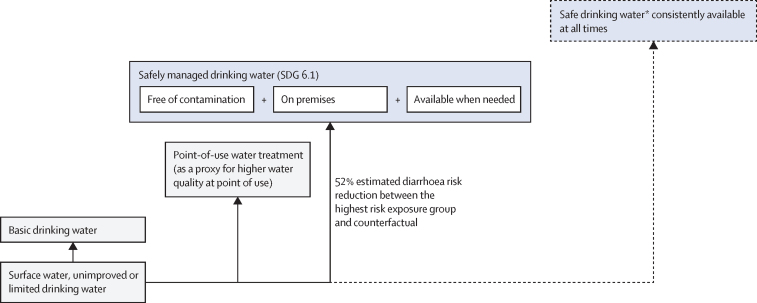
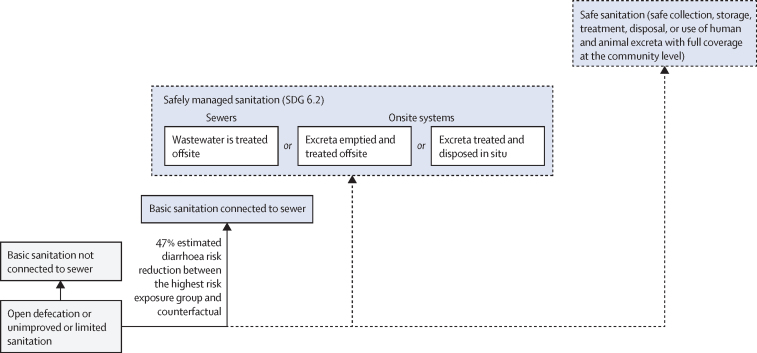
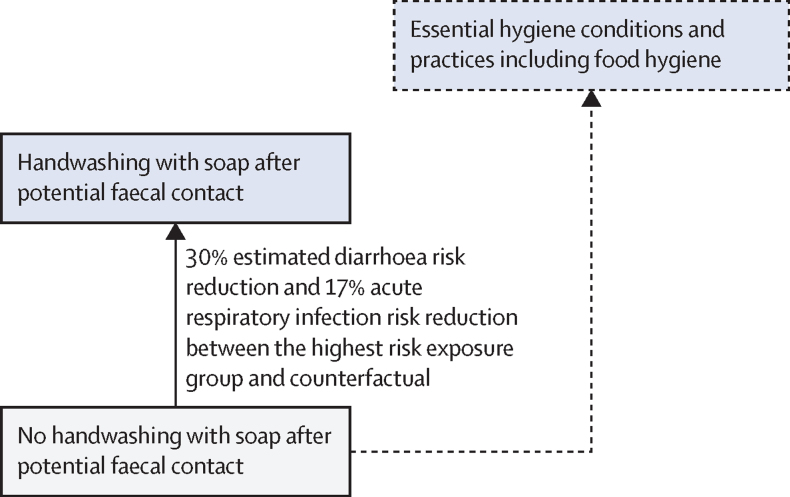
“The exposure–response relationships (figure 1, appendix 1 p 6) linking the different WASH exposure levels (Figure 2, Figure 3, Figure 4) and diarrhoea or acute respiratory infections have been estimated in two meta-analyses.4, 7”
§ Burden of disease attributable to unsafe drinking water, sanitation, and hygiene in domestic settings: a global analysis for selected adverse health outcomes > Methods > Relative risks linking exposure and health outcome (RRj)
What the sources say
- Supportedcites [4] Wolf J Hubbard S Brauer M Effectiveness of interventions to improve drinking water, sanitation, and handwashing with soap on risk of diarrhoeal disease in children in low-income and middle-income settings: a systematic review and meta-analysis Lancet 400 2022 48 59 35780792 PMC9251635 source
The Introduction (Research in context) says this meta-analysis provides updated exposure–response relationships between levels of WASH service and diarrhoea. The Methods (Data analysis) describe analyses by WASH exposure scenario. This source supports the diarrhoea part of the sentence; the acute respiratory infection part is attributed to the other citation. (LLM, conf=0.90)
- Partly supportedcites [7] Ross I Bick S Ayieko P Effectiveness of handwashing with soap for preventing acute respiratory infections in low- and middle-income countries—a systematic review and meta-analysis Lancet 401 2023 1681 1690 37121242 sourceExperimental — accuracy not yet measured
The Data analysis section says the paper pooled relative risks for acute respiratory infection outcomes, supporting its role as one of the cited meta-analyses. But its comparison is handwashing-with-soap promotion versus no handwashing intervention; our copy does not estimate an exposure–response relationship across different WASH exposure levels. Diarrhoea appears to be the subject of the other citation, not a finding attributed to this paper. (LLM, conf=0.86)
hedgedstates an association- Asserted: passes — The authors put it forward as true.
- Checkable: passes — It can be checked against evidence.
- Load-bearing: passes — The paper’s conclusions depend on it.
- Based: passes — The paper gives a reason why it holds.
- Supported
76 more claims · 9 with their cited sources checked
Create a free account to see all 130 claims and to verify the 6 references still open.
- Probably not a substantial claim. 43
- It may state two separate claims as one. 9
Self-check
Percentages, sums and reported differences re-computed from the paper’s own numbers.
Each contradiction between two passages listed here was confirmed by an independent check.
Rated minor: it would not touch a result — a value no result rests on, a p-value that stays on the same side of the significance level, or a conflict that is clerical, resolved elsewhere in the paper, or outside its own findings.
In the paper
§ Burden of disease attributable to unsafe drinking water, sanitation, and hygiene in domestic settings: a global analysis for selected adverse health outcomes > Methods > Study design
“Safely managed drinking water | 37·9% (27·1–49·9)”
§ Burden of disease attributable to unsafe drinking water, sanitation, and hygiene in domestic settings: a global analysis for selected adverse health outcomes > Results
“37·9% (95% CI 29·1–49·9) of the population in LMICs used safely managed drinking water”
Rated minor: it would not touch a result — a value no result rests on, a p-value that stays on the same side of the significance level, or a conflict that is clerical, resolved elsewhere in the paper, or outside its own findings.
In the paper
§ Burden of disease attributable to unsafe drinking water, sanitation, and hygiene in domestic settings: a global analysis for selected adverse health outcomes > Discussion
“This analysis expands upon previous minimum risk-exposure levels by using the SDG ambition of universal access to safely managed WASH services as minimum risk-exposure levels.”
§ Burden of disease attributable to unsafe drinking water, sanitation, and hygiene in domestic settings: a global analysis for selected adverse health outcomes > Methods > Population exposed (pj)
“Instead, using the latest epidemiological evidence,4 we used a counterfactual of basic sanitation connected to sewer networks (figure 3), which is not necessarily equivalent to safely managed sanitation as much of the wastewater collected in sewers is not safely treated.31”
Citations
Cites
GRADE: an emerging consensus on rating quality of evidence and strength of recommendations
Guyatt, G. H., Oxman, A. D., Vist, G. E., Kunz, R., Falck-Ytter, Y., Alonso-Coello, P., & Schünemann, H. J. (2008) · BMJ · doi:10.1136/bmj.39489.470347.ad · Cited by 23,305
Global burden of bacterial antimicrobial resistance in 2019: a systematic analysis
Murray, C. J. L., Ikuta, K. S., Sharara, F., Swetschinski, L., Robles Aguilar, G., Gray, A., Han, C., Bisignano, C., Rao, P., Wool, E., et al. (2022) · The Lancet · doi:10.1016/s0140-6736(21)02724-0 · Cited by 16,316
Lim, S. S., Vos, T., Flaxman, A. D., Danaei, G., Shibuya, K., Adair-Rohani, H., AlMazroa, M. A., Amann, M., Anderson, H. R., Andrews, K. G., et al. (2012) · The Lancet · doi:10.1016/s0140-6736(12)61766-8 · Cited by 11,805
Self-citationMurray, C. J. L., Aravkin, A. Y., Zheng, P., Abbafati, C., Abbas, K. M., Abbasi-Kangevari, M., Abd-Allah, F., Abdelalim, A., Abdollahi, M., Abdollahpour, I., et al. (2020) · The Lancet · doi:10.1016/s0140-6736(20)30752-2 · Cited by 9,854
Self-citationSelected major risk factors and global and regional burden of disease
Ezzati, M., Lopez, A. D., Rodgers, A., Vander Hoorn, S., & Murray, C. J. (2002) · The Lancet · doi:10.1016/s0140-6736(02)11403-6 · Cited by 3,594
Prüss-Ustün, A., Wolf, J., Bartram, J., Clasen, T., Cumming, O., Freeman, M. C., Gordon, B., Hunter, P. R., Medlicott, K., & Johnston, R. (2019) · International Journal of Hygiene and Environmental Health · doi:10.1016/j.ijheh.2019.05.004 · Cited by 1,308
Self-citationPrüss‐Ustün, A., Bartram, J., Clasen, T., Colford, J. M., Cumming, O., Curtis, V., Bonjour, S., Dangour, A. D., De France, J., Fewtrell, L., et al. (2014) · Tropical Medicine & International Health · doi:10.1111/tmi.12329 · Cited by 1,198
Self-citationImpacts of climate change on surface water quality in relation to drinking water production
Delpla, I., Jung, A.-V., Baures, E., Clement, M., & Thomas, O. (2009) · Environment International · doi:10.1016/j.envint.2009.07.001 · Cited by 1,070
Savović, J., Jones, H. E., Altman, D. G., Harris, R. J., Jüni, P., Pildal, J., Als-Nielsen, B., Balk, E. M., Gluud, C., Gluud, L. L., et al. (2012) · Annals of Internal Medicine · doi:10.7326/0003-4819-157-6-201209180-00537 · Cited by 1,049
Over half of known human pathogenic diseases can be aggravated by climate change
Mora, C., McKenzie, T., Gaw, I. M., Dean, J. M., von Hammerstein, H., Knudson, T. A., Setter, R. O., Smith, C. Z., Webster, K. M., Patz, J. A., et al. (2022) · Nature Climate Change · doi:10.1038/s41558-022-01426-1 · Cited by 995
Research works printed but not linked: 2
- Troeger C Colombara DV Rao PC Supplementary appendix to: global disability-adjusted life-year estimates of long-term health burden and undernutrition attributable to diarrhoeal diseases in children younger than 5 years Lancet Glob Health 6 2018 e255 e269 29433665 PMC5861379 · DOI · Paper page
- GBD 2019 Risk Factors Collaborators Global burden of 87 risk factors in 204 countries and territories, 1990–2019: a systematic analysis for the Global Burden of Disease Study 2019 Lancet 396 suppl 1 2020 1223 1249 33069327 PMC7566194
Cited by
Items 201–300 of 341
Safe drinking water in remote rural communities in present era
Chhabra, S., Solanki, N., & Vilayatkar (2023) · International Journal of Scientific Reports · doi:10.18203/issn.2454-2156.intjscirep20232188
Willingness to pay for faecal sludge management services - a scoping reviewPreprint
Tomoi, H., MacLeod, C., Moriyasu, T., et al. (2023) · Research Square · doi:10.21203/rs.3.rs-3265808/v1
Self-citationAn Analytical Approach for Temporal Infection Mapping and Composite Index Development
Wang, W., Weng, F., Zhu, J., Li, Q., & Wu, X. (2023) · Mathematics · doi:10.3390/math11204358
Serge, B., Ebongue, M., Alexandra, S. T. U., et al. (2023) · SSRN Electronic Journal · doi:10.2139/ssrn.4661903
WaterScope: A Versatile Open-Source Platform Enabling Smart, Simple, Water Testing - for AllPreprint
Mahdi, S., Dabrowska, A., Lewis, G., et al. (2024) · Research Square · doi:10.21203/rs.3.rs-3824801/v1
Design of a new fast heating device in wireless portable water dispenser in the age of intelligence
Qian, T., Liu, H., & Chen, C. (2024) · Applied Mathematics and Nonlinear Sciences · doi:10.2478/amns-2024-1533
A Liberal Proposal to Justify State Authority
Tskhadaia, G. (2024) · Analiza i Egzystencja · doi:10.18276/aie.2024.66-01
Quattrochi, J. P., Croke, K. G., Dohou, C. J., Ghib, L. S., Bokasola, Y. L., Coville, A., & Mvukiyehe, E. N. (2024) · SSRN Electronic Journal · doi:10.2139/ssrn.4891733
Sutomo, O., Rokayah, Y., & Wasludin, W. (2024) · JURNAL INFO KESEHATAN · doi:10.31965/infokes.vol22.iss1.1635
“2021; Lo et al., 2022; Wolf, et al., 2023).”
Aliyu, A. A., & Dahiru, R. (2024) · UMYU Journal of Microbiology Research (UJMR) · doi:10.47430/ujmr.2493.041
Hosking, R., Richardson, A., Gray, D. J., et al. (2024) · Research Square · doi:10.21203/rs.3.rs-4704547/v1
A spatially explicit model of the dynamics of Opisthorchis viverrini spreadPreprint
Trevisin, C., Kamber, L., Mari, L., et al. (2024) · doi:10.22541/au.172466423.38059183/v1
Water in sustaining resilient cities (SDG 11)
Healy, A., & Lewis, E. (2024) · Elsevier eBooks · doi:10.1016/b978-0-443-15537-6.00021-5 · Cited by 1
Batikawai, S. M., Osborne, N. J., Do, P., et al. (2024) · Research Square · doi:10.21203/rs.3.rs-4903215/v1
Masset, E., & Waddington, H. S. (2024) · Research Square · doi:10.21203/rs.3.rs-5328251/v1
Kraay, A. N. M., Brouwer, A. F., Zahid, M. H., Njenga, S. M., Colford, J. M., Freeman, M. C., & Eisenberg, J. N. S. (2026) · International Journal of Hygiene and Environmental Health · doi:10.1016/j.ijheh.2026.114822
Self-citationTomoi, H., Ingumba, B. B., Simiyu, S. N., et al. (2024) · Research Square · doi:10.21203/rs.3.rs-5579430/v1
Self-citationSanitation: The culture of conveniences
Dye, C. (2024) · Oxford University Press eBooks · doi:10.1093/oso/9780198887133.003.0007
Reducing Health Inequities through Water, Sanitation, and Hygiene (WASH) Infrastructure
Chetiya, A. R. (2024) · International Journal of Scientific Engineering and Research · doi:10.70729/se241211175407
Mink, T. L., Patrick, M., Conrad, A., Ahmed, T., Arun, S., Ramanarayanan, V., Chakraborti, N., Reddy, Y. M., Abhilaasha, N., Bhan, T., et al. (2025) · medRxiv · doi:10.1101/2025.01.08.25320223
Self-citationMeng, X. W., Xue, Y., Li, S., Liu, G., Yuan, S., Chen, L., Wang, X., Li, X., & Zhou, L. (2025) · doi:10.2196/preprints.70829
RIGHT TO SAFE WATER, ARGUMENTS FOR ITS LEGAL ENTITLEMENT IN PAKISTAN
Afzal, W., & Azeem, A. (2025) · The Boğaziçi law review. · doi:10.69800/blr.1507511
Brouwer, A. F., Kraay, A. N. M., Zahid, M. H., Eisenberg, M. C., Freeman, M. C., & Eisenberg, J. N. S. (2025) · Infectious Disease Modelling · doi:10.1016/j.idm.2025.02.002 · Cited by 3
“Diarrheal disease is a leading cause of morbidity and mortality in young children, with an estimated 500,000 children under 5 years dying from diarrheal disease each year (Troeger et al., 2018; Vos et al., 2020; Wolf et al., 2023).”
Self-citationBogdanova, V. D., Kislitsyna, L. V., Romanova, O. B., et al. (2025) · Экология человека · doi:10.17816/humeco631755
Dargahi, A., Zandian, H., Ghayeghi, A., Gholizadeh, H., Amini, S., & Jafarzadeh, M. (2025) · The Open Public Health Journal · doi:10.2174/0118749445360031250114045106
Behaviour change interventions to promote household connectivity to sewer: a scoping review
Alam, M., Rahat, M. A., Nawaz, S., Neeher, N., Tabassum, K. F., Upoma, T. A., Kamal, A., Evans, B., & Hutchings, P. (2025) · Global Health Action · doi:10.1080/16549716.2025.2476335 · Cited by 1
“The release of untreated wastewater also contributes to the global burden of disease related to inadequate WASH, which Wolf et al. (2023) estimate is associated with 69% of diarrhoea, 14% of acute respiratory infections, and 10% of undernutrition, and approximately 100% of the burden of…”
Self-citationMalikhah, S. N. A., Anwar, M. C., & Nuryanto, N. (2024) · Public Health Research Development. · doi:10.36568/phrd.v1i2.28
“[19].”
de Neczpal, A. J., Thorell, K., Tuts, L., et al. (2025) · Research Square · doi:10.21203/rs.3.rs-6730951/v1
Collaguazo, L. R. Q., Paula, G. G. E., Ninasunta, J. A. O., & Cando, B. A. T. (2025) · ASCE MAGAZINE · doi:10.70577/asce/1.16/2025
Reflections on the Lancet Commission on Investing in Health's Global Health 2050 report
Paul, É., Brown, G. W., Porignon, D., & Sturmberg, J. P. (2025) · The Lancet · doi:10.1016/s0140-6736(25)01088-8
Mohammed, Z. M. S., Ibrahim, M. A., Mohammed, S. A., Hamad, S. H. M., Central Bureau of Statistics, K., Khamis, G. S. M., & Elmorsy, E. M. (2025) · International Journal of ADVANCED AND APPLIED SCIENCES · doi:10.21833/ijaas.2025.07.002
Epidemicity conditions in spatial models of infectious diseases
Gatto, M., Trevisin, C., Mari, L., Pasetto, D., Bertuzzo, E., Casagrandi, R., & Rinaldo, A. (2025) · Bollettino Della Unione Matematica Italiana · doi:10.1007/s40574-025-00497-0
“For instance, unsafe water sources are responsible for 1.4 million deaths each year [44].”
InfluentialHuang, Y., Wang, S., Shao, Y., et al. (2025) · Research Square · doi:10.21203/rs.3.rs-7245947/v1
Amin, N., Foster, T., Falletta, J., & Willetts, J. (2025) · SSRN Electronic Journal · doi:10.2139/ssrn.5381987
A Smart Drainage Systems Integrating AI and Diverse Techniques
Sakshi, K., Pandey, P., Khadatkar, S., et al. (2025) · Lecture notes in networks and systems · doi:10.1007/978-981-96-5751-3_36
Pranjal, Mahapatra, G. C., Panda, A., et al. (2025) · Journal of environmental chemical engineering · doi:10.1016/j.jece.2025.118784
Graph-Based Social Impact Diffusion Optimization across a Theoretical Socio-Technical System
McKinnon, S. A., & Mattson, C. A. (2025) · Proceedings of the Design Society · doi:10.1017/pds.2025.10210
“This pump decreases a person ’ s risk of acquiring a diarrheal disease, which is a health benefit (Wolf et al., 2023).”
InfluentialLiu, W., Deng, M., Wang, Y., et al. (2025) · Water Research X · doi:10.1016/j.wroa.2025.100406
George, C. M., Bisimwa, J., Endres, K., et al. (2025) · medRxiv · doi:10.1101/2025.08.31.25334790
Harnessing climate finance for public health: a global perspective
Fang, Y., Lee, C., & Yu, J. (2026) · Humanities and Social Sciences Communications · doi:10.1057/s41599-026-07421-7
Madugula, S., Dhamodhar, D., Jayaraman, Y., Prabu, D., Rajmohan, M., Sindhu, R., Fathima, L., Indira, N., & Sujitha, S. D. A. (2025) · Discover Public Health · doi:10.1186/s12982-025-00930-x
“However, the water source and purification authenticity are not sure in the case of a few households in India [42].”
Unpredictability of Intermittent Water Supply and Associations with Child Health in Urban IndiaPreprint
Tajanpure, P., Ercümen, A., & Kumpel, E. (2025) · Research Square · doi:10.21203/rs.3.rs-7519884/v1 · Cited by 1
Wu, Y., Zhang, L., Zhao, Y., Zhong, P., Guo, S., & Zheng, X. (2025) · BMC Public Health · doi:10.1186/s12889-025-24665-1 · Cited by 3
“The World Health Organization (WHO) estimates that billions of people lack access to safe drinking water and sanitation services, leading to 1.4 million fatalities and 74 million disability-adjusted life-years [4, 5].”
InfluentialCost-effectiveness and benefit-cost analyses of promoting handwashing with soap: a systematic reviewPreprint
Ross, I., Bath, D., Wells, J., Dreibelbis, R., Ejemot-Nwadiaro, R. I., Mills, J. E., Greco, G., Pitt, C., & Cumming, O. (2025) · medRxiv · doi:10.1101/2025.10.13.25337661
Self-citationTERRITORIAL CONTRASTS IN RIO GRANDE DO SUL: SANITATION RELATED DISEASES
Sodré, N. S., Périco, E., Schröder, N. T., & da Silveira, E. F. (2025) · Revista de Geopolítica · doi:10.56238/revgeov16n5-071
“The sanitation deficit accounts for roughly 1.4 million deaths worldwide and constitutes a violation of a basic human right (Wolf et al ., 2023).”
InfluentialFabolude, G., Knoble, C., Vu, A., Aighewi, I. T., & Yu, D. (2025) · Research Square · doi:10.21203/rs.3.rs-7161842/v1
Wassonguema, B., Lê‐Lacanette, M., Braun, L., Ba, M., Siroma, F., Cabo, A., Brizuela, A. V., Séye, M., Lapègue, J., Devort, A., et al. (2025) · Maternal and Child Nutrition · doi:10.1111/mcn.70100
Self-citationBayeh, G. M., Temesgen, A., Yeshiwas, A. G., Tsega, T. D., Tsega, S. S., Gebeyehu, A. A., Yemata, G. A., Anteneh, R. M., Yirdaw, G., Yenew, C., et al. (2025) · Health Science Reports · doi:10.1002/hsr2.71445
Gusha, M., Sreelakshmi, R., Suryaparvathy, S., et al. (2025) · IEEE Global Humanitarian Technology Conference (GHTC) · doi:10.1109/ghtc66843.2025.11266220
“Unsafe drinking water, inadequate sanitation, and poor hygiene cause over 1.4 million deaths annually [1], with climate change further degrading water quality through increased floods, droughts, and pollution.”
InfluentialLi, E., Saleem, F., Bello, S., Edge, T. A., Gupta, R. S., & Schellhorn, H. E. (2025) · Environments · doi:10.3390/environments12120495
“Feces-associated pathogens are responsible for many waterborne and foodborne diseases, such as diarrhea, typhoid fever, cholera, and dysentery, causing over 1.5 million estimated annual deaths globally [6].”
InfluentialMink, T. L., Patrick, M., Conrad, A., Ahmed, M. T., Arun, S., Ramanarayanan, V., Chakraborti, N., Reddy, Y. M., Abhilaasha, N., Bhan, T., et al. (2025) · SSM - Mental Health · doi:10.1016/j.ssmmh.2025.100585 · Cited by 1
Self-citationChildhood maltreatment and suicidal behaviors among heterosexual and sexual minority youth in China
Zhang, C., Zhang, N., Xu, Z., Hu, J., Guan, M., Zhang, L., Dai, Y., An, W., Yin, Z., Zhang, Y., et al. (2025) · Child Abuse & Neglect · doi:10.1016/j.chiabu.2025.107867
Bakchi, J., Ghosh, S. K., & Sharif, A. B. (2025) · Health Science Reports · doi:10.1002/hsr2.71692
“A previous study involving global analysis suggested that the risk of ARIs increases by 14% when children are exposed to unsafe drinking water [26].”
Carbon-Based Nanocomposites for Environmental Cleaning
Namla, D., Oves, M., Ansari, M. O., Al‐Shaeri, M., & Mangse, G. (2026) · Smart nanomaterials technology · doi:10.1007/978-981-95-0187-8_11
Abass, S., Abbas, U., Abbass, M., et al. (2026) · IGI Global eBooks · doi:10.4018/979-8-3693-3920-6.ch008
Shoab, A. K., Nasim, M. I., Sen, T., Jahan, F., Alam, M., Sarker, S., Sultana, J., Khan, R., Islam, K., Jahan, H., et al. (2026) · Global Health Action · doi:10.1080/16549716.2025.2611646 · Cited by 1
“These burdens are linked to diseases, such as diarrheal diseases, respiratory infections, undernutrition, and helminthiases, primarily affecting low-and middle-income countries (LMICs) [5].”
Water quality impacts on human health: towards an integrated, solution-oriented global assessment
Hofstra, N., Flörke, M., Jones, E. R., Ouédraogo, I., Podgorski, J. E., Politi, E., Schweden, K., Simis, S. G. H., Stelzer, K., Strokal, M., et al. (2026) · Environmental Research Water · doi:10.1088/3033-4942/ae4265 · Cited by 3
Nwogu, E. A., Agunwamba, J. C., & Onyeanwuna, U. B. (2026) · International Journal of Water Resources and Environmental Engineering · doi:10.5897/ijwree2025.1121
A mathematical model of helminth transmission dynamics under WASH program interventions
Lopez, G. M., & Aparicio, J. P. (2026) · Nonlinear Analysis Real World Applications · doi:10.1016/j.nonrwa.2026.104621
Roaf, V., Evans, B., Goodwin, G., & Hutchings, P. (2026) · PLOS Water · doi:10.1371/journal.pwat.0000506
Self-citationCopeticona-Callejas, C., Jimenez, S., Torrez-Mamani, A., Choque-Pardo, B., Agramont, J., Mamani-Jarro, J., Inchauste, L., Priet, S., Soto, A., Liera, C., et al. (2026) · Journal of Water and Health · doi:10.2166/wh.2026.243
Nutritional status of children in rural and urban India based on National Family Health Surveys
Joseph, J., & Sendhil, R. (2026) · Discover Public Health · doi:10.1186/s12982-026-01467-3 · Cited by 2
“At the same time, the environmental predictors of the access to basic drinking water and standard sanitation facilities predetermine the control over respiratory pathogens and waterborne diseases, and lessen childhood mortality [11, 12, 26].”
Joseph, J., & Sendhil, R. (2026) · Child Indicators Research · doi:10.1007/s12187-025-10321-y
Goddard, F. G. B., Qureshi, H., Poulin, C., Boachie, F., Jordan, E. A., Otoo, M., Schelling, M., Peletz, R., & Delaire, C. (2026) · PLOS Water · doi:10.1371/journal.pwat.0000519
Africa’s Water Revenue ParadoxPreprint
McNicholl, D., Aydinsoy, E., & Hope, R. A. (2026) · Research Square · doi:10.21203/rs.3.rs-8878999/v1
Olson, N. E., Neher, D. A., & Weicht, T. R. (2026) · Agroecology and Sustainable Food Systems · doi:10.1080/21683565.2026.2626311
Abstraction method shapes microbial ecology and pathogen risk in water from shallow aquifers
Duncan, R., Ijaz, U. Z., Cholet, F., et al. (2026) · Total Environment Microbiology · doi:10.1016/j.temicr.2026.100074
George, C. M., Bisimwa, J., Endres, K., et al. (2026) · Tropical Medicine & International Health · doi:10.1111/tmi.70109
Thomson, P., Beresford, M., Hossain, J., Jacob, C., Jordão, C. O., Medina-Ramírez, O., Neems, S., Serrano, D. S., White, D. D., & Wutich, A. (2026) · International Journal of Qualitative Methods · doi:10.1177/16094069261432752 · Cited by 3
Development of a multidimensional deprivation index for emerging municipalities and cities in Uganda
Kananura, R. M., Birabwa, C., Sabiti, B., Ssanyu, J. N., Nyandwi, A., Akuze, J., Mutua, M. K., Fayé, C., & Waiswa, P. (2026) · Discover Global Society · doi:10.1007/s44282-026-00367-w
Ezenwaka, U., Okeke, C. C., Ojiakor, I., Nwankwo, J., Nzeadibe, T. C., & Onwujekwe, O. E. (2026) · International Journal of Environmental Health Research · doi:10.1080/09603123.2026.2645408 · Cited by 4
“The consequences of poor access to WASH services also include poor economic productivity and high morbidity of preventable diseases, such as diarrhoea, acute respiratory infection (ARI), typhoid, among others (Chakravarty et al. 2017; Wolf et al. 2023).”
Kumara, M. A. K. M. M., Liyanage, G. Y., Idroos, F. S., et al. (2026) · Integrated Environmental Assessment and Management · doi:10.1093/inteam/vjag045
Qiao, L., Wang, L., Shi, S., Wan, P., Li, M., Zheng, Z., Li, Q., Liu, X., Cai, Y., Wan, H., et al. (2026) · Biocontaminant · doi:10.48130/biocontam-0026-0002 · Cited by 1
Bayeh, G. M., Mekonen, H., Yeshiwas, A. G., et al. (2026) · Journal of Health Population and Nutrition · doi:10.1186/s41043-026-01303-z
“The burden of disease attributable to unsafe water, sanitation, and hygiene (WASH) is primarily reflected in diarrhoeal diseases, acute respiratory infections(ARI), undernutrition, and soil-transmitted helminthiases [16].”
The Burden of Disease: The Economics of Drinking Water
Kulkarni, T., Strenio, J., Douoguih, K. C., & Lyons, W. F. (2026) · Springer eBooks · doi:10.1007/978-3-032-12074-8_12
Babawo, L. S., J., J. B., & Kpaka, R. B. (2026) · African Journal of Health Nursing and Midwifery · doi:10.52589/ajhnm-cbmheclu
Sanitation security, slippage, and open defecation – lived experiences from Harar, eastern EthiopiaPreprint
Flint, A., Geremew, A., Mekbib, D., Demmu, Y. M., Mengistie, B., Poudel, P., & Howard, G. (2026) · doi:10.12688/verixiv.3050.1
Knee, J., Sumner, T., Adriano, Z., Opondo, C., Holcomb, D., Viegas, E., Nalá, R., Brown, J. M., & Cumming, O. (2026) · medRxiv · doi:10.64898/2026.04.09.26350506
Self-citationAlejandro, G. S., Suzuki, T., Chigusa, Y., et al. (2026) · BMJ Paediatrics Open · doi:10.1136/bmjpo-2025-004442
Aivey, S. A., Rahman, M. M., Ahmed, A., et al. (2026) · Indian Journal of Public Health · doi:10.4103/ijph.ijph_94_25
D’Mello-Guyett, L., Lamb, J., Demissie, T., Hailu, A., Farrington, M., Bastable, A., Dreibelbis, R., Nhial, B. C., & Ross, I. (2026) · Research Square · doi:10.21203/rs.3.rs-9404994/v1
Ward, P., Jeliazovski, J., Remington, C., et al. (2026) · Journal of Water Sanitation and Hygiene for Development · doi:10.2166/washdev.2026.197
Franceys, R., & Hutchings, P. (2026) · Journal of Water Sanitation and Hygiene for Development · doi:10.2166/washdev.2026.182
Editorial: Alleviating age-related disease burden
Halma, M. T. J., Hassaan, S., & Tuszyński, J. A. (2026) · Frontiers in Aging · doi:10.3389/fragi.2026.1828980
Fang, B., Hossain, N., Kansara, P., Herdzik, K., Strumpf, A. M., Damgaard, C. F., Harris, V., Zaitchik, B. F., Lakshmi, V., Kosek, M. N., et al. (2026) · Research Square · doi:10.21203/rs.3.rs-9543036/v1
Fraga, C. I. D. M., & Alves, C. D. M. A. (2026) · Engenharia Sanitaria e Ambiental · doi:10.1590/s1413-415220250029
Amin, N., Foster, T., Falletta, J., & Willetts, J. (2026) · International Journal of Hygiene and Environmental Health · doi:10.1016/j.ijheh.2026.114814 · Cited by 2
Nanoscale spike engineering enables one-pot detection of ultra-trace pathogens in water
Liu, L., Zhang, X., Tong, Z., et al. (2026) · Water Research X · doi:10.1016/j.wroa.2026.100554
Çakıral, K., Güran, M., & Gazi, M. (2026) · Main Group Chemistry · doi:10.1177/10241221261447230
Green pathways to equity: Rural pollution abatement and economic inequality reduction
Hua, W., Luo, L., Yan, T., & Wei, M. (2026) · Habitat International · doi:10.1016/j.habitatint.2026.103861
Nigatu, M. B., Assefa, E., Fentie, M., et al. (2026) · PLOS Water · doi:10.1371/journal.pwat.0000483
Wang, Y., He, G. X., Riot-Bretêcher, B., Pelletier, M., Huang, Y., & Loeb, S. K. (2026) · Water Research · doi:10.1016/j.watres.2026.126175
Overview of Bioreactors for Algal Biomass Harvesting
Aluna, L., Abdulkadir, A., & Singh, H. M. (2026) · Interdisciplinary biotechnological advances · doi:10.1007/978-981-95-8431-4_1
Pichel, N., Mussa, D. C., Kambala, C., Gajewski, J., & McGuigan, K. G. (2026) · Journal of Water Process Engineering · doi:10.1016/j.jwpe.2026.110257 · Cited by 1
Gorla, L., Lansford, J. E., Mukherji, A., Vera‐Hernández, M., Mohanan, M., & Maselko, J. (2026) · BMC Psychology · doi:10.1186/s40359-026-04906-7
“Because water is used for drinking, cooking, and washing, access to a clean and adequate water source significantly reduces infections, unhygienic conditions, and mortality [17, 18].”
Wei, H., Zhu, C., Du, M., Wu, X., Guo, J., Rao, J., zhang, Q., Shi, F., Kolb, J. F., & Zhuang, J. (2026) · Separation and Purification Technology · doi:10.1016/j.seppur.2026.138686
Safely managed drinking water service use and child diarrhoea based on evidence from 24 countries
Greenwood, E. E., Freymond, M., Scheidegger, A., Lauber, T. B., Tussupova, K., Pickering, A. J., & Julian, T. R. (2026) · Nature Water · doi:10.1038/s44221-026-00647-4
“However, owing to data paucity, no studies were included that evaluated the effect of interventions meeting all subcomponent criteria of SMDWS, as defined within the SDG framework 15 .”
InfluentialJohnson, R., Shank, S. E., Aaltonen, P. M., Blatchley, E. R., Payne, L., Simpson, V., & Bhadelia, A. (2026) · BMJ Open · doi:10.1136/bmjopen-2025-115870
Sanitation practices and associated factors among households in Gozamin District, Northwest Ethiopia
Teym, A., Adane, B., Moges, M., Tesfaye, A. H., Birhan, A. T., Getachew, H., Negesse, A., & Zeleke, S. K. (2026) · Discover Sustainability · doi:10.1007/s43621-026-03805-6
“However, inadequate sanitation remains a major public health challenge, particularly in low-and middle-income countries where poor practices increase the burden of disease [2, 3].”
Marma, M., Akter, A., Nahar, J., Hasan, H., & Rahman, H. (2026) · Islami Bank Medical College Journal · doi:10.70945/ibmcj.v021i01.009 · Cited by 1
“12 Hygiene practices and sanitation infrastructure are increasingly recognized as integral components of adolescent health and nutrition.”
Metadata
- Authors
- Wolf, J., Johnston, R. B., Ambelu, A., Arnold, B. F., Bain, R., Brauer, M., Brown, J., Caruso, B. A., Clasen, T., Colford, J. M., Mills, J. E., Evans, B., Freeman, M. C., Gordon, B., Kang, G., Lanata, C. F., Medlicott, K. O., Prüss-Ustün, A., Troeger, C., Boisson, S., & Cumming, O.
- Affiliations
- World Health Organization (CH)
- Ethiopian Institute of Water Resources (ET)
- University of California, San Francisco (US)
- United Nations Children's Fund (US)
- University of British Columbia (CA)
- University of North Carolina at Chapel Hill (US)
- Emory University (US)
- University of California, Berkeley (US)
- University of Leeds (GB)
- Christian Medical College, Vellore (IN)
- Vanderbilt University (US)
- University of Washington (US)
- London School of Hygiene & Tropical Medicine (GB)
- Corresponding author
- Wolf, Jennyfer
- ORCID
- Venue
- The Lancet
- Publisher
- Elsevier BV
- Published
- 2023-06
- Volume
- 401
- Issue
- 10393
- Pages
- 2060-2071
- ISSN
- 0099-5355 (ISSN-L)
- 0140-6736
- PMC
- PMC10290941
- OpenAlex
- W4379467249
- Cited by
- 343
- References
- 58
- Citations by year
- 2026: 137 · 2025: 115 · 2024: 73 · 2023: 17
- FWCI
- 59.81
- Type
- journal article
- Language
- en
- Open access
- hybrid
- doi.org
- Licence
- cc-by
- www.elsevier.com/tdm/userlicense/1.0/ (tdm)
- www.elsevier.com/legal/tdmrep-license (tdm)
- creativecommons.org/licenses/by/3.0/igo/ (vor)
- Locations
- The Lancet (publishedVersion, cc-by)
- PubMed Central (publishedVersion, cc-by)
- PubMed (publishedVersion)
- White Rose Research Online (University of Leeds, The University of Sheffield, University of York) (acceptedVersion)
- LSHTM Research Online (London School of Hygiene and Tropical Medicine) (acceptedVersion)
- Carolina Digital Repository (University of North Carolina at Chapel Hill) (submittedVersion, cc-by)
- eScholarship (California Digital Library) (submittedVersion, cc-by)
- UNC Libraries
- Funders
- World Health Organization
- Institute for Health Metrics and Evaluation
- Foreign Commonwealth & Development Office
- Topics
- Health Sciences › Nursing › Nutrition and Dietetics › Child Nutrition and Water Access
- Social Sciences › Health › Occupational Health and Global Justice
- Physical Sciences › Environmental Science › Health, Toxicology and Mutagenesis › Public Health and Environmental Issues
- Keywords
- diarrhea, acute respiratory infections, malnutrition, soil-transmitted helminthiasis, disability-adjusted life years, population attributable fraction, Sustainable Development Goals, global health burden
- MeSH terms
- Global Burden of Disease, Diarrhea, Helminthiasis, Humans, Hygiene, Respiratory Tract Infections, Sanitation, Global Health, Outcome Assessment, Health Care, Cost of Illness, Malnutrition, Drinking Water
About these checks
Registry, retraction, Cites and statistics results are computed, not judged, with one exception: a printed reference that no index lists is read once by a model before it counts as a citation error. Claims are extracted by a model and kept only when their quote appears verbatim in the text; each cited source is then checked, with a model’s help, for whether it says what the claim relies on. Those verdicts can be wrong — read the claim’s quote and the cited source before relying on one.
The claim verdicts this report counts are experimental: their accuracy is not yet measured.
A language model drew the claims from the paper on 2026-10-10, under version 3 of the claim definition (model deepseek-v4.1-flash, prompt extract-v3).
A second model labelled each claim on 2026-10-10 (model jev-1.13-20260917, definition revision gold-guideline-v0.2).
Cited sources are checked with a language model’s help (gpt-6-sol).
Statistics and arithmetic are recomputed, not judged.
Confidence bands are shown only for fields calibrated on our annotated test set. None is calibrated yet, so no band is shown.
What counts as a claim ›How we measure confidence ›How we check this ›
Are you an author, or do you see a problem with this page? Request a review
Data sources
Bibliographic data: Semantic Scholar, OpenAlex, Crossref.
Contains information from the Semantic Scholar Academic Graph Datasets, made available under the ODC Attribution License (ODC-BY 1.0).
Semantic Scholar’s data is described in: Kinney, R., et al. (2023). The Semantic Scholar Open Data Platform. arXiv:2301.10140.
