

Natural killer cell cytotoxicity of breast cancer targets is enhanced by two distinct mechanisms of antibody-dependent cellular cytotoxicity against LFA-3 and HER2/neu
Open accessThe DOI matches its Crossref record; 35 of the 36 references it cites were found in a registry or an index.
Abstract
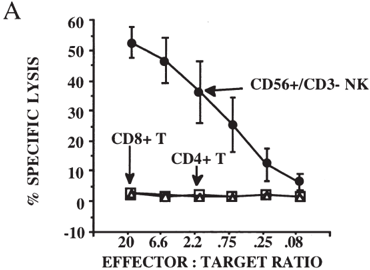
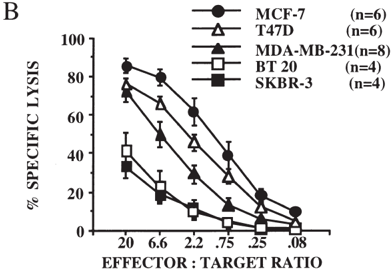
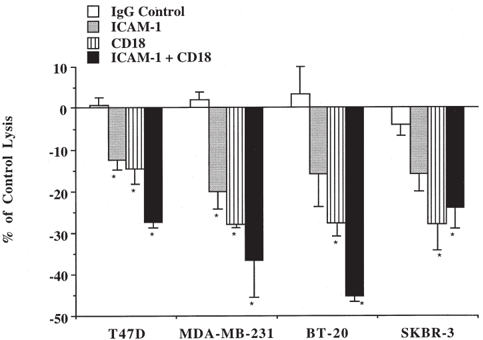
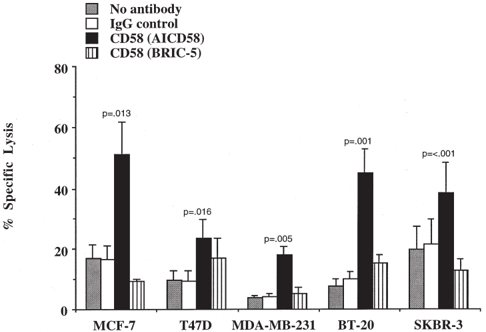
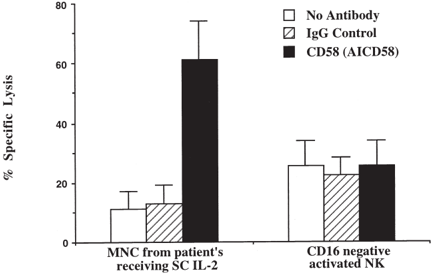
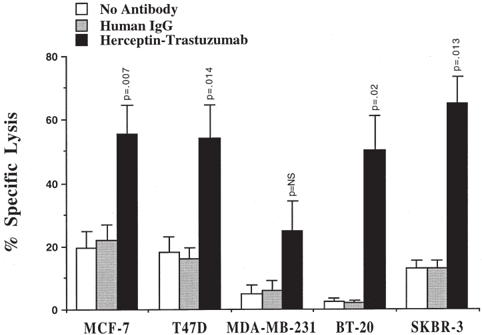
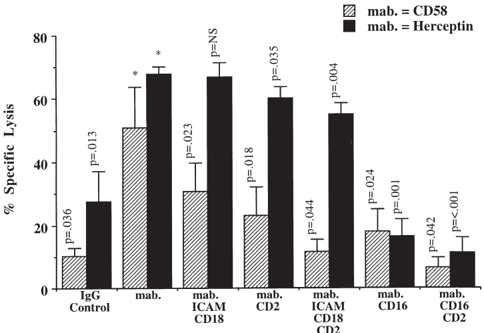
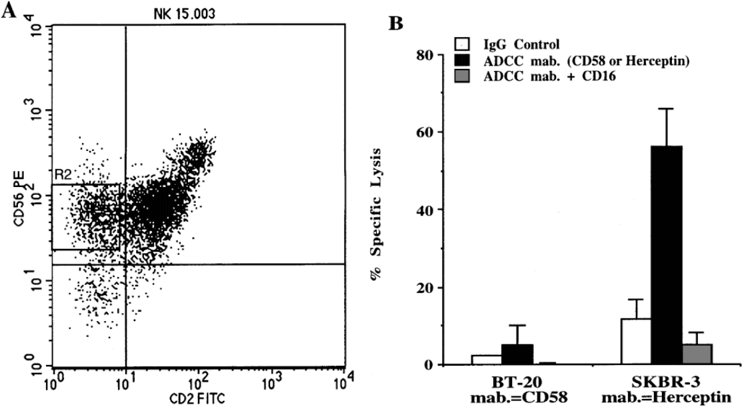
Treatment of advanced breast cancer with autologous stem cell transplantation is limited by a high probability of disease relapse. In clinical trials, interleukin 2 (IL-2) alone can expand natural killer (NK) cells in vivo and increase their cytotoxic activity against breast cancer cell lines, but this increase is modest. Understanding the mechanisms that mediate NK cell lysis of breast cancer targets may lead to improvements of current immunotherapy strategies. NK cells from normal donors or patients receiving subcutaneous IL-2 were tested in cytotoxicity assays against five breast cancer cell lines. The role of adhesion molecules and antibodies that interact through Fc receptors on NK cells was explored. NK cell lysis of breast cancer targets is variable and is partially dependent on recognition through ICAM-1 and CD18. While blocking CD2 slightly decreased cytotoxicity, contrary to expectations, an antibody against CD58 (the ligand for CD2), failed to block killing and instead mediated an increased cytotoxicity that correlated with target density of CD58. The CD58 antibody-enhanced killing was dependent not only on FcRgammaIII but also on CD2 and ICAM-1/CD18. To further elucidate the mechanism of this CD58 antibody-dependent cellular cytotoxicity (ADCC), another antibody was tested. Trastuzumab (Herceptin), a humanized antibody against HER2/neu, mediated potent ADCC against all the HER2/neu positive breast cancer targets. Unlike CD58 antibody-mediated ADCC, Herceptin ADCC was minimally affected by blocking antibodies to CD2 or ICAM-1/CD18, which suggests a different mechanism of action. This study shows that multiple mechanisms are involved in NK cell lysis of breast cancer targets, that none of the targets are inherently resistant to killing, and that two distinct mechanisms of ADCC can target immunotherapy to breast cancer cells.
Overview
The claims and statistics of this paper haven’t been checked yet.
Free: it reads the open-access text and checks the first 5 claims that cite a source we can check. Create a free account to check every claim.
Integrity signals
Registry
Cites
Statistics
Figures
Verification
Claims the paper makes
The claims and statistics of this paper haven’t been checked yet.
Free: it reads the open-access text and checks the first 5 claims that cite a source we can check. Create a free account to check every claim.
Claims other papers make about this one
Each is checked against this paper’s own text: does it say what the citing paper says it does?
In the citing paper
“as well as CD33- and CD58-targeting mAbs”
From Immunomodulation by targeted anticancer agents (2021) · cites this paper as Cooley et al., 1999
Self-check
Percentages, sums and reported differences re-computed from the paper’s own numbers.
The self-check needs the paper’s full text.
Citations
Cites
Apoptosis. Its significance in cancer and cancer Therapy
Kerr, J. F. R., Winterford, C. M., & HARMON, B. V. (1994) · Cancer · doi:10.1002/1097-0142(19940415)73:8<2157::aid-cncr2820730821>3.0.co;2-1 · Cited by 2,135
Parker, S. L., Tong, T., Bolden, S., & Wingo, P. A. (1997) · CA: A Cancer Journal for Clinicians · doi:10.3322/canjclin.47.1.5 · Cited by 2,003
Differential responses of human tumor cell lines to anti-p185HER2 monoclonal antibodies
Lewis, G. D., Figari, I., Fendly, B., Lee Wong, W., Carter, P., Gorman, C., & Shepard, H. M. (1993) · Cancer Immunology, Immunotherapy · doi:10.1007/bf01518520 · Cited by 498
Antman, K. H., Rowlings, P. A., Vaughan, W. P., Pelz, C. J., Fay, J. W., Fields, K. K., Freytes, C. O., Gale, R. P., Hillner, B. E., Holland, H. K., et al. (1997) · Journal of Clinical Oncology · doi:10.1200/jco.1997.15.5.1870 · Cited by 323
Yokoyama, W. M. (1995) · Current Opinion in Immunology · doi:10.1016/0952-7915(95)80036-0 · Cited by 299
Signal Transduction during Natural Killer Cell Activation: Inside the Mind of a Killer
Leibson, P. J. (1997) · Immunity · doi:10.1016/s1074-7613(00)80441-0 · Cited by 292
Kipps, T. J., Parham, P., Punt, J., & Herzenberg, L. A. (1985) · The Journal of experimental medicine · doi:10.1084/jem.161.1.1 · Cited by 248
Arousal and inhibition of human NK cells
Lanier, L. L., Corliss, B., & Phillips, J. H. (1997) · Immunological Reviews · doi:10.1111/j.1600-065x.1997.tb00947.x · Cited by 243
Miller, J., Alley, K., & McGlave, P. (1994) · Blood · doi:10.1182/blood.v83.9.2594.2594 · Cited by 213
Self-citationMiller, J. S., McCullar, V., Punzel, M., Lemischka, I. R., & Moore, K. A. (1999) · Blood · doi:10.1182/blood.v93.1.96 · Cited by 187
Self-citation
Research works printed but not linked: 1
- 10. necrosis factor and lymphokine-activated killer cells: correlation with expression of HER2/neu oncogenes. Cancer Res 50:7364
Cited by
Mechanisms of Disease: understanding resistance to HER2-targeted therapy in human breast cancer
Nahta, R., Yu, D., Hung, M.-C., Hortobagyi, G. N., & Esteva, F. J. (2006) · Nature Clinical Practice Oncology · doi:10.1038/ncponc0509 · Cited by 916
“HER2-targeted antibodies, including trastuzumab, have been shown to induce apoptosis in multiple breast cancer cell lines via antibody-dependent cellular cytotoxicity (ADCC)”
BackgroundMonoclonal Antibodies in Cancer Therapy
Zahavi, D., & Weiner, L. (2020) · Antibodies · doi:10.3390/antib9030034 · Cited by 831
Valabrega, G., Montemurro, F., & Aglietta, M. (2007) · Annals of Oncology · doi:10.1093/annonc/mdl475 · Cited by 626
Romee, R., Foley, B., Lenvik, T., Wang, Y., Zhang, B., Ankarlo, D., Luo, X., Cooley, S., Verneris, M., Walcheck, B., et al. (2013) · Blood · doi:10.1182/blood-2012-04-425397 · Cited by 552
“Rituximab and trastuzumab, for example, have significantly improved the outcome for patients with CD20-expressing lymphomas or with Her2-expressing breast cancers, respectively.33-36 Therefore, shedding of CD16 may limit the efficacy of antibody therapy that involves ADCC.”
BackgroundInfluentialSelf-citationArnould, L., Gelly, M., Penault-Llorca, F., Benoit, L., Bonnetain, F., Migeon, C., Cabaret, V, Fermeaux, V, Bertheau, P., Garnier, J., et al. (2006) · British Journal of Cancer · doi:10.1038/sj.bjc.6602930 · Cited by 545
“In addition, there is evidence supporting a role for trastuzumab in mediating antibodydependent cellular cytotoxicity (ADCC) (Cooley et al, 1999; Clynes et al, 2000; Carson et al, 2001; Repka et al, 2003; Gennari et al, 2004).”
BackgroundInfluentialSpector, N. L., & Blackwell, K. L. (2009) · Journal of Clinical Oncology · doi:10.1200/jco.2009.22.1507 · Cited by 497
Herceptin: mechanisms of action and resistance
Nahta, R., & Esteva, F. J. (2006) · Cancer Letters · doi:10.1016/j.canlet.2005.01.041 · Cited by 446
“Herceptin activated an antibody-dependent cellular cytotoxicity (ADCC) response in multiple breast cancer cell lines [18,34, 35].”
BackgroundGeller, M. A., Cooley, S., Judson, P. L., Ghebre, R., Carson, L. F., Argenta, P. A., Jonson, A. L., Panoskaltsis-Mortari, A., Curtsinger, J., McKenna, D., et al. (2011) · Cytotherapy · doi:10.3109/14653249.2010.515582 · Cited by 436
Self-citationHER2 therapy: Molecular mechanisms of trastuzumab resistance
Nahta, R., & Esteva, F. J. (2006) · Breast Cancer Research · doi:10.1186/bcr1612 · Cited by 433
“Importantly, mice that were null for the Fc gamma receptor expressed on natural killer cells, which are important for ADCC, lost much of the antitumor effect of trastuzumab, with only 29% tumor growth ADCC = antibody-dependent cellular cytotoxicity; ECD = extracellular domain; EGF = epidermal growth factor; EGFR = epi…”
BackgroundInfluentialTrastuzumab: triumphs and tribulations
Nahta, R., & Esteva, F. J. (2007) · Oncogene · doi:10.1038/sj.onc.1210379 · Cited by 334
“Mice with suppressed natural killer (NK) cell function, which is important for ADCC, demonstrated only 29% tumor growth inhibition in response to trastuzumab versus 96% tumor growth inhibition in control mice with intact NK cell function (Clynes et al., 2000).”
BackgroundInfluentialMechanisms of resistance to trastuzumab emtansine (T-DM1) in HER2-positive breast cancer
Hunter, F. W., Barker, H. R., Lipert, B., Rothé, F., Gebhart, G., Piccart-Gebhart, M. J., Sotiriou, C., & Jamieson, S. M. F. (2020) · British Journal of Cancer · doi:10.1038/s41416-019-0635-y · Cited by 304
“The Fc domain of trastuzumab is recognised by cognate Fcγ receptors on natural killer cells, triggering ADCC and the lysis or phagocytosis of trastuzumab-marked HER2-positive tumour cells.(23) Other proposed, but less clearly validated, mechanisms of action of trastuzumab include inhibition of angiogenesis, increased…”
BackgroundThe immune system and response to HER2-targeted treatment in breast cancer
Bianchini, G., & Gianni, L. (2014) · The Lancet Oncology · doi:10.1016/s1470-2045(13)70477-7 · Cited by 286
How to select IgG subclasses in developing anti-tumor therapeutic antibodies
Yu, J., Song, Y., & Tian, W. (2020) · Journal of Hematology & Oncology · doi:10.1186/s13045-020-00876-4 · Cited by 269
Cellular Immunotherapy of Malignancies Using the Clonal Natural Killer Cell Line NK-92
Tonn, T., Becker, S., Esser, R., Schwabe, D., & Seifried, E. (2001) · Journal of Hematotherapy & Stem Cell Research · doi:10.1089/15258160152509145 · Cited by 267
“Retargeting of NK cells to tumor-or HIV-infected cells with either bispecific antibodies (52,53) or chimeric antigen receptors (54,55) was shown to mediate specific lysis of target cells, carrying the corresponding antigen.”
Immunomodulation by targeted anticancer agents
Petroni, G., Buqué, A., Zitvogel, L., Kroemer, G., & Galluzzi, L. (2021) · Cancer Cell · doi:10.1016/j.ccell.2020.11.009 · Cited by 212
Shi, Y., Fan, X., Deng, H., Brezski, R. J., Rycyzyn, M., Jordan, R. E., Strohl, W. R., Zou, Q., Zhang, N., & An, Z. (2015) · The Journal of Immunology · doi:10.4049/jimmunol.1402891 · Cited by 195
Targeting the function of the HER2 oncogene in human cancer therapeutics
Moasser, M. M. (2007) · Oncogene · doi:10.1038/sj.onc.1210478 · Cited by 190
“This activity was greatly enhanced during the process to engineer the humanized version and trastuzumab is indeed highly efficient at activating ADCC in vitro (Carter et al., 1992; Cooley et al., 1999; Carson et al., 2001; Kubo et al., 2003; Repka et al., 2003).”
BackgroundHER-2-targeted therapy: lessons learned and future directions.
Nahta, R., & Esteva, F. J. (2003) · PubMed · Cited by 214
Tumor Necrosis Factor α Blockade: An Opportunity to Tackle Breast Cancer
Mercogliano, M. F., Bruni, S., Elizalde, P. V., & Schillaci, R. (2020) · Frontiers in Oncology · doi:10.3389/fonc.2020.00584 · Cited by 177
Fuller, S. J., Sivarajah, K., & Sugden, P. H. (2008) · Journal of Molecular and Cellular Cardiology · doi:10.1016/j.yjmcc.2008.02.278 · Cited by 175
“For optimal efficacy, the conservation of the entire trastuzumab molecule is required, suggesting involvement of an antibody-dependent cell-mediated cytotoxicity response and natural killer cell-mediated lysis [191].”
BackgroundThe Immunology of Hormone Receptor Positive Breast Cancer
Goldberg, J., Pastorello, R. G., Vallius, T., Davis, J., Cui, Y. X., Agudo, J., Waks, A. G., Keenan, T., McAllister, S. S., Tolaney, S. M., et al. (2021) · Frontiers in Immunology · doi:10.3389/fimmu.2021.674192 · Cited by 171
Nanomedicine‐Based Immunotherapy for the Treatment of Cancer Metastasis
Zhang, P., Zhai, Y., Cai, Y., Zhao, Y., & Li, Y. (2019) · Advanced Materials · doi:10.1002/adma.201904156 · Cited by 171
Use of Allogeneic NK Cells for Cancer Immunotherapy
Geller, M. A., & Miller, J. S. (2011) · Immunotherapy · doi:10.2217/imt.11.131 · Cited by 162
Self-citationCorrelation between NK function and response to trastuzumab in metastatic breast cancer patients
Beano, A., Signorino, E., Evangelista, A., Brusa, D., Mistrangelo, M., Polimeni, M. A., Spadi, R., Donadio, M., Ciuffreda, L., & Matera, L. (2008) · Journal of Translational Medicine · doi:10.1186/1479-5876-6-25 · Cited by 155
“In vitro studies [17,19] have demonstrated that NK cells kill trastuzumab-coated Her2-overexpressing cells via a Fc RIII receptor-mediated ADCC mechanism.”
InfluentialMechanisms of Resistance to Antibody-Drug Conjugates
Khoury, R., Saleh, K., Khalife, N., Saleh, M., Chahine, C., Ibrahim, R., & Lecesne, A. (2023) · International Journal of Molecular Sciences · doi:10.3390/ijms24119674 · Cited by 159
“Trastuzumab’s Fc domain is recognized by homologous Fc receptors on natural killer cells, resulting in ADCC and the destruction or phagocytosis of HER2-positive tumor cells that are tagged by trastuzumab [39].”
BackgroundCarson, W. E., Parihar, R., Lindemann, M. J., Personeni, N., Dierksheide, J., Meropol, N. J., Baselga, J., & Caligiuri, M. A. (2001) · European Journal of Immunology · doi:10.1002/1521-4141(2001010)31:10<3016::aid-immu3016>3.0.co;2-j · Cited by 155
Spiridon, C., Ghetie, M.-A., Uhr, J. W., Marcheş, R., Li, J. L., Shen, G. L., & Vitetta, E. S. (2002) · PubMed · Cited by 179
Engineered therapeutic antibodies with improved effector functions
Kubota, T., Niwa, R., Satoh, M., Akinaga, S., Shitara, K., & Hanai, N. (2009) · Cancer Science · doi:10.1111/j.1349-7006.2009.01222.x · Cited by 170
Collins, D. M., O’Donovan, N., McGowan, P. M., O’Sullivan, F., Duffy, M. J., & Crown, J. P. (2011) · Annals of Oncology · doi:10.1093/annonc/mdr484 · Cited by 172
“More recently, studies have reported trastuzumab-induced ADCC in cell lines derived from other solid tumour types, including pancreatic, esophageal, and uterine serous papillary adenocarcinoma cell lines, which express low levels of HER-2 [11, 13, 33, 34].”
BackgroundResultMechanisms of resistance to HER family targeting antibodies
Kruser, T. J., & Wheeler, D. L. (2010) · Experimental Cell Research · doi:10.1016/j.yexcr.2010.01.009 · Cited by 157
HER2-Positive Breast Cancer: Current and Future Treatment Strategies
Engel, R. H., & Kaklamani, V. (2007) · Drugs · doi:10.2165/00003495-200767090-00006 · Cited by 157
Gijsen, M., King, P., Perera, T., Parker, P. J., Harris, A. L., Larijani, B., & Kong, A. H. (2010) · PLoS Biology · doi:10.1371/journal.pbio.1000563 · Cited by 133
“. There is strong evidence of an immune-mediated mechanism in which the interaction of Herceptin's human Fc region with immune effector cells results in the stimulation of natural killer cells and activation of antibody-dependent cellular cytotoxicity”
BackgroundThe biology of natural killer cells in cancer, infection, and pregnancy
Miller, J. S. (2001) · Experimental Hematology · doi:10.1016/s0301-472x(01)00696-8 · Cited by 144
“, South San Francisco, CA, USA), a humanized antibody against HER2/neu [115], to normal resting NK cells without IL-2 activation significantly enhanced killing of breast cancer targets [116].”
BackgroundSelf-citationTGFα expression impairs Trastuzumab-induced HER2 downregulation
Valabrega, G., Montemurro, F., Sarotto, I., Petrelli, A., Rubini, P., Tacchetti, C., Aglietta, M., Comoglio, P. M., & Giordano, S. (2005) · Oncogene · doi:10.1038/sj.onc.1208478 · Cited by 142
Casa, A. (2008) · Frontiers in Bioscience · doi:10.2741/2925 · Cited by 126
“Some of these responses include internalization and degradation of HER-2 (86), diminished signaling in the PI3K pathway (87), an increase in the levels of cyclin-dependent kinase inhibitor p27 and subsequent cell cycle arrest (88), and induction of an immune response that can trigger apoptosis via antibodydependent ce…”
BackgroundKono, K., Takahashi, A., Ichihara, F., Sugai, H., Fujii, H., & Matsumoto, Y. (2002) · PubMed · Cited by 126
Stimulated γδ T Cells Increase the In Vivo Efficacy of Trastuzumab in HER-2+ Breast Cancer
Capietto, A.-H., Martinet, L., & Fournié, J. (2011) · The Journal of Immunology · doi:10.4049/jimmunol.1100681 · Cited by 133
“cells is a key mechanism of action for TTZ (12, 13).”
BackgroundAnti‐myeloma activity of natural killer lymphocytes
Frohn, C., Höppner, M., Schlenke, P., Kirchner, H., Koritke, P., & Luhm, J. (2002) · British Journal of Haematology · doi:10.1046/j.1365-2141.2002.03879.x · Cited by 129
“In vitro, many tumour and leukaemia cell lines are destroyed by NK cells (Trinchieri, 1989; Cooley et al, 1999).”
BackgroundGijsen, M., King, P., Perera, T., Parker, P. J., Harris, A. L., Larijani, B., & Kong, A. H. (2016) · PLoS Biology · doi:10.1371/journal.pbio.1002414 · Cited by 119
Gavin, P. G., Song, N., Kim, S. R., Lipchik, C., Johnson, N. L., Bandos, H., Finnigan, M., Rastogi, P., Fehrenbacher, L., Mamounas, E. P., et al. (2017) · JAMA Oncology · doi:10.1001/jamaoncol.2016.4884 · Cited by 113
Bachanová, V., & Miller, J. S. (2014) · Critical Reviews™ in Oncogenesis · doi:10.1615/critrevoncog.2014011091 · Cited by 122
Self-citationTrastuzumab Emtansine (T-DM1): A Novel Agent for Targeting HER2+ Breast Cancer
Burris, H. A., Tibbitts, J., Holden, S. N., Sliwkowski, M. X., & Phillips, G. D. L. (2011) · Clinical Breast Cancer · doi:10.1016/j.clbc.2011.03.018 · Cited by 123
Yoon, S. H., Lee, J. M., Cho, H. I., Kim, E. K., Kim, H. S., Park, M. Y., & Kim, T. (2008) · Cancer Gene Therapy · doi:10.1038/cgt.2008.98 · Cited by 108
Complement and cellular cytotoxicity in antibody therapy of cancer
Wang, S., & Weiner, G. J. (2008) · Expert Opinion on Biological Therapy · doi:10.1517/14712598.8.6.759 · Cited by 112
“Other mAbs, such as trastuzumab [37-39] and alemtuzumab [21,40-43] , also are able to mediate ADCC in vitro .”
BackgroundPrognostic and predictive role of tumour-associated macrophages in HER2 positive breast cancer
Honkanen, T. J., Tikkanen, A., Karihtala, P., Mäkinen, M. J., Väyrynen, J. P., & Koivunen, J. P. (2019) · Scientific Reports · doi:10.1038/s41598-019-47375-2 · Cited by 104
Jäger, M., Schoberth, A., Ruf, P., Hess, J., & Lindhofer, H. (2009) · Cancer Research · doi:10.1158/0008-5472.can-08-2861 · Cited by 94
“by means of antibody-dependent cellular cytotoxicity (17, 24), without contributions from T cells, completely failed to inhibit growth of these three cell lines, even at high concentrations.”
BackgroundCD58 Immunobiology at a Glance
Zhang, Y., Liu, Q., Yang, S., & Liao, Q. (2021) · Frontiers in Immunology · doi:10.3389/fimmu.2021.705260 · Cited by 103
“At a study of the mechanism that NK-mediated cytotoxicity to breast cancer targets, unexpectedly, anti-CD58 mAb failed to inhibit NK-mediated killing but instead mediated the enhanced cytotoxicity associated with CD58 expression, albeit CD2 blockade mildly reduced cytotoxicity (145).”
BackgroundTrastuzumab emtansine (T-DM1) for HER2-positive breast cancer
Boyraz, B., Şendur, M. A. N., Aksoy, S., Babacan, T., Roach, E. C., Kızılarslanoğlu, M. C., Petekkaya, İ., & Altundağ, K. (2013) · Current Medical Research and Opinion · doi:10.1185/03007995.2013.775113 · Cited by 100
Spiridon, C. I., Guinn, S., & Vitetta, E. S. (2004) · Clinical Cancer Research · doi:10.1158/1078-0432.ccr-03-0549 · Cited by 88
Adjuvant Trastuzumab Therapy for HER2-Positive Breast Cancer
Jahanzeb, M. (2008) · Clinical Breast Cancer · doi:10.3816/cbc.2008.n.037 · Cited by 89
Baj, G., Arnulfo, A., Deaglio, S., Mallone, R., Vigone, A., Cesaris, M. G. D., Surico, N., Malavasi, F., & Ferrero, E. (2002) · Breast Cancer Research and Treatment · doi:10.1023/a:1015272401822 · Cited by 94
“[15] formulated a working hypothesis that defective ICAM-1 expression could help breast cancer cells avoid immune surveillance by reducing their adhesiveness to cytotoxic lymphocytes expressing LFA-1 (CD11a), the ICAM-1 counter-”
BackgroundPhase I study of anticolon cancer humanized antibody A33.
Welt, S., Ritter, G., Williams, C., Cohen, L. S., John, M., Jungbluth, A. A., Richards, E. A., Old, L. J., & Kemeny, N. E. (2003) · PubMed · Cited by 88
Porrata, L. F., Ingle, J. N., Litzow, M., Geyer, S. M., & Markovic, S. (2001) · Bone Marrow Transplantation · doi:10.1038/sj.bmt.1703236 · Cited by 87
Trastuzumab and interleukin-2 in HER2-positive metastatic breast cancer: a pilot study.
Repka, T. L., Chiorean, E. G., Gay, J., Herwig, K. E., Kohl, V., Yee, D., & Miller, J. S. (2003) · PubMed · Cited by 105
Self-citationMonoclonal Antibody-Based Targeted Therapy in Breast Cancer: Current Status and Future Directions
Bernard-Marty, C., Lebrun, F., Awada, A. H., & Piccart, M. J. (2006) · Drugs · doi:10.2165/00003495-200666120-00004 · Cited by 93
Ji, T., Lang, J., Ning, B., Qi, F., Wang, H., Zhang, Y., Zhao, R., Yang, X. P., Zhang, L., Li, W., et al. (2018) · Advanced Materials · doi:10.1002/adma.201804395 · Cited by 81
Brufsky, A. (2010) · American Journal of Clinical Oncology · doi:10.1097/coc.0b013e318191bfb0 · Cited by 81
Chung, A. P., Cui, X., Audeh, W., & Giuliano, A. E. (2013) · Clinical Breast Cancer · doi:10.1016/j.clbc.2013.04.001 · Cited by 84
Neratinib, A Novel HER2-Targeted Tyrosine Kinase Inhibitor
Tiwari, S. R., Mishra, P. J., & Abraham, J. (2016) · Clinical Breast Cancer · doi:10.1016/j.clbc.2016.05.016 · Cited by 82
Kaur, K., Topchyan, P., Kozłowska, A. K., Ohanian, N., Chiang, J. J., Maung, P. O., Park, S., Ko, M.-W., Fang, C., Nishimura, I., et al. (2018) · OncoImmunology · doi:10.1080/2162402x.2018.1426518 · Cited by 75
Colombo, M., Corsi, F., Foschi, D., Mazzantini, E., Mazzucchelli, S., Morasso, C., Occhipinti, E., Polito, L., Prosperi, D., Ronchi, S., et al. (2010) · Pharmacological Research · doi:10.1016/j.phrs.2010.01.013 · Cited by 81
Ladoire, S., Arnould, L., Mignot, G., Apétoh, L., Rébé, C., Martin, F., Fumoleau, P., Coudert, B. P., & Ghiringhelli, F. (2011) · British Journal of Cancer · doi:10.1038/bjc.2011.261 · Cited by 79
Mathew, S. O., Chaudhary, P., Powers, S. B., Vishwanatha, J. K., & Mathew, P. A. (2016) · Oncotarget · doi:10.18632/oncotarget.11896 · Cited by 73
“Several cytokines such as IL-2, IL-4, IL-7, IL-12, IFN-γ, and IFN-α, and various drugs such as tamoxifen, toremifene and levamisole, have been used either directly to the patient or cultured with lymphokine-activated killer (LAK) cells in attempts to halt and reverse various tumor growths [13–17].”
Alnaggar, M., Lin, M., Mesmar, A., Liang, S., Qaid, A., Xu, K., Chen, J., Niu, L., & Yin, Z. (2018) · Cellular Physiology and Biochemistry · doi:10.1159/000492509 · Cited by 73
Porrata, L. F., & Markovic, S. N. (2004) · Clinical and Experimental Medicine · doi:10.1007/s10238-004-0041-4 · Cited by 72
Raja, S. M., Clubb, R. J., Bhattacharyya, M., Dimri, M., Cheng, H., Pan, W., Ortega-Cava, C. F., Reddi, A. L., Naramura, M., Band, V., et al. (2008) · Cancer Biology & Therapy · doi:10.4161/cbt.7.10.6585 · Cited by 71
HER2 breast cancer therapies: a review
Modi, S., & Murphy, C. G. (2009) · Biologics · doi:10.2147/btt.2009.3250 · Cited by 87
Shim, H. (2011) · Experimental & Molecular Medicine · doi:10.3858/emm.2011.43.10.063 · Cited by 78
Barrajón‐Catalán, E., Menéndez-Gutierrez, M. P., Falcó, A., Carrato, A., Saceda, M., & Micol, V. (2009) · Cancer Letters · doi:10.1016/j.canlet.2009.09.010 · Cited by 67
“Since conflicting assessment has been made of the expression of HER2/neu on MCF7 cells [36], the level of expression of HER2 in all the cell lines was unequivocally determined by using flow cytometry analysis (Fig.”
MethodNiemann, J., Woller, N., Brooks, J., Fleischmann-Mundt, B., Martin, N. T., Kloos, A., Knocke, S., Ernst, A. M., Manns, M. P., Kubicka, S., et al. (2019) · Nature Communications · doi:10.1038/s41467-019-11137-5 · Cited by 66
Le, X., Mao, W., Lu, C., Thornton, A., Heymach, J. V., Sood, A. K., & Bast, R. C. (2008) · Cell Cycle · doi:10.4161/cc.7.23.7212 · Cited by 65
Fan, X., Brezski, R. J., Fa, M., Deng, H., Greenplate, A. R., Gonzalez, A. O., Dubinsky, W. P., Strohl, W. R., Jordan, R. E., Zhang, N., et al. (2012) · Breast Cancer Research · doi:10.1186/bcr3240 · Cited by 67
“Since ADCC is considered one of the key mechanisms of action for trastuzumab [3,22-26], factors that compromise Fc-mediated immune functions of trastuzumab are expected to decrease its efficacy.”
BackgroundHaynes, N. M., Hawkins, E. D., Li, M., McLaughlin, N. M., Hämmerling, G. J., Schwendener, R. A., Winoto, A., Wensky, A. K., Yagita∥, H., Takeda, K., et al. (2010) · The Journal of Immunology · doi:10.4049/jimmunol.0903624 · Cited by 61
Blangé, D., Stroes, C. I., Derks, S., Bijlsma, M. F., & van Laarhoven, H. W. M. (2022) · Cancer Treatment Reviews · doi:10.1016/j.ctrv.2022.102418 · Cited by 59
Shi, Y., Fan, X., Meng, W., Deng, H., Zhang, N., & An, Z. (2014) · Breast Cancer Research · doi:10.1186/bcr3637 · Cited by 61
“It is well established that ADCC-induced cytotoxic cancer cell killing is a function of direct immune effector cell engagement with cancer cells mediated by trastuzumab [19,21,22].”
BackgroundHicks, D. G., & Kulkarni, S. (2008) · Archives of Pathology & Laboratory Medicine · doi:10.5858/2008-132-1008-taatfe · Cited by 57
Molecular Mechanisms of Cardiotoxicity Induced by ErbB Receptor Inhibitor Cancer Therapeutics
Hervent, A.-S., & Keulenaer, G. W. D. (2012) · International Journal of Molecular Sciences · doi:10.3390/ijms131012268 · Cited by 65
“This event activates the lysis of cancer cells bound to trastuzumab (Figure 2) [66,67].”
BackgroundLee, J., Kang, H. A., Bae, J. S., Kim, K. D., Lee, K. H., Lim, K. J., Choo, M. J., & Chang, S.-J. (2018) · mAbs · doi:10.1080/19420862.2018.1440170 · Cited by 60
Kim, Y. J., Sung, D., Oh, E., Cho, Y., Cho, T.-M., Farrand, L., Seo, J. H., & Kim, J. Y. (2017) · Cancer Letters · doi:10.1016/j.canlet.2017.10.020 · Cited by 57
Trastuzumab in the management of early and advanced stage breast cancer.
Bartsch, R., Wenzel, C., & Steger, G. G. (2007) · PubMed Central · Cited by 66
Raja, S. M., Luan, H., Naramura, M., Bailey, T., Clubb, R. J., Band, V., & Band, H. (2011) · Journal of Carcinogenesis · doi:10.4103/1477-3163.90442 · Cited by 58
“33-36] In fact, pre-clinical studies using F(ab ′ )2 fragments of anti-ErbB2 antibodies [37] or mice deficient in Fc γ receptor activation [38] show severely attenuated anti-tumor responses to Trastuzumab in the xenograft models.”
Targeted therapy in the treatment of solid tumors: Practice contradicts theory
Zhukov, N. V., & Tjulandin, S. A. (2008) · Biochemistry (Moscow) · doi:10.1134/s000629790805012x · Cited by 61
Zhang, X., Chen, J., Weng, Z., Li, Q., Zhao, L., Yu, N., Deng, L., Xu, W., Yang, Y., Zhu, Z., et al. (2020) · Molecular Immunology · doi:10.1016/j.molimm.2020.01.009 · Cited by 51
Şener, E., Yuksel, N., Yıldız, D. K., Yılmaz, B., Özdemir, Ö., Caglar, Y., & Degirmenci, E. (2011) · Current Eye Research · doi:10.3109/02713683.2011.601840 · Cited by 52
Nieto, Y. L., Shpall, E. J., McNiece, I., Nawaz, S., Beaudet, J., Rosinski, S. L., Pellom, J., Slat-Vasquez, V., McSweeney, P. A., Bearman, S. I., et al. (2004) · Clinical Cancer Research · doi:10.1158/1078-0432.ccr-04-0117 · Cited by 49
Harrop, R., Ryan, M. G., Myers, K. A., Redchenko, I., Kingsman, S. M., & Carroll, M. W. (2005) · Cancer Immunology Immunotherapy · doi:10.1007/s00262-005-0096-4 · Cited by 47
“The more likely possibility is that antibodies act through antibody-dependent cell-mediated cytotoxicity (ADCC) or complement fixation as seen with the anti-her2/neu antibody, herceptin [8].”
BackgroundMorrow, P. K. H., Zambrana, F. R., & Esteva, F. J. (2009) · Breast Cancer Research · doi:10.1186/bcr2324 · Cited by 55
“In vivo breast cancer models have demonstrated that trastuzumab induces antibody-dependent cellular cytotoxicity through activation of Fc receptor expressing cells (for example, macrophages and natural killer cells), leading to lysis of tumor cells [6,7].”
BackgroundMani, A., Roda, J. M., Young, D. C., Caligiuri, M. A., Fleming, G. F., Kaufman, P. A., Brufsky, A., Ottman, S., Carson, W. E., & Shapiro, C. L. (2008) · Breast Cancer Research and Treatment · doi:10.1007/s10549-008-0251-7 · Cited by 49
“One of the proposed mechanisms of trastuzumab is the generation of ADCC [4–8], and work from our laboratory demonstrates that IL-2, as well as IL-12 and IL-21, augments NK-cell-mediated ADCC against breast cancer cells coated with trastuzumab [9–11].”
A pan-HER approach for cancer therapy: background, current status and future development
Huang, Z., Brdlik, C. M., Jin, P., & Shepard, H. M. (2008) · Expert Opinion on Biological Therapy · doi:10.1517/14712590802630427 · Cited by 47
“The definitive mechanisms of action for trastuzumab are unclear, with multiple potential modes of efficacy: i) binding to metalloprotease cleavage site on HER2 ECD and blocking ADAM-mediated proteolytic cleavage, which generates active p95 HER2 [44] ; ii) providing for antibody-dependent cellular cytotoxicity (ADCC) a…”
BackgroundOverdijk, M. B., Verploegen, S., van den Brakel, J. H., Lammerts van Bueren, J. J., Vink, T., van de Winkel, J. G. J., Parren, P. W. H. I., & Bleeker, W. K. (2011) · The Journal of Immunology · doi:10.4049/jimmunol.1003926 · Cited by 45
Tyrosine kinase inhibitors: A clinical perspective
Goel, S., Mani, S., & Perez-Soler, R. (2002) · Current Oncology Reports · doi:10.1007/s11912-002-0043-x · Cited by 41
“It is also a potent mediator of antibody-dependent cellular cytotoxicity via receptors on natural killer cells and monocytes, which may partially explain its cytocidal capability [ 32 ].”
BackgroundWang, S., Astsaturov, I. A., Bingham, C. A., McCarthy, K., von Mehren, M., Xu, W., Alpaugh, R. K., Tang, Y., Littlefield, B. A., Hawkins, L. D., et al. (2011) · Cancer Immunology Immunotherapy · doi:10.1007/s00262-011-1090-7 · Cited by 40
“Trastuzumab, an approved and widely used HER2-targeted antibody that targets HER2-overexpressing breast cancer, efficiently mediates ADCC [16–18].”
HER-2-Positive Breast Cancer: Hope Beyond Trastuzumab
Bartsch, R., Wenzel, C., Zielinski, C. C., & Steger, G. G. (2007) · BioDrugs · doi:10.2165/00063030-200721020-00001 · Cited by 42
Modulation of tumor immunity by therapeutic monoclonal antibodies
Abès, R., & Teillaud, J. (2011) · Cancer and Metastasis Reviews · doi:10.1007/s10555-011-9282-3 · Cited by 37
Watanabe, J., Saito, M., Horimoto, Y., & Nakamoto, S. (2020) · Breast Cancer Research and Treatment · doi:10.1007/s10549-020-05626-1 · Cited by 37
Congy‐Jolivet, N., Probst, A., Watier, H., & Thibault, G. (2007) · Critical Reviews in Oncology/Hematology · doi:10.1016/j.critrevonc.2007.06.013 · Cited by 41
Use of natural killer cells as immunotherapy for leukaemia
Grzywacz, B. J., Miller, J. S., & Verneris, M. R. (2008) · Best Practice & Research Clinical Haematology · doi:10.1016/j.beha.2008.07.008 · Cited by 37
Self-citationLi, W., Zhang, X., Du, Y., Zhang, Y., Lü, J., Hu, W., & Zhao, J. (2022) · Biomarker Research · doi:10.1186/s40364-022-00416-x · Cited by 36
“HER2 blockade prevents the binding of ligands to HER2 receptors and promotes the internalization and degradation of the receptors, which causes inhibition of their downstream signaling pathways, thereby regulating cell survival, proliferation, and invasion [33]; (2) HER2 blockade triggers antibody-dependent cell-media…”
BackgroundCellular Adaptive Immune System Plays a Crucial Role in Trastuzumab Clinical Efficacy
Bellati, F., Napoletano, C., Ruscito, I., Liberati, M., Panici, P. B., & Nuti, M. (2010) · Journal of Clinical Oncology · doi:10.1200/jco.2010.28.6922 · Cited by 36
Skeate, R. C., Singh, C., Cooley, S., Geller, M. A., Northouse, J., Welbig, J., Slungaard, A., Miller, J. S., & McKenna, D. H. (2012) · Transfusion · doi:10.1111/j.1537-2995.2012.03942.x · Cited by 34
“the low-affinity Fc receptor for immunoglobulin (Ig)G on the alpha-subunit of CD16 of NK cells, leading to cancer cell cytolysis.(3) Passenger lymphocyte syndrome (PLS) is an immunemediated lysis of red blood cells (RBCs) that may occur after solid organ or hematopoietic stem cell (HSC) transplantation.”
BackgroundSelf-citation
Metadata
- Authors
- Cooley, S., Burns, L. J., Repka, T., & Miller, J. S.
- Affiliations
- University of Minnesota (US)
- Corresponding author
- Miller, Jeffrey S
- Venue
- Experimental Hematology
- Publisher
- Elsevier BV
- Published
- 1999-10
- Volume
- 27
- Issue
- 10
- Pages
- 1533-1541
- ISSN
- 0301-472X (ISSN-L)
- OpenAlex
- W2039609199
- Cited by
- 213
- References
- 36
- Citations by year
- 2025: 7 · 2024: 1 · 2023: 6 · 2022: 4 · 2021: 5 · 2020: 12 · 2019: 7 · 2018: 10 · 2017: 1 · 2016: 11 · 2015: 6 · 2014: 10 · 2013: 13 · 2012: 12
- FWCI
- 1.60
- Type
- journal article
- Language
- en
- Open access
- hybrid
- doi.org
- Licence
- cc-by
- www.elsevier.com/tdm/userlicense/1.0/ (tdm)
- www.elsevier.com/legal/tdmrep-license (tdm)
- www.elsevier.com/open-access/userlicense/1.0/ (vor, 8286 d)
- Locations
- Experimental Hematology (publishedVersion, cc-by)
- PubMed (publishedVersion)
- Funders
- American Cancer Society
- American Society of Hematology
- University of Minnesota
- National Institutes of Health
- National Cancer Institute (P01 CA65493, P01CA065493)
- Topics
- Life Sciences › Immunology and Microbiology › Immunology › Immune Cell Function and Interaction
- Life Sciences › Immunology and Microbiology › Immunology › Monoclonal and Polyclonal Antibodies Research
- Life Sciences › Immunology and Microbiology › Immunology › Immunotherapy and Immune Responses
- Keywords
- natural killer cells, antibody-dependent cellular cytotoxicity, breast cancer, CD58, LFA-3, HER2/neu, trastuzumab, ICAM-1, CD18, CD2, Fc gamma receptor III, interleukin-2, adhesion molecules, immunotherapy
- MeSH terms
- Trastuzumab, Antibodies, Antibodies, Monoclonal, Antibody-Dependent Cell Cytotoxicity, Antineoplastic Agents, Breast Neoplasms, Cells, Cultured, Cytotoxicity Tests, Immunologic, Female, Flow Cytometry, Humans, Interleukin-2, Killer Cells, Natural, Lymphocyte Activation, Antigens, CD, Intercellular Adhesion Molecule-1, CD18 Antigens, CD58 Antigens, Antibodies, Monoclonal, Humanized
About these checks
Registry, retraction, Cites and statistics results are computed, not judged, with one exception: a printed reference that no index lists is read once by a model before it counts as a citation error. Claims are extracted by a model and kept only when their quote appears verbatim in the text; each cited source is then checked, with a model’s help, for whether it says what the claim relies on. Those verdicts can be wrong — read the claim’s quote and the cited source before relying on one.
Statistics and arithmetic are recomputed, not judged.
Confidence bands are shown only for fields calibrated on our annotated test set. None is calibrated yet, so no band is shown.
What counts as a claim ›How we measure confidence ›How we check this ›
Are you an author, or do you see a problem with this page? Request a review
Data sources
Bibliographic data: Semantic Scholar, OpenAlex, Crossref.
Contains information from the Semantic Scholar Academic Graph Datasets, made available under the ODC Attribution License (ODC-BY 1.0).
Semantic Scholar’s data is described in: Kinney, R., et al. (2023). The Semantic Scholar Open Data Platform. arXiv:2301.10140.
