

Natural killer cell cytotoxicity of breast cancer targets is enhanced by two distinct mechanisms of antibody-dependent cellular cytotoxicity against LFA-3 and HER2/neu
Open accessThe DOI matches its Crossref record; 35 of the 36 references it cites were found in a registry or an index.
Abstract
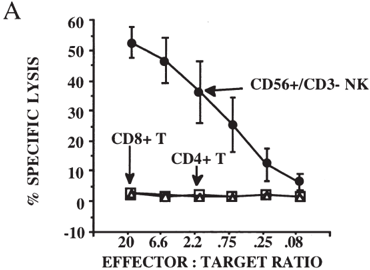
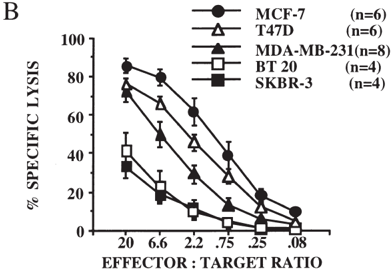
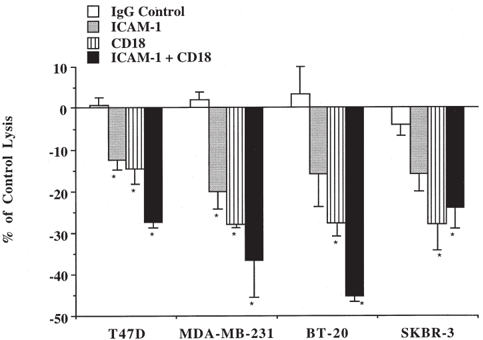
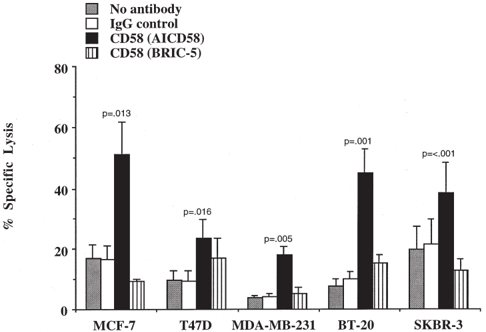
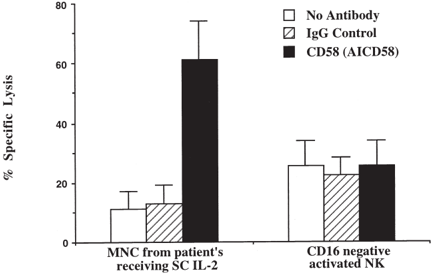
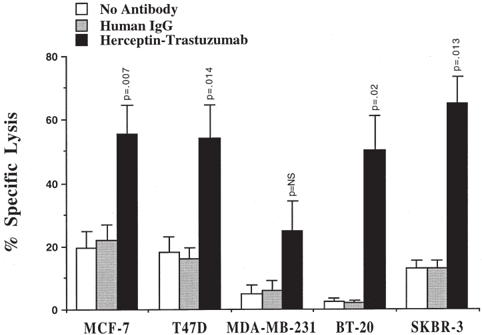
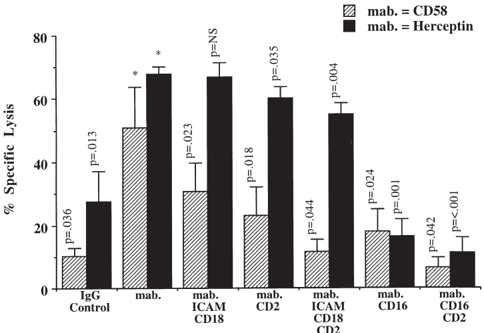
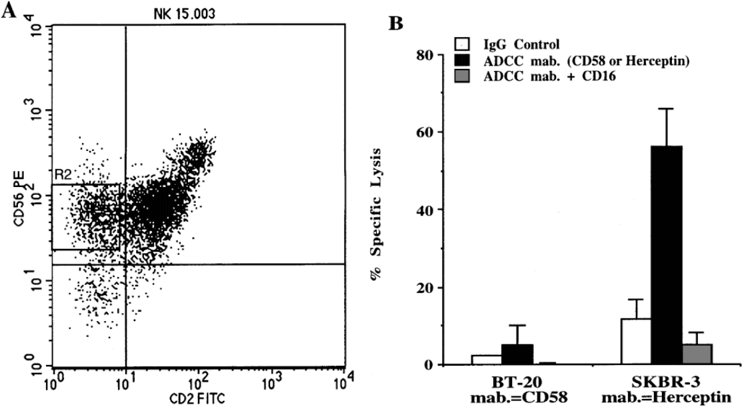
Treatment of advanced breast cancer with autologous stem cell transplantation is limited by a high probability of disease relapse. In clinical trials, interleukin 2 (IL-2) alone can expand natural killer (NK) cells in vivo and increase their cytotoxic activity against breast cancer cell lines, but this increase is modest. Understanding the mechanisms that mediate NK cell lysis of breast cancer targets may lead to improvements of current immunotherapy strategies. NK cells from normal donors or patients receiving subcutaneous IL-2 were tested in cytotoxicity assays against five breast cancer cell lines. The role of adhesion molecules and antibodies that interact through Fc receptors on NK cells was explored. NK cell lysis of breast cancer targets is variable and is partially dependent on recognition through ICAM-1 and CD18. While blocking CD2 slightly decreased cytotoxicity, contrary to expectations, an antibody against CD58 (the ligand for CD2), failed to block killing and instead mediated an increased cytotoxicity that correlated with target density of CD58. The CD58 antibody-enhanced killing was dependent not only on FcRgammaIII but also on CD2 and ICAM-1/CD18. To further elucidate the mechanism of this CD58 antibody-dependent cellular cytotoxicity (ADCC), another antibody was tested. Trastuzumab (Herceptin), a humanized antibody against HER2/neu, mediated potent ADCC against all the HER2/neu positive breast cancer targets. Unlike CD58 antibody-mediated ADCC, Herceptin ADCC was minimally affected by blocking antibodies to CD2 or ICAM-1/CD18, which suggests a different mechanism of action. This study shows that multiple mechanisms are involved in NK cell lysis of breast cancer targets, that none of the targets are inherently resistant to killing, and that two distinct mechanisms of ADCC can target immunotherapy to breast cancer cells.
Overview
The claims and statistics of this paper haven’t been checked yet.
Free: it reads the open-access text and checks the first 5 claims that cite a source we can check. Create a free account to check every claim.
Integrity signals
Registry
Cites
Statistics
Figures
Verification
Claims the paper makes
The claims and statistics of this paper haven’t been checked yet.
Free: it reads the open-access text and checks the first 5 claims that cite a source we can check. Create a free account to check every claim.
Claims other papers make about this one
Each is checked against this paper’s own text: does it say what the citing paper says it does?
In the citing paper
“as well as CD33- and CD58-targeting mAbs”
From Immunomodulation by targeted anticancer agents (2021) · cites this paper as Cooley et al., 1999
Self-check
Percentages, sums and reported differences re-computed from the paper’s own numbers.
The self-check needs the paper’s full text.
Citations
Cites
Apoptosis. Its significance in cancer and cancer Therapy
Kerr, J. F. R., Winterford, C. M., & HARMON, B. V. (1994) · Cancer · doi:10.1002/1097-0142(19940415)73:8<2157::aid-cncr2820730821>3.0.co;2-1 · Cited by 2,135
Parker, S. L., Tong, T., Bolden, S., & Wingo, P. A. (1997) · CA: A Cancer Journal for Clinicians · doi:10.3322/canjclin.47.1.5 · Cited by 2,003
Differential responses of human tumor cell lines to anti-p185HER2 monoclonal antibodies
Lewis, G. D., Figari, I., Fendly, B., Lee Wong, W., Carter, P., Gorman, C., & Shepard, H. M. (1993) · Cancer Immunology, Immunotherapy · doi:10.1007/bf01518520 · Cited by 498
Antman, K. H., Rowlings, P. A., Vaughan, W. P., Pelz, C. J., Fay, J. W., Fields, K. K., Freytes, C. O., Gale, R. P., Hillner, B. E., Holland, H. K., et al. (1997) · Journal of Clinical Oncology · doi:10.1200/jco.1997.15.5.1870 · Cited by 323
Yokoyama, W. M. (1995) · Current Opinion in Immunology · doi:10.1016/0952-7915(95)80036-0 · Cited by 299
Signal Transduction during Natural Killer Cell Activation: Inside the Mind of a Killer
Leibson, P. J. (1997) · Immunity · doi:10.1016/s1074-7613(00)80441-0 · Cited by 292
Kipps, T. J., Parham, P., Punt, J., & Herzenberg, L. A. (1985) · The Journal of experimental medicine · doi:10.1084/jem.161.1.1 · Cited by 248
Arousal and inhibition of human NK cells
Lanier, L. L., Corliss, B., & Phillips, J. H. (1997) · Immunological Reviews · doi:10.1111/j.1600-065x.1997.tb00947.x · Cited by 243
Miller, J., Alley, K., & McGlave, P. (1994) · Blood · doi:10.1182/blood.v83.9.2594.2594 · Cited by 213
Self-citationMiller, J. S., McCullar, V., Punzel, M., Lemischka, I. R., & Moore, K. A. (1999) · Blood · doi:10.1182/blood.v93.1.96 · Cited by 187
Self-citation
Research works printed but not linked: 1
- 10. necrosis factor and lymphokine-activated killer cells: correlation with expression of HER2/neu oncogenes. Cancer Res 50:7364
Cited by
Items 101–200 of 219
The success story of trastuzumab emtansine, a targeted therapy in HER2-positive breast cancer
Dieras, V. C., & Bachelot, T. (2013) · Targeted Oncology · doi:10.1007/s11523-013-0287-4 · Cited by 35
The Biology of Natural Killer Cells and Implications for Therapy of Human Disease
Chiorean, E. G., & Miller, J. S. (2001) · Stem Cells and Development · doi:10.1089/15258160152509073 · Cited by 34
“%) except for MDA-MB-231, the target with the lowest HER2/neu expression (120).”
Self-citationCampoli, M. R., Chang, C., Oldford, S. A., Edgecombe, A. D., Drover, S., & Ferrone, S. (2004) · Breast Disease · doi:10.3233/bd-2004-20112 · Cited by 30
“…HLA class I antigen loss or downregulation by breast carcinoma cells is associated with their increased susceptibility to NK cell-mediated lysis [91], to date there is no in vivo evidence of a role of NK cells in growth control of tumors with classical HLA class I antigen abnormalities in…”
Epidermal growth factor receptor blockers for the treatment of ovarian cancer
Haldar, K., Gaitskell, K. L., Bryant, A., Nicum, S., Kehoe, S. T., & Morrison, J. (2011) · Cochrane Database of Systematic Reviews · doi:10.1002/14651858.cd007927.pub3 · Cited by 31
Yoshida, R., Tazawa, H., Hashimoto, Y., Yano, S., Onishi, T., Sasaki, T., Shirakawa, Y., Kishimoto, H., Uno, F., Nishizaki, M., et al. (2012) · Cancer Immunology Immunotherapy · doi:10.1007/s00262-012-1249-x · Cited by 33
“Trastuzumab, a humanized monoclonal antibody that targets HER2, inhibits the HER2-mediated signaling pathway [2, 3] and also induces antibody-dependent cellular cytotoxicity (ADCC) [4-7].”
BackgroundEpidermal growth factor receptor blockers for the treatment of ovarian cancer
Morrison, J., Thoma, C., Goodall, R. J., Lyons, T. J., Gaitskell, K. L., Wiggans, A. J., & Bryant, A. (2018) · Cochrane Database of Systematic Reviews · doi:10.1002/14651858.cd007927.pub4 · Cited by 30
Target Points in Trastuzumab Resistance
Shojaei, S., Gardaneh, M., & Shamabadi, A. R. (2012) · International Journal of Breast Cancer · doi:10.1155/2012/761917 · Cited by 27
“Antibody-dependent cellular cytotoxicity (ADCC) is induced by TZMB and other antibodies targeting HER2 leading to apoptosis in several BC cell lines [29, 45, 71].”
BackgroundDevelopment and validation of cell-based ELISA for the quantification of trastuzumab in human plasma
Jamieson, D., Cresti, N., Verrill, M. W., & Boddy, A. V. (2009) · Journal of Immunological Methods · doi:10.1016/j.jim.2009.04.006 · Cited by 25
“The exact mechanism of action of trastuzumab is uncertain, but appears to be multifactorial and includes the direct inhibition of proliferative signalling and induction of antibody-dependent cell-mediated cytotoxicity (ADCC) (Cooley et al., 1999).”
BackgroundPotential therapeutic role of natural killer cells in cancer
Woan, K. V., & Reddy, V. S. (2006) · Expert Opinion on Biological Therapy · doi:10.1517/14712598.7.1.17 · Cited by 26
“Moreover, NK-mediated ADCC is associated with clearance of HER2/neu-positive breast cancer cells treated with trastuzumab [83].”
BackgroundDomercant, J., Polin, N. M., & Jahangir, E. (2016) · PubMed Central · Cited by 34
The epidermal growth factor receptor family in breast cancer
Koutras, A. K., & Evans, T. R. J. (2008) · OncoTargets and Therapy · doi:10.2147/ott.s3842 · Cited by 32
“Accumulating data indicate that the effect of trastuzumab on cancer cells may be due to the activation of antibody-dependent cellular cytotoxicity (ADCC) (Lewis et al 1993; Cooley et al 1999; Clynes et al 2000; Gennari et al 2004).”
Yan, H., Xiao, H. F., Zhu, J., Zhang, J., & Liu, Z. (2020) · Cancer Management and Research · doi:10.2147/cmar.s278694 · Cited by 23
Trastuzumab as first-line therapy in HER2-positive metastatic breast cancer patients
Mastro, L. D., Lambertini, M., Bighin, C., Levaggi, A., D’Alonzo, A., Giraudi, S., & Pronzato, P. (2012) · Expert Review of Anticancer Therapy · doi:10.1586/era.12.107 · Cited by 27
Cara, G. D., Marengo, G., Albanese, N. N., Marabeti, M. R., Musso, R., Cancemi, P., & Pucci‐Minafra, I. (2013) · PubMed · Cited by 22
Natural killer cells and cancer therapy, what we know and where we are going
Ghaemdoust, F., Keshavarz‐Fathi, M., & Rezaei, N. (2019) · Immunotherapy · doi:10.2217/imt-2019-0040 · Cited by 22
Immunotherapeutic options on the horizon in breast cancer treatment
van Rooijen, J. M., Stutvoet, T. S., Schröder, C. P., & de Vries, E. G. E. (2015) · Pharmacology & Therapeutics · doi:10.1016/j.pharmthera.2015.09.003 · Cited by 22
Fan, X., Brezski, R. J., Deng, H., Dhupkar, P. M., Shi, Y., Gonzalez, A. O., Zhang, S., Rycyzyn, M. A., Strohl, W. R., Jordan, R. E., et al. (2015) · Molecular Cancer Therapeutics · doi:10.1158/1535-7163.mct-14-0715 · Cited by 21
Elsaid, A. F., Agrawal, S., Agrawal, A., & Ghoneum, M. H. (2021) · Nutrients · doi:10.3390/nu13114133 · Cited by 20
Campo, V. L., Riul, T. B., Carvalho, I., & Dias‐Baruffi, M. (2014) · ChemBioChem · doi:10.1002/cbic.201400069 · Cited by 19
Potential use of humanized antibodies in the treatment of breast cancer
Schaefer, N. G., Pestalozzi, B. C., Knuth, A. K., & Renner, C. (2006) · Expert Review of Anticancer Therapy · doi:10.1586/14737140.6.7.1065 · Cited by 23
Anti-tumor immunity induced by an anti-idiotype antibody mimicking human Her-2/neu
Mohanty, K., Saha, A., Pal, S., Mallick, P., Chatterjee, S. K., Foon, K. A., & Bhattacharya‐Chatterjee, M. (2006) · Breast Cancer Research and Treatment · doi:10.1007/s10549-006-9391-9 · Cited by 18
Antibody-dependent cell cytotoxicity to breast cancer targets despite inhibitory KIR signaling.
Stein, M. N., Shin, J., Gudzowaty, O., Bernstein, A. M., & Liu, J. M. (2006) · PubMed · Cited by 23
Rodríguez, M. C., Hughes, H. B., Kremer, P. G., Subedi, G. P., & Barb, A. W. (2023) · Immunology · doi:10.1111/imm.13662 · Cited by 19
“Trastuzumab (Herceptin), a humanized monoclonal antibody that selectively targets human epidermal growth factor receptor 2 (HER2) positive cells, including the SK-BR-3 breast cancer cell line [50], has been shown to stimulate NK cells to ADCC [51, 52].”
BackgroundMiura, D., Yoneyama, K., Furuhata, Y., & Shimizu, K. (2014) · Journal of Nippon Medical School · doi:10.1272/jnms.81.211 · Cited by 17
Pratesi, G., Petrangolini, G., Tortoreto, M., Addis, A., Zunino, F., Calcaterra, C., Merlo, A. C., Tagliabue, E., Ménard, S., & Balsari, A. (2008) · Journal of Immunotherapy · doi:10.1097/cji.0b013e31817c37ff · Cited by 16
Herceptin and breast cancer: An overview for surgeons
Patani, N., & Mokbel, K. (2008) · Surgical Oncology · doi:10.1016/j.suronc.2008.11.001 · Cited by 16
Yamauchi, C., Fujii, S., Kimura, T., Kuwata, T., Wada, N., Mukai, H., Matsumoto, N., Fukayama, M., & Ochiai, A. (2011) · International Journal of Cancer · doi:10.1002/ijc.25803 · Cited by 19
Myers, K. A., Ryan, M. G., Stern, P. L., Shaw, D. M., Embleton, M. J., Kingsman, S. M., & Carroll, M. W. (2002) · Cancer Gene Therapy · doi:10.1038/sj.cgt.7700513 · Cited by 16
Yamaguchi, Y., 弘中, 克., Okawaki, M., Okita, R., Matsuura, K., Ohshita, A., & Toge, T. (2005) · PubMed · Cited by 15
Khoury, T., Mojica, W. D., Hicks, D. G., Starostik, P., Ademuyiwa, F. O., Janarthanan, B., & Cheney, R. T. (2011) · Modern Pathology · doi:10.1038/modpathol.2011.64 · Cited by 16
“It is postulated that bound antibody may achieve its therapeutic effect through several mechanisms, which may include, but are not limited to, antibody-dependent cell-meditated cytotoxicity, G1 arrest, receptor downregulation, or the prevention of heterodimer formation”
BackgroundGalán, A., Nedev, H., Bijian, K., Su, J., Alaoui‐Jamali, M. A., & Saragovi, H. U. (2012) · Oncogene · doi:10.1038/onc.2012.283 · Cited by 14
Pan-HER-targeted approach for cancer therapy: Mechanisms, recent advances and clinical prospect
Wang, M., Hu, Y., Yu, T., Ma, X., Wei, X., & Wei, Y. (2018) · Cancer Letters · doi:10.1016/j.canlet.2018.07.014 · Cited by 15
Richards, J. O., Albers, A. J., Smith, T. S., & Tjoe, J. A. (2016) · Cancer Immunology Immunotherapy · doi:10.1007/s00262-016-1885-7 · Cited by 15
“1 3 NK cell-mediated antibody-dependent cellular cytotoxicity (ADCC), an indication of immune activation [3].”
BackgroundKim, Y., Lee, S.-H., Kim, C.-J., Lee, J., Yu, D., Ahn, S.-M., Shin, D., & Kim, S. (2019) · BMC Veterinary Research · doi:10.1186/s12917-019-2068-5 · Cited by 12
“These results are consistent with the findings in human studies showing that trastuzumab induces ADCC in HER-2-non-amplified breast cancer cells [7, 36].”
ResultYamaguchi, T., Ito, M., Isobe, T., Koreishi, S., Taguchi, R., Uehara, K., Ueno, S., Imajima, T., Kitazono, T., Tsuchihashi, K., et al. (2024) · JCO Precision Oncology · doi:10.1200/po.23.00681 · Cited by 14
Chung, A. P., Choi, M. P., Han, B.-C., Bose, S., Zhang, X., Medina‐Kauwe, L. K., Sims, J. D., Murali, R., Taguiam, M., Varda, M. M., et al. (2015) · Clinical Breast Cancer · doi:10.1016/j.clbc.2015.06.001 · Cited by 13
Raja, S. M., Bailey, T., Mohapatra, B. C., Ericsson, A. C., Dimri, M., Band, V., Band, H., Ortega-Cava, C. F., Laiq, Z., Luan, H., et al. (2011) · Journal of Carcinogenesis · doi:10.4103/1477-3163.90443 · Cited by 12
“[13-16] Furthermore, immune mechanisms contribute prominently to the effectiveness of targeted therapy with humanized antibodies against ErbB2.[17-19] Thus, while human ErbB2-overexpressing tumor cell lines have provided critical in vitro systems to advance our understanding of ErbB2mediated oncogenesis, these models…”
BackgroundInfluentialRichards, J. O., Albers, A. J., Smith, T. S., & Tjoe, J. A. (2016) · Cancer Immunology Immunotherapy · doi:10.1007/s00262-016-1903-9 · Cited by 12
Immunologic approaches to breast cancer treatment
Sabel, M. S., & Nehs, M. A. (2005) · Surgical Oncology Clinics of North America · doi:10.1016/j.soc.2004.07.003 · Cited by 11
“One important method is antibodydependent cell-mediated cytotoxicity (ADCC), which involves the attachment of tumor-specific antibodies to tumor cells and the subsequent destruction of the tumor cell by immunocompetent cells, most commonly the natural killer (NK) cell.”
BackgroundAsvadi, P., Cuddihy, A. R., Dunn, R. D., Jiang, V., Wong, M., Jones, D. R., Khong, T. T., & Spencer, A. G. (2015) · British Journal of Haematology · doi:10.1111/bjh.13298 · Cited by 11
Les anticorps conjugués en oncologie : du concept au trastuzumab emtansine (T-DM1)
Gonçalvès, A., Trédan, O., Villanueva, C., & Dumontet, C. (2012) · Bulletin du Cancer · doi:10.1684/bdc.2012.1669 · Cited by 10
High serum HTATIP2/TIP30 level in serous ovarian cancer as prognostic or diagnostic marker
Kumtepe, Y., Halıcı, Z., Şengül, Ö. K., Kunak, C. S., Bayır, Y., Kılıç, N., Çadırcı, E., Pulur, A., & Bayraktutan, Z. (2013) · European journal of medical research · doi:10.1186/2047-783x-18-18 · Cited by 10
“In addition to these studies demonstrating the role of HER2/ neu in gynecological cancers, Zhang et al. reported that overexpression of human HIV-1 TAT interactive protein 2 (HTATIP2/TIP30) is associated with HER2/neu status in breast cancer [10].”
BackgroundInfluentialStroes, C. I., van den Ende, T., Derks, S., & van Laarhoven, H. W. M. (2021) · Cancer Treatment Reviews · doi:10.1016/j.ctrv.2021.102249 · Cited by 10
The Activating Receptors of Natural Killer Cells and Their Inter-Switching Potentials
Rowaiye, A. B., Asala, T., Oli, A. N., Uzochukwu, I. C., Akpa, A., & Esimone, C. O. (2020) · Current Drug Targets · doi:10.2174/1389450121666200910160929 · Cited by 9
Differential regulation of human monocytes and NK cells by antibody-opsonized tumors
Yin, J., Albers, A. J., Smith, T. S., Riddell, G. T., & Richards, J. O. (2018) · Cancer Immunology Immunotherapy · doi:10.1007/s00262-018-2179-z · Cited by 11
Johnson, T. A., & Singla, D. K. (2018) · Canadian Journal of Physiology and Pharmacology · doi:10.1139/cjpp-2018-0005 · Cited by 9
Kuratsukuri, K., Wang, C. Y., Sone, T., Nishisaka, N., Jones, R. F., & Haas, G. P. (2002) · European Urology · doi:10.1016/s0302-2838(02)00211-7 · Cited by 8
Advances in cancer immunotherapy: The role of super NK and super CAR-T cells
Almohaimeed, H. M., Chowdhury, A., Sarkar, S., Almars, A. I., Tounsi, W. A., Singh, A., Krithiga, T., Ray, S., & Uti, D. E. (2025) · International Immunopharmacology · doi:10.1016/j.intimp.2025.115074 · Cited by 7
Innovative approaches to immunotherapy in breast cancer
Quinn, K. M. (2020) · Journal of Thoracic Disease · doi:10.21037/jtd.2020.03.119 · Cited by 7
HER2/neu as a Signaling and Therapeutic Marker in Uterine Serous Carcinoma
Ettorre, V. M., Palmieri, L., Clemente, V., & Santin, A. D. (2025) · Cells · doi:10.3390/cells14161282 · Cited by 6
“Moreover, antibody-dependent-cellular-cytotoxicity (ADCC) is another major mechanism of the anti-tumor function of trastuzumab, which is mediated by effector immune cells, particularly CD56dimCD16-positive NK cells [104,105].”
Zahavi, D. J., Erbe, R., Zhang, Y., Guo, T. W., Malchiodi, Z. X., Maynard, R. E., Lekan, A. A., Gallagher, R. I., Wulfkuhle, J. D., Petricoin, E. F., et al. (2023) · Cancer Biology & Therapy · doi:10.1080/15384047.2023.2269637 · Cited by 6
“38 Importantly, CD54 surface expression is reduced in A431 ADCC-resistant cells and represented a potential cell lineage-specific resistance mechanism (Figure 3g).”
BackgroundBahl, S., Roses, R. E., Sharma, A., Koldovsky, U., Xu, S., Weinstein, S. P., Nisenbaum, H. L., Fox, K. R., Pasha, T. L., Zhang, P. J., et al. (2009) · The American Journal of Surgery · doi:10.1016/j.amjsurg.2009.06.014 · Cited by 6
Chen, X., Lin, Y., Jiang, Z., Li, Y., Zhang, Y., Wang, Y., Yu, F., Guo, W., Chen, L., Chen, M., et al. (2022) · The Breast · doi:10.1016/j.breast.2022.02.002 · Cited by 7
Porter, D., Hexner, E. O., Cooley, S., & Miller, J. S. (2008) · Cancer treatment and research · doi:10.1007/978-0-387-78580-6_20 · Cited by 6
Self-citationCytokine storm complicated by cardiogenic shock induced by anti-HER2 therapies
Godinho, R., Noto, A., Fenwick, C. W., Stravodimou, A., Hugelshofer, S., Peters, S., Hullin, R., & Obéid, M. (2023) · Journal for ImmunoTherapy of Cancer · doi:10.1136/jitc-2023-006942 · Cited by 5
Cheminfomatic-based Drug Discovery of Human Tyrosine Kinase Inhibitors
Reid, T.-E. R., Fortunak, J., Wutoh, A., & Wang, X. S. (2016) · Current Topics in Medicinal Chemistry · doi:10.2174/1568026615666150915120814 · Cited by 6
“There are multiple proposed mechanisms of action for Trastuzumab which include: (a) activation of antibody-dependent cellular cytotoxicity (ADCC)[7]; (b) inhibition of HER2 cleavage[8]; (c) induction of HER2 down-regulation; (d) inhibition of PI3K signaling pathway thus promoting apoptosis and arrest of proliferation;…”
BackgroundImmunological memory in natural killer cells
Nabekura, T. (2025) · International Immunology · doi:10.1093/intimm/dxaf016 · Cited by 4
Altundağ, K., Ali‐Seyed, M., Altundağ, Ö., Silay, Y. S., Gündüz, E., & Demircan, K. (2004) · Medical Hypotheses · doi:10.1016/j.mehy.2004.07.016 · Cited by 4
“One of the proposed mechanisms of trastuzumab antitumor action is through antibody-dependent cellular cytotoxicity (ADCC) [24,25].”
BackgroundSun, X., Cui, Q., Ni, J., Liu, X., Zhu, J., Zhou, T., Huang, H., Ouyang, K., Wu, Y., & Yang, Z. (2023) · Microbiology Spectrum · doi:10.1128/spectrum.04715-22 · Cited by 3
Devapatla, B. K., Sanders, J., & Samuelson, D. J. (2012) · Cytokine · doi:10.1016/j.cyto.2012.04.037 · Cited by 3
“Breast cancer cells that express ITGβ2 are recognized and killed my natural killer cells [22].”
BackgroundTrastuzumab Therapy and ERBB2 Genotype
Dean, L., & Kane, M. S. (2021) · Europe PMC (PubMed Central) · Cited by 6
Trends and Novel Approaches in Neoadjuvant Treatment of Breast Cancer
Steger, G. G., & Bartsch, R. (2011) · Breast Care · doi:10.1159/000335331 · Cited by 4
Sudo, T., Aruga, A., Shimizu, K., Matsushita, N., & Takasaki, K. (2006) · PubMed · Cited by 3
Adjuvant chemotherapy in breast cancer
Bartsch, R., & Steger, G. G. (2008) · memo - Magazine of European Medical Oncology · doi:10.1007/s12254-008-0019-0 · Cited by 4
Japanese Vegetable Juice, Aojiru, and Cellular Immune Response for Health Promotion
Moriguchi, S., Taka, T., Yamamoto, Y., & Hasegawa, T. (2000) · Modern nutrition · doi:10.1201/9781420042542.ch3 · Cited by 3
Jurišić, V., Vuletić, A. M., Martinović, K. M., Milović-Kovačević, M., Radenković, S., Knezevic, S., & Marković, O. (2025) · The European Physical Journal Special Topics · doi:10.1140/epjs/s11734-025-01694-w · Cited by 2
Clinical trials of NK cells for cancer
Cooley, S., & Miller, J. S. (2010) · Elsevier eBooks · doi:10.1016/b978-0-12-370454-2.00043-0 · Cited by 3
Self-citationTargeted treatment of advanced and metastatic breast cancer with lapatinib
O’Donovan, N., Corkery, B., & Crown, J. P. (2008) · OncoTargets and Therapy · doi:10.2147/ott.s3051 · Cited by 5
“Trastuzumab acts by binding to the extracellular domain of HER-2 and also mediates antibody-dependent cellular cytoxicity (ADCC) (Cooley et al 1999).”
Cytotoxicity effect of trastuzumab on canine peripheral blood mononuclear cells.
OYAMADA, T., & Okano, S. (2020) · PubMed · Cited by 2
Human Polymorphism and Variable Outcomes of Cancer Chemotherapy and Transplantation
Davies, S. M., Dickinson, A. M., & Miller, J. S. (2007) · Transplantation and Cellular Therapy · doi:10.1016/j.bbmt.2007.11.010 · Cited by 2
Self-citationSommavilla, R. (2010) · Repository for Publications and Research Data (ETH Zurich) · doi:10.3929/ethz-a-006155036 · Cited by 3
Epidermal growth factor receptor blockers for the treatment of ovarian cancer
Gaitskell, K. L., Martinek, I. E., Nicum, S., Kehoe, S. T., & Morrison, J. (2009) · Cochrane Database of Systematic Reviews · doi:10.1002/14651858.cd007927 · Cited by 2
HER2-positive metastatic breast cancer: second-line treatment
Álvarez, R. H. (2016) · Springer eBooks · doi:10.1007/978-3-319-28216-9_5 · Cited by 1
Madoz‐Gúrpide, J., Serrano‐López, J., Sanz-Álvarez, M., Morales-Gallego, M., Rodríguez-Pinilla, S. M., Rovira, A., Albanell, J., & Rojo, F. (2025) · International Journal of Molecular Sciences · doi:10.3390/ijms26041559 · Cited by 1
“Trastuzumab also induces antibody-dependent cellular cytotoxicity (ADCC), recruiting immune cells to attack HER2-overexpressing tumour cells [8].”
Kline, J. B., Grasso, L., & Nicolaides, N. C. (2025) · European Journal of Immunology · doi:10.1002/eji.202451611 · Cited by 1
“Previous studies have shown that membrane-bound ICAM-1 plays a role in enhancing the ADCC of NK cells via LFA binding and blocking this interaction reduces its ADCC activity on target cells [35, 36].”
Guan, J., Wang, T., Tessier, P. M., & Thurber, G. M. (2025) · The AAPS Journal · doi:10.1208/s12248-025-01183-x · Cited by 1
“It has also been shown to induce strong cell death in vitro via antibody-dependent cellular cytotoxicity (ADCC) (7–9).”
A Review of Trastuzumab-Based Therapy in Patients with HER2-positive Metastatic Breast Cancer
Church, D. N., & Price, C. G. A. (2009) · Clinical Medicine Therapeutics · doi:10.4137/cmt.s35 · Cited by 1
Adjuvant Biologic Agents for Breast Cancer
Kaklamani, V., & Gradishar, W. J. (2014) · Springer eBooks · doi:10.1007/978-1-4939-1145-5_25 · Cited by 1
Overview on the Use of Therapeutic Antibodies in Drug Discovery
Roguska, M., Kaymakcalan, Z., & Salfeld, J. G. (2004) · Current Protocols in Pharmacology · doi:10.1002/0471141755.ph0907s27 · Cited by 1
“Depending on the particular target and disease, it may be desirable to increase Fcmediated effector functions which are the basis for the efficacy of therapeutic antibodies such as Trastuzumab (anti-her2/Neu; Cooley et al., 1999) and Rituximab (anti-CD20; Manches et al., 2003).”
BackgroundMonoclonal antibodies at the Oncology Institute of Vojvodina: 5-year expenditure
Jelic, M., Jovanovic, D., POPOVIC, L. S., & Striber-Devaja, D. (2012) · Archive of oncology · doi:10.2298/aoo1204053j · Cited by 1
Pucci‐Minafra, I. (2014) · Springer eBooks · doi:10.1007/978-81-322-0843-3_9 · Cited by 1
Resistance to HER2-targeted therapy
Valadan, R., Rafiei, A., Tehrani, M., & Nejatollahi, F. (2013) · Research in Molecular Medicine · doi:10.18869/acadpub.rmm.1.1.1 · Cited by 1
Immunotherapy: Targeting Cancer Cells
Vindhya, M., Bharadwaj, M. N. R., Basalingappa, K. M., Gopenath, T. S., & Gnanasekaran, A. (2023) · Biological and medical physics, biomedical engineering · doi:10.1007/978-981-19-9786-0_5 · Cited by 2
Tonn, T., Becker, S., Esser, R., Schwabe, D., & Seifried, E. (2001) · Cited by 1
Epidermal growth factor receptor blockers for the treatment of ovarian cancer
Haldar, K., Gaitskell, K. L., Bryant, A., Dickinson, H. O., Nicum, S., Kehoe, S. T., & Morrison, J. (2009) · Cochrane Database of Systematic Reviews · doi:10.1002/14651858.cd007927.pub2 · Cited by 1
Okutur, S. K. (2011) · Istanbul Science University (Istanbul Bilim University)
HER2-Positive Metastatic Breast Cancer: Second-Line Treatment
Álvarez, R. H. (2013) · doi:10.1007/978-1-907673-94-8_5
Role of Stroma in Disease Progression
Bertos, N., & Park, M. (2013) · Springer eBooks · doi:10.1007/978-1-4614-3685-0_10
Regulation of Natural Killer Cells: SHIP-1, 2B4, and Immunomodulation by Lenalidomide
Fortenbery, N. R. (2012) · Digital Commons - University of South Florida (University of South Florida)
Natural Killer Cells and Allogeneic Hematopoietic Cell Transplantation
Verneris, M. R., & Miller, J. S. (2015) · Wiley eBooks · doi:10.1002/9781118416426.ch11
Self-citationLubig, J. (2013) · University of Regensburg Publication Server (University of Regensburg) · doi:10.5283/epub.27413
Solon, J. G. (2012) · Figshare · doi:10.25419/rcsi.10815665
Trastuzumab Resistance in Breast Cancer
Morgillo, F., Orditura, M., Troiani, T., Martinelli, E., Vita, F. D., & Ciardiello, F. (2010) · Springer eBooks · doi:10.1007/978-3-0346-0094-1_3
“HER-2-targeted antibodies, including trastuzumab, were shown to promote apoptosis in multiple breast cancer cell lines via antibodydependent cellular cytotoxicity (ADCC) [13].”
BackgroundEnvolvimento de galectina-1 na infecção experimental aguda por Trypanosoma cruzi
Riul, T. B. (2014) · Digital Library of Theses and Dissertations (Universidade de São Paulo) · doi:10.11606/t.60.2014.tde-31102014-143222
Berstad, M. E. B. (2015) · NORA - Norwegian Open Research Archives
Vestrheim, A. (2013) · NVA (Nasjonalt vitenarkiv)
Mechanisms of Tumor Cell Killing by Therapeutic Antibodies
Stewart, R. A., & Webster, C. I. (2009) · Cambridge University Press eBooks · doi:10.1017/cbo9780511596773.012
(2013) · CRC Press eBooks · doi:10.1201/b14587-17
Metadata
- Authors
- Cooley, S., Burns, L. J., Repka, T., & Miller, J. S.
- Affiliations
- University of Minnesota (US)
- Corresponding author
- Miller, Jeffrey S
- Venue
- Experimental Hematology
- Publisher
- Elsevier BV
- Published
- 1999-10
- Volume
- 27
- Issue
- 10
- Pages
- 1533-1541
- ISSN
- 0301-472X (ISSN-L)
- OpenAlex
- W2039609199
- Semantic Scholar
- 1d8ba8f7b2266aff12ad9d4500a461b5d4618901
- Cited by
- 213
- References
- 36
- Citations by year
- 2025: 7 · 2024: 1 · 2023: 6 · 2022: 4 · 2021: 5 · 2020: 12 · 2019: 7 · 2018: 10 · 2017: 1 · 2016: 11 · 2015: 6 · 2014: 10 · 2013: 13 · 2012: 12
- FWCI
- 1.60
- Type
- journal article
- Language
- en
- Open access
- hybrid
- doi.org
- Licence
- cc-by
- www.elsevier.com/tdm/userlicense/1.0/ (tdm)
- www.elsevier.com/legal/tdmrep-license (tdm)
- www.elsevier.com/open-access/userlicense/1.0/ (vor, 8286 d)
- Locations
- Experimental Hematology (publishedVersion, cc-by)
- PubMed (publishedVersion)
- Funders
- American Cancer Society
- American Society of Hematology
- University of Minnesota
- National Institutes of Health
- National Cancer Institute (P01 CA65493, P01CA065493)
- Topics
- Life Sciences › Immunology and Microbiology › Immunology › Immune Cell Function and Interaction
- Life Sciences › Immunology and Microbiology › Immunology › Monoclonal and Polyclonal Antibodies Research
- Life Sciences › Immunology and Microbiology › Immunology › Immunotherapy and Immune Responses
- Keywords
- natural killer cells, antibody-dependent cellular cytotoxicity, breast cancer, CD58, LFA-3, HER2/neu, trastuzumab, ICAM-1, CD18, CD2, Fc gamma receptor III, interleukin-2, adhesion molecules, immunotherapy
- MeSH terms
- Trastuzumab, Antibodies, Antibodies, Monoclonal, Antibody-Dependent Cell Cytotoxicity, Antineoplastic Agents, Breast Neoplasms, Cells, Cultured, Cytotoxicity Tests, Immunologic, Female, Flow Cytometry, Humans, Interleukin-2, Killer Cells, Natural, Lymphocyte Activation, Antigens, CD, Intercellular Adhesion Molecule-1, CD18 Antigens, CD58 Antigens, Antibodies, Monoclonal, Humanized
About these checks
Registry, retraction, Cites and statistics results are computed, not judged, with one exception: a printed reference that no index lists is read once by a model before it counts as a citation error. Claims are extracted by a model and kept only when their quote appears verbatim in the text; each cited source is then checked, with a model’s help, for whether it says what the claim relies on. Those verdicts can be wrong — read the claim’s quote and the cited source before relying on one.
Statistics and arithmetic are recomputed, not judged.
Confidence bands are shown only for fields calibrated on our annotated test set. None is calibrated yet, so no band is shown.
What counts as a claim ›How we measure confidence ›How we check this ›
Are you an author, or do you see a problem with this page? Request a review
Data sources
Bibliographic data: Semantic Scholar, OpenAlex, Crossref.
Contains information from the Semantic Scholar Academic Graph Datasets, made available under the ODC Attribution License (ODC-BY 1.0).
Semantic Scholar’s data is described in: Kinney, R., et al. (2023). The Semantic Scholar Open Data Platform. arXiv:2301.10140.
