

The DOI matches its Crossref record; 45 of the 45 references it cites were found in a registry or an index.
Temporal dynamics of glutamate efflux in the prefrontal cortex and in the hippocampus following repeated stress: effects of pretreatment with saline or diazepam
Open accessAbstract
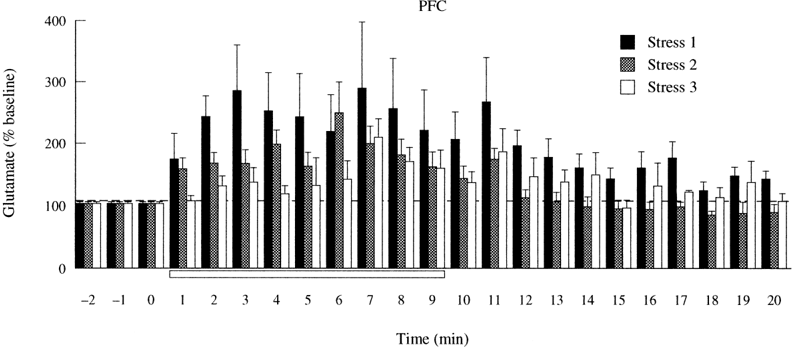
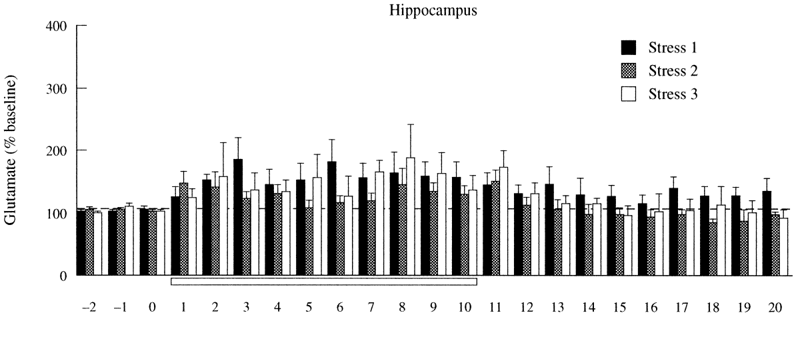
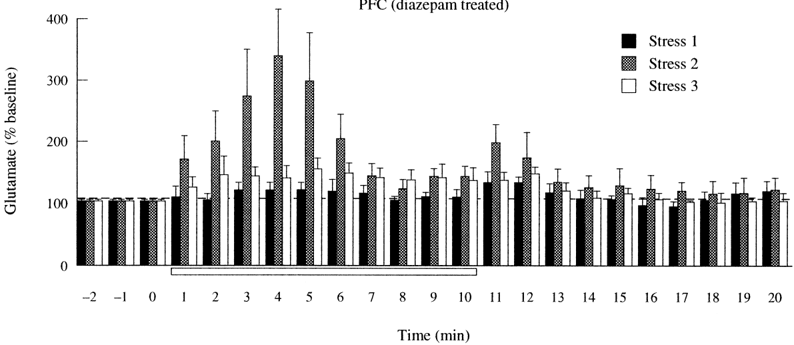
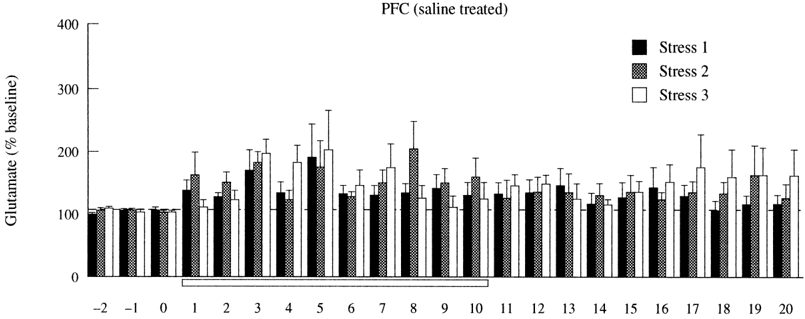
Acute stress has been associated with activation of glutamate efflux in forebrain structures. The present study sought to characterize the extracellular dynamics of glutamate in response to acute and repeated stress in the prefrontal cortex and hippocampus in rats. One-minute sampling of extracellular glutamate levels was performed during repeated tail-pinch stress. Animals were stressed three times, beginning at approximately 10.30 a.m. and continuing at 2.5-h intervals. In the prefrontal cortex, the initial 10-min tail pinch produced a robust increase in extracellular levels of glutamate. This increase was apparent immediately (i.e. 1 min) after the start of the stress procedure. The second tail pinch produced a smaller increase in glutamate levels while the third tail pinch did not significantly increase these levels. In the hippocampus, the initial stress response was smaller in magnitude than that observed in the prefrontal cortex. Furthermore, responses to subsequent tail pinches were similar to that seen following the first tail pinch. Treatment with diazepam (3 mg/kg/i.p.) 30 min before the first stress session abolished the stress response in the prefrontal cortex and hippocampus. However, in the prefrontal cortex, the second tail pinch (performed approximately 3 h after diazepam administration) produced a robust increase in glutamate efflux. In contrast, in the hippocampus of diazepam-treated rats, the second tail pinch produced a small delayed response. Pretreatment with saline resulted in non-significant responses to all three tail pinches in the prefrontal cortex. The present study suggests that: (i) stress produces a rapid increase in glutamate efflux in the prefrontal cortex and hippocampus, (ii) repeated stress reveals tolerance in the glutamatergic response in the prefrontal cortex, (iii) saline and diazepam pretreatment reduce the stress-induced efflux of glutamate in the prefrontal cortex, and (iv) exposure to diazepam may prevent the prefrontal cortex from adapting its response to the subsequent stressor. These finding are consistent with the role of the prefrontal cortex as a region which may regulate reactions to aversive stimuli.
Overview
The claims and statistics of this paper haven’t been checked yet.
Run the check — free, no account needed. It reads the open-access text and checks the sources it cites.
Integrity signals
Registry
Cites
Statistics
Figures
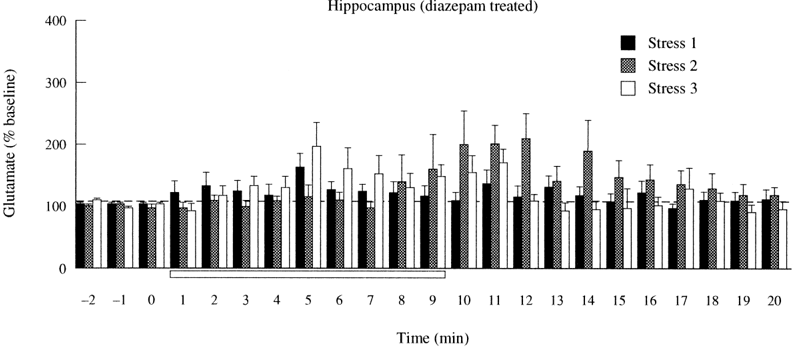
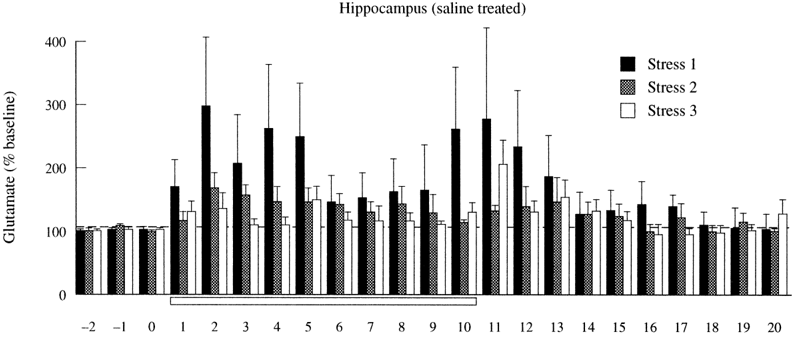
Verification
Claims the paper makes
The claims and statistics of this paper haven’t been checked yet.
Run the check — free, no account needed. It reads the open-access text and checks the sources it cites.
Claims other papers make about this one
Each is checked against this paper’s own text: does it say what the citing paper says it does?
In the citing paper
“The activational period, identified by the “1A” and “1B” in Figure 3, involves a stress-induced increase in glutamatergic transmission and activation of AMPA and NMDA receptors (Bagley and Moghaddam [243]; Venero and Borrell [244]; McEwen et al. [245]; Kole et al. [246]).”
From The Temporal Dynamics Model of Emotional Memory Processing: A Synthesis on the Neurobiological Basis of Stress-Induced Amnesia, Flashbulb and Traumatic Memories, and the Yerkes-Dodson Law (2007) · cites this paper as Bagley and Moghaddam [243]
Self-check
Percentages, sums and reported differences re-computed from the paper’s own numbers.
The self-check needs the paper’s full text.
Citations
Cites
The Rat Brain in Stereotaxic Coordinates
Paxinos, G., & Watson, C. (1983) · Elsevier eBooks · doi:10.1016/c2009-0-63235-9 · Cited by 28,585
Implications of Normal Brain Development for the Pathogenesis of Schizophrenia
Weinberger, D. R. (1987) · Archives of General Psychiatry · doi:10.1001/archpsyc.1987.01800190080012 · Cited by 3,724
Benveniste, H., Drejer, J., Schousboe, A., & Diemer, N. H. (1984) · Journal of Neurochemistry · doi:10.1111/j.1471-4159.1984.tb05396.x · Cited by 2,863
The Prefrontal Cortex: Anatomy, Physiology, and Neuropsychology of the Frontal Lobe
Fuster, J. M. (1980) · Cited by 2,367
Fuster, J. M. (1997) · Cited by 2,095
Circuitry of Primate Prefrontal Cortex and Regulation of Behavior by Representational Memory
Goldman‐Rakic, P. S. (1987) · Comprehensive Physiology · doi:10.1002/cphy.cp010509 · Cited by 1,960
Lindroth, P., & Mopper, K. (1979) · Analytical Chemistry · doi:10.1021/ac50047a019 · Cited by 1,838
Blockade of N -Methyl-D-Aspartate Receptors May Protect Against Ischemic Damage in the Brain
Simon, R. P., Swan, J. H., Griffiths, T., & Meldrum, B. S. (1984) · Science · doi:10.1126/science.6093256 · Cited by 1,682
DAMASIO, A. (1990) · Behavioural Brain Research · doi:10.1016/0166-4328(90)90144-4 · Cited by 1,275
Stress induces atrophy of apical dendrites of hippocampal CA3 pyramidal neurons
Watanabe, Y., Gould, E., & McEwen, B. S. (1992) · Brain Research · doi:10.1016/0006-8993(92)91597-8 · Cited by 1,212
Research works printed but not linked: 1
- Olsen, 1990, Molecular biology GABAA receptor, Fedn Am. Socs exp. Biol. J., 6, 2311
Cited by
Sorted by citations
Items 101–200 of 231
Jackson, M., & Moghaddam, B. (2006) · European Journal of Neuroscience · doi:10.1111/j.1460-9568.2006.05054.x · Cited by 48
Self-citationEffects of Depressive-Like Behavior of Rats on Brain Glutamate Uptake
Almeida, R. F., Thomazi, A. P., Godinho, G. F. R. D. S., Saute, J. A. M., Wofchuk, S. T., Souza, D. O., & Ganzella, M. (2010) · Neurochemical Research · doi:10.1007/s11064-010-0169-4 · Cited by 48
Cardoner, N., Andero, R., Cano, M., Marin-Blasco, I., Porta-Casteràs, D., Serra-Blasco, M., Via, E., Vicent-Gil, M., & Portella, M. J. (2024) · Current Neuropharmacology · doi:10.2174/1570159x21666230703091435 · Cited by 45
Butts, K. A., & Phillips, A. G. (2013) · The International Journal of Neuropsychopharmacology · doi:10.1017/s1461145713000187 · Cited by 45
Bollinger, J. L., Horchar, M. J., & Wohleb, E. S. (2020) · Neuropsychopharmacology · doi:10.1038/s41386-020-0720-1 · Cited by 44
Farley, S., Dumas, S., Mestikawy, S. E., & Giros, B. (2011) · Neuropharmacology · doi:10.1016/j.neuropharm.2011.09.010 · Cited by 48
Mayhew, J., Beart, P. M., & Walker, F. R. (2015) · Journal of Neuroendocrinology · doi:10.1111/jne.12273 · Cited by 44
Wang, X., Zhang, D., & Lu, X. (2014) · Molecular Psychiatry · doi:10.1038/mp.2014.75 · Cited by 42
Joffe, M. E., Santiago, C. I., Engers, J. L., Lindsley, C. W., & Conn, P. J. (2017) · Molecular Psychiatry · doi:10.1038/s41380-017-0015-z · Cited by 44
Behavioral effects of d-cycloserine in rats: The role of anxiety level
Ho, Y., Hsu, L., Wang, C.-F., Hsu, W., Lai, T., Hsu, C., & Tsai, Y. (2005) · Brain Research · doi:10.1016/j.brainres.2005.02.057 · Cited by 42
Stan, A. D., Schirda, C. V., Bertocci, M. A., Bebko, G. M., Kronhaus, D. M., Aslam, H. A., LaBarbara, E. J., Tanase, C., Lockovich, J. C., Pollock, M. H., et al. (2014) · Psychiatry Research: Neuroimaging · doi:10.1016/j.pscychresns.2014.05.016 · Cited by 35
Role of Stress, Depression, and Aging in Cognitive Decline and Alzheimer’s Disease
Daulatzai, M. A. (2014) · Current topics in behavioral neurosciences · doi:10.1007/7854_2014_350 · Cited by 42
Jett, J. D., & Morilak, D. A. (2013) · Neuropsychopharmacology · doi:10.1038/npp.2012.216 · Cited by 41
Tianeptine: An Antidepressant with Memory-Protective Properties
Zoladz, P. R., Park, C. R., Muñoz, C., Fleshner, M., & Diamond, D. M. (2008) · Current Neuropharmacology · doi:10.2174/157015908787386096 · Cited by 42
The Loss of Glutamate-GABA Harmony in Anxiety Disorders
Joanna, M. W., Stachowicz, K., Nowak, G., & Pilc, A. (2011) · InTech eBooks · doi:10.5772/19919 · Cited by 40
Adverse psychological impact, glutamatergic dysfunction, and risk factors for Alzheimer's disease
Myhrer, T. (1998) · Neuroscience & Biobehavioral Reviews · doi:10.1016/s0149-7634(98)00039-6 · Cited by 40
A Mechanistic Approach to Preventing Schizophrenia in At-Risk Individuals
Moghaddam, B. (2013) · Neuron · doi:10.1016/j.neuron.2013.03.024 · Cited by 38
Self-citationSchubert, M. I., Kalisch, R., Sotiropoulos, I., Catania, C., Sousa, N., Almeida, O. F. X., & Auer, D. P. (2008) · Journal of Psychiatric Research · doi:10.1016/j.jpsychires.2007.10.003 · Cited by 38
Investigational drugs under development for the treatment of PTSD
Ragen, B., Seidel, J., Chollak, C., Pietrzak, R. H., & Neumeister, A. (2015) · Expert Opinion on Investigational Drugs · doi:10.1517/13543784.2015.1020109 · Cited by 37
Luczynski, P., Moquin, L., & Gratton, A. P. (2015) · Stress · doi:10.3109/10253890.2015.1073256 · Cited by 33
Preterm Birth - Mother and Child
Morrison, J. C. (2012) · InTech eBooks · doi:10.5772/1284 · Cited by 33
mTOR Knockdown in the Infralimbic Cortex Evokes A Depressive-like State in Mouse
Garro-Martínez, E., Fullana, M. N., Florensa-Zanuy, E., Senserrich, J., Paz, V., Ruiz‐Bronchal, E., Adell, A., Castro, E., Díaz, Á., Pazos, Á., et al. (2021) · International Journal of Molecular Sciences · doi:10.3390/ijms22168671 · Cited by 31
Gerrits, M., Westenbroek, C., Koch, T., Grootkarzijn, A., & Horst, G. J. T. (2006) · Neuroscience · doi:10.1016/j.neuroscience.2006.07.014 · Cited by 30
The molecular neurobiology of stress – evidence from genetic and epigenetic models
Steckler, T. (2001) · Behavioural Pharmacology · doi:10.1097/00008877-200111000-00002 · Cited by 30
Yuen, E. Y., Wei, J., & Yan, Z. (2017) · The International Journal of Neuropsychopharmacology · doi:10.1093/ijnp/pyx052 · Cited by 31
Gatta, E., Mairesse, J., Deruyter, L., Marrocco, J., Camp, G. V., Bouwalerh, H., Lo‐Guidice, J., Morley‐Fletcher, S., Nicoletti, F., & Maccari, S. (2018) · NeuroToxicology · doi:10.1016/j.neuro.2018.04.005 · Cited by 31
Depression and the Glutamate/GABA-Glutamine Cycle
Mamelak, M. (2024) · Current Neuropharmacology · doi:10.2174/1570159x22666240815120244 · Cited by 29
Sifonios, L. L., Trinchero, M. F., Cereseto, M., Ferrero, A., Cladouchos, M. L., Macedo, G. F., Reinés, A. G., & Wikinski, S. (2009) · Neuroscience · doi:10.1016/j.neuroscience.2009.08.059 · Cited by 28
Huang, M., Chen, M., Tu, P., Bai, Y. M., Su, T., Yang, B., Liu, R.-S., & Li, C. (2018) · Journal of Affective Disorders · doi:10.1016/j.jad.2018.04.037 · Cited by 28
N-methyl-d-aspartic acid receptors are altered by stress and alcohol in Wistar–Kyoto rat brain
Lei, Y., & Tejani‐Butt, S. M. (2010) · Neuroscience · doi:10.1016/j.neuroscience.2010.05.003 · Cited by 29
Besheer, J., Fisher, K. R., Jaramillo, A. A., Frisbee, S., & Cannady, R. (2014) · Neuropsychopharmacology · doi:10.1038/npp.2014.85 · Cited by 28
Effects of fluoxetine on plasticity and apoptosis evoked by chronic stress in rat prefrontal cortex
Djordjevic, A. D., Djordjevic, J., Elaković, I., Adžić, M., Matić, G. M., & Radojcic, M. B. (2012) · European Journal of Pharmacology · doi:10.1016/j.ejphar.2012.07.042 · Cited by 27
The Effects of Stress on Glutamatergic Transmission in the Brain
Yuan, T., & Hou, G. (2014) · Molecular Neurobiology · doi:10.1007/s12035-014-8783-9 · Cited by 27
Robinson, S., Mogul, A. S., Taylor-Yeremeeva, E. M., Khan, A., Tirabassi, A. D., & Wang, H.-Y. (2021) · Neuroscience · doi:10.1016/j.neuroscience.2021.07.011 · Cited by 27
Morley‐Fletcher, S., Zuena, A. R., Mairesse, J., Gatta, E., Camp, G. V., Bouwalerh, H., Riozzi, B., Battaglia, G., Pittaluga, A., Olivero, G., et al. (2018) · Neuropharmacology · doi:10.1016/j.neuropharm.2018.03.018 · Cited by 28
Li, J., Sha, L., & Xu, Q. (2020) · Brain Research Bulletin · doi:10.1016/j.brainresbull.2020.05.013 · Cited by 26
Helplessness and escape performance: glutamate-adenosine interactions in the frontal cortex.
Hunter, A. M., Balleine, B., & Minor, T. (2003) · Behavioral Neuroscience · doi:10.1037//0735-7044.117.1.123 · Cited by 29
Gai, B. M., Bortolatto, C. F., Heck, S. O., Stein, A. L. A., Duarte, M. M. M. F., Zeni, G. R., & Nogueira, C. W. (2013) · Psychopharmacology · doi:10.1007/s00213-013-3361-9 · Cited by 25
Coumarin effects on amino acid levels in mice prefrontal cortex and hippocampus
Lucetti, E. C. P., Lucetti, D. L., Barbosa‐Filho, J. M., de Brito, E. M., Monteiro, V. S., Patrocínio, M. C. A., de Moura, R. R., Leal, L. K. A. M., Macêdo, D. S., de Sousa, F. C. F., et al. (2009) · Neuroscience Letters · doi:10.1016/j.neulet.2009.03.009 · Cited by 25
Wang, X., Zhang, F., Niu, L., Yan, J., Liu, H., Wang, D., Hui, J., Dai, H., Song, J., & Zhang, Z. (2023) · Journal of Affective Disorders · doi:10.1016/j.jad.2023.12.068 · Cited by 24
Ducrocq, F., & Vaïva, G. (2005) · L Encéphale · doi:10.1016/s0013-7006(05)82388-7 · Cited by 25
Hu, X., Zhao, H., Kurban, N., Qin, Y. F., Chen, X., Cui, S., & Zhang, Y. (2023) · eNeuro · doi:10.1523/eneuro.0406-23.2023 · Cited by 21
AMPA GluR‐A receptor subunit mediates hippocampal responsiveness in mice exposed to stress
Fumagalli, F., Caffino, L., Vogt, M. A., Frasca, A., Racagni, G., Sprengel, R., Gass, P., & Riva, M. A. (2010) · Hippocampus · doi:10.1002/hipo.20817 · Cited by 22
El-Khodor, B., Flores, G., Srivastava, L. K., & Boksa, P. (2004) · Synapse · doi:10.1002/syn.20073 · Cited by 23
Kwon, M., Seo, Y., Choi, S., Choi, H.-W., Jung, J., Park, S., & Suh, H. (2007) · Journal of Neurochemistry · doi:10.1111/j.1471-4159.2007.04865.x · Cited by 20
Biological determinants of depression following bereavement
Assareh, A. A., Sharpley, C. F., McFarlane, J. R., & Sachdev, P. S. (2014) · Neuroscience & Biobehavioral Reviews · doi:10.1016/j.neubiorev.2014.12.013 · Cited by 23
Gene-environment interplay in schizopsychotic disorders
Palomo, T., Archer, T., Kostrzewa, R. M., & Beninger, R. J. (2004) · Neurotoxicity Research · doi:10.1007/bf03033291 · Cited by 20
Hascup, E. R., Hascup, K. N., Pomerleau, F., Huettl, P. F., Hajós‐Korcsok, É., Kehr, J., & Gerhardt, G. A. (2012) · Journal of Neurochemistry · doi:10.1111/j.1471-4159.2012.07784.x · Cited by 19
Piroli, G. G., Reznikov, L. R., Grillo, C. A., Hagar, J. M., Fadel, J. R., & Reagan, L. P. (2012) · Experimental Neurology · doi:10.1016/j.expneurol.2012.12.005 · Cited by 19
Neurofilament‐light in former athletes: a potential biomarker of neurodegeneration and progression
Taghdiri, F., Multani, N., Ozzoude, M., Tarazi, A., Khodadadi, M., Wennberg, R. A., Mikulis, D. J., Green, R., Colella, B., Davis, K. D., et al. (2020) · European Journal of Neurology · doi:10.1111/ene.14251 · Cited by 19
Endocannabinoid-Epigenetic Cross-Talk: A Bridge toward Stress Coping
Rusconi, F., Rubino, T., & Battaglioli, E. (2020) · International Journal of Molecular Sciences · doi:10.3390/ijms21176252 · Cited by 19
Steciuk, M., Kram, M., Kramer, G. L., & Petty, F. (2000) · Stress · doi:10.3109/10253890009001123 · Cited by 18
The role of glutamate and its receptors in central nervous system in stress-induced hyperalgesia
Lian, Y., Qi, L., Chang, J., & Zhang, Y. (2017) · International Journal of Neuroscience · doi:10.1080/00207454.2017.1387112 · Cited by 18
Bollinger, J. L., Johnsamuel, S., Vollmer, L. L., Kuhn, A. M., & Wohleb, E. S. (2025) · Molecular Psychiatry · doi:10.1038/s41380-025-02993-3 · Cited by 28
Agitation in the ICU: part one Anatomical and physiologic basis for the agitated state.
Crippen, D. (1999) · Critical Care · doi:10.1186/cc348 · Cited by 18
Kinlein, S. A., Wallace, N. K., Savenkova, M. I., & Karatsoreos, I. N. (2022) · Neurobiology of Stress · doi:10.1016/j.ynstr.2022.100466 · Cited by 19
Coelho, A. A., Vila-Verde, C., Sartim, A. G., Uliana, D. L., Braga, L. A., Guimarães, F. S., & Lisboa, S. F. D. S. (2022) · Frontiers in Psychiatry · doi:10.3389/fpsyt.2022.923177 · Cited by 15
Buonaguro, E. F., Morley‐Fletcher, S., Avagliano, C., Vellucci, L., Iasevoli, F., Bouwalerh, H., Camp, G. V., Nicoletti, F., Maccari, S., & de Bartolomeis, A. (2019) · Progress in Neuro-Psychopharmacology and Biological Psychiatry · doi:10.1016/j.pnpbp.2019.109725 · Cited by 15
Cotella, E. M., Nawreen, N., Moloney, R. D., Martelle, S. E., Oshima, K. M., Lemen, P. M., NiBlack, J. N., Julakanti, R. R., Fitzgerald, M. E., Baccei, M. L., et al. (2022) · Biological Psychiatry Global Open Science · doi:10.1016/j.bpsgos.2022.02.009 · Cited by 15
Remote modulation of network excitability during deep brain stimulation for epilepsy
Li, D., & Yang, X. (2017) · Seizure · doi:10.1016/j.seizure.2017.02.016 · Cited by 15
Huzián, O., Baka, J., Csakvari, E., Dobos, N., Leranth, C., Siklós, L., Duman, R. S., Farkas, T., & Hajszán, T. (2021) · Neuroscience · doi:10.1016/j.neuroscience.2021.01.029 · Cited by 14
Psychobiological Stress and Preterm Birth
A., C., P., E., & M., L. (2012) · Preterm Birth - Mother and Child · doi:10.5772/27539 · Cited by 14
Zhang, Y., 邹韶红, Zhang, X., & 张亚林 (2012) · Asia-Pacific Psychiatry · doi:10.1111/appy.12021 · Cited by 14
Sales, A. J., Sato, V., & Joca, S. R. L. (2016) · Behavioural Pharmacology · doi:10.1097/fbp.0000000000000263 · Cited by 14
Asraf, K., Zaidan, H., Natoor, B., & Gaisler‐Salomon, I. (2023) · Translational Psychiatry · doi:10.1038/s41398-023-02534-y · Cited by 14
Bansal, Y., Fee, C., Misquitta, K. A., Codeluppi-Arrowsmith, S. A., Sibille, E. L., Berman, R., Coric, V., Sanacora, G., & Banasr, M. (2023) · Complex Psychiatry · doi:10.1159/000529534 · Cited by 12
Lee, B., Lee, J., Ko, Y., Seo, J., Hur, K., Kim, Y., Kim, S., Kim, S., Lee, S., & Jang, C. (2019) · Journal of Ginseng Research · doi:10.1016/j.jgr.2019.11.003 · Cited by 12
Evidence of Glutamatergic Dysfunction in the Pathophysiology of Schizophrenia
Hammond, J. C., Shan, D., Meador‐Woodruff, J. H., & McCullumsmith, R. E. (2014) · Springer eBooks · doi:10.1007/978-1-4939-1056-4_15 · Cited by 12
Murakami, G., Nakamura, M., Takita, M., Ishida, Y., Ueki, T., & Nakahara, D. (2015) · Neuropsychopharmacology · doi:10.1038/npp.2015.115 · Cited by 11
Zoladz, P. R., Muñoz, C., & Diamond, D. M. (2010) · Pharmaceuticals · doi:10.3390/ph3103143 · Cited by 11
Paroxetine ameliorates changes in hippocampal energy metabolism in chronic mild stress-exposed rats
Abdel-Tawab, A. M., Khedr, L. H., Nassar, N. N., & Eldenshary, E. E.-D. S. (2015) · Neuropsychiatric Disease and Treatment · doi:10.2147/ndt.s87089 · Cited by 11
Gos, T., Häuser, R., & Krzyżanowski, M. (2001) · Forensic Science International · doi:10.1016/s0379-0738(01)00527-8 · Cited by 10
Shao, M., Botvinov, J., Banerjee, D., Girirajan, S., & Lüscher, B. (2024) · Molecular Psychiatry · doi:10.1038/s41380-024-02832-x · Cited by 9
Lupinsky, D., Moquin, L., & Gratton, A. P. (2016) · Psychopharmacology · doi:10.1007/s00213-016-4468-6 · Cited by 8
The Role of the Glutamate System in Posttraumatic Stress Disorder and Glutamate-Based Treatments
Popoli, M., Ieraci, A., & Musazzi, L. (2022) · Springer eBooks · doi:10.1007/978-3-030-87480-3_5 · Cited by 8
Zhang, X., Kan, Q., Fu, Y., Liu, S., Dai, Z.-P., & Dong, Y. W. (2012) · Biochimica et Biophysica Acta (BBA) - Molecular Cell Research · doi:10.1016/j.bbamcr.2012.08.006 · Cited by 8
Fuchs, E., & Flügge, G. (2011) · Wiley eBooks · doi:10.1002/9781118083222.ch23 · Cited by 8
Common aspects of neuroplasticity, stress, mood disorders and mitochondrial functions
Hroudová, J., & Karlovu, K. (2010) · Cited by 6
The Complicated Relationship of Stress and Prefrontal Cortex
Moghaddam, B. (2016) · Biological Psychiatry · doi:10.1016/j.biopsych.2016.09.008 · Cited by 6
Self-citationRole of glutamate and advantages of combining memantine with a 5HT6 ligand in a model of depression
Abraham, R., Nirogi, R. V. S., & Shinde, A. K. (2014) · Pharmacological Reports · doi:10.1016/j.pharep.2013.10.007 · Cited by 6
Zarrabian, S., Nasehi, M., Farrahizadeh, M., & Zarrindast, M. (2017) · Progress in Neuro-Psychopharmacology and Biological Psychiatry · doi:10.1016/j.pnpbp.2017.08.007 · Cited by 5
Wisłowska-Stanek, A., Hamed, A., Lehner, M., Bidziński, A., Turzyńska, D., Sobolewska, A., Walkowiak, J., & Płaźnik, A. (2008) · PubMed · Cited by 5
Zoladz, P. R. (2008) · Digital Commons - University of South Florida (University of South Florida) · Cited by 5
Fundytus, M. E., & Coderre, T. J. (1999) · Pain Forum · doi:10.1016/s1082-3174(99)70049-8 · Cited by 5
Häuser, R., Gos, T., Krzyżanowski, M., & Goyke, E. (1999) · International Journal of Legal Medicine · doi:10.1007/s004140050229 · Cited by 5
Almeida-Souza, T. H., Silva, R. S., Franco, H. S., Santos, L. M., Melo, J. E. C., Silva, A. M. D. O. E., Menezes, E. D. C., dos Santos, J. R., Teixeira-Silva, F., Goes, T. C., et al. (2024) · Behavioural Brain Research · doi:10.1016/j.bbr.2024.115298 · Cited by 4
Reid, M. A., Whiteman, S. E., Camden, A. A., Jeffirs, S. M., & Weathers, F. W. (2024) · Chronic Stress · doi:10.1177/24705470241277451 · Cited by 5
Hwang, Y. H., Lee, M., Yun, C., Kim, Y., Baek, H., Han, B. S., & Kim, D. Y. (2021) · Journal of Spectroscopy · doi:10.1155/2021/6533727 · Cited by 4
Interactions of Lead Exposure and Stress: Implications for Cognitive Dysfunction
Cory‐Slechta, D. A. (2005) · International review of research in mental retardation · doi:10.1016/s0074-7750(05)30003-6 · Cited by 4
Nitric Oxide Signaling in Depression and Antidepressant Action
Wegener, G., & Joca, S. R. L. (2016) · Springer eBooks · doi:10.1007/978-81-322-2803-5_45 · Cited by 4
Scaglione, F., & Zangara, A. (2017) · Journal of Sleep Disorders and Management · doi:10.23937/2572-4053.1510016 · Cited by 4
Häuser, R., Gos, T., Hartwich, J., Krzyżanowski, M., & Dembinska-Kiec, A. (2000) · Neural Plasticity · doi:10.1155/np.2000.205 · Cited by 4
Antidepressant-Like Effects of Ketamine on Fear Conditioning and Extinction
Kulyk, B. D. (2017) · University Library - University of Saskatchewan (University of Saskatchewan) · Cited by 4
Bollinger, J. L., Johnsamuel, S., Vollmer, L. L., Kuhn, A. M., & Wohleb, E. S. (2024) · bioRxiv (Cold Spring Harbor Laboratory) · doi:10.1101/2024.05.14.594147 · Cited by 4
Edlund, E., Domarecka, E., Olze, H., & Szczepek, A. J. (2025) · Brain Sciences · doi:10.3390/brainsci15020110 · Cited by 3
Peñaloza‐Sancho, V., Pérez-Valenzuela, C., Gonzalez, C., Jujihara, G., Bustos, P., & Dagnino‐Subiabre, A. (2019) · Nutritional Neuroscience · doi:10.1080/1028415x.2019.1659561 · Cited by 3
Park, H.-Y., Ryu, H., Zhang, S., Kim, S. M., & Chung, C. (2024) · Neuropsychopharmacology · doi:10.1038/s41386-024-02025-8 · Cited by 2
Time-Dependent Actions of Corticosterone on Infralimbic Cortex Pyramidal Neurons of Adult Male Rats
Franco, A. C. G., Ford, N. C., Morano, R. L., Packard, B. A., Baccei, M. L., & Herman, J. P. (2025) · Journal of Neuroscience · doi:10.1523/jneurosci.0867-24.2025 · Cited by 2
Farmer, G. E., Park, C. R., Bullard, L. A., & Diamond, D. M. (2014) · Springer eBooks · doi:10.1007/978-1-4939-1056-4_10 · Cited by 2
Brief report on cognitive function and corticosteroid therapy in elderly
Castagna, A., Coppolino, G., Ruberto, C., Ruotolo, G., & Manzo, C. (2020) · Geriatric Care · doi:10.4081/gc.2020.8785 · Cited by 2
Metadata
- Authors
- Bagley, J., & Moghaddam, B.
- Affiliations
- Yale University (US)
- Corresponding author
- Moghaddam, B
- ORCID
- Moghaddam, B
- Venue
- Neuroscience
- Publisher
- Elsevier BV
- Published
- 1997-01
- Volume
- 77
- Issue
- 1
- Pages
- 65-73
- ISSN
- 0306-4522 (ISSN-L)
- OpenAlex
- W2003983445
- Cited by
- 231
- References
- 45
- Citations by year
- 2026: 2 · 2025: 6 · 2024: 7 · 2023: 6 · 2022: 4 · 2021: 7 · 2020: 6 · 2019: 7 · 2018: 5 · 2017: 13 · 2016: 7 · 2015: 11 · 2014: 16 · 2013: 12 · 2012: 17
- FWCI
- 3.22
- Type
- journal article
- Language
- en
- Open access
- hybrid
- doi.org
- Licence
- Locations
- Neuroscience (publishedVersion, cc-by-nc-nd)
- PubMed (publishedVersion)
- Funders
- U.S. Public Health Service (44866)
- National Institute of Mental Health (MH 44866, MH48404, P50MH044866)
- Topics
- Life Sciences › Neuroscience › Behavioral Neuroscience › Stress Responses and Cortisol
- Life Sciences › Neuroscience › Cellular and Molecular Neuroscience › Neuroscience and Neuropharmacology Research
- Life Sciences › Neuroscience › Cellular and Molecular Neuroscience › Neurotransmitter Receptor Influence on Behavior
- Keywords
- glutamate efflux, repeated stress, prefrontal cortex, hippocampus, diazepam, stress tolerance, stress adaptation, aversive stimuli
- MeSH terms
- Animals, Diazepam, Hippocampus, Male, Sodium Chloride, Stress, Physiological, Time Factors, Rats, Sprague-Dawley, Prefrontal Cortex, Microdialysis, Glutamic Acid, GABA Modulators, Rats
About these checks
Registry, retraction, Cites and statistics results are computed, not judged, with one exception: a printed reference that no index lists is read once by a model before it counts as a citation error. Claims are extracted by a model and kept only when their quote appears verbatim in the text; each cited source is then checked, with a model’s help, for whether it says what the claim relies on. Those verdicts can be wrong — read the claim’s quote and the cited source before relying on one.
Statistics and arithmetic are recomputed, not judged.
Confidence bands are shown only for fields calibrated on our annotated test set. None is calibrated yet, so no band is shown.
What counts as a claim ›How we measure confidence ›How we check this ›
Are you an author, or do you see a problem with this page? Request a review
