

The DOI matches its Crossref record; 45 of the 45 references it cites were found in a registry or an index.
Temporal dynamics of glutamate efflux in the prefrontal cortex and in the hippocampus following repeated stress: effects of pretreatment with saline or diazepam
Open accessAbstract
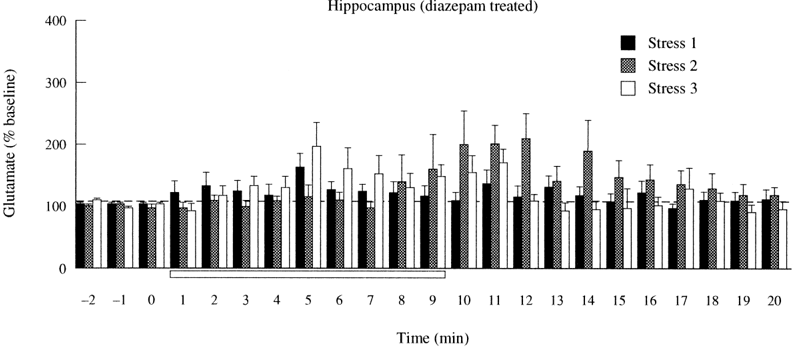
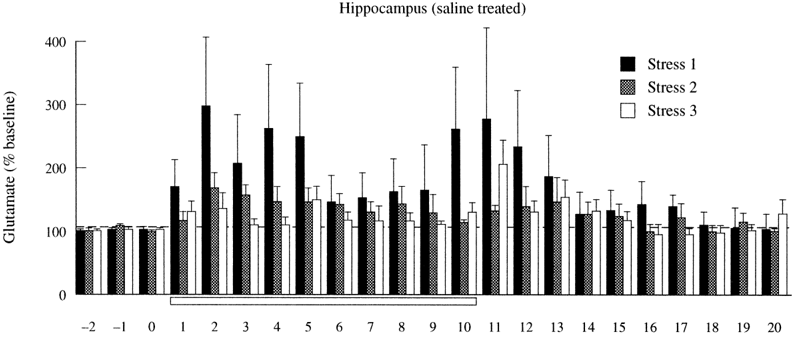
Acute stress has been associated with activation of glutamate efflux in forebrain structures. The present study sought to characterize the extracellular dynamics of glutamate in response to acute and repeated stress in the prefrontal cortex and hippocampus in rats. One-minute sampling of extracellular glutamate levels was performed during repeated tail-pinch stress. Animals were stressed three times, beginning at approximately 10.30 a.m. and continuing at 2.5-h intervals. In the prefrontal cortex, the initial 10-min tail pinch produced a robust increase in extracellular levels of glutamate. This increase was apparent immediately (i.e. 1 min) after the start of the stress procedure. The second tail pinch produced a smaller increase in glutamate levels while the third tail pinch did not significantly increase these levels. In the hippocampus, the initial stress response was smaller in magnitude than that observed in the prefrontal cortex. Furthermore, responses to subsequent tail pinches were similar to that seen following the first tail pinch. Treatment with diazepam (3 mg/kg/i.p.) 30 min before the first stress session abolished the stress response in the prefrontal cortex and hippocampus. However, in the prefrontal cortex, the second tail pinch (performed approximately 3 h after diazepam administration) produced a robust increase in glutamate efflux. In contrast, in the hippocampus of diazepam-treated rats, the second tail pinch produced a small delayed response. Pretreatment with saline resulted in non-significant responses to all three tail pinches in the prefrontal cortex. The present study suggests that: (i) stress produces a rapid increase in glutamate efflux in the prefrontal cortex and hippocampus, (ii) repeated stress reveals tolerance in the glutamatergic response in the prefrontal cortex, (iii) saline and diazepam pretreatment reduce the stress-induced efflux of glutamate in the prefrontal cortex, and (iv) exposure to diazepam may prevent the prefrontal cortex from adapting its response to the subsequent stressor. These finding are consistent with the role of the prefrontal cortex as a region which may regulate reactions to aversive stimuli.
Overview
The claims and statistics of this paper haven’t been checked yet.
Run the check — free, no account needed. It reads the open-access text and checks the sources it cites.
Integrity signals
Registry
Cites
Statistics
Figures
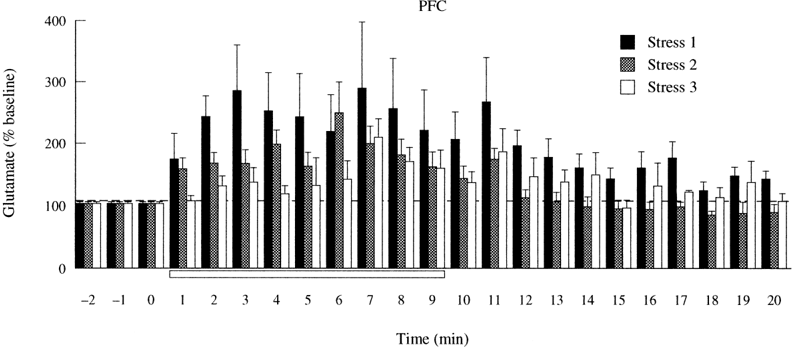
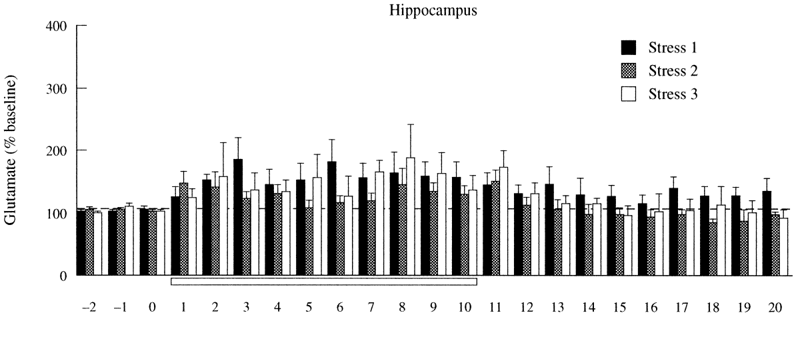
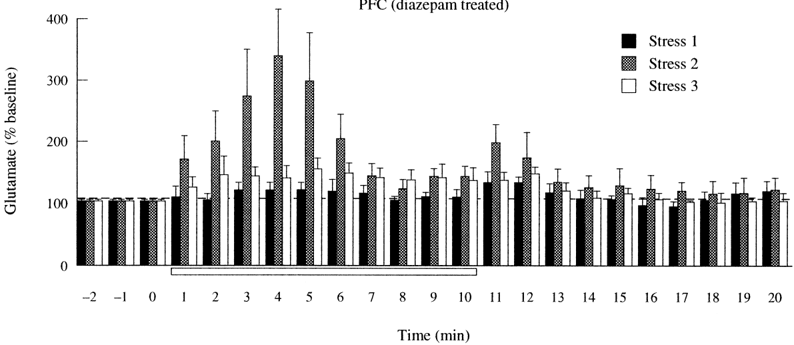
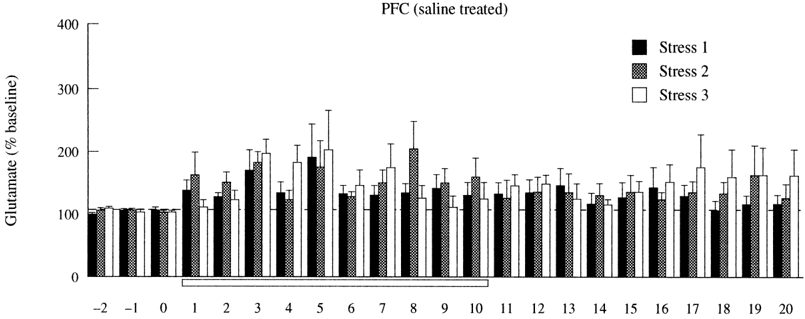
Verification
Claims the paper makes
The claims and statistics of this paper haven’t been checked yet.
Run the check — free, no account needed. It reads the open-access text and checks the sources it cites.
Claims other papers make about this one
Each is checked against this paper’s own text: does it say what the citing paper says it does?
In the citing paper
“The activational period, identified by the “1A” and “1B” in Figure 3, involves a stress-induced increase in glutamatergic transmission and activation of AMPA and NMDA receptors (Bagley and Moghaddam [243]; Venero and Borrell [244]; McEwen et al. [245]; Kole et al. [246]).”
From The Temporal Dynamics Model of Emotional Memory Processing: A Synthesis on the Neurobiological Basis of Stress-Induced Amnesia, Flashbulb and Traumatic Memories, and the Yerkes-Dodson Law (2007) · cites this paper as Bagley and Moghaddam [243]
Self-check
Percentages, sums and reported differences re-computed from the paper’s own numbers.
The self-check needs the paper’s full text.
Citations
Cites
The Rat Brain in Stereotaxic Coordinates
Paxinos, G., & Watson, C. (1983) · Elsevier eBooks · doi:10.1016/c2009-0-63235-9 · Cited by 28,585
Implications of Normal Brain Development for the Pathogenesis of Schizophrenia
Weinberger, D. R. (1987) · Archives of General Psychiatry · doi:10.1001/archpsyc.1987.01800190080012 · Cited by 3,724
Benveniste, H., Drejer, J., Schousboe, A., & Diemer, N. H. (1984) · Journal of Neurochemistry · doi:10.1111/j.1471-4159.1984.tb05396.x · Cited by 2,863
The Prefrontal Cortex: Anatomy, Physiology, and Neuropsychology of the Frontal Lobe
Fuster, J. M. (1980) · Cited by 2,367
Fuster, J. M. (1997) · Cited by 2,095
Circuitry of Primate Prefrontal Cortex and Regulation of Behavior by Representational Memory
Goldman‐Rakic, P. S. (1987) · Comprehensive Physiology · doi:10.1002/cphy.cp010509 · Cited by 1,960
Lindroth, P., & Mopper, K. (1979) · Analytical Chemistry · doi:10.1021/ac50047a019 · Cited by 1,838
Blockade of N -Methyl-D-Aspartate Receptors May Protect Against Ischemic Damage in the Brain
Simon, R. P., Swan, J. H., Griffiths, T., & Meldrum, B. S. (1984) · Science · doi:10.1126/science.6093256 · Cited by 1,682
DAMASIO, A. (1990) · Behavioural Brain Research · doi:10.1016/0166-4328(90)90144-4 · Cited by 1,275
Stress induces atrophy of apical dendrites of hippocampal CA3 pyramidal neurons
Watanabe, Y., Gould, E., & McEwen, B. S. (1992) · Brain Research · doi:10.1016/0006-8993(92)91597-8 · Cited by 1,212
Research works printed but not linked: 1
- Olsen, 1990, Molecular biology GABAA receptor, Fedn Am. Socs exp. Biol. J., 6, 2311
Cited by
Sorted by citations
Stress, Depression, and Neuroplasticity: A Convergence of Mechanisms
Pittenger, C., & Duman, R. S. (2008) · Neuropsychopharmacology · doi:10.1038/sj.npp.1301574 · Cited by 1,795
The stressed synapse: the impact of stress and glucocorticoids on glutamate transmission
Popoli, M., Yan, Z., McEwen, B. S., & Sanacora, G. (2012) · Nature Reviews Neuroscience · doi:10.1038/nrn3138 · Cited by 1,393
Towards a glutamate hypothesis of depression
Sanacora, G., Treccani, G., & Popoli, M. (2012) · Neuropharmacology · doi:10.1016/j.neuropharm.2011.07.036 · Cited by 1,036
The Semantics of Microglia Activation: Neuroinflammation, Homeostasis, and Stress
Woodburn, S. C., Bollinger, J. L., & Wohleb, E. S. (2021) · Journal of Neuroinflammation · doi:10.1186/s12974-021-02309-6 · Cited by 783
Diamond, D. M., Campbell, A. M., Park, C. R., Halonen, J., & Zoladz, P. R. (2007) · Neural Plasticity · doi:10.1155/2007/60803 · Cited by 762
“Foolish behavior, such as poor decision making, is well known to occur when frontal cortex functioning is impaired as a result of damage (Bechara et al. [390]; Bechara [374]; Bechara [375]) or acute stress (Arnsten and Goldman-Rakic [391]; Arnsten [392]; Arnsten [393]; Gray [394]; Mor-row et al. [395]; Arnsten [396];…”
BackgroundChiba, S., Numakawa, T., Ninomiya, M., Richards, M. C., Wakabayashi, C., & Kunugi, H. (2012) · Progress in Neuro-Psychopharmacology and Biological Psychiatry · doi:10.1016/j.pnpbp.2012.05.018 · Cited by 673
The prefrontal cortex as a key target of the maladaptive response to stress
Cerqueira, J. J., Mailliet, F., Almeida, O. F. X., Jay, T. M., & Sousa, N. (2007) · The Journal of Neuroscience · doi:10.1523/jneurosci.4372-06.2007 · Cited by 599
Wellman, C. L. (2001) · Journal of Neurobiology · doi:10.1002/neu.1079 · Cited by 594
Millan, M. J. (2006) · Pharmacology & Therapeutics · doi:10.1016/j.pharmthera.2005.11.006 · Cited by 569
Stress, memory, and the hippocampus: can't live with it, can't live without it
LUPIEN, S. J., & Lepage, M. (2001) · Behavioural Brain Research · doi:10.1016/s0166-4328(01)00361-8 · Cited by 522
Pharmacology and behavioral pharmacology of the mesocortical dopamine system
Tzschentke, T. M. (2001) · Progress in Neurobiology · doi:10.1016/s0301-0082(00)00033-2 · Cited by 481
Lorrain, D. S., Baccei, C. S., Bristow, L. J., Anderson, J. J., & Varney, M. A. (2003) · Neuroscience · doi:10.1016/s0306-4522(02)00652-8 · Cited by 432
McEwen, B. S., Chattarji, S., Diamond, D. M., Jay, T. M., Reagan, L. P., Svenningsson, P., & Fuchs, E. (2010) · Molecular Psychiatry · doi:10.1038/mp.2009.80 · Cited by 406
Moghaddam, B. (2002) · Biological Psychiatry · doi:10.1016/s0006-3223(01)01362-2 · Cited by 392
Self-citationIwata, M., Ota, K. T., Li, X.-Y., Sakaue, F., Li, N., Dutheil, S., Banasr, M., Duric, V., Yamanashi, T., Kaneko, K., et al. (2016) · Biological Psychiatry · doi:10.1016/j.biopsych.2015.11.026 · Cited by 387
Frodl, T., Reinhold, E., Koutsouleris, N., Reiser, M., & Meisenzahl, E. M. (2010) · Journal of Psychiatric Research · doi:10.1016/j.jpsychires.2010.01.006 · Cited by 323
Myers, B., McKlveen, J. M., & Herman, J. P. (2014) · Frontiers in Neuroendocrinology · doi:10.1016/j.yfrne.2013.12.003 · Cited by 318
Zoladz, P. R., & Diamond, D. M. (2013) · Neuroscience & Biobehavioral Reviews · doi:10.1016/j.neubiorev.2013.03.024 · Cited by 339
Musazzi, L., Milanese, M., Farisello, P., Zappettini, S., Tardito, D., Barbiero, V. S., Bonifacino, T., Mallei, A., Baldelli, P., Racagni, G., et al. (2010) · PLoS ONE · doi:10.1371/journal.pone.0008566 · Cited by 299
Venero, C., & Borrell, J. (1999) · European Journal of Neuroscience · doi:10.1046/j.1460-9568.1999.00668.x · Cited by 277
Discovering imaging endophenotypes for major depression
Hasler, G., & Northoff, G. (2011) · Molecular Psychiatry · doi:10.1038/mp.2011.23 · Cited by 274
Nasca, C., Xenos, D., Barone, Y., Caruso, A., Scaccianoce, S., Matrisciano, F., Battaglia, G., Mathé, A. A., Pittaluga, A., Lionetto, L., et al. (2013) · Proceedings of the National Academy of Sciences · doi:10.1073/pnas.1216100110 · Cited by 268
Stress, neurotransmitters, corticosterone and body–brain integration
Mora, F., Segovia, G., del Arco, A., de Blas, M., & Garrido, P. (2012) · Brain Research · doi:10.1016/j.brainres.2011.12.049 · Cited by 253
Amygdala Regulation of Nucleus Accumbens Dopamine Output is Governed by the Prefrontal Cortex
Jackson, M., & Moghaddam, B. (2001) · Journal of Neuroscience · doi:10.1523/jneurosci.21-02-00676.2001 · Cited by 246
Self-citationSelective prefrontal cortex inputs to dopamine cells: implications for schizophrenia
Sesack, S. R., & CARR, D. (2002) · Physiology & Behavior · doi:10.1016/s0031-9384(02)00931-9 · Cited by 238
Innovative approaches for the development of antidepressant drugs: Current and future strategies
Schechter, L. E., Ring, R. H., Beyer, C. E., Hughes, Z. A., Khawaja, X. Z., Malberg, J. E., & Rosenzweig-Lipson, S. J. (2005) · NeuroRx · doi:10.1602/neurorx.2.4.590 · Cited by 231
Chronic stress impairs recall of extinction of conditioned fear
Miracle, A. D., BRACE, M., HUYCK, K., SINGLER, S., & Wellman, C. L. (2005) · Neurobiology of Learning and Memory · doi:10.1016/j.nlm.2005.10.005 · Cited by 230
Reznikov, L. R., Grillo, C. A., Piroli, G. G., Pasumarthi, R. K., Reagan, L. P., & Fadel, J. R. (2007) · European Journal of Neuroscience · doi:10.1111/j.1460-9568.2007.05560.x · Cited by 211
The stressed synapse 2.0: pathophysiological mechanisms in stress-related neuropsychiatric disorders
Sanacora, G., Yan, Z., & Popoli, M. (2022) · Nature Reviews Neuroscience · doi:10.1038/s41583-021-00540-x · Cited by 197
The Cognitive Neuroscience of Development
de Haan, M., & Johnson, M. (2005) · Psychology Press eBooks · doi:10.4324/9780203989395 · Cited by 193
Cellular and molecular mechanisms in the long-term action of antidepressants.
Racagni, G., & Popoli, M. (2008) · Dialogues in Clinical Neuroscience · doi:10.31887/dcns.2008.10.4/gracagni · Cited by 192
Pham, T. H., & Gardier, A. M. (2019) · Pharmacology & Therapeutics · doi:10.1016/j.pharmthera.2019.02.017 · Cited by 186
Musazzi, L., Treccani, G., Mallei, A., & Popoli, M. (2012) · Biological Psychiatry · doi:10.1016/j.biopsych.2012.11.009 · Cited by 178
Clinical Studies Implementing Glutamate Neurotransmission in Mood Disorders
Sanacora, G., Rothman, D. L., Mason, G. F., & Krystal, J. H. (2003) · Annals of the New York Academy of Sciences · doi:10.1196/annals.1300.018 · Cited by 158
GABA and glutamate systems as therapeutic targets in depression and mood disorders
Kendell, S. F., Krystal, J. H., & Sanacora, G. (2005) · Expert Opinion on Therapeutic Targets · doi:10.1517/14728222.9.1.153 · Cited by 154
Detrimental effects of chronic hypothalamic—pituitary—adrenal axis activation
Raber, J. (1998) · Molecular Neurobiology · doi:10.1007/bf02741457 · Cited by 154
Novel Aspects of Glucocorticoid Actions
Uchôa, E. T., Aguilera, G., Herman, J. P., Fiedler, J. L., Deak, T., & de Sousa, M. B. C. (2014) · Journal of Neuroendocrinology · doi:10.1111/jne.12157 · Cited by 150
The role of glutamate on the action of antidepressants
Hashimoto, K. (2010) · Progress in Neuro-Psychopharmacology and Biological Psychiatry · doi:10.1016/j.pnpbp.2010.06.013 · Cited by 157
Hascup, E. R., Pomerleau, F., Huettl, P. F., Strömberg, I., & Gerhardt, G. A. (2007) · Journal of Neurochemistry · doi:10.1111/j.1471-4159.2007.04596.x · Cited by 146
Are BDNF and glucocorticoid activities calibrated?
Jeanneteau, F. D., & Chao, M. V. (2012) · Neuroscience · doi:10.1016/j.neuroscience.2012.09.017 · Cited by 150
NMDA Receptor Blockade Alters Stress-Induced Dendritic Remodeling in Medial Prefrontal Cortex
Martin, K. P., & Wellman, C. L. (2011) · Cerebral Cortex · doi:10.1093/cercor/bhr021 · Cited by 138
Brake, W. G., Flores, G., Francis, D. D., Meaney, M. J., Srivastava, L. K., & Gratton, A. P. (2000) · Neuroscience · doi:10.1016/s0306-4522(00)00002-6 · Cited by 138
Treccani, G., Musazzi, L., Perego, C., Milanese, M., Nava, N., Bonifacino, T., Lamanna, J., Malgaroli, A., Drago, F., Racagni, G., et al. (2014) · Molecular Psychiatry · doi:10.1038/mp.2014.5 · Cited by 133
Synaptic Plasticity, Metaplasticity and Depression
Vose, L. R., & Stanton, P. K. (2016) · Current Neuropharmacology · doi:10.2174/1570159x14666160202121111 · Cited by 131
Antiepileptic drug effects on mood and behavior: Molecular targets
Perucca, P., & Mula, M. (2012) · Epilepsy & Behavior · doi:10.1016/j.yebeh.2012.09.018 · Cited by 127
Diamond, D. M., Park, C. R., Campbell, A. M., & Woodson, J. C. (2005) · Hippocampus · doi:10.1002/hipo.20107 · Cited by 128
Sandi, C., Woodson, J. C., Haynes, V. F., Park, C. R., Touyarot, K., Lopez-Fernandez, M. A., Venero, C., & Diamond, D. M. (2005) · Biological Psychiatry · doi:10.1016/j.biopsych.2004.12.034 · Cited by 122
Bonne, O. B., Grillon, C., Vythilingam, M., Neumeister, A., & Charney, D. S. (2004) · Neuroscience & Biobehavioral Reviews · doi:10.1016/j.neubiorev.2003.12.001 · Cited by 128
Animal models in translational studies of PTSD
Daskalakis, N. P., Yehuda, R., & Diamond, D. M. (2013) · Psychoneuroendocrinology · doi:10.1016/j.psyneuen.2013.06.006 · Cited by 127
Hascup, E. R., Hascup, K. N., Humeidan, M., Pomerleau, F., Huettl, P. F., Gratton, A. P., & Gerhardt, G. A. (2010) · Journal of Neurochemistry · doi:10.1111/j.1471-4159.2010.07066.x · Cited by 116
Stress, glucocorticoids and glutamate release: Effects of antidepressant drugs
Musazzi, L., Racagni, G., & Popoli, M. (2011) · Neurochemistry International · doi:10.1016/j.neuint.2011.05.002 · Cited by 118
The As and Ds of stress: Metabolic, morphological and behavioral consequences
Reagan, L. P., Grillo, C. A., & Piroli, G. G. (2008) · European Journal of Pharmacology · doi:10.1016/j.ejphar.2008.02.050 · Cited by 113
McKlveen, J. M., Moloney, R. D., Scheimann, J. R., Myers, B., & Herman, J. P. (2019) · Biological Psychiatry · doi:10.1016/j.biopsych.2019.04.032 · Cited by 112
Madalena, K. M., & Lerch, J. K. (2017) · Neural Plasticity · doi:10.1155/2017/8640970 · Cited by 108
Astrocyte–neuron vulnerability to prenatal stress in the adult rat brain
Barros, V. G., Vega, M. D., Caltana, L. R., Brusco, A., & Antonelli, M. C. (2006) · Journal of Neuroscience Research · doi:10.1002/jnr.20758 · Cited by 103
Michael-Titus, A. T., Bains, S., Jeetle, J. K., & Whelpton, R. (2000) · Neuroscience · doi:10.1016/s0306-4522(00)00390-0 · Cited by 103
Acute or Chronic? A Stressful Question
Musazzi, L., Tornese, P., Sala, N., & Popoli, M. (2017) · Trends in Neurosciences · doi:10.1016/j.tins.2017.07.002 · Cited by 110
Woodburn, S. C., Bollinger, J. L., & Wohleb, E. S. (2021) · Neurobiology of Stress · doi:10.1016/j.ynstr.2021.100312 · Cited by 100
Jett, J. D., Bulin, S. E., Hatherall, L. C., McCartney, C. M., & Morilak, D. A. (2017) · Neuroscience · doi:10.1016/j.neuroscience.2017.01.017 · Cited by 92
Parmentier‐Batteur, S., Hutson, P. H., Menzel, K., Uslaner, J. M., Mattson, B. A., O’Brien, J. A., Magliaro, B. C., Forest, T. W., Stump, C. A., Tynebor, R. M., et al. (2013) · Neuropharmacology · doi:10.1016/j.neuropharm.2012.12.003 · Cited by 91
Neurobehavioral risk is associated with gestational exposure to stress hormones
Sandman, C. A., & Davis, E. P. (2012) · Expert Review of Endocrinology & Metabolism · doi:10.1586/eem.12.33 · Cited by 92
Gonzalez, L. E., Rojnik, B., Urrea, F., Urdaneta, H., Petrosino, P., Colasante, C., Pino, S., & Hernandez, L. (2006) · Behavioural Brain Research · doi:10.1016/j.bbr.2006.11.012 · Cited by 90
Harvey, B. H., & Shahid, M. (2011) · Pharmacology Biochemistry and Behavior · doi:10.1016/j.pbb.2011.06.014 · Cited by 90
Targeting glial physiology and glutamate cycling in the treatment of depression
Valentine, G. W., & Sanacora, G. (2009) · Biochemical Pharmacology · doi:10.1016/j.bcp.2009.04.008 · Cited by 87
Jaferi, A., & Bhatnagar, S. (2007) · Brain Research · doi:10.1016/j.brainres.2007.07.100 · Cited by 86
Kano, M., Muratsubaki, T., Oudenhove, L. V., Morishita, J., Yoshizawa, M., Kohno, K., Yagihashi, M., Tanaka, Y., Mugikura, S., Dupont, P. J., et al. (2017) · Scientific Reports · doi:10.1038/s41598-017-09635-x · Cited by 88
SC35 promotes sustainable stress-induced alternative splicing of neuronal acetylcholinesterase mRNA
Meshorer, E., Bryk, B., Toiber, D., Cohen, J. E., Podoly, E., Dori, A., & Soreq, H. (2005) · Molecular Psychiatry · doi:10.1038/sj.mp.4001735 · Cited by 84
Mascarucci, P., Perego, C., Terrazzino, S., & Simoni, M. G. D. (1998) · Neuroscience · doi:10.1016/s0306-4522(98)00105-5 · Cited by 83
Müller, H. K., Wegener, G., Popoli, M., & Elfving, B. (2011) · Brain Research · doi:10.1016/j.brainres.2011.02.048 · Cited by 80
Quintero, L., Cardenas, R., & Suárez-Roca, H. (2011) · Pain · doi:10.1016/j.pain.2011.04.017 · Cited by 78
Molteni, R., Lipska, B. K., Weinberger, D. R., Racagni, G., & Riva, M. A. (2001) · Molecular Psychiatry · doi:10.1038/sj.mp.4000865 · Cited by 75
Labrie, V., Clapcote, S. J., & Roder, J. (2008) · Pharmacology Biochemistry and Behavior · doi:10.1016/j.pbb.2008.09.016 · Cited by 73
Zoladz, P. R., Fleshner, M., & Diamond, D. M. (2013) · Progress in Neuro-Psychopharmacology and Biological Psychiatry · doi:10.1016/j.pnpbp.2013.01.001 · Cited by 79
Effect of stress on prefrontal cortex function
Moghaddam, B., & Jackson, M. (2004) · Neurotoxicity Research · doi:10.1007/bf03033299 · Cited by 73
Self-citationPadovan, C. M., Bel, E. A. D., & Guimarães, F. S. (2000) · Pharmacology Biochemistry and Behavior · doi:10.1016/s0091-3057(00)00361-0 · Cited by 72
Therapeutic Implications of the Hyperglutamatergic Effects of NMDA Antagonists
Krystal, J. H. (1999) · Neuropsychopharmacology · doi:10.1016/s0893-133x(99)00102-5 · Cited by 71
Drago, A., Crisafulli, C., Sidoti, A., & Serretti, A. (2011) · Progress in Neurobiology · doi:10.1016/j.pneurobio.2011.05.009 · Cited by 71
Marsden, W. N. (2011) · Medical Hypotheses · doi:10.1016/j.mehy.2011.06.021 · Cited by 64
Sandi, C., & Loscertales, M. (1999) · Brain Research · doi:10.1016/s0006-8993(99)01346-3 · Cited by 62
Ketamine regulates the presynaptic release machinery in the hippocampus
Müller, H. K., Wegener, G., Liebenberg, N., Zarate, C. A., Popoli, M., & Elfving, B. (2013) · Journal of Psychiatric Research · doi:10.1016/j.jpsychires.2013.03.008 · Cited by 61
McCormick, C. M., Lewis, E., Somley, B., & Kahan, T. A. (2007) · Physiology & Behavior · doi:10.1016/j.physbeh.2007.01.020 · Cited by 60
Timmerman, W., Cisci, G., Nap, A., Vries, J. B. D., & Westerink, B. H. C. (1999) · Brain Research · doi:10.1016/s0006-8993(99)01538-3 · Cited by 60
Wang, C., & Wang, S. (2009) · Synapse · doi:10.1002/syn.20654 · Cited by 61
Duncan, W. C., Ballard, E. D., & Zarate, C. A. (2017) · Handbook of Experimental Pharmacology · doi:10.1007/164_2017_51 · Cited by 58
Bambico, F. R., & Belzung, C. (2012) · Current topics in behavioral neurosciences · doi:10.1007/7854_2012_234 · Cited by 61
Poletti, S., Vai, B., Smeraldi, E., Cavallaro, R., Colombo, C., & Benedetti, F. (2015) · Journal of Affective Disorders · doi:10.1016/j.jad.2015.09.049 · Cited by 58
Molteni, R., Chourbaji, S., Brandwein, C., Racagni, G., Gass, P., & Riva, M. A. (2008) · Journal of Psychopharmacology · doi:10.1177/0269881108099815 · Cited by 57
Advances in the treatment of anxiety: Targeting glutamate
Simon, A. B., & Gorman, J. M. (2006) · NeuroRx · doi:10.1016/j.nurx.2005.12.005 · Cited by 58
Neuronal cytoskeletal alterations in an experimental model of depression
Reinés, A. G., Cereseto, M., Ferrero, A., Bonavita, C. D., & Wikinski, S. (2004) · Neuroscience · doi:10.1016/j.neuroscience.2004.08.026 · Cited by 52
Musazzi, L., Milanese, M., Farisello, P., Zappettini, S., Tardito, D., Barbiero, V. S., Bonifacino, T., Mallei, A., Baldelli, P., Racagni, G., et al. (2010) · PLoS ONE · doi:10.1371/annotation/101dd9d3-4e1b-4863-9473-bbfef49c9a1d · Cited by 53
Naylor, B., Hesam‐Shariati, N., McAuley, J. H., Boag, S., Newton-John, T. R. O., Rae, C. D., & Gustin, S. M. (2019) · Frontiers in Neurology · doi:10.3389/fneur.2019.01110 · Cited by 52
Negrón-Oyarzo, I., Pérez, M. Á., Terreros, G., Muñoz, P., & Dagnino‐Subiabre, A. (2013) · Behavioural Brain Research · doi:10.1016/j.bbr.2013.11.001 · Cited by 52
Guggenhuber, S., Parra, H. R., Bîndilă, L., Leschik, J., Lomazzo, E., Remmers, F., Zimmermann, T., Lerner, R., Klugmann, M., Pape, H., et al. (2015) · The International Journal of Neuropsychopharmacology · doi:10.1093/ijnp/pyv091 · Cited by 52
Farrell, M. R., Sayed, J. A., Underwood, A. R., & Wellman, C. L. (2010) · Neurobiology of Learning and Memory · doi:10.1016/j.nlm.2010.06.001 · Cited by 56
Ho, Y., Chang, Y.-C., Liu, T.-M., Tai, M.-Y., Wong, C., & Tsai, Y. (2000) · Neuroscience Letters · doi:10.1016/s0304-3940(00)01152-6 · Cited by 51
Barbiero, V. S., Giambelli, R., Musazzi, L., Tiraboschi, E., Tardito, D., Pérez, J., Drago, F., Racagni, G., & Popoli, M. (2007) · Neuropsychopharmacology · doi:10.1038/sj.npp.1301378 · Cited by 51
Interhemispheric Regulation of the Medial Prefrontal Cortical Glutamate Stress Response in Rats
Lupinsky, D., Moquin, L., & Gratton, A. P. (2010) · Journal of Neuroscience · doi:10.1523/jneurosci.1187-10.2010 · Cited by 49
Howells, F. M., & Russell, V. A. (2008) · Brain Research · doi:10.1016/j.brainres.2008.01.033 · Cited by 51
Reagan, L. P., Reznikov, L. R., Evans, A. N., Gabriel, C., Mocaër, E., & Fadel, J. R. (2012) · Brain Research · doi:10.1016/j.brainres.2012.05.039 · Cited by 51
Harte, M., & O'Connor, W. T. (2004) · Neuroscience · doi:10.1016/j.neuroscience.2004.08.045 · Cited by 47
Metadata
- Authors
- Bagley, J., & Moghaddam, B.
- Affiliations
- Yale University (US)
- Corresponding author
- Moghaddam, B
- ORCID
- Moghaddam, B
- Venue
- Neuroscience
- Publisher
- Elsevier BV
- Published
- 1997-01
- Volume
- 77
- Issue
- 1
- Pages
- 65-73
- ISSN
- 0306-4522 (ISSN-L)
- OpenAlex
- W2003983445
- Cited by
- 231
- References
- 45
- Citations by year
- 2026: 2 · 2025: 6 · 2024: 7 · 2023: 6 · 2022: 4 · 2021: 7 · 2020: 6 · 2019: 7 · 2018: 5 · 2017: 13 · 2016: 7 · 2015: 11 · 2014: 16 · 2013: 12 · 2012: 17
- FWCI
- 3.22
- Type
- journal article
- Language
- en
- Open access
- hybrid
- doi.org
- Licence
- Locations
- Neuroscience (publishedVersion, cc-by-nc-nd)
- PubMed (publishedVersion)
- Funders
- U.S. Public Health Service (44866)
- National Institute of Mental Health (MH 44866, MH48404, P50MH044866)
- Topics
- Life Sciences › Neuroscience › Behavioral Neuroscience › Stress Responses and Cortisol
- Life Sciences › Neuroscience › Cellular and Molecular Neuroscience › Neuroscience and Neuropharmacology Research
- Life Sciences › Neuroscience › Cellular and Molecular Neuroscience › Neurotransmitter Receptor Influence on Behavior
- Keywords
- glutamate efflux, repeated stress, prefrontal cortex, hippocampus, diazepam, stress tolerance, stress adaptation, aversive stimuli
- MeSH terms
- Animals, Diazepam, Hippocampus, Male, Sodium Chloride, Stress, Physiological, Time Factors, Rats, Sprague-Dawley, Prefrontal Cortex, Microdialysis, Glutamic Acid, GABA Modulators, Rats
About these checks
Registry, retraction, Cites and statistics results are computed, not judged, with one exception: a printed reference that no index lists is read once by a model before it counts as a citation error. Claims are extracted by a model and kept only when their quote appears verbatim in the text; each cited source is then checked, with a model’s help, for whether it says what the claim relies on. Those verdicts can be wrong — read the claim’s quote and the cited source before relying on one.
Statistics and arithmetic are recomputed, not judged.
Confidence bands are shown only for fields calibrated on our annotated test set. None is calibrated yet, so no band is shown.
What counts as a claim ›How we measure confidence ›How we check this ›
Are you an author, or do you see a problem with this page? Request a review
