

The DOI matches its Crossref record; 27 of the 29 references it cites were found in a registry or an index.
Vaccine efficacy against persistent human papillomavirus (HPV) 16/18 infection at 10 years after one, two, and three doses of quadrivalent HPV vaccine in girls in India: a multicentre, prospective, cohort study
Open accessAbstract
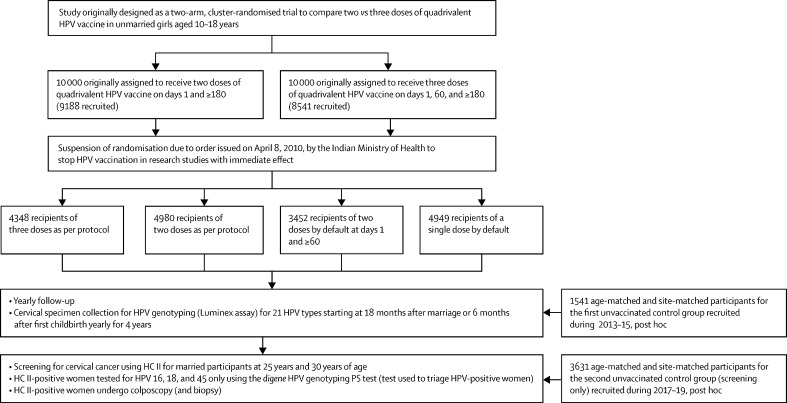
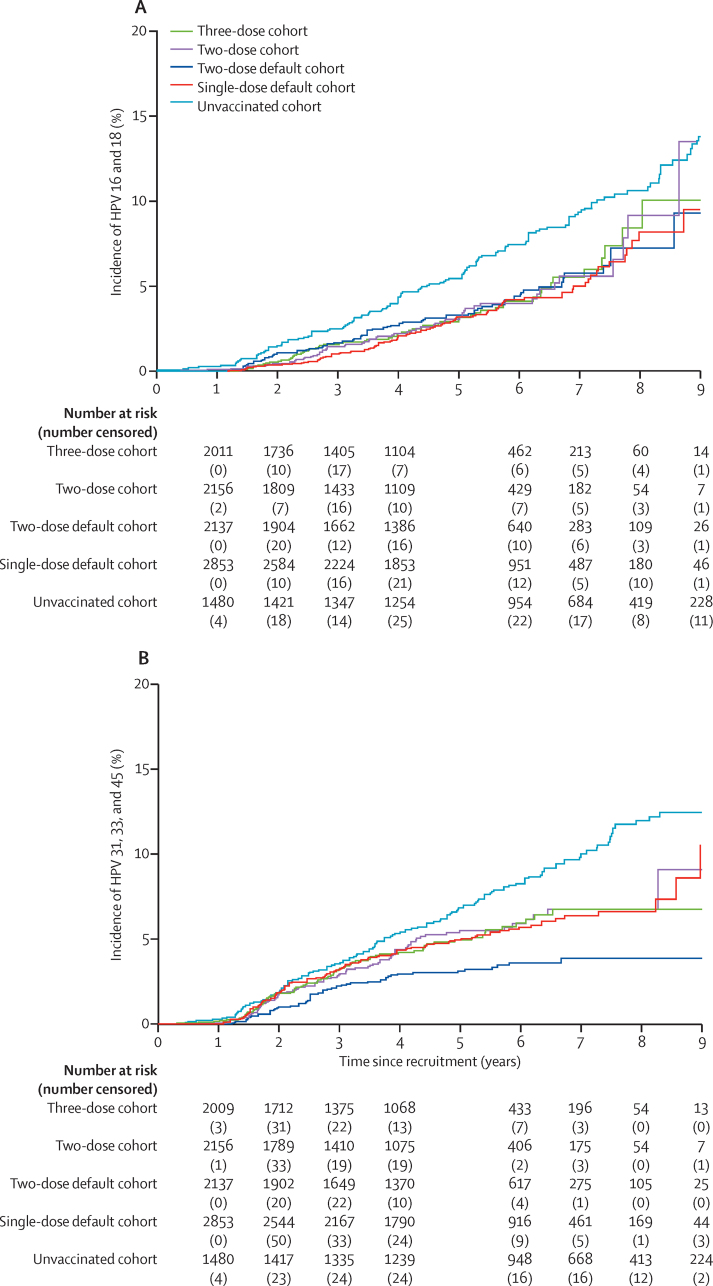
BACKGROUND: A randomised trial designed to compare three and two doses of quadrivalent human papillomavirus (HPV) vaccine in adolescent girls in India was converted to a cohort study after suspension of HPV vaccination in trials by the Indian Government. In this Article, the revised aim of the cohort study was to compare vaccine efficacy of single dose to that of three and two doses in protecting against persistent HPV 16 and 18 infection at 10 years post vaccination. METHODS: In the randomised trial, unmarried girls aged 10-18 years were recruited from nine centres across India and randomly assigned to either two doses or three doses of the quadrivalent HPV vaccine (Gardasil [Merck Sharp & Dohme, Whitehouse Station, NJ, USA]; 0·5 mL administered intramuscularly). After suspension of recruitment and vaccination, the study became a longitudinal, prospective cohort study by default, and participants were allocated to four cohorts on the basis of the number vaccine doses received per protocol: the two-dose cohort (received vaccine on days 1 and 180 or later), three-dose cohort (days 1, 60, and 180 or later), two-dose default cohort (days 1 and 60 or later), and the single-dose default cohort. Participants were followed up yearly. Cervical specimens were collected from participants 18 months after marriage or 6 months after first childbirth, whichever was earlier, to assess incident and persistent HPV infections. Married participants were screened for cervical cancer as they reached 25 years of age. Unvaccinated women age-matched to the married vaccinated participants were recruited to serve as controls. Vaccine efficacy against persistent HPV 16 and 18 infections (the primary endpoint) was analysed for single-dose recipients and compared with that in two-dose and three-dose recipients after adjusting for imbalance in the distribution of potential confounders between the unvaccinated and vaccinated cohorts. This trial is registered with ISRCTN, ISRCTN98283094, and ClinicalTrials.gov, NCT00923702. FINDINGS: Vaccinated participants were recruited between Sept 1, 2009, and April 8, 2010 (date of vaccination suspension), and followed up over a median duration of 9·0 years (IQR 8·2-9·6). 4348 participants had three doses, 4980 had two doses (0 and 6 months), and 4949 had a single dose. Vaccine efficacy against persistent HPV 16 and 18 infection among participants evaluable for the endpoint was 95·4% (95% CI 85·0-99·9) in the single-dose default cohort (2135 women assessed), 93·1% (77·3-99·8) in the two-dose cohort (1452 women assessed), and 93·3% (77·5-99·7) in three-dose recipients (1460 women assessed). INTERPRETATION: A single dose of HPV vaccine provides similar protection against persistent infection from HPV 16 and 18, the genotypes responsible for nearly 70% of cervical cancers, to that provided by two or three doses. FUNDING: Bill & Melinda Gates Foundation.
Overview
The claims and statistics of this paper haven’t been checked yet.
Run the check — free, no account needed. It reads the open-access text and checks the sources it cites.
Integrity signals
Registry
Cites
Statistics
Figures
Verification
Claims the paper makes
The claims and statistics of this paper haven’t been checked yet.
Run the check — free, no account needed. It reads the open-access text and checks the sources it cites.
Claims other papers make about this one
Each is checked against this paper’s own text: does it say what the citing paper says it does?
The source backs part of the claim, not all of it — or backs it for a different population, condition or comparison.
In the citing paper
“Notably, the IARC India trial with a quadrivalent vaccine, and the Costa Rica Trial with a bivalent vaccine, have shown comparable efficacy between single-dose and multi-dose schedules, with sustained antibody levels for at least 11 years after vaccination.”
From Evidence-based impact projections of single-dose human papillomavirus vaccination in India: a modelling study (2022) · cites this paper as [11]
Experimental — accuracy not yet measuredThe cited source says what the claim attributes to it.
In the citing paper
“which currently provides the best data on single-dose protection because of its long follow-up and near-random assignment of participants to different dose schedules.10, 11”
From Evidence-based impact projections of single-dose human papillomavirus vaccination in India: a modelling study (2022) · cites this paper as [11]
The check wasn’t confident either way, so it gives no verdict — never disputed.
In the citing paper
“The titles and abstracts of all retrieved records were independently screened by two reviewers (KJ and RRD) using pre-defined inclusion and exclusion criteria on the Rayyan web-based systematic review platform8.”
From Barriers to HPV vaccination among adolescent girls in India: A scoping review (2026) · cites this paper as [8]
Experimental — accuracy not yet measured
Self-check
Percentages, sums and reported differences re-computed from the paper’s own numbers.
The self-check needs the paper’s full text.
Citations
Cites
Vaccine delivery: a matter of size, geometry, kinetics and molecular patterns
Bachmann, M. F., & Jennings, G. T. (2010) · Nature reviews. Immunology · doi:10.1038/nri2868 · Cited by 2,120
Presentation of multivariate data for clinical use: The Framingham Study risk score functions
SULLIVAN, L. M., Massaro, J. M., & D’Agostino, R. B. (2004) · Statistics in Medicine · doi:10.1002/sim.1742 · Cited by 1,756
Epidemiologic Analysis with a Programmable Calculator
Rothman, K. J., Boice, H. D., & Austin, H. D. (1982) · American Journal of Epidemiology · Cited by 1,039
Brisson, M., Kim, J. J., Canfell, K., Drolet, M., Gingras, G., Burger, E. A., Martin, D., Simms, K. T., Bénard, É., Boily, M.-C., et al. (2020) · The Lancet · doi:10.1016/s0140-6736(20)30068-4 · Cited by 943
Bruni, L., Saura‐Lázaro, A., Montoliu, A., Brotons, M., Alemany, L., Diallo, M., Afsar, O. Z., LaMontagne, D. S., Mosina, L., Contreras, M., et al. (2020) · Preventive Medicine · doi:10.1016/j.ypmed.2020.106399 · Cited by 767
Kreimer, A. R., Struyf, F., Rosario‐Raymundo, M. R. D., Hildesheim, A., Skinner, S. R., Wacholder, S., Garland, S. M., Herrero, R., David, M., & Wheeler, C. M. (2015) · The Lancet Oncology · doi:10.1016/s1470-2045(15)00047-9 · Cited by 316
Sankaranarayanan, R., Prabhu, P. R., Pawlita, M., Gheit, T., Bhatla, N., Muwonge, R., Nene, B. M., Esmy, P. O., Joshi, S., Poli, U. R. R., et al. (2016) · The Lancet Oncology · doi:10.1016/s1470-2045(15)00414-3 · Cited by 242
Self-citationEvaluation of Durability of a Single Dose of the Bivalent HPV Vaccine: The CVT Trial
Kreimer, A. R., Sampson, J. N., Porras, C., Schiller, J. T., Kemp, T. J., Herrero, R., Wagner, S. A., Boland, J. F., Schussler, J. E., Lowy, D. R., et al. (2020) · JNCI Journal of the National Cancer Institute · doi:10.1093/jnci/djaa011 · Cited by 220
In Vivo Mechanisms of Vaccine-Induced Protection against HPV Infection
Day, P. M., Kines, R. C., Thompson, C. D., Jagu, S., Roden, R. B. S., Lowy, D. R., & Schiller, J. T. (2010) · Cell Host & Microbe · doi:10.1016/j.chom.2010.08.003 · Cited by 171
Sankaranarayanan, R., Joshi, S., Muwonge, R., Esmy, P. O., Basu, P., Prabhu, P., Bhatla, N., Nene, B. M., Shaw, J., Poli, U. R. R., et al. (2018) · Vaccine · doi:10.1016/j.vaccine.2018.02.087 · Cited by 164
Self-citation
Cited by
Sorted by citations
Items 201–272 of 272
Impfprävention HPV-assoziierter Neoplasien
Wieland, U., & Kreuter, A. (2022) · Forum · doi:10.1007/s12312-022-01063-x
Koczkodaj, P., Dillner, J., & Mańczuk, M. (2022) · Nowotwory Journal of Oncology · doi:10.5603/njo.a2021.0078
Vaccins et vaccination contre les papillomavirus
Coursaget, P., & Touzé, A. (2022) · Revue Francophone des Laboratoires · doi:10.1016/s1773-035x(22)00100-9
Baisley, K. J., Kemp, T. J., Kreimer, A. R., Basu, P. S., Changalucha, J. M., Hildesheim, A., Porras, C., Whitworth, H. S., Herrero, R., Lacey, C. J., et al. (2022) · SSRN Electronic Journal · doi:10.2139/ssrn.4055428
Self-citationAn update from the HPV specialist interest group on behalf of BASHH
Bayley, J., & Nugent, D. (2022) · Sexually Transmitted Infections · doi:10.1136/sextrans-2022-055493
HPV-Impfung: eine Dosis genauso wirksam wie 2- bzw. 3-Dosis-Schema
Lorenz, J. (2022) · Onkologie up2date · doi:10.1055/a-1804-4030
Human papillomavirus infection
Das, S., Khan, S., Shamshad, M. F., Shingadia, H. U., Jaganathan, R., Ali, S. R., & Choudhary, A. (2022) · International Journal of Health Sciences · doi:10.53730/ijhs.v6ns8.12634
Cobertura projetada para 2030: É hora de resgatar a vacina contra o HPV nas mulheres brasileiras?
Graça, A. D. V., & Soares, L. C. (2022) · Research Society and Development · doi:10.33448/rsd-v11i16.38265
HPV-Impfung bei Kindern, Jugendlichen und jungen Erwachsenen
Wieland, U. (2023) · Kinder- und Jugendmedizin · doi:10.1055/a-2089-0722
Muwonge, R., & Basu, P. S. (2023) · Vaccine · doi:10.1016/j.vaccine.2023.06.030
Self-citationA call for switching to a 1-dose 9vHPV national vaccination program in Ethiopia
Gelanew, T. I., Wondwossen, L., Mihret, A., & Mulu, A. (2023) · Frontiers in Public Health · doi:10.3389/fpubh.2023.1211894
HPV-Impfung: neue Daten und Indikation in der Sekundärprävention
Wieland, U., & Hampl, M. (2023) · Die Gynäkologie · doi:10.1007/s00129-023-05164-z
Fifteen years of vaccination against the human papilloma virus in Spain. An update
Llop, F. A. M. (2023) · Vacunas (English Edition) · doi:10.1016/j.vacune.2023.10.001
Zervixkarzinomprävention durch HPV-Impfung und Früherkennung
Hillemanns, P., Denecke, A., Hachenberg, J., STEINKASSERER, L., & Jentschke, M. (2023) · Die Gynäkologie · doi:10.1007/s00129-023-05162-1
ANALYSIS OF HUMAN PAPILLOMA VIRUS INFECTION IN THE POPULATION OF THE REPUBLIC OF MORDOVIA
Kostina, Y. A., Puzakova, D. V., Syrkina, M. G., Matveeva, L. V., Kopylova, O. V., Savkina, N. V., & Donik, D. A. (2023) · Современные проблемы науки и образования · doi:10.17513/spno.33080
1179 Risk of recurrent spontaneous preterm birth among those with persistent cervical HPV infection
Weng, J., Li, Y., Jordan, D., Shahi, M., Norgan, A. P., Enninga, E. A. L., Long, M. E., & Larish, A. (2024) · American Journal of Obstetrics and Gynecology · doi:10.1016/j.ajog.2023.11.1203
Sanjay, M., Narendranath, R., Seetharaman, N., Naidu, D., & Mohan Kumar, M. (2024) · Research Square · doi:10.21203/rs.3.rs-4223456/v1
Watson-Jones, D., Changalucha, J. M., Maxwell, C. A., Whitworth, H. S., Mutani, P., Kemp, T. J., Kamala, B., Indangasi, J., Constantine, G., Hashim, R., et al. (2024) · SSRN Electronic Journal · doi:10.2139/ssrn.4802675
Montroy, J. R., Salvadori, M. I., Forbes, N. E., Dubey, V., Almasri, S., Jirovec, A., Yan, C., Gusić, K., Stevens, A., Young, K., et al. (2024) · Relevé des maladies transmissibles au Canada · doi:10.14745/ccdr.v50i06a01f
Hu, X., Chen, Y., Lin, W., Ruan, Q., Chen, H., Li, X., Deng, Y., Liang, C., Lin, H., Zeng, L., et al. (2024) · Journal of Medical Virology · doi:10.1002/jmv.29910
TvAP65 in Trichomonas vaginalis Promotes HPV Infection by Interacting with Host MoleculesPreprint
Mei, X., Sheng, W., Zhang, Y., Tian, W., Tian, X., Yang, Z., Wang, S., & Zhang, Z. (2024) · bioRxiv (Cold Spring Harbor Laboratory) · doi:10.1101/2024.09.27.615334
Agbenyega, T., Schuind, A., Adjei, S., Antony, K., Aponte, J. J., Buabeng, P. B. Y., Clemens, J. D., Hossain, L., Kemp, T. J., Mercer, L. D., et al. (2024) · SSRN Electronic Journal · doi:10.2139/ssrn.5012902
Self-testing for human papillomavirus as a screening method for identifying risk groups
Александровна, Г. Т., Levakov, S. A., & Мушкюрова, Д. Р. (2024) · Clinical Medicine (Russian Journal) · doi:10.30629/0023-2149-2024-102-5-6-415-421
Pious, T., John, A., R, R. V., & Idikula, M. J. (2025) · medRxiv · doi:10.1101/2025.02.24.25322810
Cadilla, A., Sande, L., & Alexander, K. A. (2025) · Elsevier eBooks · doi:10.1016/b978-0-323-82763-8.00155-2
Racial and gender disparities in HPV vaccination: Implications for reducing head and neck cancer
Ogbutor, K., McMillan, E., Ramkissoon, N., Elkomi, R., Monroe, D., Zinabu, S., Ali, A., Gasmelseed, H. I., & Michael, M. B. (2025) · Journal of the National Medical Association · doi:10.1016/j.jnma.2025.07.001
Bashorun, A. O., Kotei, L., Jallow, A. F., Jawla, O., Richard-Ugwuadu, E. U., Jagana, M., Bah, L., Bah, A. T., Conteh, K., Jallow, M. S. K., et al. (2025) · PLoS ONE · doi:10.1371/journal.pone.0332842
Middeldorp, M., Donken, R., Nirmal, A., Smith, B., Marquez, A. C., Bettinger, J. A., Brisson, M., Burchell, A. N., Dobson, S. R. M., Dawar, M., et al. (2025) · BMJ Open · doi:10.1136/bmjopen-2025-100560
Gupta, S., Basu, S., & Banerjee, R. (2024) · The Evidence · doi:10.61505/evidence.2024.2.2.71
Mei, X., Sheng, W., Zhang, Y., Tian, W., Tian, X., Yang, Z., Wang, S., & Zhang, Z. (2025) · Infectious Diseases of Poverty · doi:10.1186/s40249-025-01381-x
Human papillomavirus infection and vaccination among young females in rural Uganda
Newton, R., Tenet, V., Mugisha, J. O., Kimono, B., Vorsters, A., Bell, M., & Clifford, G. M. (2025) · International Journal of Cancer · doi:10.1002/ijc.70227
Mandziuk, A., Mandziuk, M., Roczek, D., Skutta, A., Kozerska, N., Młocek, A., Jankowska, A., Mandziuk, M., & Białas, A. (2025) · International Journal of Innovative Technologies in Social Science · doi:10.31435/ijitss.4(48).2025.4024
Memory B-cells elicited by different HPV vaccine regimens in the DoRIS randomised controlled trial
Wiggins, R. C., Baisley, K. J., Indangasi, J., Changalucha, J. M., Ashwin, H. M., Brown, N., Whitworth, H. S., Joakim, D., Mayaud, P., Hashim, R., et al. (2025) · npj Vaccines · doi:10.1038/s41541-025-01313-8
M., N. K. V., Yadavannavar, M. C., Pattankar, T. P., & Rangoli, A. M. (2025) · International Journal of Community Medicine and Public Health · doi:10.18203/2394-6040.ijcmph20254049
Biocompatible hydrogel eradicates pregnancy-associated genital warts
Yang, Z., Cai, Z., Lv, T., Pan, Y., Wu, L., Zhao, X., & Zhang, X. (2025) · Naunyn-Schmiedeberg s Archives of Pharmacology · doi:10.1007/s00210-025-04552-7
Immunogenicity of one and two doses of Gardasil®9 in Tanzanian girls in the DoRIS Trial
Kemp, T. J., Baisley, K. J., Changalucha, J. M., Indangasi, J., Whitworth, H. S., Lacey, C. J., Mwanzalima, D., Hashim, R., Kapiga, S., Hayes, R., et al. (2025) · npj Vaccines · doi:10.1038/s41541-025-01344-1
Prem, K., Choi, Y. H., Bénard, É., Burger, E. A., Hadley, L., Laprise, J.-F., Regan, M. C., Drolet, M., Sy, S., Abbas, K., et al. (2024) · Figshare · doi:10.6084/m9.figshare.26611787
John, A., Rasheed, R., & Idikula, M. J. (2025) · medRxiv · doi:10.64898/2025.12.25.25343008
Gouveia, M. C., & Scaranti, M. (2026) · International Journal of Gynecological Cancer · doi:10.1016/j.ijgc.2026.104478
Yanmaz, G., & Gürsoy, E. (2026) · Discover Public Health · doi:10.1186/s12982-026-01407-1 · Cited by 1
Banerjee, D., & Nandwani, M. (2025) · Journal of Current Oncological Trends · doi:10.4103/jcot.jcot_11_25
Peter, O., Oborevwori, E., Osagie, E., Akhigbe, P., Idemudia, N. L., Obuekwe, O. N., Eki-Udoko, F. E., Schlecht, N., Bromberg, Y., Osazuwa‐Peters, N., et al. (2026) · medRxiv · doi:10.64898/2026.01.28.26344092
HPV Vaccination: A Transformative Step Towards Eliminating Cervical Cancer in India
Mohan, N. (2026) · Indian Pediatrics · doi:10.1007/s13312-026-00326-3
HPV Prevalence Among Inuit Women in Northern Quebec, Canada: A Pre- and Post-Vaccination Analysis
Talib, G., Blais, P., Smith, N., Coutlée, F., Franco, E. L., & Brassard, P. (2026) · Journal of Lower Genital Tract Disease · doi:10.1097/lgt.0000000000000953
Huu, T. D., Bombana, M., Makram, A. M., Tabash, S. A., Nghi, P. V., & Huy, N. T. (2026) · SN Comprehensive Clinical Medicine · doi:10.1007/s42399-026-02344-5
Selvi, M. S. (2026) · Asian Journal of Nursing Education and Research · doi:10.52711/2349-2996.2026.00025
Pino, M. L. D. (2026) · Vacunas (English Edition) · doi:10.1016/j.vacune.2026.500651
Pai, H. D., & Baid, R. (2026) · International Journal of Research in Medical Sciences · doi:10.18203/2320-6012.ijrms20262192
Whitworth, H. S., Beshir, K. B., Baisley, K. J., Mbwanji, G., Indangasi, J., Kemp, T. J., Kamala, B., Maxwell, C., Hashim, R., Mukerebe, C., et al. (2026) · Vaccine · doi:10.1016/j.vaccine.2026.128889
Liu, S., Wu, D., Ye, S., Xiao, Y., Wu, M., Chen, S., Zhang, X., Guo, L., Zhang, Q., Zhou, Y., et al. (2026) · The Lancet Regional Health - Western Pacific · doi:10.1016/j.lanwpc.2026.101919
Human papillomavirus in cancer: Pathogenesis and vaccination approaches
Maré, M. G. J., & Balmith, M. (2026) · SA pharmaceutical journal. · doi:10.36303/sapj.4381
Using non-targeted HPV infections in studies with risk compensation
Étiévant, L. (2026) · The International Journal of Biostatistics · doi:10.1515/ijb-2025-0087
Porcayo, M. A. T. (2026) · Springer eBooks · doi:10.1007/978-3-032-13454-7_3
Ye, J., Zhu, Z.-Q., Wang, F., Chen, Y., Xie, D., & He, X.-F. (2026) · Frontiers in Immunology · doi:10.3389/fimmu.2026.1883217
Age and sex differences in the global cancer burden
Hughes, T., Ibrahim, M., Sung, H., Pilleron, S., & Fidler-Benaoudia, M. M. (2026) · Cancer Causes & Control · doi:10.1007/s10552-026-02224-2
John, A., Rasheed, R., & Idikula, M. J. (2026) · PLoS ONE · doi:10.1371/journal.pone.0340559
Deshmukh, V. N., Patil, S. R., Hinge, D. D., & Jadhav, P. S. (2026) · The Indian Journal of Medical Research · doi:10.25259/ijmr_4_2026
Khapre, M. P., & Mukkunnoth, A. (2026) · International Journal of Community Medicine and Public Health · doi:10.18203/2394-6040.ijcmph20263246
Mosquera, I., Tisler, A., Ramírez, A. T., Elfström, K. M., Dillner, J., Robles, C., Peremiquel‐Trillas, P., Bosch, X. F., Gini, A., Baussano, I., et al. (2026) · Cancer Control · doi:10.1177/10732748261475365
Self-citationGupta, K., & Debnath, A. (2026) · Journal of Cancer Policy · doi:10.1016/j.jcpo.2026.100805
Spencer, E. R., Winer, R. L., Ba, S., Sy, M. P., Lin, J. W., Feng, Q., Gottlieb, G. S., Sow, P. S., Kiviat, N. B., & Hawes, S. E. (2026) · PLoS ONE · doi:10.1371/journal.pone.0358080
Impfprävention HPV-assoziierter Erkrankungen
Wieland, U., & Kreuter, A. (2026) · Die Dermatologie · doi:10.1007/s00105-026-05786-z
Anantharaman, D., Muwonge, R., Poli, U. R., Shah, A., Joshi, S., Malvi, S. G., Lucas, E., Zomawia, E., Verma, Y., Sherpa, M., et al. (2026) · doi:10.12688/verixiv.3691.1
Self-citationComparison of HPV vaccination strategies for pilot implementation in North India
M, A. B. K., Chakravarti, N., & Singh, T. (2026) · International Journal of Community Medicine and Public Health · doi:10.18203/2394-6040.ijcmph20263651
HPV vaccine series completion in a midwestern HIV/PrEP population
Nguyen, K., Bernhard, S., Bares, S. H., Davis, J. M., Henry, J., Havens, J. P., & Sunagawa, S. W. (2026) · AIDS Care · doi:10.1080/09540121.2026.2734033
HPV vaccination coverage and barriers for people with disability: A scoping review
Walmsley, S., Vajdic, C. M., Bishop, G. M., Long, R., & Aitken, Z. (2026) · Human Vaccines & Immunotherapeutics · doi:10.1080/21645515.2026.2738264
ANÁLISE DA PREVALÊNCIA DO HPV NO CÂNCER DE COLO DE ÚTERO E SEUS FATORES EPIDEMIOLÓGICOS DE RISCO
da Paixão, I. V., da Paixão, G. V. C., Gomes, S. A., Albuquerque, A. A. E., Pereira, J. E. G., Segato, A. C. F., da Paixão, Y. V., Carvalho, J. B. G., de Oliveira, L. S., Filho, R. R. D., et al. (2026) · Revista de Geopolítica · doi:10.56238/revgeov17n10-109
Zanwar, A., Sahni, P., Arti, A., & Garg, J. (2026) · Cureus · doi:10.7759/cureus.118291
Human Papillomavirus Vaccination in India – A Priority
Naaraayan, S. A. (2026) · Journal of Madras Medical College - Medicine · doi:10.4103/jmmcmed.jmmcmed_36_26
Metadata
- Authors
- Basu, P., Malvi, S. G., Joshi, S., Bhatla, N., Muwonge, R., Lucas, E., Verma, Y., Esmy, P. O., Poli, U. R. R., Shah, A., Zomawia, E., Pimple, S., Jayant, K., Hingmire, S., Chiwate, A., Divate, U., Vashist, S., Mishra, G., Jadhav, R., Siddiqi, M., Sankaran, S., Prabhu, P. R., Kannan, T. P. R. A., Varghese, R., Shastri, S. S., Anantharaman, D., Gheit, T., Tommasino, M., Sauvaget, C., Pillai, M. R., & Sankaranarayanan, R.
- Affiliations
- Centre international de recherche sur le cancer (FR)
- Nargis Dutt Memorial Cancer Hospital (IN)
- Jehangir Hospital (IN)
- All India Institute of Medical Sciences (IN)
- Sikkim Manipal University (IN)
- Public Health Foundation of India (IN)
- Gujarat Cancer & Research Institute (IN)
- Homi Bhabha National Institute (IN)
- Cancer Foundation of India (IN)
- Rajiv Gandhi Centre for Biotechnology (IN)
- Fred Hutch Cancer Center (US)
- The University of Texas MD Anderson Cancer Center (US)
- RTI International (US)
- Corresponding author
- Basu, Partha
- ORCID
- Basu, Partha
- Bhatla, Neerja
- Muwonge, Richard
- Lucas, Eric
- Verma, Yogesh
- Poli, Usha Rani Reddy
- Shah, Anand
- Zomawia, Eric
- Pimple, Sharmila
- Divate, Uma
- Vashist, Shachi
- Mishra, Gauravi
- Siddiqi, Maqsood
- Prabhu, Priya Ramesh
- Varghese, Rintu
- Shastri, Surendra S
- Anantharaman, Devasena
- Gheit, Tarik
- Tommasino, Massimo
- Sauvaget, Catherine
- Pillai, M Radhakrishna
- Sankaranarayanan, Rengaswamy
- Venue
- The Lancet Oncology
- Publisher
- Elsevier BV
- Published
- 2021-11
- Volume
- 22
- Issue
- 11
- Pages
- 1518-1529
- ISSN
- 1470-2045 (ISSN-L)
- PMC
- PMC8560643
- OpenAlex
- W3204615344
- Cited by
- 272
- References
- 29
- Citations by year
- 2026: 41 · 2025: 63 · 2024: 72 · 2023: 46 · 2022: 41 · 2021: 9
- FWCI
- 30.26
- Type
- journal article
- Language
- en
- Update notices
- erratum (2022-01-01)
- Open access
- hybrid
- doi.org
- Licence
- Locations
- The Lancet Oncology (publishedVersion, cc-by)
- Europe PMC (PubMed Central) (publishedVersion, other-oa)
- PubMed Central (publishedVersion, cc-by)
- PubMed (publishedVersion)
- Funders
- GlaxoSmithKline
- World Health Organization
- Centre International de Recherche sur le Cancer
- Seventh Framework Programme (FP7-HEALTH-2011-282562)
- Bill and Melinda Gates Foundation
- Topics
- Health Sciences › Medicine › Epidemiology › Cervical Cancer and HPV Research
- Health Sciences › Medicine › Surgery › Genital Health and Disease
- Life Sciences › Immunology and Microbiology › Microbiology › Reproductive tract infections research
- Keywords
- human papillomavirus, HPV16, HPV 18, quadrivalent HPV vaccine, Gardasil, vaccine efficacy, persistent HPV infection, single-dose vaccination, two-dose vaccination, adolescent girls, cervical cancer prevention, cervical cancer screening, India, cervical cancer incidence
- MeSH terms
- Human Papillomavirus Recombinant Vaccine Quadrivalent, Types 6, 11, 16, 18, Adolescent, Uterine Cervical Neoplasms, Cervix Uteri, Child, Female, Humans, India, Longitudinal Studies, Prospective Studies, Vaccination, Papillomavirus Infections, Human papillomavirus 18, Human papillomavirus 16
About these checks
Registry, retraction, Cites and statistics results are computed, not judged, with one exception: a printed reference that no index lists is read once by a model before it counts as a citation error. Claims are extracted by a model and kept only when their quote appears verbatim in the text; each cited source is then checked, with a model’s help, for whether it says what the claim relies on. Those verdicts can be wrong — read the claim’s quote and the cited source before relying on one.
Statistics and arithmetic are recomputed, not judged.
Confidence bands are shown only for fields calibrated on our annotated test set. None is calibrated yet, so no band is shown.
What counts as a claim ›How we measure confidence ›How we check this ›
Are you an author, or do you see a problem with this page? Request a review
