

Malaria outbreak in Laos driven by a selective sweep for Plasmodium falciparum kelch13 R539T mutants: a genetic epidemiology analysis
Published version of a preprint
The DOI matches its Crossref record; 7 of the 7 references it cites were found in a registry or an index.
Abstract
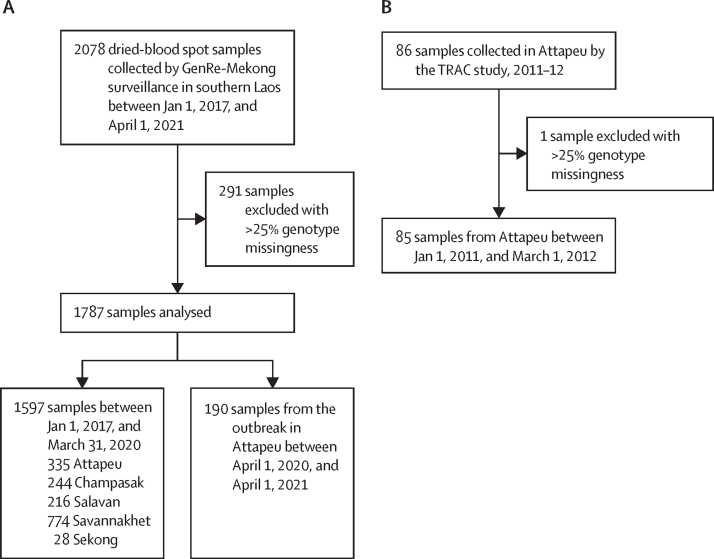
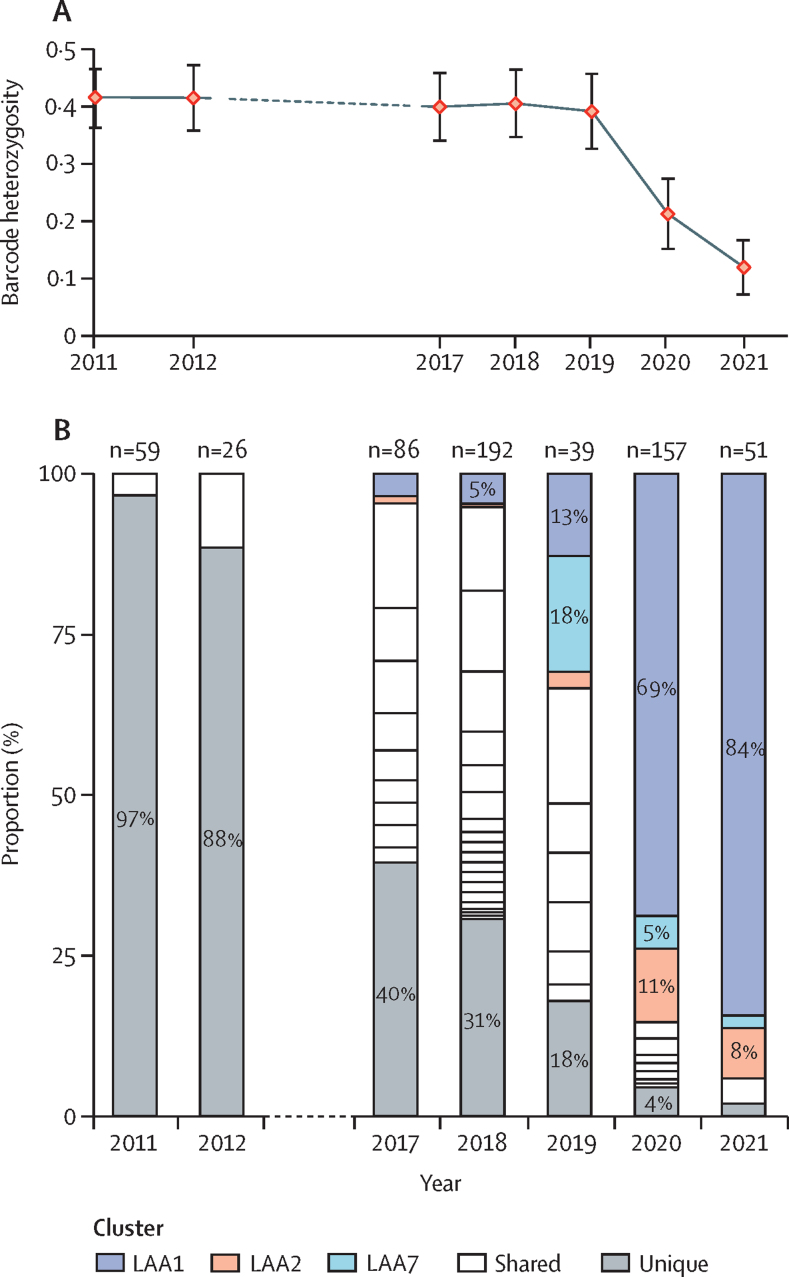
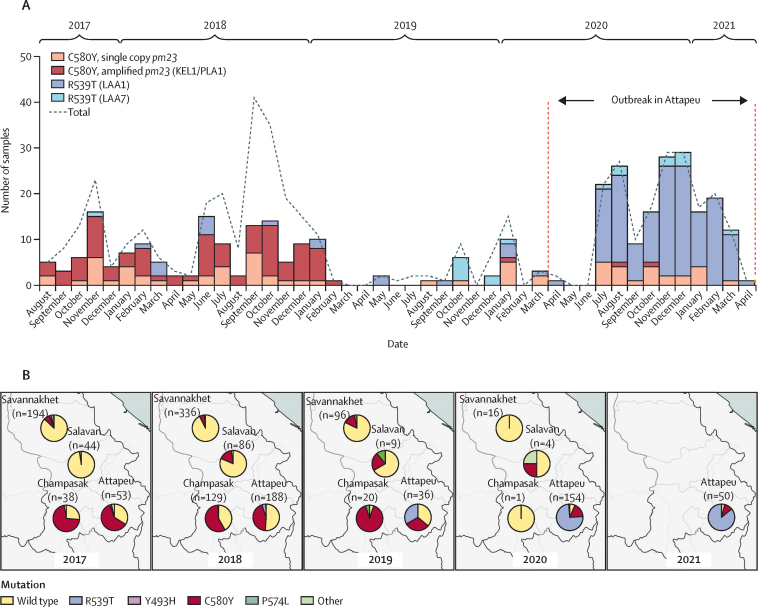
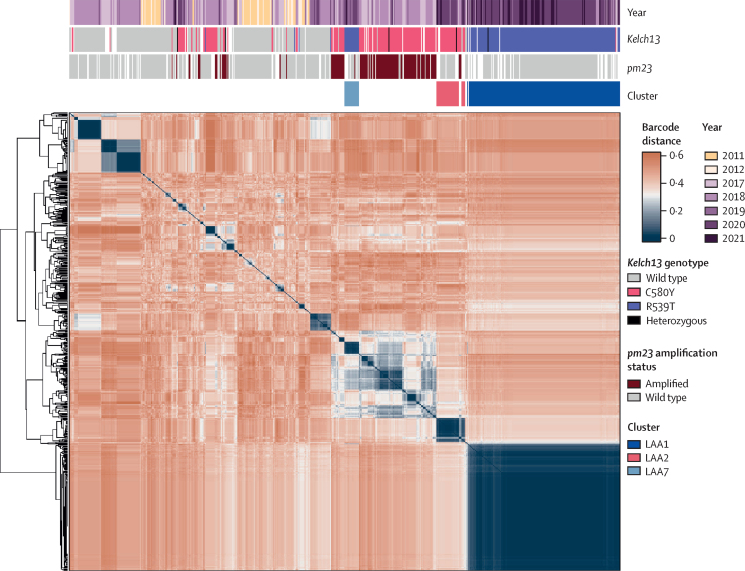
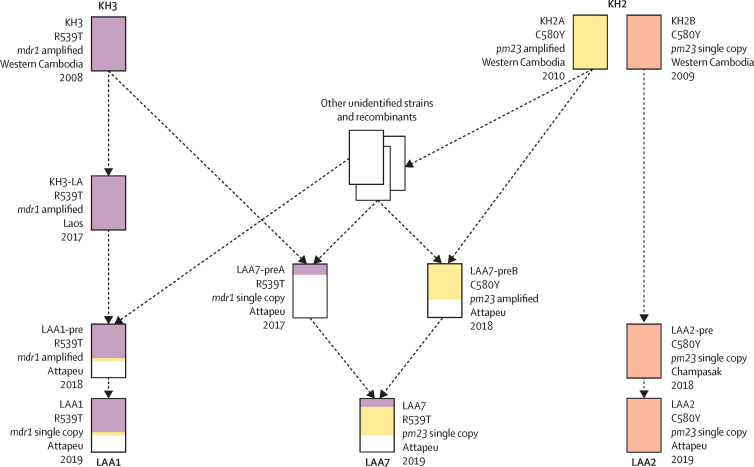
BACKGROUND: Malaria outbreaks are important public health concerns that can cause resurgence in endemic regions approaching elimination. We investigated a Plasmodium falciparum outbreak in Attapeu Province, Laos, during the 2020-21 malaria season, using genomic epidemiology methods to elucidate parasite population dynamics and identify its causes. METHODS: In this genetic analysis, 2164 P falciparum dried blood spot samples were collected from southern Laos between Jan 1, 2017, and April 1, 2021, which included 249 collected during the Attapeu outbreak between April 1, 2020, and April 1, 2021, by routine surveillance. Genetic barcodes obtained from these samples were used to investigate epidemiological changes underpinning the outbreak, estimate population diversity, and analyse population structure. Whole-genome sequencing data from additional historical samples were used to reconstruct the ancestry of outbreak strains using identity-by-descent analyses. FINDINGS: The outbreak parasite populations were characterised by unprecedented loss of genetic diversity, primarily caused by rapid clonal expansion of a multidrug-resistant strain (LAA1) carrying the kelch13 Arg539Thr (R539T) mutation. LAA1 replaced kelch13 Cys580Tyr (C580Y) mutants resistant to dihydroartemisinin-piperaquine (KEL1/PLA1) as the dominant strain. LAA1 inherited 58·8% of its genome from a strain circulating in Cambodia in 2008. A secondary outbreak strain (LAA2) carried the kelch13 C580Y allele, and a genome that is essentially identical to a Cambodian parasite from 2009. A third, low-frequency strain (LAA7) was a recombinant of KEL1/PLA1 with a kelch13 R539T mutant. INTERPRETATION: These results strongly suggest that the outbreak was driven by a selective sweep, possibly associated with multidrug-resistant phenotypes of the outbreak strains. Established resistant populations can circulate at low frequencies for years before suddenly overwhelming dominant strains when the conditions for selection become favourable-eg, when front-line therapies change. Genetic surveillance can support elimination by characterising key properties of outbreaks such as population diversity, drug resistance marker prevalence, and the origins of outbreak strains. FUNDING: Bill & Melinda Gates Foundation; The Global Fund to Fight AIDS, Tuberculosis and Malaria; Wellcome Trust. TRANSLATION: For the Lao translation of the abstract see Supplementary Materials section.
Overview
The claims and statistics of this paper haven’t been checked yet.
Free: it reads the open-access text and checks the first 5 claims that cite a source we can check. Create a free account to check every claim.
Integrity signals
Registry
Cites
Statistics
Figures
Verification
Claims the paper makes
The claims and statistics of this paper haven’t been checked yet.
Free: it reads the open-access text and checks the first 5 claims that cite a source we can check. Create a free account to check every claim.
Claims other papers make about this one
Each is checked against this paper’s own text: does it say what the citing paper says it does?
In the citing paper
“The associated increased rate of inbreeding in such settings34 is known to favour the spread of drug-resistant strains35,36.”
From Plasmodium falciparum resistant to artemisinin and diagnostics have emerged in Ethiopia (2023) · cites this paper as [36]
In the citing paper
“These tools have already been applied for detailed investigation of localized outbreaks, helping to contextualize resurgence, importation, and residual transmission [26–28].”
From Building the toolkit to address malaria resurgence and radical cure of vivax malaria in Ethiopia: a meeting report (2026) · cites this paper as [26]
Self-check
Percentages, sums and reported differences re-computed from the paper’s own numbers.
The self-check needs the paper’s full text.
Citations
Cites
Artemisinin Resistance in Plasmodium falciparum Malaria
Dondorp, A. M., Nosten, F., Yi, P., Das, D., Phyo, A. P., Tarning, J., Lwin, K. M., Ariey, F., Hanpithakpong, W., Lee, S. J., et al. (2009) · New England Journal of Medicine · doi:10.1056/nejmoa0808859 · Cited by 3,424
Self-citationSpread of Artemisinin Resistance in Plasmodium falciparum Malaria
Ashley, E. A., Dhorda, M., Fairhurst, R. M., Amaratunga, C., Lim, P., Suon, S., Sreng, S., Anderson, J. M., Mao, S., Sam, B., et al. (2014) · New England Journal of Medicine · doi:10.1056/nejmoa1314981 · Cited by 2,205 · cited 1×
“3,12,13 Analyses of genetic patterns in outbreak populations can be informative about the factors driving the outbreak.”
BackgroundSelf-citationA molecular marker of artemisinin-resistant Plasmodium falciparum malaria
Ariey, F., Witkowski, B., Amaratunga, C., Beghain, J., Langlois, A.-C., Khim, N., Kim, S., Duru, V., Bouchier, C., Ma, L., et al. (2014) · Nature · doi:10.1038/nature12876 · Cited by 2,090
Self-citationEvidence of Artemisinin-Resistant Malaria in Western Cambodia
Noedl, H., Se, Y., Schaecher, K., Smith, B. L., Socheat, D., & Fukuda, M. M. (2008) · New England Journal of Medicine · doi:10.1056/nejmc0805011 · Cited by 1,785
Bhattarai, A., Ali, A. S., Kachur, S. P., Mårtensson, A., Abbas, A. K., Khatib, R., Al-mafazy, A.-W., Ramsan, M., Rotllant, G., Gerstenmaier, J. F., et al. (2007) · PLoS Medicine · doi:10.1371/journal.pmed.0040309 · Cited by 647
Genetic architecture of artemisinin-resistant Plasmodium falciparum
Miotto, O., Amato, R., Ashley, E. A., MacInnis, B., Almagro-Garcia, J., Amaratunga, C., Lim, P., Mead, D., Oyola, S. O., Dhorda, M., et al. (2015) · Nature Genetics · doi:10.1038/ng.3189 · Cited by 609
Self-citationTun, K. M., Imwong, M., Lwin, K. M., Win, A. A., Hlaing, T. M., Hlaing, T., Lin, K., Kyaw, M. P., Plewes, K., Faiz, M. A., et al. (2015) · The Lancet Infectious Diseases · doi:10.1016/s1473-3099(15)70032-0 · Cited by 414
Self-citation
Research works printed but not linked: 22
- Malaria GEN Plasmodium falciparum Community Project Genomic epidemiology of artemisinin resistant malaria eLife 5 2016 e08714 26943619 PMC4786412 · DOI · Paper page
- Phyo AP Nkhoma S Stepniewska K Emergence of artemisinin-resistant malaria on the western border of Thailand: a longitudinal study Lancet 379 2012 1960 1966 22484134 PMC3525980 · DOI · Paper page
- Amaratunga C Lim P Suon S Dihydroartemisinin-piperaquine resistance in Plasmodium falciparum malaria in Cambodia: a multisite prospective cohort study Lancet Infect Dis 16 2016 357 365 26774243 PMC4792715 · DOI · Paper page
- Spring MD Lin JT Manning JE Dihydroartemisinin-piperaquine failure associated with a triple mutant including kelch13 C580Y in Cambodia: an observational cohort study Lancet Infect Dis 15 2015 683 691 25877962 · DOI · Paper page
- van der Pluijm RW Imwong M Chau NH Determinants of dihydroartemisinin-piperaquine treatment failure in Plasmodium falciparum malaria in Cambodia, Thailand, and Vietnam: a prospective clinical, pharmacological, and genetic study Lancet Infect Dis 19 2019 952 961 31345710 PMC6715822 · DOI · Paper page
- Lee YC Tang CS Ang LW Han HK James L Goh KT Epidemiological characteristics of imported and locally-acquired malaria in Singapore Ann Acad Med Singap 38 2009 840 849 19890574 · DOI
- Hallett RL Sutherland CJ Alexander N Combination therapy counteracts the enhanced transmission of drug-resistant malaria parasites to mosquitoes Antimicrob Agents Chemother 48 2004 3940 3943 15388456 PMC521891 · DOI
- Ataide R Ashley EA Powell R Host immunity to Plasmodium falciparum and the assessment of emerging artemisinin resistance in a multinational cohort Proc Natl Acad Sci USA 114 2017 3515 3520 28289193 PMC5380044 · DOI
- Nair S Williams JT Brockman A A selective sweep driven by pyrimethamine treatment in southeast Asian malaria parasites Mol Biol Evol 20 2003 1526 1536 12832643 · DOI · Paper page
- Miotto O Almagro-Garcia J Manske M Multiple populations of artemisinin-resistant Plasmodium falciparum in Cambodia Nat Genet 45 2013 648 655 23624527 PMC3807790 · DOI · Paper page
- Roh ME Tessema SK Murphy M High genetic diversity of Plasmodium falciparum in the low-transmission setting of the Kingdom of Eswatini J Infect Dis 220 2019 1346 1354 31190073 PMC6743842 · DOI
- Simmalavong N Phommixay S Kongmanivong P Expanding malaria diagnosis and treatment in Lao PDR: lessons learned from a public-private mix initiative Malar J 16 2017 460 29132370 PMC5683316 · DOI
- Jacob CG Thuy-Nhien N Mayxay M Genetic surveillance in the Greater Mekong subregion and south Asia to support malaria control and elimination eLife 10 2021 e62997 34372970 PMC8354633 · DOI · Paper page
- Ahouidi A Ali M Almagro-Garcia J An open dataset of Plasmodium falciparum genome variation in 7,000 worldwide samples Wellcome Open Res 6 2021 42 33824913 PMC8008441 · DOI · Paper page
- Ansbro MR Jacob CG Amato R Development of copy number assays for detection and surveillance of piperaquine resistance associated plasmepsin 2/3 copy number variation in Plasmodium falciparum Malar J 19 2020 181 32404110 PMC7218657 · DOI
- Gu Z Elis R Schlesner M Complex heatmaps reveal patterns and correlations in multidimensional genomic data Bioinformatics 2016 27207943 · DOI · Paper page
- Schaffner SF Taylor AR Wong W Wirth DF Neafsey DE hmmIBD: software to infer pairwise identity by descent between haploid genotypes Malar J 17 2018 196 29764422 PMC5952413 · DOI · Paper page
- Hamilton WL Amato R van der Pluijm RW Evolution and expansion of multidrug-resistant malaria in southeast Asia: a genomic epidemiology study Lancet Infect Dis 19 2019 943 951 31345709 PMC6715858 · DOI · Paper page
- Amato R Lim P Miotto O Genetic markers associated with dihydroartemisinin-piperaquine failure in Plasmodium falciparum malaria in Cambodia: a genotype-phenotype association study Lancet Infect Dis 17 2017 164 173 27818095 PMC5564489 · DOI · Paper page
- Price RN Uhlemann AC Brockman A Mefloquine resistance in Plasmodium falciparum and increased pfmdr1 gene copy number Lancet 364 2004 438 447 15288742 PMC4337987 · DOI · Paper page
- Landier J Parker DM Thu AM Effect of generalised access to early diagnosis and treatment and targeted mass drug administration on Plasmodium falciparum malaria in eastern Myanmar: an observational study of a regional elimination programme Lancet 391 2018 1916 1926 29703425 PMC5946089 · DOI · Paper page
- Imwong M Dhorda M Myo Tun K Molecular epidemiology of resistance to antimalarial drugs in the Greater Mekong subregion: an observational study Lancet Infect Dis 20 2020 1470 1480 32679084 PMC7689289 · DOI · Paper page
Cited by
Plasmodium falciparum resistant to artemisinin and diagnostics have emerged in Ethiopia
Fola, A. A., Feleke, S. M., Mohammed, H., Brhane, B. G., Hennelly, C. M., Assefa, A., Crudal, R. M., Reichert, E., Juliano, J. J., Cunningham, J., et al. (2023) · Nature Microbiology · doi:10.1038/s41564-023-01461-4 · Cited by 213
“The associated increased rate of inbreeding in such settings 34 is known to favour the spread of drug-resistant strains 35,36 .”
BackgroundThe emergence of artemisinin partial resistance in Africa: how do we respond?
Rosenthal, P. J., Asua, V., Bailey, J. A., Conrad, M. D., Ishengoma, D. S., Kamya, M. R., Rasmussen, C., Tadesse, F. G., Uwimana, A., & Fidock, D. A. (2024) · The Lancet Infectious Diseases · doi:10.1016/s1473-3099(24)00141-5 · Cited by 180
Rosenthal, P. J., Asua, V., & Conrad, M. D. (2024) · Nature Reviews Microbiology · doi:10.1038/s41579-024-01008-2 · Cited by 162
“Recently, strains with the R539T mutation have spread through selective sweeps, in part replacing KEL1–PLA1 lineage parasites, which is likely to have been facilitated by discontinuation of DHA–piperaquine as a first-line therapy in the region 74 .”
Degaga, T. S., Sime, H., Ruybal-Pesántez, S., Osborne, A., Mwaura, M., Bamboro, S. A., Mnjala, H., Mekonnen, G., Ermias, S., Fantahun, A., et al. (2026) · Malaria Journal · doi:10.1186/s12936-026-06050-4 · Cited by 1
Metadata
- Authors
- Wasakul, V., Disratthakit, A., Mayxay, M., Chindavongsa, K., Sengsavath, V., Thuy-Nhien, N., Pearson, R. D., Phalivong, S., Xayvanghang, S., Maude, R. J., Gonçalves, S., Day, N. P., Newton, P. N., Ashley, E. A., Kwiatkowski, D. P., Dondorp, A. M., & Miotto, O.
- Venue
- The Lancet Infectious Diseases
- Publisher
- Elsevier BV
- Published
- 2023-05
- Volume
- 23
- Issue
- 5
- Pages
- 568-577
- ISSN
- 1473-3099
- PMC
- PMC10914674
- Semantic Scholar
- 52585c58c07acf5f9a5bdfb6cc2fac47f69dc9b6
- Cited by
- 42
- References
- 7
- Language
- en
- Licence
- www.elsevier.com/tdm/userlicense/1.0/ (tdm)
- www.elsevier.com/legal/tdmrep-license (tdm)
- creativecommons.org/licenses/by/4.0/ (vor)
- Funders
- Bill and Melinda Gates Foundation (INV-001927, OPP11188166, OPP1204268)
- Global Fund to Fight AIDS, Tuberculosis and Malaria (20864-007-44)
- Wellcome Trust (204911)
About these checks
Registry, retraction, Cites and statistics results are computed, not judged, with one exception: a printed reference that no index lists is read once by a model before it counts as a citation error. Claims are extracted by a model and kept only when their quote appears verbatim in the text; each cited source is then checked, with a model’s help, for whether it says what the claim relies on. Those verdicts can be wrong — read the claim’s quote and the cited source before relying on one.
Statistics and arithmetic are recomputed, not judged.
Confidence bands are shown only for fields calibrated on our annotated test set. None is calibrated yet, so no band is shown.
What counts as a claim ›How we measure confidence ›How we check this ›
Are you an author, or do you see a problem with this page? Request a review
Data sources
Bibliographic data: Semantic Scholar, OpenAlex, Crossref.
Contains information from the Semantic Scholar Academic Graph Datasets, made available under the ODC Attribution License (ODC-BY 1.0).
Semantic Scholar’s data is described in: Kinney, R., et al. (2023). The Semantic Scholar Open Data Platform. arXiv:2301.10140.
