

Global, regional, and national age-specific progress towards the 2020 milestones of the WHO End TB Strategy: a systematic analysis for the Global Burden of Disease Study 2021
Open accessThe DOI matches its Crossref record; 104 of the 106 references it cites were found in a registry or an index; 23 of the 73 sources its claims cite were checked for support.
Abstract
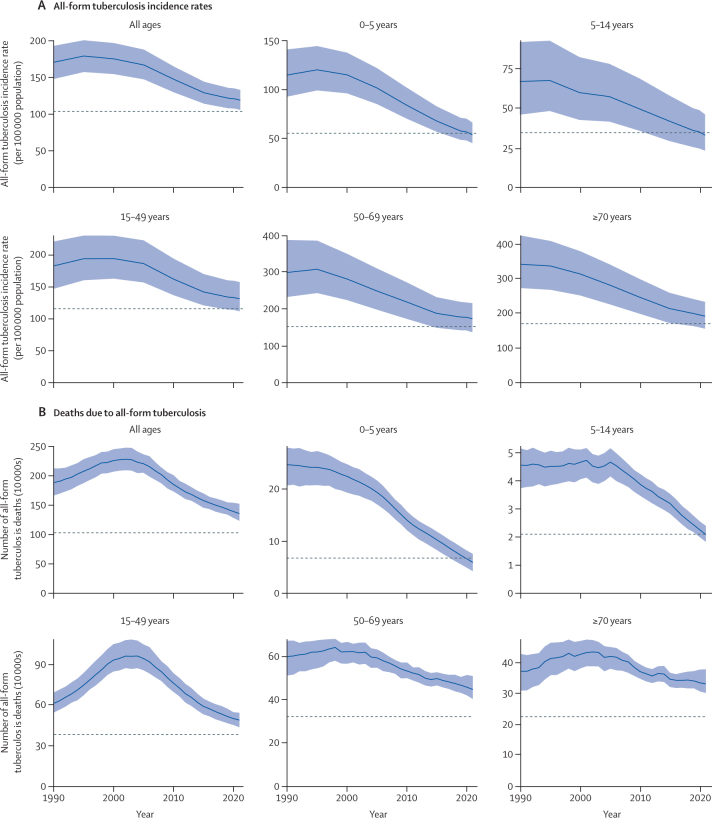
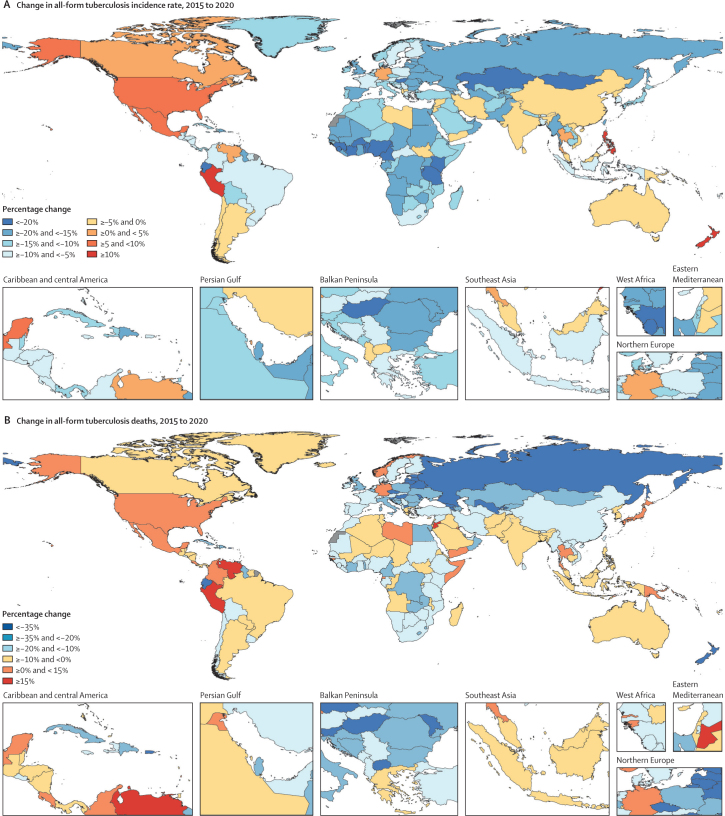
BACKGROUND: Global evaluations of the progress towards the WHO End TB Strategy 2020 interim milestones on mortality (35% reduction) and incidence (20% reduction) have not been age specific. We aimed to assess global, regional, and national-level burdens of and trends in tuberculosis and its risk factors across five separate age groups, from 1990 to 2021, and to report on age-specific progress between 2015 and 2020. METHODS: We used the Global Burden of Diseases, Injuries, and Risk Factors Study 2021 (GBD 2021) analytical framework to compute age-specific tuberculosis mortality and incidence estimates for 204 countries and territories (1990-2021 inclusive). We quantified tuberculosis mortality among individuals without HIV co-infection using 22 603 site-years of vital registration data, 1718 site-years of verbal autopsy data, 825 site-years of sample-based vital registration data, 680 site-years of mortality surveillance data, and 9 site-years of minimally invasive tissue sample (MITS) diagnoses data as inputs into the Cause of Death Ensemble modelling platform. Age-specific HIV and tuberculosis deaths were established with a population attributable fraction approach. We analysed all available population-based data sources, including prevalence surveys, annual case notifications, tuberculin surveys, and tuberculosis mortality, in DisMod-MR 2.1 to produce internally consistent age-specific estimates of tuberculosis incidence, prevalence, and mortality. We also estimated age-specific tuberculosis mortality without HIV co-infection that is attributable to the independent and combined effects of three risk factors (smoking, alcohol use, and diabetes). As a secondary analysis, we examined the potential impact of the COVID-19 pandemic on tuberculosis mortality without HIV co-infection by comparing expected tuberculosis deaths, modelled with trends in tuberculosis deaths from 2015 to 2019 in vital registration data, with observed tuberculosis deaths in 2020 and 2021 for countries with available cause-specific mortality data. FINDINGS: We estimated 9·40 million (95% uncertainty interval [UI] 8·36 to 10·5) tuberculosis incident cases and 1·35 million (1·23 to 1·52) deaths due to tuberculosis in 2021. At the global level, the all-age tuberculosis incidence rate declined by 6·26% (5·27 to 7·25) between 2015 and 2020 (the WHO End TB strategy evaluation period). 15 of 204 countries achieved a 20% decrease in all-age tuberculosis incidence between 2015 and 2020, eight of which were in western sub-Saharan Africa. When stratified by age, global tuberculosis incidence rates decreased by 16·5% (14·8 to 18·4) in children younger than 5 years, 16·2% (14·2 to 17·9) in those aged 5-14 years, 6·29% (5·05 to 7·70) in those aged 15-49 years, 5·72% (4·02 to 7·39) in those aged 50-69 years, and 8·48% (6·74 to 10·4) in those aged 70 years and older, from 2015 to 2020. Global tuberculosis deaths decreased by 11·9% (5·77 to 17·0) from 2015 to 2020. 17 countries attained a 35% reduction in deaths due to tuberculosis between 2015 and 2020, most of which were in eastern Europe (six countries) and central Europe (four countries). There was variable progress by age: a 35·3% (26·7 to 41·7) decrease in tuberculosis deaths in children younger than 5 years, a 29·5% (25·5 to 34·1) decrease in those aged 5-14 years, a 15·2% (10·0 to 20·2) decrease in those aged 15-49 years, a 7·97% (0·472 to 14·1) decrease in those aged 50-69 years, and a 3·29% (-5·56 to 9·07) decrease in those aged 70 years and older. Removing the combined effects of the three attributable risk factors would have reduced the number of all-age tuberculosis deaths from 1·39 million (1·28 to 1·54) to 1·00 million (0·703 to 1·23) in 2020, representing a 36·5% (21·5 to 54·8) reduction in tuberculosis deaths compared to those observed in 2015. 41 countries were included in our analysis of the impact of the COVID-19 pandemic on tuberculosis deaths without HIV co-infection in 2020, and 20 countries were included in the analysis for 2021. In 2020, 50 900 (95% CI 49 700 to 52 400) deaths were expected across all ages, compared to an observed 45 500 deaths, corresponding to 5340 (4070 to 6920) fewer deaths; in 2021, 39 600 (38 300 to 41 100) deaths were expected across all ages compared to an observed 39 000 deaths, corresponding to 657 (-713 to 2180) fewer deaths. INTERPRETATION: Despite accelerated progress in reducing the global burden of tuberculosis in the past decade, the world did not attain the first interim milestones of the WHO End TB Strategy in 2020. The pace of decline has been unequal with respect to age, with older adults (ie, those aged >50 years) having the slowest progress. As countries refine their national tuberculosis programmes and recalibrate for achieving the 2035 targets, they could consider learning from the strategies of countries that achieved the 2020 milestones, as well as consider targeted interventions to improve outcomes in older age groups. FUNDING: Bill & M
Overview
CoChat Summary
TL;DR
In GBD 2021, global tuberculosis incidence fell by 6·26% and tuberculosis deaths by 11·9% between 2015 and 2020, missing the WHO End TB Strategy 2020 milestones of 20% incidence reduction and 35% mortality reduction. Progress was unequal by age, with older adults improving slowest, while removing smoking, alcohol use, and diabetes would have reduced 2020 tuberculosis deaths by 36·5% versus 2015.
Key findings
- In 2021, there were an estimated 9·40 million (95% UI 8·36–10·5) tuberculosis incident cases and 1·35 million (1·23–1·52) tuberculosis deaths; HIV–tuberculosis co-infection accounted for 1·00 million (0·90–1·13) incident cases and 205 000 (158 000–248 000) deaths.
- From 2015 to 2020, the global all-age tuberculosis incidence rate declined by 6·26% (5·27–7·25) and global tuberculosis deaths declined by 11·9% (5·77–17·0); 15 of 204 countries achieved a 20% decrease in all-age incidence, and the abstract reports 17 countries attained a 35% reduction in deaths (the results text reports 19 countries/territories achieving this milestone).
- Age-specific incidence declines from 2015 to 2020 were largest in children younger than 5 years (16·5% [14·8–18·4]) and those aged 5–14 years (16·2% [14·2–17·9]), versus 6·29% (5·05–7·70) in ages 15–49, 5·72% (4·02–7·39) in ages 50–69, and 8·48% (6·74–10·4) in ages ≥70; death declines were 35·3% (26·7–41·7), 29·5% (25·5–34·1), 15·2% (10·0–20·2), 7·97% (0·472–14·1), and 3·29% (–5·56 to 9·07), respectively.
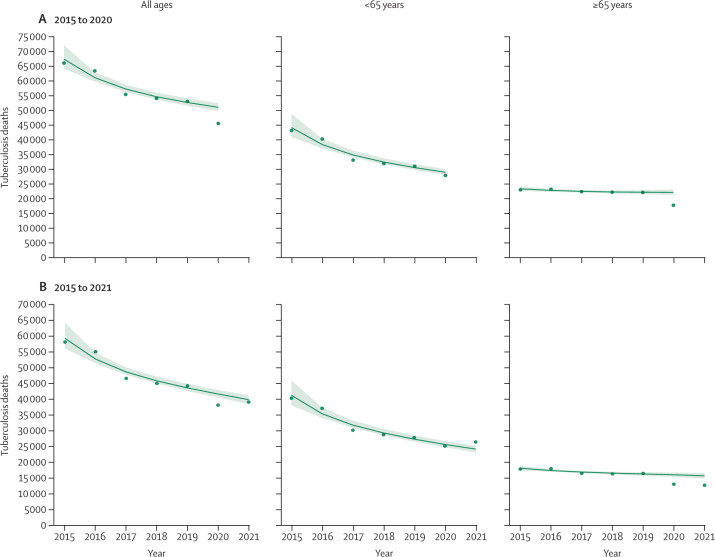
- Removing the combined effects of smoking, alcohol use, and diabetes would have reduced all-age tuberculosis deaths from 1·39 million (1·28–1·54) to 1·00 million (0·703–1·23) in 2020, a 36·5% (21·5–54·8) reduction versus observed 2015 deaths; corresponding reductions were 31·0% (15·9–48·8) in ages 15–49, 40·5% (22·3–62·6) in ages 50–69, and 41·0% (25·4–62·0) in ages ≥70. In the COVID-19 secondary analysis, 41 countries had 50 900 expected versus 45 500 observed tuberculosis deaths without HIV co-infection in 2020 (5 340 [4 070–6 920] fewer), and 20 countries had 39 600 expected versus 39 000 observed in 2021 (657 [–713 to 2 180] fewer).
Methods
- GBD 2021 analytical framework was used to compute age-specific tuberculosis mortality and incidence estimates for 204 countries and territories from 1990 to 2021. Tuberculosis mortality without HIV co-infection was modelled with CODEm using 22 603 site-years of vital registration data, 1 718 site-years of verbal autopsy data, 825 site-years of sample-based vital registration data, 680 site-years of mortality surveillance data, and 9 site-years of minimally invasive tissue sample diagnoses; HIV–tuberculosis deaths were estimated with a population attributable fraction approach.
- Tuberculosis morbidity was modelled in DisMod-MR 2.1 using prevalence surveys, annual case notifications, tuberculin surveys, and tuberculosis mortality data to produce internally consistent age-specific incidence, prevalence, and mortality estimates; incidence for countries with low-quality cause-of-death data was predicted via a mortality-to-incidence ratio approach, and incidence was disaggregated by HIV status.
- Risk-factor analysis computed age-sex-specific population attributable fractions for smoking, alcohol consumption, and diabetes among adults without HIV co-infection, then derived risk-deleted mortality rates. The COVID-19 secondary analysis used quasi-Poisson regression on 2015–2019 vital registration data to predict expected tuberculosis deaths in 2020–21 for countries with available cause-specific mortality data, stratified by ages <65 years, ≥65 years, and all ages.
Limitations
- The paper states that the primary limitation is data availability, with gaps across countries, age groups, and years; in the absence of data, estimates depended on covariates, spatial relationships, and out-of-sample predictive validity, and data scarcity is reflected in larger uncertainty intervals, with particular triangulation challenges in sub-Saharan Africa.
- The paper states it could not quantify tuberculosis mortality attributable to all important risk factors, excluding indoor air pollution and malnutrition, nor burden attributable to social determinants such as poverty and educational attainment; PAF estimates assume causality without confounding, that exposure removal does not affect unrelated risk factors, and that feasible interventions exist, and Levin’s formula may be biased although bias is often small with adjusted relative risks.
- The paper states that the COVID-19 impact could not be fully quantified due to insufficient empirical evidence and was restricted to 41 countries with available data, limiting generalisability; the text also makes evident that GBD 2021 and WHO 2022 estimates diverged for 2020–21 because of different modelling assumptions, and the authors discuss possible misclassification of COVID-19 deaths as tuberculosis deaths as an unresolved issue.
Model-written summary. Check it against the paper before relying on it.
Integrity signals
Registry
Cites
Statistics
Figures
Verification
Claims the paper makes
13 Valid · 0 Not valid · 36 Not checked · 127 Own results and interpretations
The cited sources support only part of this claim — read each source’s verdict below.
In the paper
“Recent progress has been unimpressive, however, as global annual rates of decline in tuberculosis incidence over the past 10 years have ranged between 1% and 2%.3, 4”
§ Global, regional, and national age-specific progress towards the 2020 milestones of the WHO End TB Strategy: a systematic analysis for the Global Burden of Disease Study 2021 > Introduction
What the sources say
- Partly supportedcites [3] GBD Tuberculosis Collaborators Global, regional, and national burden of tuberculosis, 1990–2016: results from the Global Burden of Diseases, Injuries, and Risk Factors 2016 Study Lancet Infect Dis 18 2018 1329 1349 30507459 PMC6250050 sourceExperimental — accuracy not yet measured
The Results section, “Changes in the burden of tuberculosis over time,” reports a 1.3% annual decline in global age-standardised incidence among HIV-negative individuals from 2006 to 2016. The claim omits that population qualifier: the same section reports a 4.0% annual decline among HIV-positive individuals, so the paper does not establish a 1–2% rate for tuberculosis incidence overall. (LLM, conf=0.86)
- Partly supportedcites [4] Pan Z Zhang J Bu Q The gap between global tuberculosis incidence and the first milestone of the WHO End Tuberculosis Strategy: an analysis based on the Global Burden of Disease 2017 database Infect Drug Resist 13 2020 1281 1286 32440164 PMC7210037 sourceExperimental — accuracy not yet measured
The Results report a global annual decline in TB incidence of 1.1%, which falls within the claimed 1%–2% range. But that figure covers 2015–2017, not the past 10 years; the Discussion also says the study analyzed only three years of data. No page numbers are available in our copy. (LLM, conf=0.88)
plain- Asserted: passes — The authors put it forward as true.
- Checkable: passes — It can be checked against evidence.
- Load-bearing: passes — The paper’s conclusions depend on it.
- Based: passes — The paper gives a reason why it holds.
- Partly supported
Every source the paper cites for this claim was checked and supports it.
In the paper
“most tuberculosis transmission among children occurs outside the household,62”
§ Global, regional, and national age-specific progress towards the 2020 milestones of the WHO End TB Strategy: a systematic analysis for the Global Burden of Disease Study 2021 > Discussion
What the sources say
- Supportedcites [62] Martinez L Lo NC Cords O Paediatric tuberculosis transmission outside the household: challenging historical paradigms to inform future public health strategies Lancet Respir Med 7 2019 544 552 31078497 PMC7323920 source
The Epidemiological evidence section states that, across 13 studies, most transmission to children occurs outside the household. The paper frames this conclusion particularly around high-burden settings. (LLM, conf=0.93)
hedgedstates a cause- Asserted: passes — The authors put it forward as true.
- Checkable: passes — It can be checked against evidence.
- Load-bearing: passes — The paper’s conclusions depend on it.
- Based: passes — The paper gives a reason why it holds.
- Supported
The cited sources support only part of this claim — read each source’s verdict below.
In the paper
“they are more likely to have adverse reactions to treatment.66”
§ Global, regional, and national age-specific progress towards the 2020 milestones of the WHO End TB Strategy: a systematic analysis for the Global Burden of Disease Study 2021 > Discussion
What the sources say
- Partly supportedcites [66] Hosford JD von Fricken ME Lauzardo M Hepatotoxicity from antituberculous therapy in the elderly: a systematic review Tuberculosis 95 2015 112 122 25595441 PMC4640443 sourceExperimental — accuracy not yet measured
The Discussion reports higher odds of TB-drug-associated hepatotoxic events in patients over 60 than in younger patients (OR 1.71, 95% CI 1.24–2.35). That supports an increased risk of a specific adverse reaction to antituberculous treatment, but the cited review does not establish that older individuals are more likely to have adverse reactions to treatment generally. Page numbers were not supplied in the passages. (LLM, conf=0.85)
hedgedstates an association- Asserted: passes — The authors put it forward as true.
- Checkable: passes — It can be checked against evidence.
- Load-bearing: passes — The paper’s conclusions depend on it.
- Based: passes — The paper gives a reason why it holds.
- Partly supported
The cited sources support only part of this claim — read each source’s verdict below.
In the paper
“This analysis provides some indication that previously described disruptions in tuberculosis services and treatment in both Russia78, 79 and Brazil80 might have led to increases in tuberculosis mortality.”
§ Global, regional, and national age-specific progress towards the 2020 milestones of the WHO End TB Strategy: a systematic analysis for the Global Burden of Disease Study 2021 > Discussion
What the sources say
- Supportedcites [78] Migliori GB Thong PM Alffenaar J-W Gauging the impact of the COVID-19 pandemic on tuberculosis services: a global study Eur Respir J 58 2021 2101786 PMC8581650 34446465 source
The cited study reports declines in TB diagnoses and care activity, including an evident decline in identified drug-resistant TB in Brazil (Abstract; page unavailable). In the citing sentence, this source supports the previously described disruptions; the suggestion that they might have increased mortality is framed as the citing authors’ own inference, not a finding attributed to this study. (LLM, conf=0.88)
- Partly supportedcites [79] Nalunjogi J Mucching-Toscano S Sibomana JP Impact of COVID-19 on diagnosis of tuberculosis, multidrug-resistant tuberculosis, and on mortality in 11 countries in Europe, Northern America, and Australia. A Global Tuberculosis Network study Int J Infect Dis 130 suppl 1 2023 S25 S29 36893943 PMC9991328 sourceExperimental — accuracy not yet measured
The Discussion (page unavailable) links disrupted TB services with reduced case-finding and higher TB mortality, supporting the general possibility in the claim. But the study's Results concern 11 countries in Europe, Northern America, and Australia; our copy does not document disruptions or mortality increases in Russia or Brazil. (LLM, conf=0.85)
- Supportedcites [80] Souza MR Paz WS Sales VBS Impact of the COVID-19 pandemic on the diagnosis of tuberculosis in Brazil: is the WHO End TB Strategy at risk? Front Pharmacol 13 2022 891711 PMC9277074 35847020 source
The Discussion reports that pandemic-related changes to Brazilian health services reduced tuberculosis diagnosis and may have affected timely treatment, access to care, and treatment adherence. The citing authors present the possible increase in mortality as their own inference, not as a finding attributed to this source. (LLM, conf=0.90)
hedgedstates a possible cause- Asserted: passes — The authors put it forward as true.
- Checkable: passes — It can be checked against evidence.
- Load-bearing: unclear — It is unclear whether the paper’s conclusions depend on it.
- Based: passes — The paper gives a reason why it holds.
- Supported
A result the paper reports from its own data — it cites no other source for it, so there is none to check. The quote shows it is in the paper.
In the paper
“HIV and tuberculosis co-infection constituted 1·00 million (0·90–1·13; 10·7% [10·3–11·0]) of the 9·40 million all-form tuberculosis incident cases and 205 000 (158 000–248 000; 15·1% [11·9–17·7]) of the 1·35 million all-form global tuberculosis deaths.”
§ Global, regional, and national age-specific progress towards the 2020 milestones of the WHO End TB Strategy: a systematic analysis for the Global Burden of Disease Study 2021 > Results > Overview
plain- Asserted: passes — The authors put it forward as true.
- Checkable: passes — It can be checked against evidence.
- Load-bearing: unclear — It is unclear whether the paper’s conclusions depend on it.
- Based: passes — The paper gives a reason why it holds.
96 more claims
Create a free account to see all 176 claims and to verify the 50 references still open.
- It may state two separate claims as one. 51
- Probably not a substantial claim. 38
Claims other papers make about this one
Each is checked against this paper’s own text: does it say what the citing paper says it does?
In the citing paper
“In contrast to our analysis, which we based on the GHE, a recent Global Burden of Disease (GBD) study reported lower tuberculosis deaths during the pandemic compared to expected deaths.83”
From Global health 2050: the path to halving premature death by mid-century (2024) · cites this paper as [83]
Self-check
Percentages, sums and reported differences re-computed from the paper’s own numbers.
Each contradiction between two passages listed here was confirmed by an independent check.
Rated major: it would touch a result — a value a result rests on, reported and recomputed p-values on opposite sides of the significance level, two passages that conflict with no sign which is right, or a cited work retracted before this paper was published.
In the paper
§ Global, regional, and national age-specific progress towards the 2020 milestones of the WHO End TB Strategy: a systematic analysis for the Global Burden of Disease Study 2021 > Results > Progress towards the End TB Strategy 2020 milestones
“19 countries and territories achieved this milestone: six in eastern Europe, four in central Europe, four in central Asia, two in the Caribbean, one in Andean Latin America, one in Australasia, and one in western sub-Saharan Africa”
§ Global, regional, and national age-specific progress towards the 2020 milestones of the WHO End TB Strategy: a systematic analysis for the Global Burden of Disease Study 2021 > Abstract > Findings
“17 countries attained a 35% reduction in deaths due to tuberculosis between 2015 and 2020”
Rated minor: it would not touch a result — a value no result rests on, a p-value that stays on the same side of the significance level, or a conflict that is clerical, resolved elsewhere in the paper, or outside its own findings.
In the paper
§ Global, regional, and national age-specific progress towards the 2020 milestones of the WHO End TB Strategy: a systematic analysis for the Global Burden of Disease Study 2021 > Discussion
“we found negative excess tuberculosis deaths in both 2020 and 2021 when aggregating across 41 of 204 countries”
§ Global, regional, and national age-specific progress towards the 2020 milestones of the WHO End TB Strategy: a systematic analysis for the Global Burden of Disease Study 2021 > Results > Impact of the COVID-19 pandemic on tuberculosis mortality
“There were 20 countries reporting data through the year 2021”
Rated minor: it would not touch a result — a value no result rests on, a p-value that stays on the same side of the significance level, or a conflict that is clerical, resolved elsewhere in the paper, or outside its own findings.
In the paper
§ Global, regional, and national age-specific progress towards the 2020 milestones of the WHO End TB Strategy: a systematic analysis for the Global Burden of Disease Study 2021 > Results > Progress towards the End TB Strategy 2020 milestones
“Furthermore, the cumulative number of countries achieving a 35% decrease would have increased from 15 to 132 in 2020 and 143 in 2021”
§ Global, regional, and national age-specific progress towards the 2020 milestones of the WHO End TB Strategy: a systematic analysis for the Global Burden of Disease Study 2021 > Abstract > Findings
“17 countries attained a 35% reduction in deaths due to tuberculosis between 2015 and 2020”
Citations
Cites
Vos, T., Lim, S. S., Abbafati, C., Abbas, K. M., Abbasi, M., Abbasifard, M., Abbasi-Kangevari, M., Abbastabar, H., Abd-Allah, F., Abdelalim, A., et al. (2020) · The Lancet · doi:10.1016/s0140-6736(20)30925-9 · Cited by 19,358
Self-citationJames, S. L., Abate, D., Abate, K. H., Abay, S. M., Abbafati, C., Abbasi, N., Abbastabar, H., Abd-Allah, F., Abdela, J., Abdelalim, A., et al. (2018) · The Lancet · doi:10.1016/s0140-6736(18)32279-7 · Cited by 13,867
Self-citationMurray, C. J. L., Aravkin, A. Y., Zheng, P., Abbafati, C., Abbas, K. M., Abbasi-Kangevari, M., Abd-Allah, F., Abdelalim, A., Abdollahi, M., Abdollahpour, I., et al. (2020) · The Lancet · doi:10.1016/s0140-6736(20)30752-2 · Cited by 9,854
Self-citationOng, K. L., Stafford, L. K., McLaughlin, S. A., Boyko, E. J., Vollset, S. E., Smith, A. E., Dalton, B. E., Duprey, J., Cruz, J. A., Hagins, H., et al. (2023) · The Lancet · doi:10.1016/s0140-6736(23)01301-6 · Cited by 6,146
Self-citationWang, H., Paulson, K. R., Pease, S. A., Watson, S., Comfort, H., Zheng, P., Aravkin, A. Y., Bisignano, C., Barber, R. M., Alam, T., et al. (2022) · The Lancet · doi:10.1016/s0140-6736(21)02796-3 · Cited by 2,069 · cited 1×
“Although the Institute for Health Metrics and Evaluation has estimated that there were 18 million excess all-cause deaths for the years 2020–21, 108 there is a scarcity of data on what fraction of these, if any, are due to tuberculosis.”
Self-citationPerin, J., Mulick, A., Yeung, D., Villavicencio, F., Lopez, G., Strong, K. L., Prieto-Merino, D., Cousens, S., Black, R. E., & Liu, L. (2022) · The Lancet Child & Adolescent Health · doi:10.1016/s2352-4642(21)00311-4 · Cited by 1,667 · cited 1×
“11 The substantial progress in reducing the tuberculosis burden in children might reflect recent trends showing marked decreases in child mortality, 54 global improvements in child nutrition outcomes, 55,56 increasing tuberculosis case finding and services for children, 57–59 and continued…”
Uplekar, M., Weil, D., Lonnroth, K., Jaramillo, E., Lienhardt, C., Dias, H. M., Falzon, D., Floyd, K., Gargioni, G., Getahun, H., et al. (2015) · The Lancet · doi:10.1016/s0140-6736(15)60570-0 · Cited by 1,117
Gavazzi, G., & Krause, K.-H. (2002) · The Lancet Infectious Diseases · doi:10.1016/s1473-3099(02)00437-1 · Cited by 990 · cited 2×
“11 Several factors could explain these marked age-related differences, including age-specific diagnostic challenges, 12,13 age-specific mixing patterns, 14 immune senescence 15 and other age-related immune dysfunctions, 16 and comorbidities common in older patients masking tuberculosis symptoms.”
Tiemersma, E. W., van der Werf, M. J., Borgdorff, M. W., Williams, B. G., & Nagelkerke, N. J. D. (2011) · PLoS ONE · doi:10.1371/journal.pone.0017601 · Cited by 583 · cited 2×
“To further improve internal consistency of modelling in DisMod, we computed all-age and both-sexes priors of tuberculosis duration using a combination of tuberculosis duration data from a systematic review of studies during the pre-chemotherapy era 25 and the HAQ Index.”
Bryazka, D., Reitsma, M. B., Griswold, M. G., Abate, K. H., Abbafati, C., Abbasi-Kangevari, M., Abbasi-Kangevari, Z., Abdoli, A., Abdollahi, M., Abdullah, A. Y. M., et al. (2022) · The Lancet · doi:10.1016/s0140-6736(22)00847-9 · Cited by 582
Self-citation
Research works printed but not linked: 1
- Byng-Maddick R Noursadeghi M Does tuberculosis threaten our ageing populations? BMC Infect Dis 16 2016 119 26968654 PMC4787032 · DOI · Paper page
Cited by
Naghavi, M., Kyu, H. H., A, B., Aalipour, M. A., Aalruz, H., Ababneh, H. S., Abafita, B. J., Abaraogu, U. O., Abbafati, C., Abbasi, M., et al. (2025) · The Lancet · doi:10.1016/s0140-6736(25)01917-8 · Cited by 595
Self-citationOh, J., Kim, S., Kim, M. S., Abate, Y. H., Abd ElHafeez, S., Abdelkader, A., Abdi, P., Abdulah, D. M., Aboagye, R. G., Abolhassani, H., et al. (2025) · The Lancet Respiratory Medicine · doi:10.1016/s2213-2600(25)00003-7 · Cited by 236
Self-citationXie, K., Cao, H., Ling, S., Zhong, J., Chen, H., Chen, P., & Huang, R. (2025) · Frontiers in Endocrinology · doi:10.3389/fendo.2025.1526482 · Cited by 152
Global health 2050: the path to halving premature death by mid-century
Jamison, D. T., Summers, L. H., Chang, A. Y., Karlsson, O., Mao, W., Norheim, O. F., Ogbuoji, O., Schäferhoff, M., Watkins, D., Adeyi, O., et al. (2024) · The Lancet · doi:10.1016/s0140-6736(24)01439-9 · Cited by 125
Self-citationOh, J. S., Kim, S., Yim, Y., Kim, M. S., Collaborators, G. 2. S. U., Shin, J. I., Jabbar, A. A., Aalruz, H., Abbasian, M., Magied, A. H. A. A. A., et al. (2026) · Nature Medicine · doi:10.1038/s41591-025-04077-9 · Cited by 85
“Two previous studies have also reported a decrease in the incidence of non-COVID lower respiratory infections and tuberculosis during the COVID-19 pandemic 7,8 .”
Self-citationZhang, S.-X., Wang, J.-C., Yang, J., Lv, S., Duan, L., Lü, Y., Tian, L.-G., Chen, M.-X., Liu, Q., Wei, F.-N., et al. (2024) · Infectious Diseases of Poverty · doi:10.1186/s40249-024-01230-3 · Cited by 74
“Acquired immune deficiency syndrome (AIDS) is a chronic, systemic, and fatal infectious disease caused by the human immunodeficiency virus (HIV) [1].”
BackgroundMethodInfluentialZhang, S.-X., Miao, F.-Y., Yang, J., Zhou, W., Lv, S., Wei, F.-N., Wang, Y., Hu, X., Yin, P., Zheng, P., et al. (2024) · Infectious Diseases of Poverty · doi:10.1186/s40249-024-01227-y · Cited by 69
“In high-burden countries, case detection and treatment success rates are still alarmingly low [1, 2].”
BackgroundResultInfluentialSelf-citationLv, H., Wang, L., Zhang, X., Dang, C., Liu, F., Zhang, X., Bai, J., You, S., Chen, H., Zhang, W., et al. (2024) · Infectious Diseases of Poverty · doi:10.1186/s40249-024-01247-8 · Cited by 54
“The methods used in GBD 2021 closely followed those used in GBD 2019 [10], and the GBD analytical framework for TB, along with the methods for TB data collection, have been previously detailed in other literature [5].”
BackgroundMethodSelf-citationGaetano, S. D., Ponzo, E., Midiri, A., Mancuso, G., Filippone, D., Infortuna, G., Zummo, S., & Biondo, C. (2025) · Hygiene · doi:10.3390/hygiene5020018 · Cited by 42
“These include HIV/AIDS, tuberculosis, and malaria [22] (Table 1).”
Tan, E.-L., Qin, Y., Yang, J., Li, X.-J., Liu, T.-Q., Yang, G.-B., Li, Y., Zhang, Z., Lu, Z., Wang, J.-C., et al. (2025) · BMC Infectious Diseases · doi:10.1186/s12879-025-11566-2 · Cited by 42
Possible modes of transmission of Novel coronavirus SARS-CoV-2: a review.
Mukhra, R., Krishan, K., & Kanchan, T. (2020) · Acta bio-medica dell'Ateneo parmense/Acta biomedica · doi:10.23750/abm.v91i3.10039 · Cited by 44
Self-citationChen, Y., Chen, W., Cheng, Z., Chen, Y., Li, M., Ma, L., Zhou, N., Qian, J., Zhu, Y., & Liu, C. (2024) · Science in One Health · doi:10.1016/j.soh.2024.100072 · Cited by 39
Self-citationLange, C., Bothamley, G. H., Günther, G., Guglielmetti, L., Kontsevaya, I., Kukša, L., Lange, B., Lorent, N., Saluzzo, F., Sester, M., et al. (2025) · Pathogens and Immunity · doi:10.20411/pai.v10i2.791 · Cited by 32
Xie, S., Xiao, H., Xu, L., Zhang, F., & Luo, M. (2025) · Frontiers in Public Health · doi:10.3389/fpubh.2025.1467509 · Cited by 26
Chen, W., Chen, Y., Cheng, Z., Chen, Y., Lv, C., Ma, L., Zhou, N., Qian, J., Liu, C., Li, M., et al. (2024) · Infectious Diseases of Poverty · doi:10.1186/s40249-024-01231-2 · Cited by 26
“According to the GBD study 2021, estimates of the disease burden for TB in 2021 have been thoroughly investigated [7].”
BackgroundMethodSelf-citationInflammatory bowel disease in south Asia: a scoping review
Shenoy, S., Jena, A., Levinson, C., Sharma, V., Deepak, P., Aswani-Omprakash, T., Sebastian, S., Colombel, J., & Agrawal, M. (2025) · The Lancet. Gastroenterology & hepatology · doi:10.1016/s2468-1253(24)00341-8 · Cited by 25
Tuberculosis: An Ongoing Global Threat
Farnia, P., Velayati, A. A., Ghanavi, J., & Farnia, P. (2025) · Advances in experimental medicine and biology · doi:10.1007/978-3-031-96883-9_1 · Cited by 26
Li, S., Mensah, E., Liu, M., Pan, L., Lu, W., Zhou, S., Zhang, L., Cheng, Y., Zhao, H., Wei, S., et al. (2025) · Frontiers in Microbiology · doi:10.3389/fmicb.2025.1695592 · Cited by 23
Cui, K., Zhao, X., Liu, W., & Bai, L. (2025) · BMC Medicine · doi:10.1186/s12916-025-04269-7 · Cited by 22
Awaidy, S. T. A., Khamis, F. A., Mujeini, S. A., Salman, J. A., & Al‐Tawfiq, J. A. (2025) · IJID Regions · doi:10.1016/j.ijregi.2025.100681 · Cited by 20
Self-citationGlobal, regional, and national burden of lip and oral cavity cancer and projections to 2036
Meng, S., Lv, A., Li, N., & Ding, X. (2025) · BMC Cancer · doi:10.1186/s12885-025-14995-z · Cited by 19
Kumar, V., Khatib, M. N., Verma, A., Lakhanpal, S., Ballal, S., Kumar, S., Bhat, M., Sharma, A., Kumar, M., Sinha, A., et al. (2024) · Journal of Clinical Tuberculosis and Other Mycobacterial Diseases · doi:10.1016/j.jctube.2024.100480 · Cited by 19
“TB causes more than 1.35 million deaths annually and was the leading cause of death due to a single infectious agent as recently as 2021 [2].”
BackgroundInfluentialLi, X., Li, Y., Guo, L., Chen, Y., Wang, G., & Zhang, H. (2025) · PLoS ONE · doi:10.1371/journal.pone.0317880 · Cited by 20
Self-citationThe Global Epidemiology of Tuberculosis: Burden, Trends, and Determinants
Walzl, G., Goletti, D., & Zumla, A. I. (2026) · Cold Spring Harbor Perspectives in Medicine · doi:10.1101/cshperspect.a041982 · Cited by 17
Holtgrewe, L., Johnson, A. B., Nyhan, K., Boffa, J., Shenoi, S., Karat, A. S., Davis, J. L., & Charalambous, S. (2024) · PLOS Global Public Health · doi:10.1371/journal.pgph.0003753 · Cited by 18
Chen, Y., Fan, L., Ren, Z., Yu, Y., Sun, J., Wang, M., Liu, C., Zhang, Y., Lu, S., Liu, X., et al. (2025) · BMC Medicine · doi:10.1186/s12916-025-03996-1 · Cited by 15
Self-citationLiu, J., Zhou, Y., Guan, J., Liu, Y., Weijian, S., Liu, W., Yin, X., Liu, Y., Li, T., Jin, L. G., et al. (2025) · International Journal of Infectious Diseases · doi:10.1016/j.ijid.2025.107966 · Cited by 15
Self-citationMaharana, J., Wang, C.-H., Tsai, L.-A., Liao, Y., Yang, C., Shen, M. C., Macale, L. S., Tran, T. N., Narsico, J. T., Perez, R. J., et al. (2025) · Cell Reports · doi:10.1016/j.celrep.2025.116057 · Cited by 15
Jiang, F., Li, X., Qiao, Q., Zhang, M., Tian, Y., Zhou, S. Y., Li, Y., Ni, R., An, Y., Liu, Y., et al. (2025) · International Journal of Surgery · doi:10.1097/js9.0000000000003412 · Cited by 15
“DS-TB is susceptible to isoniazid and rifampicin; MDR-TB resists both but remains susceptible to any fluoroquinolone and one injectable second-line agent; XDR-TB adds resistance to a fluoroquinolone and at least one second-line injectable [ 5 , 13 , 15 ] .”
InfluentialSelf-citationMobaderi, T., Kazemnejad, A., & Salehi, M. (2025) · BMC Infectious Diseases · doi:10.1186/s12879-025-10715-x · Cited by 14
“In regions like Eastern Europe, significant progress has been made, with several countries achieving a 35% reduction in TB deaths [16].”
Xiaoyan, W. U., Dong, Y.-Y., Ying, Y.-C., Chen, G. S., Fan, Q., Yin, P., & Chen, Y. (2025) · Frontiers in Aging Neuroscience · doi:10.3389/fnagi.2025.1596392 · Cited by 15
Tadese, Z. B., Arage, F. G., Tsegaw, T. K., Alemu, E. A., Abate, T. G., & Taye, E. A. (2025) · BMC Infectious Diseases · doi:10.1186/s12879-025-11228-3 · Cited by 12
“Detailed estimates of these indices can be found in the appendix of the GBD 2021 capstone paper [36].”
Yayan, J., & Rasche, K. (2026) · BMC Geriatrics · doi:10.1186/s12877-025-06934-1 · Cited by 12
“Sex-specific differences in TB burden are evident, with men consistently exhibiting higher incidence and mortality rates than women [21, 24].”
Kolhar, M., Rajeh, A. M. A., & Kazi, R. N. A. (2024) · Diagnostics · doi:10.3390/diagnostics14131334 · Cited by 11
“Given the substantial global impact of TB as the leading cause of mortality from infectious diseases before the advent of COVID-19, projections by the Stop TB Partnership suggest that the COVID-19 pandemic could exacerbate TB’s burden [1,2].”
BackgroundZheng, P., Qiu, X., Zhang, L., Liu, P., Peng, Z., & Huang, Z. (2025) · Scientific Reports · doi:10.1038/s41598-025-94899-x · Cited by 11
Self-citationFitriangga, A., Alex, A., Tamtama, R., & Aryati, R. (2025) · Indian Journal of Tuberculosis · doi:10.1016/j.ijtb.2025.08.006 · Cited by 11
Common Adverse Reactions and Management Strategies of First-Line Anti-Tuberculosis Drugs
He, K., Zhang, J., Du, X., He, X., Zeng, Y., & Liu, M. (2026) · Infection and Drug Resistance · doi:10.2147/idr.s564580 · Cited by 13
Wang, Y., Ma, Z., Liu, Z., Dong, X., Shu, W., Wei, M., Cui, J., Shu, W., Li, R., Jing, W., et al. (2025) · Journal of Infection · doi:10.1016/j.jinf.2025.106517 · Cited by 10
The Perspectives of Combining Antibiotics with Saponins—Herbal Excipients
Makiej, A., Smułek, W., & Kaczorek, E. (2025) · Molecules · doi:10.3390/molecules30204102 · Cited by 11
“TB remains one of the leading causes of death from bacterial infections, resulting in over 1 million deaths annually [13].”
Che, B., Zheng, X., Chen, B., Lu, Y., Zhang, Y., & Xu, B. (2024) · BMC Pulmonary Medicine · doi:10.1186/s12890-024-03293-2 · Cited by 10
Lee, S. W., Jeon, D., Choi, H., Chung, C., Mok, J., Jeong, D., Sohn, H., & Kang, Y. A. (2025) · ERJ Open Research · doi:10.1183/23120541.00191-2025 · Cited by 9
“This study found that the decrease in TB incidence and mortality rates progressively slowed with increasing age, which is consistent with findings from a global study [8].”
Self-citationLv, H., Chen, H., Zhang, X., Li, X., Liu, L., Dang, C., Liu, X., Zhao, C., Zhang, X., Bai, J., et al. (2025) · BMC Public Health · doi:10.1186/s12889-025-24575-2 · Cited by 11
Self-citationLedesma, J. R., Zhang, M., Liew, M. F., Dominguez, R.-M. V., Whikehart, S. M., Verma, M., Ma, J., Movo, A., Chu, H. T., Ostroff, S. M., et al. (2026) · The Lancet Infectious Diseases · doi:10.1016/s1473-3099(26)00295-1 · Cited by 8
Self-citationGashegu, M., Ndahindwa, V., Rwagasore, E., Tuyishime, A., Musanabaganwa, C., Gahamanyi, N., Mukagatare, I., Mbarushimana, D., Green, C., Dzinamarira, T., et al. (2024) · Antibiotics · doi:10.3390/antibiotics13111084 · Cited by 8
Self-citationEffects of the COVID-19 Pandemic on Tuberculosis Outcomes in the United States: A Bayesian Analysis
Swartwood, N. A., Cohen, T., Marks, S. M., Hill, A. N., Asay, G. R. B., Self, J. L., Feng, P.-J. I., Horsburgh, C. R., Salomon, J. A., & Menzies, N. A. (2025) · Clinical Infectious Diseases · doi:10.1093/cid/ciaf092 · Cited by 8
Self-citationNuances in the global impact of COVID-19 on tuberculosis control efforts: An updated review
Semnani, K., & Esmaeili, S. (2025) · Medicine · doi:10.1097/md.0000000000042195 · Cited by 8
“[32] This pattern may have followed a disparity in observation of preventive public health measures.”
Elimination of tuberculosis by 2025, an Indian perspective
Veggalam, S., & Kandi, V. (2026) · Discover Public Health · doi:10.1186/s12982-026-01451-x · Cited by 7
Towards improving the quality and usefulness of GBD tuberculosis estimates
White, R. G., & Rao, J. P. (2024) · The Lancet Infectious Diseases · doi:10.1016/s1473-3099(24)00079-3 · Cited by 7
Lü, Z., Feng, S., Feng, M., & Shen, J. (2025) · Frontiers in Public Health · doi:10.3389/fpubh.2025.1626232 · Cited by 7
Chen, S.-Y. (2024) · Scientific Reports · doi:10.1038/s41598-024-80343-z · Cited by 6
Recent advances in inhibitor development and metabolic targeting in tuberculosis therapy
Patel, R. R., Vidyasagar, Singh, S. K., & Singh, M. (2025) · Microbial Pathogenesis · doi:10.1016/j.micpath.2025.107515 · Cited by 6
Self-citationTrend and forecast analysis of the changing disease burden of tuberculosis in China, 1990–2021
Zhang, S.-X., Zheng, J., Wang, Y., Lv, W., Yang, J., Wang, J.-C., & Lu, Z. (2025) · Epidemiology and Infection · doi:10.1017/s0950268825100095 · Cited by 6
Liu, S., Yang, Y., Wang, D., Gao, L., Qin, J., Wu, Y., Li, D., Li, X., Chen, M., Wang, H., et al. (2025) · Frontiers in Medicine · doi:10.3389/fmed.2025.1589406 · Cited by 6
Mouzinga, F. H., Assiana, D. O. E., Dello, M. N. M., Ngouama, B. B., Okombi, F. H. O., Akiera, B. A., Grobusch, M. P., Mouanga, A. M., Elenga, V. A., Nguimbi, E., et al. (2025) · BMJ Global Health · doi:10.1136/bmjgh-2025-019877 · Cited by 6
Zenner, D., Hui, D. S. C., Sahu, S., Diţiu, L., Yeboah‐Manu, D., Ntoumi, F., Mfinanga, S., Chakaya, J. M., Zumla, A., Ahmed, R., et al. (2026) · The Lancet Microbe · doi:10.1016/j.lanmic.2026.101433 · Cited by 7
IA´ Tools for the development of investigative skills
Alvarado, M. A. G. (2023) · LatIA · doi:10.62486/latia202317 · Cited by 6
Ramirez, D., Brumwell, A. N., Rahman, M. M., Hossain, F., Kulkarni, S., Malik, A. A., Campbell, J. I., van de Water, B. J., Kamul, M. K., Rahman, M. T., et al. (2025) · Journal of Global Health · doi:10.7189/jogh.15.04024 · Cited by 5
Self-citationXiao, Y.-R., Ren, X., Zhang, M.-D., Zhu, H., Wang, X., Sun, W.-S., Guo, X., Fei, H., Liu, J., Yao, H., et al. (2025) · Infectious Diseases of Poverty · doi:10.1186/s40249-025-01345-1 · Cited by 5
“As the global process of population aging accelerates, the elderly population is gradually emerging as the primary susceptible group for these three chronic infectious diseases [3–5].”
Self-citationLi, C., Liang, S., Wang, X., Lui, S., & Wang, C. (2025) · Precision Clinical Medicine · doi:10.1093/pcmedi/pbaf008 · Cited by 5
Gennaro, F. D., Cotugno, S., Guido, G., Cavallin, F., Papagni, R., Vita, E. D., Cesari, G. M., Gregorio, S. D., Giliberti, V., Cassano, D., et al. (2025) · Open Forum Infectious Diseases · doi:10.1093/ofid/ofaf258 · Cited by 5
Du, R., Rao, L., Xiao, X., Zhao, Q., Shen, X., & Xu, B. (2025) · Aging Clinical and Experimental Research · doi:10.1007/s40520-025-03070-z · Cited by 5
Afşin, E., Bolu, F., Kaymak, Ş. Ö., Özsarı, E., & Konuk, S. (2025) · Respiratory Medicine · doi:10.1016/j.rmed.2025.108287 · Cited by 5
Liu, Q., Chen, Q., Guo, Y., Yu, S., Rui, J., Li, K., Qu, H., Gavotte, L., Frutos, R., & Chen, T. (2024) · Heliyon · doi:10.1016/j.heliyon.2024.e35016 · Cited by 4
Wu, J., Xiao, P., Zhang, Y., & Peng, P. (2024) · Archivos de Bronconeumología · doi:10.1016/j.arbres.2024.11.017 · Cited by 4
He, Y., Shen, L., Du, J., Cao, X., Zhang, B., Wang, D., Feng, B., Li, Z., Di, Y., Huang, J., et al. (2024) · Clinical Microbiology and Infection · doi:10.1016/j.cmi.2024.10.016 · Cited by 3
Cheng, Y., Huang, W.-C., Li, Y., Liu, S.-S., Sheu, M., & Lee, I. (2025) · International Journal of Molecular Sciences · doi:10.3390/ijms26115384 · Cited by 3
Wang, X., Guo, J., Shi, X., & Cui, L. (2025) · Frontiers in Public Health · doi:10.3389/fpubh.2025.1621695 · Cited by 3
A Multi-Stage Deep Learning Approach to Tuberculosis Detection with Explainable Insights
Sobhan, S., Zami, A., Ahmed, M., Zihan, T. M., Khan, T. A., & Saha, A. (2025) · International Conference on Next-Generation Computing, IoT and Machine Learning (NCIM) · doi:10.1109/ncim65934.2025.11159991 · Cited by 3
“Tuberculosis (TB) is responsible for over 1.3 million fatalities worldwide [1].”
InfluentialSelf-citationKou, Y., Wang, S., Shi, J., Tan, X., Zhang, R., Li, X., & Li, X. (2025) · BMC Infectious Diseases · doi:10.1186/s12879-025-11843-0 · Cited by 3
Metformin alleviates presbycusis by activating the SIRT1/PINK1/GPX4 pathway in vitro and in vivo
Zeng, C., Lin, W. C., Gu, X., Chen, X., Lin, Y., Chen, Y., Chen, Z., & Lin, C. (2025) · Inflammopharmacology · doi:10.1007/s10787-025-02040-1 · Cited by 3
집단시설 결핵 역학조사 결과 5년 추이, 2019–2023년
김, 지., Kim, J., 심, 지., 최, 성., & Park, Y.-J. (2025) · Public Health Weekly Report · doi:10.56786/phwr.2025.18.11suppl.3 · Cited by 3
Immune dysregulation in endometrial tuberculosis: elevated HLA-G and IL-1Ra as key modulators
Huang, D., Dai, J., Yu, H., & Chen, W. (2025) · Frontiers in Cellular and Infection Microbiology · doi:10.3389/fcimb.2025.1548238 · Cited by 3
Kurmi, S. P. C., & Karati, D. (2025) · Discover Chemistry. · doi:10.1007/s44371-025-00208-w · Cited by 3
Shangase, P. Z., & Shandu, N. M. (2024) · International Journal of Environmental Research and Public Health · doi:10.3390/ijerph21091137 · Cited by 3
Morán‐Mariños, C., Llanos-Tejada, F., Huamani-Llantoy, R., Bernal-Turpo, C., López-Pilco, K., Ventura‐León, A., & Casanova-Mendoza, R. (2025) · Therapeutic Advances in Drug Safety · doi:10.1177/20420986241312484 · Cited by 3
Clinical Aspects of Infectious Diseases
Waheed, Y. (2024) · Journal of Clinical Medicine · doi:10.3390/jcm13164853 · Cited by 3
Ullah, K., Ullah, A., Ullah, I., Nouman, Roohullah, Khan, K., & Ullah, W. (2024) · Journal of Health and Rehabilitation Research · doi:10.61919/jhrr.v4i3.1585 · Cited by 2
“Globally, approximately 10 million individuals are affected by tuberculosis each year, with a significant proportion succumbing to the disease, making it one of the leading causes of mortality from bacterial infections worldwide (2).”
BackgroundBharti, R., Mishra, S., & Pandey, A. (2025) · Results in Chemistry · doi:10.1016/j.rechem.2025.102354 · Cited by 2
Lin, K., Yao, Y., Xiong, Y., & Li, X. (2025) · International Journal for Equity in Health · doi:10.1186/s12939-025-02531-1 · Cited by 2
Economic Burden of TB Deaths in India (2021): A Retrospective Cross-sectional Study
Nagarajan, K., Muniyandi, M., Janagaraj, V., Chelvanayagam, K., Arangba, S., Sellappan, S., & Vasantha, M. (2025) · Open Forum Infectious Diseases · doi:10.1093/ofid/ofaf433 · Cited by 2
“Information on TB deaths for 28 Indian states and 3 Union Territories in 2021 were extracted from the Global Burden of Disease (GBD) database [8, 9].”
Mtetwa, H. N., Amoah, I. D., Kumari, S., Bux, F., & Reddy, P. (2025) · The Science of The Total Environment · doi:10.1016/j.scitotenv.2025.180408 · Cited by 2
Lopes, L. C. P. (2025) · Tropical Doctor · doi:10.1177/00494755251376416 · Cited by 2
Allel, K., Palmer, T., Jaoude, G. J. A., Korotych, O., Yedilbayev, A., Vilc, V., Corloteanu, A., Macari, M., Evghenia, C., Laticevschi, D., et al. (2025) · BMJ Global Health · doi:10.1136/bmjgh-2024-018099 · Cited by 2
“44 Although we could not employ a societal perspective, implementing mSTR could significantly cut TB-related costs for patients and their families, crucial for the 87% of global MDR/RR-TB patients facing catastrophic expenses.”
Self-citationWang, L., Wang, H., Wang, Y., Ma, C., & Shi, X. (2026) · Frontiers in Nutrition · doi:10.3389/fnut.2025.1666550 · Cited by 2
Spatio-temporal analysis of tuberculosis prevalence in Iran
Khodadoust, B., Sarvi, F., Rimaz, S., Khodadost, M., & Nasehi, M. (2026) · BMC Infectious Diseases · doi:10.1186/s12879-026-12760-6 · Cited by 2
“According to the World Health Organization (WHO), Iran is classified as a medium-TB-bur-den country, with an estimated incidence rate of 10.88 per 100,000 population [1, 7].”
InfluentialUndernutrition among Tuberculosis Patients in Southern Afghanistan: Prevalence and Determinants
Stanikzai, M. H., Bariz, H., Anwary, Z., & Stanikzai, K. A. (2026) · Nigerian Postgraduate Medical Journal · doi:10.4103/npmj.npmj_405_25 · Cited by 2
Mondragón-Quiguanas, A., Salazar, J. I. M., Mosquera-Hernández, J. C., Aricapa, M. Z., Flórez, C. E. P., Morales, G. E., Moreno-Drada, J. A., Gutiérrez, B., & Rivadeneira, L. M. D. (2026) · Pathogens · doi:10.3390/pathogens15030329 · Cited by 3
“…of the Sustainable Development Goals and the End TB strategy [45,46], as evidenced by a 2024 study in The Lancet that reports, despite recent progress in lowering the global tuberculosis burden, the first provisional milestones of the WHO’s End TB strategy for 2020 were not achieved [47].”
Sumardi, C. D. M., Puspandari, D. A., & Widayanti, A. W. (2026) · JURNAL FARMASIMED (JFM) · doi:10.35451/kjr6pf92 · Cited by 2
Li, M., Zhang, Z., Li, W., Liu, D., Pang, N., & Xierenguli, A. (2026) · Clinical Epidemiology · doi:10.2147/clep.s594777 · Cited by 2
Liu, X., Mijiti, P., Xia, L., LaCourse, S. M., Talafuhan, W., Kay, A. W., Yang, Y., Liu, H., Ye, D., Martínez, L., et al. (2026) · European Respiratory Journal · doi:10.1183/13993003.01648-2025 · Cited by 2
Self-citationZhang, S., Qi, J., Zheng, J., Qin, Y., Yang, J., Li, X., Wang, J., Zhou, M., & Jiang, H. (2026) · Journal of Infection · doi:10.1016/j.jinf.2026.106816 · Cited by 2
Blagojevic, C., Bryce, A. N., Ovadia, A., Slater, M., Pryal, D., Careaga, R. E., Moffroid, H., Yerramilli, A., Charani, E., Daneman, N., et al. (2026) · Clinical Microbiology and Infection · doi:10.1016/j.cmi.2026.07.020 · Cited by 2
Utomo, B. (2025) · JOURNAL OF COMMUNICABLE DISEASES · doi:10.24321/0019.5138.202551 · Cited by 2
Jin, P., Liu, Q., Chen, W., Guo, X., Jiang, H., Zhang, R.-M., Ding, M., Zhang, K., Cao, Z.-L., He, J., et al. (2024) · Expert Review of Vaccines · doi:10.1080/14760584.2024.2425283 · Cited by 1
Hung, L., Kung, P., Tsai, T., Tsai, W., & Huang, K. (2025) · The Clinical Respiratory Journal · doi:10.1111/crj.70088 · Cited by 1
Cognitive impairment in tuberculous meningitis: Systematic review & meta-analysis
Ashwin, J. V., Verma, R. K., Shahi, M. K., Singh, B. P., & Kamble, A. A. (2025) · Indian Journal of Tuberculosis · doi:10.1016/j.ijtb.2025.06.003 · Cited by 1
Chien, Y.-S., Lin, T.-Y., Lai, C.-C., Hsu, C.-Y., Hsieh, Y.-C., Lin, S., Wang, H. C., Chen, H.-P., Chen, H.-H., Luh, D., et al. (2025) · BMC Infectious Diseases · doi:10.1186/s12879-025-11449-6 · Cited by 1
Pavinati, G., de Lima, L. V., Sesnik, H. H., Stolarz, M. F., & Magnabosco, G. T. (2025) · Enfermagem em Foco · doi:10.21675/2357-707x.2025.v16.e-202514supl1 · Cited by 1
Zeng, Q., & Depeng, J. (2025) · Canadian Journal of Infectious Diseases and Medical Microbiology · doi:10.1155/cjid/8899003 · Cited by 1
Hayibor, K. M., Kenu, E., Bandoh, D. A., Owusu-Arthur, B., Odikro, M. A., Mensah, G. I., Awalime, D., Asante-Poku, A., Ivanova, O., Rachow, A., et al. (2026) · Frontiers in Health Services · doi:10.3389/frhs.2025.1738753 · Cited by 1
Metadata
- Authors
- Ledesma, J. R., Ma, J., Zhang, M., Basting, A. V. L., Chu, H. T., Vongpradith, A., Novotney, A., LeGrand, K. E., Xu, Y. Y., Dai, X., Nicholson, S. I., Stafford, L. K., Carter, A., Ross, J. M., Abbastabar, H., Abdoun, M., Abdulah, D. M., Aboagye, R. G., Abolhassani, H., Abrha, W. A., Abubaker Ali, H., Abu-Gharbieh, E., Aburuz, S., Addo, I. Y., Adepoju, A. V., Adhikari, K., Adnani, Q. E. S., Adra, S., Afework, A., Aghamiri, S., Agyemang-Duah, W., Ahinkorah, B. O., Ahmad, D., Ahmad, S., Ahmadzade, A. M., Ahmed, H., Ahmed, M., Ahmed, A., Akinosoglou, K., AL-Ahdal, T. M. A., Alam, N., Albashtawy, M., AlBataineh, M. T., Al-Gheethi, A. A. S., Ali, A., Ali, E. A., Ali, L., Ali, Z., Ali, S. S. S., Allel, K., Altaf, A., Al-Tawfiq, J. A., Alvis-Guzman, N., Alvis-Zakzuk, N. J., Amani, R., Amusa, G. A., Amzat, J., Andrews, J. R., Anil, A., Anwer, R., Aravkin, A. Y., Areda, D., Artamonov, A. A., Aruleba, R. T., Asemahagn, M. A., Atre, S. R., Aujayeb, A., Azadi, D., Azadnajafabad, S., Azzam, A. Y., Badar, M., Badiye, A. D., Bagherieh, S., Bahadorikhalili, S., Baig, A. A., Banach, M., Banik, B., Bardhan, M., Barqawi, H. J., Basharat, Z., Baskaran, P., Basu, S., Beiranvand, M., Belete, M. A., Belew, M. A., Belgaumi, U. I., Beloukas, A., Bettencourt, P. J. G., Bhagavathula, A. S., Bhardwaj, N., Bhardwaj, P., Bhargava, A., Bhat, V., Bhatti, J. S., Bhatti, G. K., Bikbov, B., Bitra, V. R., Bjegovic-Mikanovic, V., Buonsenso, D., Burkart, K., Bustanji, Y., Butt, Z. A., Camargos, P., Cao, Y., Carr, S., Carvalho, F., Cegolon, L., Cenderadewi, M., Cevik, M., Chahine, Y., Chattu, V. K., Ching, P. R., Chopra, H., Chung, E., Claassens, M. M., Coberly, K., Cruz-Martins, N., Dabo, B., Dadana, S., Dadras, O., Darban, I., Darega Gela, J., Darwesh, A. M., Dashti, M., Demessa, B. H., Demisse, B., Demissie, S., Derese, A. M. A., Deribe, K., Desai, H. D., Devanbu, V. G. C., Dhali, A., Dhama, K., Dhingra, S., Do, T. H. P., Dongarwar, D., Dsouza, H. L., Dube, J., Dziedzic, A. M., Ed-Dra, A., Efendi, F., Effendi, D. E., Eftekharimehrabad, A., Ekadinata, N., Ekundayo, T. C., Elhadi, M., Elilo, L. T., Emeto, T. I., Engelbert Bain, L., Fagbamigbe, A. F., Fahim, A., Feizkhah, A., Fetensa, G., Fischer, F., Gaipov, A., Gandhi, A. P., Gautam, R. K., Gebregergis, M. W., Gebrehiwot, M., Gebrekidan, K. G., Ghaffari, K., Ghassemi, F., Ghazy, R. M., Goodridge, A., Goyal, A., Guan, S.-Y., Gudeta, M. D., Guled, R. A., Gultom, N. B., Gupta, V. B., Gupta, V. K., Gupta, S., Hagins, H., Hailu, S. G., Hailu, W. B., Hamidi, S., Hanif, A., Harapan, H., Hasan, R. S., Hassan, S., Haubold, J., Hezam, K., Hong, S. H., Horita, N., Hossain, M. B., Hosseinzadeh, M., Hostiuc, M., Hostiuc, S., Huynh, H.-H., Ibitoye, S. E., Ikuta, K. S., Ilic, I. M., Ilic, M. D., Islam, M. R., Ismail, N. E., Ismail, F., Jafarzadeh, A., Jakovljevic, M., Jalili, M., Janodia, M. D., Jomehzadeh, N., Jonas, J. B., Joseph, N., Joshua, C. E., Kabir, Z., Kamble, B. D., Kanchan, T., Kandel, H., Kanmodi, K. K., Kantar, R. S., Karaye, I. M., Karimi Behnagh, A., Kassa, G. G., Kaur, R. J., Kaur, N., Khajuria, H., Khamesipour, F., Khan, Y. H., Khan, M. N., Khan Suheb, M. Z., Khatab, K., Khatami, F., Kim, M. S., Kosen, S., Koul, P. A., Koulmane Laxminarayana, S. L., Krishan, K., Kucuk Bicer, B., Kuddus, M. A., Kulimbet, M., Kumar, N., Lal, D. K., Landires, I., Latief, K., Le, T. D. T., Le, T. T. T., Ledda, C., Lee, M., Lee, S. W., Lerango, T. L., Lim, S. S., Liu, C., Liu, X., Lopukhov, P. D., Luo, H., Lv, H., Mahajan, P. B., Mahboobipour, A. A., Majeed, A., Malakan Rad, E., Malhotra, K., Malik, M. S. A., Malinga, L. A., Mallhi, T. H., Manilal, A., Martinez-Guerra, B. A., Martins-Melo, F. R., Marzo, R. R., Masoumi-Asl, H., Mathur, V., Maude, R. J., Mehrotra, R., Memish, Z. A., Mendoza, W., Menezes, R. G., Merza, M. A., Mestrovic, T., Mhlanga, L., Misra, S., Misra, A. K., Mithra, P., Moazen, B., Mohammed, H., Mokdad, A. H., Monasta, L., Moore, C. E., Mousavi, P., Mulita, F., Musaigwa, F., Muthusamy, R., Nagarajan, A. J., Naghavi, P., Naik, G. R., Naik, G., Nair, S., Nair, T. S., Natto, Z. S., Nayak, B. P., Negash, H., Nguyen, D. H., Nguyen, V. T., Niazi, R. K., Nnaji, C. A., Nnyanzi, L. A., Noman, E. A., Nomura, S., Oancea, B., Obamiro, K. O., Odetokun, I. A., Odo, D. B. O., Odukoya, O. O., Oh, I.-H., Okereke, C. O., Okonji, O. C., Oren, E., Ortiz-Brizuela, E., Osuagwu, U. L., Ouyahia, A., P A, M. P., Parija, P. P., Parikh, R. R., Park, S., Parthasarathi, A., Patil, S., Pawar, S., Peng, M., Pepito, V. C. F., Peprah, P., Perdigão, J., Perico, N., Pham, H. T., Postma, M. J., Prabhu, A. R. A., Prasad, M., Prashant, A., Prates, E. J. S., Rahim, F., Rahman, M., Rahman, M. A., Rahmati, M., Rajaa, S., Ramasamy, S. K., Rao, I. R., Rao, S. J., Rapaka, D., Rashid, A. M., Ratan, Z. A., Ravikumar, N., Rawaf, S., Reddy, M. M. R. K., Redwan, E. M. M., Remuzzi, G., Reyes, L. F., Rezaei, N., Rezaeian, M., Rezahosseini, O., Rodrigues, M., Roy, P., Ruela, G. D. A., Sabour, S., Saddik, B., Saeed, U., Safi, S. Z., Saheb Sharif-Askari, N., Saheb Sharif-Askari, F., Sahebkar, A., Sahiledengle, B., Sahoo, S. S., Salam, N., Salami, A. A., Saleem, S., Saleh, M. A., Samadi Kafil, H., Samadzadeh, S., Samodra, Y. L., Sanjeev, R. K., Saravanan, A., Sawyer, S. M., Selvaraj, S., Senapati, S., Senthilkumaran, S., Shah, P. A., Shahid, S., Shaikh, M. A., Sham, S., Shamshirgaran, M. A., Shanawaz, M., Sharath, M., Sherchan, S. P., Shetty, R. S., Shirzad-Aski, H., Shittu, A., Siddig, E. E., Silva, J. P., Singh, S., Singh, P., Singh, H., Singh, J. A., Siraj, M. S., Siswanto, S., Solanki, R., Solomon, Y., Soriano, J. B., Sreeramareddy, C. T., Srivastava, V. K., Steiropoulos, P., Swain, C. K., Tabuchi, T., Tampa, M., Tamuzi, J. J. L., Tat, N. Y., Tavakoli Oliaee, R., Teklay, G., Tesfaye, E. G., Tessema, B., Thangaraju, P., Thapar, R., Thum, C. C. C., Ticoalu, J. H. V., Tleyjeh, I. M., Tobe-Gai, R., Toma, T. M., Tram, K. H., Udoakang, A. J., Umar, T. P., Umeokonkwo, C. D., Vahabi, S. M., Vaithinathan, A. G., van Boven, J. F. M., Varthya, S. B., Wang, Z., Warsame, M. S. A., Westerman, R., Wonde, T. E., Yaghoubi, S., Yi, S., Yiğit, V., Yon, D. K., Yonemoto, N., Yu, C., Zakham, F., Zangiabadian, M., Zeukeng, F., Zhang, H., Zhao, Y., Zheng, P., Zielińska, M., Salomon, J. A., Reiner Jr, R. C., Naghavi, M., Vos, T., Hay, S. I., Murray, C. J. L., & Kyu, H. H.
- Affiliations
- University of Washington (US)
- ORCID
- Ledesma, Jorge R
- Ma, Jianing
- Basting, Ann V L
- Novotney, Amanda
- LeGrand, Kate E
- Xu, Yvonne Yiru
- Dai, Xiaochen
- Stafford, Lauryn K
- Carter, Austin
- Ross, Jennifer M
- Abbastabar, Hedayat
- Abdoun, Meriem
- Abdulah, Deldar Morad
- Aboagye, Richard Gyan
- Abolhassani, Hassan
- Aburuz, Salahdein
- Addo, Isaac Yeboah
- Adhikari, Kishor
- Adnani, Qorinah Estiningtyas Sakilah
- Adra, Saryia
- Ahinkorah, Bright Opoku
- Ahmad, Danish
- Ahmadzade, Amir Mahmoud
- Ahmed, Haroon
- Ahmed, Mohammed
- Ahmed, Ayman
- Akinosoglou, Karolina
- AL-Ahdal, Tareq Mohammed Ali
- Alam, Nazmul
- Albashtawy, Mohammed
- Al-Gheethi, Adel Ali Saeed
- Ali, Abid
- Ali, Endale Alemayehu
- Ali, Liaqat
- Ali, Zahid
- Ali, Syed Shujait Shujait
- Allel, Kasim
- Altaf, Awais
- Alvis-Zakzuk, Nelson J.
- Amzat, Jimoh
- Andrews, Jason R
- Anil, Abhishek
- Anwer, Razique
- Aravkin, Aleksandr Y
- Artamonov, Anton A
- Aruleba, Raphael Taiwo
- Asemahagn, Mulusew A
- Atre, Sachin R
- Aujayeb, Avinash
- Azadi, Davood
- Azadnajafabad, Sina
- Azzam, Ahmed Y
- Badar, Muhammad
- Badiye, Ashish D
- Bagherieh, Sara
- Baig, Atif Amin
- Banach, Maciej
- Banik, Biswajit
- Bardhan, Mainak
- Barqawi, Hiba Jawdat
- Basharat, Zarrin
- Baskaran, Pritish
- Basu, Saurav
- Beiranvand, Maryam
- Belete, Melaku Ashagrie
- Belew, Makda Abate
- Belgaumi, Uzma Iqbal
- Beloukas, Apostolos
- Bettencourt, Paulo J G
- Bhagavathula, Akshaya Srikanth
- Bhardwaj, Nikha
- Bhardwaj, Pankaj
- Bhargava, Ashish
- Bhatti, Jasvinder Singh
- Bhatti, Gurjit Kaur
- Bikbov, Boris
- Bitra, Veera R
- Bjegovic-Mikanovic, Vesna
- Buonsenso, Danilo
- Burkart, Katrin
- Bustanji, Yasser
- Butt, Zahid A
- Camargos, Paulo
- Cao, Yu
- Carr, Sinclair
- Cegolon, Luca
- Cenderadewi, Muthia
- Chahine, Yaacoub
- Chattu, Vijay Kumar
- Ching, Patrick R
- Chopra, Hitesh
- Claassens, Mareli M
- Dadana, Sriharsha
- Dadras, Omid
- Darban, Isaac
- Darwesh, Aso Mohammad
- Demisse, Biniyam
- Demissie, Solomon
- Deribe, Kebede
- Desai, Hardik Dineshbhai
- Dhali, Arkadeep
- Dhama, Kuldeep
- Dhingra, Sameer
- Dongarwar, Deepa
- Dsouza, Haneil Larson
- Dube, John
- Dziedzic, Arkadiusz Marian
- Efendi, Ferry
- Effendi, Diyan Ermawan
- Ekadinata, Nopryan
- Ekundayo, Temitope Cyrus
- Elhadi, Muhammed
- Elilo, Legesse Tesfaye
- Emeto, Theophilus I
- Fagbamigbe, Adeniyi Francis
- Fahim, Ayesha
- Feizkhah, Alireza
- Fischer, Florian
- Gaipov, Abduzhappar
- Gandhi, Aravind P
- Gautam, Rupesh K
- Gebrehiwot, Mesfin
- Gebrekidan, Kahsu Gebrekirstos
- Ghaffari, Kazem
- Ghassemi, Fariba
- Ghazy, Ramy Mohamed
- Goodridge, Amador
- Guan, Shi-Yang
- Guled, Rashid Abdi
- Gultom, Novianti Br
- Gupta, Veer Bala
- Gupta, Vivek Kumar
- Gupta, Sapna
- Hailu, Semira Goitom
- Hailu, Wase Benti
- Hamidi, Samer
- Hanif, Asif
- Harapan, Harapan
- Hasan, Rumina Syeda
- Haubold, Johannes
- Hezam, Kamal
- Hong, Sung Hwi
- Horita, Nobuyuki
- Hossain, Md. Belal
- Hosseinzadeh, Mehdi
- Hostiuc, Mihaela
- Hostiuc, Sorin
- Huynh, Hong-Han
- Ibitoye, Segun Emmanuel
- Ikuta, Kevin S
- Islam, Md. Rabiul
- Ismail, Nahlah Elkudssiah
- Ismail, Faisal
- Jafarzadeh, Abdollah
- Janodia, Manthan Dilipkumar
- Jomehzadeh, Nabi
- Jonas, Jost B
- Joseph, Nitin
- Kabir, Zubair
- Kamble, Bhushan Dattatray
- Kanchan, Tanuj
- Kandel, Himal
- Kanmodi, Kehinde Kazeem
- Kantar, Rami S
- Karaye, Ibraheem M
- Kassa, Gebrehiwot G
- Kaur, Rimple Jeet
- Kaur, Navjot
- Khajuria, Himanshu
- Khamesipour, Faham
- Khan, M Nuruzzaman
- Khatab, Khaled
- Kim, Min Seo
- Kosen, Soewarta
- Koul, Parvaiz A
- Krishan, Kewal
- Kuddus, Md Abdul
- Kulimbet, Mukhtar
- Kumar, Nithin
- Landires, Iván
- Latief, Kamaluddin
- Le, Trang Diep Thanh
- Ledda, Caterina
- Lee, Munjae
- Lee, Seung Won
- Lerango, Temesgen L
- Lim, Stephen S
- Liu, Chaojie
- Liu, Xuefeng
- Luo, Hong
- Mahajan, Preetam Bhalchandra
- Mahboobipour, Amir Ali
- Majeed, Azeem
- Malhotra, Kashish
- Malik, Muhammad Sajeel Ahmed
- Malinga, Lesibana Anthony
- Mallhi, Tauqeer Hussain
- Manilal, Aseer
- Marzo, Roy Rillera
- Masoumi-Asl, Hossein
- Mathur, Vasundhara
- Maude, Richard James
- Mehrotra, Ravi
- Memish, Ziad A
- Menezes, Ritesh G
- Merza, Muayad Aghali
- Mhlanga, Laurette
- Misra, Sanjeev
- Misra, Arup Kumar
- Mithra, Prasanna
- Moazen, Babak
- Mohammed, Hussen
- Mokdad, Ali H
- Monasta, Lorenzo
- Moore, Catrin E
- Mousavi, Parsa
- Mulita, Francesk
- Musaigwa, Fungai
- Nagarajan, Ahamarshan Jayaraman
- Naghavi, Pirouz
- Naik, Ganesh R
- Naik, Gurudatta
- Nair, Sanjeev
- Nair, Tapas Sadasivan
- Natto, Zuhair S
- Nayak, Biswa Prakash
- Nguyen, Dang H
- Nnaji, Chukwudi A
- Nnyanzi, Lawrence Achilles
- Noman, Efaq Ali
- Nomura, Shuhei
- Oancea, Bogdan
- Obamiro, Kehinde O
- Odetokun, Ismail A
- Odo, Daniel Bogale Odo
- Odukoya, Oluwakemi Ololade
- Oh, In-Hwan
- Okonji, Osaretin Christabel
- Oren, Eyal
- Osuagwu, Uchechukwu Levi
- Ouyahia, Amel
- Parija, Pragyan Paramita
- Parikh, Romil R
- Park, Seoyeon
- Parthasarathi, Ashwaghosha
- Patil, Shankargouda
- Pawar, Shrikant
- Peng, Minjin
- Pepito, Veincent Christian Filipino
- Peprah, Prince
- Perdigão, João
- Perico, Norberto
- Pham, Hoang Tran
- Postma, Maarten J
- Prasad, Manya
- Prashant, Akila
- Prates, Elton Junio Sady
- Rahim, Fakher
- Rahman, Mosiur
- Rahman, Muhammad Aziz
- Rahmati, Masoud
- Rajaa, Sathish
- Ramasamy, Shakthi Kumaran
- Rao, Indu Ramachandra
- Rapaka, Deepthi
- Rashid, Ahmed Mustafa
- Ratan, Zubair Ahmed
- Ravikumar, Nakul
- Rawaf, Salman
- Remuzzi, Giuseppe
- Reyes, Luis Felipe
- Rezaei, Nazila
- Rezaeian, Mohsen
- Rezahosseini, Omid
- Rodrigues, Mónica
- Roy, Priyanka
- Ruela, Guilherme de Andrade
- Sabour, Siamak
- Saddik, Basema
- Saeed, Umar
- Safi, Sher Zaman
- Sahebkar, Amirhossein
- Sahiledengle, Biniyam
- Sahoo, Soumya Swaroop
- Salam, Nasir
- Salami, Afeez Abolarinwa
- Saleem, Samreen
- Saleh, Mohamed A
- Samadzadeh, Sara
- Samodra, Yoseph Leonardo
- Sanjeev, Rama Krishna
- Saravanan, Aswini
- Sawyer, Susan M
- Selvaraj, Siddharthan
- Senapati, Sabyasachi
- Senthilkumaran, Subramanian
- Shah, Pritik A
- Shahid, Samiah
- Shaikh, Masood Ali
- Shamshirgaran, Mohammad Ali
- Sharath, Medha
- Sherchan, Samendra P
- Shetty, Ranjitha S
- Shittu, Aminu
- Siddig, Emmanuel Edwar
- Silva, João Pedro
- Singh, Surjit
- Singh, Paramdeep
- Singh, Harpreet
- Siraj, Md Shahjahan
- Siswanto, Siswanto
- Solanki, Ranjan
- Solomon, Yonatan
- Soriano, Joan B
- Sreeramareddy, Chandrashekhar T
- Steiropoulos, Paschalis
- Swain, Chandan Kumar
- Tabuchi, Takahiro
- Tampa, Mircea
- Tat, Nathan Y
- Teklay, Gebrehiwot
- Tessema, Belay
- Thangaraju, Pugazhenthan
- Thapar, Rekha
- Toma, Temesgen Mohammed
- Tram, Khai Hoan
- Udoakang, Aniefiok John
- Umar, Tungki Pratama
- Umeokonkwo, Chukwuma David
- Vahabi, Seyed Mohammad
- Vaithinathan, Asokan Govindaraj
- Varthya, Shoban Babu
- Wang, Ziyue
- Westerman, Ronny
- Wonde, Tewodros Eshete
- Yaghoubi, Sajad
- Yi, Siyan
- Yiğit, Vahit
- Yon, Dong Keon
- Yonemoto, Naohiro
- Yu, Chuanhua
- Zakham, Fathiah
- Zangiabadian, Moein
- Zeukeng, Francis
- Zhang, Haijun
- Zhao, Yang
- Zielińska, Magdalena
- Salomon, Joshua A
- Naghavi, Mohsen
- Vos, Theo
- Hay, Simon I
- Murray, Christopher J L
- Kyu, Hmwe Hmwe
- Venue
- The Lancet Infectious Diseases
- Publisher
- Elsevier BV
- Published
- 2024-07
- Volume
- 24
- Issue
- 7
- Pages
- 698-725
- ISSN
- 1473-3099 (ISSN-L)
- PMC
- PMC11187709
- OpenAlex
- W4392970825
- Semantic Scholar
- d707a077d18b9cdef721866ce35d1deaf6b2d7df
- Cited by
- 146
- References
- 106
- Citations by year
- 2026: 54 · 2025: 70 · 2024: 21
- FWCI
- 50.21
- Type
- journal article
- Language
- en
- Open access
- hybrid
- doi.org
- Licence
- cc-by
- www.elsevier.com/tdm/userlicense/1.0/ (tdm)
- www.elsevier.com/legal/tdmrep-license (tdm)
- creativecommons.org/licenses/by/4.0/ (vor)
- Locations
- The Lancet Infectious Diseases (publishedVersion, cc-by)
- PubMed Central (publishedVersion, cc-by)
- Charles Sturt University Research Output (CRO) (publishedVersion, cc-by)
- PubMed (publishedVersion)
- EUR Research Repository (Erasmus University Rotterdam) (publishedVersion, cc-by)
- University of Groningen research database (University of Groningen / Centre for Information Technology) (publishedVersion, cc-by)
- University of Southern Denmark Research Portal (University of Southern Denmark) (publishedVersion, cc-by)
- Teesside University Research Portal (Teesside University) (acceptedVersion, cc-by)
- St George's Online Research Archive (St George's University of London) (acceptedVersion)
- Pure (Coventry University) (acceptedVersion, cc-by)
- LSHTM Research Online (London School of Hygiene and Tropical Medicine) (acceptedVersion)
- SHURA (Sheffield Hallam University Research Archive) (Sheffield Hallam University) (acceptedVersion)
- ResearchOnline - JCU (James Cook University) (submittedVersion)
- Lirias (KU Leuven) (submittedVersion, cc-by)
- AJOU Open Repository (Ajou University) (submittedVersion)
- Kocaeli Üniversitesi - AVESİS (submittedVersion)
- eCommons - AKU (Aga Khan University) (submittedVersion)
- National University of Singapore (submittedVersion)
- Touro Scholar (Touro College) (submittedVersion)
- FedUni ResearchOnline (Federation University Australia) (submittedVersion, cc-by)
- ArTS Archivio della ricerca di Trieste (University of Trieste https://www.units.it/) (submittedVersion, cc-by)
- ArTS Archivio della ricerca di Trieste (University of Trieste https://www.units.it/) (submittedVersion, cc-by-nc-nd)
- Universitätsbibliographie, Universität Duisburg-Essen (submittedVersion)
- Figshare (submittedVersion, cc-by)
- Työväentutkimus Vuosikirja (submittedVersion)
- Intellectum (Universidad de La Sabana) (submittedVersion, cc-by-nc-nd)
- Minerva Access (University of Melbourne) (submittedVersion, cc-by)
- ANU Open Research (Australian National University) (submittedVersion, cc-by)
- Portuguese National Funding Agency for Science, Research and Technology (RCAAP Project by FCT) (submittedVersion, cc-by)
- Funders
- Bill & Melinda Gates Foundation
- Topics
- Health Sciences › Medicine › Infectious Diseases › Tuberculosis Research and Epidemiology
- Health Sciences › Medicine › Public Health, Environmental and Occupational Health › HIV, TB, and STIs Epidemiology
- Health Sciences › Medicine › Infectious Diseases › Infectious Diseases and Tuberculosis
- Keywords
- tuberculosis, End TB Strategy, age-specific mortality, tuberculosis incidence, HIV coinfection, smoking, alcohol consumption, diabetes mellitus, risk factors, COVID-19 pandemic impact, tuberculosis control, tuberculosis prevalence, tuberculosis incidence trends, population attributable fraction
- MeSH terms
- Global Burden of Disease, Adolescent, Adult, Age Factors, Aged, Aged, 80 and over, Child, Child, Preschool, Female, Humans, Infant, Infant, Newborn, Male, Middle Aged, Risk Factors, Tuberculosis, Global Health, World Health Organization, HIV Infections, Incidence, Young Adult, Coinfection
About these checks
Registry, retraction, Cites and statistics results are computed, not judged, with one exception: a printed reference that no index lists is read once by a model before it counts as a citation error. Claims are extracted by a model and kept only when their quote appears verbatim in the text; each cited source is then checked, with a model’s help, for whether it says what the claim relies on. Those verdicts can be wrong — read the claim’s quote and the cited source before relying on one.
The claim verdicts this report counts are experimental: their accuracy is not yet measured.
A language model drew the claims from the paper on 2026-10-04, under version 3 of the claim definition (model deepseek-v4.1-flash, prompt extract-v3).
A second model labelled each claim on 2026-10-04 (model jev-1.13-20260917, definition revision gold-guideline-v0.2).
Cited sources are checked with a language model’s help (gpt-6-sol).
Statistics and arithmetic are recomputed, not judged.
Confidence bands are shown only for fields calibrated on our annotated test set. None is calibrated yet, so no band is shown.
What counts as a claim ›How we measure confidence ›How we check this ›
Are you an author, or do you see a problem with this page? Request a review
Data sources
Bibliographic data: Semantic Scholar, OpenAlex, Crossref.
Contains information from the Semantic Scholar Academic Graph Datasets, made available under the ODC Attribution License (ODC-BY 1.0).
Semantic Scholar’s data is described in: Kinney, R., et al. (2023). The Semantic Scholar Open Data Platform. arXiv:2301.10140.
