

Global, regional, and national age-specific progress towards the 2020 milestones of the WHO End TB Strategy: a systematic analysis for the Global Burden of Disease Study 2021
Open accessThe DOI matches its Crossref record; 104 of the 106 references it cites were found in a registry or an index; 23 of the 73 sources its claims cite were checked for support.
Abstract
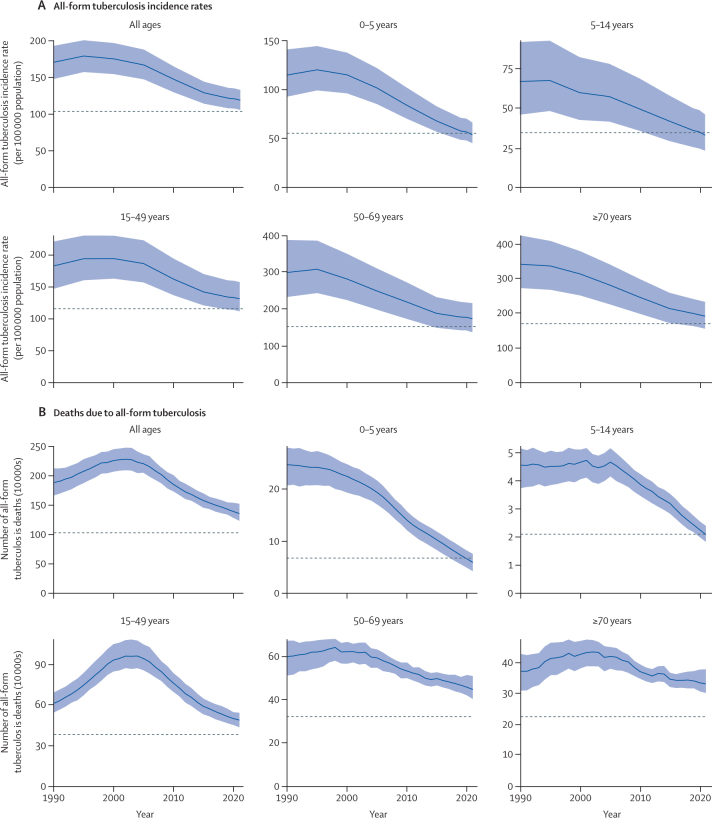
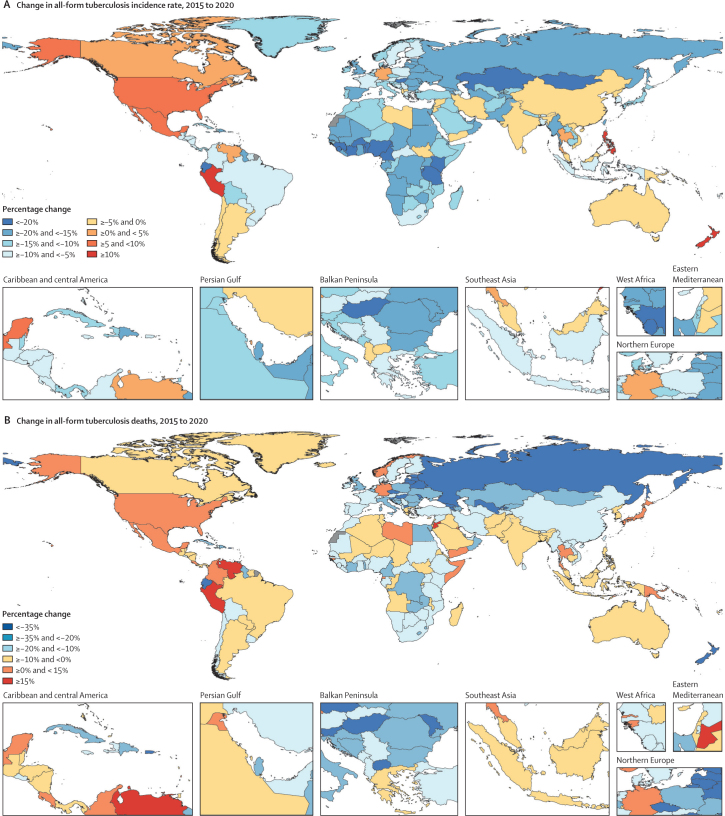
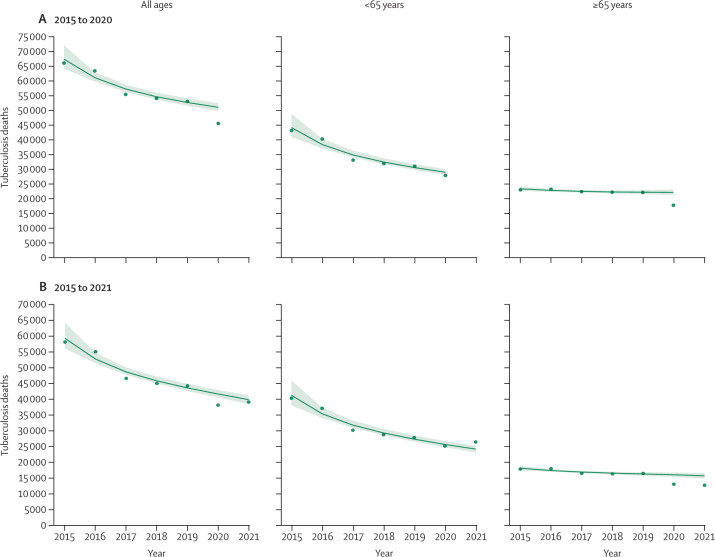
BACKGROUND: Global evaluations of the progress towards the WHO End TB Strategy 2020 interim milestones on mortality (35% reduction) and incidence (20% reduction) have not been age specific. We aimed to assess global, regional, and national-level burdens of and trends in tuberculosis and its risk factors across five separate age groups, from 1990 to 2021, and to report on age-specific progress between 2015 and 2020. METHODS: We used the Global Burden of Diseases, Injuries, and Risk Factors Study 2021 (GBD 2021) analytical framework to compute age-specific tuberculosis mortality and incidence estimates for 204 countries and territories (1990-2021 inclusive). We quantified tuberculosis mortality among individuals without HIV co-infection using 22 603 site-years of vital registration data, 1718 site-years of verbal autopsy data, 825 site-years of sample-based vital registration data, 680 site-years of mortality surveillance data, and 9 site-years of minimally invasive tissue sample (MITS) diagnoses data as inputs into the Cause of Death Ensemble modelling platform. Age-specific HIV and tuberculosis deaths were established with a population attributable fraction approach. We analysed all available population-based data sources, including prevalence surveys, annual case notifications, tuberculin surveys, and tuberculosis mortality, in DisMod-MR 2.1 to produce internally consistent age-specific estimates of tuberculosis incidence, prevalence, and mortality. We also estimated age-specific tuberculosis mortality without HIV co-infection that is attributable to the independent and combined effects of three risk factors (smoking, alcohol use, and diabetes). As a secondary analysis, we examined the potential impact of the COVID-19 pandemic on tuberculosis mortality without HIV co-infection by comparing expected tuberculosis deaths, modelled with trends in tuberculosis deaths from 2015 to 2019 in vital registration data, with observed tuberculosis deaths in 2020 and 2021 for countries with available cause-specific mortality data. FINDINGS: We estimated 9·40 million (95% uncertainty interval [UI] 8·36 to 10·5) tuberculosis incident cases and 1·35 million (1·23 to 1·52) deaths due to tuberculosis in 2021. At the global level, the all-age tuberculosis incidence rate declined by 6·26% (5·27 to 7·25) between 2015 and 2020 (the WHO End TB strategy evaluation period). 15 of 204 countries achieved a 20% decrease in all-age tuberculosis incidence between 2015 and 2020, eight of which were in western sub-Saharan Africa. When stratified by age, global tuberculosis incidence rates decreased by 16·5% (14·8 to 18·4) in children younger than 5 years, 16·2% (14·2 to 17·9) in those aged 5-14 years, 6·29% (5·05 to 7·70) in those aged 15-49 years, 5·72% (4·02 to 7·39) in those aged 50-69 years, and 8·48% (6·74 to 10·4) in those aged 70 years and older, from 2015 to 2020. Global tuberculosis deaths decreased by 11·9% (5·77 to 17·0) from 2015 to 2020. 17 countries attained a 35% reduction in deaths due to tuberculosis between 2015 and 2020, most of which were in eastern Europe (six countries) and central Europe (four countries). There was variable progress by age: a 35·3% (26·7 to 41·7) decrease in tuberculosis deaths in children younger than 5 years, a 29·5% (25·5 to 34·1) decrease in those aged 5-14 years, a 15·2% (10·0 to 20·2) decrease in those aged 15-49 years, a 7·97% (0·472 to 14·1) decrease in those aged 50-69 years, and a 3·29% (-5·56 to 9·07) decrease in those aged 70 years and older. Removing the combined effects of the three attributable risk factors would have reduced the number of all-age tuberculosis deaths from 1·39 million (1·28 to 1·54) to 1·00 million (0·703 to 1·23) in 2020, representing a 36·5% (21·5 to 54·8) reduction in tuberculosis deaths compared to those observed in 2015. 41 countries were included in our analysis of the impact of the COVID-19 pandemic on tuberculosis deaths without HIV co-infection in 2020, and 20 countries were included in the analysis for 2021. In 2020, 50 900 (95% CI 49 700 to 52 400) deaths were expected across all ages, compared to an observed 45 500 deaths, corresponding to 5340 (4070 to 6920) fewer deaths; in 2021, 39 600 (38 300 to 41 100) deaths were expected across all ages compared to an observed 39 000 deaths, corresponding to 657 (-713 to 2180) fewer deaths. INTERPRETATION: Despite accelerated progress in reducing the global burden of tuberculosis in the past decade, the world did not attain the first interim milestones of the WHO End TB Strategy in 2020. The pace of decline has been unequal with respect to age, with older adults (ie, those aged >50 years) having the slowest progress. As countries refine their national tuberculosis programmes and recalibrate for achieving the 2035 targets, they could consider learning from the strategies of countries that achieved the 2020 milestones, as well as consider targeted interventions to improve outcomes in older age groups. FUNDING: Bill & M
Overview
CoChat Summary
TL;DR
In GBD 2021, global tuberculosis incidence fell by 6·26% and tuberculosis deaths by 11·9% between 2015 and 2020, missing the WHO End TB Strategy 2020 milestones of 20% incidence reduction and 35% mortality reduction. Progress was unequal by age, with older adults improving slowest, while removing smoking, alcohol use, and diabetes would have reduced 2020 tuberculosis deaths by 36·5% versus 2015.
Key findings
- In 2021, there were an estimated 9·40 million (95% UI 8·36–10·5) tuberculosis incident cases and 1·35 million (1·23–1·52) tuberculosis deaths; HIV–tuberculosis co-infection accounted for 1·00 million (0·90–1·13) incident cases and 205 000 (158 000–248 000) deaths.
- From 2015 to 2020, the global all-age tuberculosis incidence rate declined by 6·26% (5·27–7·25) and global tuberculosis deaths declined by 11·9% (5·77–17·0); 15 of 204 countries achieved a 20% decrease in all-age incidence, and the abstract reports 17 countries attained a 35% reduction in deaths (the results text reports 19 countries/territories achieving this milestone).
- Age-specific incidence declines from 2015 to 2020 were largest in children younger than 5 years (16·5% [14·8–18·4]) and those aged 5–14 years (16·2% [14·2–17·9]), versus 6·29% (5·05–7·70) in ages 15–49, 5·72% (4·02–7·39) in ages 50–69, and 8·48% (6·74–10·4) in ages ≥70; death declines were 35·3% (26·7–41·7), 29·5% (25·5–34·1), 15·2% (10·0–20·2), 7·97% (0·472–14·1), and 3·29% (–5·56 to 9·07), respectively.
- Removing the combined effects of smoking, alcohol use, and diabetes would have reduced all-age tuberculosis deaths from 1·39 million (1·28–1·54) to 1·00 million (0·703–1·23) in 2020, a 36·5% (21·5–54·8) reduction versus observed 2015 deaths; corresponding reductions were 31·0% (15·9–48·8) in ages 15–49, 40·5% (22·3–62·6) in ages 50–69, and 41·0% (25·4–62·0) in ages ≥70. In the COVID-19 secondary analysis, 41 countries had 50 900 expected versus 45 500 observed tuberculosis deaths without HIV co-infection in 2020 (5 340 [4 070–6 920] fewer), and 20 countries had 39 600 expected versus 39 000 observed in 2021 (657 [–713 to 2 180] fewer).
Methods
- GBD 2021 analytical framework was used to compute age-specific tuberculosis mortality and incidence estimates for 204 countries and territories from 1990 to 2021. Tuberculosis mortality without HIV co-infection was modelled with CODEm using 22 603 site-years of vital registration data, 1 718 site-years of verbal autopsy data, 825 site-years of sample-based vital registration data, 680 site-years of mortality surveillance data, and 9 site-years of minimally invasive tissue sample diagnoses; HIV–tuberculosis deaths were estimated with a population attributable fraction approach.
- Tuberculosis morbidity was modelled in DisMod-MR 2.1 using prevalence surveys, annual case notifications, tuberculin surveys, and tuberculosis mortality data to produce internally consistent age-specific incidence, prevalence, and mortality estimates; incidence for countries with low-quality cause-of-death data was predicted via a mortality-to-incidence ratio approach, and incidence was disaggregated by HIV status.
- Risk-factor analysis computed age-sex-specific population attributable fractions for smoking, alcohol consumption, and diabetes among adults without HIV co-infection, then derived risk-deleted mortality rates. The COVID-19 secondary analysis used quasi-Poisson regression on 2015–2019 vital registration data to predict expected tuberculosis deaths in 2020–21 for countries with available cause-specific mortality data, stratified by ages <65 years, ≥65 years, and all ages.
Limitations
- The paper states that the primary limitation is data availability, with gaps across countries, age groups, and years; in the absence of data, estimates depended on covariates, spatial relationships, and out-of-sample predictive validity, and data scarcity is reflected in larger uncertainty intervals, with particular triangulation challenges in sub-Saharan Africa.
- The paper states it could not quantify tuberculosis mortality attributable to all important risk factors, excluding indoor air pollution and malnutrition, nor burden attributable to social determinants such as poverty and educational attainment; PAF estimates assume causality without confounding, that exposure removal does not affect unrelated risk factors, and that feasible interventions exist, and Levin’s formula may be biased although bias is often small with adjusted relative risks.
- The paper states that the COVID-19 impact could not be fully quantified due to insufficient empirical evidence and was restricted to 41 countries with available data, limiting generalisability; the text also makes evident that GBD 2021 and WHO 2022 estimates diverged for 2020–21 because of different modelling assumptions, and the authors discuss possible misclassification of COVID-19 deaths as tuberculosis deaths as an unresolved issue.
Model-written summary. Check it against the paper before relying on it.
Integrity signals
Registry
Cites
Statistics
Figures
Verification
Claims the paper makes
13 Valid · 0 Not valid · 36 Not checked · 127 Own results and interpretations
The cited sources support only part of this claim — read each source’s verdict below.
In the paper
“Recent progress has been unimpressive, however, as global annual rates of decline in tuberculosis incidence over the past 10 years have ranged between 1% and 2%.3, 4”
§ Global, regional, and national age-specific progress towards the 2020 milestones of the WHO End TB Strategy: a systematic analysis for the Global Burden of Disease Study 2021 > Introduction
What the sources say
- Partly supportedcites [3] GBD Tuberculosis Collaborators Global, regional, and national burden of tuberculosis, 1990–2016: results from the Global Burden of Diseases, Injuries, and Risk Factors 2016 Study Lancet Infect Dis 18 2018 1329 1349 30507459 PMC6250050 sourceExperimental — accuracy not yet measured
The Results section, “Changes in the burden of tuberculosis over time,” reports a 1.3% annual decline in global age-standardised incidence among HIV-negative individuals from 2006 to 2016. The claim omits that population qualifier: the same section reports a 4.0% annual decline among HIV-positive individuals, so the paper does not establish a 1–2% rate for tuberculosis incidence overall. (LLM, conf=0.86)
- Partly supportedcites [4] Pan Z Zhang J Bu Q The gap between global tuberculosis incidence and the first milestone of the WHO End Tuberculosis Strategy: an analysis based on the Global Burden of Disease 2017 database Infect Drug Resist 13 2020 1281 1286 32440164 PMC7210037 sourceExperimental — accuracy not yet measured
The Results report a global annual decline in TB incidence of 1.1%, which falls within the claimed 1%–2% range. But that figure covers 2015–2017, not the past 10 years; the Discussion also says the study analyzed only three years of data. No page numbers are available in our copy. (LLM, conf=0.88)
plain- Asserted: passes — The authors put it forward as true.
- Checkable: passes — It can be checked against evidence.
- Load-bearing: passes — The paper’s conclusions depend on it.
- Based: passes — The paper gives a reason why it holds.
- Partly supported
Every source the paper cites for this claim was checked and supports it.
In the paper
“most tuberculosis transmission among children occurs outside the household,62”
§ Global, regional, and national age-specific progress towards the 2020 milestones of the WHO End TB Strategy: a systematic analysis for the Global Burden of Disease Study 2021 > Discussion
What the sources say
- Supportedcites [62] Martinez L Lo NC Cords O Paediatric tuberculosis transmission outside the household: challenging historical paradigms to inform future public health strategies Lancet Respir Med 7 2019 544 552 31078497 PMC7323920 source
The Epidemiological evidence section states that, across 13 studies, most transmission to children occurs outside the household. The paper frames this conclusion particularly around high-burden settings. (LLM, conf=0.93)
hedgedstates a cause- Asserted: passes — The authors put it forward as true.
- Checkable: passes — It can be checked against evidence.
- Load-bearing: passes — The paper’s conclusions depend on it.
- Based: passes — The paper gives a reason why it holds.
- Supported
The cited sources support only part of this claim — read each source’s verdict below.
In the paper
“they are more likely to have adverse reactions to treatment.66”
§ Global, regional, and national age-specific progress towards the 2020 milestones of the WHO End TB Strategy: a systematic analysis for the Global Burden of Disease Study 2021 > Discussion
What the sources say
- Partly supportedcites [66] Hosford JD von Fricken ME Lauzardo M Hepatotoxicity from antituberculous therapy in the elderly: a systematic review Tuberculosis 95 2015 112 122 25595441 PMC4640443 sourceExperimental — accuracy not yet measured
The Discussion reports higher odds of TB-drug-associated hepatotoxic events in patients over 60 than in younger patients (OR 1.71, 95% CI 1.24–2.35). That supports an increased risk of a specific adverse reaction to antituberculous treatment, but the cited review does not establish that older individuals are more likely to have adverse reactions to treatment generally. Page numbers were not supplied in the passages. (LLM, conf=0.85)
hedgedstates an association- Asserted: passes — The authors put it forward as true.
- Checkable: passes — It can be checked against evidence.
- Load-bearing: passes — The paper’s conclusions depend on it.
- Based: passes — The paper gives a reason why it holds.
- Partly supported
The cited sources support only part of this claim — read each source’s verdict below.
In the paper
“This analysis provides some indication that previously described disruptions in tuberculosis services and treatment in both Russia78, 79 and Brazil80 might have led to increases in tuberculosis mortality.”
§ Global, regional, and national age-specific progress towards the 2020 milestones of the WHO End TB Strategy: a systematic analysis for the Global Burden of Disease Study 2021 > Discussion
What the sources say
- Supportedcites [78] Migliori GB Thong PM Alffenaar J-W Gauging the impact of the COVID-19 pandemic on tuberculosis services: a global study Eur Respir J 58 2021 2101786 PMC8581650 34446465 source
The cited study reports declines in TB diagnoses and care activity, including an evident decline in identified drug-resistant TB in Brazil (Abstract; page unavailable). In the citing sentence, this source supports the previously described disruptions; the suggestion that they might have increased mortality is framed as the citing authors’ own inference, not a finding attributed to this study. (LLM, conf=0.88)
- Partly supportedcites [79] Nalunjogi J Mucching-Toscano S Sibomana JP Impact of COVID-19 on diagnosis of tuberculosis, multidrug-resistant tuberculosis, and on mortality in 11 countries in Europe, Northern America, and Australia. A Global Tuberculosis Network study Int J Infect Dis 130 suppl 1 2023 S25 S29 36893943 PMC9991328 sourceExperimental — accuracy not yet measured
The Discussion (page unavailable) links disrupted TB services with reduced case-finding and higher TB mortality, supporting the general possibility in the claim. But the study's Results concern 11 countries in Europe, Northern America, and Australia; our copy does not document disruptions or mortality increases in Russia or Brazil. (LLM, conf=0.85)
- Supportedcites [80] Souza MR Paz WS Sales VBS Impact of the COVID-19 pandemic on the diagnosis of tuberculosis in Brazil: is the WHO End TB Strategy at risk? Front Pharmacol 13 2022 891711 PMC9277074 35847020 source
The Discussion reports that pandemic-related changes to Brazilian health services reduced tuberculosis diagnosis and may have affected timely treatment, access to care, and treatment adherence. The citing authors present the possible increase in mortality as their own inference, not as a finding attributed to this source. (LLM, conf=0.90)
hedgedstates a possible cause- Asserted: passes — The authors put it forward as true.
- Checkable: passes — It can be checked against evidence.
- Load-bearing: unclear — It is unclear whether the paper’s conclusions depend on it.
- Based: passes — The paper gives a reason why it holds.
- Supported
A result the paper reports from its own data — it cites no other source for it, so there is none to check. The quote shows it is in the paper.
In the paper
“HIV and tuberculosis co-infection constituted 1·00 million (0·90–1·13; 10·7% [10·3–11·0]) of the 9·40 million all-form tuberculosis incident cases and 205 000 (158 000–248 000; 15·1% [11·9–17·7]) of the 1·35 million all-form global tuberculosis deaths.”
§ Global, regional, and national age-specific progress towards the 2020 milestones of the WHO End TB Strategy: a systematic analysis for the Global Burden of Disease Study 2021 > Results > Overview
plain- Asserted: passes — The authors put it forward as true.
- Checkable: passes — It can be checked against evidence.
- Load-bearing: unclear — It is unclear whether the paper’s conclusions depend on it.
- Based: passes — The paper gives a reason why it holds.
96 more claims
Create a free account to see all 176 claims and to verify the 50 references still open.
- It may state two separate claims as one. 51
- Probably not a substantial claim. 38
Claims other papers make about this one
Each is checked against this paper’s own text: does it say what the citing paper says it does?
In the citing paper
“In contrast to our analysis, which we based on the GHE, a recent Global Burden of Disease (GBD) study reported lower tuberculosis deaths during the pandemic compared to expected deaths.83”
From Global health 2050: the path to halving premature death by mid-century (2024) · cites this paper as [83]
Self-check
Percentages, sums and reported differences re-computed from the paper’s own numbers.
Each contradiction between two passages listed here was confirmed by an independent check.
Rated major: it would touch a result — a value a result rests on, reported and recomputed p-values on opposite sides of the significance level, two passages that conflict with no sign which is right, or a cited work retracted before this paper was published.
In the paper
§ Global, regional, and national age-specific progress towards the 2020 milestones of the WHO End TB Strategy: a systematic analysis for the Global Burden of Disease Study 2021 > Results > Progress towards the End TB Strategy 2020 milestones
“19 countries and territories achieved this milestone: six in eastern Europe, four in central Europe, four in central Asia, two in the Caribbean, one in Andean Latin America, one in Australasia, and one in western sub-Saharan Africa”
§ Global, regional, and national age-specific progress towards the 2020 milestones of the WHO End TB Strategy: a systematic analysis for the Global Burden of Disease Study 2021 > Abstract > Findings
“17 countries attained a 35% reduction in deaths due to tuberculosis between 2015 and 2020”
Rated minor: it would not touch a result — a value no result rests on, a p-value that stays on the same side of the significance level, or a conflict that is clerical, resolved elsewhere in the paper, or outside its own findings.
In the paper
§ Global, regional, and national age-specific progress towards the 2020 milestones of the WHO End TB Strategy: a systematic analysis for the Global Burden of Disease Study 2021 > Discussion
“we found negative excess tuberculosis deaths in both 2020 and 2021 when aggregating across 41 of 204 countries”
§ Global, regional, and national age-specific progress towards the 2020 milestones of the WHO End TB Strategy: a systematic analysis for the Global Burden of Disease Study 2021 > Results > Impact of the COVID-19 pandemic on tuberculosis mortality
“There were 20 countries reporting data through the year 2021”
Rated minor: it would not touch a result — a value no result rests on, a p-value that stays on the same side of the significance level, or a conflict that is clerical, resolved elsewhere in the paper, or outside its own findings.
In the paper
§ Global, regional, and national age-specific progress towards the 2020 milestones of the WHO End TB Strategy: a systematic analysis for the Global Burden of Disease Study 2021 > Results > Progress towards the End TB Strategy 2020 milestones
“Furthermore, the cumulative number of countries achieving a 35% decrease would have increased from 15 to 132 in 2020 and 143 in 2021”
§ Global, regional, and national age-specific progress towards the 2020 milestones of the WHO End TB Strategy: a systematic analysis for the Global Burden of Disease Study 2021 > Abstract > Findings
“17 countries attained a 35% reduction in deaths due to tuberculosis between 2015 and 2020”
Citations
Cites
Vos, T., Lim, S. S., Abbafati, C., Abbas, K. M., Abbasi, M., Abbasifard, M., Abbasi-Kangevari, M., Abbastabar, H., Abd-Allah, F., Abdelalim, A., et al. (2020) · The Lancet · doi:10.1016/s0140-6736(20)30925-9 · Cited by 19,358
Self-citationJames, S. L., Abate, D., Abate, K. H., Abay, S. M., Abbafati, C., Abbasi, N., Abbastabar, H., Abd-Allah, F., Abdela, J., Abdelalim, A., et al. (2018) · The Lancet · doi:10.1016/s0140-6736(18)32279-7 · Cited by 13,867
Self-citationMurray, C. J. L., Aravkin, A. Y., Zheng, P., Abbafati, C., Abbas, K. M., Abbasi-Kangevari, M., Abd-Allah, F., Abdelalim, A., Abdollahi, M., Abdollahpour, I., et al. (2020) · The Lancet · doi:10.1016/s0140-6736(20)30752-2 · Cited by 9,854
Self-citationOng, K. L., Stafford, L. K., McLaughlin, S. A., Boyko, E. J., Vollset, S. E., Smith, A. E., Dalton, B. E., Duprey, J., Cruz, J. A., Hagins, H., et al. (2023) · The Lancet · doi:10.1016/s0140-6736(23)01301-6 · Cited by 6,146
Self-citationWang, H., Paulson, K. R., Pease, S. A., Watson, S., Comfort, H., Zheng, P., Aravkin, A. Y., Bisignano, C., Barber, R. M., Alam, T., et al. (2022) · The Lancet · doi:10.1016/s0140-6736(21)02796-3 · Cited by 2,069 · cited 1×
“Although the Institute for Health Metrics and Evaluation has estimated that there were 18 million excess all-cause deaths for the years 2020–21, 108 there is a scarcity of data on what fraction of these, if any, are due to tuberculosis.”
Self-citationPerin, J., Mulick, A., Yeung, D., Villavicencio, F., Lopez, G., Strong, K. L., Prieto-Merino, D., Cousens, S., Black, R. E., & Liu, L. (2022) · The Lancet Child & Adolescent Health · doi:10.1016/s2352-4642(21)00311-4 · Cited by 1,667 · cited 1×
“11 The substantial progress in reducing the tuberculosis burden in children might reflect recent trends showing marked decreases in child mortality, 54 global improvements in child nutrition outcomes, 55,56 increasing tuberculosis case finding and services for children, 57–59 and continued…”
Uplekar, M., Weil, D., Lonnroth, K., Jaramillo, E., Lienhardt, C., Dias, H. M., Falzon, D., Floyd, K., Gargioni, G., Getahun, H., et al. (2015) · The Lancet · doi:10.1016/s0140-6736(15)60570-0 · Cited by 1,117
Gavazzi, G., & Krause, K.-H. (2002) · The Lancet Infectious Diseases · doi:10.1016/s1473-3099(02)00437-1 · Cited by 990 · cited 2×
“11 Several factors could explain these marked age-related differences, including age-specific diagnostic challenges, 12,13 age-specific mixing patterns, 14 immune senescence 15 and other age-related immune dysfunctions, 16 and comorbidities common in older patients masking tuberculosis symptoms.”
Tiemersma, E. W., van der Werf, M. J., Borgdorff, M. W., Williams, B. G., & Nagelkerke, N. J. D. (2011) · PLoS ONE · doi:10.1371/journal.pone.0017601 · Cited by 583 · cited 2×
“To further improve internal consistency of modelling in DisMod, we computed all-age and both-sexes priors of tuberculosis duration using a combination of tuberculosis duration data from a systematic review of studies during the pre-chemotherapy era 25 and the HAQ Index.”
Bryazka, D., Reitsma, M. B., Griswold, M. G., Abate, K. H., Abbafati, C., Abbasi-Kangevari, M., Abbasi-Kangevari, Z., Abdoli, A., Abdollahi, M., Abdullah, A. Y. M., et al. (2022) · The Lancet · doi:10.1016/s0140-6736(22)00847-9 · Cited by 582
Self-citationModeling causes of death: an integrated approach using CODEm
Foreman, K. J., Lozano, R., Lopez, A. D., & Murray, C. J. (2012) · Population Health Metrics · doi:10.1186/1478-7954-10-1 · Cited by 564 · cited 1×
“Using these data as inputs, we fitted quasi-Poission regression models to data from 2015 to 2019 with population size as an offset to estimate the expected number of tuberculosis deaths in 2020–21 for each country.”
Self-citationAlipanah, N., Jarlsberg, L., Miller, C., Linh, N. N., Falzon, D., Jaramillo, E., & Nahid, P. (2018) · PLOS Medicine · doi:10.1371/journal.pmed.1002595 · Cited by 503 · cited 1×
“…research has indicated that treatment adherence interventions (eg, patient counselling and education, reminders, and digital health technologies) 47,48 and social protection interventions (eg, cash transfers and economic incentives) 49,50 can increase treatment adherence and prevent mortality.”
Weinberger, D. M., Chen, J., Cohen, T., Crawford, F. W., Mostashari, F., Olson, D., Pitzer, V. E., Reich, N. G., Russi, M., Simonsen, L., et al. (2020) · JAMA Internal Medicine · doi:10.1001/jamainternmed.2020.3391 · Cited by 485 · cited 1×
“81 Several other studies have also shown potential misclassified COVID-19 deaths in non-COVID-19 respiratory conditions, 82,83 which might be amplified in locations with scarce or inadequate SARS-CoV-2 diagnostic capabilities.”
Population attributable fraction
Mansournia, M. A., & Altman, D. G. (2018) · BMJ · doi:10.1136/bmj.k757 · Cited by 475 · cited 1×
“Studies have also highlighted the potential for bias in Levin’s formula for PAF calculation that we used in this analysis, 105,106 but the bias when using adjusted relative risks, as we have done here, is often small.”
Kyu, H. H., Maddison, E. R., Henry, N. J., Ledesma, J. R., Wiens, K. E., Reiner, R., Biehl, M. H., Shields, C., Osgood-Zimmerman, A., Ross, J. M., et al. (2018) · The Lancet Infectious Diseases · doi:10.1016/s1473-3099(18)30625-x · Cited by 437 · cited 2×
“We have previously published detailed methods of the GBD analytical framework 18,19 and tuberculosis burden estimation in GBD. 1,3,11 Here, we summarise the methodology for estimating tuberculosis mortality and morbidity, as well as key risk factors, with more detailed descriptions of the modelling…”
Self-citationStunting in childhood: an overview of global burden, trends, determinants, and drivers of decline
Vaivada, T., Akseer, N., Akseer, S., Somaskandan, A., Stefopulos, M., & Bhutta, Z. A. (2020) · The American Journal of Clinical Nutrition · doi:10.1093/ajcn/nqaa159 · Cited by 381 · cited 1×
“…the tuberculosis burden in children might reflect recent trends showing marked decreases in child mortality, 54 global improvements in child nutrition outcomes, 55,56 increasing tuberculosis case finding and services for children, 57–59 and continued reductions in vertical HIV transmission.”
Burden of childhood tuberculosis in 22 high-burden countries: a mathematical modelling study
Dodd, P. J., Gardiner, E., Coghlan, R., & Seddon, J. A. (2014) · The Lancet Global Health · doi:10.1016/s2214-109x(14)70245-1 · Cited by 370
Building a tuberculosis-free world: The Lancet Commission on tuberculosis
Reid, M. J. A., Arinaminpathy, N., Bloom, A., Bloom, B. R., Boehme, C., Chaisson, R., Chin, D. P., Churchyard, G., Cox, H., Ditiu, L., et al. (2019) · The Lancet · doi:10.1016/s0140-6736(19)30024-8 · Cited by 361
Self-citationOlsen, S. J., Azziz-Baumgartner, E., Budd, A. P., Brammer, L., Sullivan, S., Pineda, R. F., Cohen, C., & Fry, A. M. (2020) · American Journal of Transplantation · doi:10.1111/ajt.16381 · Cited by 339
The impact of COVID-19 on TB: a review of the data
McQuaid, C. F., Vassall, A., Cohen, T., Fiekert, K., COVID/TB Modelling Working Group *, & White, R. G. (2021) · The International Journal of Tuberculosis and Lung Disease · doi:10.5588/ijtld.21.0148 · Cited by 319 · cited 1×
“77 In the context of our analysis of 41 countries, we found many countries reporting lower than expected deaths, while a few countries had more deaths than expected in the absence of the COVID-19 pandemic, with Russia reporting an 8% increase in deaths in 2020 and a 15% increase in 2021, and Brazil…”
Mirzayev, F., Viney, K., Linh, N. N., Gonzalez-Angulo, L., Gegia, M., Jaramillo, E., Zignol, M., & Kasaeva, T. (2021) · European Respiratory Journal · doi:10.1183/13993003.03300-2020 · Cited by 301 · cited 1×
“51 Additional research should examine the marked progress in reducing tuberculosis deaths in the 17 countries that achieved the End TB mortality milestone in 2020.”
Barber, R. M., Sorensen, R. J. D., Pigott, D. M., Bisignano, C., Carter, A., Amlag, J. O., Collins, J. K., Abbafati, C., Adolph, C., Allorant, A., et al. (2022) · The Lancet · doi:10.1016/s0140-6736(22)00484-6 · Cited by 298
Self-citationHaakenstad, A., Yearwood, J. A., Fullman, N., Bintz, C., Bienhoff, K., Weaver, M. R., Nandakumar, V., LeGrand, K. E., Knight, M., Abbafati, C., et al. (2022) · The Lancet Global Health · doi:10.1016/s2214-109x(22)00429-6 · Cited by 258
Self-citationDelayed tuberculosis diagnosis and tuberculosis transmission.
Golub, J. E., Bur, S., Cronin, W. A., Gange, S. J., Baruch, N., Comstock, G. W., & Chaisson, R. E. (2006) · PubMed · Cited by 246
The potential impact of COVID-19-related disruption on tuberculosis burden
McQuaid, C. F., McCreesh, N., Read, J. M., Sumner, T., CMMID COVID-19 Working Group, Houben, R. M. G. J., White, R. G., & Harris, R. C. (2020) · European Respiratory Journal · doi:10.1183/13993003.01718-2020 · Cited by 224 · cited 1×
“Although many models have predicted hundreds of thousands of additional tuberculosis deaths due to the COVID-19 pandemic, 75,76 our analyses of the available vital registration data have so far indicated variable impact in 2020 and 2021.”
Health effects associated with smoking: a Burden of Proof study
Dai, X., Gil, G. F., Reitsma, M. B., Ahmad, N. S., Anderson, J. A., Bisignano, C., Carr, S., Feldman, R., Hay, S. I., He, J., et al. (2022) · Nature Medicine · doi:10.1038/s41591-022-01978-x · Cited by 224 · cited 2×
“We then used DisMod’s statistical triangulation approach, using the estimated tuberculosis duration priors and age-sex-specific tuberculosis mortality, prevalence, and incidence data, to derive final age-sex-specific tuberculosis duration estimates (appendix 1 pp 27–28).”
Self-citationEpidemiology of Tuberculosis and Progress Toward Meeting Global Targets — Worldwide, 2019
Fukunaga, R., Glaziou, P., Harris, J. B., Date, A., Floyd, K., & Kasaeva, T. (2021) · MMWR. Morbidity and Mortality Weekly Report · doi:10.15585/mmwr.mm7012a4 · Cited by 222
COVID-19 deaths in Africa: prospective systematic postmortem surveillance study
Mwananyanda, L., Gill, C. J., MacLeod, W., Kwenda, G., Pieciak, R., Mupila, Z., Lapidot, R., Mupeta, F., Forman, L., Ziko, L., et al. (2021) · BMJ · doi:10.1136/bmj.n334 · Cited by 211 · cited 1×
“84 Further investigations and scrutiny of cause of death data are urgently needed to understand the degree to which COVID-19 deaths were misassigned to tuberculosis and other respiratory condi tions.”
Houben, R. M. G. J., Menzies, N. A., Sumner, T., Huynh, G. H., Arinaminpathy, N., Goldhaber-Fiebert, J. D., Lin, H.-H., Wu, C.-Y., Mandal, S., Pandey, S., et al. (2016) · The Lancet Global Health · doi:10.1016/s2214-109x(16)30199-1 · Cited by 196
Self-citationCommunity-based active case-finding interventions for tuberculosis: a systematic review
Burke, R. M., Nliwasa, M., Feasey, H. R. A., Chaisson, L. H., Golub, J. E., Naufal, F., Shapiro, A. E., Ruperez, M., Telisinghe, L., Ayles, H., et al. (2021) · The Lancet Public Health · doi:10.1016/s2468-2667(21)00033-5 · Cited by 190
How countries can reduce child stunting at scale: lessons from exemplar countries
Bhutta, Z. A., Akseer, N., Keats, E. C., Vaivada, T., Baker, S., Horton, S. E., Katz, J., Menon, P., Piwoz, E., Shekar, M., et al. (2020) · The American Journal of Clinical Nutrition · doi:10.1093/ajcn/nqaa153 · Cited by 187 · cited 1×
“…the tuberculosis burden in children might reflect recent trends showing marked decreases in child mortality, 54 global improvements in child nutrition outcomes, 55,56 increasing tuberculosis case finding and services for children, 57–59 and continued reductions in vertical HIV transmission.”
Results from early programmatic implementation of Xpert MTB/RIF testing in nine countries
Creswell, J., Codlin, A. J., Andre, E., Micek, M. A., Bedru, A., Carter, E. J., Yadav, R.-P., Mosneaga, A., Rai, B., Banu, S., et al. (2014) · BMC Infectious Diseases · doi:10.1186/1471-2334-14-2 · Cited by 175
Public health utility of cause of death data: applying empirical algorithms to improve data quality
Johnson, S. C., Cunningham, M., Dippenaar, I. N., Sharara, F., Wool, E. E., Agesa, K. M., Han, C., Miller-Petrie, M. K., Wilson, S., Fuller, J. E., et al. (2021) · BMC Medical Informatics and Decision Making · doi:10.1186/s12911-021-01501-1 · Cited by 175 · cited 2×
“We processed raw cause of death data to account for completeness and differences in coding schemes, to redistribute deaths from unspecified codes to more specific underlying causes of death, 20 and to reassign misclassified HIV deaths.”
Self-citationTrimmed constrained mixed effects models: formulations and algorithms
Zheng, P., Barber, R., Sorensen, R. J. D., Murray, C. J. L., & Aravkin, A. Y. (2021) · Journal of Computational and Graphical Statistics · doi:10.1080/10618600.2020.1868303 · Cited by 174 · cited 3×
“We estimated incidence for these countries through a mortality-to-incidence ratio approach using countries with high-quality data ratings on cause of death data as inputs into a Bayesian meta-regression analysis 23 where the HAQ Index 24 was the primary covariate.”
Self-citationCaraux-Paz, P., Diamantis, S., de Wazières, B., & Gallien, S. (2021) · Journal of Clinical Medicine · doi:10.3390/jcm10245888 · Cited by 174
The incidence of tuberculosis among adolescents and young adults: a global estimate
Snow, K. J., Sismanidis, C., Denholm, J., Sawyer, S. M., & Graham, S. M. (2018) · European Respiratory Journal · doi:10.1183/13993003.02352-2017 · Cited by 173 · cited 1×
“The current evidence suggests that although the tuberculosis burden remains substantially high in children, 7,8 older age groups generally have the highest rates of tuberculosis mortality and incidence.”
Self-citationAge- and Sex-Specific Social Contact Patterns and Incidence of Mycobacterium tuberculosis Infection
Dodd, P. J., Looker, C., Plumb, I. D., Bond, V. A., Schaap, A., Shanaube, K., Muyoyeta, M., Vynnycky, E., Godfrey‐Faussett, P., Corbett, E. L., et al. (2015) · American Journal of Epidemiology · doi:10.1093/aje/kwv160 · Cited by 163
Ledesma, J. R., Ma, J., Vongpradith, A., Maddison, E. R., Novotney, A., Biehl, M. H., LeGrand, K. E., Ross, J. M., Jahagirdar, D., Bryazka, D., et al. (2022) · The Lancet Infectious Diseases · doi:10.1016/s1473-3099(21)00449-7 · Cited by 160
Self-citationGauging the impact of the COVID-19 pandemic on tuberculosis services: a global study
Migliori, G. B., Thong, P. M., Alffenaar, J.-W., Denholm, J., Tadolini, M., Alyaquobi, F., Blanc, F.-X., Buonsenso, D., Cho, J.-G., Codecasa, L. R., et al. (2021) · European Respiratory Journal · doi:10.1183/13993003.01786-2021 · Cited by 155
Self-citationBhargava, A., Bhargava, M., Meher, A., Teja, G. S., Velayutham, B., Watson, B., Benedetti, A., Barik, G., Singh, V. P., Singh, D., et al. (2023) · The Lancet Global Health · doi:10.1016/s2214-109x(23)00324-8 · Cited by 151
Self-citationDoes tuberculosis threaten our ageing populations?
Byng-Maddick, R., & Noursadeghi, M. (2016) · BMC Infectious Diseases · doi:10.1186/s12879-016-1451-0 · Cited by 149 · cited 1×
“For example, older individuals are more likely to progress to active tuberculosis, they do not have classical clinical features, 65 which has been shown to delay diagnosis and treatment, 17 and they are more likely to have adverse reactions to treatment.”
A systematic review and meta-analysis of the catastrophic costs incurred by tuberculosis patients
Ghazy, R. M., Saeh, H. M. E., Abdulaziz, S., Hammouda, E. A., Elzorkany, A. M., Khidr, H., Zarif, N., Elrewany, E. M. A., & ElHafeez, S. A. (2022) · Scientific Reports · doi:10.1038/s41598-021-04345-x · Cited by 133 · cited 1×
“Tuberculosis subsequently augments existing social and economic vulnerabilities as it creates substantial losses in productivity 73 and catastrophic financial costs 74 for people living in poverty.”
Self-citationTuberculosis elimination: where are we now?
Matteelli, A., Rendon, A., Tiberi, S., Al-Abri, S., Voniatis, C., Carvalho, A. C. C., Centis, R., D'Ambrosio, L., Visca, D., Spanevello, A., et al. (2018) · European Respiratory Review · doi:10.1183/16000617.0035-2018 · Cited by 130
Eliminating Mother-to-Child Transmission of HIV by 2030: 5 Strategies to Ensure Continued Progress
Vrazo, A. C., Sullivan, D., & Phelps, B. R. (2018) · Global Health Science and Practice · doi:10.9745/ghsp-d-17-00097 · Cited by 119 · cited 1×
“60,61 Despite these improvements, the burden of tuberculosis in children remains high, with an estimated 89 800 deaths in 2020.”
Goga, A. E., Dinh, T., Jackson, D. J., Lombard, C. J., Delaney, K. P., Puren, A. J., Sherman, G. G., Woldesenbet, S., Ramokolo, V., Crowley, S., et al. (2014) · Journal of Epidemiology & Community Health · doi:10.1136/jech-2014-204535 · Cited by 107 · cited 1×
“60,61 Despite these improvements, the burden of tuberculosis in children remains high, with an estimated 89 800 deaths in 2020.”
Impact of aging on immunity in the context of COVID-19, HIV, and tuberculosis
Grifoni, A., Alonzi, T., Alter, G., Noonan, D. M., LANDAY, A. L., Albini, A., & Goletti, D. (2023) · Frontiers in Immunology · doi:10.3389/fimmu.2023.1146704 · Cited by 94 · cited 1×
“11 Several factors could explain these marked age-related differences, including age-specific diagnostic challenges, 12,13 age-specific mixing patterns, 14 immune senescence 15 and other age-related immune dysfunctions, 16 and comorbidities common in older patients masking tuberculosis symptoms.”
Mhimbira, F., Cuevas, L. E., Dacombe, R. J., Mkopi, A., & Sinclair, D. (2017) · Cochrane Database of Systematic Reviews · doi:10.1002/14651858.cd011432.pub2 · Cited by 85 · cited 1×
“…could consider enhancing interventions that have previously been shown to improve detection and mitigate delays in treatment initiation, including active case finding, 36 tuberculosis outreach screening with communication campaigns, 37 and the use of new rapid tuberculosis diagnostic tools.”
Martinez, L., Lo, N. C., Cords, O., Hill, P. C., Khan, P., Hatherill, M., Mandalakas, A., Kay, A., Croda, J., Horsburgh, C. R., et al. (2019) · The Lancet Respiratory Medicine · doi:10.1016/s2213-2600(19)30137-7 · Cited by 85 · cited 1×
“With recent evidence suggesting that most tuberculosis transmission among children occurs outside the household, 62 integrating effective household contact-tracing programmes 63,64 with community-based strategies (eg, routine or mass screen ing, targeted preventive therapy, and environmental…”
Self-citationExcess mortality in the United States during the first three months of the COVID-19 pandemic
Rivera, R., Rosenbaum, J. E., & Quispe, W. (2020) · Epidemiology and Infection · doi:10.1017/s0950268820002617 · Cited by 83 · cited 1×
“81 Several other studies have also shown potential misclassified COVID-19 deaths in non-COVID-19 respiratory conditions, 82,83 which might be amplified in locations with scarce or inadequate SARS-CoV-2 diagnostic capabilities.”
Stamm, P., Sagoschen, I., Weise, K., Plachter, B., Münzel, T., Gori, T., & Vosseler, M. (2021) · Medical Microbiology and Immunology · doi:10.1007/s00430-021-00720-7 · Cited by 82
Dodd, P. J., Yuen, C. M., Becerra, M. C., Revill, P., Jenkins, H. E., & Seddon, J. A. (2018) · The Lancet Global Health · doi:10.1016/s2214-109x(18)30401-7 · Cited by 74 · cited 1×
“…that most tuberculosis transmission among children occurs outside the household, 62 integrating effective household contact-tracing programmes 63,64 with community-based strategies (eg, routine or mass screen ing, targeted preventive therapy, and environmental interventions) will be…”
Zawedde‐Muyanja, S., Nakanwagi-Mukwaya, A., Dongo, J. P., Sekadde, M. P., Nyinoburyo, R., Ssentongo, G., Detjen, A., Mugabe, F., Nakawesi, J. S., Karamagi, Y., et al. (2018) · The International Journal of Tuberculosis and Lung Disease · doi:10.5588/ijtld.18.0025 · Cited by 74 · cited 1×
“…the tuberculosis burden in children might reflect recent trends showing marked decreases in child mortality, 54 global improvements in child nutrition outcomes, 55,56 increasing tuberculosis case finding and services for children, 57–59 and continued reductions in vertical HIV transmission.”
Population attributable fraction in textbooks: Time to revise
Khosravi, A., Nazemipour, M., Shinozaki, T., & Mansournia, M. A. (2021) · Global Epidemiology · doi:10.1016/j.gloepi.2021.100062 · Cited by 74 · cited 2×
“105 However, these assumptions might not always hold true in practice.”
Li, J., Chung, P.-H., Leung, C. L. K., Nishikiori, N., Chan, E. Y. Y., & Yeoh, E.-K. (2017) · Infectious Diseases of Poverty · doi:10.1186/s40249-017-0284-4 · Cited by 73 · cited 1×
“69 Our study highlights that one opportunity for reducing the tuberculosis burden among older adults and achieving the End TB targets is by better addressing tuberculosis risk factors.”
Time to diagnosis of tuberculosis is greater in older patients: a retrospective cohort review
Abbara, A., Collin, S. M., Kon, O. M., Buell, K., Sullivan, A., Barrett, J., Corrah, T., McGregor, A., Hansel, T., John, L., et al. (2019) · ERJ Open Research · doi:10.1183/23120541.00228-2018 · Cited by 73 · cited 1×
“For example, older individuals are more likely to progress to active tuberculosis, they do not have classical clinical features, 65 which has been shown to delay diagnosis and treatment, 17 and they are more likely to have adverse reactions to treatment.”
J Carter, D., Daniel, R., Torrens, A. W., N Sanchez, M., Maciel, E. L. N., Bartholomay, P., Barreira, D. C., Rasella, D., Barreto, M. L., Rodrigues, L. C., et al. (2019) · BMJ Global Health · doi:10.1136/bmjgh-2018-001029 · Cited by 69
Comorbidities and increased mortality of COVID-19 among the elderly: a systematic review
Péterfi, A., Mészáros, Á., Szarvas, Z., Pénzes, M., Fekete, M., Fehér, Á., Lehoczki, A., Csípő, T., & Fazekas-Pongor, V. (2022) · Physiology International · doi:10.1556/2060.2022.00206 · Cited by 65
Hepatotoxicity from antituberculous therapy in the elderly: a systematic review
Hosford, J. D., von Fricken, M. E., Lauzardo, M., Chang, M., Dai, Y., Lyon, J. A., Shuster, J., & Fennelly, K. P. (2015) · Tuberculosis · doi:10.1016/j.tube.2014.10.006 · Cited by 63
Wang, Q., Guo, S., Wei, X., Dong, Q., Xu, N., Li, H., Zhao, J., & Sun, Q. (2022) · BMJ Open · doi:10.1136/bmjopen-2021-059396 · Cited by 61
Surendra, H., Elyazar, I., Puspaningrum, E., Darmawan, D., Pakasi, T. T., Lukitosari, E., Sulistyo, S., Deviernur, S. M., Fuady, A., Thwaites, G. E., et al. (2023) · The Lancet Global Health · doi:10.1016/s2214-109x(23)00312-1 · Cited by 58
Klein, K., Bernachea, M. P., Iribarren, S., Gibbons, L., Chirico, C., & Rubinstein, F. (2019) · PLoS Medicine · doi:10.1371/journal.pmed.1002788 · Cited by 54 · cited 1×
“…research has indicated that treatment adherence interventions (eg, patient counselling and education, reminders, and digital health technologies) 47,48 and social protection interventions (eg, cash transfers and economic incentives) 49,50 can increase treatment adherence and prevent mortality.”
Long-term outcomes of the global tuberculosis and COVID-19 co-infection cohort
Global Tuberculosis Network and TB/COVID-19 Global Study Group, Casco, N., Jorge, A. L., Palmero, D., Alffenaar, J. C., Fox, G. J., Ezz, W. N., Cho, J., Denholm, J. T., Skrahina, A. M., et al. (2023) · European Respiratory Journal · doi:10.1183/13993003.00925-2023 · Cited by 53
Colvin, C. E., Mugyabuso, J., Munuo, G., Lyimo, J., Oren, E., Mkomwa, Z., Makame, M., Mwangomale, A., Mahamba, V., Mueller, L., et al. (2014) · Global Health Science and Practice · doi:10.9745/ghsp-d-14-00026 · Cited by 51 · cited 1×
“…26% reduc tion (appendix 2 pp 86–149), the national tuberculosis programme scaled up community-based interventions aiming to link individuals to tuberculosis services with proven effectiveness 42 while introducing an effective nationwide quality-improvement initiative in tuberculosis case finding.”
Self-citationLee, C., Wang, J., Lin, H.-C., Lin, P.-Y., Chang, J., Suk, C., Lee, L., Lan, C., & Bai, K. (2017) · BMC Infectious Diseases · doi:10.1186/s12879-017-2554-y · Cited by 51
Do incentives improve tuberculosis treatment outcomes in the Republic of Moldova?
Ciobanu, A., Domente, L., Soltan, V., Bivol, S., Severin, L., Plesca, V., Van den Bergh, R., Kumar, A. M. V., & de Colombani, P. (2014) · Public Health Action · doi:10.5588/pha.14.0047 · Cited by 48
Sripad, A., Castedo, J., Danford, N., Zaha, R., & Freile, C. (2014) · The International Journal of Tuberculosis and Lung Disease · doi:10.5588/ijtld.13.0253 · Cited by 47 · cited 2×
“For instance, national social protection interventions in Moldova 52 (which achieved a 48% reduction) and Ecuador 53 (which achieved a 41% reduction; appendix 2 pp 86–149) markedly increased treatment adherence, potentially prevented drug resistance, and might have played a role in the countries’ progress.”
Diagnostic Challenges in Childhood Pulmonary Tuberculosis—Optimizing the Clinical Approach
Gunasekera, K. S., Vonasek, B. J., Oliwa, J. N., Triasih, R., Lancioni, C., Graham, S. M., Seddon, J. A., & Marais, B. J. (2022) · Pathogens · doi:10.3390/pathogens11040382 · Cited by 45 · cited 1×
“11 Several factors could explain these marked age-related differences, including age-specific diagnostic challenges, 12,13 age-specific mixing patterns, 14 immune senescence 15 and other age-related immune dysfunctions, 16 and comorbidities common in older patients masking tuberculosis symptoms.”
Souza, M. D. R., Paz, W. S. D., Sales, V. B. D. S., Jesus, G. F. H. D., Tavares, D. D. S., Lima, S. V. M. A., Sousa, Á. F. L., Melo, E. V. D., Carmo, R. F. D., Souza, C. D. F. D., et al. (2022) · Frontiers in Pharmacology · doi:10.3389/fphar.2022.891711 · Cited by 45 · cited 4×
“A recent study in Brazil found marked levels of misclassified COVID-19 deaths in garbage codes and hypothesised that there are additional misclassified COVID-19 deaths in other respiratory diseases.”
InfluentialCastellanos-Joya, M., Delgado-Sánchez, G., Ferreyra-Reyes, L. D., Cruz‐Hervert, L. P., Ferreira-Guerrero, E., Ortiz-Solís, G., Jiménez, M. I., Salazar, L. L., Montero-Campos, R., Mongua-Rodríguez, N., et al. (2014) · PLoS ONE · doi:10.1371/journal.pone.0106961 · Cited by 44 · cited 1×
“70,72 However, eliminating risk factors would still leave 1·00 million global tuberculosis deaths in 2020.”
Schwoebel, V., Koura, K. G., Adjobimey, M., Gnanou, S., Wandji, A., Gody, J., Delacourt, C., Detjen, A., Graham, S. M., Masserey, É., et al. (2020) · The International Journal of Tuberculosis and Lung Disease · doi:10.5588/ijtld.19.0712 · Cited by 43 · cited 1×
“…the tuberculosis burden in children might reflect recent trends showing marked decreases in child mortality, 54 global improvements in child nutrition outcomes, 55,56 increasing tuberculosis case finding and services for children, 57–59 and continued reductions in vertical HIV transmission.”
Chong, K. C., Leung, C. C., Yew, W. W., Zee, B. C. Y., Tam, G. C. H., Wang, M. H., Jia, K. M., Chung, P. H., Lau, S. Y. F., Han, X., et al. (2019) · Scientific Reports · doi:10.1038/s41598-019-41256-4 · Cited by 40 · cited 2×
“67 However, the high probability of adverse reactions to treatment, potentially contributing to higher likelihoods of interruptions to tuberculosis preventive therapy in this age group, 68 underscores the importance of developing shorter, less toxic treatments, along with early diagnosis, for…”
Economic support intervention improves tuberculosis treatment outcomes in rural Nigeria
Ukwaja, K. N., Alobu, I., Gidado, M., Onazi, O., & Oshi, D. C. (2017) · The International Journal of Tuberculosis and Lung Disease · doi:10.5588/ijtld.16.0741 · Cited by 35
Lungu, P., Kerkhoff, A. D., Muyoyeta, M., Kasapo, C., Nyangu, S., Kagujje, M., Chimzizi, R., Nyimbili, S., Khunga, M., Kasese-Chanda, N., et al. (2022) · Bulletin of the World Health Organization · doi:10.2471/blt.21.286109 · Cited by 35 · cited 1×
“85,86 With additional evidence show ing that the average duration until cure or death is 3 years for untreated patients with tuberculosis, 25 this timeframe might have also provided opportunities for tuberculosis service recovery programmes 87–90 to mobilise and avert mortality.”
Nalunjogi, J., Mucching-Toscano, S., Sibomana, J. P., Centis, R., D'Ambrosio, L., Alffenaar, J.-W., Denholm, J., Blanc, F.-X., Borisov, S., Danila, E., et al. (2023) · International Journal of Infectious Diseases · doi:10.1016/j.ijid.2023.02.025 · Cited by 35 · cited 1×
“This analysis provides some indication that previously described disruptions in tuberculosis services and treatment in both Russia 78,79 and Brazil 80 might have led to increases in tuberculosis mortality.”
BUTIMBA: Intensifying the Hunt for Child TB in Swaziland through Household Contact Tracing
Mandalakas, A. M., Ngo, K., Ustero, P., Golin, R., Anabwani-Richter, F., Mzileni, B., Sikhondze, W., & Stevens, R. H. (2017) · PLoS ONE · doi:10.1371/journal.pone.0169769 · Cited by 34
Siddiqi, K., Keding, A., Marshall, A., Dogar, O. F., Li, J., Huque, R., Fatima, R., Khan, A., Elsey, H., Gabe, R., et al. (2021) · Thorax · doi:10.1136/thoraxjnl-2020-215926 · Cited by 32 · cited 1×
“71 Mexico’s innovative tuberculosis and diabetes partnership is another example that provides bidirectional services across the continuum of care and has been shown to improve tuberculosis treatment outcomes while screening 85% of all diagnosed tuberculosis cases for diabetes.”
Coutinho, I., Alves, L. C., Werneck, G. L., & Trajman, A. (2023) · The Lancet Regional Health - Americas · doi:10.1016/j.lana.2023.100444 · Cited by 32 · cited 2×
“…national social protection interventions in Moldova 52 (which achieved a 48% reduction) and Ecuador 53 (which achieved a 41% reduction; appendix 2 pp 86–149) markedly increased treatment adherence, potentially prevented drug resistance, and might have played a role in the countries’ progress.”
Oga-Omenka, C., Sassi, A., Vasquez, N. A., Baruwa, E., Rosapep, L., Daniels, B., Olusola-Faleye, B., Huria, L., Adamu, A., Johns, B., et al. (2023) · PLOS Global Public Health · doi:10.1371/journal.pgph.0001618 · Cited by 32
Lestari, T., Kamaludin, Lowbridge, C., Kenangalem, E., Poespoprodjo, J. R., Graham, S. M., & Ralph, A. P. (2022) · PLOS Global Public Health · doi:10.1371/journal.pgph.0001114 · Cited by 30
Pan, Z., Zhang, J., Bu, Q., He, H., Bai, L., Yang, J., Liu, Q., & Lyu, J. (2020) · Infection and Drug Resistance · doi:10.2147/idr.s248875 · Cited by 29
Morishita, F., Viney, K. A., Lowbridge, C., Elsayed, H., Oh, K. H., Rahevar, K., Marais, B. J., & Islam, T. (2020) · Western Pacific surveillance response journal · doi:10.5365/wpsar.2020.11.3.002 · Cited by 29
Marley, G., Zou, X., Nie, J., Cheng, W., Xie, Y., Liao, H., Wang, Y., Tao, Y., Tucker, J. D., Sylvia, S., et al. (2023) · PLOS Medicine · doi:10.1371/journal.pmed.1004091 · Cited by 28 · cited 1×
“…research has indicated that treatment adherence interventions (eg, patient counselling and education, reminders, and digital health technologies) 47,48 and social protection interventions (eg, cash transfers and economic incentives) 49,50 can increase treatment adherence and prevent mortality.”
Modeling the impact of COVID-19 on future tuberculosis burden
Tovar, M., Aleta, A., Sanz, J., & Moreno, Y. (2022) · Communications Medicine · doi:10.1038/s43856-022-00145-0 · Cited by 26 · cited 1×
“Although many models have predicted hundreds of thousands of additional tuberculosis deaths due to the COVID-19 pandemic, 75,76 our analyses of the available vital registration data have so far indicated variable impact in 2020 and 2021.”
Review of antiretroviral therapy coverage in 10 highest burden HIV countries in Africa: 2015–2020
Babatunde, A. O., Akin‐Ajani, O. D., Abdullateef, R. O., Togunwa, T. O., & Isah, H. O. (2023) · Journal of Medical Virology · doi:10.1002/jmv.28320 · Cited by 25 · cited 1×
“46 We observed that only 17 countries achieved the End TB mortality milestone in 2020, indicating continued suboptimal treatment outcomes globally, potentially owing to poor early linkage to treatment, inadequate support for people with tuberculosis to ensure treatment adherence, unidentified drug…”
Feng, J.-Y., Huang, W.-C., Lin, S.-M., Wang, T.-Y., Lee, S. S.-J., Shu, C.-C., Pan, S.-W., Chen, C.-Y., Lin, C.-B., Wei, Y.-F., et al. (2020) · International Journal of Infectious Diseases · doi:10.1016/j.ijid.2020.05.009 · Cited by 24
Self-citationThe Impact of COVID-19 on Tuberculosis Program Performance in the Kingdom of Lesotho
Andom, A. T., Fejfar, D., Yuen, C. M., Ndayizigiye, M., Mugunga, J. C., & Mukherjee, J. S. (2023) · Tropical Medicine and Infectious Disease · doi:10.3390/tropicalmed8030165 · Cited by 24 · cited 1×
“85,86 With additional evidence show ing that the average duration until cure or death is 3 years for untreated patients with tuberculosis, 25 this timeframe might have also provided opportunities for tuberculosis service recovery programmes 87–90 to mobilise and avert mortality.”
Attributed causes of excess mortality during the COVID-19 pandemic in a south Indian city
Lewnard, J. A., B, C. M., Kang, G., & Laxminarayan, R. (2023) · Nature Communications · doi:10.1038/s41467-023-39322-7 · Cited by 23
Ferguson, J. P., Alvarez, A., Mulligan, M., Judge, C. S., & O'Donnell, M. J. (2024) · European Journal of Epidemiology · doi:10.1007/s10654-023-01063-8 · Cited by 22 · cited 1×
“107 Moreover, although we accounted for potential biases when quantifying the relationship between risk factors and tuberculosis through the inclusion of bias covariates, these covariates might not entirely identify and rectify bias if all or most input studies are inherently biased.”
França, E. B., Ishitani, L. H., de Abreu, D. M. X., Teixeira, R. A., Corrêa, P. R. L., de Jesus, E. D. S., Marinho, M. A. D., Bahia, T. V., Bierrenbach, A. L., Setel, P., et al. (2022) · PLOS Global Public Health · doi:10.1371/journal.pgph.0000199 · Cited by 21 · cited 1×
“81 Several other studies have also shown potential misclassified COVID-19 deaths in non-COVID-19 respiratory conditions, 82,83 which might be amplified in locations with scarce or inadequate SARS-CoV-2 diagnostic capabilities.”
Ogbudebe, C., Jeong, D., Odume, B., Chukwuogo, O., Dim, C., Useni, S., Okuzu, O., Malolan, C., Kim, D., Nwariaku, F., et al. (2023) · JMIR Public Health and Surveillance · doi:10.2196/40311 · Cited by 20 · cited 1×
“We provide complete details of the methods for estimation of the tuberculosis risk factors in appendix 1 (pp 39–67).”
Ledesma, J. R., Basting, A. V. L., Chu, H. T., Ma, J., Zhang, M., Vongpradith, A., Novotney, A., Dalos, J., Zheng, P., Murray, C. J. L., et al. (2023) · Microorganisms · doi:10.3390/microorganisms11092191 · Cited by 20 · cited 1×
“30 We subsequently compared age-specific observed tuberculosis deaths to predicted tuberculosis deaths in 2020 and 2021 to identify potential excess tuberculosis deaths.”
Self-citationMannan, S., Omenka, C. O., ThekkePurakkal, A. S., Huria, L., Kalra, A., Gandhi, R. K., Kapoor, T., Gunawardena, N., Raj, S., Kaur, M., et al. (2022) · Journal of Clinical Tuberculosis and Other Mycobacterial Diseases · doi:10.1016/j.jctube.2022.100327 · Cited by 16
Partnering with the private laboratories to strengthen TB diagnostics in Nigeria
Ali, T., Singh, U. B., Ohikhuai, C., Panwal, T., Adetiba, T., Agbaje, A., Olusola-Faleye, B., Klinton, J. S., Omenka, C. O., Tseja-Akinrin, A., et al. (2023) · Journal of Clinical Tuberculosis and Other Mycobacterial Diseases · doi:10.1016/j.jctube.2023.100369 · Cited by 15 · cited 1×
“…2 pp 86–149), indicating that its novel active case-finding interventions with advanced surveillance in tuberculosis hotspots, 39 increase in diagnostic equipment and par tnering with the private sector, 40 and economic incentives for patients 41 were effective in helping to achieve the milestone.”
Lin, E.-C., Tu, H.-P., & Hong, C.-H. (2023) · Respiratory Research · doi:10.1186/s12931-023-02365-x · Cited by 13
What is the impact of the COVID-19 pandemic on tuberculosis?
Kyu, H. H., & Ledesma, J. R. (2023) · The Lancet Global Health · doi:10.1016/s2214-109x(23)00360-1 · Cited by 13
Self-citationBigogo, G., Cain, K., Nyole, D., Masyongo, G., Auko, J. A., Wamola, N., Okumu, A., Agaya, J., Montgomery, J., Borgdorff, M., et al. (2018) · BMC Infectious Diseases · doi:10.1186/s12879-018-3172-z · Cited by 12
Rahman, M. T., Malik, A. A., Amanullah, F., & Creswell, J. (2022) · Journal of the Pediatric Infectious Diseases Society · doi:10.1093/jpids/piac093 · Cited by 10 · cited 1×
“…that most tuberculosis transmission among children occurs outside the household, 62 integrating effective household contact-tracing programmes 63,64 with community-based strategies (eg, routine or mass screen ing, targeted preventive therapy, and environmental interventions) will be…”
Ma, J., Vongpradith, A., Ledesma, J. R., Novotney, A., Yi, S., Lim, K., Hay, S. I., Murray, C. J. L., & Kyu, H. H. (2022) · BMC Infectious Diseases · doi:10.1186/s12879-022-07891-5 · Cited by 9 · cited 2×
“11 The substantial progress in reducing the tuberculosis burden in children might reflect recent trends showing marked decreases in child mortality, 54 global improvements in child nutrition outcomes, 55,56 increasing tuberculosis case finding and services for children, 57–59 and continued…”
Self-citationSabet, N., Omar, T., Milovanovic, M., Magajane, T., Mosala, M., Moloantoa, T., Kato-Kalule, N., Semedo, L. V., Swanepoel, F., Wallis, C., et al. (2023) · Clinical Infectious Diseases · doi:10.1093/cid/ciad212 · Cited by 8
Krishnamoorthy, Y., Nagarajan, R., Rajaa, S., Majella, M. G., Murali, S., & Jayaseelan, V. (2021) · Public Health · doi:10.1016/j.puhe.2021.06.021 · Cited by 6
Self-citationAdamou Mana, Z., Beaudou, C. N., Hilaire, K. F. J., Konso, J., Ndahbove, C., Waindim, Y., Ganava, M., Malama, T., Matip, C., Meoto, P., et al. (2022) · PLOS Global Public Health · doi:10.1371/journal.pgph.0000301 · Cited by 5
Enhancing tuberculosis case finding in Tanzania: implementation of a quality improvement initiative
Wandwalo, E. R., Kamara, V., Yassin, M. A., Morrison, L., Nwaneri, N., Asiimwe, S., Matiku, S., & Mutayoba, B. K. (2020) · Public Health Action · doi:10.5588/pha.19.0065 · Cited by 4 · cited 1×
“43 The marked progress in Cameroon 44 (30% reduction in incidence) and Kenya 45 (23% reduction in incidence; appendix 2 pp 86–149) might also point to the success of intensified tuberculosis case-finding programmes that were reported to increase case detection in these respective countries .”
Ferguson, J. P., Alvarez, A., Mulligan, M., et al. (2023) · medRxiv · doi:10.1101/2023.02.02.23284941 · Cited by 2
Research works printed but not linked: 1
- Byng-Maddick R Noursadeghi M Does tuberculosis threaten our ageing populations? BMC Infect Dis 16 2016 119 26968654 PMC4787032 · DOI · Paper page
Cited by
Naghavi, M., Kyu, H. H., A, B., Aalipour, M. A., Aalruz, H., Ababneh, H. S., Abafita, B. J., Abaraogu, U. O., Abbafati, C., Abbasi, M., et al. (2025) · The Lancet · doi:10.1016/s0140-6736(25)01917-8 · Cited by 595
Self-citationOh, J., Kim, S., Kim, M. S., Abate, Y. H., Abd ElHafeez, S., Abdelkader, A., Abdi, P., Abdulah, D. M., Aboagye, R. G., Abolhassani, H., et al. (2025) · The Lancet Respiratory Medicine · doi:10.1016/s2213-2600(25)00003-7 · Cited by 236
Self-citationXie, K., Cao, H., Ling, S., Zhong, J., Chen, H., Chen, P., & Huang, R. (2025) · Frontiers in Endocrinology · doi:10.3389/fendo.2025.1526482 · Cited by 152
Global health 2050: the path to halving premature death by mid-century
Jamison, D. T., Summers, L. H., Chang, A. Y., Karlsson, O., Mao, W., Norheim, O. F., Ogbuoji, O., Schäferhoff, M., Watkins, D., Adeyi, O., et al. (2024) · The Lancet · doi:10.1016/s0140-6736(24)01439-9 · Cited by 125
Self-citationOh, J. S., Kim, S., Yim, Y., Kim, M. S., Collaborators, G. 2. S. U., Shin, J. I., Jabbar, A. A., Aalruz, H., Abbasian, M., Magied, A. H. A. A. A., et al. (2026) · Nature Medicine · doi:10.1038/s41591-025-04077-9 · Cited by 85
“Two previous studies have also reported a decrease in the incidence of non-COVID lower respiratory infections and tuberculosis during the COVID-19 pandemic 7,8 .”
Self-citation
Metadata
- Authors
- Ledesma, J. R., Ma, J., Zhang, M., Basting, A. V. L., Chu, H. T., Vongpradith, A., Novotney, A., LeGrand, K. E., Xu, Y. Y., Dai, X., Nicholson, S. I., Stafford, L. K., Carter, A., Ross, J. M., Abbastabar, H., Abdoun, M., Abdulah, D. M., Aboagye, R. G., Abolhassani, H., Abrha, W. A., Abubaker Ali, H., Abu-Gharbieh, E., Aburuz, S., Addo, I. Y., Adepoju, A. V., Adhikari, K., Adnani, Q. E. S., Adra, S., Afework, A., Aghamiri, S., Agyemang-Duah, W., Ahinkorah, B. O., Ahmad, D., Ahmad, S., Ahmadzade, A. M., Ahmed, H., Ahmed, M., Ahmed, A., Akinosoglou, K., AL-Ahdal, T. M. A., Alam, N., Albashtawy, M., AlBataineh, M. T., Al-Gheethi, A. A. S., Ali, A., Ali, E. A., Ali, L., Ali, Z., Ali, S. S. S., Allel, K., Altaf, A., Al-Tawfiq, J. A., Alvis-Guzman, N., Alvis-Zakzuk, N. J., Amani, R., Amusa, G. A., Amzat, J., Andrews, J. R., Anil, A., Anwer, R., Aravkin, A. Y., Areda, D., Artamonov, A. A., Aruleba, R. T., Asemahagn, M. A., Atre, S. R., Aujayeb, A., Azadi, D., Azadnajafabad, S., Azzam, A. Y., Badar, M., Badiye, A. D., Bagherieh, S., Bahadorikhalili, S., Baig, A. A., Banach, M., Banik, B., Bardhan, M., Barqawi, H. J., Basharat, Z., Baskaran, P., Basu, S., Beiranvand, M., Belete, M. A., Belew, M. A., Belgaumi, U. I., Beloukas, A., Bettencourt, P. J. G., Bhagavathula, A. S., Bhardwaj, N., Bhardwaj, P., Bhargava, A., Bhat, V., Bhatti, J. S., Bhatti, G. K., Bikbov, B., Bitra, V. R., Bjegovic-Mikanovic, V., Buonsenso, D., Burkart, K., Bustanji, Y., Butt, Z. A., Camargos, P., Cao, Y., Carr, S., Carvalho, F., Cegolon, L., Cenderadewi, M., Cevik, M., Chahine, Y., Chattu, V. K., Ching, P. R., Chopra, H., Chung, E., Claassens, M. M., Coberly, K., Cruz-Martins, N., Dabo, B., Dadana, S., Dadras, O., Darban, I., Darega Gela, J., Darwesh, A. M., Dashti, M., Demessa, B. H., Demisse, B., Demissie, S., Derese, A. M. A., Deribe, K., Desai, H. D., Devanbu, V. G. C., Dhali, A., Dhama, K., Dhingra, S., Do, T. H. P., Dongarwar, D., Dsouza, H. L., Dube, J., Dziedzic, A. M., Ed-Dra, A., Efendi, F., Effendi, D. E., Eftekharimehrabad, A., Ekadinata, N., Ekundayo, T. C., Elhadi, M., Elilo, L. T., Emeto, T. I., Engelbert Bain, L., Fagbamigbe, A. F., Fahim, A., Feizkhah, A., Fetensa, G., Fischer, F., Gaipov, A., Gandhi, A. P., Gautam, R. K., Gebregergis, M. W., Gebrehiwot, M., Gebrekidan, K. G., Ghaffari, K., Ghassemi, F., Ghazy, R. M., Goodridge, A., Goyal, A., Guan, S.-Y., Gudeta, M. D., Guled, R. A., Gultom, N. B., Gupta, V. B., Gupta, V. K., Gupta, S., Hagins, H., Hailu, S. G., Hailu, W. B., Hamidi, S., Hanif, A., Harapan, H., Hasan, R. S., Hassan, S., Haubold, J., Hezam, K., Hong, S. H., Horita, N., Hossain, M. B., Hosseinzadeh, M., Hostiuc, M., Hostiuc, S., Huynh, H.-H., Ibitoye, S. E., Ikuta, K. S., Ilic, I. M., Ilic, M. D., Islam, M. R., Ismail, N. E., Ismail, F., Jafarzadeh, A., Jakovljevic, M., Jalili, M., Janodia, M. D., Jomehzadeh, N., Jonas, J. B., Joseph, N., Joshua, C. E., Kabir, Z., Kamble, B. D., Kanchan, T., Kandel, H., Kanmodi, K. K., Kantar, R. S., Karaye, I. M., Karimi Behnagh, A., Kassa, G. G., Kaur, R. J., Kaur, N., Khajuria, H., Khamesipour, F., Khan, Y. H., Khan, M. N., Khan Suheb, M. Z., Khatab, K., Khatami, F., Kim, M. S., Kosen, S., Koul, P. A., Koulmane Laxminarayana, S. L., Krishan, K., Kucuk Bicer, B., Kuddus, M. A., Kulimbet, M., Kumar, N., Lal, D. K., Landires, I., Latief, K., Le, T. D. T., Le, T. T. T., Ledda, C., Lee, M., Lee, S. W., Lerango, T. L., Lim, S. S., Liu, C., Liu, X., Lopukhov, P. D., Luo, H., Lv, H., Mahajan, P. B., Mahboobipour, A. A., Majeed, A., Malakan Rad, E., Malhotra, K., Malik, M. S. A., Malinga, L. A., Mallhi, T. H., Manilal, A., Martinez-Guerra, B. A., Martins-Melo, F. R., Marzo, R. R., Masoumi-Asl, H., Mathur, V., Maude, R. J., Mehrotra, R., Memish, Z. A., Mendoza, W., Menezes, R. G., Merza, M. A., Mestrovic, T., Mhlanga, L., Misra, S., Misra, A. K., Mithra, P., Moazen, B., Mohammed, H., Mokdad, A. H., Monasta, L., Moore, C. E., Mousavi, P., Mulita, F., Musaigwa, F., Muthusamy, R., Nagarajan, A. J., Naghavi, P., Naik, G. R., Naik, G., Nair, S., Nair, T. S., Natto, Z. S., Nayak, B. P., Negash, H., Nguyen, D. H., Nguyen, V. T., Niazi, R. K., Nnaji, C. A., Nnyanzi, L. A., Noman, E. A., Nomura, S., Oancea, B., Obamiro, K. O., Odetokun, I. A., Odo, D. B. O., Odukoya, O. O., Oh, I.-H., Okereke, C. O., Okonji, O. C., Oren, E., Ortiz-Brizuela, E., Osuagwu, U. L., Ouyahia, A., P A, M. P., Parija, P. P., Parikh, R. R., Park, S., Parthasarathi, A., Patil, S., Pawar, S., Peng, M., Pepito, V. C. F., Peprah, P., Perdigão, J., Perico, N., Pham, H. T., Postma, M. J., Prabhu, A. R. A., Prasad, M., Prashant, A., Prates, E. J. S., Rahim, F., Rahman, M., Rahman, M. A., Rahmati, M., Rajaa, S., Ramasamy, S. K., Rao, I. R., Rao, S. J., Rapaka, D., Rashid, A. M., Ratan, Z. A., Ravikumar, N., Rawaf, S., Reddy, M. M. R. K., Redwan, E. M. M., Remuzzi, G., Reyes, L. F., Rezaei, N., Rezaeian, M., Rezahosseini, O., Rodrigues, M., Roy, P., Ruela, G. D. A., Sabour, S., Saddik, B., Saeed, U., Safi, S. Z., Saheb Sharif-Askari, N., Saheb Sharif-Askari, F., Sahebkar, A., Sahiledengle, B., Sahoo, S. S., Salam, N., Salami, A. A., Saleem, S., Saleh, M. A., Samadi Kafil, H., Samadzadeh, S., Samodra, Y. L., Sanjeev, R. K., Saravanan, A., Sawyer, S. M., Selvaraj, S., Senapati, S., Senthilkumaran, S., Shah, P. A., Shahid, S., Shaikh, M. A., Sham, S., Shamshirgaran, M. A., Shanawaz, M., Sharath, M., Sherchan, S. P., Shetty, R. S., Shirzad-Aski, H., Shittu, A., Siddig, E. E., Silva, J. P., Singh, S., Singh, P., Singh, H., Singh, J. A., Siraj, M. S., Siswanto, S., Solanki, R., Solomon, Y., Soriano, J. B., Sreeramareddy, C. T., Srivastava, V. K., Steiropoulos, P., Swain, C. K., Tabuchi, T., Tampa, M., Tamuzi, J. J. L., Tat, N. Y., Tavakoli Oliaee, R., Teklay, G., Tesfaye, E. G., Tessema, B., Thangaraju, P., Thapar, R., Thum, C. C. C., Ticoalu, J. H. V., Tleyjeh, I. M., Tobe-Gai, R., Toma, T. M., Tram, K. H., Udoakang, A. J., Umar, T. P., Umeokonkwo, C. D., Vahabi, S. M., Vaithinathan, A. G., van Boven, J. F. M., Varthya, S. B., Wang, Z., Warsame, M. S. A., Westerman, R., Wonde, T. E., Yaghoubi, S., Yi, S., Yiğit, V., Yon, D. K., Yonemoto, N., Yu, C., Zakham, F., Zangiabadian, M., Zeukeng, F., Zhang, H., Zhao, Y., Zheng, P., Zielińska, M., Salomon, J. A., Reiner Jr, R. C., Naghavi, M., Vos, T., Hay, S. I., Murray, C. J. L., & Kyu, H. H.
- Affiliations
- University of Washington (US)
- ORCID
- Ledesma, Jorge R
- Ma, Jianing
- Basting, Ann V L
- Novotney, Amanda
- LeGrand, Kate E
- Xu, Yvonne Yiru
- Dai, Xiaochen
- Stafford, Lauryn K
- Carter, Austin
- Ross, Jennifer M
- Abbastabar, Hedayat
- Abdoun, Meriem
- Abdulah, Deldar Morad
- Aboagye, Richard Gyan
- Abolhassani, Hassan
- Aburuz, Salahdein
- Addo, Isaac Yeboah
- Adhikari, Kishor
- Adnani, Qorinah Estiningtyas Sakilah
- Adra, Saryia
- Ahinkorah, Bright Opoku
- Ahmad, Danish
- Ahmadzade, Amir Mahmoud
- Ahmed, Haroon
- Ahmed, Mohammed
- Ahmed, Ayman
- Akinosoglou, Karolina
- AL-Ahdal, Tareq Mohammed Ali
- Alam, Nazmul
- Albashtawy, Mohammed
- Al-Gheethi, Adel Ali Saeed
- Ali, Abid
- Ali, Endale Alemayehu
- Ali, Liaqat
- Ali, Zahid
- Ali, Syed Shujait Shujait
- Allel, Kasim
- Altaf, Awais
- Alvis-Zakzuk, Nelson J.
- Amzat, Jimoh
- Andrews, Jason R
- Anil, Abhishek
- Anwer, Razique
- Aravkin, Aleksandr Y
- Artamonov, Anton A
- Aruleba, Raphael Taiwo
- Asemahagn, Mulusew A
- Atre, Sachin R
- Aujayeb, Avinash
- Azadi, Davood
- Azadnajafabad, Sina
- Azzam, Ahmed Y
- Badar, Muhammad
- Badiye, Ashish D
- Bagherieh, Sara
- Baig, Atif Amin
- Banach, Maciej
- Banik, Biswajit
- Bardhan, Mainak
- Barqawi, Hiba Jawdat
- Basharat, Zarrin
- Baskaran, Pritish
- Basu, Saurav
- Beiranvand, Maryam
- Belete, Melaku Ashagrie
- Belew, Makda Abate
- Belgaumi, Uzma Iqbal
- Beloukas, Apostolos
- Bettencourt, Paulo J G
- Bhagavathula, Akshaya Srikanth
- Bhardwaj, Nikha
- Bhardwaj, Pankaj
- Bhargava, Ashish
- Bhatti, Jasvinder Singh
- Bhatti, Gurjit Kaur
- Bikbov, Boris
- Bitra, Veera R
- Bjegovic-Mikanovic, Vesna
- Buonsenso, Danilo
- Burkart, Katrin
- Bustanji, Yasser
- Butt, Zahid A
- Camargos, Paulo
- Cao, Yu
- Carr, Sinclair
- Cegolon, Luca
- Cenderadewi, Muthia
- Chahine, Yaacoub
- Chattu, Vijay Kumar
- Ching, Patrick R
- Chopra, Hitesh
- Claassens, Mareli M
- Dadana, Sriharsha
- Dadras, Omid
- Darban, Isaac
- Darwesh, Aso Mohammad
- Demisse, Biniyam
- Demissie, Solomon
- Deribe, Kebede
- Desai, Hardik Dineshbhai
- Dhali, Arkadeep
- Dhama, Kuldeep
- Dhingra, Sameer
- Dongarwar, Deepa
- Dsouza, Haneil Larson
- Dube, John
- Dziedzic, Arkadiusz Marian
- Efendi, Ferry
- Effendi, Diyan Ermawan
- Ekadinata, Nopryan
- Ekundayo, Temitope Cyrus
- Elhadi, Muhammed
- Elilo, Legesse Tesfaye
- Emeto, Theophilus I
- Fagbamigbe, Adeniyi Francis
- Fahim, Ayesha
- Feizkhah, Alireza
- Fischer, Florian
- Gaipov, Abduzhappar
- Gandhi, Aravind P
- Gautam, Rupesh K
- Gebrehiwot, Mesfin
- Gebrekidan, Kahsu Gebrekirstos
- Ghaffari, Kazem
- Ghassemi, Fariba
- Ghazy, Ramy Mohamed
- Goodridge, Amador
- Guan, Shi-Yang
- Guled, Rashid Abdi
- Gultom, Novianti Br
- Gupta, Veer Bala
- Gupta, Vivek Kumar
- Gupta, Sapna
- Hailu, Semira Goitom
- Hailu, Wase Benti
- Hamidi, Samer
- Hanif, Asif
- Harapan, Harapan
- Hasan, Rumina Syeda
- Haubold, Johannes
- Hezam, Kamal
- Hong, Sung Hwi
- Horita, Nobuyuki
- Hossain, Md. Belal
- Hosseinzadeh, Mehdi
- Hostiuc, Mihaela
- Hostiuc, Sorin
- Huynh, Hong-Han
- Ibitoye, Segun Emmanuel
- Ikuta, Kevin S
- Islam, Md. Rabiul
- Ismail, Nahlah Elkudssiah
- Ismail, Faisal
- Jafarzadeh, Abdollah
- Janodia, Manthan Dilipkumar
- Jomehzadeh, Nabi
- Jonas, Jost B
- Joseph, Nitin
- Kabir, Zubair
- Kamble, Bhushan Dattatray
- Kanchan, Tanuj
- Kandel, Himal
- Kanmodi, Kehinde Kazeem
- Kantar, Rami S
- Karaye, Ibraheem M
- Kassa, Gebrehiwot G
- Kaur, Rimple Jeet
- Kaur, Navjot
- Khajuria, Himanshu
- Khamesipour, Faham
- Khan, M Nuruzzaman
- Khatab, Khaled
- Kim, Min Seo
- Kosen, Soewarta
- Koul, Parvaiz A
- Krishan, Kewal
- Kuddus, Md Abdul
- Kulimbet, Mukhtar
- Kumar, Nithin
- Landires, Iván
- Latief, Kamaluddin
- Le, Trang Diep Thanh
- Ledda, Caterina
- Lee, Munjae
- Lee, Seung Won
- Lerango, Temesgen L
- Lim, Stephen S
- Liu, Chaojie
- Liu, Xuefeng
- Luo, Hong
- Mahajan, Preetam Bhalchandra
- Mahboobipour, Amir Ali
- Majeed, Azeem
- Malhotra, Kashish
- Malik, Muhammad Sajeel Ahmed
- Malinga, Lesibana Anthony
- Mallhi, Tauqeer Hussain
- Manilal, Aseer
- Marzo, Roy Rillera
- Masoumi-Asl, Hossein
- Mathur, Vasundhara
- Maude, Richard James
- Mehrotra, Ravi
- Memish, Ziad A
- Menezes, Ritesh G
- Merza, Muayad Aghali
- Mhlanga, Laurette
- Misra, Sanjeev
- Misra, Arup Kumar
- Mithra, Prasanna
- Moazen, Babak
- Mohammed, Hussen
- Mokdad, Ali H
- Monasta, Lorenzo
- Moore, Catrin E
- Mousavi, Parsa
- Mulita, Francesk
- Musaigwa, Fungai
- Nagarajan, Ahamarshan Jayaraman
- Naghavi, Pirouz
- Naik, Ganesh R
- Naik, Gurudatta
- Nair, Sanjeev
- Nair, Tapas Sadasivan
- Natto, Zuhair S
- Nayak, Biswa Prakash
- Nguyen, Dang H
- Nnaji, Chukwudi A
- Nnyanzi, Lawrence Achilles
- Noman, Efaq Ali
- Nomura, Shuhei
- Oancea, Bogdan
- Obamiro, Kehinde O
- Odetokun, Ismail A
- Odo, Daniel Bogale Odo
- Odukoya, Oluwakemi Ololade
- Oh, In-Hwan
- Okonji, Osaretin Christabel
- Oren, Eyal
- Osuagwu, Uchechukwu Levi
- Ouyahia, Amel
- Parija, Pragyan Paramita
- Parikh, Romil R
- Park, Seoyeon
- Parthasarathi, Ashwaghosha
- Patil, Shankargouda
- Pawar, Shrikant
- Peng, Minjin
- Pepito, Veincent Christian Filipino
- Peprah, Prince
- Perdigão, João
- Perico, Norberto
- Pham, Hoang Tran
- Postma, Maarten J
- Prasad, Manya
- Prashant, Akila
- Prates, Elton Junio Sady
- Rahim, Fakher
- Rahman, Mosiur
- Rahman, Muhammad Aziz
- Rahmati, Masoud
- Rajaa, Sathish
- Ramasamy, Shakthi Kumaran
- Rao, Indu Ramachandra
- Rapaka, Deepthi
- Rashid, Ahmed Mustafa
- Ratan, Zubair Ahmed
- Ravikumar, Nakul
- Rawaf, Salman
- Remuzzi, Giuseppe
- Reyes, Luis Felipe
- Rezaei, Nazila
- Rezaeian, Mohsen
- Rezahosseini, Omid
- Rodrigues, Mónica
- Roy, Priyanka
- Ruela, Guilherme de Andrade
- Sabour, Siamak
- Saddik, Basema
- Saeed, Umar
- Safi, Sher Zaman
- Sahebkar, Amirhossein
- Sahiledengle, Biniyam
- Sahoo, Soumya Swaroop
- Salam, Nasir
- Salami, Afeez Abolarinwa
- Saleem, Samreen
- Saleh, Mohamed A
- Samadzadeh, Sara
- Samodra, Yoseph Leonardo
- Sanjeev, Rama Krishna
- Saravanan, Aswini
- Sawyer, Susan M
- Selvaraj, Siddharthan
- Senapati, Sabyasachi
- Senthilkumaran, Subramanian
- Shah, Pritik A
- Shahid, Samiah
- Shaikh, Masood Ali
- Shamshirgaran, Mohammad Ali
- Sharath, Medha
- Sherchan, Samendra P
- Shetty, Ranjitha S
- Shittu, Aminu
- Siddig, Emmanuel Edwar
- Silva, João Pedro
- Singh, Surjit
- Singh, Paramdeep
- Singh, Harpreet
- Siraj, Md Shahjahan
- Siswanto, Siswanto
- Solanki, Ranjan
- Solomon, Yonatan
- Soriano, Joan B
- Sreeramareddy, Chandrashekhar T
- Steiropoulos, Paschalis
- Swain, Chandan Kumar
- Tabuchi, Takahiro
- Tampa, Mircea
- Tat, Nathan Y
- Teklay, Gebrehiwot
- Tessema, Belay
- Thangaraju, Pugazhenthan
- Thapar, Rekha
- Toma, Temesgen Mohammed
- Tram, Khai Hoan
- Udoakang, Aniefiok John
- Umar, Tungki Pratama
- Umeokonkwo, Chukwuma David
- Vahabi, Seyed Mohammad
- Vaithinathan, Asokan Govindaraj
- Varthya, Shoban Babu
- Wang, Ziyue
- Westerman, Ronny
- Wonde, Tewodros Eshete
- Yaghoubi, Sajad
- Yi, Siyan
- Yiğit, Vahit
- Yon, Dong Keon
- Yonemoto, Naohiro
- Yu, Chuanhua
- Zakham, Fathiah
- Zangiabadian, Moein
- Zeukeng, Francis
- Zhang, Haijun
- Zhao, Yang
- Zielińska, Magdalena
- Salomon, Joshua A
- Naghavi, Mohsen
- Vos, Theo
- Hay, Simon I
- Murray, Christopher J L
- Kyu, Hmwe Hmwe
- Venue
- The Lancet Infectious Diseases
- Publisher
- Elsevier BV
- Published
- 2024-07
- Volume
- 24
- Issue
- 7
- Pages
- 698-725
- ISSN
- 1473-3099 (ISSN-L)
- PMC
- PMC11187709
- OpenAlex
- W4392970825
- Semantic Scholar
- d707a077d18b9cdef721866ce35d1deaf6b2d7df
- Cited by
- 146
- References
- 106
- Citations by year
- 2026: 54 · 2025: 70 · 2024: 21
- FWCI
- 50.21
- Type
- journal article
- Language
- en
- Open access
- hybrid
- doi.org
- Licence
- cc-by
- www.elsevier.com/tdm/userlicense/1.0/ (tdm)
- www.elsevier.com/legal/tdmrep-license (tdm)
- creativecommons.org/licenses/by/4.0/ (vor)
- Locations
- The Lancet Infectious Diseases (publishedVersion, cc-by)
- PubMed Central (publishedVersion, cc-by)
- Charles Sturt University Research Output (CRO) (publishedVersion, cc-by)
- PubMed (publishedVersion)
- EUR Research Repository (Erasmus University Rotterdam) (publishedVersion, cc-by)
- University of Groningen research database (University of Groningen / Centre for Information Technology) (publishedVersion, cc-by)
- University of Southern Denmark Research Portal (University of Southern Denmark) (publishedVersion, cc-by)
- Teesside University Research Portal (Teesside University) (acceptedVersion, cc-by)
- St George's Online Research Archive (St George's University of London) (acceptedVersion)
- Pure (Coventry University) (acceptedVersion, cc-by)
- LSHTM Research Online (London School of Hygiene and Tropical Medicine) (acceptedVersion)
- SHURA (Sheffield Hallam University Research Archive) (Sheffield Hallam University) (acceptedVersion)
- ResearchOnline - JCU (James Cook University) (submittedVersion)
- Lirias (KU Leuven) (submittedVersion, cc-by)
- AJOU Open Repository (Ajou University) (submittedVersion)
- Kocaeli Üniversitesi - AVESİS (submittedVersion)
- eCommons - AKU (Aga Khan University) (submittedVersion)
- National University of Singapore (submittedVersion)
- Touro Scholar (Touro College) (submittedVersion)
- FedUni ResearchOnline (Federation University Australia) (submittedVersion, cc-by)
- ArTS Archivio della ricerca di Trieste (University of Trieste https://www.units.it/) (submittedVersion, cc-by)
- ArTS Archivio della ricerca di Trieste (University of Trieste https://www.units.it/) (submittedVersion, cc-by-nc-nd)
- Universitätsbibliographie, Universität Duisburg-Essen (submittedVersion)
- Figshare (submittedVersion, cc-by)
- Työväentutkimus Vuosikirja (submittedVersion)
- Intellectum (Universidad de La Sabana) (submittedVersion, cc-by-nc-nd)
- Minerva Access (University of Melbourne) (submittedVersion, cc-by)
- ANU Open Research (Australian National University) (submittedVersion, cc-by)
- Portuguese National Funding Agency for Science, Research and Technology (RCAAP Project by FCT) (submittedVersion, cc-by)
- Funders
- Bill & Melinda Gates Foundation
- Topics
- Health Sciences › Medicine › Infectious Diseases › Tuberculosis Research and Epidemiology
- Health Sciences › Medicine › Public Health, Environmental and Occupational Health › HIV, TB, and STIs Epidemiology
- Health Sciences › Medicine › Infectious Diseases › Infectious Diseases and Tuberculosis
- Keywords
- tuberculosis, End TB Strategy, age-specific mortality, tuberculosis incidence, HIV coinfection, smoking, alcohol consumption, diabetes mellitus, risk factors, COVID-19 pandemic impact, tuberculosis control, tuberculosis prevalence, tuberculosis incidence trends, population attributable fraction
- MeSH terms
- Global Burden of Disease, Adolescent, Adult, Age Factors, Aged, Aged, 80 and over, Child, Child, Preschool, Female, Humans, Infant, Infant, Newborn, Male, Middle Aged, Risk Factors, Tuberculosis, Global Health, World Health Organization, HIV Infections, Incidence, Young Adult, Coinfection
About these checks
Registry, retraction, Cites and statistics results are computed, not judged, with one exception: a printed reference that no index lists is read once by a model before it counts as a citation error. Claims are extracted by a model and kept only when their quote appears verbatim in the text; each cited source is then checked, with a model’s help, for whether it says what the claim relies on. Those verdicts can be wrong — read the claim’s quote and the cited source before relying on one.
The claim verdicts this report counts are experimental: their accuracy is not yet measured.
A language model drew the claims from the paper on 2026-10-04, under version 3 of the claim definition (model deepseek-v4.1-flash, prompt extract-v3).
A second model labelled each claim on 2026-10-04 (model jev-1.13-20260917, definition revision gold-guideline-v0.2).
Cited sources are checked with a language model’s help (gpt-6-sol).
Statistics and arithmetic are recomputed, not judged.
Confidence bands are shown only for fields calibrated on our annotated test set. None is calibrated yet, so no band is shown.
What counts as a claim ›How we measure confidence ›How we check this ›
Are you an author, or do you see a problem with this page? Request a review
Data sources
Bibliographic data: Semantic Scholar, OpenAlex, Crossref.
Contains information from the Semantic Scholar Academic Graph Datasets, made available under the ODC Attribution License (ODC-BY 1.0).
Semantic Scholar’s data is described in: Kinney, R., et al. (2023). The Semantic Scholar Open Data Platform. arXiv:2301.10140.
