

The DOI matches its Crossref record; 26 of the 26 references it cites were found in a registry or an index.
Effects of water quality, sanitation, handwashing, and nutritional interventions on diarrhoea and child growth in rural Kenya: a cluster-randomised controlled trial
Open accessAbstract
Background Poor nutrition and exposure to faecal contamination are associated with diarrhoea and growth faltering, both of which have long-term consequences for child health. We aimed to assess whether water, sanitation, handwashing, and nutrition interventions reduced diarrhoea or growth faltering. Methods The WASH Benefits cluster-randomised trial enrolled pregnant women from villages in rural Kenya and evaluated outcomes at 1 year and 2 years of follow-up. Geographically-adjacent clusters were block-randomised to active control (household visits to measure mid-upper-arm circumference), passive control (data collection only), or compound-level interventions including household visits to promote target behaviours: drinking chlorinated water (water); safe sanitation consisting of disposing faeces in an improved latrine (sanitation); handwashing with soap (handwashing); combined water, sanitation, and handwashing; counselling on appropriate maternal, infant, and young child feeding plus small-quantity lipid-based nutrient supplements from 6–24 months (nutrition); and combined water, sanitation, handwashing, and nutrition. Primary outcomes were caregiver-reported diarrhoea in the past 7 days and length-for-age Z score at year 2 in index children born to the enrolled pregnant women. Masking was not possible for data collection, but analyses were masked. Analysis was by intention to treat. This trial is registered with ClinicalTrials.gov, number NCT01704105. Findings Between Nov 27, 2012, and May 21, 2014, 8246 women in 702 clusters were enrolled and randomly assigned an intervention or control group. 1919 women were assigned to the active control group; 938 to passive control; 904 to water; 892 to sanitation; 917 to handwashing; 912 to combined water, sanitation, and handwashing; 843 to nutrition; and 921 to combined water, sanitation, handwashing, and nutrition. Data on diarrhoea at year 1 or year 2 were available for 6494 children and data on length-for-age Z score in year 2 were available for 6583 children (86% of living children were measured at year 2). Adherence indicators for sanitation, handwashing, and nutrition were more than 70% at year 1, handwashing fell to less than 25% at year 2, and for water was less than 45% at year 1 and less than 25% at year 2; combined groups were comparable to single groups. None of the interventions reduced diarrhoea prevalence compared with the active control. Compared with active control (length-for-age Z score −1·54) children in nutrition and combined water, sanitation, handwashing, and nutrition were taller by year 2 (mean difference 0·13 [95% CI 0·01–0·25] in the nutrition group; 0·16 [0·05–0·27] in the combined water, sanitation, handwashing, and nutrition group). The individual water, sanitation, and handwashing groups, and combined water, sanitation, and handwashing group had no effect on linear growth. Interpretation Behaviour change messaging combined with technologically simple interventions such as water treatment, household sanitation upgrades from unimproved to improved latrines, and handwashing stations did not reduce childhood diarrhoea or improve growth, even when adherence was at least as high as has been achieved by other programmes. Counselling and supplementation in the nutrition group and combined water, sanitation, handwashing, and nutrition interventions led to small growth benefits, but there was no advantage to integrating water, sanitation, and handwashing with nutrition. The interventions might have been more efficacious with higher adherence or in an environment with lower baseline sanitation coverage, especially in this context of high diarrhoea prevalence. Funding Bill & Melinda Gates Foundation, United States Agency for International Development.
Overview
The claims and statistics of this paper haven’t been checked yet.
Run the check — free, no account needed. It reads the open-access text and checks the sources it cites.
Integrity signals
Registry
Cites
Statistics
Figures
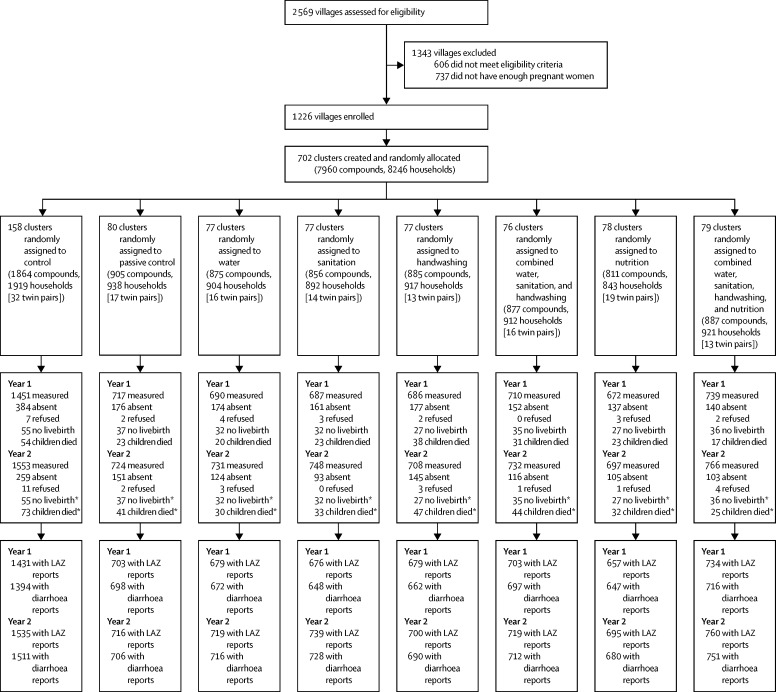
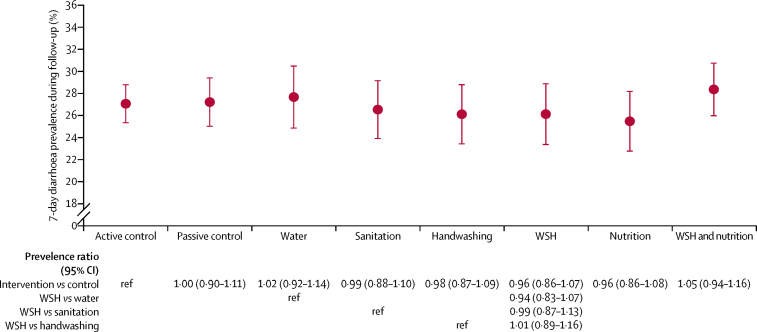
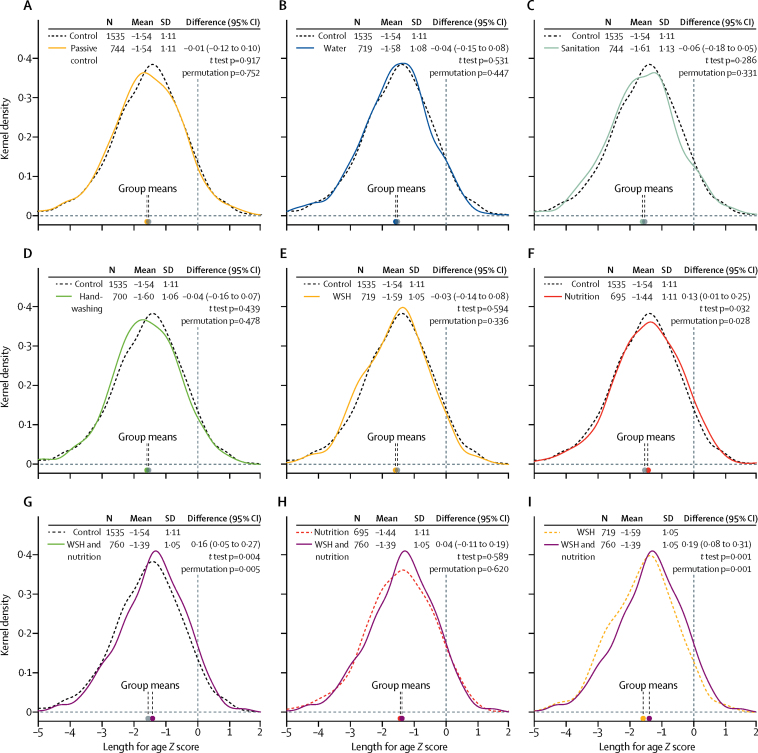
Verification
Claims the paper makes
The claims and statistics of this paper haven’t been checked yet.
Run the check — free, no account needed. It reads the open-access text and checks the sources it cites.
Claims other papers make about this one
Each is checked against this paper’s own text: does it say what the citing paper says it does?
The source backs part of the claim, not all of it — or backs it for a different population, condition or comparison.
In the citing paper
“Evidence on impact of improving household safe drinking water sources and/or treatment and storage, access to basic latrines and handwashing with soap on overall enteric pathogen detection and diarrhoea in children under 2 years of age is mixed, with some rigorously controlled and well-powered trials of interventions reporting little impact, even with high levels of behavioural compliance.1 6 7”
From Environmental and behavioural exposure pathways associated with diarrhoea and enteric pathogen detection in 5-month-old, periurban Kenyan infants: a cross-sectional study (2022) · cites this paper as [6]
Experimental — accuracy not yet measured
Self-check
Percentages, sums and reported differences re-computed from the paper’s own numbers.
The self-check needs the paper’s full text.
Citations
Cites
Maternal and child undernutrition and overweight in low-income and middle-income countries
Black, R. E., Victora, C. G., Walker, S. P., Bhutta, Z. A., Christian, P., de Onis, M., Ezzati, M., Grantham-McGregor, S., Katz, J., Martorell, R., et al. (2013) · The Lancet · doi:10.1016/s0140-6736(13)60937-x · Cited by 8,475
Wang, H., Naghavi, M., Allen, C., Barber, R. M., Bhutta, Z. A., Carter, A., Casey, D. C., Charlson, F. J., Chen, A. Z., Coates, M. M., et al. (2016) · The Lancet · doi:10.1016/s0140-6736(16)31012-1 · Cited by 6,596
Kotloff, K. L., Nataro, J. P., Blackwelder, W. C., Nasrin, D., Farag, T. H., Panchalingam, S., Wu, Y., Sow, S. O., Sur, D., Breiman, R. F., et al. (2013) · The Lancet · doi:10.1016/s0140-6736(13)60844-2 · Cited by 3,560
The stunting syndrome in developing countries
Prendergast, A. J., & Humphrey, J. H. (2014) · Paediatrics and International Child Health · doi:10.1179/2046905514y.0000000158 · Cited by 1,366
Interactions of Nutrition and Infection
Scrimshaw, N. S., Taylor, C. E., & Gordon, J. E. (1969) · Public Health · doi:10.1016/s0033-3506(69)80119-8 · Cited by 1,298
Child undernutrition, tropical enteropathy, toilets, and handwashing
Humphrey, J. H. (2009) · The Lancet · doi:10.1016/s0140-6736(09)60950-8 · Cited by 905
Luby, S. P., Rahman, M., Arnold, B. F., Unicomb, L., Ashraf, S., Winch, P. J., Stewart, C. P., Begum, F., Hussain, F., Benjamin-Chung, J., et al. (2018) · The Lancet Global Health · doi:10.1016/s2214-109x(17)30490-4 · Cited by 759
Self-citationNgure, F. M., Reid, B. M., Humphrey, J. H., Mbuya, M. N. N., Pelto, G. H., & Stoltzfus, R. J. (2014) · Annals of the New York Academy of Sciences · doi:10.1111/nyas.12330 · Cited by 538
Clasen, T., Boisson, S., Routray, P., Torondel, B., Bell, M., Cumming, O., Ensink, J., Freeman, M., Jenkins, M., Odagiri, M., et al. (2014) · The Lancet Global Health · doi:10.1016/s2214-109x(14)70307-9 · Cited by 537
Self-citationInterventions to improve water quality for preventing diarrhoea
Clasen, T., Alexander, K., Sinclair, D., Boisson, S., Peletz, R., Chang, H. H., Majorin, F., & Cairncross, S. (2015) · Cochrane Database of Systematic Reviews · doi:10.1002/14651858.cd004794.pub3 · Cited by 514
Self-citation
Cited by
Sorted by citations
Items 601–601 of 601
Lemma, H., Melaku, I., Asefa, L., Berhanu, G., Sori, G., Karbana, G., Dhengesu, D., & Roba, H. (2026) · Sage Open Pediatrics · doi:10.1177/30502225261498655
Metadata
- Authors
- Null, C., Stewart, C. P., Pickering, A. J., Dentz, H. N., Arnold, B. F., Arnold, C. D., Benjamin-Chung, J., Clasen, T., Dewey, K. G., Fernald, L. C. H., Hubbard, A. E., Kariger, P., Lin, A., Luby, S. P., Mertens, A., Njenga, S. M., Nyambane, G., Ram, P. K., & Colford, J. M.
- Affiliations
- Innovations for Poverty Action (US)
- University of California, Davis (US)
- Tufts University (US)
- University of California, Berkeley (US)
- Emory University (US)
- Stanford Medicine (US)
- Kenya Medical Research Institute (KE)
- University at Buffalo, State University of New York (US)
- Corresponding author
- Null, Clair
- ORCID
- Venue
- The Lancet Global Health
- Publisher
- Elsevier BV
- Published
- 2018-03
- Volume
- 6
- Issue
- 3
- Pages
- e316-e329
- ISSN
- 2214-109X (ISSN-L)
- PMC
- PMC5809717
- OpenAlex
- W4239240204
- Cited by
- 602
- References
- 26
- Citations by year
- 2026: 42 · 2025: 44 · 2024: 61 · 2023: 50 · 2022: 59 · 2021: 109 · 2020: 110 · 2019: 86 · 2018: 38
- FWCI
- 70.90
- Type
- journal article
- Language
- en
- Open access
- gold
- doi.org
- Licence
- Locations
- The Lancet Global Health (publishedVersion, cc-by)
- PubMed Central (publishedVersion, cc-by)
- LSHTM Research Online (London School of Hygiene and Tropical Medicine) (acceptedVersion)
- RePEc: Research Papers in Economics (submittedVersion)
- DOAJ (DOAJ: Directory of Open Access Journals) (submittedVersion, cc-by-sa)
- eScholarship (California Digital Library) (submittedVersion)
- Funders
- Bill and Melinda Gates Foundation (AID-OAA-F-13-00040)
- United States Agency for International Development
- Topics
- Health Sciences › Nursing › Nutrition and Dietetics › Child Nutrition and Water Access
- Health Sciences › Medicine › Pediatrics, Perinatology and Child Health › Global Maternal and Child Health
- Social Sciences › Development › Poverty, Education, and Child Welfare
- Keywords
- diarrhea, child growth faltering, water, sanitation and hygiene interventions, handwashing with soap, chlorinated drinking water, fecal contamination, lipid-based nutrient supplements, length-for-age z-score, home visits, rural Kenya, fecal-oral transmission, diarrhea prevention
About these checks
Registry, retraction, Cites and statistics results are computed, not judged, with one exception: a printed reference that no index lists is read once by a model before it counts as a citation error. Claims are extracted by a model and kept only when their quote appears verbatim in the text; each cited source is then checked, with a model’s help, for whether it says what the claim relies on. Those verdicts can be wrong — read the claim’s quote and the cited source before relying on one.
Statistics and arithmetic are recomputed, not judged.
Confidence bands are shown only for fields calibrated on our annotated test set. None is calibrated yet, so no band is shown.
What counts as a claim ›How we measure confidence ›How we check this ›
Are you an author, or do you see a problem with this page? Request a review
