

Scaling-up treatment of depression and anxiety: a global return on investment analysis
Open accessThe DOI matches its Crossref record; 38 of the 39 references it cites were found in a registry or an index.
Abstract
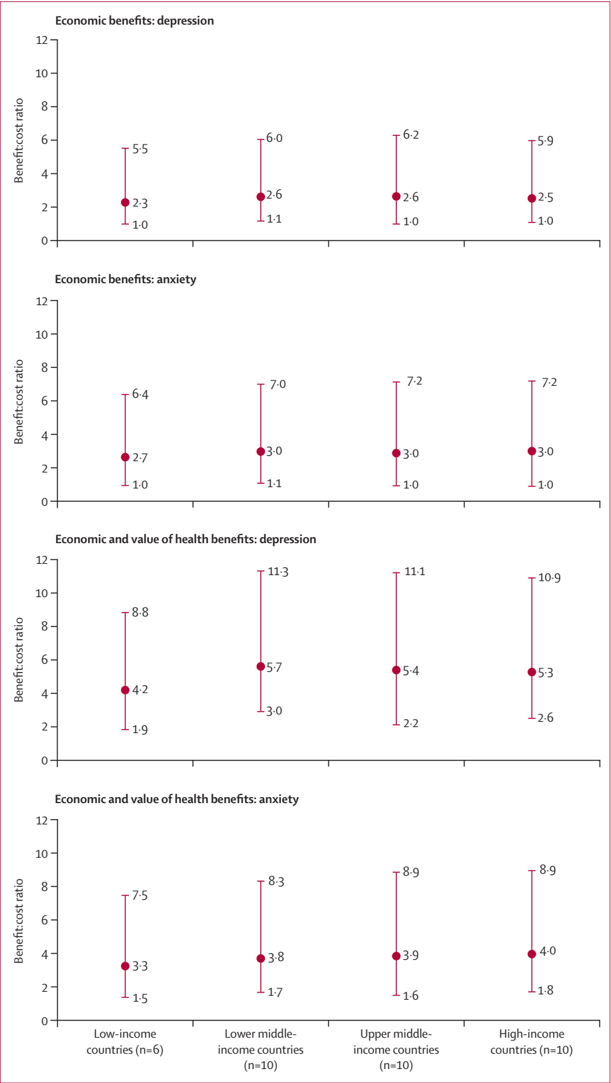
BACKGROUND: Depression and anxiety disorders are highly prevalent and disabling disorders, which result not only in an enormous amount of human misery and lost health, but also lost economic output. Here we propose a global investment case for a scaled-up response to the public health and economic burden of depression and anxiety disorders. METHODS: In this global return on investment analysis, we used the mental health module of the OneHealth tool to calculate treatment costs and health outcomes in 36 countries between 2016 and 2030. We assumed a linear increase in treatment coverage. We factored in a modest improvement of 5% in both the ability to work and productivity at work as a result of treatment, subsequently mapped to the prevailing rates of labour participation and gross domestic product (GDP) per worker in each country. FINDINGS: The net present value of investment needed over the period 2016-30 to substantially scale up effective treatment coverage for depression and anxiety disorders is estimated to be US$147 billion. The expected returns to this investment are also substantial. In terms of health impact, scaled-up treatment leads to 43 million extra years of healthy life over the scale-up period. Placing an economic value on these healthy life-years produces a net present value of $310 billion. As well as these intrinsic benefits associated with improved health, scaled-up treatment of common mental disorders also leads to large economic productivity gains (a net present value of $230 billion for scaled-up depression treatment and $169 billion for anxiety disorders). Across country income groups, resulting benefit to cost ratios amount to 2·3-3·0 to 1 when economic benefits only are considered, and 3·3-5·7 to 1 when the value of health returns is also included. INTERPRETATION: Return on investment analysis of the kind reported here can contribute strongly to a balanced investment case for enhanced action to address the large and growing burden of common mental disorders worldwide. FUNDING: Grand Challenges Canada.
Overview
The claims and statistics of this paper haven’t been checked yet.
Free: it reads the open-access text and checks the first 5 claims that cite a source we can check. Create a free account to check every claim.
Integrity signals
Registry
Cites
Statistics
Figures
Verification
Claims the paper makes
The claims and statistics of this paper haven’t been checked yet.
Free: it reads the open-access text and checks the first 5 claims that cite a source we can check. Create a free account to check every claim.
Claims other papers make about this one
Each is checked against this paper’s own text: does it say what the citing paper says it does?
The cited source says what the claim attributes to it.
In the citing paper
“Even in high-income countries, depression treatment rates are often below 30% (16, 17).”
From Personalised depression forecasting using mobile sensor data and ecological momentary assessment (2022) · cites this paper as [16]
The cited source says what the claim attributes to it.
In the citing paper
“Furthermore, the uptake of therapies is low, even in high-income countries (Chisholm et al. 2016), and one reason may be that therapies are not sufficiently acceptable to patients.”
From The Role of Common Factors in Psychotherapy Outcomes (2019) · cites this paper as Chisholm et al. 2016
The cited source says what the claim attributes to it.
In the citing paper
“Economic modelling work for the general population in all WHO regions indicates that investment in both pharmacological and psychological therapies can be costeffective even in the most resource-constrained regions of the world. 444,445”
From The Lancet Psychiatry Commission on youth mental health (2024) · cites this paper as [445]
In the citing paper
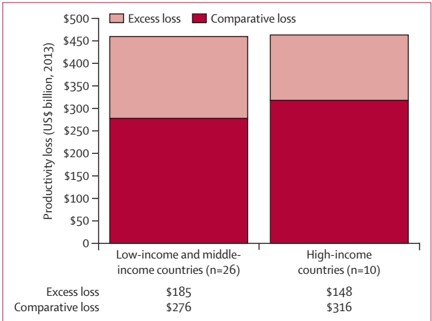
“NCDs also place a heavy economic burden on countries, with the annual lost productivity attributable to depression and anxiety disorders worldwide, for example, estimated in 2013 to be US$ 900 billion 6 .”
From Integrated care for people with long-term mental and physical health conditions in low-income and middle-income countries (2019) · cites this paper as [6]
Self-check
Percentages, sums and reported differences re-computed from the paper’s own numbers.
The self-check needs the paper’s full text.
Citations
Cites
Transforming Our World: The 2030 Agenda for Sustainable Development
(2018) · A New Era in Global Health · doi:10.1891/9780826190123.ap02 · Cited by 19,351
Awais, A. (2015) · Data Archiving and Networked Services (DANS) · doi:10.17632/zcvgc6m58h.1 · Cited by 6,707
Whiteford, H. A., Degenhardt, L., Rehm, J., Baxter, A. J., Ferrari, A. J., Erskine, H. E., Charlson, F. J., Norman, R. E., Flaxman, A. D., Johns, N., et al. (2013) · The Lancet · doi:10.1016/s0140-6736(13)61611-6 · Cited by 6,006
No health without mental health
Prince, M., Patel, V., Saxena, S., Maj, M., Maselko, J., Phillips, M. R., & Rahman, A. (2007) · The Lancet · doi:10.1016/s0140-6736(07)61238-0 · Cited by 3,753
Self-citationDisease control priorities in developing countries
(2006) · Choice Reviews Online · doi:10.5860/choice.44-0343 · Cited by 3,628
(2012) · RePEc: Research Papers in Economics · Cited by 1,951
Cost of disorders of the brain in Europe 2010
Gustavsson, A., Svensson, M., Jacobi, F., Allgulander, C., Alonso, J., Beghi, E., Dodel, R., Ekman, M., Faravelli, C., Fratiglioni, L., et al. (2011) · European Neuropsychopharmacology · doi:10.1016/j.euroneuro.2011.08.008 · Cited by 1,723
Disease control priorities in developing countries
Frenk, J. (2006) · Salud Pública de México · doi:10.1590/s0036-36342006000600011 · Cited by 1,599
Global prevalence of anxiety disorders: a systematic review and meta-regression
Baxter, A. J., Scott, K. M., Vos, T., & Whiteford, H. A. (2013) · Psychological Medicine · doi:10.1017/s003329171200147x · Cited by 1,537
Ferrari, A. J., Somerville, A. J., Baxter, A. J., Norman, R., Patten, S. B., Vos, T., & Whiteford, H. A. (2013) · Psychological Medicine · doi:10.1017/s0033291712001511 · Cited by 1,230
Global health 2035: a world converging within a generation
Jamison, D. T., Summers, L. H., Alleyne, G., Arrow, K. J., Berkley, S., Binagwaho, A., Bustreo, F., Evans, D., Feachem, R. G. A., Frenk, J., et al. (2013) · The Lancet · doi:10.1016/s0140-6736(13)62105-4 · Cited by 1,220 · cited 1×
“7 Stenberg and colleagues 36 attributed two-thirds of that derived value to the instrumental components, which are measured here directly via the labour force outcomes, leaving the remaining third for the intrinsic benefi ts of health, which is equivalent to 0 · 5 times per person income.”
Wells, K. B., Sherbourne, C., Schoenbaum, M., Duan, N., Meredith, L., Unützer, J., Miranda, J., Carney, M. F., & Rubenstein, L. V. (2000) · JAMA · doi:10.1001/jama.283.2.212 · Cited by 1,021
[Global health 2035: a world converging within a generation].
Jamison, D. T. T., Summers, L. H., Alleyne, G. A. O., Arrow, K. J., Berkley, S., Binagwaho, A., Bustreo, F., Evans, D., Feachem, R. G., Frenk, J. M., et al. (2015) · PubMed · Cited by 944
Poverty and mental disorders: breaking the cycle in low-income and middle-income countries
Lund, C., De Silva, M., Plagerson, S., Cooper, S., Chisholm, D., Das, J., Knapp, M., & Patel, V. (2011) · The Lancet · doi:10.1016/s0140-6736(11)60754-x · Cited by 929 · cited 1×
“41 In many countries, poor people face signifi cant barriers to accessing services, including the fi nancial cost of seeking and paying towards health care.”
Self-citationPatel, V., Chisholm, D., Parikh, R., Charlson, F. J., Degenhardt, L., Dua, T., Ferrari, A. J., Hyman, S., Laxminarayan, R., Levin, C., et al. (2016) · The Lancet · doi:10.1016/s0140-6736(15)00390-6 · Cited by 889
Self-citationAlonso, J., Petukhova, M., Vilagut, G., Chatterji, S., Heeringa, S., Üstün, T. B., Alhamzawi, A. O., Viana, M. C., Angermeyer, M., Bromet, E., et al. (2011) · Molecular Psychiatry · doi:10.1038/mp.2010.101 · Cited by 482
van Zoonen, K., Buntrock, C., Ebert, D. D., Smit, F., Reynolds, C. F., Beekman, A. T., & Cuijpers, P. (2014) · International Journal of Epidemiology · doi:10.1093/ije/dyt175 · Cited by 425 · cited 1×
“15 In line with WHO’s Mental Health Gap Action Programme (mhGAP) intervention guide, modelled interventions included basic psycho-social treatment for mild cases, and either basic or more intensive psychosocial treatment plus anti depressant drug for moderate to severe cases.”
Self-citationWang, P. S., Simon, G. E., Avorn, J., Azocar, F., Ludman, E. J., McCulloch, J., Petukhova, M. Z., & Kessler, R. C. (2007) · JAMA · doi:10.1001/jama.298.12.1401 · Cited by 408
Rahman, A., Fisher, J., Bower, P., Luchters, S., Tran, T., Yasamy, M. T., Saxena, S., & Waheed, W. (2013) · Bulletin of the World Health Organization · doi:10.2471/blt.12.109819 · Cited by 403
Self-citationStenberg, K., Axelson, H., Sheehan, P., Anderson, I., Gülmezoglu, A. M., Temmerman, M., Mason, E., Friedman, H. S., Bhutta, Z. A., Lawn, J. E., et al. (2014) · The Lancet · doi:10.1016/s0140-6736(13)62231-x · Cited by 355
Self-citationKeynejad, R. C., Dua, T., Barbui, C., & Thornicroft, G. (2018) · Evidence Based Mental Health · doi:10.1136/eb-2017-102750 · Cited by 341
Fit Mind, Fit Job: From Evidence to Practice in Mental Health and Work
OECD (2015) · Mental Health and Work · doi:10.1787/9789264228283-en · Cited by 329
Interventions to improve return to work in depressed people
Nieuwenhuijsen, K., Faber, B., Verbeek, J. H., Neumeyer-Gromen, A., Hees, H. L., Verhoeven, A. C., van der Feltz-Cornelis, C. M., & Bültmann, U. (2014) · Cochrane Database of Systematic Reviews · doi:10.1002/14651858.cd006237.pub3 · Cited by 299
Psychological treatment of depression: A meta-analytic database of randomized studies
Cuijpers, P., van Straten, A., Warmerdam, L., & Andersson, G. (2008) · BMC Psychiatry · doi:10.1186/1471-244x-8-36 · Cited by 241
Self-citationRost, K., Smith, J. L., & Dickinson, M. (2004) · Medical Care · doi:10.1097/00005650-200412000-00007 · Cited by 215
Cuijpers, P., Weitz, E., Karyotaki, E., Garber, J., & Andersson, G. (2015) · European Child & Adolescent Psychiatry · doi:10.1007/s00787-014-0660-6 · Cited by 205
Self-citationRollman, B. L., Belnap, B. H., Mazumdar, S., Houck, P. R., Zhu, F., Gardner, W., Reynolds, C. F., Schulberg, H. C., & Shear, M. K. (2005) · Archives of General Psychiatry · doi:10.1001/archpsyc.62.12.1332 · Cited by 197
Economic evaluation of a task-shifting intervention for common mental disorders in India
Buttorff, C., Hock, R., Weiss, H., Naik, S., Araya, R., Kirkwood, B., Chisholm, D., & Patel, V. (2012) · Bulletin of the World Health Organization · doi:10.2471/blt.12.104133 · Cited by 175
Self-citationThe Effects of Primary Care Depression Treatment on Patients' Clinical Status and Employment
Schoenbaum, M., Unützer, J., McCaffrey, D., Duan, N., Sherbourne, C., & Wells, K. B. (2002) · Health Services Research · doi:10.1111/1475-6773.01086 · Cited by 166
Woo, J., Kim, W. B., Hwang, T.-Y., Frick, K. D., Choi, B. H., Seo, Y.-J., Kang, E.-H., Kim, S. J., Ham, B., Lee, J., et al. (2011) · Value in Health · doi:10.1016/j.jval.2010.11.006 · Cited by 147
Cost of scaling up mental healthcare in low-and middle-income countries
Chisholm, D., Lund, C., & Saxena, S. (2007) · British Journal of Psychiatry · doi:10.1192/bjp.bp.107.038463 · Cited by 114 · cited 3×
“10,16,18,19 Key categories of resource use were: medication: 6 months continual antidepressant drug (generically produced fl uoxetine) was included for moderate to severe cases; outpatient and primary care: regular visits were needed for all cases, ranging from four per case per year for basic…”
Self-citationEstimating the coverage of mental health programmes: a systematic review
De Silva, M. J., Lee, L., Fuhr, D. C., Rathod, S., Chisholm, D., Schellenberg, J., & Patel, V. (2014) · International Journal of Epidemiology · doi:10.1093/ije/dyt191 · Cited by 106
Self-citationChisholm, D., & Saxena, S. (2012) · BMJ · doi:10.1136/bmj.e609 · Cited by 100
Self-citationPerspectives: an international review of the national cost estimates of mental illness, 1990-2003.
Hu, T.-W. (2006) · PubMed · Cited by 96
Role of common mental and physical disorders in partial disability around the world
Bruffaerts, R., Vilagut, G., Demyttenaere, K., Alonso, J., AlHamzawi, A., Andrade, L. H., Benjet, C., Bromet, E., Bunting, B., de Girolamo, G., et al. (2012) · British Journal of Psychiatry · doi:10.1192/bjp.bp.111.097519 · Cited by 96 · cited 2×
“…World Mental Health Survey, 4–15 more days out of role per year were recorded because of depression and 8–24 days because of generalised anxiety disorders; additional time lost per year due to presenteeism was 11–25 partial disability days for depression and 12–26 for generalised anxiety disorders.”
Lund, C., Waruguru, M., Kingori, J., Kippen-Wood, S., Breuer, E., Mannarath, S., & Raja, S. (2013) · International Health · doi:10.1093/inthealth/ihs037 · Cited by 69
Chisholm, D., Burman-Roy, S., Fekadu, A., Kathree, T., Kizza, D., Luitel, N. P., Petersen, I., Shidhaye, R., De Silva, M., & Lund, C. (2016) · British Journal of Psychiatry · doi:10.1192/bjp.bp.114.153866 · Cited by 63
Self-citationErratum: Global health 2035: a world converging within a generation (Lancet (2013) 382 (1898-1955))
Jamison, D. T. T., Summers, L. H., & Alleyne, G. A. O. (2014) · The Lancet · Cited by 61
Cited by
Nature and mental health: An ecosystem service perspective
Bratman, G. N., Anderson, C. B., Berman, M. G., Cochran, B., de Vries, S., Flanders, J., Folke, C., Frumkin, H., Gross, J. J., Hartig, T., et al. (2019) · Science Advances · doi:10.1126/sciadv.aax0903 · Cited by 2,001
Physical Activity and Incident Depression: A Meta-Analysis of Prospective Cohort Studies
Schuch, F. B., Vancampfort, D., Firth, J., Rosenbaum, S., Ward, P. B., Silva, E. S., Hallgren, M., Ponce De Leon, A., Dunn, A. L., Deslandes, A. C., et al. (2018) · American Journal of Psychiatry · doi:10.1176/appi.ajp.2018.17111194 · Cited by 1,763
“128 Excluded were: (1) studies without primary data (reviews, commentaries, editorials); (2) 129 conference presentations without information about the methods or the outcomes; (3) studies in 130”
BackgroundMethodKandola, A., Ashdown-Franks, G., Hendrikse, J., Sabiston, C. M., & Stubbs, B. (2019) · Neuroscience & Biobehavioral Reviews · doi:10.1016/j.neubiorev.2019.09.040 · Cited by 1,309
Poverty, depression, and anxiety: Causal evidence and mechanisms
Ridley, M., Rao, G., Schilbach, F., & Patel, V. (2020) · Science · doi:10.1126/science.aay0214 · Cited by 1,220
Lund, C., Brooke-Sumner, C., Baingana, F., Baron, E. C., Breuer, E., Chandra, P., Haushofer, J., Herrman, H., Jordans, M., Kieling, C., et al. (2018) · The Lancet Psychiatry · doi:10.1016/s2215-0366(18)30060-9 · Cited by 1,147
Self-citation
Metadata
- Authors
- Chisholm, D., Sweeny, K., Sheehan, P., Rasmussen, B., Smit, F., Cuijpers, P., & Saxena, S.
- Affiliations
- World Health Organization (CH)
- Trimbos Institute (NL)
- Vrije Universiteit Amsterdam (NL)
- Corresponding author
- Chisholm, Dan
- Venue
- The Lancet Psychiatry
- Publisher
- Elsevier BV
- Published
- 2016-05
- Volume
- 3
- Issue
- 5
- Pages
- 415-424
- ISSN
- 2215-0366 (ISSN-L)
- OpenAlex
- W2340346722
- Cited by
- 1,451
- References
- 39
- Citations by year
- 2026: 126 · 2025: 136 · 2024: 164 · 2023: 178 · 2022: 206 · 2021: 192 · 2020: 144 · 2019: 116 · 2018: 83 · 2017: 71 · 2016: 32
- FWCI
- 158.29
- Type
- journal article
- Language
- en
- Open access
- hybrid
- doi.org
- Licence
- cc-by
- www.elsevier.com/tdm/userlicense/1.0/ (tdm)
- creativecommons.org/licenses/by/4.0/ (vor)
- Locations
- The Lancet Psychiatry (publishedVersion, cc-by)
- PubMed (publishedVersion)
- Amsterdam UMC (VU Amsterdam) - Institutional Repository (publishedVersion)
- VU Research Portal (publishedVersion, other-oa)
- Pure Amsterdam UMC (submittedVersion, other-oa)
- Victoria University Research Repository (Victoria University) (submittedVersion)
- Data Archiving and Networked Services (DANS) (submittedVersion, other-oa)
- Data Archiving and Networked Services (DANS) (submittedVersion)
- Funders
- European Union under the 7th Framework programme (Grant agreement 305968)
- Topics
- Health Sciences › Medicine › Psychiatry and Mental health › Mental Health Treatment and Access
- Social Sciences › Economics, Econometrics and Finance › Economics and Econometrics › Health Systems, Economic Evaluations, Quality of Life
- Health Sciences › Medicine › Pharmacology (medical) › Treatment of Major Depression
- Keywords
- depression, anxiety disorders, common mental disorders, return on investment, mental health investment, economic burden of mental illness, productivity improvement, healthy life years, treatment coverage, benefit-cost ratio
- MeSH terms
- Anxiety, Cost-Benefit Analysis, Depression, Humans, Mental Health Services, Global Health, Health Care Costs, Cost of Illness
About these checks
Registry, retraction, Cites and statistics results are computed, not judged, with one exception: a printed reference that no index lists is read once by a model before it counts as a citation error. Claims are extracted by a model and kept only when their quote appears verbatim in the text; each cited source is then checked, with a model’s help, for whether it says what the claim relies on. Those verdicts can be wrong — read the claim’s quote and the cited source before relying on one.
Statistics and arithmetic are recomputed, not judged.
Confidence bands are shown only for fields calibrated on our annotated test set. None is calibrated yet, so no band is shown.
What counts as a claim ›How we measure confidence ›How we check this ›
Are you an author, or do you see a problem with this page? Request a review
Data sources
Bibliographic data: Semantic Scholar, OpenAlex, Crossref.
Contains information from the Semantic Scholar Academic Graph Datasets, made available under the ODC Attribution License (ODC-BY 1.0).
Semantic Scholar’s data is described in: Kinney, R., et al. (2023). The Semantic Scholar Open Data Platform. arXiv:2301.10140.
