

AVATAR therapy for auditory verbal hallucinations in people with psychosis: a single-blind, randomised controlled trial
Open accessThe DOI matches its Crossref record; 29 of the 30 references it cites were found in a registry or an index.
Abstract
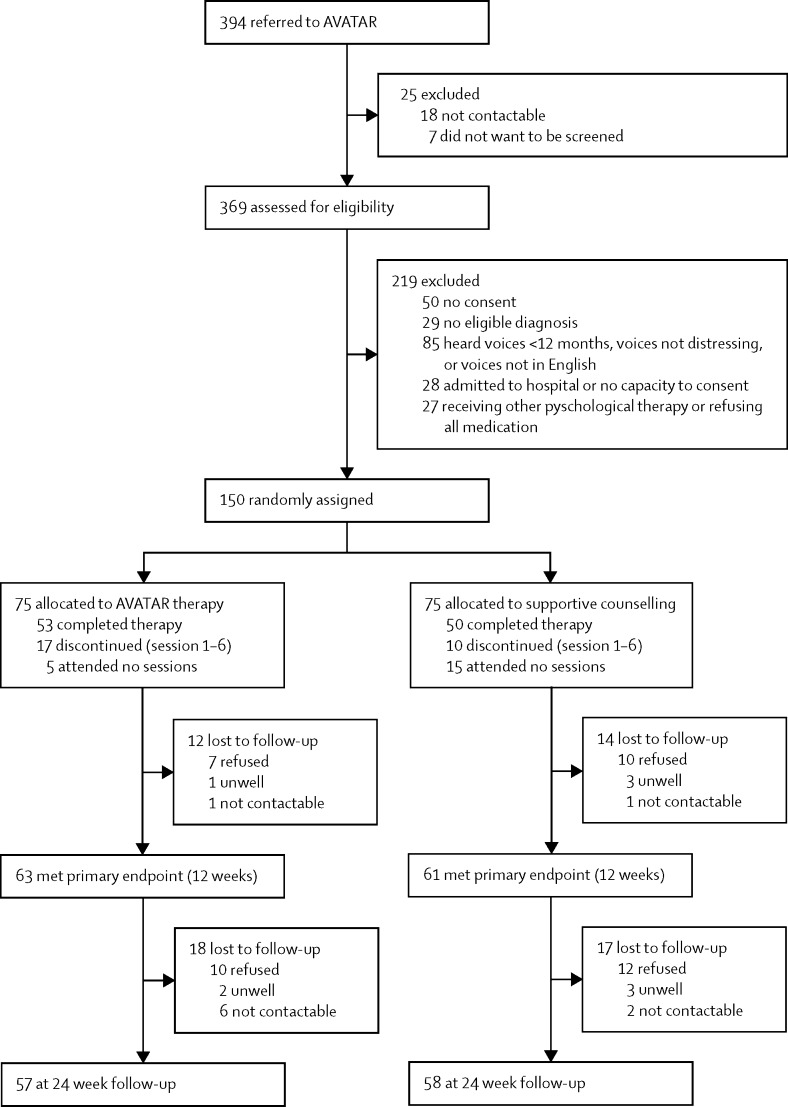
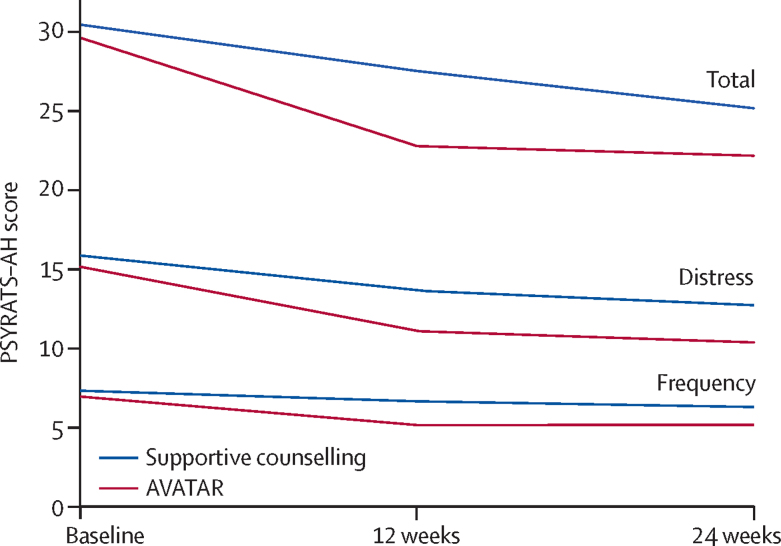
BACKGROUND: A quarter of people with psychotic conditions experience persistent auditory verbal hallucinations, despite treatment. AVATAR therapy (invented by Julian Leff in 2008) is a new approach in which people who hear voices have a dialogue with a digital representation (avatar) of their presumed persecutor, voiced by the therapist so that the avatar responds by becoming less hostile and concedes power over the course of therapy. We aimed to investigate the effect of AVATAR therapy on auditory verbal hallucinations, compared with a supportive counselling control condition. METHODS: We did this single-blind, randomised controlled trial at a single clinical location (South London and Maudsley NHS Trust). Participants were aged 18 to 65 years, had a clinical diagnosis of a schizophrenia spectrum (ICD10 F20-29) or affective disorder (F30-39 with psychotic symptoms), and had enduring auditory verbal hallucinations during the previous 12 months, despite continued treatment. Participants were randomly assigned (1:1) to receive AVATAR therapy or supportive counselling with randomised permuted blocks (block size randomly varying between two and six). Assessments were done at baseline, 12 weeks, and 24 weeks, by research assessors who were masked to therapy allocation. The primary outcome was reduction in auditory verbal hallucinations at 12 weeks, measured by total score on the Psychotic Symptoms Rating Scales Auditory Hallucinations (PSYRATS-AH). Analysis was by intention-to-treat with linear mixed models. The trial was prospectively registered with the ISRCTN registry, number 65314790. FINDINGS: Between Nov 1, 2013, and Jan 28, 2016, 394 people were referred to the study, of whom 369 were assessed for eligibility. Of these people, 150 were eligible and were randomly assigned to receive either AVATAR therapy (n=75) or supportive counselling (n=75). 124 (83%) met the primary outcome. The reduction in PSYRATS-AH total score at 12 weeks was significantly greater for AVATAR therapy than for supportive counselling (mean difference -3·82 [SE 1·47], 95% CI -6·70 to -0·94; p<0·0093). There was no evidence of any adverse events attributable to either therapy. INTERPRETATION: To our knowledge, this is the first powered, randomised controlled trial of AVATAR therapy. This brief, targeted therapy was more effective after 12 weeks of treatment than was supportive counselling in reducing the severity of persistent auditory verbal hallucinations, with a large effect size. Future multi-centre studies are needed to establish the effectiveness of AVATAR therapy and, if proven effective, we think it should become an option in the psychological treatment of auditory verbal hallucinations. FUNDING: Wellcome Trust.
Overview
The claims and statistics of this paper haven’t been checked yet.
Free: it reads the open-access text and checks the first 5 claims that cite a source we can check. Create a free account to check every claim.
Integrity signals
Registry
Cites
Statistics
Figures
Verification
Claims the paper makes
The claims and statistics of this paper haven’t been checked yet.
Free: it reads the open-access text and checks the first 5 claims that cite a source we can check. Create a free account to check every claim.
Claims other papers make about this one
Each is checked against this paper’s own text: does it say what the citing paper says it does?
The cited source doesn’t support the claim as written.
In the citing paper
“and have been successfully used to treat persecutory delusions for people with psychosis (61).”
From Key Considerations for Incorporating Conversational AI in Psychotherapy (2019) · cites this paper as [61]
Checked by a reasoning model — may be wrong.
Experimental — accuracy not yet measuredThe cited source says what the claim attributes to it.
In the citing paper
“Furtherly, distressing voice-hearing may improve in response to specific coaching [69]”
From The “common” experience of voice-hearing and its relationship with shame and guilt: a systematic review (2022) · cites this paper as [69]
The cited source says what the claim attributes to it.
In the citing paper
“with some promising early results [12–15]”
The cited source says what the claim attributes to it.
In the citing paper
“Craig et al. (43) showed that this avatar therapy was successful in diminishing the severity of patients' auditory verbal hallucinations.”
From Computer-assisted avatar-based treatment for dysfunctional beliefs in depressive inpatients: A pilot study (2021) · cites this paper as [43]
The check wasn’t confident either way, so it gives no verdict — never disputed.
In the citing paper
“In mental health, conversational AI has been shown to both facilitate and impede disclosure in different contexts.”
From Key Considerations for Incorporating Conversational AI in Psychotherapy (2019) · cites this paper as [61]
Experimental — accuracy not yet measured
Self-check
Percentages, sums and reported differences re-computed from the paper’s own numbers.
The self-check needs the paper’s full text.
Citations
Cites
Society and the Adolescent Self-Image
Rosenberg, M. (1965) · doi:10.1515/9781400876136 · Cited by 30,126
Lovibond, P. F., & Lovibond, S. H. (1995) · Behaviour Research and Therapy · doi:10.1016/0005-7967(94)00075-u · Cited by 14,523
The necessary and sufficient conditions of therapeutic personality change.
Rogers, C. R. (1957) · Journal of Consulting Psychology · doi:10.1037/h0045357 · Cited by 5,599
Scale for Assessment of Positive Symptoms (SAPS) 1984
Andreasen, N. C. (1995) · Open Scholarship Institutional Repository (Washington University in St. Louis) · Cited by 2,423
Scale for the Assessment of Negative Symptoms
Andreasen, N. C. (2014) · PsycTESTS Dataset · doi:10.1037/t12696-000 · Cited by 1,866
HADDOCK, G., McCARRON, J., TARRIER, N., & FARAGHER, E. B. (1999) · Psychological Medicine · doi:10.1017/s0033291799008661 · Cited by 1,461
Assessing Depression in Schizophrenia: The Calgary Depression Scale
Addington, D., Addington, J., & Maticka-tyndale, E. (1993) · British Journal of Psychiatry · doi:10.1192/s0007125000292581 · Cited by 1,177
Application and Results of the Manchester Short Assessment of Quality of Life (Mansa)
Priebe, S., Huxley, P., Knight, S., & Evans, S. (1999) · International Journal of Social Psychiatry · doi:10.1177/002076409904500102 · Cited by 1,071
The Omnipotence of Voices: A Cognitive Approach to Auditory Hallucinations
Chadwick, P., & Birchwood, M. (1994) · British Journal of Psychiatry · doi:10.1192/bjp.164.2.190 · Cited by 803
The Maudsley Addiction Profile (MAP): a brief instrument for assessing treatment outcome
Marsden, J., Gossop, M., Stewart, D., Best, D., Farrell, M., Lehmann, P., Edwards, C., & Strang, J. (1998) · Addiction · doi:10.1046/j.1360-0443.1998.9312185711.x · Cited by 488
Cited by
Items 101–200 of 403
Rus‐Calafell, M., Ehrbar, N., Ward, T., Edwards, C., Huckvale, M. A., Walke, J., Garety, P. A., & Craig, T. (2022) · BMC Psychiatry · doi:10.1186/s12888-022-04010-1 · Cited by 18
“Participants’ perceived impact of AVATAR therapy on everyday life was also consistent with the RCT results [8], with most participants reporting a significant decrease of frequency of their voices.”
BackgroundMethodResultInfluentialSelf-citationSheaves, B., Johns, L., Černis, E., Griffith, L., Panel, T. M. H. V. L. E. A., & Freeman, D. H. (2020) · Psychology and Psychotherapy Theory Research and Practice · doi:10.1111/papt.12303 · Cited by 27
“…investigating social schemata (assessed via quantitative methods or alternative qualitative questions) and the impact on social networks would be valuable, particularly given the existence of relational therapies (Craig et al., 2018; Hayward, Jones, Bogen-Johnston, Thomas, & Strauss, 2017).”
Zhuo, C., Fang, T., Chen, C., Chen, M., Sun, Y., Ma, X., Li, R., Tian, H., & Ping, J. (2020) · Brain and Behavior · doi:10.1002/brb3.1991 · Cited by 34
“However, in 2019, Lancet Psychiatry described the importance of strengthening longitudinal research in this field (Craig et al., 2018).”
BackgroundHudon, A., Beaudoin, M., Phraxayavong, K., Dellazizzo, L., Potvin, S., & Dumais, A. (2022) · Health Informatics Journal · doi:10.1177/14604582221142442 · Cited by 20
“The fi rst objective of this study is to conduct the automated text classi fi cation of interactions in AT.”
BackgroundMethodInfluentialMellor, M. J. (2018) · Frontiers in Psychology · doi:10.3389/fpsyg.2018.01674 · Cited by 17
Melvin, K., Crossley, J., & Cromby, J. (2021) · EClinicalMedicine · doi:10.1016/j.eclinm.2021.101153 · Cited by 19
“This study provides a further example of the relevance of visual and arts-based approaches to hallucinations, which is consistent with their growing uptake in research methods and practice [3,25,37,39].”
BackgroundResultTsamitros (2022) · doi:10.1007/s00115-022-01378-z · Cited by 16
AI to Train AI: Using ChatGPT to Improve the Accuracy of a Therapeutic Dialogue System
Gabor-Siatkowska, K., Sowański, M., Rzatkiewicz, R., Stefaniak, I., Kozłowski, M., & Janicki, A. (2023) · Electronics · doi:10.3390/electronics12224694 · Cited by 20
Khorev, V. S., Kiselev, A. R., Badarin, A., Antipov, V. M., Drapkina, O. M., Kurkin, S., & Hramov, A. E. (2024) · The European Physical Journal Special Topics · doi:10.1140/epjs/s11734-024-01289-x · Cited by 18
“…individuals have been found to be more open about reporting mental health symptoms when interacting with a conversational AI compared to a human listener, and these systems have successfully been implemented in treating persecutory delusions among individuals with psychosis [153, 204, 205].”
Switzer, F., & Harper, S. F. (2019) · Psychosis · doi:10.1080/17522439.2019.1578400 · Cited by 16
“…of these approaches, four of which focussed on brief interventions for auditory hallucinations (Van der Gaag, Valmaggia, & Smit, 2014; Leff et al., 2013; Craig et al. 2018; Hazell 2018) and three of which focussed on delusions (Foster, Startup, Potts, & Freeman, 2010; Freeman et al., 2014, 2015).”
BackgroundPsychosocial Intervention for Patients with Schizophrenia
Kim, S. (2018) · 신경정신의학 · doi:10.4306/jknpa.2018.57.3.235 · Cited by 19
Kocur, M., Dechant, M., Wolff, C., Nothdurfter, C., Wetter, T. C., Rupprecht, R., & Shiban, Y. (2021) · Frontiers in Psychiatry · doi:10.3389/fpsyt.2021.608997 · Cited by 15
Kramarz, E., Lyles, S., Fisher, H. L., & Riches, S. (2020) · Psychosis · doi:10.1080/17522439.2020.1781234 · Cited by 20
“Approaches such as the Hearing Voices Movement (Romme & Escher, 1989) and Avatar Therapy (Craig et al., 2018) indicate that service users are receptive to safe spaces to speak about voices and learn coping strategies to reduce distress.”
BackgroundDodgson, G., Alderson‐Day, B., Smailes, D., Ryles, F., Mayer, C., Glen-Davison, J., Mitrenga, K. J., & Fernyhough, C. (2020) · Behavioural and Cognitive Psychotherapy · doi:10.1017/s1352465820000661 · Cited by 16
“This scale has been used extensively as an outcome measure on research on CBTp in general, and auditory hallucinations in particular (Craig et al., 2018; Tarrier et al., 2004).”
The psychological therapy preferences of patients who hear voices
Berry, C., Baloc, A.-I., Fowler, D. G., Bibby-Jones, A.-M., Hazell, C. M., & Hayward, M. (2022) · Psychosis · doi:10.1080/17522439.2022.2095000 · Cited by 17
“…on beliefs about the self and voices (Hazell et al., 2018); AVATAR and Relating Therapy, both focusing on relationships with voices and others (Craig et al., 2018; Hayward et al., 2017); and cognitive therapies such as COMMAND, focusing on reducing risk behavior associated with commanding…”
BackgroundCardi, V., Ward, T., Aya, V., Calissano, C., Thompson, A., & Treasure, J. (2022) · Eating and Weight Disorders · doi:10.1007/s40519-022-01487-3 · Cited by 11
“A proof-of-concept study [17] and a fully powered randomised controlled study [6] have demonstrated the efficacy of AVATAR therapy in reducing the frequency, distress and power associated with the voices in psychosis with ongoing work focussed on optimisation and wider implementation [9].”
BackgroundSelf-citationFernández-Sotos, P., Fernández‐Caballero, A., González, P., Aparicio, A. I., Martínez‐Gras, I., Torío, I., Dompablo, M., Fernandez, L. G., Santos, J. L., & Rodríguez–Jiménez, R. (2019) · Journal of Medical Internet Research · doi:10.2196/11824 · Cited by 17
“The inclusion of technological devices is being investigated in several areas such as neurocognitive remediation [34], adherence to pharmacological treatment [35], social cognition remediation [36], treatment of refractory auditory hallucinations [37], or training in social skills [38].”
The role of characterisation in everyday voice engagement and AVATAR therapy dialogue
Ward, T., Lister, R., Fornells‐Ambrojo, M., Rus‐Calafell, M., Edwards, C., O’Brien, C., Craig, T., & Garety, P. A. (2021) · Psychological Medicine · doi:10.1017/s0033291721000659 · Cited by 18
Self-citationPaquin, V., Ackerman, R. A., Depp, C. A., Moore, R. C., Harvey, P. D., & Pinkham, A. E. (2024) · JMIR Mental Health · doi:10.2196/59198 · Cited by 17
Brander, M., Egger, S., Hürlimann, N., Seifritz, E., Sumner, R. W., Vetter, S., & Magnenat, S. (2021) · JMIR Serious Games · doi:10.2196/26820 · Cited by 18
“With the help of a therapist, they progressively gain control over the voices, which leads to a reduction of symptoms and distress while increasing quality of life [12].”
BackgroundMethodRelating behaviours and therapeutic actions during AVATAR therapy dialogue: An observational study
O’Brien, C., Rus‐Calafell, M., Craig, T., Garety, P. A., Ward, T., Lister, R., & Fornells‐Ambrojo, M. (2021) · British Journal of Clinical Psychology · doi:10.1111/bjc.12296 · Cited by 19
“…large fully powered randomized controlled trial comparing AVATAR therapy and supportive counselling that showed AVATAR therapy to be more effective post-therapy in terms of reductions in the frequency, distress, and omnipotence of voices after an average of 6 therapy sessions (Craig et al., 2018).”
InfluentialSelf-citationAvatar-based counselling for psychological distress in secondary school pupils: pilot evaluation
Cooper, M., van Rijn, B., & Chryssafidou, E. (2018) · British Journal of Guidance and Counselling · doi:10.1080/03069885.2018.1506567 · Cited by 20
“There is increasing evidence of clinical effectiveness for VRET (Morina, Ijntema, Meyerbröker, & Emmelkamp, 2015), such as reductions in the severity of persistent auditory verbal hallucinations (Craig et al., 2018).”
BackgroundMatthijssen, S. J. M. A., Heitland, I., Verhoeven, L. C. M., & van den Hout, M. (2019) · Frontiers in Psychiatry · doi:10.3389/fpsyt.2019.00637 · Cited by 18
“Other non-medication treatment strategies for AHs with different strengths of evidence are transcranial magnetic stimulation (14), AVATAR therapy (15), Acceptance and Commitment Therapy (16), mindfulness (17), relating therapy (18), and voice dialogue [e.”
BackgroundHayward, M., Bibby-Jones, A.-M., Strawson, W., Quadt, L., Larsson, D. E. O., Silva, M., Davies, G., Fielding-Smith, S. F., Hazell, C. M., Critchley, H., et al. (2021) · Clinical Psychology & Psychotherapy · doi:10.1002/cpp.2655 · Cited by 14
Augustin, E., Beaudoin, M., Giguère, S., Ziady, H., Phraxayavong, K., & Dumais, A. (2024) · Journal of Personalized Medicine · doi:10.3390/jpm14060614 · Cited by 21
“Previous trials have demonstrated the effectiveness of AT in reducing the frequency and distress associated with AVH in people with schizophrenia [22,24].”
BackgroundDudley, R. E. J., Dodgson, G., Common, S., Ogundimu, E. O., Liley, J., O'Grady, L., Watson, F., Gibbs, C., Arnott, B., Fernyhough, C., et al. (2024) · Journal of Psychiatric Research · doi:10.1016/j.jpsychires.2024.04.031 · Cited by 11
Clarke, P., Bibby-Jones, A.-M., & Hayward, M. (2021) · The Cognitive Behaviour Therapist · doi:10.1017/s1754470x21000143 · Cited by 14
“…conversation that can involve the delivery of higher intensity forms of CBT for voices delivered by highly-trained therapists, e.g. mindfulness-based group therapy (Chadwick et al., 2016), avatar therapy (Craig et al., 2017) or cognitive therapy for command hallucination (Birchwood et al., 2014).”
BackgroundUnderstanding AVATAR therapy: who, or what, is changing?
Alderson‐Day, B., & Jones, N. (2017) · The Lancet Psychiatry · doi:10.1016/s2215-0366(17)30471-6 · Cited by 12
Paradigms Lost, Paradigms Found: Lessons Learned in the Fight Against the Stigma of Mental Illness
Stuart, H. L., & Sartorius, N. (2022) · Oxford University Press eBooks · doi:10.1093/med/9780197555804.001.0001 · Cited by 16
Lüdtke, T., Hedelt, K. S., & Westermann, S. (2023) · Journal of Behavior Therapy and Experimental Psychiatry · doi:10.1016/j.jbtep.2023.101885 · Cited by 13
Assessing the subjective experience of participating in a clinical trial (AVATAR)
Hall, J., Rus‐Calafell, M., Omari‐Asor, L., Ward, T., Emsley, R., Garety, P. A., & Craig, T. (2018) · Psychiatry Research · doi:10.1016/j.psychres.2018.02.026 · Cited by 11
Self-citationLongden, E., Branitsky, A., Jones, W., & Peters, S. (2021) · Psychology and Psychotherapy Theory Research and Practice · doi:10.1111/papt.12373 · Cited by 13
Kozłowski, M., Gabor-Siatkowska, K., Stefaniak, I., Sowański, M., & Janicki, A. (2023) · Lecture notes in computer science · doi:10.1007/978-3-031-35995-8_33 · Cited by 13
“Avatar-based dialogue systems (although human-controlled) have been shown to be successful in therapy for auditory hallucinations [6, 26].”
Implementation of virtual reality (VR) in diagnostics and therapy of nonaffective psychoses
Kruk, D., Mętel, D., Gawęda, Ł., & Cechnicki, A. (2020) · Psychiatria Polska · doi:10.12740/pp/onlinefirst/113437 · Cited by 12
AVATAR therapy: a promising new approach for persistent distressing voices
Craig, T. (2019) · World Psychiatry · doi:10.1002/wps.20589 · Cited by 10
Self-citationVirtual Reality: Challenges and Perspectives in Mental Health
Machado, S. E. D. C., Paes, F., Ferreira-Garcia, R., Gonçalves, L. L., Carta, M. G., Appolinário, J. C., & Nardi, A. E. (2025) · ALPHA PSYCHIATRY · doi:10.31083/ap47536 · Cited by 15
Garcelán, S. P., López‐Jiménez, A. M., Bellido‐Zanin, G., Senín‐Calderón, C., Ruíz-Veguilla, M., & Testal, J. F. R. (2019) · Journal of Clinical Psychology · doi:10.1002/jclp.22890 · Cited by 10
Evidence-based psychological approaches for auditory hallucinations
Hayward, M. (2018) · BJ Psych Advances · doi:10.1192/bja.2017.11 · Cited by 13
Fielding-Smith, S. F., Greenwood, K., Wichers, M., PETERS, E. R., & Hayward, M. (2020) · Psychological Medicine · doi:10.1017/s0033291720002238 · Cited by 12
“, 2019; Hayward, Edgecumbe, Jones, Berry, & Strauss, 2018) or interpersonal relationships with voices (Craig et al., 2018; Hayward, Jones, Bogen-Johnston, Thomas, & Strauss, 2017), may offer hearers an alternative way of responding to their voices.”
BackgroundLincoln, T. M., Pillny, M., Schlier, B., & Hayward, M. (2021) · BMJ Open · doi:10.1136/bmjopen-2020-046390 · Cited by 10
Hudon, A., Beaudoin, M., Phraxayavong, K., Dellazizzo, L., Potvin, S., & Dumais, A. (2021) · JMIR Mental Health · doi:10.2196/22651 · Cited by 12
Listening to and believing derogatory and threatening voices
Sheaves, B., Johns, L., Loe, B. S., Bold, E., Černis, E., Panel, T. M. H. V. L. E. A., Molodynski, A., & Freeman, D. (2023) · Schizophrenia Bulletin · doi:10.1093/schbul/sbac101 · Cited by 8
Diemer, J., Kothgassner, O. D., Herrmann, M. J., & Zwanzger, P. (2023) · Der Nervenarzt · doi:10.1007/s00115-023-01570-9 · Cited by 9
Vernal, D. L., Nordentoft, M., Christensen, M. J., Smith, L. C., Mariegaard, L. S., Mainz, J., & Glenthøj, L. B. (2023) · World Social Psychiatry · doi:10.4103/wsp.wsp_4_23 · Cited by 10
Fässler, L., Bighelli, I., Leucht, S., Sabé, M., Bajbouj, M., Knaevelsrud, C., & Böge, K. (2024) · PLoS ONE · doi:10.1371/journal.pone.0306324 · Cited by 12
Application of artificial intelligence tools in diagnosis and treatmentof mental disorders
Kister, K., Laskowski, J., Makarewicz, A., & Tarkowski, J. (2023) · Current Problems of Psychiatry · doi:10.12923/2353-8627/2023-0001 · Cited by 13
Orepić, P., Bernasconi, F., Faggella, M., Faivre, N., & Blanke, O. (2023) · Psychological Medicine · doi:10.1017/s0033291723002222 · Cited by 8
Schnackenberg, J., Fleming, M., & Martin, C. R. (2018) · Community Mental Health Journal · doi:10.1007/s10597-018-0294-0 · Cited by 11
“2018) or AVATAR Therapy (Craig et al 2017).”
Das Potenzial der virtuellen Realität in der Verhaltenstherapie
Diemer, J. (2019) · Nervenheilkunde · doi:10.1055/a-0928-0734 · Cited by 8
“[48] Craig TKJ, Rus-Calafell M, Ward T, et al.”
Morrice, F., Bibby-Jones, A.-M., Burgio, V., Strauss, C., & Hayward, M. (2021) · Clinical Psychology & Psychotherapy · doi:10.1002/cpp.2647 · Cited by 10
Luxton, D. D., & Hudlická, E. (2021) · Advances in neuroethics · doi:10.1007/978-3-030-74188-4_4 · Cited by 23
Ward, T., Garety, P. A., Jackson, M. C., & PETERS, E. R. (2019) · Psychological Medicine · doi:10.1017/s0033291719000576 · Cited by 9
“, 2004), which has become a key target of relational approaches to voices (Hayward et al., 2017; Craig et al., 2018).”
BackgroundSelf-citationThe Therapeutic Use of Digital Technologies in Psychosis
Bell, I., Lim, M. H., & Thomas, N. (2019) · Elsevier eBooks · doi:10.1016/b978-0-12-815012-2.00027-4 · Cited by 10
Lin, X., Zhuo, C., Li, G., Li, J., Gao, X., Chen, C., & Jiang, D. (2019) · Brain and Behavior · doi:10.1002/brb3.1487 · Cited by 11
“…effective intervention strategies for persistent AHs are lacking, with poor therapeutic outcomes for AHs (Breier, Schreiber, Dyer, & Pickar, 1991; Craig et al., 2018; Craig, Ward, & Rus-Calafell, 2016; Harkavy-Friedman et al., 2003; Johns et al., 2014; Lee, Choi, Song, Chung, & Suh, 2004;…”
Hayward, M., Berry, C., Cameron, B., Arnold, K., Berry, K., Bremner, S., Cavanagh, K., Fowler, D., Gage, H., Greenwood, K., et al. (2020) · Trials · doi:10.1186/s13063-020-4181-y · Cited by 7
Hudon, A., Couture, J., Dellazizzo, L., Beaudoin, M., Phraxayavong, K., Potvin, S., & Dumais, A. (2023) · Journal of Clinical Medicine · doi:10.3390/jcm12062299 · Cited by 9
Zhang, H., Qiao, Z., Wang, H., Duan, B., & Yin, J. (2024) · Multimedia Systems · doi:10.1007/s00530-024-01467-w · Cited by 12
“The framework is based on a text embedding model [61] that can be fine-tuned for specific tasks, collects data through the web, and then integrates these and LangChain into a client development platform.”
Christensen, M. J., Rydborg, M. P., Jørgensen, R., Nielsen, C. D., Mainz, J., Bell, I., Thomas, N., Smith, L. C., Mariegaard, L. S., Ward, T., et al. (2025) · JMIR Serious Games · doi:10.2196/77920 · Cited by 13
“This supports the exploration of AT in both brief and extended versions [30,58], tailoring the intervention to individual needs and therapeutic targets [29].”
Self-citationThomas, N., Ward, T., Longden, E., Bell, I., Brand, R. M., Christensen, M. J., Glenthøj, L. B., Rus‐Calafell, M., & Hayward, M. (2025) · Schizophrenia Bulletin · doi:10.1093/schbul/sbaf142 · Cited by 14
“12 ,43 ,60 Establishing whether this is the case in larger datasets, and identifying who is in this subset of individuals is a further priority.”
InfluentialSelf-citationRammou, A., Berry, C., Fowler, D. G., & Hayward, M. (2022) · Psychology and Psychotherapy Theory Research and Practice · doi:10.1111/papt.12411 · Cited by 10
“…coefficient > .93 for distress and > .87 for frequency) (Woodward et al., 2014), and they have been used in adult (e.g. Badcock et al., 2020; Craig et al., 2018; du Sert et al., 2018; Hayward et al., 2017, 2018; Jongeneel et al., 2018; Lincoln et al., 2021; Paulik et al., 2019, 2018) and…”
MethodFreize, V. V., Malyshko, L. V., Grachev, G. I., Vb, D., Semenova, N. V., & Незнанов, Н. Г. (2021) · V M BEKHTEREV REVIEW OF PSYCHIATRY AND MEDICAL PSYCHOLOGY · doi:10.31363/2313-7053-2021-1-18-24 · Cited by 13
García, A. S., Fernández-Sotos, P., Vicente-Querol, M. Á., Sánchez-Reolid, R., Rodríguez–Jiménez, R., & Fernández‐Caballero, A. (2021) · Virtual Reality · doi:10.1007/s10055-021-00558-7 · Cited by 16
Hudon, A., Lammatteo, V., Rodrigues‐Coutlée, S., Dellazizzo, L., Giguère, S., Phraxayavong, K., Potvin, S., & Dumais, A. (2023) · BMC Psychiatry · doi:10.1186/s12888-023-04861-2 · Cited by 14
Mobile health in the specific management of first-episode psychosis: a systematic literature review
Maechling, C., Yrondi, A., & Cambon, A. (2023) · Frontiers in Psychiatry · doi:10.3389/fpsyt.2023.1137644 · Cited by 10
Therapeutic Spoken Dialogue System in Clinical Settings: Initial Experiments
Gabor-Siatkowska, K., Sowański, M., Pudo, M., Rzatkiewicz, R., Stefaniak, I., Kozłowski, M., & Janicki, A. (2023) · International Conference on Systems, Signals and Image Processing · doi:10.1109/iwssip58668.2023.10180265 · Cited by 7
“, a human-controlled dialogue system, with application in therapy for patients with auditory hallucinations [4], [5].”
Game Transfer Phenomena in a Clinical Case with Psychosis and Gaming Disorder
Le, H. K., de Gortari, A. B. O., Callan, A., Poynton, D., Vecchio, D., & Chen, W. (2023) · Psychiatry International · doi:10.3390/psychiatryint4030028 · Cited by 11
Nursing Process Addressing the Nursing Focus “Hallucination”: A Scoping Review
Gonçalves, P., Sampaio, F., Sequeira, C., & Silva, M. A. T. D. C. P. E. (2019) · Clinical Nursing Research · doi:10.1177/1054773819877534 · Cited by 7
“In this way, for instance, a randomized controlled trial carried out by Craig et al. (2018) considered frequency and severity as indicators to evaluate the efficacy of a therapy on hallucinations.”
BackgroundZhuo, C., Ji, F., Lin, X., Tian, H., Wang, L., Xu, Y. J., Wang, W., & Jiang, D. (2020) · Brain and Behavior · doi:10.1002/brb3.1637 · Cited by 8
“…investigations of the brain features of AVHs (Di Biase et al., 2020; Kubera et al., 2019; Steinmann et al., 2019) and AVH treatment strategies (Craig et al., 2018; Javitt & Sweet, 2015; Kantrowitz et al., 2019; Kubera, Barth, Hirjak, Thomann, & Wolf, 2015; Thomas, Moulier, Valero-Cabre, &…”
BackgroundInfluentialDigitally Enhanced Psychological Assessment and Treatment of Paranoia: A Systematic Review
Bird, M., O'Neill, E., & Riches, S. (2024) · Clinical Psychology & Psychotherapy · doi:10.1002/cpp.3019 · Cited by 6
Rus‐Calafell, M., Luker, M., Marzinzik, M., Nguyen, P.-M., Schneider, S., Teismann, T., Ehrbar, N., Tas, E., Zhang, X. C., Edwards, C., et al. (2025) · BMJ Open · doi:10.1136/bmjopen-2024-098004 · Cited by 8
“Trial registration number ISRCTN35980117.”
InfluentialSelf-citationToh, W. L., Richards, S. E., Fernyhough, C., Longden, E., Moseley, P., Ramachandran, P., Thomas, N., & Rossell, S. L. (2025) · Schizophrenia · doi:10.1038/s41537-025-00673-3 · Cited by 8
“202,212 and use of virtual/ augmented 213 reality to represent voices in the form of avatars 214 .”
A relationship of sorts: gender and auditory hallucinations in schizophrenia spectrum disorders
Süßenbacher, S., Gmeiner, A., Diendorfer, T., Schrank, B., Unger, A., & Amering, M. (2021) · Archives of Women s Mental Health · doi:10.1007/s00737-021-01109-4 · Cited by 10
Nijman, S. A., Veling, W., Timmerman, M. E., & Pijnenborg, G. H. M. (2023) · Cyberpsychology Behavior and Social Networking · doi:10.1089/cyber.2022.0228 · Cited by 11
Moffa, G., Kuipers, J., Kuipers, E., McManus, S., & Bebbington, P. (2023) · Psychological Medicine · doi:10.1017/s003329172300185x · Cited by 7
“…leading to schizophrenia has long been argued (e.g. McReynolds, 1960), interest has been renewed by the recent development of psychological treatments of psychosis (Craig et al., 2018; Freeman et al., 2015, 2017; Garety et al., 2021), several of which have beneficial effects on affective phenomena.”
BackgroundTélépsychologie et visioconsultation
Haddouk, L. (2018) · Annales Médico-psychologiques revue psychiatrique · doi:10.1016/j.amp.2018.01.004 · Cited by 7
Loizou, S., Fowler, D. G., & Hayward, M. (2022) · Clinical Psychology Review · doi:10.1016/j.cpr.2022.102191 · Cited by 8
Alone in a crowded mind: When psychosis masks loneliness.
Knafo, D. (2019) · Psychoanalytic Psychology · doi:10.1037/pap0000257 · Cited by 7
Semino, E., Demjén, Z., & Collins, L. C. (2020) · Medical Humanities · doi:10.1136/medhum-2020-011940 · Cited by 8
Liang, N., Li, X., Liu, S., Liu, Y., Zhao, W., Wen, Y., Li, Q., Guo, J., & Xu, Y. J. (2021) · Psychiatry Research · doi:10.1016/j.psychres.2021.114150 · Cited by 8
Brief psychological interventions for schizophrenia: a systematic review and meta-analysis
Pike, B., Ambrosio, L., & Ellett, L. (2025) · Psychological Medicine · doi:10.1017/s0033291725001126 · Cited by 8
“Additionally,somestudieshavefoundthatusingmore discretecomponentsofCBThasbeeneffectivefortreatingindividualpsychoticsymptoms,including persecutorydelusions(Freemanetal.,2016),andauditoryhallucinations(Craigetal.,2018).”
Donath, V. M., Ries, E. S., Mariegaard, L. S., Kristensen, T. D., Ebdrup, B. H., Strauss, G. P., Fisher, P. M., Rostrup, E., Nordentoft, M., Hilker, R. W., et al. (2025) · PLoS ONE · doi:10.1371/journal.pone.0331632 · Cited by 4
“Virtual reality-based therapy (VRT) is a therapeutic tool that holds promise for amplifying the effects of standard psycho-social approaches [31,32].”
Hsu, T., Tseng, P., Hsu, C.-W., Yang, F., Changchien, T.-C., Lin, Y., & Liang, C. (2025) · Schizophrenia · doi:10.1038/s41537-025-00671-5 · Cited by 5
“Our second largest included study, Craig et al., using logistic regression analysis, also reported no signi fi cant predictors 20 .”
InfluentialLi, H., Sun, S., Jing, Z., Zhang, R., & He, Y. (2025) · Frontiers in Public Health · doi:10.3389/fpubh.2025.1706897 · Cited by 6
Spark, J., Rowe, E., Álvarez‐Jiménez, M., Bell, I., Byrne, L. K., Dzafic, I., Ellinghaus, C., Lavoie, S., Lum, J. A. G., McLean, B., et al. (2025) · JMIR Research Protocols · doi:10.2196/63405 · Cited by 7
“…number of VR trials to date have all involved avatar therapy, a related approach that involves the creation of a computerized, audio-visual avatar that mimics the hallucinated voices normally experienced by participants, either on a computer screen [30] or using a head-mounted display [31,32].”
A Systematic Review of the experimental induction of auditory perceptual experiences
Anderson, A., Hartley, S., & Bucci, S. (2020) · Journal of Behavior Therapy and Experimental Psychiatry · doi:10.1016/j.jbtep.2020.101635 · Cited by 5
Virtuelle Realität bei Angsterkrankungen – vom experimentellen Tool zur klinischen Praxis
Zwanzger, P., Sich, M., & Diemer, J. (2021) · Fortschritte der Neurologie · Psychiatrie · doi:10.1055/a-1526-2210 · Cited by 6
“150 Patienten mit Erkrankungen aus dem schizophrenen Formenkreis profitierten in einer Studie von Craig und Kollegen signifikant von einer AVATAR-Therapie [18], indem die Belastung durch Stimmen-hören etwa doppelt so stark zurückging wie bei der Standardbe-handlung in der Vergleichsgruppe.”
BackgroundKubera, K. M., Hirjak, D., Wolf, N. D., & Wolf, R. C. (2021) · Der Nervenarzt · doi:10.1007/s00115-021-01175-0 · Cited by 5
Brand, R. M., Badcock, J. C., & Paulik, G. (2022) · Psychology and Psychotherapy Theory Research and Practice · doi:10.1111/papt.12399 · Cited by 5
Hudon, A., Beaudoin, M., Phraxayavong, K., Potvin, S., & Dumais, A. (2023) · Journal of Personalized Medicine · doi:10.3390/jpm13121660 · Cited by 7
“Pilot studies examining the effects of AT showed that patients with TRS improved by significantly lowering the frequency of persistent auditory hallucinations as well as the distress associated with these symptoms, with large effect sizes [31,32].”
BackgroundGiguère, S., Dellazizzo, L., Beaudoin, M., Lapierre, M.-A., Villeneuve, M., Phraxayavong, K., Potvin, S., & Dumais, A. (2023) · BioMedInformatics · doi:10.3390/biomedinformatics3040067 · Cited by 3
Lotfaliany, M., Agustini, B., Walker, A. J., Turner, A., Wrobel, A. L., Williams, L. J., Dean, O. M., Miles, S., Rossell, S. L., Berk, M., et al. (2024) · Australian & New Zealand Journal of Psychiatry · doi:10.1177/00048674241253452 · Cited by 6
Impact of early social isolation on social circuits and behavior: relevance to schizophrenia
Kawatake-Kuno, A., Leventhal, M. B., & Morishita, H. (2025) · Neuropsychopharmacology · doi:10.1038/s41386-025-02156-6 · Cited by 9
Rosen, C., Chase, K. A., Garcelán, S. P., Marvin, R. W., & Sharma, R. P. (2019) · Psychosis · doi:10.1080/17522439.2019.1652843 · Cited by 6
“, 2019), Mindfulness-based interventions (Louise, Fitzpatrick, Strauss, Rossell, & Thomas, 2018; Strauss, Thomas, & Hayward, 2015), Avatar therapy (Craig et al., 2018; Leff, Williams, Huckvale, Arbuthnot, & Leff, 2013), and internet-based interventions (Thomas et al.”
Jongeneel, A., van Veen, S. C., Scheffers, D., Riper, H. M., van den Hout, M., van der Gaag, M., & van den Berg, D. P. G. (2019) · Schizophrenia Research · doi:10.1016/j.schres.2019.11.048 · Cited by 6
Can Gender Differences in Distress Due to Difficult Voices Be Explained by Differences in Relating?
Schlier, B., Sitara, X., Strauss, C., Rammou, A., Lincoln, T. M., & Hayward, M. (2021) · Cognitive Therapy and Research · doi:10.1007/s10608-020-10190-5 · Cited by 6
Sitnik‐Warchulska, K., Izydorczyk, B., & Wajda, Z. (2022) · Routledge eBooks · doi:10.4324/9781003221043 · Cited by 4
Hudon, A., Léveillé, N., Sanchez-Schicharew, K., Dellazizzo, L., Phraxayavong, K., & Dumais, A. (2022) · Annals of Medicine · doi:10.1080/07853890.2022.2121852 · Cited by 6
Dellazizzo, L., du Sert, O. P., Potvin, S., Breton, R., Pelletier, J., Renaud, P., & Dumais, A. (2018) · Psychosis · doi:10.1080/17522439.2018.1499799 · Cited by 6
Hallucinations across sensory domains in people with post-traumatic stress disorder and psychosis
Dudley, R. E. J., White, S., Miskin, R., Oakes, L., Longden, E., Steel, C., Swann, S., Underwood, R., & PETERS, E. R. (2024) · Psychiatry Research · doi:10.1016/j.psychres.2024.116229 · Cited by 11
“The mean score of 32.78 ( sd = 5.43) reflects a high degree of impact of voices, comparable to or higher than in other psychological treatment studies for Psychosis (Morrison et al., 2018) or auditory hallucinations (Craig et al., 2018).”
InfluentialArtificial Intelligence and Psychotherapy
Bal, F. (2025) · Psikiyatride Guncel Yaklasimlar - Current Approaches in Psychiatry · doi:10.18863/pgy.1538432 · Cited by 7
Metadata
- Authors
- Craig, T. K., Rus-Calafell, M., Ward, T., Leff, J. P., Huckvale, M., Howarth, E., Emsley, R., & Garety, P. A.
- Affiliations
- King's College London (GB)
- The Royal Free Hospital (GB)
- University College London (GB)
- Manchester Academic Health Science Centre (GB)
- Corresponding author
- Craig, Tom KJ
- Venue
- The Lancet Psychiatry
- Publisher
- Elsevier BV
- Published
- 2018-01
- Volume
- 5
- Issue
- 1
- Pages
- 31-40
- ISSN
- 2215-0366 (ISSN-L)
- PMC
- PMC5746597
- OpenAlex
- W2769474648
- Cited by
- 403
- References
- 30
- Citations by year
- 2026: 35 · 2025: 49 · 2024: 44 · 2023: 56 · 2022: 56 · 2021: 48 · 2020: 45 · 2019: 37 · 2018: 30
- FWCI
- 25.37
- Type
- journal article
- Language
- en
- Open access
- hybrid
- doi.org
- Licence
- cc-by
- www.elsevier.com/tdm/userlicense/1.0/ (tdm)
- creativecommons.org/licenses/by/4.0/ (vor)
- Locations
- The Lancet Psychiatry (publishedVersion, cc-by)
- PubMed Central (publishedVersion, cc-by)
- PubMed (publishedVersion)
- Research Explorer (The University of Manchester) (publishedVersion, cc-by)
- UCL Discovery (University College London) (submittedVersion)
- Research Portal (King's College London) (submittedVersion, cc-by)
- Funders
- Wellcome Trust (098272/Z/12/Z, FWBC-AVATAR 098272/z/12/z)
- National Institute for Health and Care Research (NF-SI-0510-10121, NIHR-RMFI-2015-06-13-101)
- King's College London
- Topics
- Health Sciences › Medicine › Psychiatry and Mental health › Schizophrenia research and treatment
- Life Sciences › Neuroscience › Cognitive Neuroscience › Hallucinations in medical conditions
- Social Sciences › Psychology › Clinical Psychology › Psychotherapy Techniques and Applications
- Keywords
- AVATAR therapy, auditory verbal hallucinations, psychosis, schizophrenia spectrum disorders, avatars, voice dialogue, supportive counseling, treatment-resistant psychosis, psychotherapeutic interventions, adverse events, relapse prevention
- MeSH terms
- Adult, Affective Disorders, Psychotic, Computers, Female, Hallucinations, Humans, Male, Middle Aged, Psychiatric Status Rating Scales, Psychological Techniques, Schizophrenia, Schizophrenic Psychology, Single-Blind Method, Treatment Outcome, Recognition, Psychology, Pattern Recognition, Physiological
About these checks
Registry, retraction, Cites and statistics results are computed, not judged, with one exception: a printed reference that no index lists is read once by a model before it counts as a citation error. Claims are extracted by a model and kept only when their quote appears verbatim in the text; each cited source is then checked, with a model’s help, for whether it says what the claim relies on. Those verdicts can be wrong — read the claim’s quote and the cited source before relying on one.
Statistics and arithmetic are recomputed, not judged.
Confidence bands are shown only for fields calibrated on our annotated test set. None is calibrated yet, so no band is shown.
What counts as a claim ›How we measure confidence ›How we check this ›
Are you an author, or do you see a problem with this page? Request a review
Data sources
Bibliographic data: Semantic Scholar, OpenAlex, Crossref.
Contains information from the Semantic Scholar Academic Graph Datasets, made available under the ODC Attribution License (ODC-BY 1.0).
Semantic Scholar’s data is described in: Kinney, R., et al. (2023). The Semantic Scholar Open Data Platform. arXiv:2301.10140.
