

AVATAR therapy for auditory verbal hallucinations in people with psychosis: a single-blind, randomised controlled trial
Open accessThe DOI matches its Crossref record; 29 of the 30 references it cites were found in a registry or an index.
Abstract
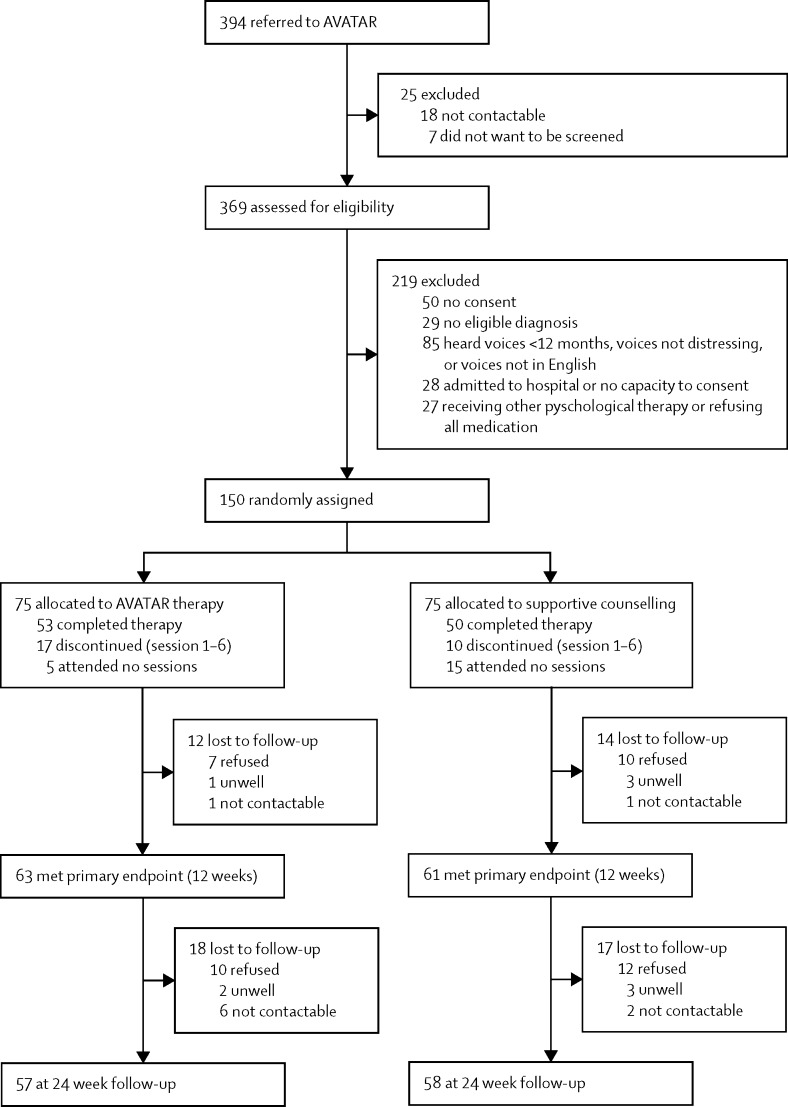
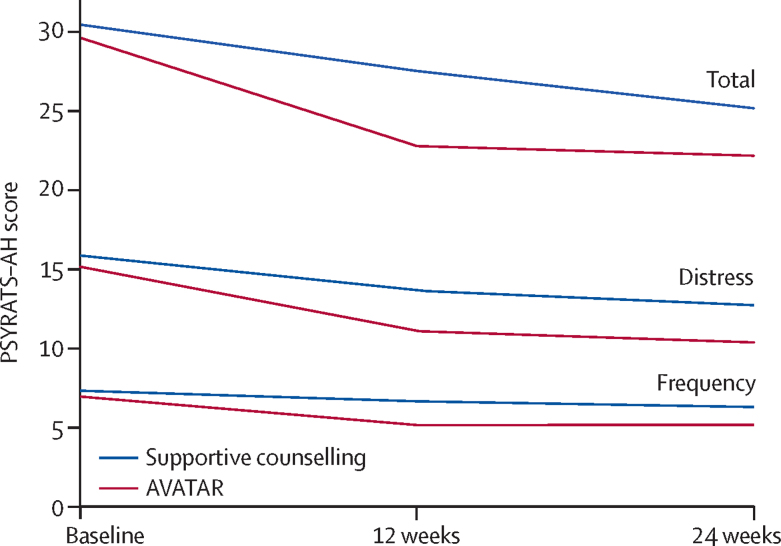
BACKGROUND: A quarter of people with psychotic conditions experience persistent auditory verbal hallucinations, despite treatment. AVATAR therapy (invented by Julian Leff in 2008) is a new approach in which people who hear voices have a dialogue with a digital representation (avatar) of their presumed persecutor, voiced by the therapist so that the avatar responds by becoming less hostile and concedes power over the course of therapy. We aimed to investigate the effect of AVATAR therapy on auditory verbal hallucinations, compared with a supportive counselling control condition. METHODS: We did this single-blind, randomised controlled trial at a single clinical location (South London and Maudsley NHS Trust). Participants were aged 18 to 65 years, had a clinical diagnosis of a schizophrenia spectrum (ICD10 F20-29) or affective disorder (F30-39 with psychotic symptoms), and had enduring auditory verbal hallucinations during the previous 12 months, despite continued treatment. Participants were randomly assigned (1:1) to receive AVATAR therapy or supportive counselling with randomised permuted blocks (block size randomly varying between two and six). Assessments were done at baseline, 12 weeks, and 24 weeks, by research assessors who were masked to therapy allocation. The primary outcome was reduction in auditory verbal hallucinations at 12 weeks, measured by total score on the Psychotic Symptoms Rating Scales Auditory Hallucinations (PSYRATS-AH). Analysis was by intention-to-treat with linear mixed models. The trial was prospectively registered with the ISRCTN registry, number 65314790. FINDINGS: Between Nov 1, 2013, and Jan 28, 2016, 394 people were referred to the study, of whom 369 were assessed for eligibility. Of these people, 150 were eligible and were randomly assigned to receive either AVATAR therapy (n=75) or supportive counselling (n=75). 124 (83%) met the primary outcome. The reduction in PSYRATS-AH total score at 12 weeks was significantly greater for AVATAR therapy than for supportive counselling (mean difference -3·82 [SE 1·47], 95% CI -6·70 to -0·94; p<0·0093). There was no evidence of any adverse events attributable to either therapy. INTERPRETATION: To our knowledge, this is the first powered, randomised controlled trial of AVATAR therapy. This brief, targeted therapy was more effective after 12 weeks of treatment than was supportive counselling in reducing the severity of persistent auditory verbal hallucinations, with a large effect size. Future multi-centre studies are needed to establish the effectiveness of AVATAR therapy and, if proven effective, we think it should become an option in the psychological treatment of auditory verbal hallucinations. FUNDING: Wellcome Trust.
Overview
The claims and statistics of this paper haven’t been checked yet.
Free: it reads the open-access text and checks the first 5 claims that cite a source we can check. Create a free account to check every claim.
Integrity signals
Registry
Cites
Statistics
Figures
Verification
Claims the paper makes
The claims and statistics of this paper haven’t been checked yet.
Free: it reads the open-access text and checks the first 5 claims that cite a source we can check. Create a free account to check every claim.
Claims other papers make about this one
Each is checked against this paper’s own text: does it say what the citing paper says it does?
The cited source doesn’t support the claim as written.
In the citing paper
“and have been successfully used to treat persecutory delusions for people with psychosis (61).”
From Key Considerations for Incorporating Conversational AI in Psychotherapy (2019) · cites this paper as [61]
Checked by a reasoning model — may be wrong.
Experimental — accuracy not yet measuredThe cited source says what the claim attributes to it.
In the citing paper
“Furtherly, distressing voice-hearing may improve in response to specific coaching [69]”
From The “common” experience of voice-hearing and its relationship with shame and guilt: a systematic review (2022) · cites this paper as [69]
The cited source says what the claim attributes to it.
In the citing paper
“with some promising early results [12–15]”
The cited source says what the claim attributes to it.
In the citing paper
“Craig et al. (43) showed that this avatar therapy was successful in diminishing the severity of patients' auditory verbal hallucinations.”
From Computer-assisted avatar-based treatment for dysfunctional beliefs in depressive inpatients: A pilot study (2021) · cites this paper as [43]
The check wasn’t confident either way, so it gives no verdict — never disputed.
In the citing paper
“In mental health, conversational AI has been shown to both facilitate and impede disclosure in different contexts.”
From Key Considerations for Incorporating Conversational AI in Psychotherapy (2019) · cites this paper as [61]
Experimental — accuracy not yet measured
Self-check
Percentages, sums and reported differences re-computed from the paper’s own numbers.
The self-check needs the paper’s full text.
Citations
Cites
Society and the Adolescent Self-Image
Rosenberg, M. (1965) · doi:10.1515/9781400876136 · Cited by 30,126
Lovibond, P. F., & Lovibond, S. H. (1995) · Behaviour Research and Therapy · doi:10.1016/0005-7967(94)00075-u · Cited by 14,523
The necessary and sufficient conditions of therapeutic personality change.
Rogers, C. R. (1957) · Journal of Consulting Psychology · doi:10.1037/h0045357 · Cited by 5,599
Scale for Assessment of Positive Symptoms (SAPS) 1984
Andreasen, N. C. (1995) · Open Scholarship Institutional Repository (Washington University in St. Louis) · Cited by 2,423
Scale for the Assessment of Negative Symptoms
Andreasen, N. C. (2014) · PsycTESTS Dataset · doi:10.1037/t12696-000 · Cited by 1,866
HADDOCK, G., McCARRON, J., TARRIER, N., & FARAGHER, E. B. (1999) · Psychological Medicine · doi:10.1017/s0033291799008661 · Cited by 1,461
Assessing Depression in Schizophrenia: The Calgary Depression Scale
Addington, D., Addington, J., & Maticka-tyndale, E. (1993) · British Journal of Psychiatry · doi:10.1192/s0007125000292581 · Cited by 1,177
Application and Results of the Manchester Short Assessment of Quality of Life (Mansa)
Priebe, S., Huxley, P., Knight, S., & Evans, S. (1999) · International Journal of Social Psychiatry · doi:10.1177/002076409904500102 · Cited by 1,071
The Omnipotence of Voices: A Cognitive Approach to Auditory Hallucinations
Chadwick, P., & Birchwood, M. (1994) · British Journal of Psychiatry · doi:10.1192/bjp.164.2.190 · Cited by 803
The Maudsley Addiction Profile (MAP): a brief instrument for assessing treatment outcome
Marsden, J., Gossop, M., Stewart, D., Best, D., Farrell, M., Lehmann, P., Edwards, C., & Strang, J. (1998) · Addiction · doi:10.1046/j.1360-0443.1998.9312185711.x · Cited by 488
Cited by
Items 201–300 of 403
Stefaniak, I., Gabor-Siatkowska, K., Kozłowski, M., & Janicki, A. (2026) · PLoS ONE · doi:10.1371/journal.pone.0343519 · Cited by 4
Advancing Mental Health with Immersive Virtual Reality: Benefits, Challenges, and Emerging Trends
Gkoumas, C., Bourikas, L., Mantadelis, T., & Karakasidou, E. (2024) · IEEE International Symposium on Mixed and Augmented Reality Adjunct (ISMAR-Adjunct) · doi:10.1109/ismar-adjunct64951.2024.00064 · Cited by 7
“Overall, IVR has demonstrated considerable promise in addressing specific symptoms related to psychosis [31, 32, 20].”
Power to the voice hearer — The German version of the voice power differential scale
Gmeiner, A., Gaglia, A., Habicher, S., Rumpold, T., Süßenbacher, S., Schrank, B., & Amering, M. (2020) · PLoS ONE · doi:10.1371/journal.pone.0230778 · Cited by 4
Using and Creating Therapeutic Games in Virtual Reality and the Player/Game/Therapy Model
Ústav lékařské etiky a humanitních základů medicíny, 2. L. F. U. K., Zielina, M., Šmahaj, J., Raudenská, J., & Javůrková, A. (2022) · Ceskoslovenska psychologie · doi:10.51561/cspsych.66.3.332 · Cited by 4
Clinical applications of extended reality
Khan, S. (2023) · Elsevier eBooks · doi:10.1016/b978-0-323-98381-5.00013-1 · Cited by 4
Beaudoin, M., Potvin, S., Phraxayavong, K., & Dumais, A. (2023) · Journal of Personalized Medicine · doi:10.3390/jpm13030522 · Cited by 9
“Unlike CBTp, ATp has also been shown to induce a significant increase in participants’ QoL [23,24].”
BackgroundWood, L., Morrison, A. P., Lay, B., Williams, C., & Johnson, S. (2024) · Psychosis · doi:10.1080/17522439.2024.2386176 · Cited by 5
“…and auditory hallucinations, including one which targeted insomnia in inpatient settings, demonstrating the potential for a brief targeted protocol-driven approach in this setting to be effective (Craig et al., 2018; Freeman, Dunn, et al., 2015; Freeman, Waite, et al., 2015; Sheaves et al., 2017).”
Rus‐Calafell, M., Ehrbar, N., Teismann, T., Schneider, S., Tas, E., Schuster, S., Edwards, C., Huckvale, M. A., Craig, T., Garety, P. A., et al. (2025) · Journal of Clinical Psychology · doi:10.1002/jclp.23785 · Cited by 5
Self-citationPozitív technológia – Hogyan segíthetik az új technológiák a teljes emberi működést?
Szondy, M. (2019) · Magyar Pszichológiai Szemle · doi:10.1556/0016.2019.74.3.9 · Cited by 6
Réalité virtuelle et santé des personnes âgées institutionnalisées. Vers un EHPAD 2.0 ?
Elies, C., & Serra, É. (2022) · Pratiques Psychologiques · doi:10.1016/j.prps.2022.01.004 · Cited by 11
Promoting psychological interventions in psychosis: the NSW Tertiary Referral Service for Psychosis
Davies, K., Gott, C., Ferdman, A., Lloyd, K., Pnevmatikos, N., Chase, E., & Lappin, J. (2023) · Australian Psychologist · doi:10.1080/00050067.2023.2211759 · Cited by 5
“These include AVATAR therapy (Craig et al., 2018), SlowMo (Garety et al.”
Human AI: Ethics and broader impact for mental healthcare
Singh, S., Joshi, R., Jain, P., & Abilash, K. (2023) · Elsevier eBooks · doi:10.1016/b978-0-443-19096-4.00005-5 · Cited by 8
Smith, L., Rossell, S. L., Thomas, N., & Toh, W. L. (2023) · Behavioural and Cognitive Psychotherapy · doi:10.1017/s1352465823000395 · Cited by 4
“…comprising active verbal engagement with voices to practise adaptive forms of responding to the experience, through chairwork (Hayward et al ., 2017), direct therapist engagement with voices (Longden et al ., 2022), or use of computer-generated avatars to represent voices (Craig et al ., 2018).”
BackgroundCella, M., Tomlin, P., Robotham, D., Green, P. A., Griffiths, H., Stahl, D. R., & Valmaggia, L. (2023) · Efficacy and Mechanism Evaluation · doi:10.3310/hnvc2041 · Cited by 6
Анатольевна, С. О., Zhirnova, O. V., & Truevtsev, D. V. (2020) · Clinical Psychology and Special Education · doi:10.17759/cpse.2020090202 · Cited by 4
Montagnese, M., Leptourgos, P., Fernyhough, C., Waters, F., Larøi, F., Jardri, R., McCarthy‐Jones, S., Thomas, N., Dudley, R. E. J., Taylor, J., et al. (2020) · OSF Preprints (OSF Preprints) · doi:10.31219/osf.io/zebxv · Cited by 4
Hidding, M., Veling, W., Pijnenborg, G. H. M., & van der Stouwe, E. C. D. (2025) · Journal of Behavior Therapy and Experimental Psychiatry · doi:10.1016/j.jbtep.2025.102053 · Cited by 4
Goulet, M., Dellazizzo, L., Goyer, S., Dollé, S., Hudon, A., Phraxayavong, K., Désilets, M., & Dumais, A. (2025) · Behavioral Sciences · doi:10.3390/bs15101431 · Cited by 6
Yoon, R.-M., Hong, H.-W., & Park, Y.-M. (2025) · The Arts in Psychotherapy · doi:10.1016/j.aip.2025.102381 · Cited by 3
Fässler, L., Koop, S., Opper, F., Bighelli, I., Leucht, S., Sabé, M., Bajbouj, M., Knaevelsrud, C., & Böge, K. (2026) · JAMA Psychiatry · doi:10.1001/jamapsychiatry.2026.1443 · Cited by 5
Kullmann, F., Teismann, T., Krause, K., Friedrich, S., Margraf, J., Schneider, S., & Rus‐Calafell, M. (2023) · Verhaltenstherapie · doi:10.1159/000530422 · Cited by 3
“…und der Leidensdruck durch belastende Stimmen verglichen mit einer Kontrollgruppe, die unterstützende Beratung erhielt, redu-ziert werden konnte [Craig et al., 2018 In der qualitativen Befragung der Teilnehmenden fiel ebenfalls auf, dass monetäre Aspekte bei der Behandlung psychotischer…”
BackgroundSelf-citationFey, M., Peperkorn, N., Borchert, T., Meyer, M. L., Raacke, J., & Shiban, Y. (2023) · International Journal of Cognitive Therapy · doi:10.1007/s41811-023-00186-w · Cited by 7
“Patients were able to engage in dialogue with the avatar representing the hallucinations and learned to contradict the personal insults (Craig et al., 2018).”
Natali, L., Ward, T., Rowlands, K., Aya, V., Treasure, J. L., & Cardi, V. (2023) · Clinical Psychology & Psychotherapy · doi:10.1002/cpp.2934 · Cited by 6
Self-citationАнатольевна, С. О., Truevtsev, D. V., & Zhirnova, O. V. (2023) · Counseling Psychology and Psychotherapy · doi:10.17759/cpp.2023310405 · Cited by 3
“Новые стратегии ле-чения [11; 16] делают акцент на социальном контексте, межличностных аспектах восприятия голоса, ставят задачу, противоположную устра-нению голосов как симптома болезни, развитию способностей их иг-норирования.”
Valenza, G., Alcañíz, M., Carli, V., Dudnik, G., Gentili, C., Provinciale, J. G., Rossi, S., Toschi, N., & van Wassenhove, V. (2024) · IEEE Signal Processing Magazine · doi:10.1109/msp.2023.3344430 · Cited by 3
“Furthermore, avatar-based therapy showed promising results with auditory hallucinations [4].”
BackgroundMarotti, J., Saunders, R., Montague, A. E., & Fornells‐Ambrojo, M. (2025) · Psychological Medicine · doi:10.1017/s003329172500008x · Cited by 3
“…data from the AVATAR2 multisite (London, Manchester, Glasgow) randomized controlled trial (RCT; see Garety et al., 2021 for detailed description) testing the efficacy of two versions of AVATAR therapy (Craig et al., 2018; Leff et al., 2014) against treatment-as-usual was used for this study.”
Unmet Needs in Modern Psychiatric Practice
Sampogna, G., Luciano, M., Vecchio, V. D., Giallonardo, V., Pocai, B., Pompili, M., & Fiorillo, A. (2020) · Springer eBooks · doi:10.1007/978-3-030-42637-8_1 · Cited by 3
Raffard, S., & Bortolon, C. (2021) · Annales Médico-psychologiques revue psychiatrique · doi:10.1016/j.amp.2020.08.008 · Cited by 3
Анатольевна, С. О., Zhirnova, O. V., & Truevtsev, D. V. (2021) · Counseling Psychology and Psychotherapy · doi:10.17759/cpp.2021290204 · Cited by 3
“На данном этапе развития науки AVATAR [28] представляет собой интегративный вид терапии, отвечающий требованиям современных информационных технологий и ориентированный на рассмотрение когнитивного и перцептивного аспектов деятельности, анализ отношений с «голосом» посредством работы с самооценкой человека и регуляцию…”
InfluentialAcceptance and Commitment Therapy for Patients with a First Psychotic Episode
Владимирович, Ч. Н., Moiseeva, T., Belyakova, M. A., Polyakova, M. D., & Sozinova, M. V. (2021) · Consortium Psychiatricum · doi:10.17816/cp97 · Cited by 4
“In the various studies by Gaudiano et al., the parameters used for assessment of the treatment outcomes differ, 35-37,41 In the studies reviewed, ACT has been used in various forms, for both a short term of two to four sessions,³¹ , ³² , ⁴¹ and for a longer term of 10–24 sessions.”
BackgroundMethodSolar, A., Bennett, K., & Hulse, G. K. (2022) · Australasian Psychiatry · doi:10.1177/10398562221108815 · Cited by 4
Coping Strategy Enhancement for Auditory Verbal Hallucinations Within Routine Clinical Practice
Zanello, A., Mutanda, D., Sentissi, O., & Hayward, M. (2023) · The Journal of Nervous and Mental Disease · doi:10.1097/nmd.0000000000001589 · Cited by 3
“…of the patients, the therapeutic conversation about distressing AVH may need to be continued through engagement with a higher-intensity intervention, such as relating therapy (Hayward et al., 2017), AVATAR therapy (Craig et al., 2018; Leff et al., 2014), or Accept Voices (Langlois et al., 2020b).”
BackgroundMehl, S., Hesse, K., Moritz, S., Müller, D., Kircher, T. T. J., & Bechdolf, A. (2023) · Der Nervenarzt · doi:10.1007/s00115-022-01433-9 · Cited by 5
“Inneuen Dritte-Welle-Interventionen der KVT-P ist die Verbesserung der sozialen Kompetenz im Kontakt mit Halluzinationen sogar ein erklärtes primäres Therapieziel (beispielsweise in der Relating Therapy: [34] oder der AVATAR-Therapie [35]).”
BackgroundAndrades, B. A., & Tordo, F. (2023) · L Évolution Psychiatrique · doi:10.1016/j.evopsy.2023.02.001 · Cited by 3
Edwards, C., Owrid, O., Miller, L., Jafari, H., Emsley, R., Rus‐Calafell, M., Craig, T., Clancy, M., McLeod, H. J., Fornells‐Ambrojo, M., et al. (2023) · Frontiers in Psychiatry · doi:10.3389/fpsyt.2023.1192655 · Cited by 4
“This approach has been shown, in a fully powered trial, to reduce voice frequency and voice-related distress when compared with an active control at the end of therapy (primary endpoint) although group differences did not persist at follow-up (17).”
ResultSelf-citationHudon, A., Phraxayavong, K., Potvin, S., & Dumais, A. (2023) · Machine Learning and Knowledge Extraction · doi:10.3390/make5030057 · Cited by 4
“(2018, trial number: ISRCTN, number 65,314 790) conducted the first single-blind, randomized controlled trial with 150 patients from 18 to 65 years who had received a clinical diagnosis of schizophrenia spectrum and had auditory verbal hallucinations despite continued treatment [14].”
BackgroundMethodCalissano, C., Thompson, A., Treasure, J., Cardi, V., & Ward, T. (2023) · Mental Health Science · doi:10.1002/mhs2.45 · Cited by 5
Self-citationRackemann, L. J., Wood, A. P., & Brand, R. M. (2024) · Australian Psychologist · doi:10.1080/00050067.2024.2342789 · Cited by 5
“Recent refinements and innovations in CBTp protocols are also finding increased effect sizes in robust treat-ment trials (Craig et al., 2018; Freeman et al., 2021).”
The effect of trauma‐focused therapy on voice‐hearing: An experience sampling study
Burger, S., Hardy, A., Verdaasdonk, I., van der Vleugel, B. M., Delespaul, P., van Zelst, C., de Bont, P. A. J. M., Staring, A. B. P., de Roos, C., de Jongh, A., et al. (2024) · Psychology and Psychotherapy Theory Research and Practice · doi:10.1111/papt.12556 · Cited by 8
Strakeljahn, F., Lincoln, T. M., & Schlier, B. (2025) · Psychological Medicine · doi:10.1017/s0033291725000881 · Cited by 3
“This is particularly interesting because many recent innovations in psychotherapeutic treatments for voice hearing, e.g., AVATAR therapy (Craig et al., 2018; Ward et al., 2020) or Relating Therapy (Hayward et al., 2017; Lincoln et al., 2024), focus on treating AVH distress rather than AVH-presence…”
Clinical Psychology in the Age of in the new technology : focusing on the recent studies trends
Song, H. (2019) · 한국심리학회지: 일반 · doi:10.22257/kjp.2019.12.38.4.549 · Cited by 4
Zhuo, C., Cheng, L., Li, G., Xu, Y. J., Jing, R., Li, S., Zhang, L., Lin, X., & Zhou, C. (2019) · Brain Imaging and Behavior · doi:10.1007/s11682-019-00043-5 · Cited by 3
Cavelti, M., Kaeser, J. M., Lerch, S., Bauer, S., Moessner, M., Berger, T., Hayward, M., & Kaess, M. (2022) · Trials · doi:10.1186/s13063-022-06846-0 · Cited by 3
“Reducing the level of psychological distress due to voice-hearing (instead of reducing hearing voices per se) is the main therapy aim of CBTv and the PSYRATS-AH has been widely used in clinical trials investigating the efficacy of CBTv in the past [17, 35, 36].”
MethodReattribution of Auditory Hallucinations Throughout Avatar Therapy: A Case Series
Giguère, S., Beaudoin, M., Dellazizzo, L., Phraxayavong, K., Potvin, S., & Dumais, A. (2025) · Reports — Medical Cases Images and Videos · doi:10.3390/reports8030113 · Cited by 5
“…interventions explicitly encourage patients to engage with their voices and embrace the communicative aspect of the experience of voice hearing [40–43], which was hypothesized to be responsible for positive changes in the relationship between patients and their voices [11,41,42,44].”
InfluentialCiarmoli, D., Gennaro, A., Lecce, F., Reho, M., & Triberti, S. (2025) · European Journal of Investigation in Health, Psychology and Education · doi:10.3390/ejihpe15120256 · Cited by 1
“The use of an avatar concerns psychosis, where avatar therapy has shown promising effects in reducing the frequency and distress associated with auditory hallucinations (Craig et al., 2018).”
Increasing access to psychological treatments for mental illness
Hayward, M. (2018) · The Lancet Psychiatry · doi:10.1016/s2215-0366(18)30262-1 · Cited by 2
Preliminary Evidence for Heterogeneity of Beliefs About Auditory Verbal Hallucinations Intent
Zanello, A., & Dugre, J. R. (2021) · The Journal of Nervous and Mental Disease · doi:10.1097/nmd.0000000000001391 · Cited by 2
“Indeed, in psychological intervention studies, the mean severity of AVHs benevolence is not reported (du Sert et al., 2018; Leff et al., 2013) or is reported with a high between-subject variability (Craig et al., 2018; Penn et al., 2009; Zanello et al., 2014).”
BackgroundDellazizzo, L., Potvin, S., Phraxayavong, K., Giguère, S., Hamidi, L.-N., & Dumais, A. (2021) · Santé mentale au Québec · doi:10.7202/1081514ar · Cited by 4
Simon, J., Kiss, N., Korrelboom, K., Kingdon, D., Wykes, T., Phiri, P., van der Gaag, M., Baksh, M. F., & Steel, C. (2022) · International Journal of Environmental Research and Public Health · doi:10.3390/ijerph191911985 · Cited by 2
“Unexpected clinical improvements have been reported within the control group of a number of trials of psychological therapies for severe mental health problems [34], though such studies typically do not report detailed health economic analyses and, therefore, cannot provide further explorations of potential underlying…”
BackgroundEnsemble Methods to Optimize Automated Text Classification in Avatar Therapy
Hudon, A., Phraxayavong, K., Potvin, S., & Dumais, A. (2024) · BioMedInformatics · doi:10.3390/biomedinformatics4010024 · Cited by 4
Hayward, M., Ashment, H., Frost, H., Byles, R., Vogel, E., Walsh, L., Fowler, D. G., Loizou, S., & Strauss, C. (2024) · Psychosis · doi:10.1080/17522439.2024.2351817 · Cited by 4
“Person Based Cognitive Therapy (PBCT) is a 12-session group intervention which draws upon cognitive behavioural strategies and mindfulness principles to facilitate acceptance of distressing voices and the re-evaluation of beliefs about self and voices.”
InfluentialUsing AVATAR therapy to conquer auditory hallucinations
Nordentoft, M. (2024) · Nature Medicine · doi:10.1038/s41591-024-03312-z · Cited by 3
Hudon, A., Quilliam, S., Phraxayavong, K., Potvin, S., & Dumais, A. (2024) · American Journal of Psychotherapy · doi:10.1176/appi.psychotherapy.20240016 · Cited by 3
Validation of an Upgraded Virtual Reality Platform Designed for Real-Time Dialogical Psychotherapies
Simoes-Gomes, T., Potvin, S., Giguère, S., Beaudoin, M., Phraxayavong, K., & Dumais, A. (2025) · BioMedInformatics · doi:10.3390/biomedinformatics5010004 · Cited by 2
Auditory verbal hallucinations: The ins and outs of subtypes
Cioroboiu, N., Whittingham, K., Dodgson, G., Fernyhough, C., & Alderson‐Day, B. (2025) · Psychiatry Research · doi:10.1016/j.psychres.2025.116696 · Cited by 4
Dudley, R. E. J., O’Grady, L., Cioroboiu, N., Bates, E. J., Gibbs, C., Dodgson, G., & Aynsworth, C. (2025) · Behavioural and Cognitive Psychotherapy · doi:10.1017/s1352465825100969 · Cited by 1
“There are an increasing number of digitally delivered treatments for hallucinations (Bell et al ., 2020; Craig et al ., 2018).”
Relating between the voice and voice-hearer: Validation of a revised version of the Voice And You
Schlier, B., Strauss, C., Lincoln, T. M., & Hayward, M. (2020) · Schizophrenia Research · doi:10.1016/j.schres.2020.10.010 · Cited by 2
Mikkonen, K., Wegelius, A., Salmijärvi, L., Paunio, T., & Kieseppä, T. (2020) · Helda - University of Helsinki Institutional Repository · Cited by 3
Hacking into Cybertherapy: Considering a Gesture-enhanced Therapy with Avatars (g+TA)
Gerner, A. (2020) · Kairos · doi:10.2478/kjps-2020-0004 · Cited by 5
The CHALLENGE Project: Fighting Auditory Hallucinations by using Virtual Reality
Viera, L., Fisher, P., Lajboschitz, S., Serafin, S., & Nordentoft, M. (2021) · IEEE Conference on Virtual Reality and 3D User Interfaces Abstracts and Workshops (VRW) · doi:10.1109/vrw52623.2021.00027 · Cited by 3
The Sound of Hallucinations: Toward a more convincing emulation of internalized voices
Lee, H., Jiang, R., Yoo, Y., Henry, M., & Cooperstock, J. R. (2022) · CHI Conference on Human Factors in Computing Systems · doi:10.1145/3491102.3501871 · Cited by 6
“Avatar therapy offers a communication environment in which patients can enter into a face-to-face dialogue with an avatar representing their auditory hallucinations [11, 14, 36].”
BackgroundVentriglio, A., Wijesuriya, R., & Bhugra, D. (2022) · Oxford University Press eBooks · doi:10.1093/med/9780198861478.003.0002 · Cited by 2
Virtual reality interventions for victims of crime: A systematic review
Parmigiani, G., Tortora, L., Meynen, G., Mandarelli, G., & Ferracuti, S. (2022) · Journal of Traumatic Stress · doi:10.1002/jts.22810 · Cited by 3
“…interventions have shown positive effects in patients affected by specific phobias (Botella et al., 2017), PTSD (Botella et al., 2015), psychoses (Craig et al., 2018; Veling et al., 2014), and eating disorders (Ferrer-Garcia & Gutierrez-Maldonado, 2012), as well as offenders in forensic mental…”
BackgroundDissociative experiences arise from disrupted multi-sensory integrationPreprint
Moffatt, J. A., Lesur, M. R., Lenggenhager, B., Weijs, M. L., Maglianella, V., Critchley, H., Garfinkel, S. N., & Greenwood, K. (2024) · PsyArXiv (OSF Preprints) · doi:10.31234/osf.io/e5z74 · Cited by 3
Alevizopoulos, A. G., Alevizopoulou, M., Kritikos, I., & Alevizopoulos, G. A. (2024) · Preprints.org · doi:10.20944/preprints202404.1956.v1 · Cited by 1
Stuart, H. L., & Sartorius, N. (2022) · Oxford University Press eBooks · doi:10.1093/med/9780197555804.003.0001 · Cited by 2
Kapadia, S. V. (2022) · Indian Journal of Psychological Medicine · doi:10.1177/02537176221090106 · Cited by 1
Baumeister, A., Rüegg, N., Lüdtke, T., & Moritz, S. (2023) · Springer eBooks · doi:10.1007/978-3-662-65816-1_7 · Cited by 1
Rakitzi, S. (2023) · Springer eBooks · doi:10.1007/978-3-031-27837-2_19 · Cited by 1
Verdaasdonk, I., Charalambides, M., Baumeister, D., Jackson, M., Garety, P. A., Morgan, C., Ward, T., & PETERS, E. R. (2025) · Social Psychiatry and Psychiatric Epidemiology · doi:10.1007/s00127-025-02917-0 · Cited by 1
Self-citationSivaji, P., Venkatasubramanian, P., Venkatraman, L., & Ramachandran, P. (2025) · Asian Journal of Psychiatry · doi:10.1016/j.ajp.2025.104533 · Cited by 1
Avatar therapy: does 3D add value?
Hayward, M. (2025) · The Lancet Psychiatry · doi:10.1016/s2215-0366(25)00210-x · Cited by 1
Hansen, N. S., Ries, E. S., Ward, T., Cardi, V., Christensen, A. B., Hjorthøj, C. R., Nordentoft, M., Micali, N., & Glenthøj, L. B. (2025) · PLoS ONE · doi:10.1371/journal.pone.0319875 · Cited by 2
Self-citationLiu, S. Y., Tang, S., Tan, Y., & Xiang, B. (2025) · The Canadian Journal of Psychiatry · doi:10.1177/07067437251372186 · Cited by 2
“Moreover, 2 studies evaluated patient QoL using the Q-LES-Q-SF scale, 42,49 the remaining 2 adopted the MANSA 45,50 , and 1 study employed the ReQoL total.”
A Descriptive Analysis of Emotional Expressions and Variations Across Avatar Therapy
Hudon, A., Quilliam, S., Fortier, A., Phraxayavong, K., Potvin, S., & Dumais, A. (2025) · International Journal of Human-Computer Interaction · doi:10.1080/10447318.2025.2597581 · Cited by 1
“Current literature on AT has shown that this method is effective in reducing the frequency and intensity of auditory hallucinations (Craig et al., 2018; Du Sert et al., 2018).”
InfluentialRasmussen, K., Vernal, D. L., Mariegaard, L. S., Jørgensen, G., Zeka, F., Smith, L. C., Nordentoft, M., Midtgaard, J., & Glenthøj, L. B. (2026) · Digital Health · doi:10.1177/20552076251411033 · Cited by 3
“8,10,11 Building on this, virtual reality-assisted therapy (VRT) for persistent voices usesimmersivevirtualreality(VR)toenablecontrolledandreal-isticvoiceinteractionsundertherapistguidance,withdemon-strated ef fi cacy.”
Rutter-Eley, E. L., Craig, T., Garety, P. A., Rus‐Calafell, M., Ball, H., Clancy, M., McDonnell, J., Gumley, A. I., Haddock, G., Bucci, S., et al. (2026) · JMIR Mental Health · doi:10.2196/77566 · Cited by 1
“This aligns with relational approaches for distressing voices [3,7,42] and reflects the broader secondary outcomes observed in the main trial, such as improved voice understanding and empowerment [9].”
InfluentialSelf-citationVirtual Reality–Based Avatar Intervention for Eating Disorders: Mixed Methods Feasibility Study
Hansen, N. S., Ries, E. S., Rasmussen, K., Cardi, V., Christensen, A. B., Hjorthøj, C. R., Micali, N., Ward, T., & Glenthøj, L. B. (2026) · JMIR Formative Research · doi:10.2196/88445 · Cited by 1
“It has demonstrated efficacy in reducing voice severity in 2 fully powered randomized clinical trials [25-27].”
Self-citationRozenova, M. I., Огнев, А. С., & Лихачева, Э. В. (2026) · Journal of Modern Foreign Psychology · doi:10.17759/jmfp.2026150208 · Cited by 1
Treatment-Resistant Schizophrenia
Freudenreich, O. (2019) · Current clinical psychiatry · doi:10.1007/978-3-030-29450-2_12 · Cited by 1
Lin, X., Li, G., Ji, F., Cheng, L., Chen, G., Zhang, W., Su, Z., Zhang, Z., Wang, W., Zhou, C., et al. (2020) · International Journal of Neuroscience · doi:10.1080/00207454.2020.1750387 · Cited by 1
Artificial Intelligence in Schizophrenia
Schneider, H. (2022) · Springer eBooks · doi:10.1007/978-3-030-64573-1_214 · Cited by 1
Stuart, H. L., & Sartorius, N. (2022) · Oxford University Press eBooks · doi:10.1093/med/9780197555804.003.0012 · Cited by 1
Stuart, H. L., & Sartorius, N. (2022) · Oxford University Press eBooks · doi:10.1093/med/9780197555804.003.0013 · Cited by 1
Alderson‐Day, B., & Ward, T. (2022) · doi:10.1093/oso/9780192898388.003.0005 · Cited by 1
Self-citationOh, E., & Gang, M. (2023) · Journal of Korean Academy of Nursing · doi:10.4040/jkan.22121 · Cited by 3
Thomas, N., & Morris, K. A. (2023) · Springer eBooks · doi:10.1007/978-3-031-27003-1_15 · Cited by 2
Campaner, R., & Costerbosa, M. L. (2023) · Integrated science · doi:10.1007/978-3-031-27945-4_3 · Cited by 2
On the psychological structure of alienation syndrome and the mechanisms of negative “voice” content
Анатольевна, С. О., Truevtsev, D. V., & Zhirnova, O. V. (2023) · Neurology Bulletin · doi:10.17816/nb117415 · Cited by 3
Mental Health Aspects of Information Technology: Impact on Behavior and on Treatment Applications
Nallapula, K., & Pumariega, A. J. (2023) · Oxford University Press eBooks · doi:10.1093/med/9780197521359.003.0038 · Cited by 1
Trad, N. K. (2023) · The AMA Journal of Ethic · doi:10.1001/amajethics.2023.684 · Cited by 1
Psychosocial Management of Psychosis
Kingdon, D. (2024) · Cambridge University Press eBooks · doi:10.1017/9781911623861.013 · Cited by 1
O'Neill, E., Bird, M., & Riches, S. (2024) · Mental Health and Digital Technologies · doi:10.1108/mhdt-03-2024-0009 · Cited by 3
Hignett, R., Curran, R., Fisher, H. L., & Riches, S. (2024) · Psychology and Psychotherapy Theory Research and Practice · doi:10.1111/papt.12540 · Cited by 1
A Multimodal Approach for Improving a Dialogue Agent for Therapeutic Sessions in Psychiatry
Gabor-Siatkowska, K., Stefaniak, I., & Janicki, A. (2024) · Springer eBooks · doi:10.1007/978-3-031-60049-4_22 · Cited by 1
Affectional interactions with your animated child avatar can enhance wellbeing
Edalat, A., Polydorou, N., Ryan, F., Gilbert, B. J., & Nicholls, D. (2024) · Frontiers in Virtual Reality · doi:10.3389/frvir.2024.1424217 · Cited by 5
Application of visual speech synthesis in therapy of auditory verbal hallucinations
Sorokosz, K. (2018) · International Interdisciplinary PhD Workshop (IIPhDW) · doi:10.1109/iiphdw.2018.8388236 · Cited by 1
“published results of avatar based therapy for auditory verbal hallucinations in people with psychosis [4].”
BackgroundSocial Avatar Theory: From In Vitro to In Vivo (Instagrammer Cognition - Mind the Gap)
Brunskill, D. (2019) · Psychology and Behavioral Science International Journal · doi:10.19080/pbsij.2019.11.555812 · Cited by 1
“555812 002 As the digital world has expanded, multiple avatar subtypes have emerged, each with different, but related characteristics, dependent on avatar purpose such as therapeutic agent [4], and interview facilitation [5].”
BackgroundPillny, M., & Lincoln, T. M. (2020) · Psychotherapie · doi:10.30820/2364-1517-2020-1-67 · Cited by 2
A Socio-Ecological Perspective
Jones-Bonofiglio, K. (2020) · The International Library of Bioethics · doi:10.1007/978-3-030-56156-7_3 · Cited by 1
Metadata
- Authors
- Craig, T. K., Rus-Calafell, M., Ward, T., Leff, J. P., Huckvale, M., Howarth, E., Emsley, R., & Garety, P. A.
- Affiliations
- King's College London (GB)
- The Royal Free Hospital (GB)
- University College London (GB)
- Manchester Academic Health Science Centre (GB)
- Corresponding author
- Craig, Tom KJ
- Venue
- The Lancet Psychiatry
- Publisher
- Elsevier BV
- Published
- 2018-01
- Volume
- 5
- Issue
- 1
- Pages
- 31-40
- ISSN
- 2215-0366 (ISSN-L)
- PMC
- PMC5746597
- OpenAlex
- W2769474648
- Cited by
- 403
- References
- 30
- Citations by year
- 2026: 35 · 2025: 49 · 2024: 44 · 2023: 56 · 2022: 56 · 2021: 48 · 2020: 45 · 2019: 37 · 2018: 30
- FWCI
- 25.37
- Type
- journal article
- Language
- en
- Open access
- hybrid
- doi.org
- Licence
- cc-by
- www.elsevier.com/tdm/userlicense/1.0/ (tdm)
- creativecommons.org/licenses/by/4.0/ (vor)
- Locations
- The Lancet Psychiatry (publishedVersion, cc-by)
- PubMed Central (publishedVersion, cc-by)
- PubMed (publishedVersion)
- Research Explorer (The University of Manchester) (publishedVersion, cc-by)
- UCL Discovery (University College London) (submittedVersion)
- Research Portal (King's College London) (submittedVersion, cc-by)
- Funders
- Wellcome Trust (098272/Z/12/Z, FWBC-AVATAR 098272/z/12/z)
- National Institute for Health and Care Research (NF-SI-0510-10121, NIHR-RMFI-2015-06-13-101)
- King's College London
- Topics
- Health Sciences › Medicine › Psychiatry and Mental health › Schizophrenia research and treatment
- Life Sciences › Neuroscience › Cognitive Neuroscience › Hallucinations in medical conditions
- Social Sciences › Psychology › Clinical Psychology › Psychotherapy Techniques and Applications
- Keywords
- AVATAR therapy, auditory verbal hallucinations, psychosis, schizophrenia spectrum disorders, avatars, voice dialogue, supportive counseling, treatment-resistant psychosis, psychotherapeutic interventions, adverse events, relapse prevention
- MeSH terms
- Adult, Affective Disorders, Psychotic, Computers, Female, Hallucinations, Humans, Male, Middle Aged, Psychiatric Status Rating Scales, Psychological Techniques, Schizophrenia, Schizophrenic Psychology, Single-Blind Method, Treatment Outcome, Recognition, Psychology, Pattern Recognition, Physiological
About these checks
Registry, retraction, Cites and statistics results are computed, not judged, with one exception: a printed reference that no index lists is read once by a model before it counts as a citation error. Claims are extracted by a model and kept only when their quote appears verbatim in the text; each cited source is then checked, with a model’s help, for whether it says what the claim relies on. Those verdicts can be wrong — read the claim’s quote and the cited source before relying on one.
Statistics and arithmetic are recomputed, not judged.
Confidence bands are shown only for fields calibrated on our annotated test set. None is calibrated yet, so no band is shown.
What counts as a claim ›How we measure confidence ›How we check this ›
Are you an author, or do you see a problem with this page? Request a review
Data sources
Bibliographic data: Semantic Scholar, OpenAlex, Crossref.
Contains information from the Semantic Scholar Academic Graph Datasets, made available under the ODC Attribution License (ODC-BY 1.0).
Semantic Scholar’s data is described in: Kinney, R., et al. (2023). The Semantic Scholar Open Data Platform. arXiv:2301.10140.
