

AVATAR therapy for auditory verbal hallucinations in people with psychosis: a single-blind, randomised controlled trial
Open accessThe DOI matches its Crossref record; 29 of the 30 references it cites were found in a registry or an index.
Abstract
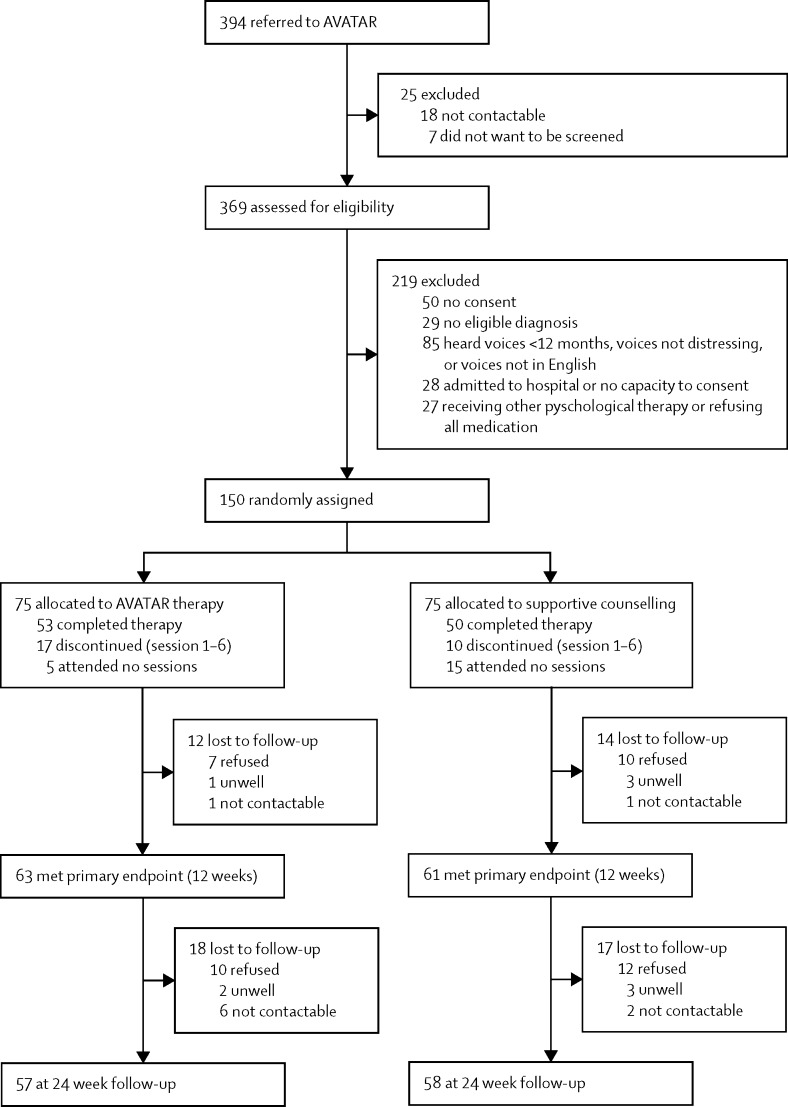
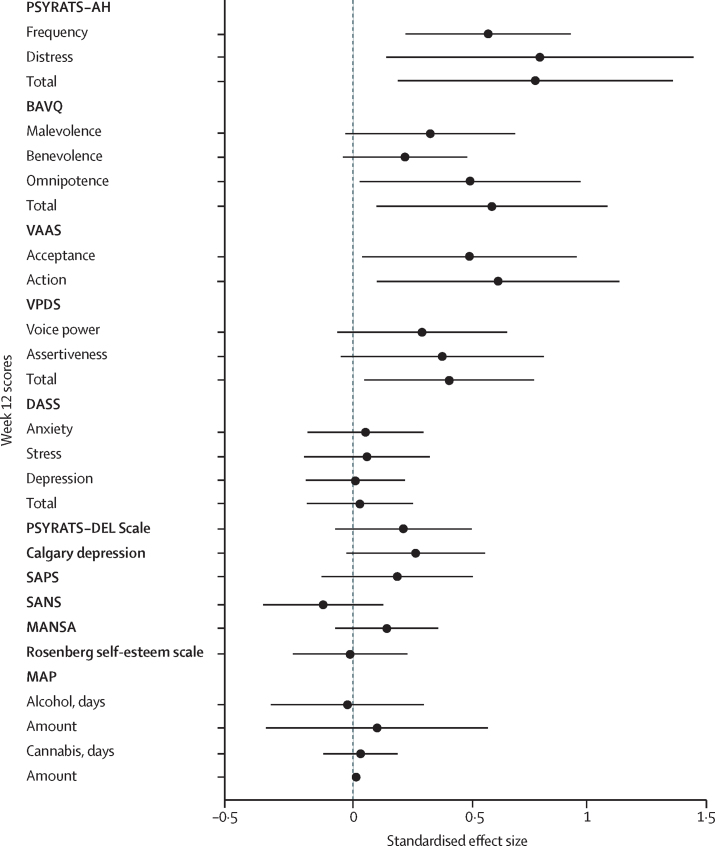
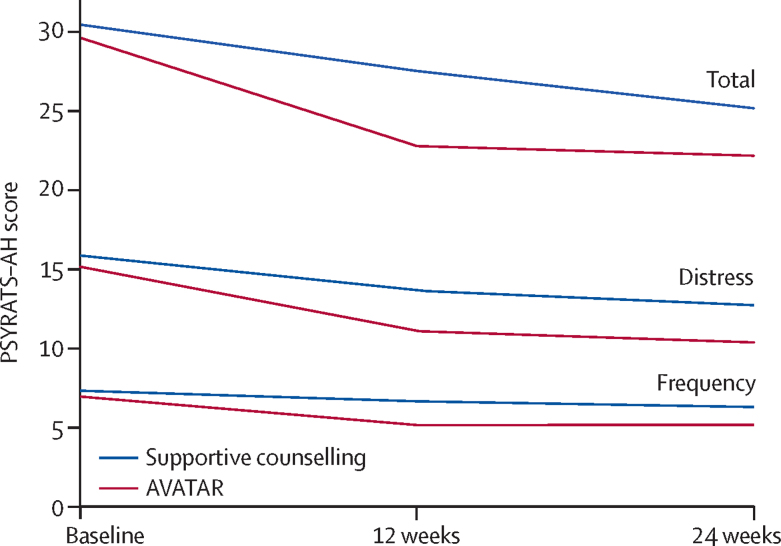
BACKGROUND: A quarter of people with psychotic conditions experience persistent auditory verbal hallucinations, despite treatment. AVATAR therapy (invented by Julian Leff in 2008) is a new approach in which people who hear voices have a dialogue with a digital representation (avatar) of their presumed persecutor, voiced by the therapist so that the avatar responds by becoming less hostile and concedes power over the course of therapy. We aimed to investigate the effect of AVATAR therapy on auditory verbal hallucinations, compared with a supportive counselling control condition. METHODS: We did this single-blind, randomised controlled trial at a single clinical location (South London and Maudsley NHS Trust). Participants were aged 18 to 65 years, had a clinical diagnosis of a schizophrenia spectrum (ICD10 F20-29) or affective disorder (F30-39 with psychotic symptoms), and had enduring auditory verbal hallucinations during the previous 12 months, despite continued treatment. Participants were randomly assigned (1:1) to receive AVATAR therapy or supportive counselling with randomised permuted blocks (block size randomly varying between two and six). Assessments were done at baseline, 12 weeks, and 24 weeks, by research assessors who were masked to therapy allocation. The primary outcome was reduction in auditory verbal hallucinations at 12 weeks, measured by total score on the Psychotic Symptoms Rating Scales Auditory Hallucinations (PSYRATS-AH). Analysis was by intention-to-treat with linear mixed models. The trial was prospectively registered with the ISRCTN registry, number 65314790. FINDINGS: Between Nov 1, 2013, and Jan 28, 2016, 394 people were referred to the study, of whom 369 were assessed for eligibility. Of these people, 150 were eligible and were randomly assigned to receive either AVATAR therapy (n=75) or supportive counselling (n=75). 124 (83%) met the primary outcome. The reduction in PSYRATS-AH total score at 12 weeks was significantly greater for AVATAR therapy than for supportive counselling (mean difference -3·82 [SE 1·47], 95% CI -6·70 to -0·94; p<0·0093). There was no evidence of any adverse events attributable to either therapy. INTERPRETATION: To our knowledge, this is the first powered, randomised controlled trial of AVATAR therapy. This brief, targeted therapy was more effective after 12 weeks of treatment than was supportive counselling in reducing the severity of persistent auditory verbal hallucinations, with a large effect size. Future multi-centre studies are needed to establish the effectiveness of AVATAR therapy and, if proven effective, we think it should become an option in the psychological treatment of auditory verbal hallucinations. FUNDING: Wellcome Trust.
Overview
The claims and statistics of this paper haven’t been checked yet.
Free: it reads the open-access text and checks the first 5 claims that cite a source we can check. Create a free account to check every claim.
Integrity signals
Registry
Cites
Statistics
Figures
Verification
Claims the paper makes
The claims and statistics of this paper haven’t been checked yet.
Free: it reads the open-access text and checks the first 5 claims that cite a source we can check. Create a free account to check every claim.
Claims other papers make about this one
Each is checked against this paper’s own text: does it say what the citing paper says it does?
The cited source doesn’t support the claim as written.
In the citing paper
“and have been successfully used to treat persecutory delusions for people with psychosis (61).”
From Key Considerations for Incorporating Conversational AI in Psychotherapy (2019) · cites this paper as [61]
Checked by a reasoning model — may be wrong.
Experimental — accuracy not yet measuredThe cited source says what the claim attributes to it.
In the citing paper
“Furtherly, distressing voice-hearing may improve in response to specific coaching [69]”
From The “common” experience of voice-hearing and its relationship with shame and guilt: a systematic review (2022) · cites this paper as [69]
The cited source says what the claim attributes to it.
In the citing paper
“with some promising early results [12–15]”
The cited source says what the claim attributes to it.
In the citing paper
“Craig et al. (43) showed that this avatar therapy was successful in diminishing the severity of patients' auditory verbal hallucinations.”
From Computer-assisted avatar-based treatment for dysfunctional beliefs in depressive inpatients: A pilot study (2021) · cites this paper as [43]
The check wasn’t confident either way, so it gives no verdict — never disputed.
In the citing paper
“In mental health, conversational AI has been shown to both facilitate and impede disclosure in different contexts.”
From Key Considerations for Incorporating Conversational AI in Psychotherapy (2019) · cites this paper as [61]
Experimental — accuracy not yet measured
Self-check
Percentages, sums and reported differences re-computed from the paper’s own numbers.
The self-check needs the paper’s full text.
Citations
Cites
Society and the Adolescent Self-Image
Rosenberg, M. (1965) · doi:10.1515/9781400876136 · Cited by 30,126
Lovibond, P. F., & Lovibond, S. H. (1995) · Behaviour Research and Therapy · doi:10.1016/0005-7967(94)00075-u · Cited by 14,523
The necessary and sufficient conditions of therapeutic personality change.
Rogers, C. R. (1957) · Journal of Consulting Psychology · doi:10.1037/h0045357 · Cited by 5,599
Scale for Assessment of Positive Symptoms (SAPS) 1984
Andreasen, N. C. (1995) · Open Scholarship Institutional Repository (Washington University in St. Louis) · Cited by 2,423
Scale for the Assessment of Negative Symptoms
Andreasen, N. C. (2014) · PsycTESTS Dataset · doi:10.1037/t12696-000 · Cited by 1,866
HADDOCK, G., McCARRON, J., TARRIER, N., & FARAGHER, E. B. (1999) · Psychological Medicine · doi:10.1017/s0033291799008661 · Cited by 1,461
Assessing Depression in Schizophrenia: The Calgary Depression Scale
Addington, D., Addington, J., & Maticka-tyndale, E. (1993) · British Journal of Psychiatry · doi:10.1192/s0007125000292581 · Cited by 1,177
Application and Results of the Manchester Short Assessment of Quality of Life (Mansa)
Priebe, S., Huxley, P., Knight, S., & Evans, S. (1999) · International Journal of Social Psychiatry · doi:10.1177/002076409904500102 · Cited by 1,071
The Omnipotence of Voices: A Cognitive Approach to Auditory Hallucinations
Chadwick, P., & Birchwood, M. (1994) · British Journal of Psychiatry · doi:10.1192/bjp.164.2.190 · Cited by 803
The Maudsley Addiction Profile (MAP): a brief instrument for assessing treatment outcome
Marsden, J., Gossop, M., Stewart, D., Best, D., Farrell, M., Lehmann, P., Edwards, C., & Strang, J. (1998) · Addiction · doi:10.1046/j.1360-0443.1998.9312185711.x · Cited by 488
Cited by
Items 301–400 of 403
Hjorth, P., & Juel, H. (2021) · International Journal of Social Psychiatry · doi:10.1177/0020764021991580 · Cited by 1
“Similar results were found in another study (Craig et al., 2018), where the reduction in Psychotic Symptom Rating Scales – Auditory Hallucinations (PSYRATS-AH) total score at 12 weeks was significantly greater for avatar therapy than for supportive counseling (mean difference –3.8).”
ResultInfluentialEighth Kraepelin Symposium—Translation in Psychiatry and Psychotherapy: A Life-Long Necessity
Schaub, A., & Falkai, P. (2021) · Schizophrenia Bulletin · doi:10.1093/schbul/sbab020 · Cited by 1
Using Technology to Fight Stigma
Stuart, H. L., & Sartorius, N. (2022) · Oxford University Press eBooks · doi:10.1093/med/9780197555804.003.0010 · Cited by 1
Takatori, M. M. O., & Rigo, R. S. (2023) · Research Society and Development · doi:10.33448/rsd-v12i5.41427 · Cited by 1
Recovery from Mental Illness, Challenges, and Solutions from Across the Globe
Molodynski, A., & Mohan, R. (2023) · World Social Psychiatry · doi:10.4103/wsp.wsp_20_23 · Cited by 1
Demjén, Z., Marszalek, A., Semino, E., & Varese, F. (2016) · Bloomsbury Publishing Plc eBooks · doi:10.5040/9781350057685.0008 · Cited by 4
“…has been a surge in interest in therapies that could specifically modify the relationship between hearers and their voices, such as AVATAR therapy (Craig et al., 2018), Relating Therapy for distressing voices (Hayward et al., 2018) and the Voice Dialogue approach developed within the contex of…”
BackgroundKee, S. L., Garganera, J. P., Maravilla, N. M. A. T., Garganera, W., Fermin, J. L., AlDahoul, N., Karim, H. B. A., & Tan, M. J. T. (2021) · OSF Preprints (OSF Preprints) · doi:10.31219/osf.io/3wg5p · Cited by 1
Ward, T., Alem, A., Jamieson-Craig, T., Deb, K. S., Devi, S. R. L., Fekadu, A., Gumley, A. I., Hanlon, C., Kelly, R. E., Manyazewal, T., et al. (2026) · medRxiv · doi:10.64898/2026.04.21.26348779 · Cited by 1
Self-citationDuration of Untreated Psychosis: An Important Prognostic Indicator
Singh, A. P. (2018) · Dual Diagnosis Open Access · doi:10.21767/2472-5048.100036
Social Robots as Therapists: Preliminary Tests of Feasibility
Robinson, N. (2018) · Queensland University of Technology · doi:10.5204/thesis.eprints.119160
Schnackenberg, J., Schumacher, B., & Debesay, S. (2019) · PPH · doi:10.1055/a-0864-7619
“[21] Craig TKJ, Rus-Calafell M, Ward T et al.”
BackgroundBell, I. (2019) · Minerva Access (University of Melbourne)
Repenser l’organisation des soins psychiatriques à l’heure de l’Internet des objets
Sol, H., & Rialle, V. (2019) · Droit Santé et Société · doi:10.3917/dsso.055.0045
Technological Interventions for Psychosis
Rauschenberg, C., Rus‐Calafell, M., Reininghaus, U., & Valmaggia, L. (2021) · Elsevier eBooks · doi:10.1016/b978-0-12-818697-8.00070-4
Self-citationPazmiño, V., & Patrício, D. (2012) · Americanae (AECID Library) · Cited by 1
Stacy, M. A., & Davidson, C. A. (2022) · Cambridge University Press eBooks · doi:10.1017/9781108951760.006
Glenthøj, L. B., Jankowski, S. E., Dixon, L. B., & Nordentoft, M. (2022) · Cambridge University Press eBooks · doi:10.1017/9781108951760.008
Lau, H. C. (2022) · Oxford University Press eBooks · doi:10.1093/oso/9780198856771.003.0009
KAJIAN LITERATUR SISTEMIK : TEKNOLOGI DIGITAL DALAM MENILAI HALUSINASI
Hardi, A. (2021) · Coping Community of Publishing in Nursing · doi:10.24843/coping.2021.v09.i06.p02
Employment Inequity and Workplace Stigma
Stuart, H. L., & Sartorius, N. (2022) · Oxford University Press eBooks · doi:10.1093/med/9780197555804.003.0009 · Cited by 1
Stuart, H. L., & Sartorius, N. (2022) · Oxford University Press eBooks · doi:10.1093/med/9780197555804.003.0011
Stuart, H. L., & Sartorius, N. (2022) · Oxford University Press eBooks · doi:10.1093/med/9780197555804.003.0008
Eleven Steps to Build an Anti-stigma Program
Stuart, H. L., & Sartorius, N. (2022) · Oxford University Press eBooks · doi:10.1093/med/9780197555804.003.0004
Cultures Count: They Stigmatize and Destigmatize Mental Illnesses
Stuart, H. L., & Sartorius, N. (2022) · Oxford University Press eBooks · doi:10.1093/med/9780197555804.003.0002
Stuart, H. L., & Sartorius, N. (2022) · Oxford University Press eBooks · doi:10.1093/med/9780197555804.003.0007
Stuart, H. L., & Sartorius, N. (2022) · Oxford University Press eBooks · doi:10.1093/med/9780197555804.003.0006
Stuart, H. L., & Sartorius, N. (2022) · Oxford University Press eBooks · doi:10.1093/med/9780197555804.003.0005
Paradigms Found in Fighting Stigma
Stuart, H. L., & Sartorius, N. (2022) · Oxford University Press eBooks · doi:10.1093/med/9780197555804.003.0003
Virtual Reality Avatar Therapy for People Hearing Voices
(2019) · Case Medical Research · doi:10.31525/ct1-nct04099940
Artificial Intelligence in Schizophrenia
Schneider, H. (2021) · Springer eBooks · doi:10.1007/978-3-030-58080-3_214-1 · Cited by 1
Ben, A. F. (2018) · Practical Neurology · doi:10.1136/practneurol-2017-001852
Stuart, H., & Sartorius, N. (2022) · Oxford University Press eBooks · doi:10.1093/med/9780197555804.002.0006
Stuart, H., & Sartorius, N. (2022) · Oxford University Press eBooks · doi:10.1093/med/9780197555804.002.0004
Stuart, H. L., & Sartorius, N. (2022) · Oxford University Press eBooks · doi:10.1093/med/9780197555804.005.0001
Stuart, H., & Sartorius, N. (2022) · Oxford University Press eBooks · doi:10.1093/med/9780197555804.002.0003
Psychosis: Consequence and cause of fractured personal relationships?
Craig, T. (2022) · Oxford University Press eBooks · doi:10.1093/med/9780198861478.003.0035
Self-citationCampaner, R. (2022) · European studies in philosophy of science · doi:10.1007/978-3-031-05883-7_7
Fang, Y., Hu, M., & Liu, Y. (2022) · International Symposium on Artificial Intelligence for Medicine Sciences (ISAIMS) · doi:10.1145/3570773.3570828
Alderson-Day, B. (2023) · Manchester University Press eBooks · doi:10.7765/9781526173515.00021
Utilization of Digital Technology in Handling Schizophrenia: A Literature Study
Kurniawan, K., Rahayu, S. R., Tresnala, R., Arisandi, T., Nazriah, A. I., Khoirunnisa, K., Widianti, E., & Fitriani, N. (2022) · Jurnal Berita Ilmu Keperawatan · doi:10.23917/bik.v15i2.17187 · Cited by 1
“The most populous country is England (Cella et al., 2019; Craig et al., 2018; Eisner et al., 2019; Lobban et al., 2020, 2017; Sin, Henderson, & Norman, 2014), then other countries. such as America (Schlosser et al., 2018), Australia (Alvarez-Jimenez et al., 2019; Thomas et al., 2016), Hong Kong…”
BackgroundCognitive-Behavioral Therapy for Schizophrenia and Related Psychoses
Nagendra, A., Wright, A. C., Browne, J., Marcus, P. H., & Cather, C. (2023) · Current clinical psychiatry · doi:10.1007/978-3-031-29368-9_19
-, N. R. Y. (2023) · International Journal For Multidisciplinary Research · doi:10.36948/ijfmr.2023.v05i05.6385
Link, M., Gerth, S., Belikova-Gerth, V., & Jesse, J. (2023) · Springer eBooks · doi:10.1007/978-3-658-42060-4_9
Applications of AI in the psychological and psychiatric fields: what the experts offer us
Collecchia, G., & Gobbi, R. D. (2024) · Elsevier eBooks · doi:10.1016/b978-0-443-14054-9.00007-7
Virtual reality: the great therapeutic potential and the possible risks
Collecchia, G., & Gobbi, R. D. (2024) · Elsevier eBooks · doi:10.1016/b978-0-443-14054-9.00001-6
Whispers of progress: innovative apps to cope with distressing voice experiences
Jongeneel, M. J. (2024) · doi:10.5463/thesis.667
Wechsler, T. F., & Mühlberger, A. (2024) · DNP – Die Neurologie & Psychiatrie · doi:10.1007/s15202-024-6239-2 · Cited by 1
The Metaverse and Mental Health
Yadav, V., & Dhanda, N. (2024) · Wiley eBooks · doi:10.1002/9781394205127.ch17 · Cited by 1
Virtuell virkelighet, virkelig mestring: Virtual Reality som verktøy i behandling av psykoselidelser
Gjerstad, C. L., Schjøtt-Pedersen, O., Seierstad, A., Røssberg, J. I., Bull, H., Berentzen, L., & Lystad, J. U. (2024) · Tidsskrift for Norsk psykologforening · doi:10.52734/mxmi5408
Loizou, S., Schlier, B., Fowler, D. G., & Hayward, M. (2024) · European Archives of Psychiatry and Clinical Neuroscience · doi:10.1007/s00406-024-01916-7 · Cited by 1
Yukang, X., & Zhu, L. (2023) · Cambridge University Press eBooks · doi:10.1017/9781107165250.020
Social Virtual Environments for Neuroscience and Mental Health
Gaggioli, A., Parsons, T. D., & Riva, G. (2023) · Cambridge University Press eBooks · doi:10.1017/9781107165250.026
The Current State of the Use of XR Technology in Medicine
Nakaguchi, T. (2024) · リハビリテーション医学 : 日本リハビリテーション医学会誌 · doi:10.2490/jjrmc.61.785
Dialoguer avec ses hallucinations pour mieux les maîtriser
Bouvard, I. (2024) · Cerveau & Psycho · doi:10.3917/cerpsy.172.0013
Анатольевна, С. О., Truevtsev, D. V., & Zhirnova, O. V. (2024) · Counseling Psychology and Psychotherapy · doi:10.17759/cpp.2024320402
Chapter 5: Safety and Community Container Setting
Bowman, S. L., Diakolambrianou, E., Baird, J., Bandhoesingh, A., Westborg, J., & Hugaas, K. H. (2025) · Acta Universitatis Upsaliensis eBooks · doi:10.33063/6tbcs669 · Cited by 1
I see you: AVATAR therapy for auditory hallucinations
Outhoff, K. (2024) · South African General Practitioner · doi:10.36303/sagp.1207
Hansen, N. S., Ries, E. S., Ward, T. T., Cardi, V., Christensen, A., Hjorthøj, C. R., Nordentoft, M., Micali, N., & Glenthøj, L. (2025) · medRxiv · doi:10.1101/2025.02.12.25322135
Self-citationGrundy, A. C. (2025) · Psychosis · doi:10.1080/17522439.2025.2492641
“This position is being challenged by dialogic interventions with voices (e.g. Avatar Therapy, Craig et al., 2018; Talking with Voices Therapy; Longden et al., 2022), which are beginning to demonstrate that engaging with voices can be therapeutic and empowering.”
Cobandag, M., & Sigala, N. (2026) · European Psychiatry · doi:10.1192/j.eurpsy.2026.10537
Digitale Interventionen bei Psychosen: aktuelle Chancen und Herausforderungen
Luker, M., & Rus‐Calafell, M. (2025) · Der Nervenarzt · doi:10.1007/s00115-025-01883-x
Self-citationBighelli, I., Salanti, G., Huhn, M., Schneider‐Thoma, J., Krause, M., Reitmeir, C., Wallis, S., Schwermann, F., Pitschel‐Walz, G., Barbui, C., et al. (2025) · FOCUS The Journal of Lifelong Learning in Psychiatry · doi:10.1176/appi.focus.25023024
Dennard, S., Garety, P. A., Edwards, C., Gumley, A. I., Owrid, O., Miller, L., Allan, S., Duerden, A., Yanga, F., Burns, C., et al. (2025) · JMIR Formative Research · doi:10.2196/78204 · Cited by 1
“All of the PPI consultants who were involved within this study were individuals with lived experience of psychosis, some of whom had previously been participants in the first AVATAR research trial [24].”
Self-citationEpidemiology and Population Level Research
Morgan, C., Davis, S., & Knowles, G. (2025) · Cambridge University Press eBooks · doi:10.1017/9781009028967.010
Prajapati, R., Saroj, A., & Tripathi, A. (2025) · Indian Journal of Psychiatry · doi:10.4103/indianjpsychiatry_349_25
“[8] Neuroimaging evidence suggests that treatment-resistant schizophrenia involves distinct structural and functional alterations—such as reduced grey matter in frontotemporal areas and altered basal ganglia perfusion—supporting the need for individualized, neurobiologically informed treatment…”
Ranjan, J. K., Saishree, S., & Choudhary, A. (2025) · Indian Journal of Psychological Medicine · doi:10.1177/02537176251393747
“58 The voices and implemented settings of these Avatars are designed by the perceptual and thought disturbances of the patients in a controlled and graded manner.”
Hampshire, C., Dack, C., Daryan, S., Fialho, C., Taher, R., Teale, A., Yiend, J., & Jacobsen, P. C. (2025) · doi:10.2196/preprints.88032
McCrone, P., Gkaintatzi, E., Ward, T., Edwards, C., Jafari, H., Emsley, R., Huckvale, M. A., Rus‐Calafell, M., Fornells‐Ambrojo, M., Gumley, A. I., et al. (2025) · BJPsych Open · doi:10.1192/bjo.2025.10925
Self-citationThe Impact of AVATAR Therapy on Voice Hearing in Everyday Life: ESM Outcomes of the AVATAR2 Trial
Edwards, C., Smith, R., Lafit, G., Ward, T., Emsley, R., Rus‐Calafell, M., Myin‐Germeys, I., PETERS, E. R., Bucci, S., Craig, T. K., et al. (2025) · Schizophrenia Bulletin · doi:10.1093/schbul/sbaf100
“17 ESM is a novel approach to data collection in the context of a randomized controlled trial of psychological therapy in psychosis.”
InfluentialSelf-citationDigital clinicians in spaceflight and off-Earth habitation
Clark, K. B. (2025) · Elsevier eBooks · doi:10.1016/b978-0-443-32904-3.00029-7
Thompson, A., Calissano, C., Treasure, J. L., Ball, H., Montague, A. E., Ward, T., & Cardi, V. (2024) · Figshare · doi:10.6084/m9.figshare.26626738
Self-citationJackson, S., Huckvale, M. A., Bucci, S., Clancy, M., Edwards, C., Fornells‐Ambrojo, M., Gumley, A., Haddock, G., Jamieson-Craig, T., McDonnell, J., et al. (2025) · Corpora · doi:10.3366/cor.2025.0345
Self-citationLecomte, T., Sauvé, G., & Mueser, K. T. (2025) · Canadian Journal of Community Mental Health · doi:10.7870/cjcmh-2025-009
Pennisi, G. (2025) · Perspectives in pragmatics, psychology & philosophy · doi:10.1007/978-3-032-13214-7_6
Anticipation and prevention of real risks of virtual environments in psychiatry
Marloth, M., DEANE‐DRUMMOND, C. E., Kellmeyer, P., Latoschik, M. E., Chandler, J. A., Meynen, G., & Vogeley, K. T. (2026) · npj Digital Medicine · doi:10.1038/s41746-026-02348-4
“…only possible because substantially different experiences can be made in virtual environments, 2. easier access also for people with disabilities, 3. better availability so that virtual psychotherapeutic offers can already be made available if personal therapeutic…”
Habla, A. F., Soleim, S. B., Due, A. S., Tinglef, T. H., Eskelund, K., Díaz-i-Calvete, J., Larsen, K. M., Kristensen, T. D., Ebdrup, B. H., Nordentoft, M., et al. (2026) · PLoS ONE · doi:10.1371/journal.pone.0333716
The Best Psychiatry in the World: Ambition and Achievement in Denmark
Nordentoft, M. (2026) · Springer eBooks · doi:10.1007/978-3-032-09475-9_26
Milcent, A.-S. (2020) · theses.fr (ABES) · doi:10.70675/8173a7dczb592z44b9zade5z069f8ca4d5f9 · Cited by 1
Hsu, T., Liang, C., Changchien, T.-C., Tseng, P., Carvalho, A. F., Stubbs, B., Thompson, T., Böge, K., Hsu, C.-W., Yang, F., et al. (2026) · Psychological Medicine · doi:10.1017/s0033291726104127 · Cited by 2
“Among them, 11 studies (Craig et al., 2018; Dellazizzo et al., 2021; Durham et al., 2003; Freeman et al., 2015; Garety et al., 2024; Husain et al., 2017; Leff et al., 2013; Liang et al., 2022; Mortan Sevi et al., 2020; Penn et al., 2009; Percie du Sert et al., 2018) reported 3-month follow-up data,…”
InfluentialOpper, F., Henges, S., Weinstein, P., Arnheim, D., Fässler, L., du Sert, O. P., Stefaniak, I., Sabé, M., Glenthøj, L. B., Thomas, N., et al. (2026) · BJPsych Open · doi:10.1192/bjo.2026.11014 · Cited by 4
“Medium-and long-term Craig et al, 2018 26 Dellazizzo et al, 2021 67 Garety et al, 2024 Ext. / Brf. 64 Leff et al, 2013 25 Liang et al, 2022 68 Percie du Sert et al, 2018 65 Smith et al, 2025 69 Stefaniak et al, 2019 66 Negative effect sizes described lower scores in intervention groups.…”
InfluentialAlevizopoulos, A. G., Anastasiou, G. G., Kritikos, I., Alevizopoulou, M., & Alevizopoulos, G. A. (2026) · Biosensors · doi:10.3390/bios16050265 · Cited by 2
“In the two RCTs focusing on AVATAR therapy, either brief or extended, vs. TAU, 305 participants experienced AT for the treatment of AVHs [34,35].”
InfluentialKyte, S., Bukovsky, D., Song, J., Shewchuk, H., Ueno, F., Carmona-Torres, E., Foussias, G., Agarwal, S. M., Strafella, A., Remington, G. J., et al. (2026) · Schizophrenia Bulletin · doi:10.1093/schbul/sbag052 · Cited by 1
Milano, B. A., Perez, A. G., & Sentissi, O. (2026) · L Encéphale · doi:10.1016/j.encep.2026.02.018
Jin, X., Shen, T., Wang, Y., Cai, J., Dai, Z., Li, L., Shi, Z., & Huang, C. (2026) · International Journal of Evidence-Based Healthcare · doi:10.1097/xeb.0000000000000595 · Cited by 2
ter Heide, J. J., Bicanic, I., Holtrop, B., Maassen, L., van Nistelrooij, I., Hoogeveen, M., Overbeek, M. M. M., Voorendonk, E. M., Zebel, S., Gevers, T., et al. (2026) · European Journal of Psychotraumatology · doi:10.1080/20008066.2026.2668166
“Within mental health care, the use of interventions facilitated by generative AI is still limited (Craig et al., 2018; Pet-kovski et al., 2026; Van Minnen et al., 2022).”
Mărginean, R. M., Dobrean, A., Pavăl, D., Mardan, R., Kopelovich, S. L., & Georgescu, R. (2026) · Journal of Medical Internet Research · doi:10.2196/preprints.102529
Introduction to virtual reality technology
Brizzi, G., Pupillo, C., & Riva, G. (2026) · Elsevier eBooks · doi:10.1016/b978-0-443-36741-0.00009-7
Hampshire, C., Dack, C., Daryan, S., Fialho, C., Taher, R., Teale, A., Yiend, J., & Jacobsen, P. C. (2026) · JMIR Human Factors · doi:10.2196/88032
“The remaining 7 RCTs had low risk of bias [38,45-47].”
InfluentialBeaudoin, M., Potvin, S., Giguère, S., Giguère, C., Aardema, F., Abdel‐Baki, A., Benedictis, L. D., Lipp, O., Lalonde, P., Stip, É., et al. (2026) · JMIR Mental Health · doi:10.2196/106791
“Drawing on findings from comparable studies, pilot data on the effects of VRT on AVH, and the small to moderate effect sizes typically observed for CBT, the between-group statistical power for the PSYRATS-AH outcome was estimated at f =0.25 [15,16,19,43].”
InfluentialGiving the voice a face: Efficacy and feasibility of avatar therapy in a Hungarian cohort
Egervári, L., Csukly, G., Gerlinger, L., Tombor, L., Hermán, L., Réthelyi, J., Glenthøj, L. B., Kilencz, T., Csizmadia, L., Ochoa, S., et al. (2026) · Acta Psychologica · doi:10.1016/j.actpsy.2026.107489
Can Psychotherapy Relieve the Societal Burden of Psychopathology?
Strayhorn, J. M., Chai, K. Y. Y., & Zhang‐James, Y. (2026) · SpringerBriefs in modern perspectives on disability research. · doi:10.1007/978-981-92-0922-4_5
Evidence So Far on Psychoeducation
Strayhorn, J. M., Chai, K. Y. Y., & Zhang‐James, Y. (2026) · SpringerBriefs in modern perspectives on disability research. · doi:10.1007/978-981-92-0922-4_8
Ward, T., Kelly, R. E., Robson, M., Woods, A., Murcutt, I., Oshodi, E., Jamieson-Craig, T., Deb, K. S., Gumley, A. I., Manyazewal, T., et al. (2026) · Wellcome Open Research · doi:10.12688/wellcomeopenres.26502.1
Self-citationLewins, A., Thomas‐Carmichael, C., Goodby, E., & Steel, C. (2026) · British Journal of Clinical Psychology · doi:10.1111/bjc.70092
He, X., & Yong, X. (2026) · Frontiers in Virtual Reality · doi:10.3389/frvir.2026.1889087
Psychotherapy remains a human endeavor: Human therapy is valued more than AI-integrated therapyPreprint
Xu, C., & Kim, T. T. (2026) · medRxiv · doi:10.64898/2026.09.29.26364234
Elor, A., Kuznetsov, M., Kusumoto, L., Duval, J., Burnett, K., Skelton, F., & Touchett, H. N. (2026) · Frontiers in Digital Health · doi:10.3389/fdgth.2026.1952753
“This aligns with the mechanism literature, in which embodiment can intensify emotional engagement (24, 35) and avatar identity shapes behavior and therapeutic effect (44, 46, 47).”
Watson, A. J., Mok, C. L. M., & Riches, S. (2026) · Mental Health and Digital Technologies · doi:10.1108/mhdt-02-2026-0014
Metadata
- Authors
- Craig, T. K., Rus-Calafell, M., Ward, T., Leff, J. P., Huckvale, M., Howarth, E., Emsley, R., & Garety, P. A.
- Affiliations
- King's College London (GB)
- The Royal Free Hospital (GB)
- University College London (GB)
- Manchester Academic Health Science Centre (GB)
- Corresponding author
- Craig, Tom KJ
- Venue
- The Lancet Psychiatry
- Publisher
- Elsevier BV
- Published
- 2018-01
- Volume
- 5
- Issue
- 1
- Pages
- 31-40
- ISSN
- 2215-0366 (ISSN-L)
- PMC
- PMC5746597
- OpenAlex
- W2769474648
- Cited by
- 403
- References
- 30
- Citations by year
- 2026: 35 · 2025: 49 · 2024: 44 · 2023: 56 · 2022: 56 · 2021: 48 · 2020: 45 · 2019: 37 · 2018: 30
- FWCI
- 25.37
- Type
- journal article
- Language
- en
- Open access
- hybrid
- doi.org
- Licence
- cc-by
- www.elsevier.com/tdm/userlicense/1.0/ (tdm)
- creativecommons.org/licenses/by/4.0/ (vor)
- Locations
- The Lancet Psychiatry (publishedVersion, cc-by)
- PubMed Central (publishedVersion, cc-by)
- PubMed (publishedVersion)
- Research Explorer (The University of Manchester) (publishedVersion, cc-by)
- UCL Discovery (University College London) (submittedVersion)
- Research Portal (King's College London) (submittedVersion, cc-by)
- Funders
- Wellcome Trust (098272/Z/12/Z, FWBC-AVATAR 098272/z/12/z)
- National Institute for Health and Care Research (NF-SI-0510-10121, NIHR-RMFI-2015-06-13-101)
- King's College London
- Topics
- Health Sciences › Medicine › Psychiatry and Mental health › Schizophrenia research and treatment
- Life Sciences › Neuroscience › Cognitive Neuroscience › Hallucinations in medical conditions
- Social Sciences › Psychology › Clinical Psychology › Psychotherapy Techniques and Applications
- Keywords
- AVATAR therapy, auditory verbal hallucinations, psychosis, schizophrenia spectrum disorders, avatars, voice dialogue, supportive counseling, treatment-resistant psychosis, psychotherapeutic interventions, adverse events, relapse prevention
- MeSH terms
- Adult, Affective Disorders, Psychotic, Computers, Female, Hallucinations, Humans, Male, Middle Aged, Psychiatric Status Rating Scales, Psychological Techniques, Schizophrenia, Schizophrenic Psychology, Single-Blind Method, Treatment Outcome, Recognition, Psychology, Pattern Recognition, Physiological
About these checks
Registry, retraction, Cites and statistics results are computed, not judged, with one exception: a printed reference that no index lists is read once by a model before it counts as a citation error. Claims are extracted by a model and kept only when their quote appears verbatim in the text; each cited source is then checked, with a model’s help, for whether it says what the claim relies on. Those verdicts can be wrong — read the claim’s quote and the cited source before relying on one.
Statistics and arithmetic are recomputed, not judged.
Confidence bands are shown only for fields calibrated on our annotated test set. None is calibrated yet, so no band is shown.
What counts as a claim ›How we measure confidence ›How we check this ›
Are you an author, or do you see a problem with this page? Request a review
Data sources
Bibliographic data: Semantic Scholar, OpenAlex, Crossref.
Contains information from the Semantic Scholar Academic Graph Datasets, made available under the ODC Attribution License (ODC-BY 1.0).
Semantic Scholar’s data is described in: Kinney, R., et al. (2023). The Semantic Scholar Open Data Platform. arXiv:2301.10140.
