

Global, regional, and national burden of 12 mental disorders in 204 countries and territories, 1990-2019: a systematic analysis for the Global Burden of Disease Study 2019.
Open accessThe DOI matches its Crossref record; 33 of the 33 references it cites were found in a registry or an index; 14 of the 24 sources its claims cite were checked for support.
Abstract
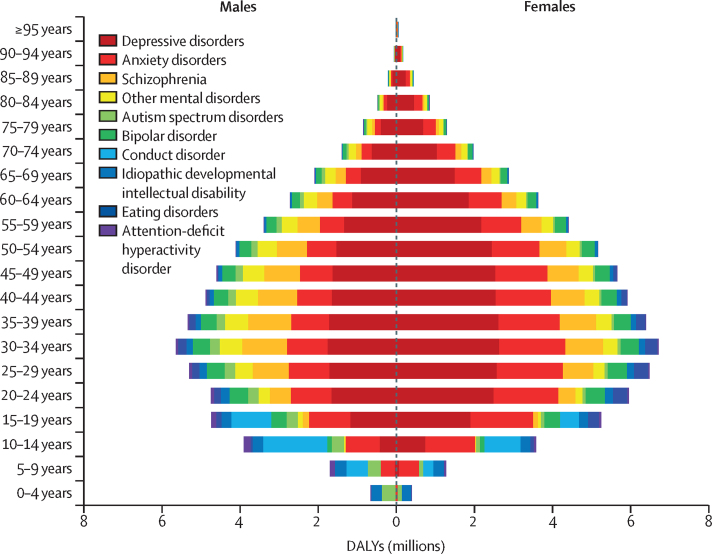
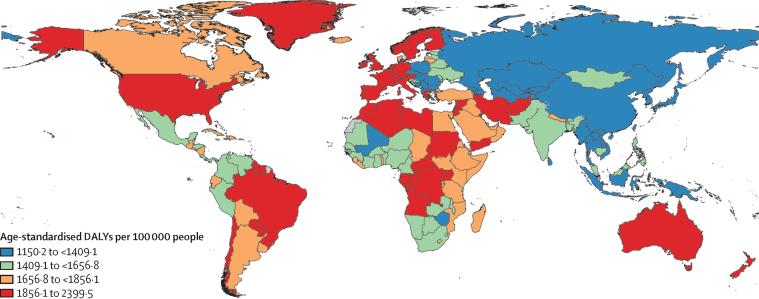
BACKGROUND: The mental disorders included in the Global Burden of Diseases, Injuries, and Risk Factors Study (GBD) 2019 were depressive disorders, anxiety disorders, bipolar disorder, schizophrenia, autism spectrum disorders, conduct disorder, attention-deficit hyperactivity disorder, eating disorders, idiopathic developmental intellectual disability, and a residual category of other mental disorders. We aimed to measure the global, regional, and national prevalence, disability-adjusted life-years (DALYS), years lived with disability (YLDs), and years of life lost (YLLs) for mental disorders from 1990 to 2019. METHODS: In this study, we assessed prevalence and burden estimates from GBD 2019 for 12 mental disorders, males and females, 23 age groups, 204 countries and territories, between 1990 and 2019. DALYs were estimated as the sum of YLDs and YLLs to premature mortality. We systematically reviewed PsycINFO, Embase, PubMed, and the Global Health Data Exchange to obtain data on prevalence, incidence, remission, duration, severity, and excess mortality for each mental disorder. These data informed a Bayesian meta-regression analysis to estimate prevalence by disorder, age, sex, year, and location. Prevalence was multiplied by corresponding disability weights to estimate YLDs. Cause-specific deaths were compiled from mortality surveillance databases. The Cause of Death Ensemble modelling strategy was used to estimate death rate by age, sex, year, and location. The death rates were multiplied by the years of life expected to be remaining at death based on a normative life expectancy to estimate YLLs. Deaths and YLLs could be calculated only for anorexia nervosa and bulimia nervosa, since these were the only mental disorders identified as underlying causes of death in GBD 2019. FINDINGS: Between 1990 and 2019, the global number of DALYs due to mental disorders increased from 80·8 million (95% uncertainty interval [UI] 59·5-105·9) to 125·3 million (93·0-163·2), and the proportion of global DALYs attributed to mental disorders increased from 3·1% (95% UI 2·4-3·9) to 4·9% (3·9-6·1). Age-standardised DALY rates remained largely consistent between 1990 (1581·2 DALYs [1170·9-2061·4] per 100 000 people) and 2019 (1566·2 DALYs [1160·1-2042·8] per 100 000 people). YLDs contributed to most of the mental disorder burden, with 125·3 million YLDs (95% UI 93·0-163·2; 14·6% [12·2-16·8] of global YLDs) in 2019 attributable to mental disorders. Eating disorders accounted for 17 361·5 YLLs (95% UI 15 518·5-21 459·8). Globally, the age-standardised DALY rate for mental disorders was 1426·5 (95% UI 1056·4-1869·5) per 100 000 population among males and 1703·3 (1261·5-2237·8) per 100 000 population among females. Age-standardised DALY rates were highest in Australasia, Tropical Latin America, and high-income North America. INTERPRETATION: GBD 2019 showed that mental disorders remained among the top ten leading causes of burden worldwide, with no evidence of global reduction in the burden since 1990. The estimated YLLs for mental disorders were extremely low and do not reflect premature mortality in individuals with mental disorders. Research to establish causal pathways between mental disorders and other fatal health outcomes is recommended so that this may be addressed within the GBD study. To reduce the burden of mental disorders, coordinated delivery of effective prevention and treatment programmes by governments and the global health community is imperative. FUNDING: Bill & Melinda Gates Foundation, Australian National Health and Medical Research Council, Queensland Department of Health, Australia.
Overview
CoChat Summary
TL;DR
GBD 2019 estimated prevalence and burden for 12 mental disorders across 204 countries and territories from 1990 to 2019. Mental disorders caused 970·1 million cases and 125·3 million DALYs in 2019, with no evidence of global reduction in age-standardised DALY rates since 1990.
Key findings
- Global mental disorder cases increased from 654·8 million (95% UI 603·6–708·1) in 1990 to 970·1 million (900·9–1044·4) in 2019, a 48·1% increase, with no marked increases in age-standardised prevalence for any disorder.
- DALYs increased from 80·8 million (59·5–105·9) to 125·3 million (93·0–163·2), and the proportion of global DALYs attributed to mental disorders rose from 3·1% (2·4–3·9) to 4·9% (3·9–6·1); age-standardised DALY rates remained largely consistent (1581·2 to 1566·2 per 100 000).
- YLDs accounted for most burden: 125·3 million YLDs (93·0–163·2), or 14·6% (12·2–16·8) of global YLDs in 2019. YLLs were estimated only for eating disorders, at 17 361·5 (15 518·5–21 459·8).
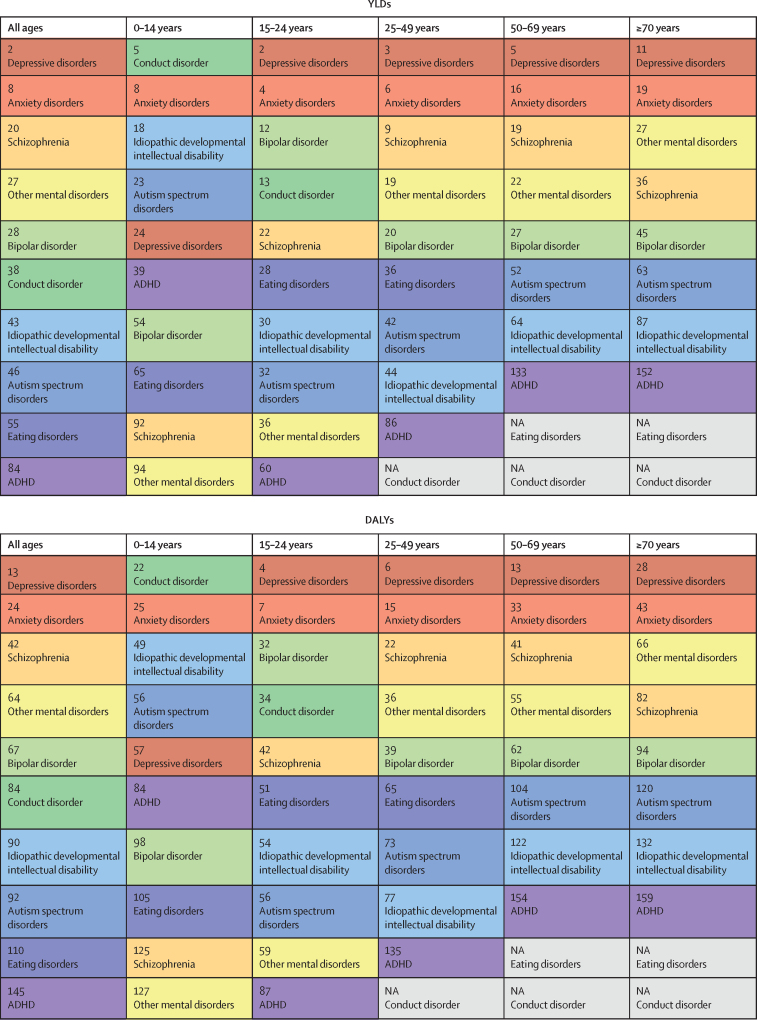
- Depressive disorders accounted for the largest proportion of mental disorder DALYs in 2019 (37·3% [32·3–43·0]), followed by anxiety disorders (22·9% [18·6–27·5]) and schizophrenia (12·2% [9·6–15·2]); age-standardised DALY rates were highest in Australasia, Tropical Latin America, and high-income North America.
Methods
- GBD 2019 estimated prevalence and burden for 12 mental disorders by sex, 23 age groups, 204 countries and territories, and year from 1990 to 2019.
- Systematic reviews of PsycINFO, Embase, PubMed, and the Global Health Data Exchange informed Bayesian meta-regression (DisMod-MR 2.1) prevalence estimates; prevalence was multiplied by disability weights to estimate YLDs, and Cause of Death Ensemble modelling estimated deaths/YLLs.
- DALYs were calculated as YLDs plus YLLs; YLLs were estimated only for anorexia nervosa and bulimia nervosa. Uncertainty intervals were derived from the 25th and 975th ordinals of 1000 draws, and age-standardised rates used the GBD world population age standard.
Limitations
- The paper states that some estimates relied on sparse datasets and high-quality survey data remain scarce for many countries; measurement error could not be fully quantified, and uncertainty intervals do not incorporate unquantified measurement, selection, or model specification bias.
- The paper states that severity distributions were derived from few studies, mostly from high-income countries, likely underestimating burden where treatment access is limited; most data used DSM-IV and ICD-10 classifications, and personality disorders, binge eating disorder, and other specified feeding or eating disorders were not fully captured.
- The paper states that YLLs were estimated only for eating disorders and are extremely low, not reflecting premature mortality in people with mental disorders; disability weights capture health loss but not welfare loss, and comorbidity adjustment assumes independent distributions. Evident from the text: burden estimates for low-data regions, such as parts of sub-Saharan Africa and Asia, carry more uncertainty.
Model-written summary. Check it against the paper before relying on it.
Integrity signals
Registry
Cites
Statistics
Figures
Verification
Claims the paper makes
10 Valid · 0 Not valid · 9 Not checked · 131 Own results and interpretations
The cited sources support only part of this claim — read each source’s verdict below.
In the paper
“Between 1990 and 2019, a reduction in DALYs from communicable, maternal, neonatal, and nutritional diseases has been offset by an increase in burden due to non-communicable diseases, including mental disorders.3, 4, 5”
§ Global, regional, and national burden of 12 mental disorders in 204 countries and territories, 1990–2019: a systematic analysis for the Global Burden of Disease Study 2019 > Introduction
What the sources say
- Could not verifycites [3] Wang H Abbas KM Abbasifard M Global age-sex-specific fertility, mortality, healthy life expectancy (HALE), and population estimates in 204 countries and territories, 1950-2019: a comprehensive demographic analysis for the Global Burden of Disease Study 2019 Lancet 396 2020 1160 1203 33069325 PMC7566045 sourceExperimental — accuracy not yet measured
The Results (Mortality and HALE; page unavailable) report changes in survival and years lived in poor health, while the Discussion (Global population health improvement; page unavailable) describes overall improvements in mortality and HALE. Searches for DALYs and the named disease categories found no passage assessing whether declining communicable-disease DALYs were offset by rising non-communicable-disease burden, including mental disorders. (LLM, conf=0.73)
- Partly supportedcites [4] Murray CJL Aravkin AY Zheng P Global burden of 87 risk factors in 204 countries and territories, 1990-2019: a systematic analysis for the Global Burden of Disease Study 2019 Lancet 396 2020 1223 1249 33069327 PMC7566194 sourceExperimental — accuracy not yet measured
The Results (Attributable burden by age group; page unavailable) report substantial 1990–2019 declines in DALYs attributable to child malnutrition and environmental risks, alongside rising attributable-DALY shares for several other risks. But this is an analysis of risk-attributable burden, not a finding that declining DALYs from the stated disease categories were offset by increasing non-communicable disease DALYs; the passages also do not establish an increase for mental disorders. (LLM, conf=0.84)
- Supportedcites [5] Vos T Lim SS Abbafati C Global burden of 369 diseases and injuries in 204 countries and territories, 1990-2019: a systematic analysis for the Global Burden of Disease Study 2019 Lancet 396 2020 1204 1222 33069326 PMC7567026 source
The Results (Global trends; page not provided) report that total global DALYs remained almost constant from 1990 to 2019, while major infectious, neonatal, and nutritional causes declined and non-communicable causes, including depressive disorders, were among the largest contributors to increasing DALYs. The Results (National trends; page not provided) also describe a shift from communicable, maternal, neonatal, and nutritional diseases towards non-communicable causes. The increase refers to absolute DALY counts, not necessarily age-standardised rates. (LLM, conf=0.88)
plainstates a cause- Asserted: passes — The authors put it forward as true.
- Checkable: passes — It can be checked against evidence.
- Load-bearing: unclear — It is unclear whether the paper’s conclusions depend on it.
- Based: passes — The paper gives a reason why it holds.
- Could not verify
The cited sources support only part of this claim — read each source’s verdict below.
In the paper
“The first covariate identified the mean mortality rate in the previous ten years due to war and terrorism for each GBD location, considering the known association between conflict and elevated prevalence of major depressive disorder and anxiety disorders.12”
§ Global, regional, and national burden of 12 mental disorders in 204 countries and territories, 1990–2019: a systematic analysis for the Global Burden of Disease Study 2019 > Methods > Estimation of YLDs
What the sources say
- Partly supportedcites [12] Charlson F van Ommeren M Flaxman A Cornett J Whiteford H Saxena S New WHO prevalence estimates of mental disorders in conflict settings: a systematic review and meta-analysis Lancet 394 2019 240 248 31200992 PMC6657025 sourceExperimental — accuracy not yet measured
Split into 2 atoms — 1 confirmed, 1 partially supported, 0 disputed, 0 misattributed, 0 unverifiable. Expand the claim to see per-atom verdicts.
plainstates an association- Asserted: passes — The authors put it forward as true.
- Checkable: passes — It can be checked against evidence.
- Load-bearing: unclear — It is unclear whether the paper’s conclusions depend on it.
- Based: passes — The paper gives a reason why it holds.
- Partly supported
The cited sources support only part of this claim — read each source’s verdict below.
In the paper
“Alternative mortality-based metrics have shown that excess deaths in people with mental disorders occur not just from suicide and other external causes but also from infectious diseases, neoplasms, diabetes, and circulatory system and respiratory diseases.34, 35”
§ Global, regional, and national burden of 12 mental disorders in 204 countries and territories, 1990–2019: a systematic analysis for the Global Burden of Disease Study 2019 > Discussion
What the sources say
- Supportedcites [34] Plana-Ripoll O Pedersen CB Agerbo E A comprehensive analysis of mortality-related health metrics associated with mental disorders: a nationwide, register-based cohort study Lancet 394 2019 1827 1835 31668728 source
The Discussion states that people with mental disorders have premature mortality attributable to suicide and other external causes, but that most premature mortality is attributable to general medical conditions. It explicitly lists infectious diseases, neoplasms, diabetes mellitus, circulatory-system diseases, and respiratory diseases. (LLM, conf=0.95)
- Partly supportedcites [35] Walker ER McGee RE Druss BG Mortality in mental disorders and global disease burden implications: a systematic review and meta-analysis JAMA Psychiatry 72 2015 334 341 25671328 PMC4461039 sourceExperimental — accuracy not yet measured
The Results (Mortality; page unavailable) find elevated mortality from both natural and unnatural causes among people with mental disorders. The Discussion identifies suicide and cardiovascular disease, and the introductory passage mentions infections, heart disease, and other chronic diseases. Our copy does not establish the claim’s more specific list of excess deaths from neoplasms, diabetes, and respiratory diseases. (LLM, conf=0.88)
plainstates an association- Asserted: passes — The authors put it forward as true.
- Checkable: passes — It can be checked against evidence.
- Load-bearing: passes — The paper’s conclusions depend on it.
- Based: passes — The paper gives a reason why it holds.
- Supported
Every source the paper cites for this claim was checked and supports it.
In the paper
“Binge eating disorder and the group of ‘other specified feeding or eating disorders’ are likely to explain a substantial proportion of eating disorder burden currently not captured by GBD analyses.33”
§ Global, regional, and national burden of 12 mental disorders in 204 countries and territories, 1990–2019: a systematic analysis for the Global Burden of Disease Study 2019 > Discussion
What the sources say
- Supportedcites [33] Santomauro DF Melen S Mitchison D Vos T Whiteford H Ferrari AJ The hidden burden of eating disorders: an extension of estimates from the Global Burden of Disease Study 2019 Lancet Psychiatry 8 2021 320 328 33675688 PMC7973414 source
The Introduction says GBD 2019 recognised only anorexia nervosa and bulimia nervosa as causes of burden. The Discussion states that excluding binge-eating disorder and OSFED left a large proportion of eating disorder burden uncaptured in GBD 2019, directly supporting the claim. (LLM, conf=0.94)
hedgedstates a possible cause- Asserted: passes — The authors put it forward as true.
- Checkable: passes — It can be checked against evidence.
- Load-bearing: unclear — It is unclear whether the paper’s conclusions depend on it.
- Based: passes — The paper gives a reason why it holds.
- Supported
The cited sources support only part of this claim — read each source’s verdict below.
In the paper
“DALYs for depressive and anxiety disorders were high in countries with high rates of childhood sexual abuse,4 intimate partner violence,4 and conflict and war.12”
§ Global, regional, and national burden of 12 mental disorders in 204 countries and territories, 1990–2019: a systematic analysis for the Global Burden of Disease Study 2019 > Discussion
What the sources say
- Could not verifycites [4] Murray CJL Aravkin AY Zheng P Global burden of 87 risk factors in 204 countries and territories, 1990-2019: a systematic analysis for the Global Burden of Disease Study 2019 Lancet 396 2020 1223 1249 33069327 PMC7566194 sourceExperimental — accuracy not yet measured
The Results section discusses childhood sexual abuse as a risk exposure, and the Limitations section identifies both childhood sexual abuse and intimate partner violence as risks with sparse data. Neither passage reports that depressive or anxiety disorder DALYs were high in countries with high rates of those exposures. Searches for depressive disorders, anxiety disorders, depression, and anxiety did not locate that country-level finding; the separate conflict-and-war citation is not assessed here. (LLM, conf=0.75)
- Partly supportedcites [12] Charlson F van Ommeren M Flaxman A Cornett J Whiteford H Saxena S New WHO prevalence estimates of mental disorders in conflict settings: a systematic review and meta-analysis Lancet 394 2019 240 248 31200992 PMC6657025 sourceExperimental — accuracy not yet measured
Citation 12 is attached to the conflict-and-war portion of the sentence. The Results report substantially higher years lived with disability (YLDs) for depression and anxiety in conflict-affected populations than the global estimates. The paper does not report country-level DALYs or assess whether countries with higher rates of conflict and war have higher DALYs; the childhood sexual abuse and intimate partner violence portions carry a different citation. (LLM, conf=0.85)
plainstates an association- Asserted: passes — The authors put it forward as true.
- Checkable: passes — It can be checked against evidence.
- Load-bearing: unclear — It is unclear whether the paper’s conclusions depend on it.
- Based: passes — The paper gives a reason why it holds.
- Could not verify
68 more claims · 2 with their cited sources checked
Create a free account to see all 150 claims and to verify the 2 references still open.
- Probably not a substantial claim. 52
- It may state two separate claims as one. 33
- The quote only partly states this claim. 1
Claims other papers make about this one
Each is checked against this paper’s own text: does it say what the citing paper says it does?
The cited source doesn’t support the claim as written.
In the citing paper
“Deaths and YLLs could only be calculated for anorexia nervosa as it was the only mental disorder identified as an underlying cause of death (suicide was categorised as a separate cause to mental disorders in GBD 2023).2,8”
From Updated trends in the global prevalence and burden of mental disorders, 1990–2023: a systematic analysis for the Global Burden of Disease Study 2023 (2026) · cites this paper as [2]
Checked by a reasoning model — may be wrong.
Experimental — accuracy not yet measuredThe source backs part of the claim, not all of it — or backs it for a different population, condition or comparison.
In the citing paper
“Mental disorders also have broader societal consequences impacting those responsible for the wellbeing of individuals with mental disorders, as well as employers, due to diminished productivity and work force participation, and government, with increased welfare and mental health service requirements.2”
From Updated trends in the global prevalence and burden of mental disorders, 1990–2023: a systematic analysis for the Global Burden of Disease Study 2023 (2026) · cites this paper as [2]
Experimental — accuracy not yet measuredThe source backs part of the claim, not all of it — or backs it for a different population, condition or comparison.
In the citing paper
“common among females, while autism spectrum disorders, conduct disorder, ADHD, IDID, and the residual group of other mental disorders were more common among males.2,16”
From Updated trends in the global prevalence and burden of mental disorders, 1990–2023: a systematic analysis for the Global Burden of Disease Study 2023 (2026) · cites this paper as [2]
Experimental — accuracy not yet measuredThe source backs part of the claim, not all of it — or backs it for a different population, condition or comparison.
In the citing paper
“Individuals with mental disorders are at an increased risk of early mortality from a range of physical illnesses and injuries, such as suicide and homicide, 2,38 but these are categorised as separate causes within GBD.”
From Updated trends in the global prevalence and burden of mental disorders, 1990–2023: a systematic analysis for the Global Burden of Disease Study 2023 (2026) · cites this paper as [2]
Experimental — accuracy not yet measured
22 more claims about this paper
Create a free account to see every claim other papers make about this one.
Citations
Cites
Vos, T., Lim, S. S., Abbafati, C., Abbas, K. M., Abbasi, M., Abbasifard, M., Abbasi-Kangevari, M., Abbastabar, H., Abd-Allah, F., Abdelalim, A., et al. (2020) · The Lancet · doi:10.1016/s0140-6736(20)30925-9 · Cited by 19,358
Murray, C. J. L., Aravkin, A. Y., Zheng, P., Abbafati, C., Abbas, K. M., Abbasi-Kangevari, M., Abd-Allah, F., Abdelalim, A., Abdollahi, M., Abdollahpour, I., et al. (2020) · The Lancet · doi:10.1016/s0140-6736(20)30752-2 · Cited by 9,854
Whiteford, H. A., Degenhardt, L., Rehm, J., Baxter, A. J., Ferrari, A. J., Erskine, H. E., Charlson, F. J., Norman, R. E., Flaxman, A. D., Johns, N., et al. (2013) · The Lancet · doi:10.1016/s0140-6736(13)61611-6 · Cited by 6,006
Santomauro, D. F., Mantilla Herrera, A. M., Shadid, J., Zheng, P., Ashbaugh, C., Pigott, D. M., Abbafati, C., Adolph, C., Amlag, J. O., Aravkin, A. Y., et al. (2021) · The Lancet · doi:10.1016/s0140-6736(21)02143-7 · Cited by 5,444
The Lancet Commission on global mental health and sustainable development
Patel, V., Saxena, S., Lund, C., Thornicroft, G., Baingana, F., Bolton, P., Chisholm, D., Collins, P. Y., Cooper, J. L., Eaton, J., et al. (2018) · The Lancet · doi:10.1016/s0140-6736(18)31612-x · Cited by 3,692
Walker, E. R., McGee, R. E., & Druss, B. G. (2015) · JAMA Psychiatry · doi:10.1001/jamapsychiatry.2014.2502 · Cited by 2,976
Wang, H., Abbas, K. M., Abbasifard, M., Abbasi-Kangevari, M., Abbastabar, H., Abd-Allah, F., Abdelalim, A., Abolhassani, H., Abreu, L. G., Abrigo, M. R. M., et al. (2020) · The Lancet · doi:10.1016/s0140-6736(20)30977-6 · Cited by 1,971
Guidelines for accurate and transparent health estimates reporting: the GATHER statement
Stevens, G. A., Alkema, L., Black, R. E., Boerma, J. T., Collins, G. S., Ezzati, M., Grove, J. T., Hogan, D. R., Hogan, M. C., Horton, R., et al. (2016) · The Lancet · doi:10.1016/s0140-6736(16)30388-9 · Cited by 1,798
Charlson, F., van Ommeren, M., Flaxman, A., Cornett, J., Whiteford, H., & Saxena, S. (2019) · The Lancet · doi:10.1016/s0140-6736(19)30934-1 · Cited by 1,702
Degenhardt, L., Charlson, F., Ferrari, A., Santomauro, D., Erskine, H., Mantilla-Herrara, A., Whiteford, H., Leung, J., Naghavi, M., Griswold, M., et al. (2018) · The Lancet Psychiatry · doi:10.1016/s2215-0366(18)30337-7 · Cited by 1,572
Research works printed but not linked: 1
- Flaxman AD Vos T Murray CJL An integrative metaregression framework for descriptive epidemiology 2015 University of Washington Press Washington
Cited by
Santomauro, D. F., Mantilla Herrera, A. M., Shadid, J., Zheng, P., Ashbaugh, C., Pigott, D. M., Abbafati, C., Adolph, C., Amlag, J. O., Aravkin, A. Y., et al. (2021) · The Lancet · doi:10.1016/s0140-6736(21)02143-7 · Cited by 5,444
Ferrari, A. J., Santomauro, D. F., Aali, A., Abate, Y. H., Abbafati, C., Abbastabar, H., Abd ElHafeez, S., Abdelmasseh, M., Abd-Elsalam, S., Abdollahi, A., et al. (2024) · The Lancet · doi:10.1016/s0140-6736(24)00757-8 · Cited by 5,112
The social determinants of mental health and disorder: evidence, prevention and recommendations
Kirkbride, J. B., Anglin, D. M., Colman, I., Dykxhoorn, J., Jones, P. B., Patalay, P., Pitman, A., Soneson, E., Steare, T., Wright, T., et al. (2024) · World Psychiatry · doi:10.1002/wps.21160 · Cited by 1,253
Quantifying the global burden of mental disorders and their economic value
Arias, D., Saxena, S., & Verguet, S. (2022) · eClinicalMedicine · doi:10.1016/j.eclinm.2022.101675 · Cited by 771
Marx, W., Penninx, B. W. J. H., Solmi, M., Furukawa, T. A., Firth, J., Carvalho, A. F., & Berk, M. (2023) · Nature Reviews Disease Primers · doi:10.1038/s41572-023-00454-1 · Cited by 768
Kieling, C., Buchweitz, C., Caye, A., Silvani, J., Ameis, S. H., Brunoni, A. R., Cost, K. T., Courtney, D. B., Georgiades, K., Merikangas, K. R., et al. (2024) · JAMA Psychiatry · doi:10.1001/jamapsychiatry.2023.5051 · Cited by 687
Solmi, M., Seitidis, G., Mavridis, D., Correll, C. U., Dragioti, E., Guimond, S., Tuominen, L., Dargél, A., Carvalho, A. F., Fornaro, M., et al. (2023) · Molecular Psychiatry · doi:10.1038/s41380-023-02138-4 · Cited by 570
Lawrance, E. L., Thompson, R., Newberry Le Vay, J., Page, L., & Jennings, N. (2022) · International Review of Psychiatry · doi:10.1080/09540261.2022.2128725 · Cited by 500
Global burden of hematologic malignancies and evolution patterns over the past 30 years
Zhang, N., Wu, J., Wang, Q., Liang, Y., Li, X., Chen, G., Ma, L., Liu, X., & Zhou, F. (2023) · Blood Cancer Journal · doi:10.1038/s41408-023-00853-3 · Cited by 432
Lam, R. W., Kennedy, S. H., Adams, C., Bahji, A., Beaulieu, S., Bhat, V., Blier, P., Blumberger, D. M., Brietzke, E., Chakrabarty, T., et al. (2024) · The Canadian Journal of Psychiatry · doi:10.1177/07067437241245384 · Cited by 369
Castelpietra, G., Knudsen, A. K. S., Agardh, E. E., Armocida, B., Beghi, M., Iburg, K. M., Logroscino, G., Ma, R., Starace, F., Steel, N., et al. (2022) · The Lancet Regional Health - Europe · doi:10.1016/j.lanepe.2022.100341 · Cited by 347
Berk, M., Köhler‐Forsberg, O., Turner, M., Penninx, B. W. J. H., Wrobel, A., Firth, J., Loughman, A., Reavley, N. J., McGrath, J. J., Momen, N. C., et al. (2023) · World Psychiatry · doi:10.1002/wps.21110 · Cited by 336
Towards a youth mental health paradigm: a perspective and roadmap
Uhlhaas, P. J., Davey, C. G., Mehta, U. M., Shah, J., Torous, J., Allen, N. B., Avenevoli, S., Bella-Awusah, T., Chanen, A., Chen, E. Y. H., et al. (2023) · Molecular Psychiatry · doi:10.1038/s41380-023-02202-z · Cited by 318
“Syndromes such as schizophrenia, depression, anxiety, and personality disorders comprise some of the largest disease burdens worldwide [2].”
BackgroundAmbient temperature and mental health: a systematic review and meta-analysis
Thompson, R., Lawrance, E. L., Roberts, L. F., Grailey, K., Ashrafian, H., Maheswaran, H., Toledano, M. B., & Darzi, A. (2023) · The Lancet Planetary Health · doi:10.1016/s2542-5196(23)00104-3 · Cited by 306
Lane, M. M., Gamage, E., Travica, N., Dissanayaka, T., Ashtree, D. N., Gauci, S., Lotfaliany, M., O’Neil, A., Jacka, F. N., & Marx, W. (2022) · Nutrients · doi:10.3390/nu14132568 · Cited by 320
Hammoudi Halat, D., Soltani, A., Dalli, R., Alsarraj, L., & Malki, A. (2023) · Journal of Clinical Medicine · doi:10.3390/jcm12134425 · Cited by 296
Yang, T., Wang, J., Huang, J., Kelly, F. J., & Li, G. (2023) · JAMA Psychiatry · doi:10.1001/jamapsychiatry.2022.4812 · Cited by 289
Degenhardt, L., Webb, P., Colledge-Frisby, S., Ireland, J., Wheeler, A., Ottaviano, S., Willing, A., Kairouz, A., Cunningham, E. B., Hajarizadeh, B., et al. (2023) · The Lancet Global Health · doi:10.1016/s2214-109x(23)00057-8 · Cited by 279
López-Gil, J. F., García-Hermoso, A., Smith, L., Firth, J., Trott, M., Mesas, A. E., Jiménez-López, E., Gutiérrez-Espinoza, H., Tárraga-López, P. J., & Victoria-Montesinos, D. (2023) · JAMA Pediatrics · doi:10.1001/jamapediatrics.2022.5848 · Cited by 276
Randomized Trial of a Generative AI Chatbot for Mental Health Treatment
Heinz, M. V., Mackin, D. M., Trudeau, B. M., Bhattacharya, S., Wang, Y., Banta, H. A., Jewett, A. D., Salzhauer, A. J., Griffin, T. Z., & Jacobson, N. C. (2025) · NEJM AI · doi:10.1056/aioa2400802 · Cited by 287
Feeding gut microbes to nourish the brain: unravelling the diet–microbiota–gut–brain axis
Schneider, E., O’Riordan, K. J., Clarke, G., & Cryan, J. F. (2024) · Nature Metabolism · doi:10.1038/s42255-024-01108-6 · Cited by 272
Piao, J., Huang, Y., Han, C., Li, Y., Xu, Y., Liu, Y., & He, X. (2022) · European Child & Adolescent Psychiatry · doi:10.1007/s00787-022-02040-4 · Cited by 264
Ketamine and rapid antidepressant action: New treatments and novel synaptic signaling mechanisms
Krystal, J. H., Kavalali, E. T., & Monteggia, L. M. (2024) · Neuropsychopharmacology · doi:10.1038/s41386-023-01629-w · Cited by 262
“Despite over 60 years of antidepressant development, mood disorders remain among the most disabling medical conditions in the world and they are associated with shortening of life expectancy by up to 10 years [5, 6].”
BackgroundXiong, R.-G., Li, J., Cheng, J., Zhou, D.-D., Wu, S.-X., Huang, S.-Y., Saimaiti, A., Yang, Z.-J., Gan, R.-Y., & Li, H.-B. (2023) · Nutrients · doi:10.3390/nu15143258 · Cited by 249
“In 2019, the number of individuals suffering from mental disorders was estimated to be close to 970 million [2].”
BackgroundAndreassen, O. A., Hindley, G. F. L., Frei, O., & Smeland, O. B. (2023) · World Psychiatry · doi:10.1002/wps.21034 · Cited by 243
(2024) · doi:10.21203/rs.3.rs-4612612/v1 · Cited by 241
“It happened to be the perfect thing”: experiences of generative AI chatbots for mental health
Siddals, S., Torous, J., & Coxon, A. (2024) · npj Mental Health Research · doi:10.1038/s44184-024-00097-4 · Cited by 241
Kaul, I., Sawchak, S., Correll, C. U., Kakar, R., Breier, A., Zhu, H., Miller, A. C., Paul, S. M., & Brannan, S. K. (2024) · The Lancet · doi:10.1016/s0140-6736(23)02190-6 · Cited by 239
Global Mental Health: Where We Are and Where We Are Going
Moitra, M., Owens, S., Hailemariam, M., Wilson, K. S., Mensa-Kwao, A., Gonese, G., Kamamia, C. K., White, B., Young, D. M., & Collins, P. Y. (2023) · Current Psychiatry Reports · doi:10.1007/s11920-023-01426-8 · Cited by 239
Chan, J. K. N., Correll, C. U., Wong, C. S. M., Chu, R. S. T., Fung, V. S. C., Wong, G. H. S., Lei, J. H. C., & Chang, W. C. (2023) · eClinicalMedicine · doi:10.1016/j.eclinm.2023.102294 · Cited by 233
Solmi, M., Song, M., Yon, D. K., Lee, S. W., Fombonne, E., Kim, M. S., Park, S., Lee, M. H., Hwang, J., Keller, R., et al. (2022) · Molecular Psychiatry · doi:10.1038/s41380-022-01630-7 · Cited by 226
(2025) · doi:10.1186/s12888-025-06932-y · Cited by 227
“Nationally, our study found that the countries with the highest DALYs for mental disorders were Green-land, Greece, the United States, and Australia; which is consistent with previous research results [7].”
InfluentialGlobal burden of hip fracture: The Global Burden of Disease Study
Feng, J.-N., Zhang, C.-G., Li, B.-H., Zhan, S.-Y., Wang, S.-F., & Song, C.-L. (2024) · Osteoporosis International · doi:10.1007/s00198-023-06907-3 · Cited by 221
Cortese, S., Song, M., Farhat, L. C., Yon, D. K., Lee, S. W., Kim, M. S., Park, S., Oh, J. W., Lee, S., Cheon, K.-A., et al. (2023) · Molecular Psychiatry · doi:10.1038/s41380-023-02228-3 · Cited by 246
Central regulation of stress-evoked peripheral immune responses
Chan, K. L., Poller, W. C., Swirski, F. K., & Russo, S. J. (2023) · Nature Reviews Neuroscience · doi:10.1038/s41583-023-00729-2 · Cited by 207
Wu, Y., Wang, L., Tao, M., Cao, H., Yuan, H., Ye, M., Chen, X., Wang, K., & Zhu, C. (2023) · Epidemiology and Psychiatric Sciences · doi:10.1017/s2045796023000756 · Cited by 202
“Notably, the prevalence of mental disorders is high, ranking in the top 10 among diseases worldwide (Charlson, et al. 2019; Collaborators 2020, pp. 1204–1222; Collaborators 2021) and the disability rate is also high (Collaborators 2020, pp. 1223–1249; Collaborators 2022).”
BackgroundVan Meter, A. R., Knowles, E. A., & Mintz, E. H. (2023) · Journal of the American Academy of Child & Adolescent Psychiatry · doi:10.1016/j.jaac.2022.07.867 · Cited by 193
Santo, T., Campbell, G., Gisev, N., Martino-Burke, D., Wilson, J., Colledge-Frisby, S., Clark, B., Tran, L. T., & Degenhardt, L. (2022) · Drug and Alcohol Dependence · doi:10.1016/j.drugalcdep.2022.109551 · Cited by 189
Castaldelli-Maia, J. M., & Bhugra, D. (2022) · International Review of Psychiatry · doi:10.1080/09540261.2022.2040450 · Cited by 187
The 2023 wearable photoplethysmography roadmap
Charlton, P. H., Allen, J., Bailón, R., Baker, S., Behar, J. A., Chen, F., Clifford, G. D., Clifton, D. A., Davies, H. J., Ding, C., et al. (2023) · Physiological Measurement · doi:10.1088/1361-6579/acead2 · Cited by 187
Hoge, E. A., Bui, E., Mete, M., Dutton, M. A., Baker, A. W., & Simon, N. M. (2023) · JAMA Psychiatry · doi:10.1001/jamapsychiatry.2022.3679 · Cited by 182
Marx, W., Manger, S. H., Blencowe, M., Murray, G., Ho, F. Y.-Y., Lawn, S., Blumenthal, J. A., Schuch, F., Stubbs, B., Ruusunen, A., et al. (2023) · The World Journal of Biological Psychiatry · doi:10.1080/15622975.2022.2112074 · Cited by 179
The youth mental health crisis: analysis and solutions
McGorry, P., Gunasiri, H., Mei, C., Rice, S., & Gao, C. X. (2025) · Frontiers in Psychiatry · doi:10.3389/fpsyt.2024.1517533 · Cited by 175
Bueno, H., Deaton, C., Farrero, M., Forsyth, F., Braunschweig, F., Buccheri, S., Dragan, S., Gevaert, S., Held, C., Kurpas, D., et al. (2025) · European Heart Journal · doi:10.1093/eurheartj/ehaf191 · Cited by 178
Zhong, W., Luo, J., & Zhang, H. (2024) · Journal of Affective Disorders · doi:10.1016/j.jad.2024.04.057 · Cited by 173
A network analysis of anxiety and depression symptoms in Chinese disabled elderly
Zhang, P., Wang, L., Zhou, Q., Dong, X., Guo, Y., Wang, P., He, W., Wang, R., Wu, T., Yao, Z., et al. (2023) · Journal of Affective Disorders · doi:10.1016/j.jad.2023.04.065 · Cited by 169
Correll, C. U., Agid, O., Crespo-Facorro, B., de Bartolomeis, A., Fagiolini, A., Seppälä, N., & Howes, O. D. (2022) · CNS Drugs · doi:10.1007/s40263-022-00932-2 · Cited by 162
Qin, Z., Shi, D.-D., Li, W., Cheng, D., Zhang, Y.-D., Zhang, S., Tsoi, B., Zhao, J., Wang, Z., & Zhang, Z.-J. (2023) · Journal of Neuroinflammation · doi:10.1186/s12974-023-02744-7 · Cited by 162
Liu, J., Liu, Y., Ma, W., Tong, Y., & Zheng, J. (2024) · Scientific Reports · doi:10.1038/s41598-024-62381-9 · Cited by 160
Metabolic Profile and Long-Term Risk of Depression, Anxiety, and Stress-Related Disorders
Chourpiliadis, C., Zeng, Y., Lovik, A., Wei, D., Valdimarsdóttir, U., Song, H., Hammar, N., & Fang, F. (2024) · JAMA Network Open · doi:10.1001/jamanetworkopen.2024.4525 · Cited by 164
Barth, C., Crestol, A., de Lange, A. G., & Galea, L. A. M. (2023) · The Lancet Diabetes & Endocrinology · doi:10.1016/s2213-8587(23)00224-3 · Cited by 179
Artificial intelligence in psychiatry research, diagnosis, and therapy
Sun, J., Dong, Q., Wang, S.-W., Zheng, Y., Liu, X., Lu, T., Yuan, K., Shi, J., Hu, B., Hu, B., et al. (2023) · Asian Journal of Psychiatry · doi:10.1016/j.ajp.2023.103705 · Cited by 200
New and emerging approaches to treat psychiatric disorders
Scangos, K. W., State, M. W., Miller, A. H., Baker, J. T., & Williams, L. M. (2023) · Nature Medicine · doi:10.1038/s41591-022-02197-0 · Cited by 180
Tseng, P., Zeng, B., Hung, C., Liang, C., Stubbs, B., Carvalho, A. F., Brunoni, A. R., Su, K., Tu, Y., Wu, Y., et al. (2022) · JAMA Psychiatry · doi:10.1001/jamapsychiatry.2022.1513 · Cited by 162
Cutler, A. J., Mattingly, G. W., & Maletic, V. (2023) · Translational Psychiatry · doi:10.1038/s41398-023-02514-2 · Cited by 194
Is AI the Future of Mental Healthcare?
Minerva, F., & Giubilini, A. (2023) · Topoi · doi:10.1007/s11245-023-09932-3 · Cited by 184
“One of the reasons people don’t seek help when they suffer from mental health issues is that they are often unaware of their changed mental health status (Gilleen et al. 2010).”
BackgroundIs Target-Based Drug Discovery Efficient? Discovery and “Off-Target” Mechanisms of All Drugs
Sadri, A. (2023) · Journal of Medicinal Chemistry · doi:10.1021/acs.jmedchem.2c01737 · Cited by 163
Change in the global burden of depression from 1990-2019 and its prediction for 2030
Zhang, Y., Jia, X., Yang, Y., Sun, N., Shi, S., & Wang, W. (2024) · Journal of Psychiatric Research · doi:10.1016/j.jpsychires.2024.07.054 · Cited by 187
Sleep Deprivation and Insomnia in Adolescence: Implications for Mental Health
Uccella, S., Cordani, R., Salfi, F., Gorgoni, M., Scarpelli, S., Gemignani, A., Geoffroy, P. A., De Gennaro, L., Palagini, L., Ferrara, M., et al. (2023) · Brain Sciences · doi:10.3390/brainsci13040569 · Cited by 131
Dietary Nutrient Deficiencies and Risk of Depression (Review Article 2018–2023)
Zielińska, M., Łuszczki, E., & Dereń, K. (2023) · Nutrients · doi:10.3390/nu15112433 · Cited by 183
ChatGPT is not ready yet for use in providing mental health assessment and interventions
Dergaa, I., Fekih-Romdhane, F., Hallit, S., Loch, A. A., Glenn, J. M., Fessi, M. S., Ben Aissa, M., Souissi, N., Guelmami, N., Swed, S., et al. (2024) · Frontiers in Psychiatry · doi:10.3389/fpsyt.2023.1277756 · Cited by 125
Dragioti, E., Radua, J., Solmi, M., Gosling, C. J., Oliver, D., Lascialfari, F., Ahmed, M., Cortese, S., Estradé, A., Arrondo, G., et al. (2023) · World Psychiatry · doi:10.1002/wps.21068 · Cited by 130
Bipolar disorders: an update on critical aspects
Oliva, V., Fico, G., Prisco, M. D., Gonda, X., Rosa, A. R., & Vieta, E. (2024) · The Lancet Regional Health - Europe · doi:10.1016/j.lanepe.2024.101135 · Cited by 229
Third-party evaluators perceive AI as more compassionate than expert humans
Ovsyannikova, D., de Mello, V. O., & Inzlicht, M. (2025) · Communications Psychology · doi:10.1038/s44271-024-00182-6 · Cited by 124
Fonseca‐Pedrero, E., Díez-Gómez, A., Pérez‐Albéniz, A., Al‐Halabí, S., Lucas‐Molina, B., & Debbané, M. (2023) · Psychiatry Research · doi:10.1016/j.psychres.2023.115486 · Cited by 166
Pretorius, C., McCashin, D., & Coyle, D. (2022) · Internet Interventions · doi:10.1016/j.invent.2022.100591 · Cited by 174
The promise of the metaverse in mental health: the new era of MEDverse
Cerasa, A., Gaggioli, A., Marino, F., Riva, G., & Pioggia, G. (2022) · Heliyon · doi:10.1016/j.heliyon.2022.e11762 · Cited by 121
Global health 2050: the path to halving premature death by mid-century
Jamison, D. T., Summers, L. H., Chang, A. Y., Karlsson, O., Mao, W., Norheim, O. F., Ogbuoji, O., Schäferhoff, M., Watkins, D., Adeyi, O., et al. (2024) · The Lancet · doi:10.1016/s0140-6736(24)01439-9 · Cited by 125
Neurobiology and systems biology of stress resilience
Kalisch, R., Russo, S. J., & Müller, M. B. (2024) · Physiological Reviews · doi:10.1152/physrev.00042.2023 · Cited by 166
How do different types and characteristics of green space impact mental health? A scoping review
Beute, F., Marselle, M. R., Olszewska-Guizzo, A., Andreucci, M. B., Lammel, A., Davies, Z. G., Glanville, J., Keune, H., O’Brien, L., Remmen, R., et al. (2023) · People and Nature · doi:10.1002/pan3.10529 · Cited by 182
“Mental health problems are one of the major disease burdens worldwide, with incidences continuing to rise (GBD Mental Health Collaborators, 2022).”
BackgroundEmerging role of the host microbiome in neuropsychiatric disorders: overview and future directions
Hashimoto, K. (2023) · Molecular Psychiatry · doi:10.1038/s41380-023-02287-6 · Cited by 158
Unemployment and Substance Use: An Updated Review of Studies from North America and Europe
Nolte-Troha, C., Roser, P., Henkel, D., Scherbaum, N., Koller, G., & Franke, A. G. (2023) · Healthcare · doi:10.3390/healthcare11081182 · Cited by 172
“However, a specific focus on substance-use disorders (SUDs) is still significantly underrepresented in the research, and at times, it has even been excluded from systematic reviews [15].”
BackgroundIncidence and prevalence of functional neurological disorder: a systematic review
Finkelstein, S. A., Diamond, C., Carson, A. J., & Stone, J. (2024) · Journal of Neurology Neurosurgery & Psychiatry · doi:10.1136/jnnp-2024-334767 · Cited by 134
Meyer, A., Riese, J., & Streichert, T. (2024) · JMIR Medical Education · doi:10.2196/50965 · Cited by 110
Zhao, R., Amanvermez, Y., Pei, J., Castro‐Ramirez, F., Rapsey, C., Garcia, C., Ebert, D. D., Haro, J. M., Fodor, L. A., David, O. A., et al. (2025) · Journal of Child Psychology and Psychiatry · doi:10.1111/jcpp.14145 · Cited by 110
Inflammatory Biomarkers and Risk of Psychiatric Disorders
Zeng, Y., Chourpiliadis, C. P., Hammar, N., Seitz, C., Valdimarsdóttir, U. A., Fang, F., Song, H., & Wei, D. (2024) · JAMA Psychiatry · doi:10.1001/jamapsychiatry.2024.2185 · Cited by 141
Li, J., Pandian, V., Davidson, P. M., Song, Y., Chen, N., & Fong, D. (2025) · International Journal of Surgery · doi:10.1097/js9.0000000000002260 · Cited by 114
“Notably, the age-standardized DALY rates for mental disorders remained stable from 1990 to 2019 [ 28 ] , but experienced a 9.4% increase in 2021.”
InfluentialHe, Q., Mok, T. N., Sin, T., Yin, J., Li, S., Yin, Y., Ming, W., & Feng, B. (2023) · JMIR Public Health and Surveillance · doi:10.2196/45943 · Cited by 131
Virtual brain twins: from basic neuroscience to clinical use
Wang, H., Triebkorn, P., Breyton, M., Dollomaja, B., Lemaréchal, J.-D., Petkoski, S., Sorrentino, P., Depannemaecker, D., Hashemi, M., & Jirsa, V. (2024) · National Science Review · doi:10.1093/nsr/nwae079 · Cited by 195
Spencer, C. N., Khalil, M., Herbert, M., Aravkin, A. Y., Arrieta, A., Baeza, M. J., Bustreo, F., Cagney, J., Calderon-Anyosa, R. J. C., Carr, S., et al. (2023) · Nature Medicine · doi:10.1038/s41591-023-02629-5 · Cited by 104
Environmental Toxicant Exposure and Depressive Symptoms
Guo, J., Garshick, E., Si, F., Tang, Z., Lian, X., Wang, Y. Q., Li, J., & Koutrakis, P. (2024) · JAMA Network Open · doi:10.1001/jamanetworkopen.2024.20259 · Cited by 123
Yang, C.-H., Lv, J.-J., Kong, X.-M., Chu, F., Li, Z.-B., Lu, W., & Li, X. (2024) · The British Journal of Psychiatry · doi:10.1192/bjp.2024.69 · Cited by 128
The effects of temperature on mental health: evidence from China
Hua, Y., Qiu, Y., & Tan, X. (2022) · Journal of Population Economics · doi:10.1007/s00148-022-00932-y · Cited by 115
Li, S., Zhang, X., Cai, Y., Zheng, L., Pang, H., & Lou, L. (2023) · Annals of General Psychiatry · doi:10.1186/s12991-023-00486-7 · Cited by 139
An urgent call to address work‐related psychosocial hazards and improve worker well‐being
Schulte, P. A., Sauter, S. L., Pandalai, S. P., Tiesman, H. M., Chosewood, L. C., Cunningham, T. R., Wurzelbacher, S. J., Pana‐Cryan, R., Swanson, N. G., Chang, C., et al. (2024) · American Journal of Industrial Medicine · doi:10.1002/ajim.23583 · Cited by 143
Forbes, A., Keleher, M. R., Venditto, M., & DiBiasi, F. (2023) · Journal of Medical Internet Research · doi:10.2196/43727 · Cited by 94
Feng, X., Jia, M., Cai, M., Zhu, T., Hashimoto, K., & Yang, J. (2025) · Molecular Psychiatry · doi:10.1038/s41380-025-03085-y · Cited by 156
Villarreal-Zegarra, D., Barrera-Begazo, J., Otazú-Alfaro, S., Mayo-Puchoc, N., Bazo-Alvarez, J. C., & Huarcaya-Victoria, J. (2023) · BMJ Open · doi:10.1136/bmjopen-2023-076193 · Cited by 93
Faber, S. C., Roy, A. K., Michaels, T. I., & Williams, M. T. (2023) · Frontiers in Psychiatry · doi:10.3389/fpsyt.2023.1098292 · Cited by 124
Gut microbiota, nutrition, and mental health
Merlo, G., Bachtel, G., & Sugden, S. G. (2024) · Frontiers in Nutrition · doi:10.3389/fnut.2024.1337889 · Cited by 130
Hong, C., Liu, Z., Gao, L., Jin, Y., Shi, J., Liang, R., Maimaitiming, M., Ning, X., & Luo, Y. (2022) · Epidemiology and Psychiatric Sciences · doi:10.1017/s2045796022000683 · Cited by 92
Depression Recognition Using Remote Photoplethysmography From Facial Videos
Casado, C. Á., Cañellas, M. L., & López, M. B. (2023) · IEEE Transactions on Affective Computing · doi:10.1109/taffc.2023.3238641 · Cited by 120
Wallensten, J., Ljunggren, G., Nager, A., Wachtler, C., Bogdanović, N., Petrović, P., & Carlsson, A. C. (2023) · Alzheimer s Research & Therapy · doi:10.1186/s13195-023-01308-4 · Cited by 123
“Depression is common worldwide and a primary contributor to the global burden of disease [23, 26].”
BackgroundThe clinical implications of climate change for mental health
Crandon, T. J., Dey, C., Scott, J. G., Thomas, H. J., Ali, S., & Charlson, F. J. (2022) · Nature Human Behaviour · doi:10.1038/s41562-022-01477-6 · Cited by 88
Alemi, Q., Panter‐Brick, C., Oriya, S., Ahmady, M., Alimi, A. Q., Faiz, H., Hakim, N., Hashemi, S. A. S., Manaly, M. A., Naseri, R., et al. (2023) · BJPsych Open · doi:10.1192/bjo.2023.502 · Cited by 128
(2023) · doi:10.1186/s12888-023-04827-4 · Cited by 89
The gut virome is associated with stress-induced changes in behaviour and immune responses in mice
Ritz, N. L., Draper, L. A., Bastiaanssen, T. F. S., Turkington, C. J. R., Peterson, V. L., van de Wouw, M., Vlčková, K., Fülling, C., Guzzetta, K. E., Burokas, A., et al. (2024) · Nature Microbiology · doi:10.1038/s41564-023-01564-y · Cited by 93
Rim, S. J., Hahm, B.-J., Seong, S. J., Park, J. E., Chang, S. M., Kim, B.-S., An, H., Jeon, H. J., Hong, J. P., & Park, S. (2023) · Psychiatry Investigation · doi:10.30773/pi.2022.0307 · Cited by 81
Bizzozero‐Peroni, B., Martínez‐Vizcaíno, V., Fernández‐Rodríguez, R., Jiménez‐López, E., de Arenas‐Arroyo, S. N., Saz‐Lara, A., Goñi, V. D., & Mesas, A. E. (2024) · Nutrition Reviews · doi:10.1093/nutrit/nuad176 · Cited by 115
Behnoush, A. H., Mousavi, A., Ghondaghsaz, E., Shojaei, S., Cannavò, A., & Khalaji, A. (2024) · Neuroscience & Biobehavioral Reviews · doi:10.1016/j.neubiorev.2024.105582 · Cited by 87
Metadata
- Authors
- *
- Corresponding author
- *
- Venue
- The Lancet Psychiatry
- Publisher
- Elsevier BV
- Published
- 2022-02
- Volume
- 9
- Issue
- 2
- Pages
- 137-150
- ISSN
- 2215-0366 (ISSN-L)
- PMC
- PMC8776563
- OpenAlex
- W4205208574
- Cited by
- 6,481
- References
- 33
- Citations by year
- 2026: 1577 · 2025: 1938 · 2024: 1557 · 2023: 1050 · 2022: 349
- FWCI
- 183.57
- Type
- journal article
- Language
- en
- Open access
- hybrid
- doi.org
- Licence
- cc-by
- www.elsevier.com/tdm/userlicense/1.0/ (tdm)
- www.elsevier.com/legal/tdmrep-license (tdm)
- creativecommons.org/licenses/by/4.0/ (vor)
- Locations
- The Lancet Psychiatry (publishedVersion, cc-by)
- PubMed Central (publishedVersion, cc-by)
- PubMed (publishedVersion)
- Adelaide Research & Scholarship (AR&S) (University of Adelaide) (submittedVersion, cc-by)
- Minerva Access (University of Melbourne) (submittedVersion, cc-by)
- Spiral (Imperial College London) (submittedVersion, other-oa)
- Funders
- ACADIA Pharmaceuticals
- Fundação de Amparo à Pesquisa do Estado do Rio Grande do Sul
- Medical Research Council
- National Institute for Health Research Southampton Biomedical Research Centre
- Royal Academy of Engineering
- Academy of Medical Sciences
- Conselho Nacional de Desenvolvimento Científico e Tecnológico
- Queensland Health
- Department of Health, State Government of Victoria
- U.S. Department of Defense
- South African Medical Research Council
- National Institute of Mental Health
- Danmarks Grundforskningsfond (1177991)
- U.S. Department of Veterans Affairs
- University of Melbourne
- Bill and Melinda Gates Foundation
- King's College London
- National Institutes of Health
- National Health and Medical Research Council (APP1121516, APP1137969, APP1138488)
- Topics
- Health Sciences › Medicine › Psychiatry and Mental health › Mental Health Treatment and Access
- Health Sciences › Medicine › Public Health, Environmental and Occupational Health › Global Health and Epidemiology
- Social Sciences › Economics, Econometrics and Finance › Economics and Econometrics › Health Systems, Economic Evaluations, Quality of Life
- Keywords
- mental illness, depressive disorders, anxiety disorders, bipolar disorder, schizophrenia, autism spectrum disorder, conduct disorder, attention deficit hyperactivity disorder, eating disorders, intellectual disability, disability-adjusted life years, years lived with disability, years of life lost, prevalence, disability weights, excess mortality, anorexia nervosa, bulimia nervosa, sex differences, age differences, global burden
- MeSH terms
- Global Burden of Disease, Disability-Adjusted Life Years, Adolescent, Adult, Aged, Mental Disorders, Child, Child, Preschool, Female, Humans, Infant, Male, Middle Aged, Risk Factors, Severity of Illness Index, Global Health, Prevalence, Epidemiologic Studies, Age Distribution, Young Adult
About these checks
Registry, retraction, Cites and statistics results are computed, not judged, with one exception: a printed reference that no index lists is read once by a model before it counts as a citation error. Claims are extracted by a model and kept only when their quote appears verbatim in the text; each cited source is then checked, with a model’s help, for whether it says what the claim relies on. Those verdicts can be wrong — read the claim’s quote and the cited source before relying on one.
The claim verdicts this report counts are experimental: their accuracy is not yet measured.
A language model drew the claims from the paper on 2026-10-10, under version 3 of the claim definition (model deepseek-v4.1-flash, prompt extract-v3).
A second model labelled each claim on 2026-10-10 (model jev-1.13-20260917, definition revision gold-guideline-v0.2).
Cited sources are checked with a language model’s help (gpt-6-sol).
Statistics and arithmetic are recomputed, not judged.
Confidence bands are shown only for fields calibrated on our annotated test set. None is calibrated yet, so no band is shown.
What counts as a claim ›How we measure confidence ›How we check this ›
Are you an author, or do you see a problem with this page? Request a review
Data sources
Bibliographic data: Semantic Scholar, OpenAlex, Crossref.
Contains information from the Semantic Scholar Academic Graph Datasets, made available under the ODC Attribution License (ODC-BY 1.0).
Semantic Scholar’s data is described in: Kinney, R., et al. (2023). The Semantic Scholar Open Data Platform. arXiv:2301.10140.
