

Automated virtual reality cognitive therapy versus virtual reality mental relaxation therapy for the treatment of persistent persecutory delusions in patients with psychosis (THRIVE): a parallel-group, single-blind, randomised controlled trial in England with mediation analyses
Open accessThe DOI matches its Crossref record; 37 of the 37 references it cites were found in a registry or an index.
Abstract
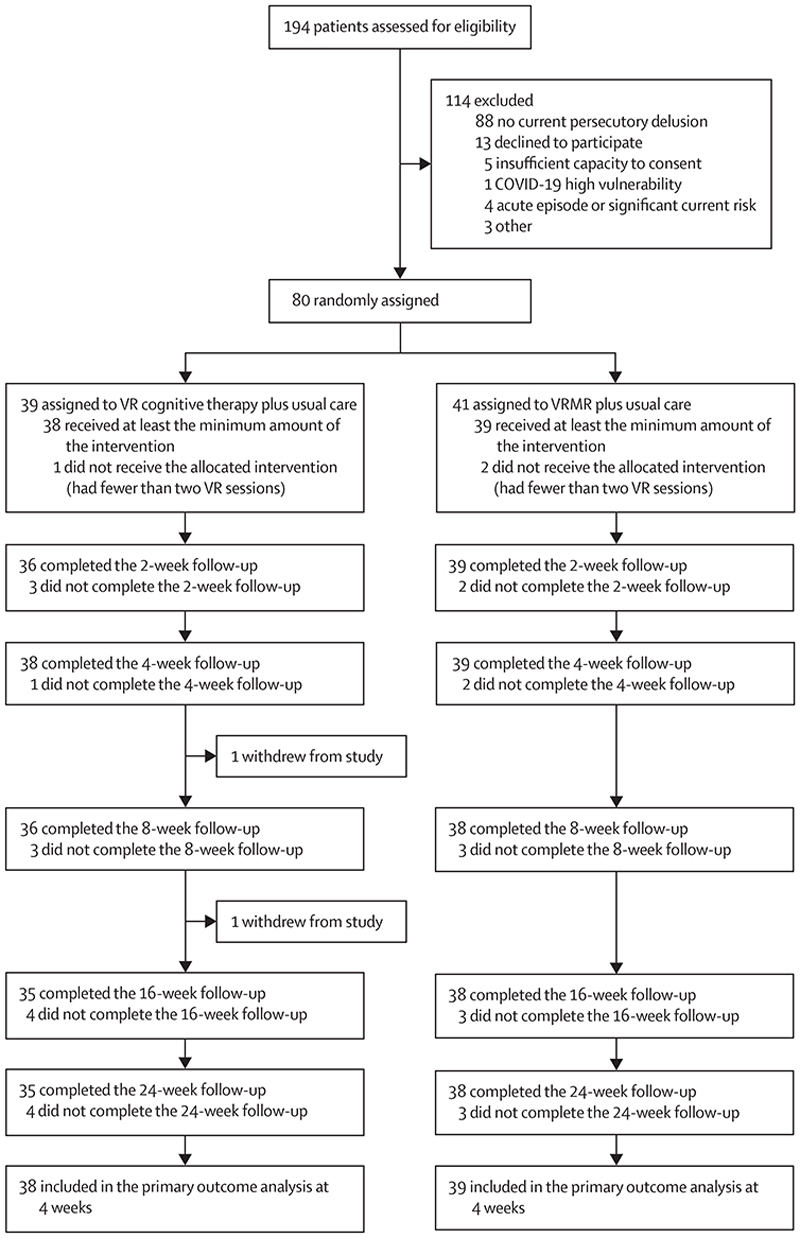
BACKGROUND: Persecutory delusions are a major psychiatric problem that often do not respond sufficiently to standard pharmacological or psychological treatments. We developed a new brief automated virtual reality (VR) cognitive treatment that has the potential to be used easily in clinical services. We aimed to compare VR cognitive therapy with an alternative VR therapy (mental relaxation), with an emphasis on understanding potential mechanisms of action. METHODS: THRIVE was a parallel-group, single-blind, randomised controlled trial across four UK National Health Service trusts in England. Participants were included if they were aged 16 years or older, had a persistent (at least 3 months) persecutory delusion held with at least 50% conviction, reported feeling threatened when outside with other people, and had a primary diagnosis from the referring clinical team of a non-affective psychotic disorder. We randomly assigned (1:1) patients to either THRIVE VR cognitive therapy or VR mental relaxation, using a permuted blocks algorithm with randomly varying block size, stratified by severity of delusion. Usual care continued for all participants. Each VR therapy was provided in four sessions over approximately 4 weeks, supported by an assistant psychologist or clinical psychologist. Trial assessors were masked to group allocation. Outcomes were assessed at 0, 2 (therapy mid-point), 4 (primary endpoint, end of treatment), 8, 16, and 24 weeks. The primary outcome was persecutory delusion conviction, assessed by the Psychotic Symptoms Rating Scale (PSYRATS; rated 0-100%). Outcome analyses were done in the intention-to-treat population. We assessed the treatment credibility and expectancy of the interventions and the two mechanisms (defence behaviours and safety beliefs) that the cognitive intervention was designed to target. This trial is prospectively registered with the ISRCTN registry, ISRCTN12497310. FINDINGS: From Sept 21, 2018, to May 13, 2021 (with a pause due to COVID-19 pandemic restrictions from March 16, 2020, to Sept 14, 2020), we recruited 80 participants with persistent persecutory delusions (49 [61%] men, 31 [39%] women, with a mean age of 40 years [SD 13, range 18-73], 64 [80%] White, six [8%] Black, one [1%] Indian, three [4%] Pakistani, and six [8%] other race or ethnicity). We randomly assigned 39 (49%) participants assigned to VR cognitive therapy and 41 (51%) participants to VR mental relaxation. 33 (85%) participants who were assigned to VR cognitive therapy attended all four sessions, and 35 (85%) participants assigned to VR mental relaxation attended all four sessions. We found no significant differences between the two VR interventions in participant ratings of treatment credibility (adjusted mean difference -1·55 [95% CI -3·68 to 0·58]; p=0·15) and outcome expectancy (-0·91 [-3·42 to 1·61]; p=0·47). 77 (96%) participants provided follow-up data at the primary timepoint. Compared with VR mental relaxation, VR cognitive therapy did not lead to a greater improvement in persecutory delusions (adjusted mean difference -2·16 [-12·77 to 8·44]; p=0·69). Compared with VR mental relaxation, VR cognitive therapy did not lead to a greater reduction in use of defence behaviours (adjusted mean difference -0·71 [-4·21 to 2·79]; p=0·69) or a greater increase in belief in safety (-5·89 [-16·83 to 5·05]; p=0·29). There were 17 serious adverse events unrelated to the trial (ten events in seven participants in the VR cognitive therapy group and seven events in five participants in the VR mental relaxation group). INTERPRETATION: The two VR interventions performed similarly, despite the fact that they had been designed to affect different mechanisms. Both interventions had high uptake rates and were associated with large improvements in persecutory delusions but it cannot be determined that the treatments accounted for the change. Immersive technologies hold promise for the treatment of severe mental health problems. However, their use will likely benefit from experimental research on the application of different therapeutic techniques and the effects on a range of potential mechanisms of action. FUNDING: Medical Research Council Developmental Pathway Funding Scheme and National Institute for Health and Care Research Oxford Health Biomedical Research Centre.
Overview
The claims and statistics of this paper haven’t been checked yet.
Free: it reads the open-access text and checks the first 5 claims that cite a source we can check. Create a free account to check every claim.
Integrity signals
Registry
Cites
Statistics
Figures
Verification
Claims the paper makes
The claims and statistics of this paper haven’t been checked yet.
Free: it reads the open-access text and checks the first 5 claims that cite a source we can check. Create a free account to check every claim.
Claims other papers make about this one
Each is checked against this paper’s own text: does it say what the citing paper says it does?
The cited source says what the claim attributes to it.
In the citing paper
“It may be preferable to base blinding efficacy estimates on outcome assessors’ reports of whether they have been unblinded, rather than their guesses, as was done in a number of studies [36, 40, 56, 60, 69].”
From Blinding outcome assessors in randomised controlled trials of psychological interventions: how is it done? A narrative review (2026) · cites this paper as [40]
Self-check
Percentages, sums and reported differences re-computed from the paper’s own numbers.
The self-check needs the paper’s full text.
Citations
Cites
Development and preliminary testing of the new five-level version of EQ-5D (EQ-5D-5L)
Herdman, M., Gudex, C., Lloyd, A., Janssen, M., Kind, P., Parkin, D., Bonsel, G., & Badia, X. (2011) · Quality of Life Research · doi:10.1007/s11136-011-9903-x · Cited by 9,795
Simulator Sickness Questionnaire: An Enhanced Method for Quantifying Simulator Sickness
Kennedy, R. S., Lane, N. E., Berbaum, K. S., & Lilienthal, M. G. (1993) · The International Journal of Aviation Psychology · doi:10.1207/s15327108ijap0303_3 · Cited by 5,457 · cited 1×
“The minimum clinically important difference on this scale is unknown.”
Posner, K., Brown, G. K., Stanley, B., Brent, D. A., Yershova, K. V., Oquendo, M. A., Currier, G. W., Melvin, G. A., Greenhill, L., Shen, S., et al. (2011) · American Journal of Psychiatry · doi:10.1176/appi.ajp.2011.10111704 · Cited by 5,157
The Warwick-Edinburgh Mental Well-being Scale (WEMWBS): development and UK validation
Tennant, R., Hiller, L., Fishwick, R., Platt, S., Joseph, S., Weich, S., Parkinson, J., Secker, J., & Stewart-Brown, S. (2007) · Health and Quality of Life Outcomes · doi:10.1186/1477-7525-5-63 · Cited by 5,031 · cited 1×
“There were two post hoc analyses to aid in interpretation of the results.”
Psychometric properties of the credibility/expectancy questionnaire
Devilly, G. J., & Borkovec, T. D. (2000) · Journal of Behavior Therapy and Experimental Psychiatry · doi:10.1016/s0005-7916(00)00012-4 · Cited by 2,295 · cited 1×
“We”
HADDOCK, G., McCARRON, J., TARRIER, N., & FARAGHER, E. B. (1999) · Psychological Medicine · doi:10.1017/s0033291799008661 · Cited by 1,461 · cited 1×
“…Rating Scale, 30 overall paranoia assessed by the Revised-Green et al Paranoid Thoughts Scale (R-GPTS), 31 delusion severity using the PSYRATS interview, 27 and psychological wellbeing using the Warwick-Edinburgh Mental Wellbeing Scale 32 and the Questionnaire about the Process of Recovery.”
Psychological investigation of the structure of paranoia in a non-clinical population
Freeman, D., Garety, P. A., Bebbington, P. E., Smith, B., Rollinson, R., Fowler, D., Kuipers, E., Ray, K., & Dunn, G. (2005) · British Journal of Psychiatry · doi:10.1192/bjp.186.5.427 · Cited by 786 · cited 1×
“Given the close connection between anxiety and persecutory delusions—paranoia probably builds on anxious threat cognitions 11,12 —we chose VR mental relaxation as the comparison condition.”
Self-citationThe importance of behaviour in the maintenance of anxiety and panic: A cognitive account
Salkovskis, P. M. (1991) · Behavioural Psychotherapy · doi:10.1017/s0141347300011472 · Cited by 780 · cited 1×
“4 In both conditions we used a single experimental session of 30 minutes in graded VR environments (train and lift scenarios) with psychological advice provided by a therapist.”
Clark, D. M., Ehlers, A., Hackmann, A., McManus, F., Fennell, M., Grey, N., Waddington, L., & Wild, J. (2006) · Journal of Consulting and Clinical Psychology · doi:10.1037/0022-006x.74.3.568 · Cited by 603 · cited 1×
“39 Both VR groups showed large improvements over time but we found no significant differences on any primary or secondary outcome measure.”
Self-citationRelaxation training for anxiety: a ten-years systematic review with meta-analysis
Manzoni, G. M., Pagnini, F., Castelnuovo, G., & Molinari, E. (2008) · BMC Psychiatry · doi:10.1186/1471-244x-8-41 · Cited by 480 · cited 1×
“Relaxation can reduce anxiety 13 and, therefore, might plausibly reduce paranoia.”
Research works printed but not linked: 1
- Gilbert P Compassion focussed therapy Routledge Hove 2010
Cited by
Torous, J., Linardon, J., Goldberg, S. B., Sun, S., Bell, I., Nicholas, J., Hassan, L., Hua, Y., Milton, A., & Firth, J. (2025) · World Psychiatry · doi:10.1002/wps.21299 · Cited by 323
“This mirrors the findings of another trial comparing VR CBT targeting social behaviors with virtual reality relaxation in a psychosis sample, which also found no difference between these conditions 47 .”
Advances in the use of virtual reality to treat mental health conditions
Bell, I. H., Pot-Kolder, R., Rizzo, A., Rus-Calafell, M., Cardi, V., Cella, M., Ward, T., Riches, S., Reinoso, M., Thompson, A., et al. (2024) · Nature Reviews Psychology · doi:10.1038/s44159-024-00334-9 · Cited by 140
“Basic forms of artificial intelligence have already been integrated into VR-based treatments for fear of heights 131,132 , public speaking anxiety 133 , spider phobia 134 and psychosis 135,136 , with good research evidence for effectiveness.”
Tabassum, A., Ghaznavi, I., Abd-Alrazaq, A. A., & Qadir, J. (2025) · Journal of Medical Internet Research · doi:10.2196/72400 · Cited by 44
“These virtual spaces are meticulously crafted to deliver multisensory interventions—combining 360° visuals, ambient soundscapes, haptic feedback, and even olfactory cues—enabling avatar embodiment, teleportation, and emotional immersion that fosters deep cognitive and affective engagement [1,9].”
Cushnan, J., McCafferty, P., & Best, P. (2024) · BMC Health Services Research · doi:10.1186/s12913-024-11481-3 · Cited by 36
“Additionally, recent studies like THRIVE—a four-session automated cognitive VR intervention—dem-onstrate that automated VR can be effective and offer advantages in cost efficiency and treatment accessibility [60].”
BackgroundMethodZeka, F., Clemmensen, L., Valmaggia, L., Veling, W., Hjorthøj, C. R., & Glenthøj, L. B. (2024) · Acta Psychiatrica Scandinavica · doi:10.1111/acps.13777 · Cited by 37
Clinical adoption of virtual reality in mental health is challenged by lack of high-quality research
Selaskowski, B., Wiebe, A., Kannen, K., Asché, L., Pakos, J., Philipsen, A., & Braun, N. (2024) · npj Mental Health Research · doi:10.1038/s44184-024-00069-8 · Cited by 34
Lindsay, J. A. B., McGowan, N. M., Henning, T., Harriss, E., & Saunders, K. (2024) · Journal of Medical Internet Research · doi:10.2196/54941 · Cited by 25
“Recent work with virtual reality in community and psychosis samples has found that compassionate imagery, cognitive therapy, and mental relaxation exercises all appear to be effective in the reduction of paranoia symptoms [106,107].”
The future of psychiatry: clinical practice, diagnosis, and treatment
Turner, S., Yadav, P., Morrin, H., & Bhat, A. (2025) · International Review of Psychiatry · doi:10.1080/09540261.2025.2594523 · Cited by 23
Sunyaev, A., Fürstenau, D., & Davidson, E. (2024) · Business & Information Systems Engineering · doi:10.1007/s12599-024-00870-x · Cited by 17
“Finally, the turn towards more immersive digital experiences in healthcare, such as the use of virtual reality technologies for therapeutic applications, virtual coaches, digital twins, and bots (Makin 2019; Weimann et al. 2022; Freeman et al. 2022, 2023), prompts a critical assessment.”
Jeppesen, U. N., Vernal, D. L., Due, A. S., Mariegaard, L. S., Pinkham, A. E., Austin, S. F., Vos, M., Christensen, M. J., Hansen, N. S., Smith, L. C., et al. (2025) · Nature Medicine · doi:10.1038/s41591-025-03880-8 · Cited by 14
“Furthermore, automated VR therapies have also been investigated, and while these show feasibility, shorter interventions have not demonstrated superiority over comparators 26,27 .”
Virtual Reality for the Treatment of Positive Symptoms of Psychosis: A Meta-Analysis of Trials
Spark, J., Pot-Kolder, R., Dzafic, I., Nelson, B., Byrne, L. K., & Lum, J. A. G. (2025) · Current Treatment Options in Psychiatry · doi:10.1007/s40501-025-00350-3 · Cited by 12
Confusing virtual reality with reality – An experimental study
Wiesing, M., Comadran, G., & Slater, M. (2025) · iScience · doi:10.1016/j.isci.2025.112655 · Cited by 10
“54 Early results suggest that VR also has promise for the evaluation and treatment of schizophrenia.”
Self-citationWei, S., Freeman, D. H., Harris, V., & Rovira, A. (2024) · Scientific Reports · doi:10.1038/s41598-024-67534-4 · Cited by 9
Self-citationRosebrock, L. E., Freeman, J., Rovira, A., Miguel, A. L., Ward, R., Bousfield, M., Riffiod, L., Kamvar, R., Kabir, T., Waite, F., et al. (2024) · JMIR Serious Games · doi:10.2196/51512 · Cited by 9
“Both interventions were supported by a clinical or assistant psychologist and produced large reductions in paranoia [12].”
BackgroundSelf-citationPsychosocial and digital intervention for patients with schizophrenia
Kim, S., Baek, S.-H., & Cho, C. (2024) · Journal of Korean Medical Association · doi:10.5124/jkma.2024.67.2.103 · Cited by 7
Advancing Mental Health with Immersive Virtual Reality: Benefits, Challenges, and Emerging Trends
Gkoumas, C., Bourikas, L., Mantadelis, T., & Karakasidou, E. (2024) · IEEE International Symposium on Mixed and Augmented Reality Adjunct (ISMAR-Adjunct) · doi:10.1109/ismar-adjunct64951.2024.00064 · Cited by 7
“Overall, IVR has demonstrated considerable promise in addressing specific symptoms related to psychosis [31, 32, 20].”
Settling the Score: Virtual Reality as a Tool to Enhance Trauma-Focused Therapy for PTSD
Rizzo, A., Hartholt, A., & Mozgai, S. (2024) · Springer eBooks · doi:10.1007/978-3-031-56537-3_14 · Cited by 8
Digitally Enhanced Psychological Assessment and Treatment of Paranoia: A Systematic Review
Bird, M., O'Neill, E., & Riches, S. (2024) · Clinical Psychology & Psychotherapy · doi:10.1002/cpp.3019 · Cited by 6
CBT for psychosis in Parkinson's disease: A framework for how and why
Foley, J. A., & Bell, V. (2025) · Schizophrenia Research · doi:10.1016/j.schres.2025.04.023 · Cited by 5
Lambe, S., Mulhall, S., Bird, J. C., Williams, K., Mitchell, J., Roddan, M., Sokunle, G., Rosebrock, L. E., Freeman, D. H., & Waite, F. (2025) · Behavioural and Cognitive Psychotherapy · doi:10.1017/s1352465825100994 · Cited by 3
“Patients with persecutory delusions were participants in the THRIVE Trial (Freeman et al ., 2023), a randomised controlled trial of an automated VR therapy.”
Self-citationLiu, S. Y., Tang, S., Tan, Y., & Xiang, B. (2025) · The Canadian Journal of Psychiatry · doi:10.1177/07067437251372186 · Cited by 2
“59 Moreover, certain VR-based stimuli may be misconstrued by patients as real threats.”
Alevizopoulos, A. G., Anastasiou, G. G., Kritikos, I., Alevizopoulou, M., & Alevizopoulos, G. A. (2026) · Biosensors · doi:10.3390/bios16050265 · Cited by 2
“Four studies [34,35,38,41] had low concerns, four studies [39,40,42,44] had some concerns and four studies [36,37,43,45] .”
Schönig, S. N., Lincoln, T. M., & Krkovic, K. (2026) · Psychological Medicine · doi:10.1017/s0033291726104681 · Cited by 1
O’Keeffe, S. (2026) · Trials · doi:10.1186/s13063-026-09698-0
“When unblinding occurred, it was often reported that a different outcome assessor who was blinded collected subsequent data [40, 51, 52, 60, 67–69, 72, 74, 75].”
InfluentialWhat if AI Could Revolutionize Literature Reviews in Virtual Reality and Mental Health?
Guedes, P., Abrantes, P., Teixeira, J. M., & Teichrieb, V. (2024) · Congresso Latino-Americano de Software Livre e Tecnologias Abertas (Latinoware) · doi:10.5753/latinoware.2024.245673
“– VR cognitive therapy vs. VR mental relaxation [27].”
InfluentialPilarski, B., Stencel, M., Bula, B., Florek, S., & Pudło, R. (2025) · Annales Academiae Medicae Silesiensis · doi:10.18794/aams/202384
Peng, Y., Chen, Q., & Jiang, X. (2025) · International Journal of Surgery · doi:10.1097/js9.0000000000003007
“Fourth, the effectiveness of VR therapy can vary widely depending on several factors, such as the type of surgery, VR intervention method, and patient characteristics [7] .”
Validating virtual reality placebo condition
Valge, K. (2025) · DSpace repository (University of Tartu)
Lindsay, J. A. B. (2024) · Oxford University Research Archive (ORA) (University of Oxford) · doi:10.5287/ora-9ojgemz17
Gant, T., Taylor, K. M., Ward, T., Garety, P., & Hardy, A. (2026) · Internet Interventions · doi:10.1016/j.invent.2026.101013
Alvarez Carrillo, J. R. (2025) · El Repositorio Academico Digital de la UANL (Universidad Autónoma de Nuevo León)
Exploring service user attitudes towards mental health technologies
Fitzpatrick, P. J., Dhondt, N., Thuery, G., O’Brien, D., Ledden, K., Young, G. W., Gillan, C. M., Harkin, A., & Kelly, J. R. (2026) · Irish Journal of Psychological Medicine · doi:10.1017/ipm.2026.10170
“In the UK, the National Institute for Health and Care Excellence (NICE) recently published early value assessment guidance on MHT, including virtual reality (VR) technology for managing psychosis symptoms in adults and young people (Freeman et al. 2022, Freeman et al. 2023, NICE, 2024).”
Aleksandrowicz, A., Gawęda, Ł., Piwińska, J., Krężołek, M., Gelner, H., Lamarca, M., Berna, F. S., Vanessa Acuña, P., König, C., Möritz, S., et al. (2026) · Clinical Psychology & Psychotherapy · doi:10.1002/cpp.70241
Patient expectations for outcome with psychological intervention for psychosis
Freeman, D. H., Rosebrock, L. E., & Waite, F. (2026) · Schizophrenia Research · doi:10.1016/j.schres.2026.03.005
Self-citationHybrid Models in Digital Psychiatry: Toward Blended Human–AI Care
Jang, S. (2026) · Mood and Emotion · doi:10.35986/me.2026.24.1.11
Liu, X., Wang, H., Wang, S., Wang, R., Zhao, Q., Tian, S., Guo, X., & Cao, H. (2026) · Psychiatry Research · doi:10.1016/j.psychres.2026.117188
Onwumere, J., Rogers, L., Aung, K. W., Pietro, J. D., & Valmaggia, L. (2026) · BMC Psychiatry · doi:10.1186/s12888-026-08203-w
“The last decade has seen growth and innovation in digital health technologies, including applications of virtual reality (VR) software in the assessment and treatment of mental health conditions [22, 23].”
Mărginean, R. M., Dobrean, A., Pavăl, D., Mardan, R., Kopelovich, S. L., & Georgescu, R. (2026) · Journal of Medical Internet Research · doi:10.2196/preprints.102529
Hampshire, C., Dack, C., Daryan, S., Fialho, C., Taher, R., Teale, A., Yiend, J., & Jacobsen, P. C. (2026) · JMIR Human Factors · doi:10.2196/88032
“%) blended DMHIs [41,42,49,63].”
InfluentialThompson, E., Lim, S., & Olsson, I. (2025) · Journal of Social Entrepreneurship and Creative Technology · doi:10.70177/jseact.v2i6.2988
“Existing models of VR-based therapy do not sufficiently address the barriers to implementation in low-income or rural areas, where access to mental health services is most limited (Freeman et al., 2023; Fujita et al., 2025).”
Jeppesen, U. N., Vernal, D. L., Christensen, M. J., Pinkham, A. E., Veling, W., Hidding, M., Jensen, S. N., Austin, S. F., Nordentoft, M., & Glenthøj, L. B. (2026) · Schizophrenia Bulletin Open · doi:10.1093/schizbullopen/sgag028
“Importantly, our results on safety behaviors align with the THRIVE trial, 21 which compared VR –CBTp with VR-based mental relaxation and found similar improvements in safety behaviors without differential mediation.”
InfluentialWang, Y., Hue, M. T., Lau, K. W., Zhou, D.-H. R., Ng, S., & Weng, X. (2026) · JMIR Research Protocols · doi:10.2196/86937
“The target size also accords with comparable 2-arm VR intervention studies [16].”
Popescu, E. (2026) · Research Square · doi:10.21203/rs.3.rs-10966714/v1
Do Psychological Interventions Reduce Paranoia in Adolescents? A Systematic Review
Tierney-Sutton, L., Taylor, C. D. J., Pile, V., Watling, D., Lobo, S., Courten, E., & Kingston, J. L. (2026) · Clinical Child and Family Psychology Review · doi:10.1007/s10567-026-00587-1
Popescue, E. (2026) · SSRN Electronic Journal · doi:10.2139/ssrn.7433518
Deng, M., Lui, S. S. Y., & Chan, R. C. K. (2026) · Neuroscience & Biobehavioral Reviews · doi:10.1016/j.neubiorev.2026.107033
Metadata
- Authors
- Freeman, D., Lister, R., Waite, F., Galal, U., Yu, L.-M., Lambe, S., Beckley, A., Bold, E., Jenner, L., Diamond, R., Kirkham, M., Twivy, E., Causier, C., Carr, L., Saidel, S., Day, R., Beacco, A., Rovira, A., Ivins, A., Nah, R., Slater, M., Clark, D. M., & Rosebrock, L.
- Affiliations
- Oxford Health NHS Foundation Trust (GB)
- University of Oxford (GB)
- Northamptonshire Healthcare NHS Foundation Trust (GB)
- Universitat de Barcelona (ES)
- Central and North West London NHS Foundation Trust (GB)
- Corresponding author
- Freeman, Daniel
- ORCID
- Venue
- The Lancet Psychiatry
- Publisher
- Elsevier BV
- Published
- 2023-11
- Volume
- 10
- Issue
- 11
- Pages
- 836-847
- ISSN
- 2215-0366 (ISSN-L)
- PMC
- PMC7617886
- OpenAlex
- W4386914803
- Cited by
- 40
- References
- 37
- Citations by year
- 2026: 14 · 2025: 12 · 2024: 14
- FWCI
- 8.11
- Type
- journal article
- Language
- en
- Open access
- hybrid
- doi.org
- Licence
- cc-by
- www.elsevier.com/tdm/userlicense/1.0/ (tdm)
- www.elsevier.com/legal/tdmrep-license (tdm)
- creativecommons.org/licenses/by/4.0/ (vor)
- Locations
- The Lancet Psychiatry (publishedVersion, cc-by)
- PubMed (publishedVersion)
- PubMed Central (acceptedVersion, cc-by)
- UPCommons institutional repository (Universitat Politècnica de Catalunya) (submittedVersion, cc-by-nc-nd)
- UCL Discovery (University College London) (submittedVersion, cc-by)
- Funders
- Medical Research Council (MR/P02629X/1)
- National Institute for Health and Care Research
- European Research Council (742989)
- NIHR Oxford Biomedical Research Centre (BRC-1215-2000)
- Wellcome Trust (102176/B/13/Z)
- Topics
- Health Sciences › Medicine › Psychiatry and Mental health › Schizophrenia research and treatment
- Physical Sciences › Computer Science › Human-Computer Interaction › Virtual Reality Applications and Impacts
- Social Sciences › Psychology › Applied Psychology › Digital Mental Health Interventions
- Keywords
- persecutory delusions, psychosis, safety beliefs, treatment credibility, treatment expectancy, mechanism of action, brief psychological intervention, non-affective psychosis, mediation analysis, THRIVE trial, NHS mental health services, digital mental health interventions
About these checks
Registry, retraction, Cites and statistics results are computed, not judged, with one exception: a printed reference that no index lists is read once by a model before it counts as a citation error. Claims are extracted by a model and kept only when their quote appears verbatim in the text; each cited source is then checked, with a model’s help, for whether it says what the claim relies on. Those verdicts can be wrong — read the claim’s quote and the cited source before relying on one.
Statistics and arithmetic are recomputed, not judged.
Confidence bands are shown only for fields calibrated on our annotated test set. None is calibrated yet, so no band is shown.
What counts as a claim ›How we measure confidence ›How we check this ›
Are you an author, or do you see a problem with this page? Request a review
Data sources
Bibliographic data: Semantic Scholar, OpenAlex, Crossref.
Contains information from the Semantic Scholar Academic Graph Datasets, made available under the ODC Attribution License (ODC-BY 1.0).
Semantic Scholar’s data is described in: Kinney, R., et al. (2023). The Semantic Scholar Open Data Platform. arXiv:2301.10140.
