

The DOI matches its Crossref record; 20 of the 21 references it cites were found in a registry or an index.
Cognitive behavioural therapy for irritable bowel syndrome: 24-month follow-up of participants in the ACTIB randomised trial
Open accessAbstract
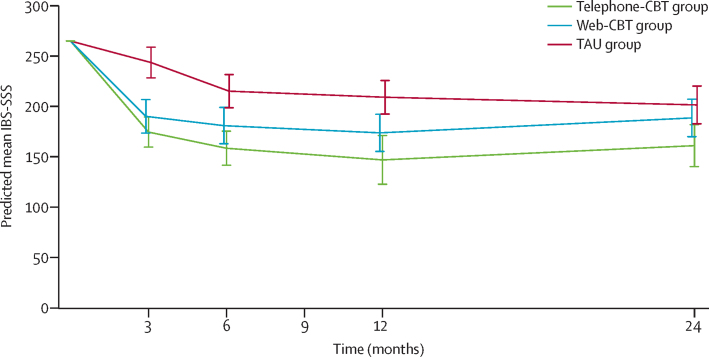
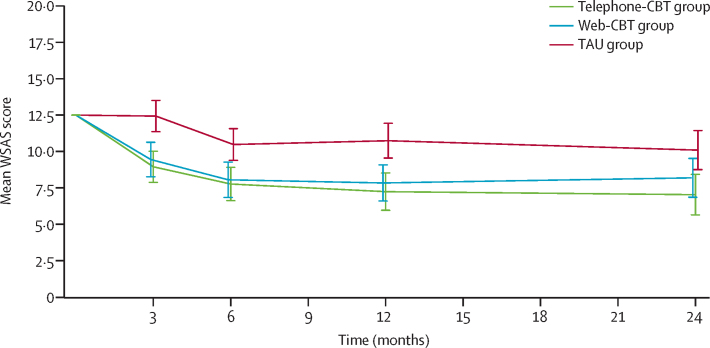
BACKGROUND: Irritable bowel syndrome (IBS) is common, affecting 10-20% of the adult population worldwide, with many people reporting ongoing symptoms despite first-line therapies. Cognitive behavioural therapy (CBT) is recommended in guidelines for refractory IBS but there is insufficient access to CBT for IBS and uncertainty about whether benefits last in the longer term. Assessing Cognitive behavioural Therapy for IBS (ACTIB) was a large, randomised, controlled trial of two forms of CBT for patients with refractory IBS. ACTIB results showed that, at 12 months, both forms of CBT for IBS were significantly more effective than treatment as usual at reducing IBS symptom severity in adults with refractory IBS. This follow-up study aimed to evaluate 24-month clinical outcomes of participants in the ACTIB trial. METHODS: In the ACTIB three-group, randomised, controlled trial, 558 adults with refractory IBS were randomly allocated to receive either therapist-delivered telephone CBT (telephone-CBT group), web-based CBT with minimal therapist support (web-CBT group), or treatment as usual (TAU group) and were followed up for 12 months. Participants were adults with refractory IBS (clinically significant symptoms for ≥12 months despite being offered first-line therapies), recruited by letter and opportunistically from 74 general practices and three gastroenterology centres in London and the south of England (UK) between May 1, 2014, and March 31, 2016. Primary outcome measures were IBS Symptom Severity Score (IBS-SSS) and Work and Social Adjustment Scale (WSAS), assessed in the intention-to-treat (ITT) population with multiple imputation. This study was a non-prespecified naturalistic follow-up and analysis of the participants of the ACTIB trial at 24 months assessing the same outcomes as the original trial. Outcome measures were completed online by participants or a paper questionnaire was posted, or telephone follow-up undertaken. The ACTIB trial is registered with the International Standard Randomised Controlled Trial Number registry, number ISRCTN44427879. FINDINGS: 24-month follow-up of outcomes was achieved for 323 (58%) of 558 participants: 119 (64%) of 186 in the telephone-CBT group, 99 (54%) of 185 in the web-CBT group, and 105 (56%) of 187 in the TAU group. At 24 months, mean IBS-SSS was 40·5 points (95% CI 15·0 to 66·0; p=0·002) lower in the telephone-CBT group and 12·9 points (-12·9 to 38·8; p=0·33) lower in the web-CBT group than in the TAU group. The mean WSAS score was 3·1 points (1·3 to 4·9; p<0·001) lower in the telephone-CBT group and 1·9 points (0·1 to 3·7; p=0·036) lower in the web-CBT group than in the TAU group. A clinically significant IBS-SSS change (≥50 points) from baseline to 24 months was found in 84 (71%) of 119 participants in the telephone-CBT group, in 62 (63%) of 99 in the web-CBT group, and in 48 (46%) of 105 in the TAU group. In total 41 adverse events were reported between 12 to 24 months: 11 in the telephone-CBT group, 15 in the web-CBT group, and 15 in the TAU group. Of these, eight were reported as gastrointestinal related, five as psychological, and six as musculoskeletal. There were no adverse events related to treatment. INTERPRETATION: At 24-month follow-up, sustained improvements in IBS were seen in both CBT groups compared with TAU, although some previous gains were reduced compared with the 12-month outcomes. IBS-specific CBT has the potential to provide long-term improvement in IBS, achievable within a usual clinical setting. Increasing access to CBT for IBS could achieve long-term patient benefit. FUNDING: UK National Institute for Health Research.
Overview
The claims and statistics of this paper haven’t been checked yet.
Run the check — free, no account needed. It reads the open-access text and checks the sources it cites.
Integrity signals
Registry
Cites
Statistics
Figures
Verification
Claims the paper makes
The claims and statistics of this paper haven’t been checked yet.
Run the check — free, no account needed. It reads the open-access text and checks the sources it cites.
Claims other papers make about this one
Each is checked against this paper’s own text: does it say what the citing paper says it does?
The cited source says what the claim attributes to it.
In the citing paper
“Similar improvements have been observed in the treatment of irritable bowel syndrome, with those receiving internet-based CBT showing sustained improvements compared to standard treatment over a 2-year period [33].”
Self-check
Percentages, sums and reported differences re-computed from the paper’s own numbers.
The self-check needs the paper’s full text.
Citations
Cites
The Hospital Anxiety and Depression Scale
Zigmond, A. S., & Snaith, R. P. (1983) · Acta Psychiatrica Scandinavica · doi:10.1111/j.1600-0447.1983.tb09716.x · Cited by 47,139
Depression and quality of life in older persons: A review
Sivertsen, H., Bjørkløf, G. H., Engedal, K., Selbæk, G., & Helvik, A.-S. (2015) · Dementia and Geriatric Cognitive Disorders · doi:10.1159/000437299 · Cited by 14,152
Multiple imputation using chained equations: Issues and guidance for practice
White, I. R., Royston, P., & Wood, A. M. (2011) · Statistics in Medicine · doi:10.1002/sim.4067 · Cited by 9,792
The functional gastrointestinal disorders and the Rome III process
Drossman, D. A. (2006) · Gastroenterology · doi:10.1053/j.gastro.2006.03.008 · Cited by 2,416
Global Prevalence of and Risk Factors for Irritable Bowel Syndrome: A Meta-analysis
Lovell, R. M., & Ford, A. C. (2012) · Clinical Gastroenterology and Hepatology · doi:10.1016/j.cgh.2012.02.029 · Cited by 2,155
FRANCIS, C. Y., MORRIS, J., & WHORWELL, P. J. (1997) · Alimentary Pharmacology & Therapeutics · doi:10.1046/j.1365-2036.1997.142318000.x · Cited by 1,708
Howie, J. G., Heaney, D., Maxwell, M., & Walker, J. J. (1998) · Family Practice · doi:10.1093/fampra/15.2.165 · Cited by 487
English Indices of Deprivation
Communities (2013) · Cited by 409
Moss-Morris, R., McCrone, P., Yardley, L., van Kessel, K., Wills, G., & Dennison, L. (2012) · Behaviour Research and Therapy · doi:10.1016/j.brat.2012.03.001 · Cited by 209
Self-citationEveritt, H. A., Landau, S., O’Reilly, G., Sibelli, A., Hughes, S., Windgassen, S., Holland, R., Little, P., McCrone, P., Bishop, F., et al. (2019) · Gut · doi:10.1136/gutjnl-2018-317805 · Cited by 198
Self-citation
Cited by
Sorted by citations
Items 101–115 of 115
Sweeney, L., Moss-Morris, R. E., Czuber‐Dochan, W., & Norton, C. S. (2021) · Figshare · doi:10.6084/m9.figshare.14443203
Self-citationDiagnosis and treatment of irritable bowel syndrome with diarrhea: Key clinical considerations
Kassebaum-Ladewski, A., Orleck, K. D., & Skarbinski, K. F. (2026) · Journal of the American Association of Nurse Practitioners · doi:10.1097/jxx.0000000000001218
Kim, H. K., Kim, H., & Lee, A. (2026) · Internet Interventions · doi:10.1016/j.invent.2026.100905
Tong, A., Carboni, M., & Findon, J. L. (2026) · Research in Autism · doi:10.1016/j.reia.2026.202832
Muellers, K., Nelms, S. D., & Warren, M. A. (2026) · Springer eBooks · doi:10.1007/978-3-032-12819-5_7
Yamazaki, T., Kurisu, K., Machida, T., Kunio, M., Kanemitsu, Y., Hanadate, T., Fukudo, S., & Yoshiuchi, K. (2026) · BioPsychoSocial Medicine · doi:10.1186/s13030-026-00354-2
Rooyen, D. M. V., Cai, M., Nair, B. R., & Talley, N. J. (2026) · Expert Review of Gastroenterology & Hepatology · doi:10.1080/17474124.2026.2651944
Saudi consensus statements on the management of irritable bowel syndrome
Alzahrani, M. A., Alzubide, S. R., Abufarhaneh, E. H., Alqaraawi, A., Al-Amro, R., Alhalafi, M., Alamr, A., Alsulaimi, M. S., Alshumrani, W., Alotaibi, S., et al. (2026) · Saudi Journal of Gastroenterology · doi:10.4103/sjg.sjg_472_25
Hawkins, J., Bath, J., & Tollow, P. (2026) · The Cognitive Behaviour Therapist · doi:10.1017/s1754470x26100658
Butt, M. F., Reghefaoui, M., Bush, D., Aliyu, A. I., Darie, A.-M., Mohanan, A., Sibelli, A., Card, T. R., & Corsetti, M. (2026) · BMC Gastroenterology · doi:10.1186/s12876-026-04964-6
Self-citationConstipation with bloating: a clinical approach to evaluation and management
Cangemi, D. J., Laitman, A. P., Faiman, O., & Chang, B. W. (2026) · Annals of Medicine · doi:10.1080/07853890.2026.2684172
Therapeutic approaches to abdominal pain: From pharmacology to complementary therapies
Pokora, B., Pokora, K., & Fichna, J. (2026) · Elsevier eBooks · doi:10.1016/b978-0-443-41638-5.00005-3
Zhao, J., Li, X., Dong, J.-X., Yang, J.-Y., Li, Z.-G., & Zhu, L. (2026) · Journal of Integrative and Complementary Medicine · doi:10.1177/27683605261461176
Paine, P., Moulton, C., Chisholm, A., Twist, K., Pironi, L., Jeppesen, P. B., Wanten, G., Cuerda, C., Klek, S., Joly, F., et al. (2026) · Clinical Nutrition · doi:10.1016/j.clnu.2026.106723
Ibrahim, O., Hall, C., & Peters, S. L. (2026) · doi:10.2196/preprints.105572
Metadata
- Authors
- Everitt, H. A., Landau, S., O'Reilly, G., Sibelli, A., Hughes, S., Windgassen, S., Holland, R., Little, P., McCrone, P., Bishop, F. L., Goldsmith, K., Coleman, N., Logan, R., Chalder, T., & Moss-Morris, R.
- Affiliations
- University of Southampton (GB)
- King's College London (GB)
- University Hospital Southampton NHS Foundation Trust (GB)
- King's College Hospital (GB)
- Corresponding author
- Everitt, Hazel A
- ORCID
- Venue
- The Lancet Gastroenterology & Hepatology
- Publisher
- Elsevier BV
- Published
- 2019-11
- Volume
- 4
- Issue
- 11
- Pages
- 863-872
- ISSN
- 2468-1156 (ISSN-L)
- 2468-1253
- PMC
- PMC7026694
- OpenAlex
- W2971693121
- Cited by
- 116
- References
- 21
- Citations by year
- 2026: 16 · 2025: 18 · 2024: 19 · 2023: 14 · 2022: 18 · 2021: 15 · 2020: 13 · 2019: 3
- FWCI
- 11.16
- Type
- journal article
- Language
- en
- Open access
- hybrid
- doi.org
- Licence
- Locations
- The Lancet. Gastroenterology & hepatology (publishedVersion, cc-by)
- PubMed Central (publishedVersion, cc-by)
- PubMed (publishedVersion)
- ePrints Soton (University of Southampton) (acceptedVersion)
- Research Portal (King's College London) (submittedVersion, cc-by)
- Funders
- National Institute for Health and Care Research (11/69/02)
- Topics
- Health Sciences › Medicine › Gastroenterology › Gastrointestinal motility and disorders
- Health Sciences › Medicine › Pediatrics, Perinatology and Child Health › Infant Health and Development
- Social Sciences › Psychology › Experimental and Cognitive Psychology › Anxiety, Depression, Psychometrics, Treatment, Cognitive Processes
- Keywords
- irritable bowel syndrome, refractory irritable bowel syndrome, cognitive behavioral therapy, long-term outcomes, symptom severity, work and social functioning, medication adherence, relapse, general practitioner referral, gastroenterology referral, patient-reported outcomes, work and social adjustment
- MeSH terms
- Adolescent, Adult, Aged, England, Female, Follow-Up Studies, Humans, Male, Middle Aged, Surveys and Questionnaires, Cognitive Behavioral Therapy, Treatment Outcome, Telemedicine, Irritable Bowel Syndrome, Young Adult
About these checks
Registry, retraction, Cites and statistics results are computed, not judged, with one exception: a printed reference that no index lists is read once by a model before it counts as a citation error. Claims are extracted by a model and kept only when their quote appears verbatim in the text; each cited source is then checked, with a model’s help, for whether it says what the claim relies on. Those verdicts can be wrong — read the claim’s quote and the cited source before relying on one.
Statistics and arithmetic are recomputed, not judged.
Confidence bands are shown only for fields calibrated on our annotated test set. None is calibrated yet, so no band is shown.
What counts as a claim ›How we measure confidence ›How we check this ›
Are you an author, or do you see a problem with this page? Request a review
