

The DOI matches its Crossref record; 37 of the 37 references it cites were found in a registry or an index; 20 of the 30 sources its claims cite were checked for support.
Internet-based cognitive behavioural therapy programme as an intervention for people diagnosed with adult-onset, focal, isolated, idiopathic cervical dystonia: a feasibility study protocol
Open accessAbstract
Background: Dystonia is one of the most common forms of movement disorder, caused by the co-contraction of antagonistic muscles, leading to abnormal postures and considerable disability. Non-motor symptoms, notably psychiatric disorders, are well recognised comorbid features of the disorder. However, there is no standardised model for the management of these symptoms in dystonia, with them frequently going undiagnosed and untreated. An internet-based cognitive behavioural therapy programme may provide a future model of care that also maximises available resources. Methods: This study represents a two-armed randomised feasibility trail, aiming to recruit a total of 20 participants with a diagnosis of adult-onset primary focal cervical dystonia. Participants will be recruited from the Global Myoclonus Dystonia Registry and Dystonia Non-Motor Symptom Study (conducted at Cardiff University) based on presence of moderate symptoms of anxiety/depression as indicated by standardised questionnaires. All participants will undergo assessment at baseline, 3 and 6 months, with this including questionnaires for assessment of non-motor symptoms and clinical assessment of motor symptom severity. Participants will be randomised to either the control (n = 10) or treatment (n = 10) groups. The treatment group will be asked to complete one session of the online CBT program a week, for 8 weeks. The primary outcome measure will be the engagement of participants with the programme, with secondary outcomes of non-motor and motor symptom scores. Discussion: Promising results have been shown using face-to-face cognitive behavioural therapy to reduce levels of anxiety and depression in individuals with a diagnosis of dystonia. However, no studies to date have sought to determine the feasibility of an internet-delivered cognitive behavioural therapy programme. A number of effective internet-based programmes have been developed that combat anxiety and depression in the general population, suggesting the potential for its effectiveness in cervical dystonia patients. Success with this study would significantly impact the clinical care delivery for patients with cervical dystonia, as well as widening potential access to effective treatment. Trial registration: This feasibility trial has been registered with Health and Care Research Wales Research Directory. Trial registration number 44245. Date of registration: 21 November 2019. https://www.healthandcareresearch.gov.wales/research-studies-in-wales/ © 2020 The Author(s).
Overview
CoChat Summary
## TL;DR
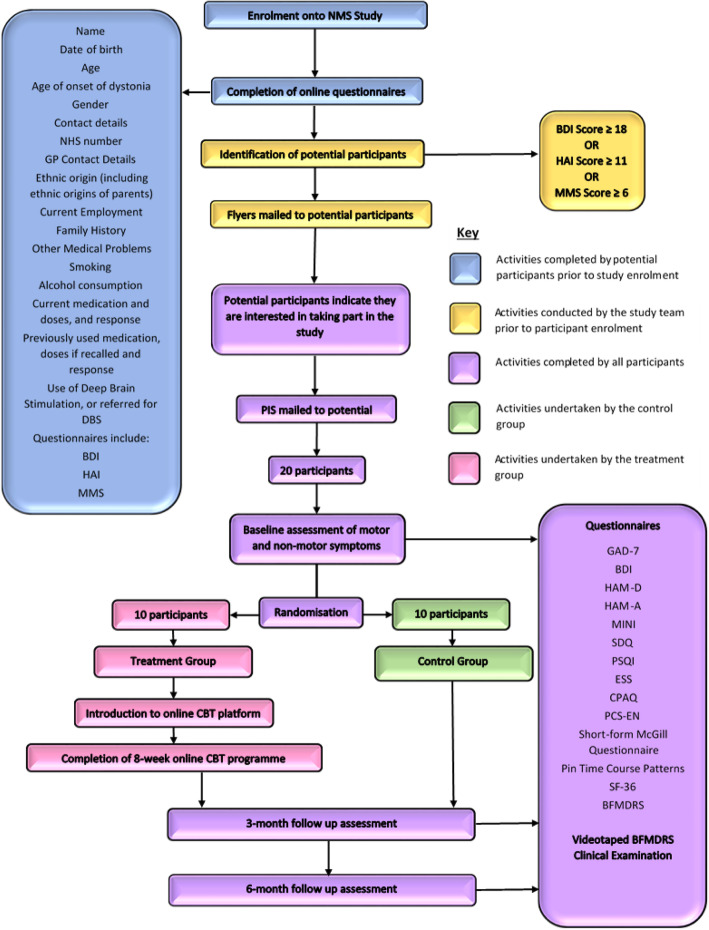
This is a study protocol for a two-arm randomized feasibility trial testing whether a guided internet-based CBT program is feasible for people with cervical dystonia and anxiety/depression symptoms. The paper does not report trial results; it specifies the planned sample, intervention, outcomes, and analysis.
## Key findings
- Not stated in the paper.
- The planned feasibility trial will recruit 20 participants, randomized 1:1 to 10 treatment and 10 control participants.
- Participants in the intervention arm are asked to complete one online CBT session per week for 8 weeks, with sessions lasting 30–40 min each.
- Feasibility will be judged mainly by engagement: the paper plans to track number of logins, modules completed, use of optional resources, and completion of 3- and 6-month follow-up.
## Methods
- Design: Two-arm randomized feasibility study of a guided, internet-based self-help CBT programme versus routine care alone.
- Sample/data: Adults with adult-onset primary focal cervical dystonia recruited from the Global Myoclonus Dystonia Registry and Dystonia Non-Motor Symptom Study, with anxiety/depression symptoms identified by standardized questionnaires; target sample n = 20.
- Main analysis: Descriptive statistics for feasibility outcomes; questionnaire and rating-scale scores compared with Student’s t test or Wilcoxon rank sum test, and categorical variables with chi-squared or Fisher’s exact test; analyses in R.
## Limitations
- The paper states that the study is underpowered for comparative statistical analysis of the feasibility data.
- The authors note that the small sample size may produce sample selection bias and limit representation across trial arms.
- Because the intervention is not blinded to participants, the paper says this could introduce bias in willingness to continue and self-reported mood; this is an evident limitation of the design (stated in the paper).
Model-written summary. Check it against the paper before relying on it.
Integrity signals
Registry
Cites
Statistics
Figures
Verification
Claims the paper makes
14 Valid · 0 Not valid · 3 Not checked · 19 Own results and interpretations
Every source the paper cites for this claim was checked and supports it.
In the paper
“There is also increasing recognition that non-motor symptoms form an important part of the disorder [1, 2].”
§ Internet-based cognitive behavioural therapy programme as an intervention for people diagnosed with adult-onset, focal, isolated, idiopathic cervical dystonia: a feasibility study protocol > Background > Background and rationale
What the sources say
- Supportedcites [1] Peall KJ, Lorentzos MS, Heyman I, Tijssen MAJ, Owen MJ, Dale RC, et al. A review of psychiatric co-morbidity described in genetic and immune mediated movement disorders. Neuroscience and Biobehavioral Reviews Elsevier Ltd. 2017;80:23–35. source
The Introduction (p. 3) describes psychiatric illness as an increasingly recognised component of many movement disorders. The review’s discussion of genetic dystonias (pp. 11–12) identifies depression, anxiety and other psychiatric symptoms in specific dystonia subtypes, supporting the cited point about non-motor symptoms in dystonia. (LLM, conf=0.90)
- Supportedcites [2] Stamelou M, Edwards MJ, Hallett M, Bhatia KP. The non-motor syndrome of primary dystonia: clinical and pathophysiological implications. Brain Oxford University Press. 2012;135:1668–81. source
The Introduction says recent studies have identified non-motor features in many patients with primary dystonia. It also describes the frequent co-existence of depression and anxiety and explicitly calls for recognition of the importance of non-motor symptoms in the clinical picture of primary dystonia. (LLM, conf=0.94)
hedgedstates an association- Asserted: passes — The authors put it forward as true.
- Checkable: passes — It can be checked against evidence.
- Load-bearing: passes — The paper’s conclusions depend on it.
- Based: passes — The paper gives a reason why it holds.
- Supported
The cited sources support only part of this claim — read each source’s verdict below.
In the paper
“with a recent feasibility study demonstrating the ability for face-to-face CBT combined with mindfulness to substantially reduce depression and anxiety scores using standardised questionnaires [12].”
§ Internet-based cognitive behavioural therapy programme as an intervention for people diagnosed with adult-onset, focal, isolated, idiopathic cervical dystonia: a feasibility study protocol > Background > Background and rationale
What the sources say
- Partly supportedcites [12] Sandhu H, Bernstein CJ, Davies G, Tang NKY, Belhag M, Tingle A, et al. Combined cognitive-behavioural and mindfulness programme for people living with dystonia: a proof-of-concept study. BMJ Open. 2016;1(6):8. sourceExperimental — accuracy not yet measured
The Methods describe an in-person, three-day group programme combining CBT and mindfulness. In Results > Questionnaires, mean HADS anxiety and depression scores both fell by the three-month follow-up. But the Discussion explicitly says no inference can be drawn from the quantitative data, so this small proof-of-concept study does not demonstrate that the programme caused substantial reductions. (LLM, conf=0.90)
boostedstates a cause- Asserted: passes — The authors put it forward as true.
- Checkable: passes — It can be checked against evidence.
- Load-bearing: passes — The paper’s conclusions depend on it.
- Based: passes — The paper gives a reason why it holds.
- Partly supported
The sources with a verdict support this claim; the rest weren’t checked yet, have no full text we could read, or their verdicts aren’t rated yet.
In the paper
“Psychiatric difficulties have been shown to have an impact on both psychological and physical QoL, which in some cases is greater than the cervical dystonia motor severity [6, 37].”
§ Internet-based cognitive behavioural therapy programme as an intervention for people diagnosed with adult-onset, focal, isolated, idiopathic cervical dystonia: a feasibility study protocol > Discussion
What the sources say
- Supportedcites [6] Ben-Shlomo Y, Camfield L, Warner T. What are the determinants of quality of life in people with cervical dystonia? J Neurol Neurosurg Psychiatry. 2002;72(5):608–14. source
The Results report that anxiety and depression predicted worse mental and physical quality-of-life scores. In the multivariable analyses, their effects were larger than those of disease severity, although disease severity remained a significant predictor. (LLM, conf=0.93)
- Not checked — no full text of the sourcecites [37] Pekmezovic T, Svetel M, Ivanovic N, Dragasevic N, Petrovic I, Tepavcevic DK, et al. Quality of life in patients with focal dystonia. Clin Neurol Neurosurg. 2009 Feb;111(2):161–4. source
boostedstates a cause- Asserted: passes — The authors put it forward as true.
- Checkable: passes — It can be checked against evidence.
- Load-bearing: passes — The paper’s conclusions depend on it.
- Based: passes — The paper gives a reason why it holds.
- Supported
The cited sources support only part of this claim — read each source’s verdict below.
In the paper
“CBT has been shown to be particularly effective in the management of the psychiatric symptoms frequently observed in cervical dystonia [10, 11]”
§ Internet-based cognitive behavioural therapy programme as an intervention for people diagnosed with adult-onset, focal, isolated, idiopathic cervical dystonia: a feasibility study protocol > Background > Background and rationale
What the sources say
- Partly supportedcites [10] Cuijpers P, Berking M, Andersson G, Quigley L, Kleiboer A, Dobson KS. A meta-analysis of cognitive-behavioural therapy for adult depression, alone and in comparison with other treatment. Canadian Journal of Psychiatry Canadian Psychiatric Association. 2013;58:376–85. sourceExperimental — accuracy not yet measured
The Clinical Implications (p. 3) state that CBT is effective for adult depression. The paper does not establish its effectiveness for psychiatric symptoms in people with cervical dystonia, and it finds no evidence that CBT is more effective than other psychotherapies. Thus the general effectiveness claim is supported, but the condition-specific and 'particularly effective' claims are not. (LLM, conf=0.88)
- Partly supportedcites [11] van Hees MLJM, Rotter T, Ellermann T, Evers SMAA. The effectiveness of individual interpersonal psychotherapy as a treatment for major depressive disorder in adult outpatients: a systematic review. BMC Psychiatry [Internet]. 2013 Dec 11 [cited 2020 Jan 6];13(1):22. Available from: http://bmcpsychiatry.biomedcentral.com/articles/10.1186/1471-244X-13-22. sourceExperimental — accuracy not yet measured
The Background and Main results sections (page numbers unavailable) describe CBT as a treatment for depression in adult outpatients, with efficacy appearing comparable to interpersonal psychotherapy. The paper does not examine cervical dystonia or establish that CBT is particularly effective for psychiatric symptoms in that population. (LLM, conf=0.84)
boostedstates a cause- Asserted: passes — The authors put it forward as true.
- Checkable: passes — It can be checked against evidence.
- Load-bearing: passes — The paper’s conclusions depend on it.
- Based: passes — The paper gives a reason why it holds.
- Partly supported
The cited sources support only part of this claim — read each source’s verdict below.
In the paper
“A consistent psychiatric phenotype has been demonstrated across a number of cohorts, with up to 65.9% of individuals affected with symptoms including major depressive disorder and anxiety-related disorders [3–5].”
§ Internet-based cognitive behavioural therapy programme as an intervention for people diagnosed with adult-onset, focal, isolated, idiopathic cervical dystonia: a feasibility study protocol > Background > Background and rationale
What the sources say
- Partly supportedcites [3] Peall KJ, Smith DJ, Kurian MA, Wardle M, Waite AJ, Hedderly T, et al. SGCE mutations cause psychiatric disorders: clinical and genetic characterization. Brain [Internet]. 2013 Jan [cited 2020 Jan 6];136(1):294–303. Available from: https://academic.oup.com/brain/article-lookup/doi/10.1093/brain/aws308. sourceExperimental — accuracy not yet measured
The Results (Stage two; page unavailable) report psychiatric disorders in 77.8% of manifesting SGCE mutation carriers, with elevated rates of generalized anxiety disorder and social phobia. The paper also reports differences in clinician-rated depressive symptoms, but it does not establish an elevated rate of major depressive disorder or give the claimed maximum of 65.9%; its reported rate exceeds that figure. (LLM, conf=0.86)
- Not checked — no full text of the sourcecites [4] Wenzel T, Schnider P, Wimmer A, Steinhoff N, Moraru E, Auff E. Psychiatric comorbidity in patients with spasmodic torticollis. J Psychosom Res. 1998;44(6):687–90. source
- Partly supportedcites [5] Moraru E, Schnider P, Wimmer A, Wenzel T, Birner P, Griengl H, et al. Relation between depression and anxiety in dystonic patients: implications for clinical management. Depress Anxiety [Internet]. 2002 [cited 2020 Jan 6];16(3):100–3. Available from: http://doi.wiley.com/10.1002/da.10039. sourceExperimental — accuracy not yet measured
The Psychiatric Assessment section reports at least one current or lifetime psychiatric diagnosis in 55% of 40 cervical dystonia patients, including major depressive disorder (37.5%) and anxiety disorders (40%). This supports the types of disorders named, but this single cohort does not establish a consistent phenotype across cohorts or the cited 65.9% figure. The Discussion also says the evaluation did not indicate one specific disorder associated with cervical dystonia. (LLM, conf=0.87)
boostedstates an association- Asserted: passes — The authors put it forward as true.
- Checkable: passes — It can be checked against evidence.
- Load-bearing: passes — The paper’s conclusions depend on it.
- Based: passes — The paper gives a reason why it holds.
- Partly supported
4 more claims
Create a free account to see all 36 claims and every source verdict.
- Probably not a substantial claim. 21
- It may state two separate claims as one. 11
Citations
Cites
SALKOVSKIS, P. M., RIMES, K. A., WARWICK, H. M. C., & CLARK, D. M. (2002) · Psychological Medicine · doi:10.1017/s0033291702005822 · Cited by 1,351
Cuijpers, P., Berking, M., Andersson, G., Quigley, L., Kleiboer, A., & Dobson, K. S. (2013) · The Canadian Journal of Psychiatry · doi:10.1177/070674371305800702 · Cited by 1,066
Zachariae, R., Lyby, M. S., Ritterband, L. M., & O'Toole, M. S. (2016) · Sleep Medicine Reviews · doi:10.1016/j.smrv.2015.10.004 · Cited by 704
Therapist-supported Internet cognitive behavioural therapy for anxiety disorders in adults
Olthuis, J. V., Watt, M. C., Bailey, K., Hayden, J. A., & Stewart, S. H. (2016) · Cochrane Database of Systematic Reviews · doi:10.1002/14651858.cd011565.pub2 · Cited by 390
Seyffert, M., Lagisetty, P., Landgraf, J., Chopra, V., Pfeiffer, P. N., Conte, M. L., & Rogers, M. A. M. (2016) · PLOS ONE · doi:10.1371/journal.pone.0149139 · Cited by 323 · cited 1×
“Internet-based CBT has been found to be effective in treating patients with insomnia [29, 30].”
BackgroundWagner, B., Horn, A. B., & Maercker, A. (2014) · Journal of Affective Disorders · doi:10.1016/j.jad.2013.06.032 · Cited by 311 · cited 1×
“reporting that at 3 months post-treatment, depression scores for patients that received the internet-based CBT remained stable while those who had received the face-toface intervention worsened [28].”
BackgroundCognitive-Behavioral Therapy for Depression in Parkinson's Disease: A Randomized, Controlled Trial
Dobkin, R. D., Menza, M., Allen, L. A., Gara, M. A., Mark, M. H., Tiu, J., Bienfait, K. L., & Friedman, J. (2011) · American Journal of Psychiatry · doi:10.1176/appi.ajp.2011.10111669 · Cited by 310
The non-motor syndrome of primary dystonia: clinical and pathophysiological implications
Stamelou, M., Edwards, M. J., Hallett, M., & Bhatia, K. P. (2012) · Brain · doi:10.1093/brain/awr224 · Cited by 299 · cited 1×
“There is also increasing recognition that non-motor symptoms form an important part of the disorder [1, 2].”
BackgroundWhat are the determinants of quality of life in people with cervical dystonia?
Ben-Shlomo, Y. (2002) · Journal of Neurology, Neurosurgery & Psychiatry · doi:10.1136/jnnp.72.5.608 · Cited by 208
The impact of blepharospasm and cervical dystonia on health-related quality of life and depression
Müller, J., Kemmler, G., Wissel, J., Schneider, A., Voller, B., Grossmann, J., Diez, J., Homann, N., Wenning, G. K., Schnider, P., et al. (2002) · Journal of Neurology · doi:10.1007/s00415-002-0733-1 · Cited by 207
Cited by
Gupta, M., Malik, T., & Sinha, C. (2022) · JMIR Research Protocols · doi:10.2196/36910 · Cited by 40
“In contrast to traditional worksheets or psychoeducation materials common in digital mental health [64,65], all therapeutic interventions in this study are conducted in a conversational format via the Wysa AI-enabled agent, which guides the user through the program in order to create a sense of…”
BackgroundA Systematic Review of Cognition in Cervical Dystonia
O’Connor, S. S., Hevey, D., Burke, T., Rafee, S., Pender, N. P., & O’Keeffe, F. M. (2023) · Neuropsychology Review · doi:10.1007/s11065-022-09558-z · Cited by 26
“While the evidence base for cognitive rehabilitation in CD is lacking, there is emerging evidence suggesting that cognitive behaviour therapy and mindfulness may be effective psychological interventions for pwCD (Kobayashi et al., 2020; Sandhu et al., 2016; Wadon et al., 2020 ).”
BackgroundCognitive and Neuropsychiatric Impairment in Dystonia
Bailey, G. A., Martin‐Solana, E., & Peall, K. J. (2022) · Current Neurology and Neuroscience Reports · doi:10.1007/s11910-022-01233-3 · Cited by 23
Self-citationO’Connor, S. S., Hevey, D., & O’Keeffe, F. M. (2022) · Journal of Clinical Psychology in Medical Settings · doi:10.1007/s10880-022-09851-2 · Cited by 24
“Trials for CBT for dystonia are currently underway (Kobayashi et al., 2020; Wadon et al., 2020).”
BackgroundNon-motor symptoms in dystonia: from diagnosis to treatment
Peall, K. J., Berman, B. D., Bruggemann, N., Defazio, G., Gimeno, H., Jinnah, H., Perlmutter, J., Richardson, S. P., Roze, E., Schrag, A., et al. (2023) · Dystonia · doi:10.3389/dyst.2023.11860 · Cited by 15
Self-citation
Metadata
- Authors
- Wadon, M. E., Winter, M., & Peall, K. J.
- Affiliations
- Cardiff University (GB)
- University Hospital of Wales (GB)
- Corresponding author
- Wadon, Megan E.
- Peall, Kathryn J.
- Venue
- Pilot and Feasibility Studies
- Published
- 2020-07-15
- Volume
- 6
- Issue
- 1
- Pages
- 100-100
- ISSN
- 2055-5784 (ISSN-L)
- PMC
- PMC7362556
- OpenAlex
- W3042900976
- Cited by
- 9
- References
- 37
- Citations by year
- 2025: 1 · 2024: 2 · 2023: 2 · 2022: 3 · 2021: 1
- FWCI
- 0.65
- Type
- journal article
- Language
- en
- Open access
- gold
- doi.org
- Licence
- cc-by
- creativecommons.org/licenses/by/4.0 (tdm)
- creativecommons.org/licenses/by/4.0 (vor)
- Locations
- Pilot and Feasibility Studies (publishedVersion, cc-by)
- PubMed Central (publishedVersion, cc-by)
- PubMed (publishedVersion)
- ORCA Online Research @Cardiff (Cardiff University) (acceptedVersion)
- DOAJ (DOAJ: Directory of Open Access Journals) (submittedVersion, cc-by-sa)
- Funders
- Jacques and Gloria Gossweiler Foundation (516019)
- Topics
- Health Sciences › Medicine › Clinical Neurology › Deep Brain Stimulation and Movement Disorders
- Social Sciences › Psychology › Applied Psychology › Digital Mental Health Interventions
- Health Sciences › Medicine › Clinical Neurology › Botulinum Toxin and Related Neurological Disorders
- Keywords
- internet-based cognitive behavioral therapy, cervical dystonia, non-motor symptoms, anxiety, depression, feasibility, online psychological intervention, treatment engagement
About these checks
Registry, retraction, Cites and statistics results are computed, not judged, with one exception: a printed reference that no index lists is read once by a model before it counts as a citation error. Claims are extracted by a model and kept only when their quote appears verbatim in the text; each cited source is then checked, with a model’s help, for whether it says what the claim relies on. Those verdicts can be wrong — read the claim’s quote and the cited source before relying on one.
The claim verdicts this report counts are experimental: their accuracy is not yet measured.
A language model drew the claims from the paper on 2026-10-11, under version 3 of the claim definition (model deepseek-v4.1-flash, prompt extract-v3).
A second model labelled each claim on 2026-10-11 (model jev-1.13-20260917, definition revision gold-guideline-v0.2).
Cited sources are checked with a language model’s help (gpt-6-sol).
Statistics and arithmetic are recomputed, not judged.
Confidence bands are shown only for fields calibrated on our annotated test set. None is calibrated yet, so no band is shown.
What counts as a claim ›How we measure confidence ›How we check this ›
Are you an author, or do you see a problem with this page? Request a review
How to cite
Cite CoChat for the checks on this page, and the paper for its own findings.
- This page
- CoChat. (2026). Citation check: Internet-based cognitive behavioural therapy programme as an intervention for people diagnosed with adult-onset, focal, isolated, idiopathic cervical dystonia: a feasibility study protocol. https://app.cochat.ai/papers/10.1186/s40814-020-00641-x
- The paper
- Wadon, M. E., Winter, M., & Peall, K. J. (2020). Internet-based cognitive behavioural therapy programme as an intervention for people diagnosed with adult-onset, focal, isolated, idiopathic cervical dystonia: a feasibility study protocol. Pilot and Feasibility Studies. https://doi.org/10.1186/s40814-020-00641-x
Data sources
Bibliographic data: Semantic Scholar, OpenAlex, Crossref.
Contains information from the Semantic Scholar Academic Graph Datasets, made available under the ODC Attribution License (ODC-BY 1.0).
Semantic Scholar’s data is described in: Kinney, R., et al. (2023). The Semantic Scholar Open Data Platform. arXiv:2301.10140.
